Friday, December 26, 2025
Home Blog Page 3531

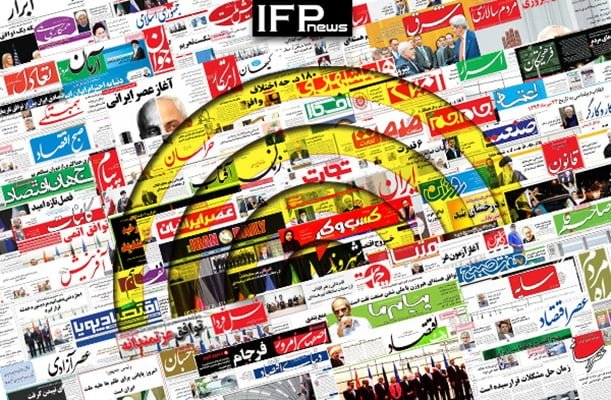
A Look at Iranian Newspaper Front Pages on July 18

A Look at Iranian Newspaper Front Pages on November 19

The top story in all papers today was the harsh reactions in the US to a meeting between US President Donald Trump and his Russian counterpart Vladimir Putin in Helsinki. The US Congress and many others in the country are outraged by Trump’s stances and talks with Putin.

The cessation of Iran’s electricity exports to Iraq over the Arab country’s huge debts, and a decision by Iraqi Prime Minister Haider al-Abadi to replace Iran with Saudi Arabia also received great coverage.

Also a top story was the Expediency Council’s rejection of a bill passed by the Parliament, which allowed the government to implement the FATF standards.

The above issues, as well as many more, are highlighted in the following headlines and top stories:


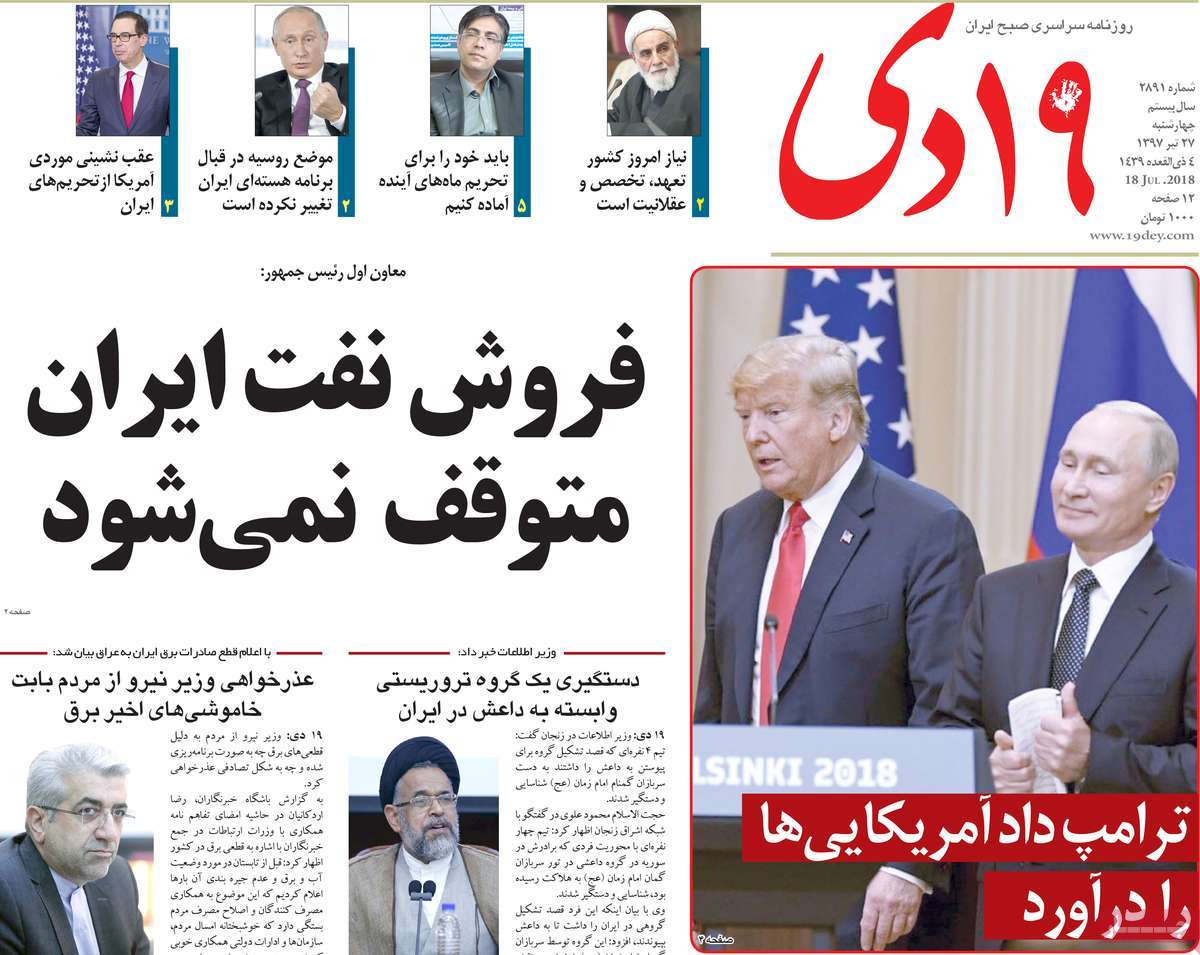
19 Dey:

1- Iran’s Oil Exports Not to Be Stopped: VP

2- Russia’s Position on Iran Nuclear Deal Not Changed

3- Americans Outraged by Trump’s Meeting with Putin

4- ISIS Terrorists Arrested in Iran
A Look at Iranian Newspaper Front Pages on July 18


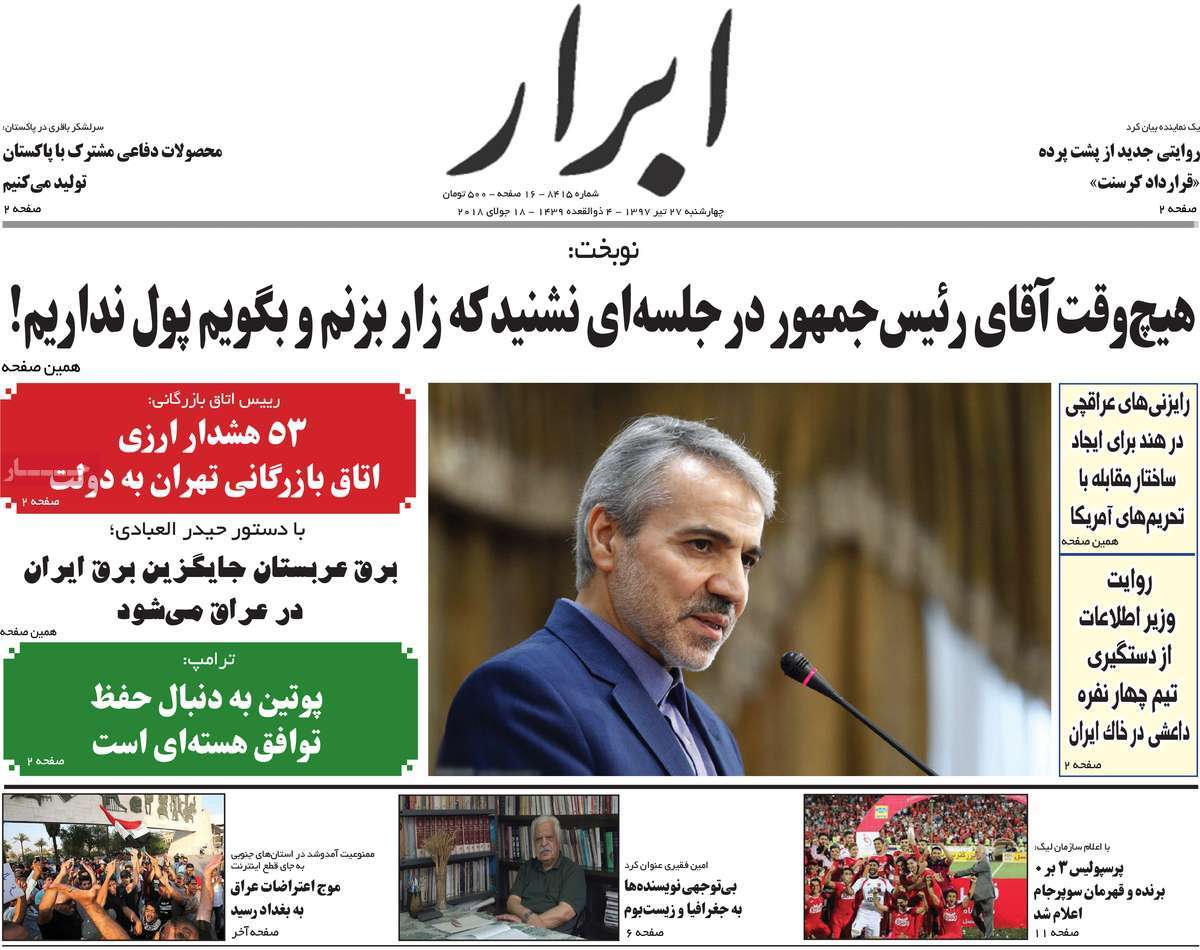
Abrar:

1- Iraq to Use Saudi Arabia’s Electricity instead of Importing Iran’s Power

2- Trump: Putin Looking for Preserving Iran Nuclear Deal
A Look at Iranian Newspaper Front Pages on July 18


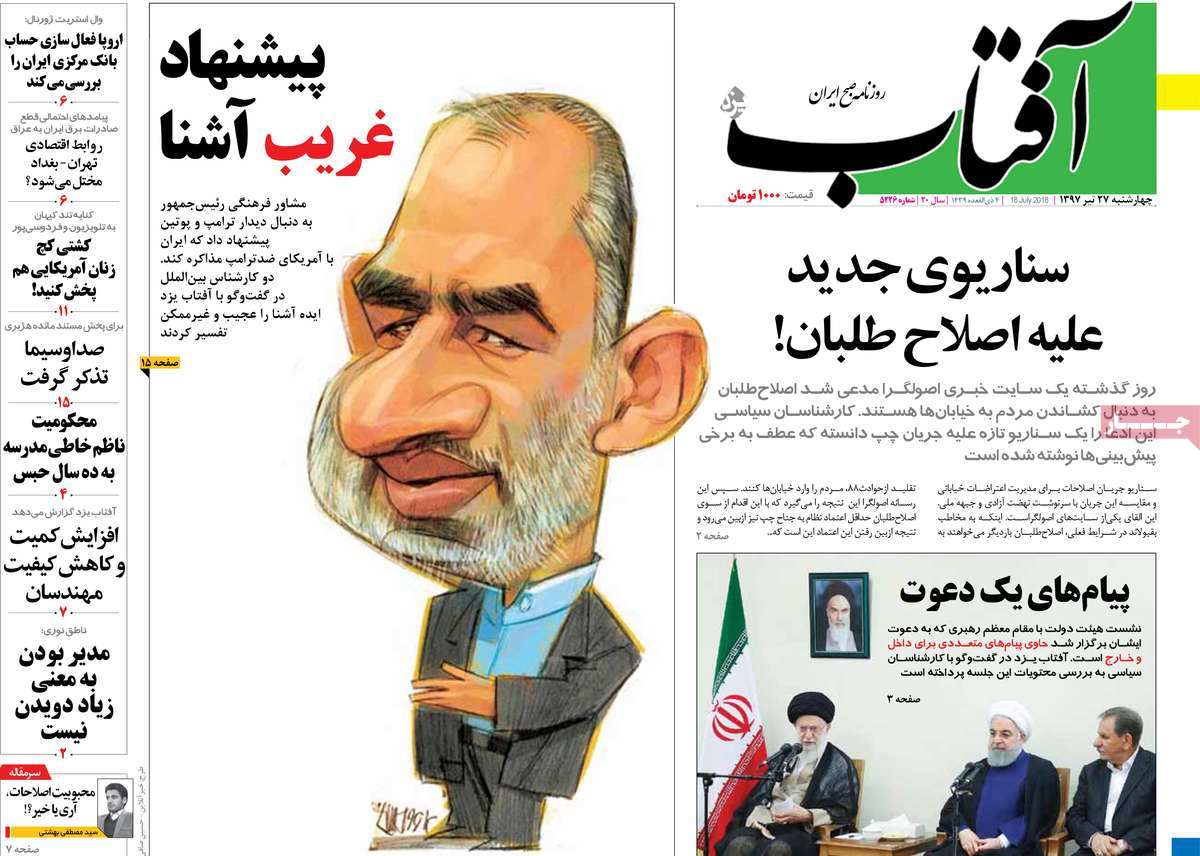
Aftab-e Yazd:

1- Iran Needs to Hold Talks with Anti-Trump Figures in US: Rouhani’s Aide

2- Kayhan Criticizes IRIB for Airing Croatian President’s Hugs after FIFA World Cup Final

  • You’re Now Free to Even Broadcast American Women’s WWE Matches!
A Look at Iranian Newspaper Front Pages on July 18


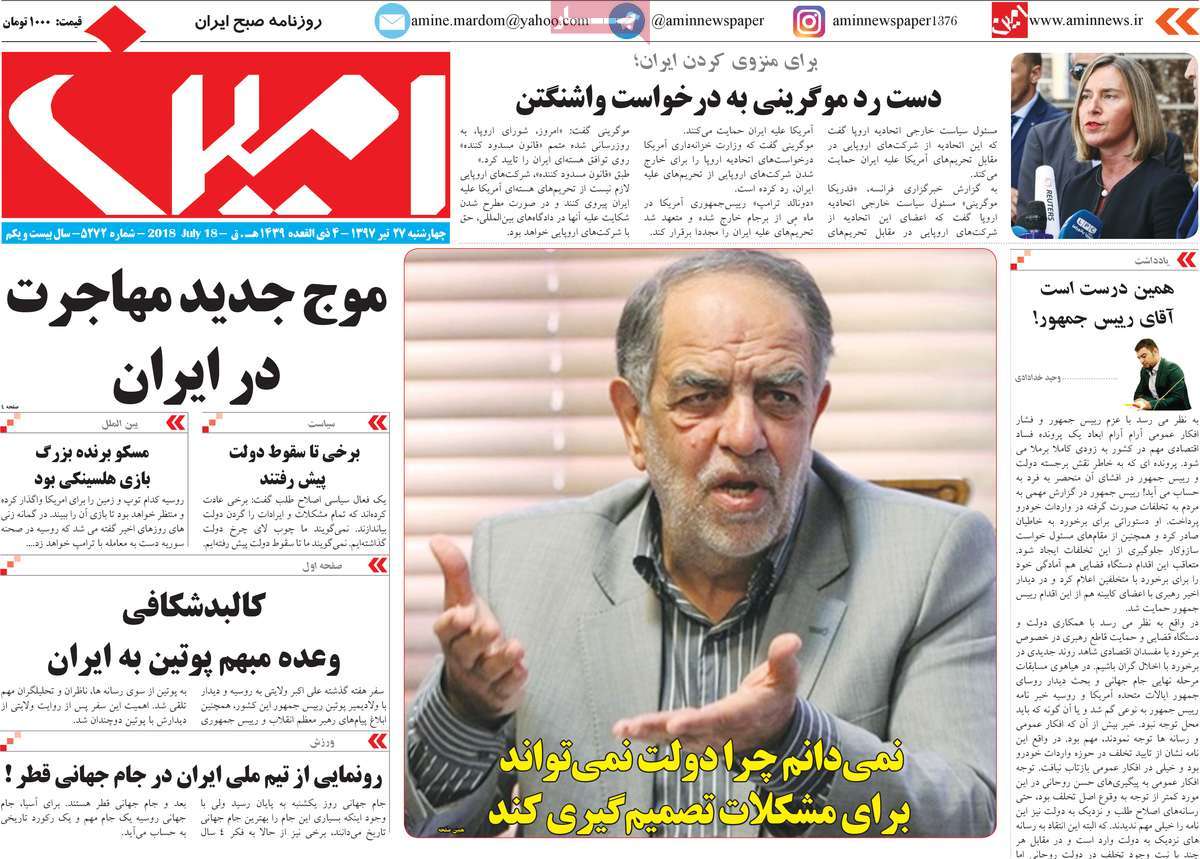
Amin:

1- Mogherini Rejects US’ Call for Isolation of Iran

2- Moscow Big Winner of Helsinki Game
A Look at Iranian Newspaper Front Pages on July 18


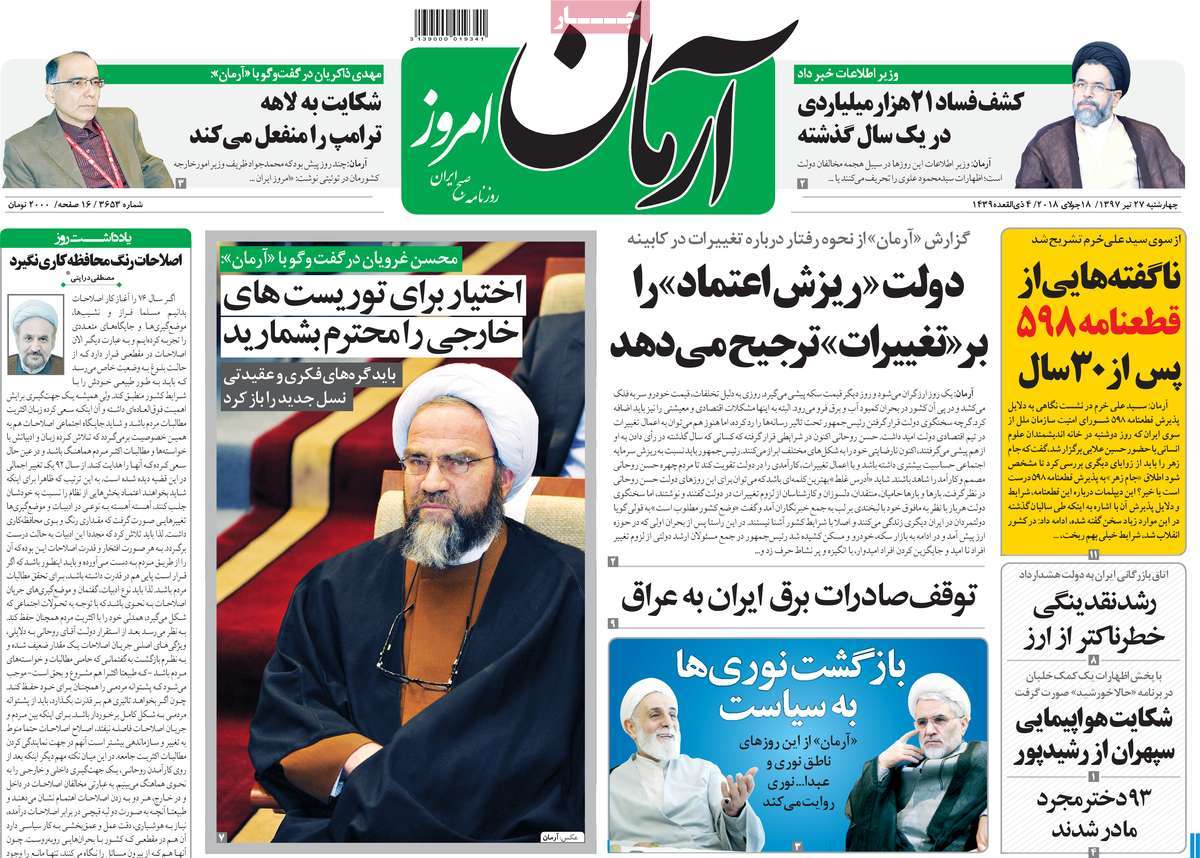
Arman-e Emrooz:

1- Iran’s Lawsuit at The Hague to Put Trump in Passive Position

2- Cleric Calls for Giving More Freedom to Foreign Tourists

3- Iran’s Electricity Exports to Iraq Stopped
A Look at Iranian Newspaper Front Pages on July 18


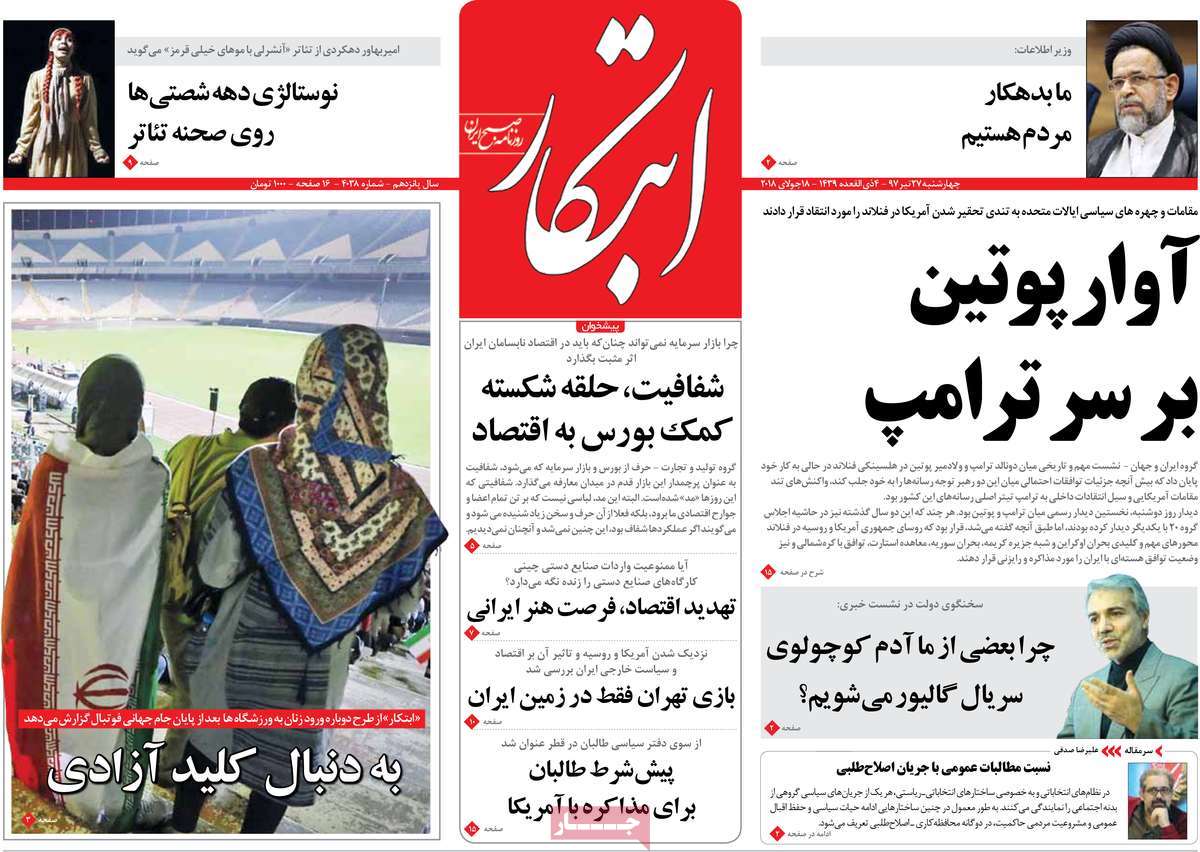
Ebtekar:

1- Putin Once Again Wreaks Havoc on Trump

2- Issue of Women’s Presence in Stadiums to Be Raised Soon: VP

3- Taliban’s Precondition for Holding Talks with US
A Look at Iranian Newspaper Front Pages on July 18


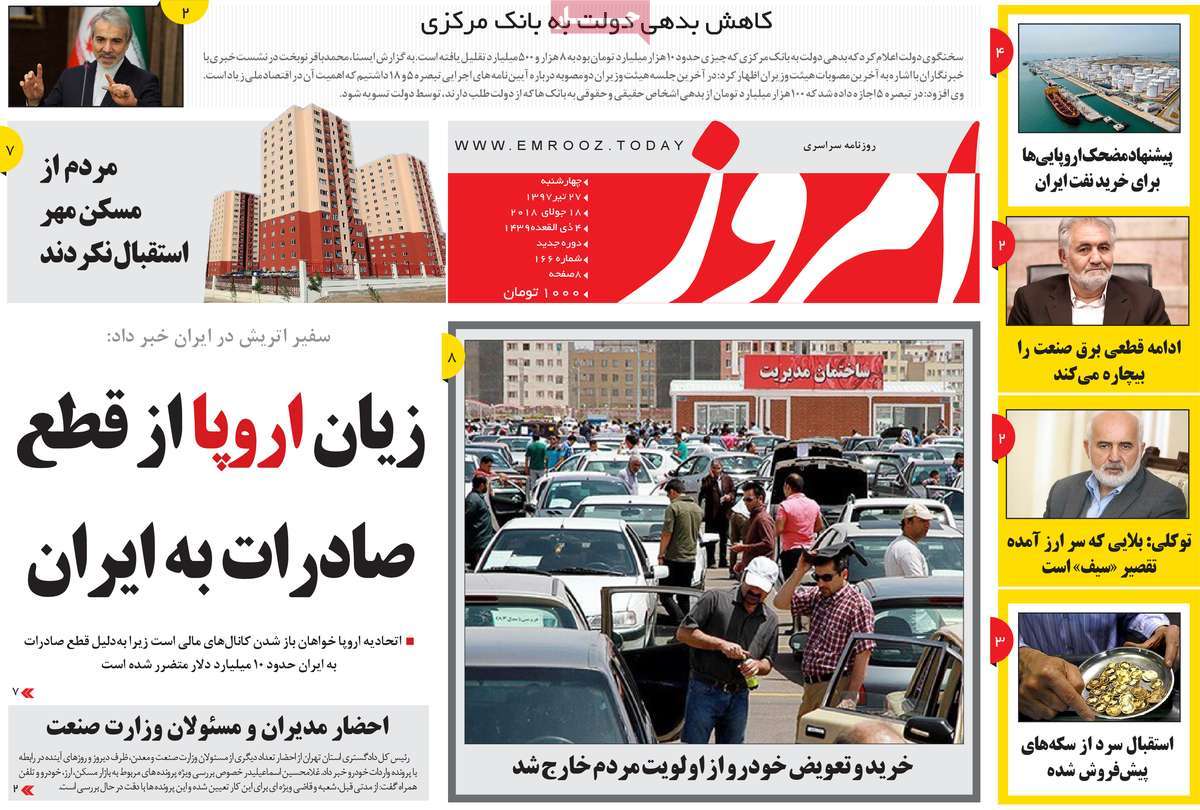
Emrooz:

1- Austrian Ambassador Says Cutting Exports to Iran Will Damage Europe

2- Central Bank Chief Is to Blame for What Happened to Forex Market: Former MP
A Look at Iranian Newspaper Front Pages on July 18


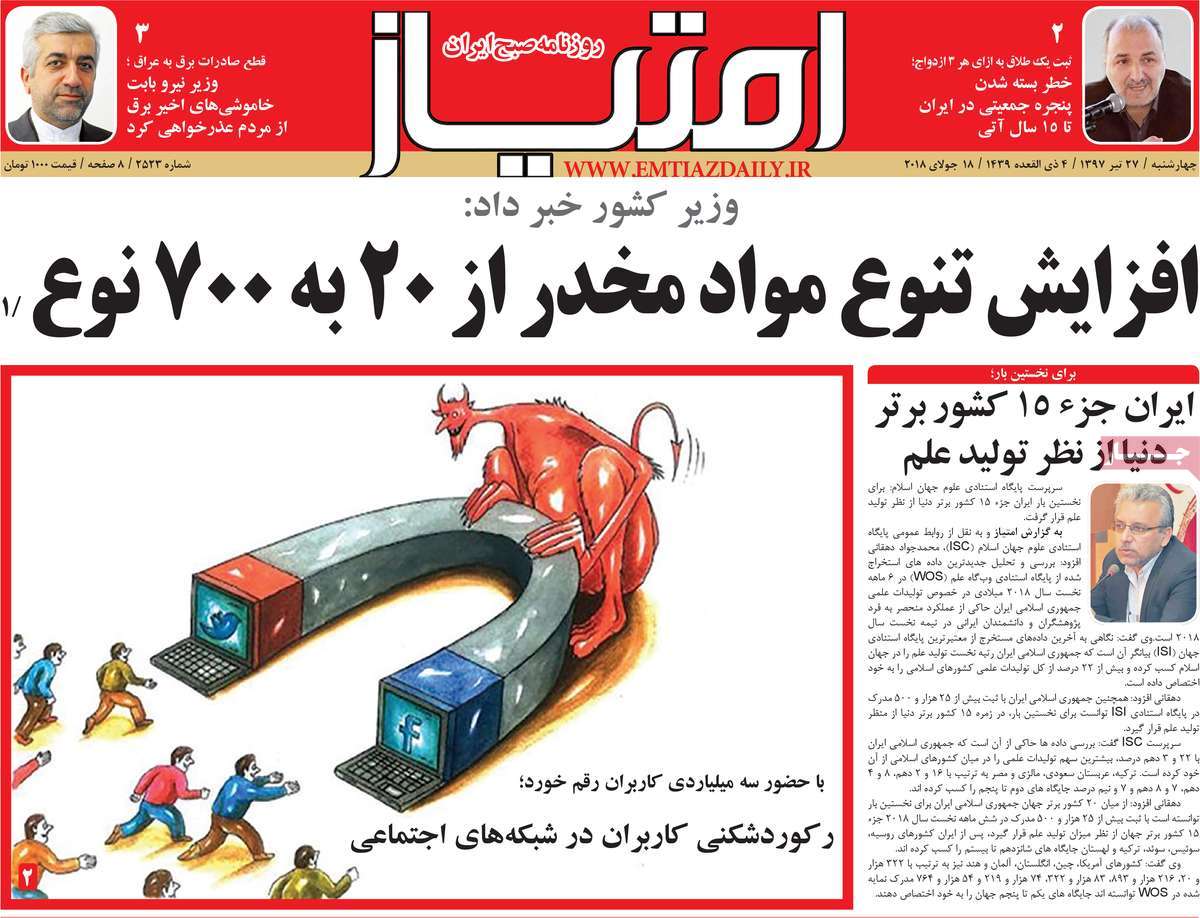
Emtiaz:

1- Illicit Drugs Used to Be of 20 Types, Now We Have 700 Types of Them: Interior Minister

2- Iran Ranks among Top 15 Countries in Science Production for First Time in History
A Look at Iranian Newspaper Front Pages on July 18


Ettela’at:

1- Europe Allocates $80 Billion for Doing Business with Iran

2- Saudi Coalition Admits: Yemenis Have Fired 160 Rockets

3- Efforts to Keep Beautiful Anzali Lagoon Alive

4- US’ Political Community Strongly Protests Trump’s Remarks in Meeting with Putin
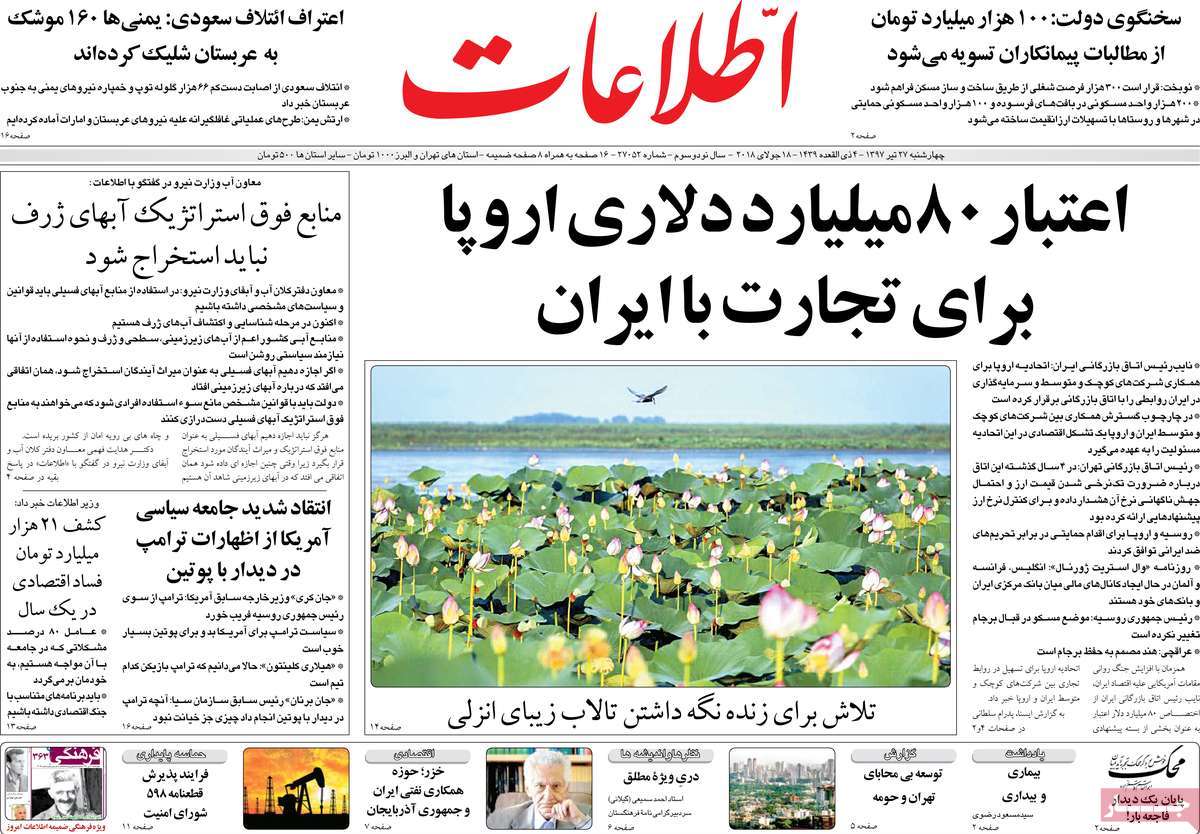
A Look at Iranian Newspaper Front Pages on July 18


Haft-e Sobh:

1- Iranian Girl Accidentally Travels to Russia Alone with Her Cheap Car

2- Iran’s Expediency Council Totally Opposed to FATF
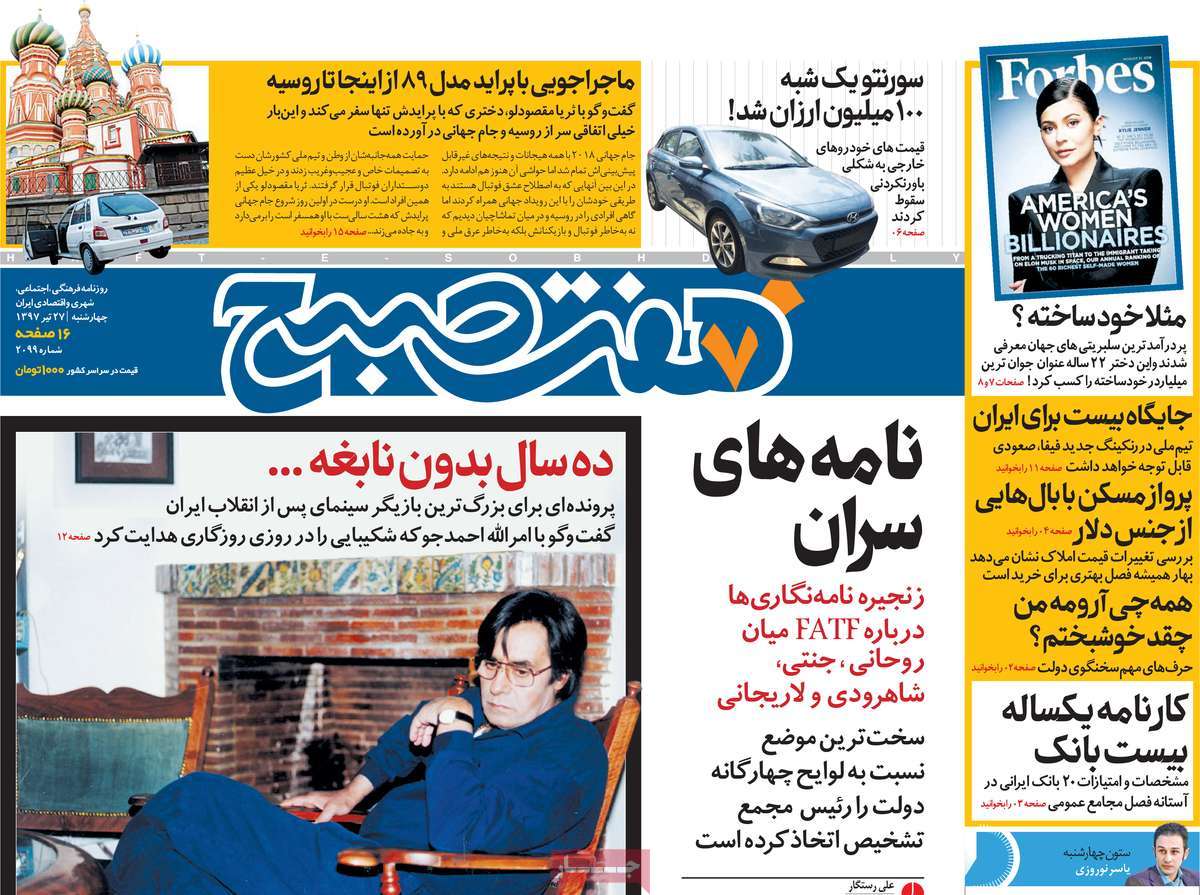
A Look at Iranian Newspaper Front Pages on July 18


Hemayat:

1- Bill on Iran’s Accession to Palermo Convention Rejected

2- Kids Who Got Old: Shocking Report by PBS on Arab Coalition’s Genocide in Yemen
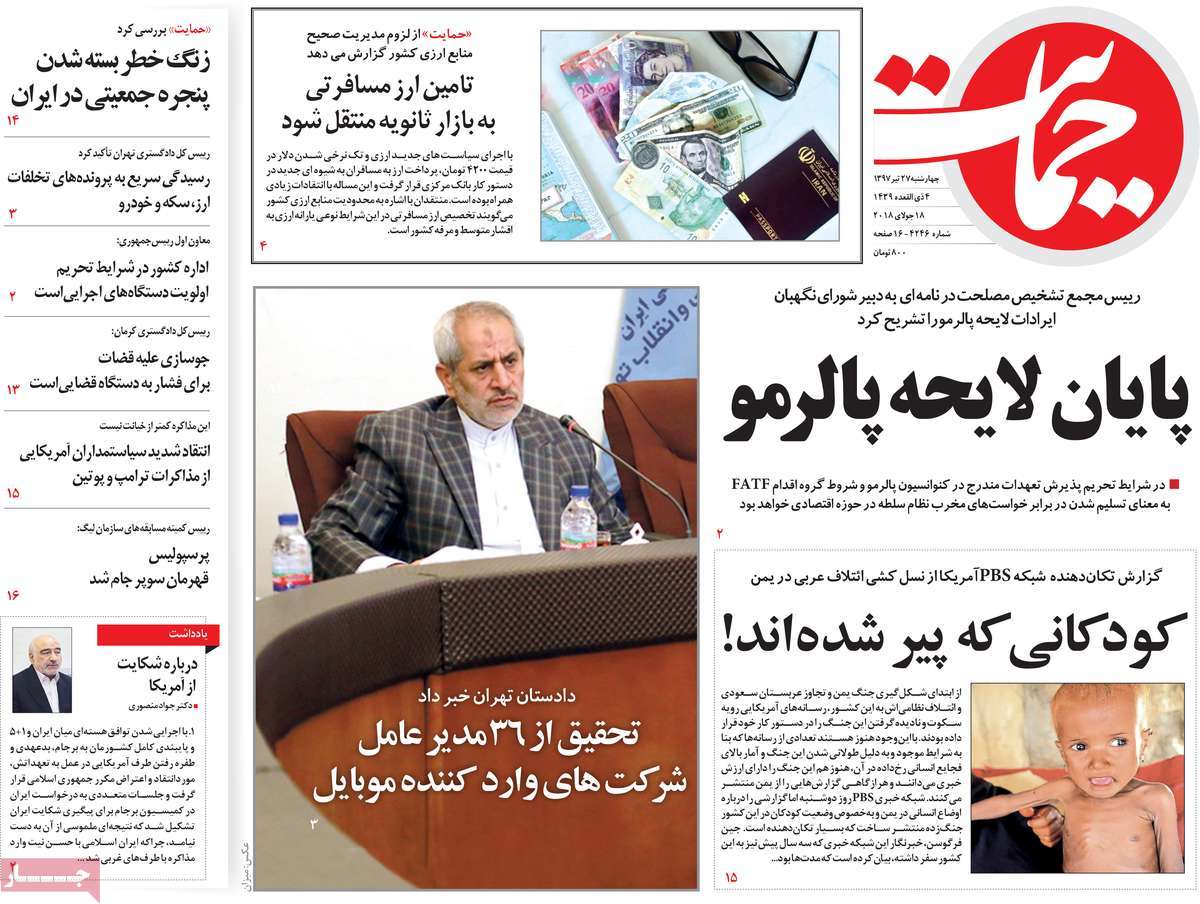
A Look at Iranian Newspaper Front Pages on July 18


Iran:

1- Draft Bill Prepared for Transparency in Fight against Corruption
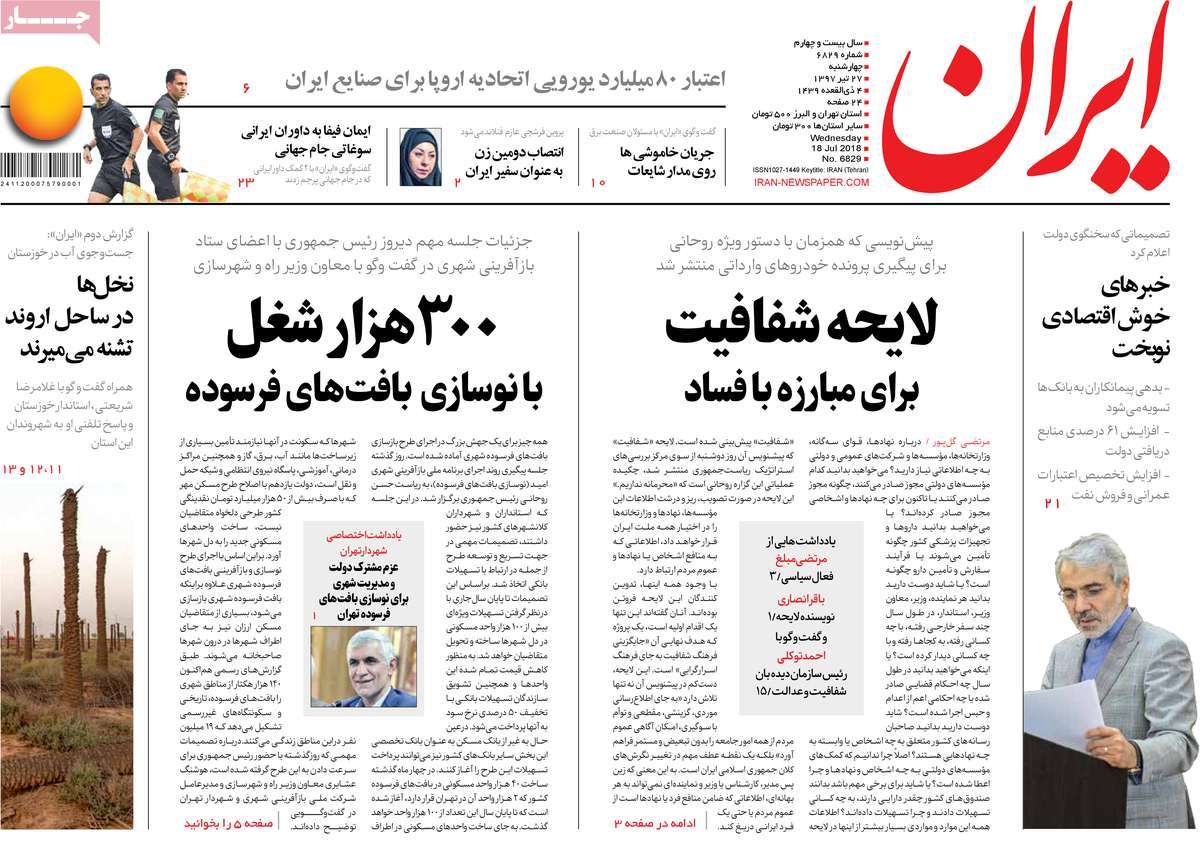
A Look at Iranian Newspaper Front Pages on July 18


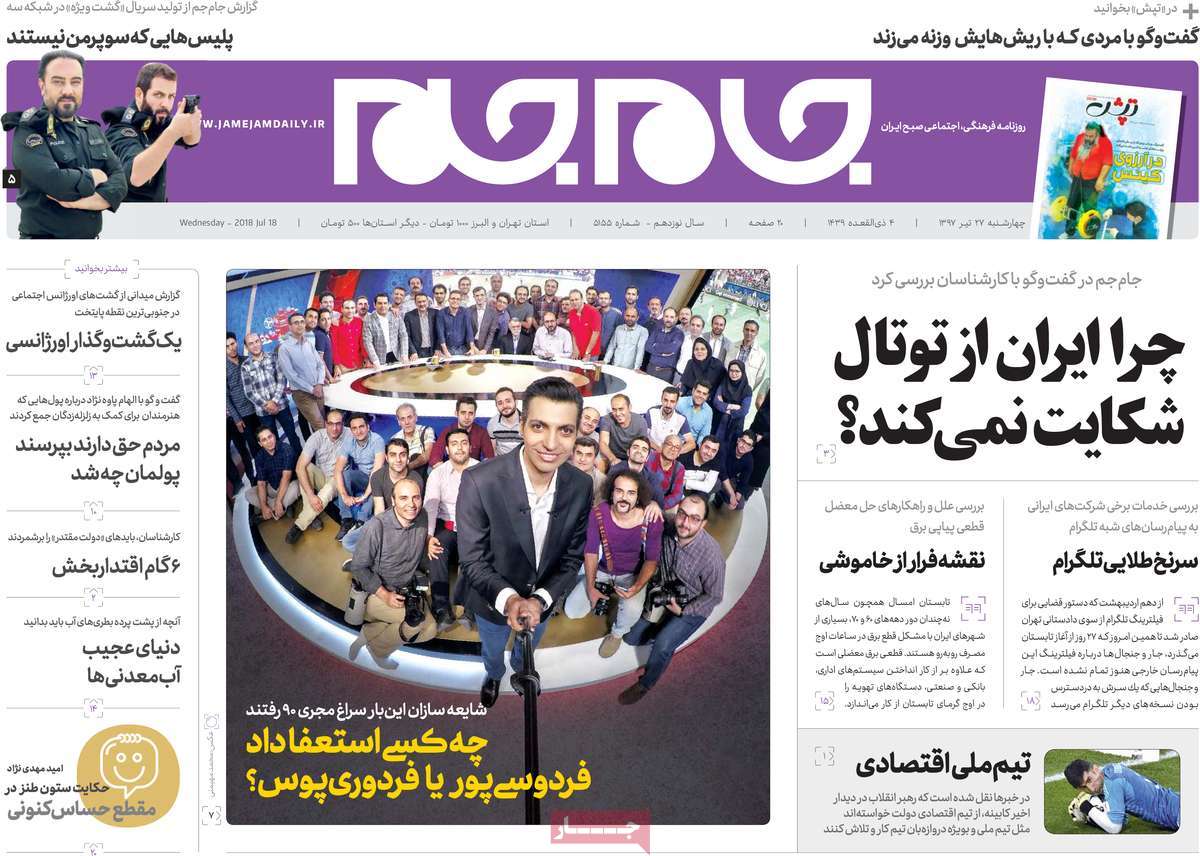
Jame Jam:

1- Why Doesn’t Iran File Lawsuit against Total?
A Look at Iranian Newspaper Front Pages on July 18


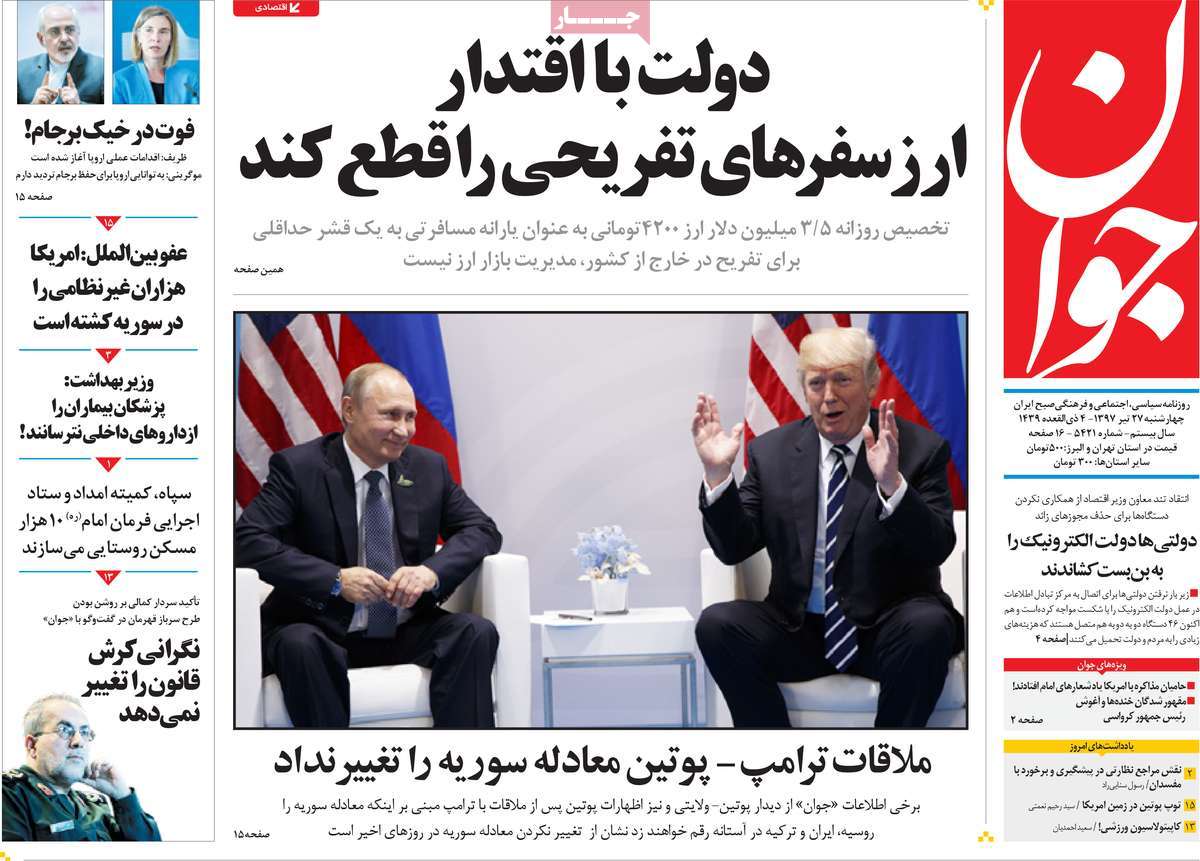
Javan:

1- Government Must Stop Giving Official-Rate Currencies to Those Going Abroad for Pleasure

2- US Has Killed Thousands of Civilians in Syria: Amnesty International

3- Trump-Putin Meeting Did Not Change Syria Equation
A Look at Iranian Newspaper Front Pages on July 18


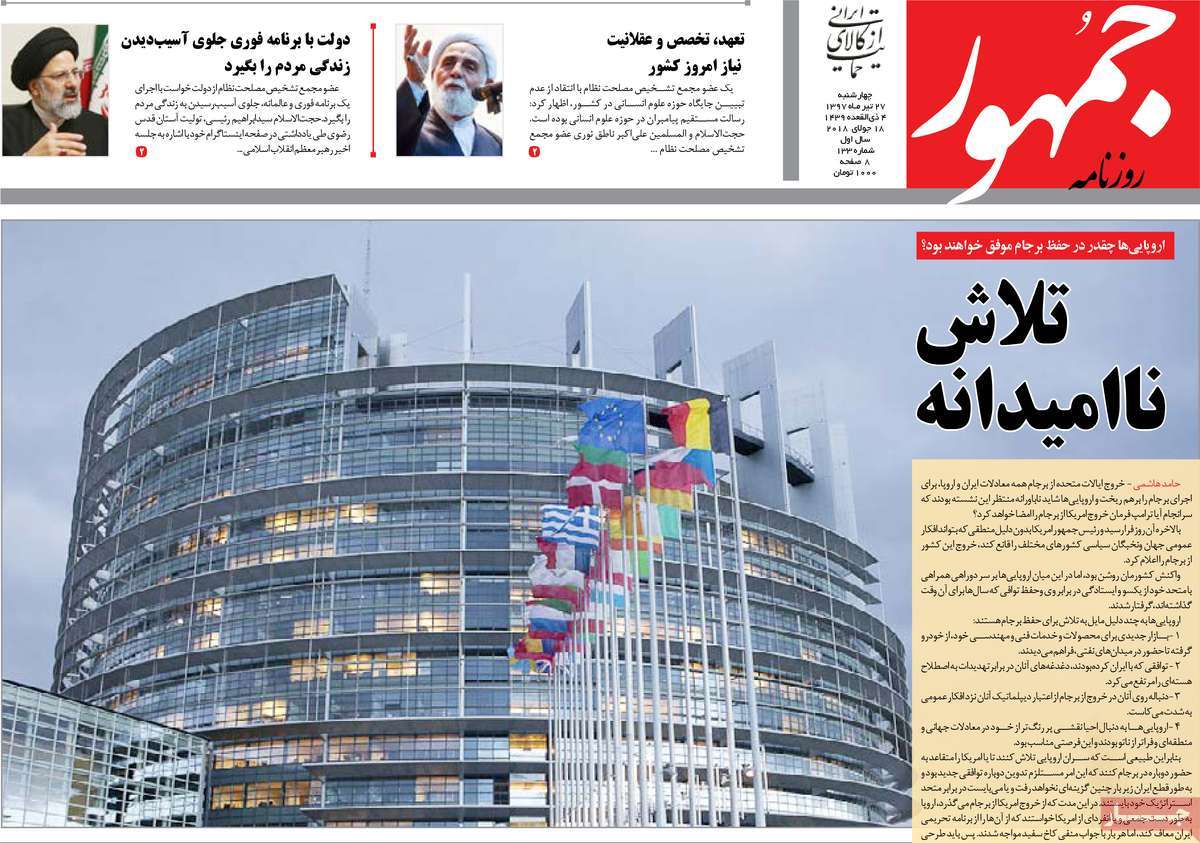
Jomhour:

1- Desperate Effort: How Much Europeans Will Succeed in Keeping JCPOA Alive?
A Look at Iranian Newspaper Front Pages on July 18


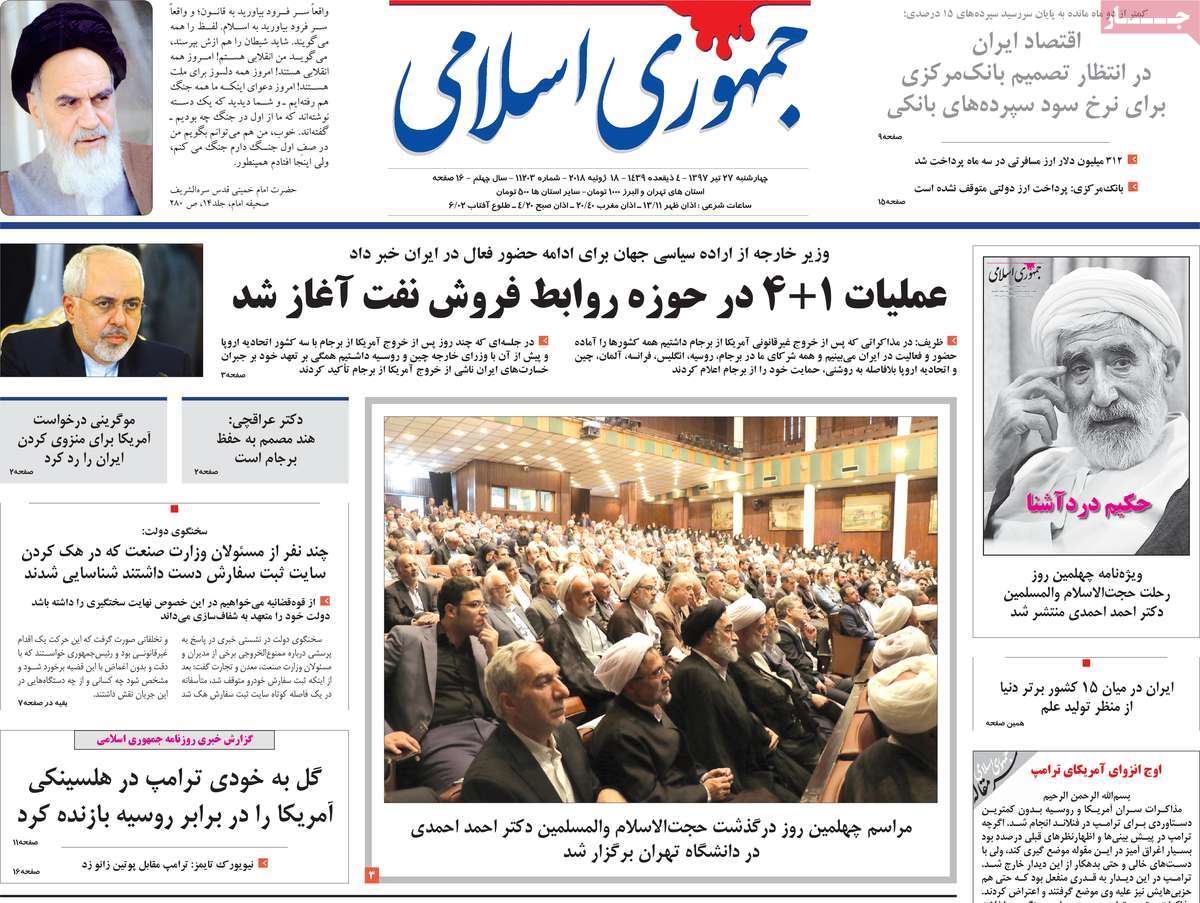
Jomhouri Eslami:

1- FM Zarif Says World Resolved to Help Iran Maintain Its Active Role at Int’l Level

2- Trump’s Own Goal in Helsinki Leads to US’ Defeat against Russia
A Look at Iranian Newspaper Front Pages on July 18


Kayhan:

1- Government Expected to Change Its Behaviour, Reshuffle Cabinet to Resolve Issues
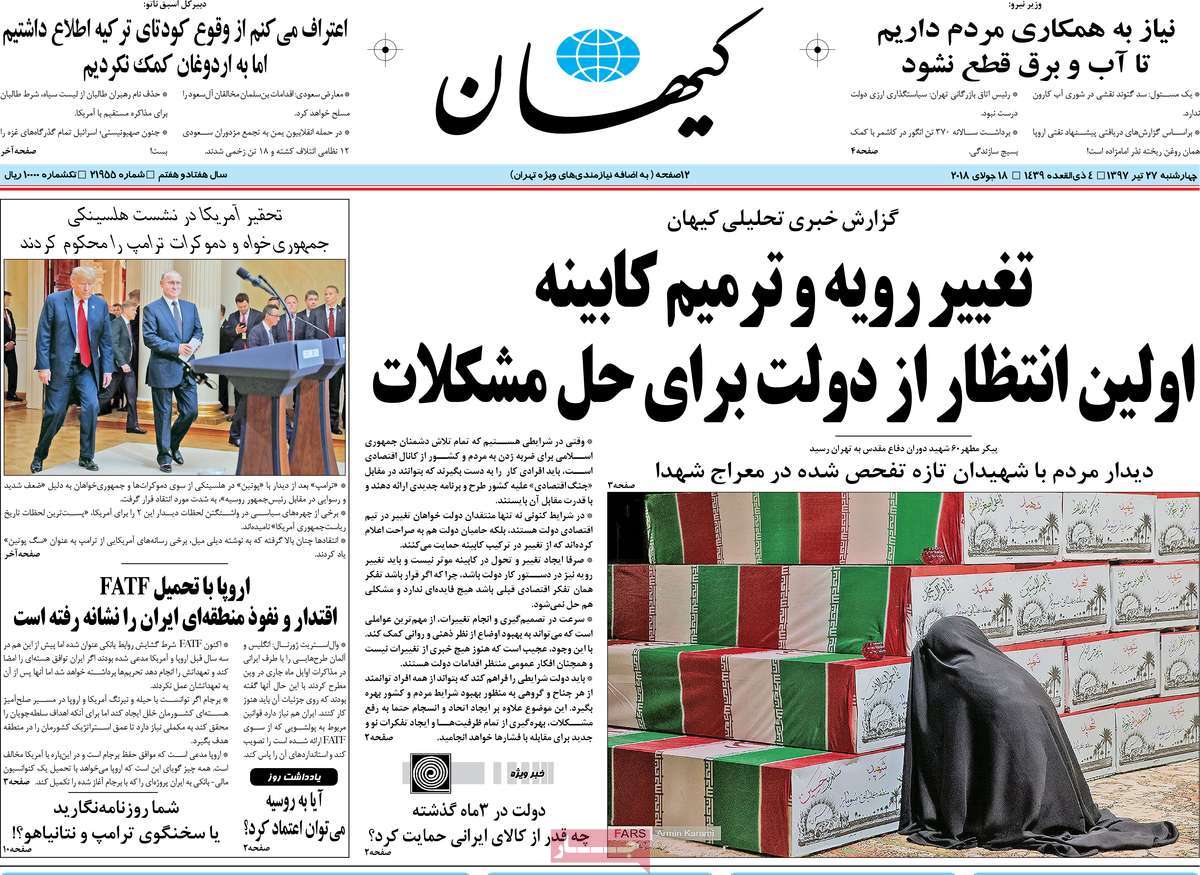
A Look at Iranian Newspaper Front Pages on July 18


Quds:

1- West Minus Trump: From Dream to Reality
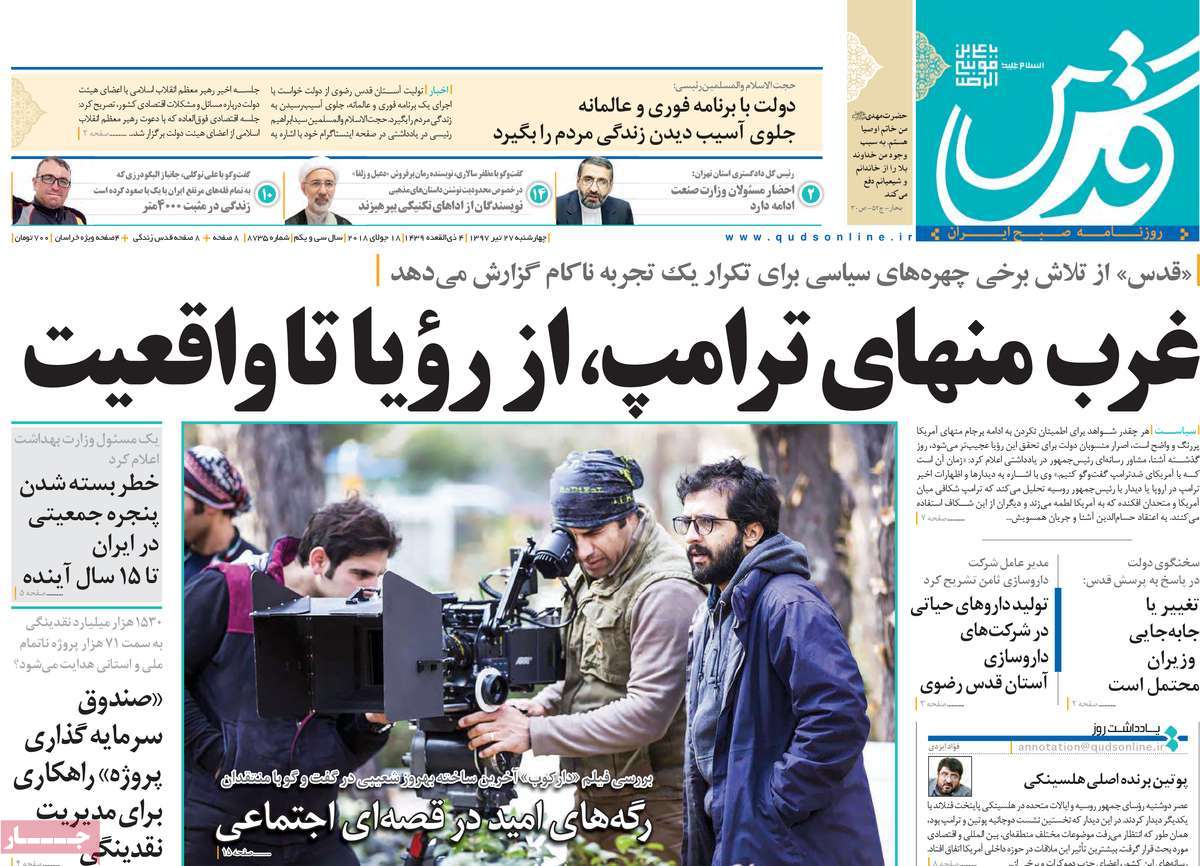
A Look at Iranian Newspaper Front Pages on July 18


Sazandegi:

1- Reformist Figure: It’s Fatal for a Country to Have Non-Partisan Parliament

2- Rafsanjani’s Son: We Must Think of Iran in 2021
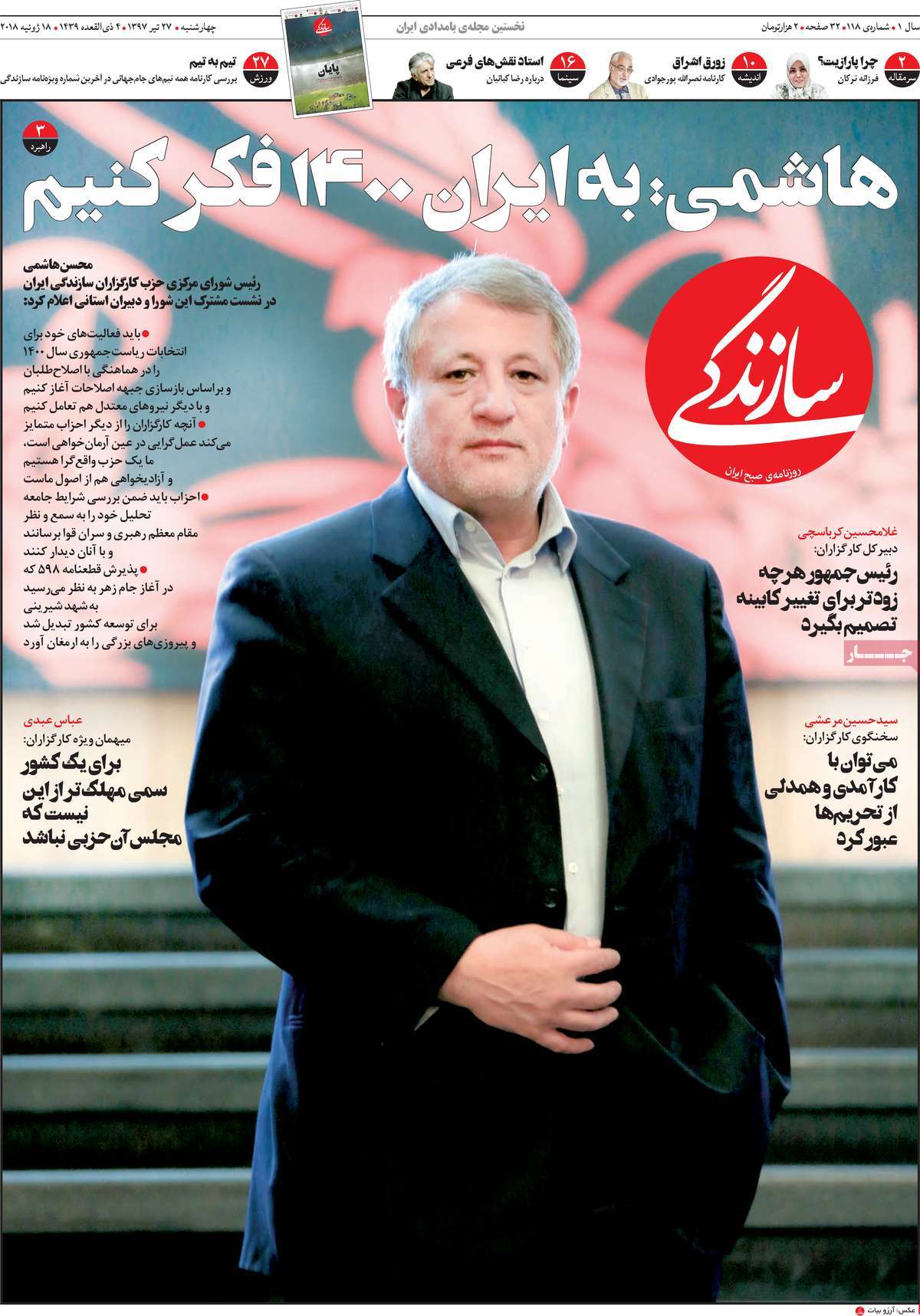
A Look at Iranian Newspaper Front Pages on July 18


Seda-ye Eslahat:

1- 170 Million Headscarves, Chadors Used Annually

2- Iran Counts on India amid US Sanctions: Araqchi
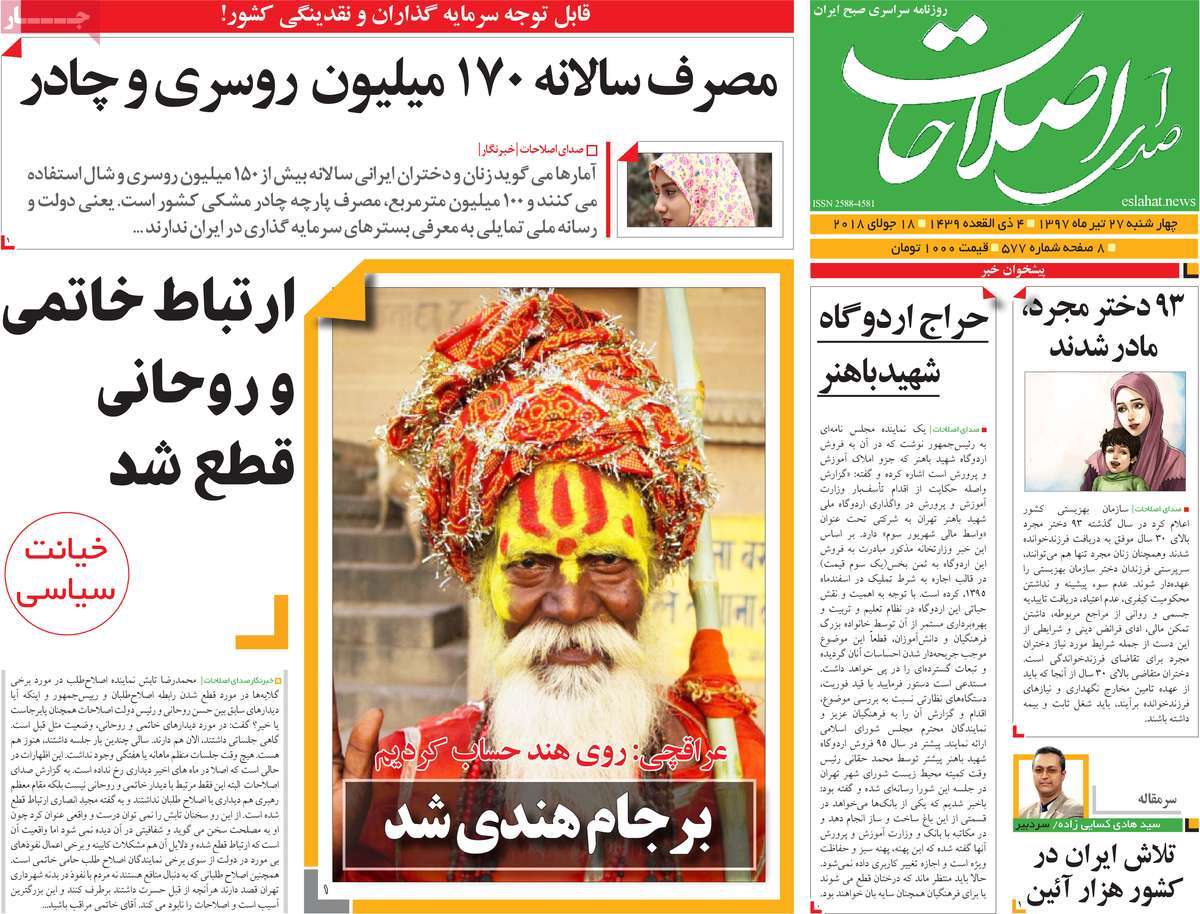
A Look at Iranian Newspaper Front Pages on July 18


Setareh Sobh:

1- All on One Side, Trump and Putin on the Other Side
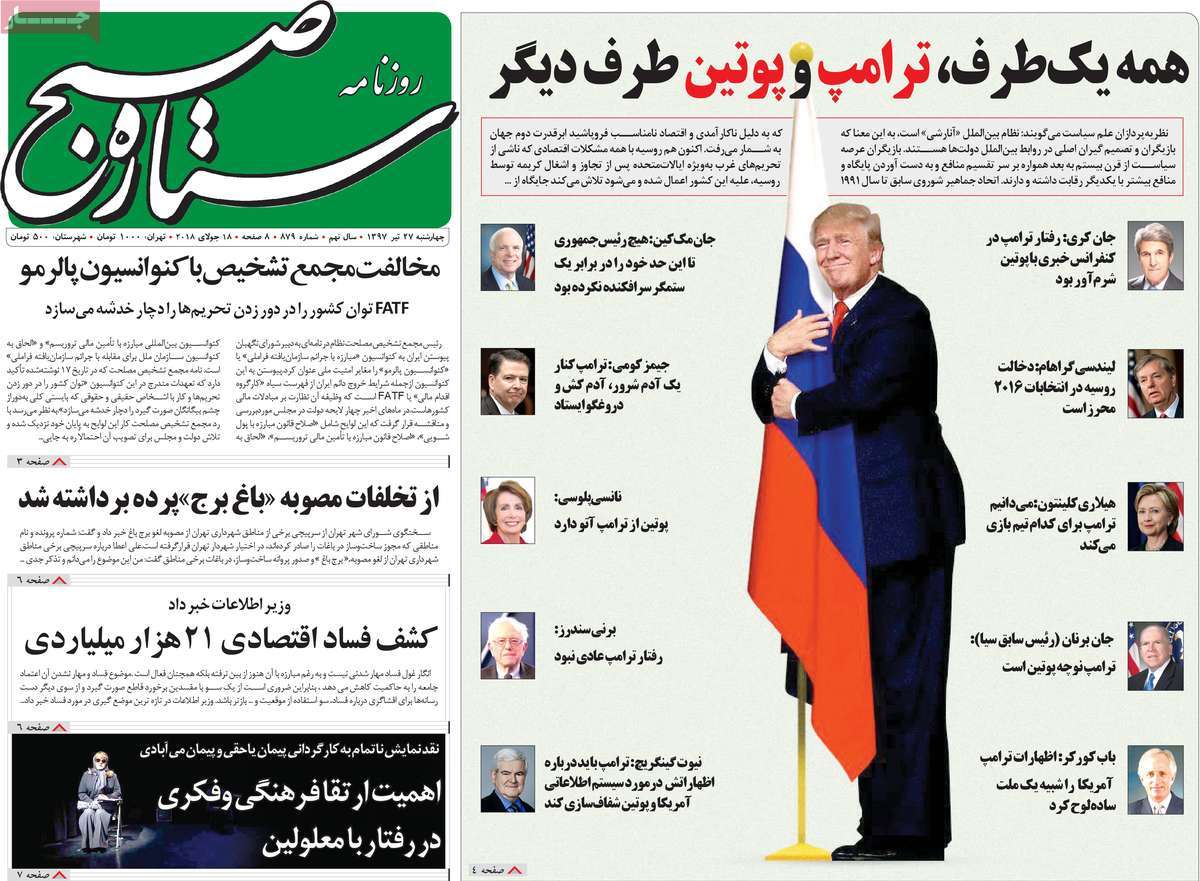
A Look at Iranian Newspaper Front Pages on July 18


Siasat-e Rooz:

1- Zionist Regime’s Army Afraid of Kites

2- American Bluff: US Treasury Dept. Says Exceptions to Be Made on Iran Oil Sanctions
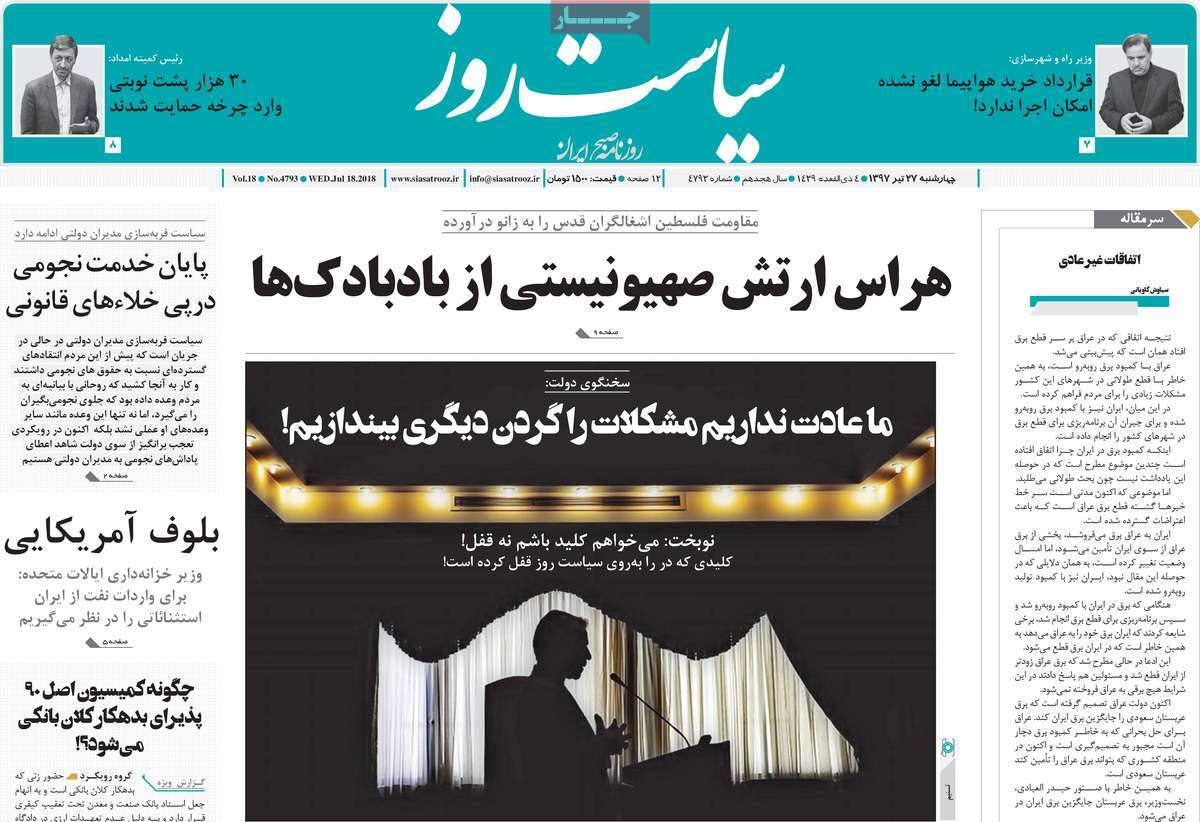
A Look at Iranian Newspaper Front Pages on July 18


Sokhan-e Rooz:

1- Shameless, Cowardly, Humiliating!

  • US Congress Outraged by Putin-Trump Talks
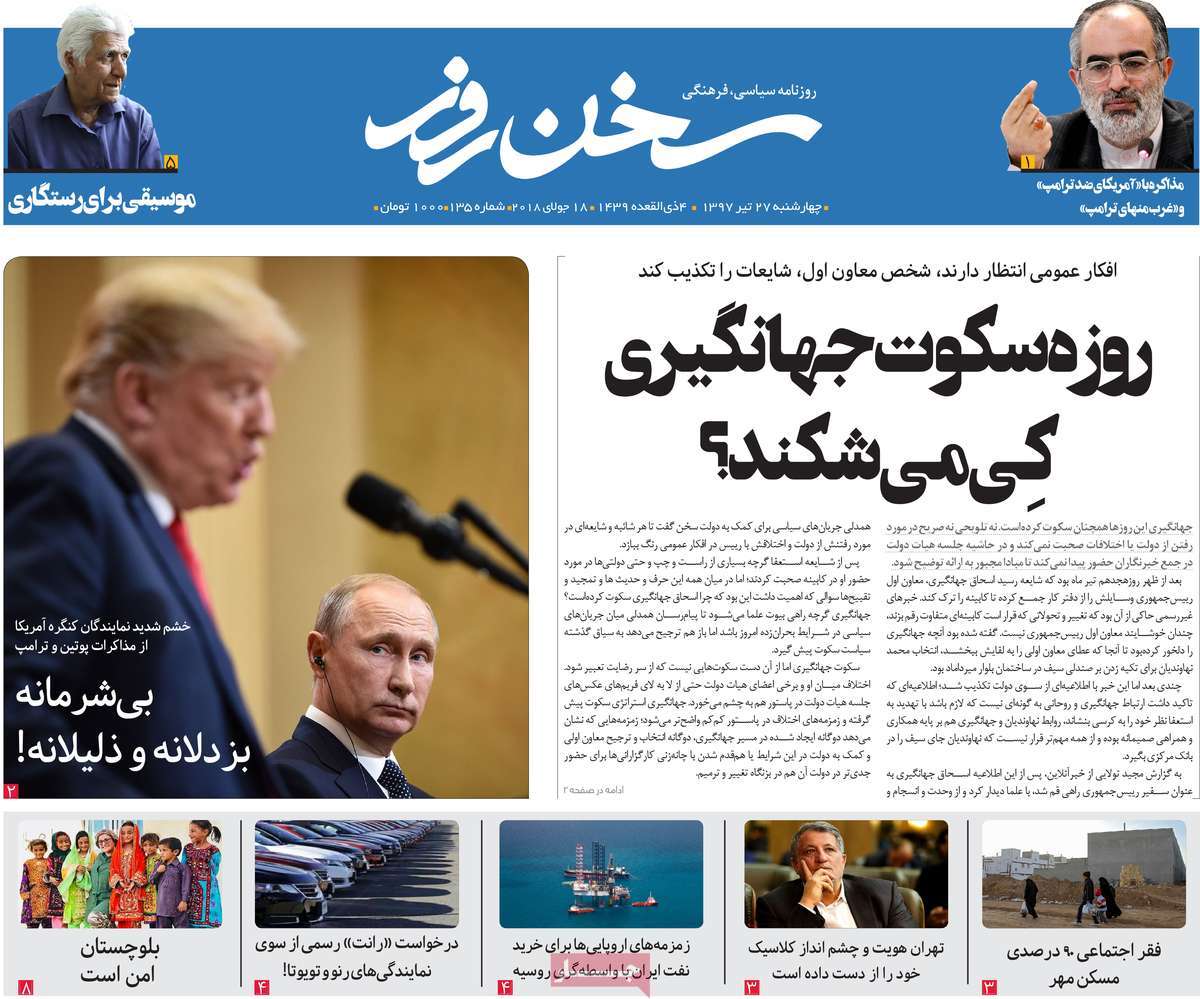
A Look at Iranian Newspaper Front Pages on July 18

Qurut; Special Dish Made in Eastern Iran

If we want to introduce regional cuisine in Iran, which is a typical example of the country’s geography, we should certainly go to South Khorasan; a desert region where every food is worth a lot.

Due to the warm and dry climate of South Khorasan, animal husbandry has always been more dominant than farming in this area. Therefore, it is not surprising that the most important ingredient in Khorasan Razavi province is whey, which is used differently in foods and also as a popular daily intake alone or in combination with local herbs.

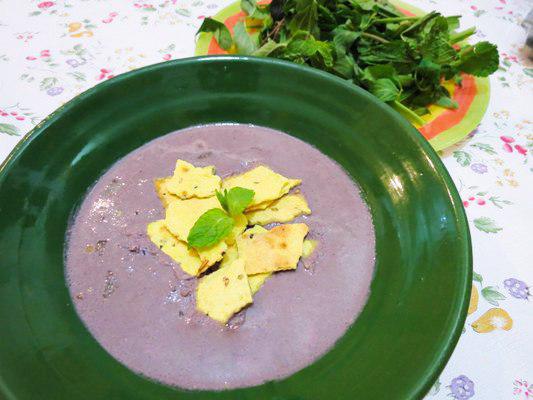
The Birjandi whey dish or Qurut is the most famous food in southern Khorasan with its purple colour which has a special taste. It would be a great experience to try this dish.

Qurut; Special Dish Made in Eastern IranThis delicious food was formerly used by the general public, but the high-ranking people could not forgo Qurut as well. The main ingredient of this food, which is purple, is special Qurut (whey) of Birjand, and powdered walnut.
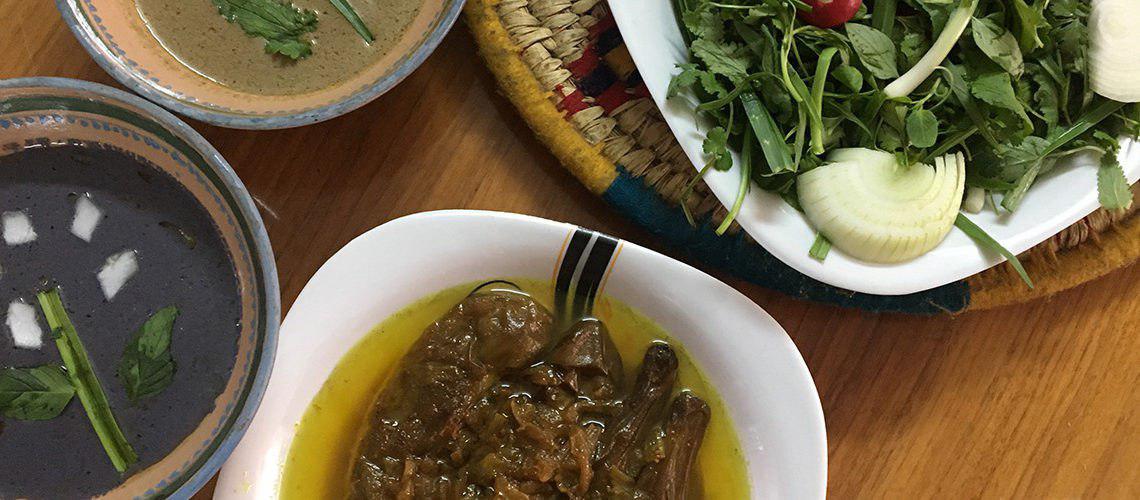
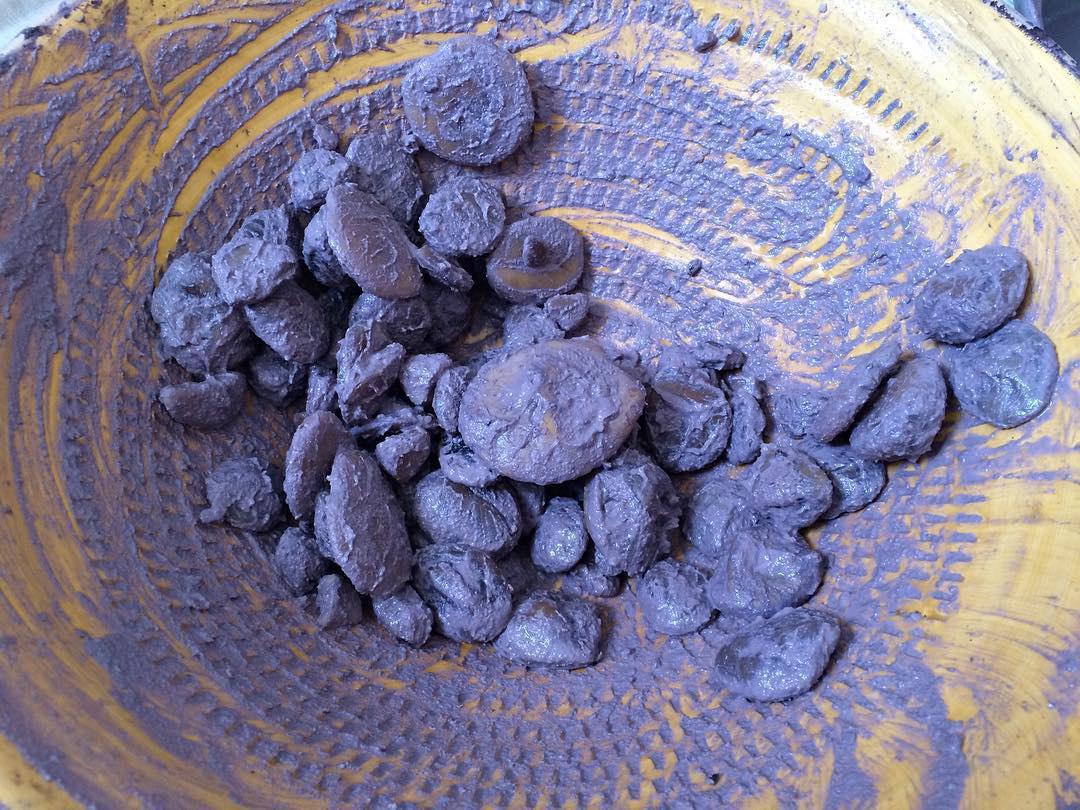
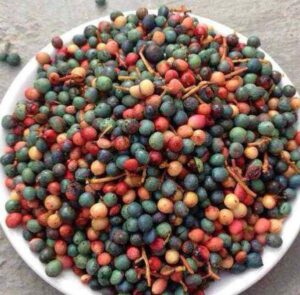
To get a better purple colour and change of the taste, some locals use mountain pistachios of Khorasan region instead of walnut.

According to the Cultural Heritage, Handicrafts and Tourism Department of South Khorasan province, the local dish of the southern Khorasan Province was inscribed in the Intangible Cultural Heritage List of Iran on July 14, 2018. The inscription came after the setting of Birjandi purple sufra and serving Qurut for 1,200 Birjandis residing in Tehran.

Qurut; Special Dish Made in Eastern Iran

Recipe

Qurut is served in both hot and cold forms. To prepare hot Qurut, they mix some onions or fried garlic with a little salt, black pepper and cinnamon, then add whey to it. Before getting boiled, it is taken off the heat and is ready to be served.

First, they should moisten the hard whey in water for one hour, and then empty the water and put the whey pieces that are now softened in a special container called “whey grinder”, which is hollow with rough walls. After that, they pour powdered walnut on whey pieces, and start to rub them into the wall of the container using their hand palms. They also slowly add water to get a liquid mixture. Then they pour oil in a pot and sauté onions. Some also add chopped mint to fried onions. When the onions get fried, they add the mixture of whey, walnut or mountain pistachio, saffron, water and cinnamon to onions and heat a bit.

Now Qurut is ready. They pour it into a bowl and mix it with Sangak bread or Komaj which is a local type of bread in South Khorasan. Sometimes, hot Qurut is served with eggplants, potatoes, zucchini and cooked vegetables like spinach.

Qurut; Special Dish Made in Eastern Iran

Iran Ready to Assist Yemenis If They Ask: Leader’s Aide

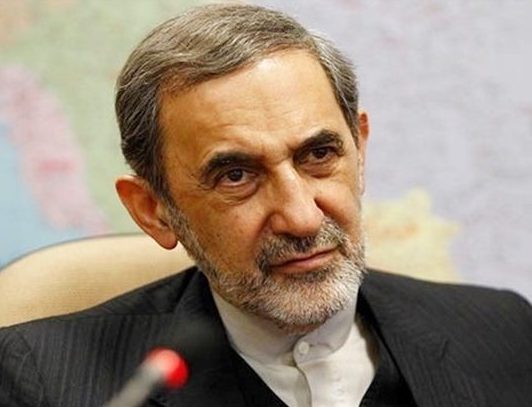
“We welcome any kind of help that we can do to the people in the region, governments of the region, including Syria, Iraq, Lebanon and also Yemen,” Ali Akbar Velayati told RT in an interview during his recent trip to Russia aired on July 15.

“If Yemen asks us to help them bring peace and tranquility to the region, we will not hesitate to do that,” Velayati said.

Since 2015, Yemen has been the scene of a Saudi military campaign, which Riyadh says aims to push Houti fighters out of the Yemen capital Sana’a and restore to power the fugitive president Abd-Rabbu Mansour Hadi.

The US and its regional allies are accusing Iran of seeking to dominate the region, saying Iran’s measures are destabilizing the region.

But Tehran says it’s regional presence is aimed at promoting peace and fighting terrorism.

Last week, Velayati met with Russian President Vladimir Putin in Moscow to deliver a message from the Leader of Iran’s Islamic Revolution Ayatollah Seyyed Ali Khamenei and President Hassan Rouhani.

The trip came as the US is working to tighten the screws on Iran, vowing to impose harsh sanctions on the country to force Tehran to accept US demands regarding its nuclear and regional activities.

Rouhani’s Aide Says Iran Must Negotiate with ‘The West minus Trump’

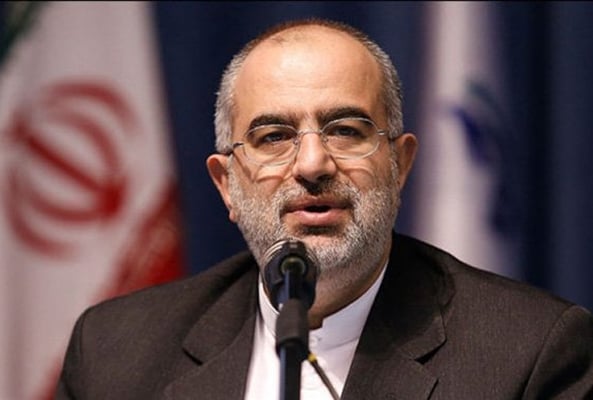
Referring to the Monday meeting between Trump and his Russian counterpart Vladimir Putin in Finland’s capital of Helsinki, Hesamoddin Ashna said the meeting did not end up in favour of Iran’s adversaries.

“They thought the Helsinki meeting will be a sad day for Iran, but now former US officials and some senators and European figures say it was a sad day for America!” Ashna wrote in a post in his Twitter account, ILNA reported.

Pointing to Trump’s confrontational stance towards US allies showcased in the recent G-7 meeting in Canada and Trump’s visit to Europe this week, Ashna said this behaviour contrasted sharply with Trump’s friendly approach towards Putin.

“Trump has transformed the definition of the West … The Helsinki [meeting] showed that now the West means the coalition between Europe and the [anti-Trump] Americas against Trump’s America,” he said.

Trump’s trip to Belgium, Britain and Finland was marked by his frequent taunts and threats aimed at America’s NATO allies, a sharp contrast to his unrestrained bid to court Russia despite the conclusion by US intelligence agencies that Moscow meddled in the 2016 US election to aid his candidacy, Euronews reported.

In Brussels, Trump sowed confusion and chaos, blasting NATO allies for not contributing enough money for their own defense. Then he called German Chancellor Angela Merkel a “captive” of Moscow for its support of the Nord Stream 2 gas pipeline from Russia, and supported domestic opponents of British Prime Minister Theresa May.

On the eve of his summit with Putin, Trump added insult to injury by calling the EU a “foe” for its trade policies in a CBS interview that aired on Sunday.

That language stood in stark contrast to the scene on Monday at Finland’s presidential palace, where Trump called the Russian leader, accused by the West of all manner of grievances, a “good competitor” and said “I think the word competitor is a compliment.”

The Trump-Putin meeting drew a wave of condemnation by US lawmakers from both Republican and Democratic parties, worried that Trump is creating a chasm among the US and its traditional allies that could be highly dangerous to the US interests.

Ashna said Trump’s controversial measures have created a chance for Iran to draw closer to anti-Trump western leaders.

“This is chance for improving relations with the West. Now we have something called ‘the West minus Trump’,” he said, adding the new definition of the west covers Europe, Canada and a half of US population.

“It’s time for us to enter into talks with the anti-Trump America and the west minus Trump,” he said.

Putin’s Envoy Due in Tehran to Brief Iranians on Helsinki Summit

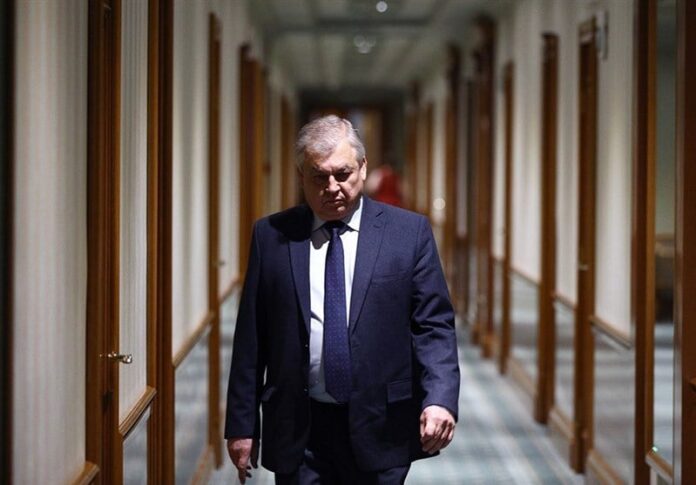
According to the report, carried by RBS news agency on Wednesday, Lavrentiev will travel to the Iranian capital on Wednesday to brief Iranian officials on the Trump-Putin meeting held in Helsinki on Monday.

He is also reportedly scheduled to coordinate possible joint actions based on the agreements reached in the Finnish capital.

On July 16, US President Donald Trump and his Russian counterpart Vladimir Putin had a one-on-one meeting in Helsinki that lasted more than 90 minutes.

Ahead of the meeting, Ali Akbar Velayati, an international adviser to the Leader of the Islamic Revolution, visited Moscow and held talks with Putin.

“US Unlikely to Get Tough on Iran before November”

The Iranian news website Fararu has, in an analytical piece, weighed in on the US’ oil sanctions on the Islamic Republic of Iran and its growing pressure on Tehran ahead of the November deadline for re-imposition of nuclear-related sanctions.

The full text of the article follows.

The US government is sensitive about hikes in oil prices on the threshold of the country’s important by-elections. As a result, it is unlikely to escalate tensions with Iran before the elections.

After its unilateral withdrawal from the Iran nuclear deal on May 8, 2018, Washington announced that it will reinstate sanctions against Iran and will impose the highest level of sanctions against the Islamic Republic.

Some time later, the Americans unveiled their key measure to exert maximum pressure on Iran. A senior US State Department official told media that the White House had called on all those buying oil from Iran to bring their petroleum purchases from the country to zero; otherwise, they would face the United States’ unilateral sanctions. This unexpected announcement by the US pushed up crude prices on world markets immediately, so much so that White House officials had to tone down their remarks in order to calm down the market.

Although the US has always spoken of putting maximum economic pressure on Iran, observers and analysts believe Washington will not get tough on Iran, especially in the oil sector, at least until next November.

Monitoring Trump’s remarks and positions on crude prices shows he is especially sensitive about price hikes.

Although the Organization of Petroleum-Exporting Countries (OPEC) agreed to raise crude output by roughly one million barrels per day after oil sanctions on Iran were announced, still serious doubts exist on the possibility of compensating, by other producers, for the crude shortage caused by Iran sanctions. So, Trump recently spoke of Saudi King Salman bin Abdulaziz Al-Saud’s agreement to add two million barrels per day to its current output. Of course, following Trump’s comments, the White House issue a statement toning down the US president’s remarks.

The reason behind Trump’s sensitivity about oil is the by-elections of the US Congress.

The by-elections are slated to be held on November 6, 2018. The vote comes as Donald Trump is barely halfway through with his presidency. Candidates will compete for all 435 seats at the House of Representatives as well as 35 Senate seats up for grabs. So, if the Democrats manage to secure the majority of the seats in Congress, it will depict a disappointing outlook for Trump.

But in the run-up to such an important election, will Trump accept the risk of a rise in oil prices because of a halt to Iran’s crude exports? Analysts believe the answer is “no.”

The Bank of America says Washington is unlikely to adopt a tough position on Iran in the lead-up to the congressional elections in November.

Iran, OPEC’s third largest producer, is facing US sanctions, which will make some buyers of Iran’s oil stop petroleum purchases.

Still, the Bank of America said “the [Trump] administration may look for an easy win on trade to appease markets and voters alike before November,”

It is noteworthy that the Bank of America had already warned that bringing Iran’s oil exports to zero may push up crude prices by up to 50 dollars per barrel.

It was due to these concerns over a rise in oil prices before the by-elections that the US is considering using its Strategic Petroleum Reserve (SPR) in order to regulate the prices of petroleum.

Iran FM Says Europe Underestimating Its Power, Influence

Speaking in an exclusive interview with Euronews on Wednesday, the Iranian top diplomat said he believes Europe is selling itself short.

“What we need from the Europeans is both the political commitment, which they have made, now we need to see the measures in place on the ground, not simply in writing, not simply in words — in the banking sector, in the investment sector, in the energy sector, in the transportation sector, in the SME sector,” he said.

“I believe generally Europe is underestimating its power and its influence, we believe that it should be more active in regional peace and security, in international peace and security as well as in promoting a greater cooperation and dialogue”.

Zarif went on to say that Tehran has a good relationship with Russia and the Syrian government but blames the US for supporting the so called Islamic State.

“We have good communication and coordination with Russia and with Syrian government and we will continue to do so. Our objective here is very clear, that is our objectives and the objective of the Russian Federation and that is to fight against terrorism and extremism”.

“Now if President Trump wants to take credit for it, he should take credit for supporting ISIS which has been what the US and its allies have been doing all along. The fact that US arms, US weapons have been found in the hands of ISIS and other extremist organizations is documented, is documented by western sources. So I think we should look at the realities, those who fought terrorism, those who fought extremism are Syrian people and those who work with Syria people.”

The remarks come as Iran has filed a suit against the US alleging that Washington’s decision in May to impose sanctions after pulling out of a nuclear deal, violates a 1955 treaty between the two countries.

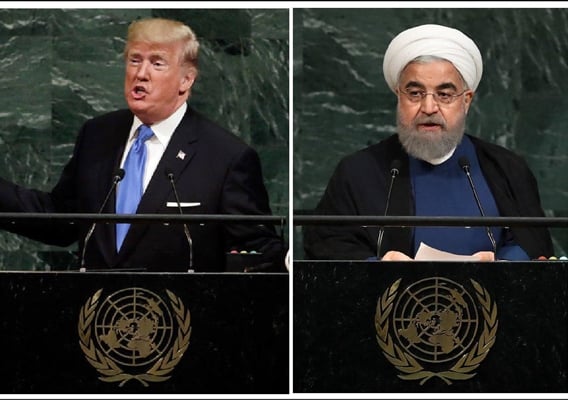
“Iran President Ignored Eight Calls by Trump in 2017 NY Trip”

“During the last year visit of Hassan Rouhani to New York, Trump called us eight times but we didn’t respond,” said Mahmoud Vaezi, the presidential chief of staff, after a Cabinet meeting in Tehran on Wednesday.

The remarks came in response to Trump’s statement Thursday that he expects Iran to call him wanting to make a deal.

“Iran at some point will call me and ask for a deal, and we’ll make a deal,” he said. “They are feeling “a lot of pain right now,” he added.

Trump has hardened the US’ line on Iran, reviving a nearly-forgotten mantra that all options are on the table when it comes to Iran, including military ones.

Trump has also pulled the US out of the 2015 nuclear accord and is preparing to impose what he has described as “the highest level” of sanctions on Iran to push the country to renegotiate the nuclear deal.

Iran’s Foreign Ministry Spokesman Bahram Qassemi said Monday it will be Trump who has to make the call to begin talks with Iran.

“Maybe someday he will call Tehran and ask for negotiations – this is more likely,” Qassemi said.

“There were some signs of this in the past,” Qassemi said, referring to Trump’s rejected calls last September.

The Trump call was first reported by Qassemi himself shortly after Rouhani returned from New York.

Hossein Mousavian, a member of Iran’s nuclear negotiating team in 2000s who is currently a fellow at Princeton University, said last month US Vice President Mike Pence had called Deputy Foreign Minister Abbas Araqchi and invited Rouhani to Trump’s dinner feast.

This is while US officials have denied any such requests have been made by Trump.

In 2013, shortly after Tehran and Washington engaged in nuclear talks that later led to the 2015 nuclear deal, then US President Barack Obama and Rouhani spoke by telephone.

Tehran to Host Gathering of Iranian Ambassadors, Heads of Missions Abroad

In a Wednesday statement, Qassemi said it will be the first gathering of Iranian ambassadors in the 12th administration.

“The gathering will be held next week after the Iranian foreign minister and Foreign Ministry executives as well as the heads of the Islamic Republic of Iran’s missions abroad meet Supreme Leader [of the Islamic Revolution Ayatollah Seyyed Ali Khamenei] and visit the shrine of the founder of the Islamic Republic of Iran [Imam Khomeini], with Iranian President [Hassan Rouhani] delivering a speech,” said the spokesman.

“The heads of the legislative and judiciary branches [of government] will also deliver speeches at the gathering,” he said.

According to Qassemi, high on the agenda of the gathering will be the latest regional and international developments as well as Iran’s position on those developments within the framework of the “Targeted Promotion of Diplomacy and Foreign Relations” plan.

In addition to specialized meetings, the seminar will also feature speeches by several ministers on key regional issues as well as other specialized topics on which the participants will exchange views, he added.

“Given the importance of economic diplomacy within the framework of [the] Economic Resilience [initiative] and while taking the new circumstances in the country as well as global developments into account, and considering the necessity of paying more attention to economic issues, a major part of the sessions and meetings at the seminar, compared to previous seminars, will be allocated to economic issues and how Iranian embassies should engage with the public and private sectors in their respective countries and how they should interact with their domestic counterparts in order to deal with the new situation,” said the spokesman.

Iran Says Ready for Uranium Enrichment at Higher Levels

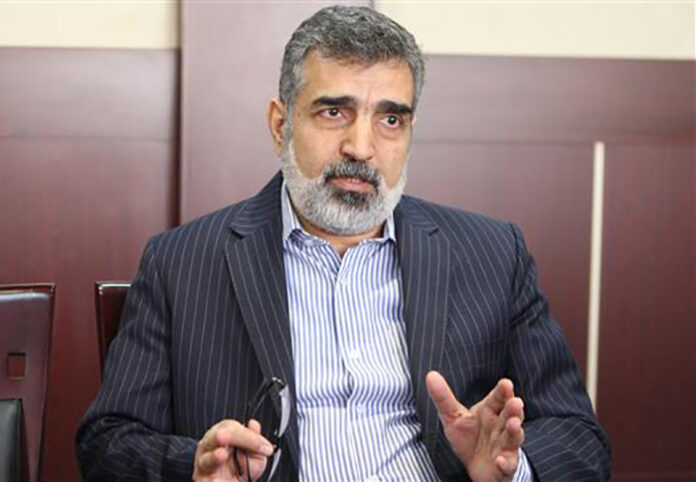
Behrouz Kamalvandi

“We have of course adopted some measures in order to prepare the ground for eventually increasing the level of enrichment if it is needed and if the negotiations with the Europeans fail,” he said on Tuesday.

“We are of course continuing to carry out and implement our obligations based on the JCPOA,” he noted in reference to Joint Comprehensive Plan of Action signed between Iran and the P5+1 group of countries in 2015.

Under the JCPOA, Iran undertook to put limits on its nuclear program in exchange for the removal of nuclear-related sanctions imposed against Tehran.

“But at the same time, taking every scenario into consideration, we are preparing ourselves,” he added.

In May, US President Donald Trump announced that he would pull America out of a 2015 nuclear agreement with Iran and re-impose the sanctions that the deal had envisaged to be lifted.

Since the US president pulled Washington out of the nuclear deal, European countries have been scrambling to ensure that Iran gets enough economic benefits to persuade it to stay in the deal. The remaining parties have vowed to stay in the accord.

Earlier in the day, EU foreign policy chief Federica Mogherini announced that European countries have activated a blocking statute that prohibits companies from complying with US sanctions on Iran.

“Today, the European Council has endorsed the update of the blocking statute annex on the nuclear deal with Iran,” Mogherini told reporters in Brussels at a meeting with EU foreign ministers.

A blocking statute is a law enacted in 1996 to protect European entities “against the effects of the extra-territorial application of legislation adopted by a third country.”

On Sunday, Leader of the Islamic Revolution Ayatollah Seyyed Ali Khamenei said that European signatories to the nuclear deal with Iran must provide Tehran with necessary guarantees about the continued implementation of the deal.

Ayatollah Khamenei noted that drawing up a “stable economic roadmap” was needed to solve the country’s economic problems, emphasizing that solution of those problems must not be made conditional on the continuation of the JCPOA.