Monday, December 29, 2025
Home Blog Page 3523

Hoor-al-Azim Wetland at Iran-Iraq Border on Fire Again

Hoor-al-Azim

Kiomars Hajizadeh, the Director General of Khuzestan Crisis Management Department, says a huge part of the fire in the Hoor-al-Azim wetland occurred in Iraq, which is likely to be deliberate.

“Unfortunately, the situation in Iraq has made the situation difficult to deal with. This country must make special efforts to resolve this issue,” he stressed.

So far many measures have been taken to prevent fires in the wetland, but since the source of fires is not in Iran, the operations have become very difficult to carry out, he added.

The fire engulfed a region that has not undergone any clearing operations after the war imposed by Iraq, he noted.

Hajizadeh said the problem of smoke diffusion in the cities of Khuzestan province has turned into a serious one, saying that the most appropriate solution for this problem is the release of water from the Karkheh River.

“And that’s why in the early days of the incident, a committee was set up to release water,” he noted.

“Khuzestan’s water and power departments need to do some investigations to determine whether the water, which is to be transferred to Iraq, can be provided from the Karkheh River,” underlined Hajizadeh.

Khuzestan crisis management department is set to send aircraft to contain and extinguish the fire, he noted.

“A joint meeting will also be held between officials with Iran’s Khuzestan province and Iraq’s Maysan Governorate,” he added.

The first fires in Hoor-al-Azim wetland in late June lasted more than 20 days and burned over 18,000 hectares of the lagoon on the Iraqi side.

The people of the southern cities of Khuzestan struggled with the smoke of the fire and it was hard for them to breathe. Since Saturday, the wetland has been on fire for the second time.

US Sanctions to Cost Dearly for Iranian Patients: Minister

Seyyed Hassan Qazizadeh Hashemi says the Iranian foreign ministry can reveal the horrible nature of those who claim to be advocates of human rights and defenders of the people of the world, but in practice harm ordinary citizens through sanctions.

However, the Islamic Republic will not allow anyone to harm people in the field of health, he said, speaking in a meeting with Iranian ambassadors overseas.

Referring to the proper quality of pharmaceuticals and medical equipment made in the country, Qazizadeh Hashemi said, “Our goal in these two areas is to, at first, supply the country’s needs and then export Iranian products.”

Hashemi highlighted the World Health Organization’s reports on the health situation in Iran, saying that Iran is one of the 10 leading countries in the field of combating non-contagious diseases, and that the president of the Islamic Republic, in September, will report on Iran’s actions in this area at the UN.

The US pulled out of the 2015 nuclear deal with Iran early March, threatening to impose the “highest level” of bans on the Islamic Republic that would ultimately destroy its economy.

While US President Donald Trump claims he is a supporter of the Iranian nation and their rights, the sanctions imposed on the country are expected to target millions of ordinary citizens, particularly the poor and the patients.

Gov’t under Pressure to Do More to Stop Rial’s Historic Plunge

A dramatic decline in the value of the Iranian rial has increased the prices of imported consumer goods and depressed some markets in the past few months.

On Monday, one US dollar was traded for IRR 120,000 in the free market, leading the government to face a strong backlash from political and social circles for its handling of the economy.

Lawmakers, experts and figures from various political persuasions, particularly the conservative critics of the government, have pressed Rouhani to reshuffle his economic team to halt a plunge in people’s purchasing power and tamp down public discontent.

Ordinary citizens have also taken Rouhani’s administration to task on social media, highlighting the hardships they face in making ends meet amid high inflation.

Amid sharp criticism, Rouhani’s cabinet last Wednesday approved Abdolnasser Hemmati to replace Valiollah Seif as the new governor of the central bank.

Seif’s replacement, a former professor of economics, banker and insurance official, had been appointed as Iran’s ambassador to China before he was called back from Beijing for the new job.

The first senior shake-up since the beginning of forex rate problems suggested the embattled Rouhani is eventually conceding a need for change to ease criticism.

But many critics believe a long way is ahead for the government to restore public trust and it needs to get more serious about the country’s economy.

Some lawmakers, including Jalal Mirzaei, have threatened the parliament could move to impeach the government’s economic ministers if the president fails to take action.


Popular Expectations

Lawmaker Aziz Akbarian said on Sunday people expect more dismissals because of the tough economic reality facing the nation of 80 million.

“The negligence of the government’s economic team has led to raging inflation and grave economic hardships. There is no commodity whose price has not increased by 50 percent,” IRNA quoted him as saying.

The lawmaker referred to the government’s plan to unify official and free-market exchange rates, which was announced last month, and said it has failed to improve conditions and has just produced more corruption.

“Currency reserves are not allocated to basic goods … they are spent on unnecessary imports,” he said.

“I urge the government to move to reshuffle the economic team … Replacing Mr Seif is not enough. The government’s economic team is weak and ineffective,” he said, speaking in an open parliament session on Sunday.

Zabih Nikfar, another lawmaker, urged Rouhani to accelerate a shakeup in the Cabinet, as his economic team is really in need of fresh blood.

“Taking into account the conditions of the currency and [gold] coin markets, people expect the government to keep up reforming the economic team,” ISNA quoted him as saying in the parliament on Monday.


Seif’s Replacement a Show

Some other figures critical of the government’s performance have called Seif’s replacement a show, blaming at least part of the current crisis on the economic policies of the government.

These figures, who are mainly conservative, believe the exchange rate problems have their roots in the neoliberal thinking of key policy makers, which has increased liquidity, spread corruption, weakened domestic production, intensified the class conflict and brought rampant inflation.

Majid Mottaqifar, the spokesman for the conservative Resistance Front, told Fars News Agency on Monday that the dismissed official, Valiollah Seif, has been a victim of economic policies devised by others.

“Replacing Mr Seif wouldn’t do any good, as he was not the real governor of the economy,” he said.

“The central bank has no independence in policy-making and the government sees the body as a penny bank … Although Seif’s performance was mediocre, he was a victim of real economic policymakers,” he said.

Mottaqifar said the party believes the government has a naive view about Iran’s economy and it is mismanaging Iran’s monetary policy.

“According to this view, the country is kept waiting for foreign openings. Our urgent need is a change in this view,” he said.

“The real problem lies in people who keep the country waiting for a deal with the west,” he said.

Rouhani vowed during the presidential campaign for the 2013 elections that a nuclear agreement to settle Iran’s long-running dispute with the west – which was eventually reached in 2015-  would bring prosperity after prolonged isolation.

Conservatives believe this forecast has proven to be a miscalculation and Rouhani’s government has made a big mistake by pinning hopes on other countries to help Iran revitalize its economy.


Currency Coup or Economic War?

This is while some figures believe Rouhani is not to blame for the current economic hardships.

Some officials and experts have described the exchange rate problems as part of an economic war launched by the US, which has hardened its line against Tehran and is openly talking about the need for a regime change in Iran.

US pulled out of the 2015 nuclear deal early March, threatening to impose the “highest level” of economic bans on the Islamic Republic that would ultimately destroy its economy.

But speculations over the root cause of the current conditions are not limited to the government’s mismanagement and the adversaries’ economic war.

The pro-reform Arman-e Emrooz Daily has even raised the possibility that the crisis could be a “currency coup”, suggesting in an article published on Monday that the government’s political opponents could be behind the wild exchange rate fluctuations. The report says the government’s opponents seek to damage Rouhani’s reputation and kill the reformists’ chance to win the next presidential elections in 2021.

The reformist news website Entekhab also said in a Monday report that domestic elements and opponents of the Rouhani administration, rather than foreign factors and enemies, are behind the current crisis in the country’s economy.

“Economic experts unanimously believe no foreign pressure, sanction, or generally economic factor can lead to such a plunge in the value of Iran’s national currency,” the report said.

It also blasted a recent report published by the conservative newspaper Resalat which predicted the US dollar rate will even increase to IRR 250,000, and said the opponents of Rouhani are destroying the entire country in order to achieve their partisan goals.

Iran Rules Out Holding Talks with Current US Administration

Bahram Qassemi

“With current America and these policies, there will definitely not be the possibility of dialogue and engagement, and the United States has shown that it is totally unreliable,” Foreign Ministry spokesman Bahram Qassemi said on Monday.

President Donald Trump pulled the United States out of an international nuclear deal known as the JCPOA with Tehran in May and announced his intention to impose the strictest regime of sanctions on the country.

Qassemi, speaking to reporters in Tehran during his weekly news briefing, dismissed calls for negotiations by US leaders, including by Trump who said recently that he was ready “to make a real deal” with Iran.

“Given the current circumstances and hostile actions of the United States, the country’s withdrawal from the JCPOA and continuation of hostile policies, its efforts to put economic pressure on the Iranian people and its sanctions, I think there are no conditions for such a discussion at all.”

Qassemi further brushed aside reports about a policy of regime change or collapse having been instituted by the Trump administration toward Iran, calling them “irrelevant” and a “raw dream which will never come true.”

The spokesman also said a military confrontation between Iran and the United States was out of the question, but that Tehran had prepared itself for any eventuality.

“America’s hostile policies against Iran continue, and Iran has prepared itself for this behavior, doing what it takes to thwart these conspiracies and hostile policies,” he said, adding that “Iran and its brave people will be victorious in this battle.”

Qassemi further shrugged off reports that the Trump administration was quietly pushing ahead with a bid to create an “Arab NATO” with the participation of six Persian Gulf Arab states, Egypt and Jordan to counter Iran.

“What we have seen from the overall inter-Arab relations, and the current situation and the lack of coherence and consensus and the gap that exists among these countries, this issue should be viewed as no more than a slogan,” he said.

The spokesman, however, acknowledged that Trump was taking advantage of the weakness of Muslim and Arab states to use their oil revenues to his own benefit through various machinations.

“Over the past four decades, the Islamic Republic has shown how it has been able to stand alongside the people and with the support and resistance of the great people of Iran resist foreign conspiracies and pressures,” he said.

“We will certainly pass through this stage as well, and these reports and allegations are not worthy of attention,” Qassemi added.

The official also pointed to ongoing talks between the Islamic Republic and European countries, saying Tehran has asked the European signatories to the nuclear deal to give it assurances about the deal’s continued existence.

“Constant communication with the European parties continues and this is a reason for optimism,” Qassemi said, stressing that the overall situation is positive.

Tehran’s Parvaneh Bazaar: A Heaven for Antiques Lovers

In Parvaneh Friday Market, you may fail to find what you were looking for, but you will definitely find a whole lot more, perhaps even more interesting.

The weekly market is located in a multi-story parking lot in Jomhouri Street in downtown Tehran.

The place is used as a parking during the normal days, but on Fridays, it turns into an amusing and crowded bazaar involving thousands of interesting and memorable goods.

Created over 15 years ago by Tehran’s Municipality, the market has through the years developed its own identity, with specific salespeople, distinct audience and even its own culture.

The market’s huge diversity and its characteristics offer an ever-refreshing experience.

It’s easy to get caught up in the exciting bazaar, where each floor is dedicated to a different set of goods.

The first floor is an antique collector’s dream, with everything from vintage photos and records to home decor and paintings.

Here you can also find old padlocks and cameras, sculptures, pots and pans of a wide range of materials, from silver and copper to porcelain and crystal, kettles, typewriters, some old stamps and coins, colourful chandeliers, old radios, turn-tables and records, all sorts of books and even old match boxes.

The second and third floors display a wide range of handicrafts including colourful rugs, clothes, decorative items, accessories, jewellery, and more.

Other items that can be found in this market are different types of traditional pastry and homemade pickles, variety of musical instruments, old games and puzzles.

If you get hungry, there are plenty of kiosks selling delicious falafels, soup, and samosas.

The market is presumably the most popular flea market in the capital.

Following are photos of the lovely market retrieved from the Azad News Agency (ANA):

Iran Parliament Working on Plan to Abolish Conscription

Abolfazl Aboutorabi, a member of the Parliament’s Legal and Judicial Commission, says the new plan will change the way military service is done in the Islamic Republic.

“Various systems of military service are practiced in different countries in the world, which include professional, voluntary, and compulsory military service and another system called civilian service,” he told the Tasnim News Agency on Monday.

“Compulsory conscription is implemented in just 28 countries. Meanwhile, the length of the service is more than one year only in few of these 28 countries. So the system we have in Iran has so many problems,” he went on to say.

For instance, he added, the majority of cases in the Judicial Organization of Iran’s Armed Forces today are related to draft evasion and escape from the barracks.

To resolve this problem and implement a better system of military service, the Iranian Parliament has introduced a plan based on which the military service is implemented in the form of “Basij volunteers”, he noted.

A similar plan is already being implemented by the Islamic Revolution Guards Corps (IRGC) at the Iranian border areas, Aboutorabi said, adding that the IRGC is currently recruiting Basij volunteers from local people of Sistan and Baluchestan and some western provinces in order to secure the borders.

“Based on the Parliament’s new plan, which has been inspired by the IRGC’s experiences in border areas, the military service will become voluntary and professional, and can last for 5 years,” he noted.

“Those who want to be hired by state bodies but don’t want to be drafted need to make a payment which is three times higher than the total money spent by the Armed Forces for a soldier,” he explained.

According to the lawmaker, the plan has been raised in the Parliament’s National Security Commission, and is expected to be discussed in a working group including representatives of the Armed Forces and the Parliament.

After a number of shooting incidents in some Iranian barracks, which were said to have been caused by the psychological pressure on the draftees, some politicians called for abolishing the draft, including Mohsen Rezaei, the Secretary of the Expediency Council, a powerful body that makes the final decisions on cases where there is a disagreement between the Parliament and the Guardian Council.

Heshmatollah Falahatpisheh, the current chairman of the Iranian Parliament’s National Security Commission, has also called the draft “an obsolete policy.”

“The army must be professional. Even the salaried army staff must undergo psychological exams before they join,” Falahatpisheh told the Fararu news website.

According to Constitution of the Islamic Republic of Iran, all men older than 18 years old must go for military service or conscription. The length of conscription is between 18 months and 2 years.

Military service begins with two months of physical training, in which recruits wake before dawn six days a week for frog jumps and other exercises, and education in weapons, self-defence and responding to chemical attacks. Then they are assigned to up to 19 months of active duty.

Soldiers must do their compulsory service in one of the country’s military branches which include the Army Ground Force, the Iranian Navy, the Air Force (IRIAF), the Khatam al-Anbiya Air Defence Headquarters, the IRGC Ground Force, the IRGC Navy, the IRGC Aerospace Force, and the Law Enforcement.

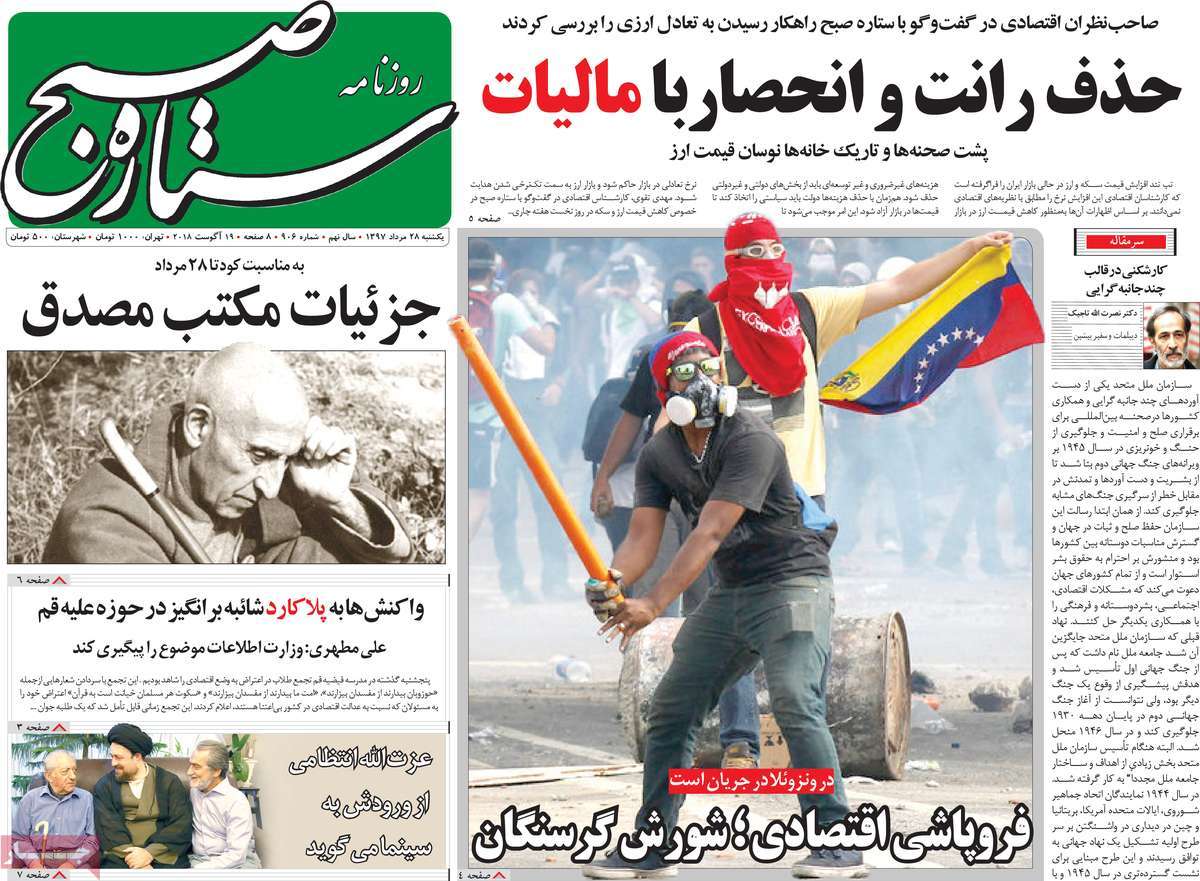
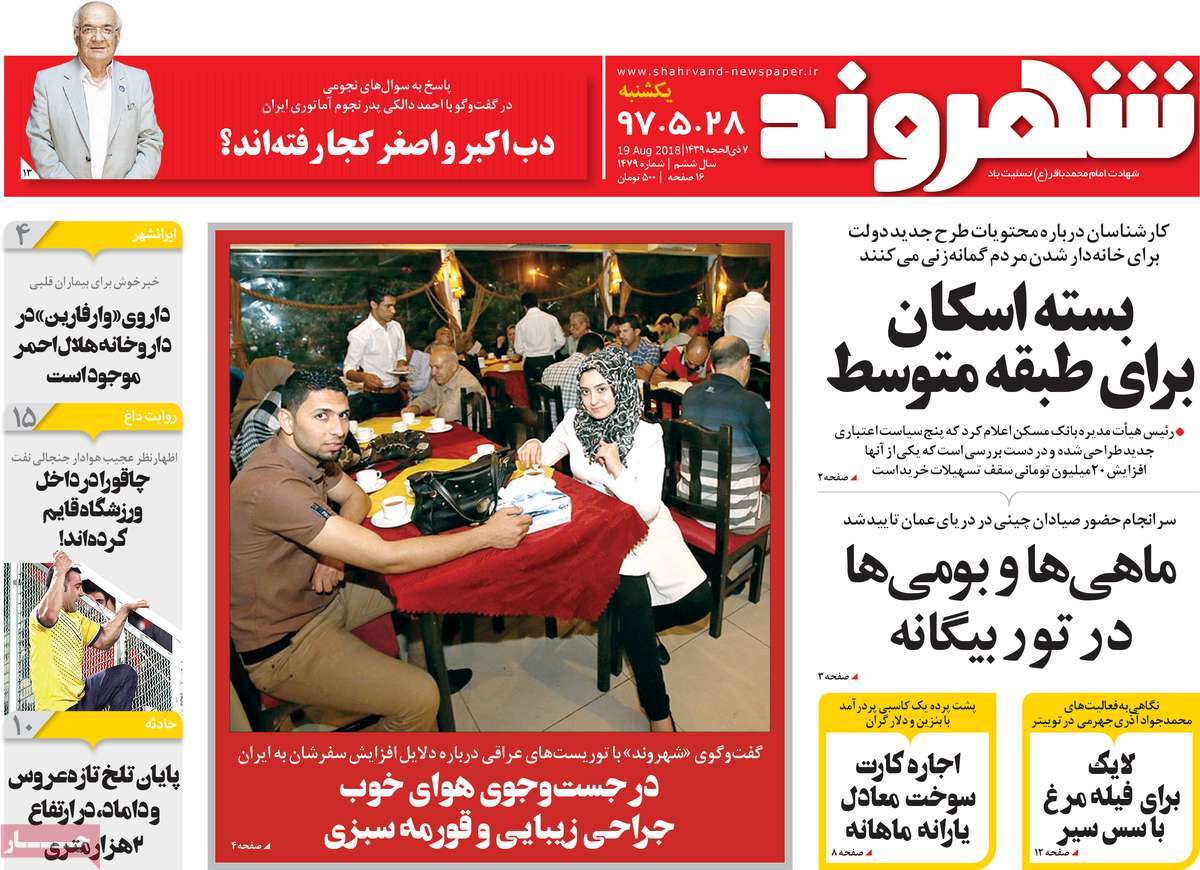
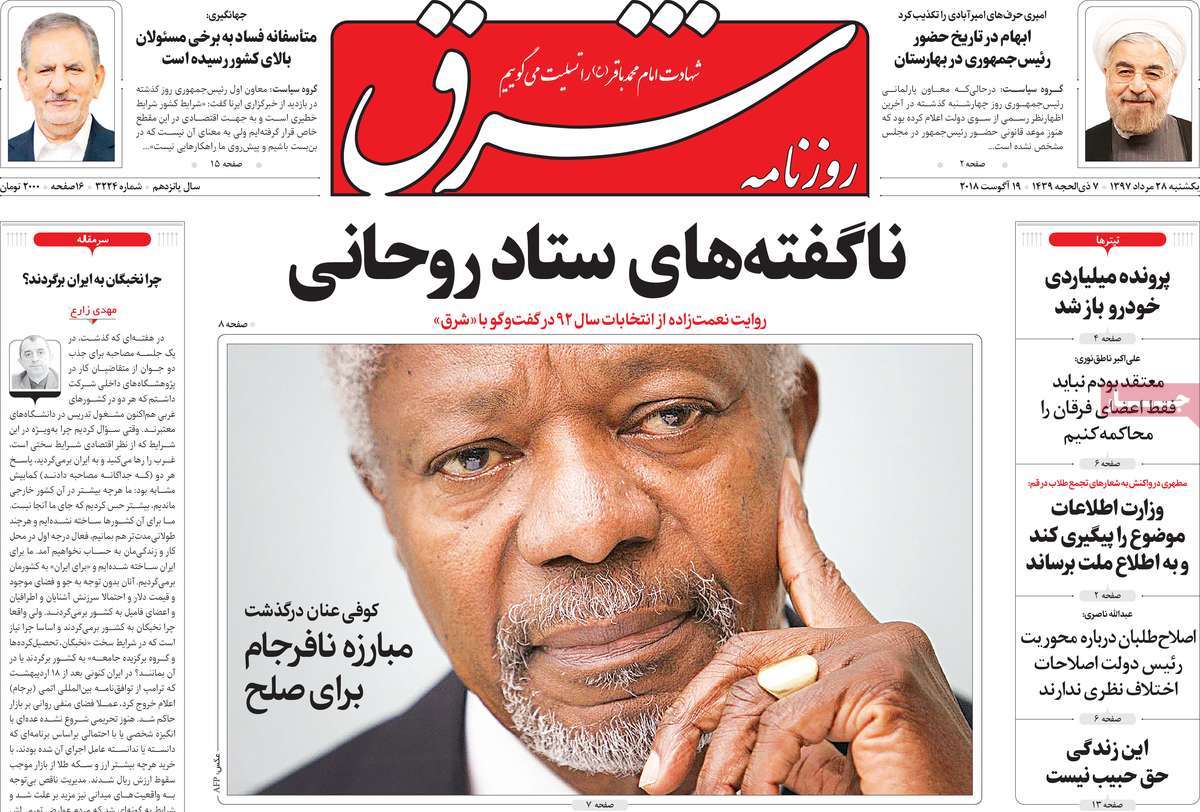
A Look at Iranian Newspaper Front Pages on July 30

A Look at Iranian Newspaper Front Pages on November 19

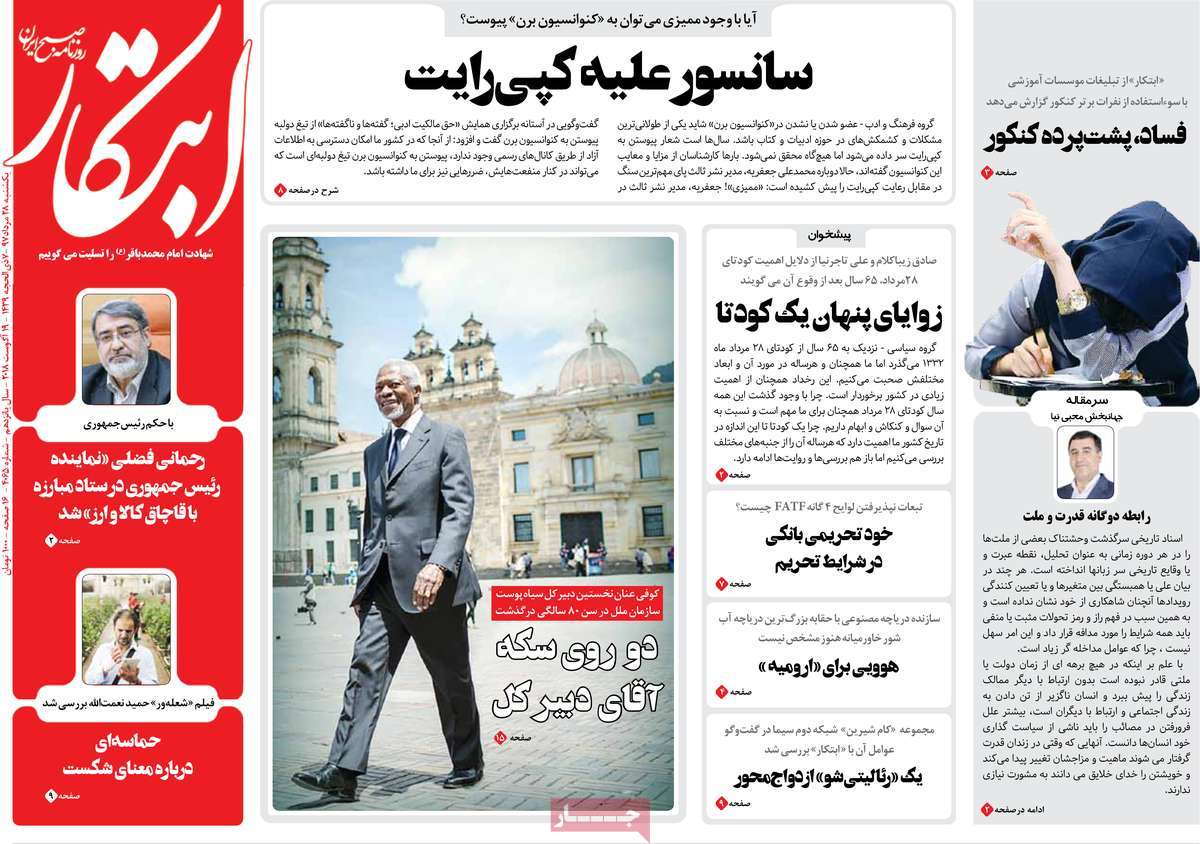
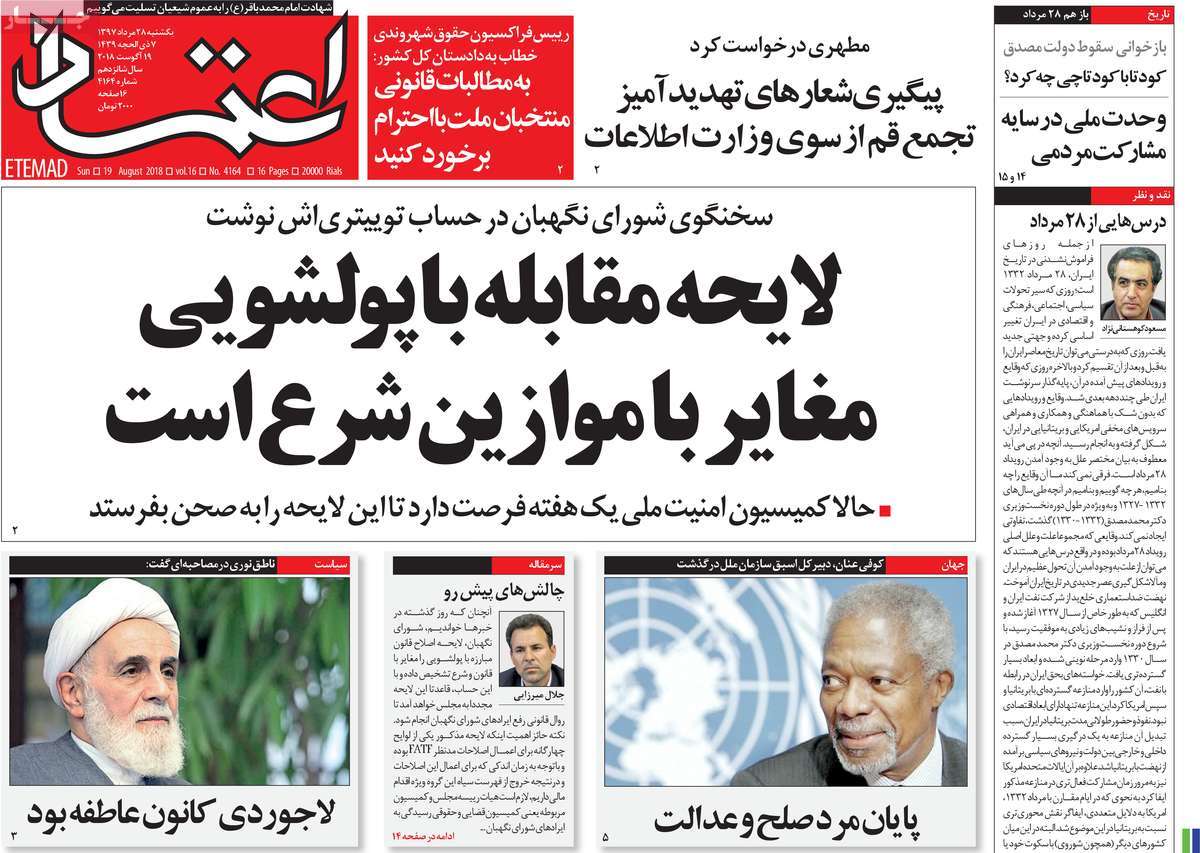
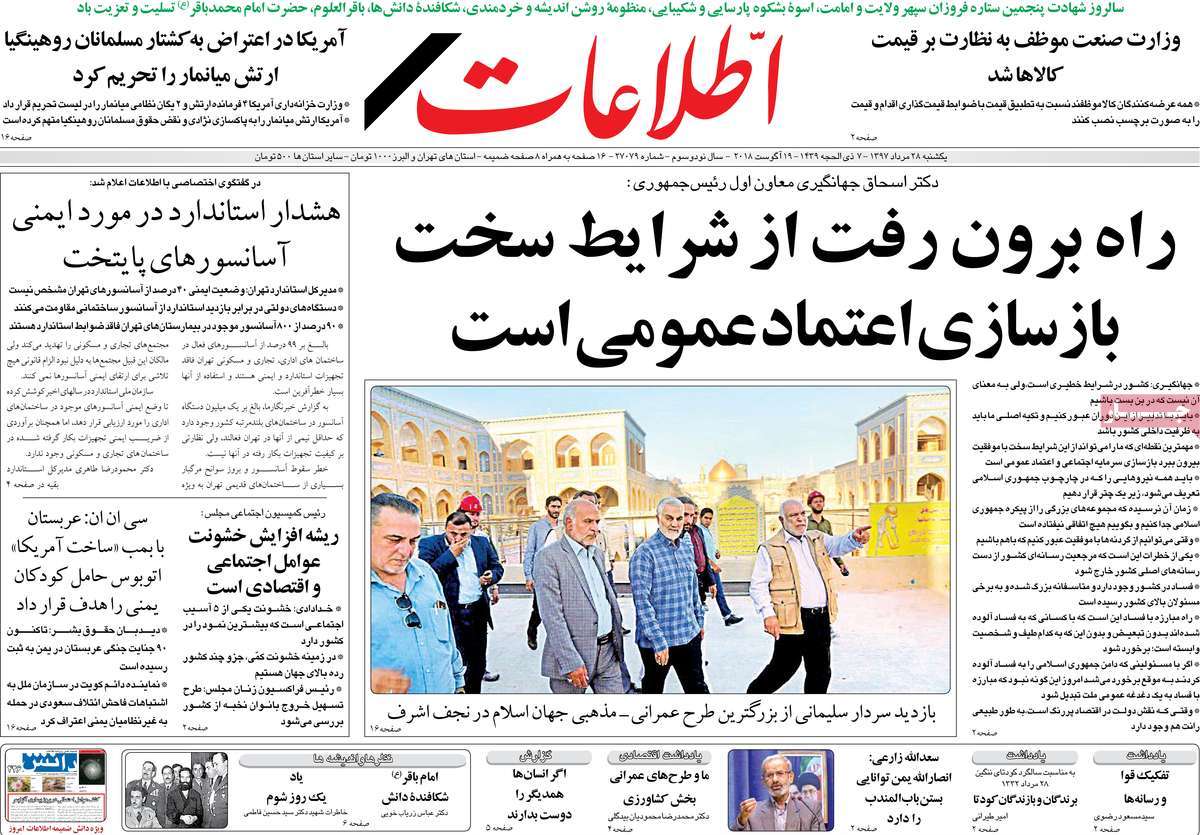
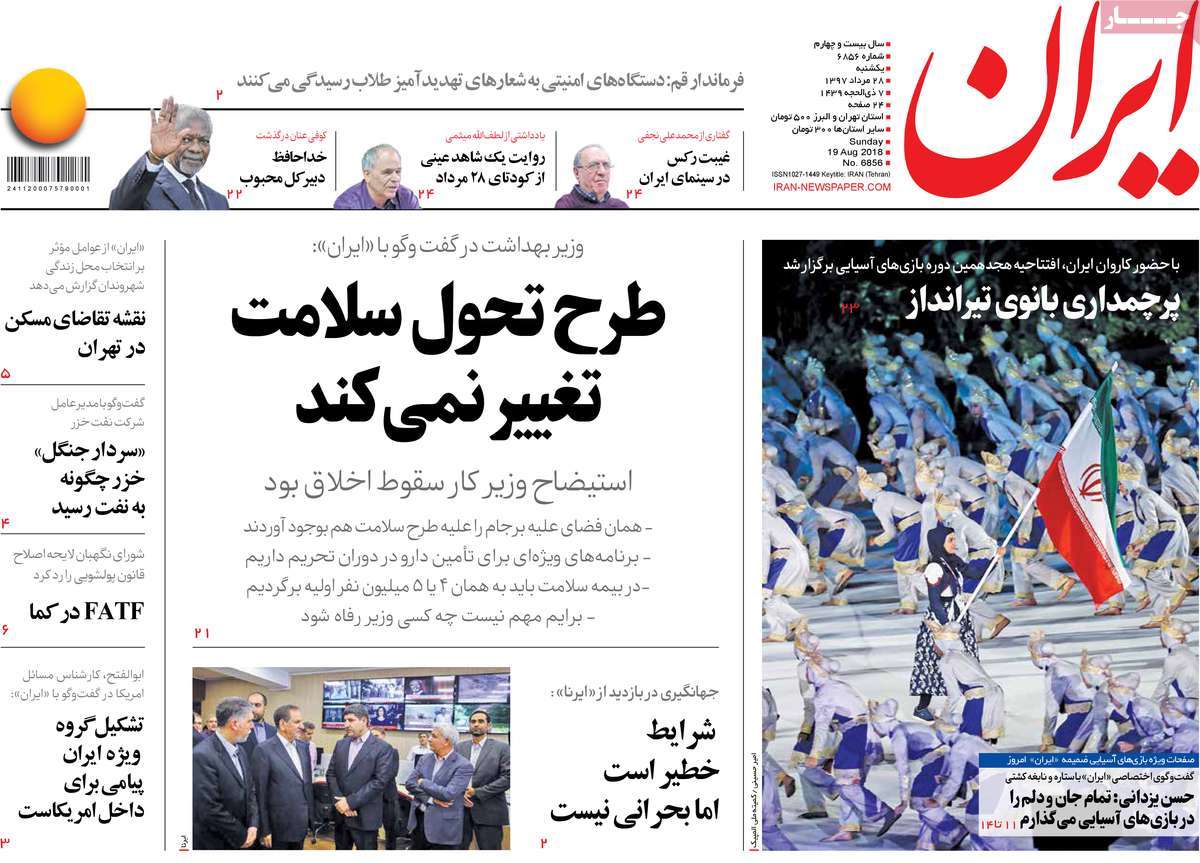
The ongoing fluctuations in Iran’s foreign currency and gold coin markets hit the headlines on Monday, as the Iranian currency hit its lowest-ever value against the US dollar and other currencies.

Also a top story was remark by Foreign Minister Mohammad Javad Zarif about the US’ addiction to sanctions as well as a rift between Europe and the US, which has been intensified by the US’ policies on the Iran nuclear deal, and must be used by the Islamic Republic as an opportunity.

The above issues, as well as many more, are highlighted in the following headlines and top stories:


19 Dey:

1- Dollar Rate in Iran Exceeds IRR 100,000

A Look at Iranian Newspaper Front Pages on July 30


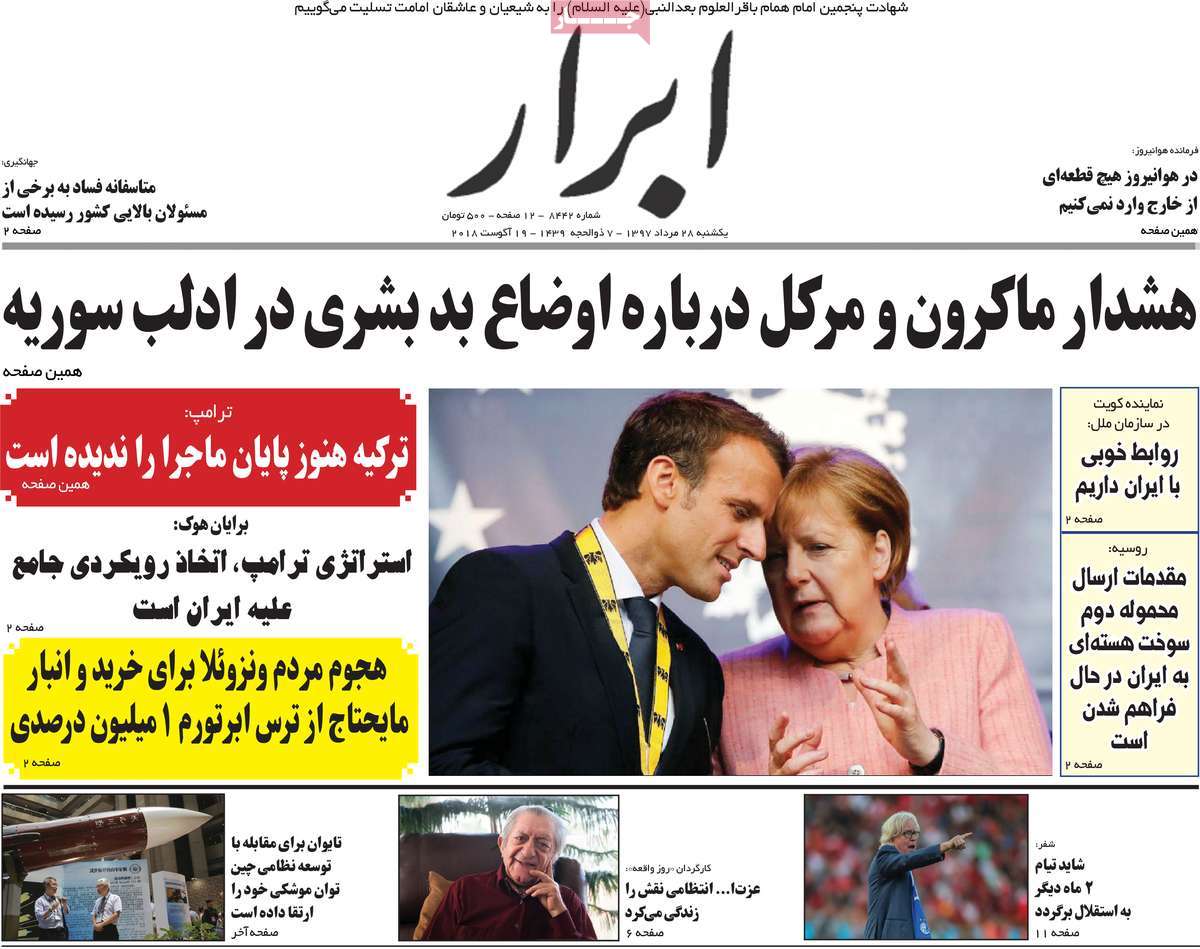
Abrar:

1- Zarif: I’m Not Immature to Think We Can Cause Rift between Europe, US

2- Omani FM Visits Washington to Mediate between Iran, US

A Look at Iranian Newspaper Front Pages on July 30


Arman-e Emrooz:

1- Economic Elites Agree There’s a “Forex Coup” Going on

2- FM Reacts to US’ Recent Moves: We’ll Use Opportunity of Rift between US, Europe

A Look at Iranian Newspaper Front Pages on July 30


Ebtekar:

1- Zarif: US Addicted to Sanctions

A Look at Iranian Newspaper Front Pages on July 30


Etemad:

1- Women Did the Job Wherever They Entered: Rouhani

2- You Can’t Insult Iran in Morning, Invite It to Talks in Afternoon: Iran Envoy to UN

A Look at Iranian Newspaper Front Pages on July 30


Ettela’at:

1- Zarif: World Has Come to Conclusion US Must Quit Addiction to Sanctions

2- Young Iranian Volleyball Players Win Asian Title

A Look at Iranian Newspaper Front Pages on July 30


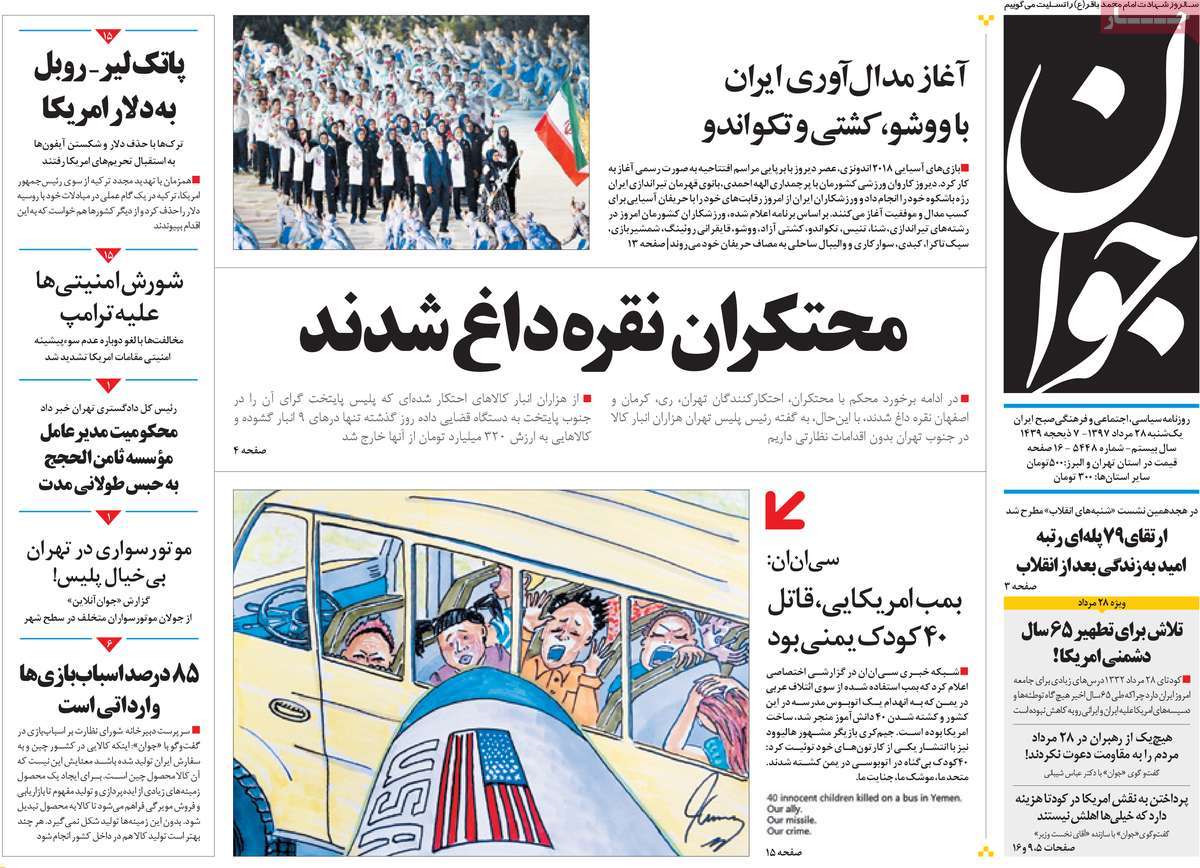
Javan:

1- China, Turkey Not to Implement Iran Sanctions

2- American Academic Warns: Those Implementing FATF Must Adapt Themselves to US Policies

A Look at Iranian Newspaper Front Pages on July 30


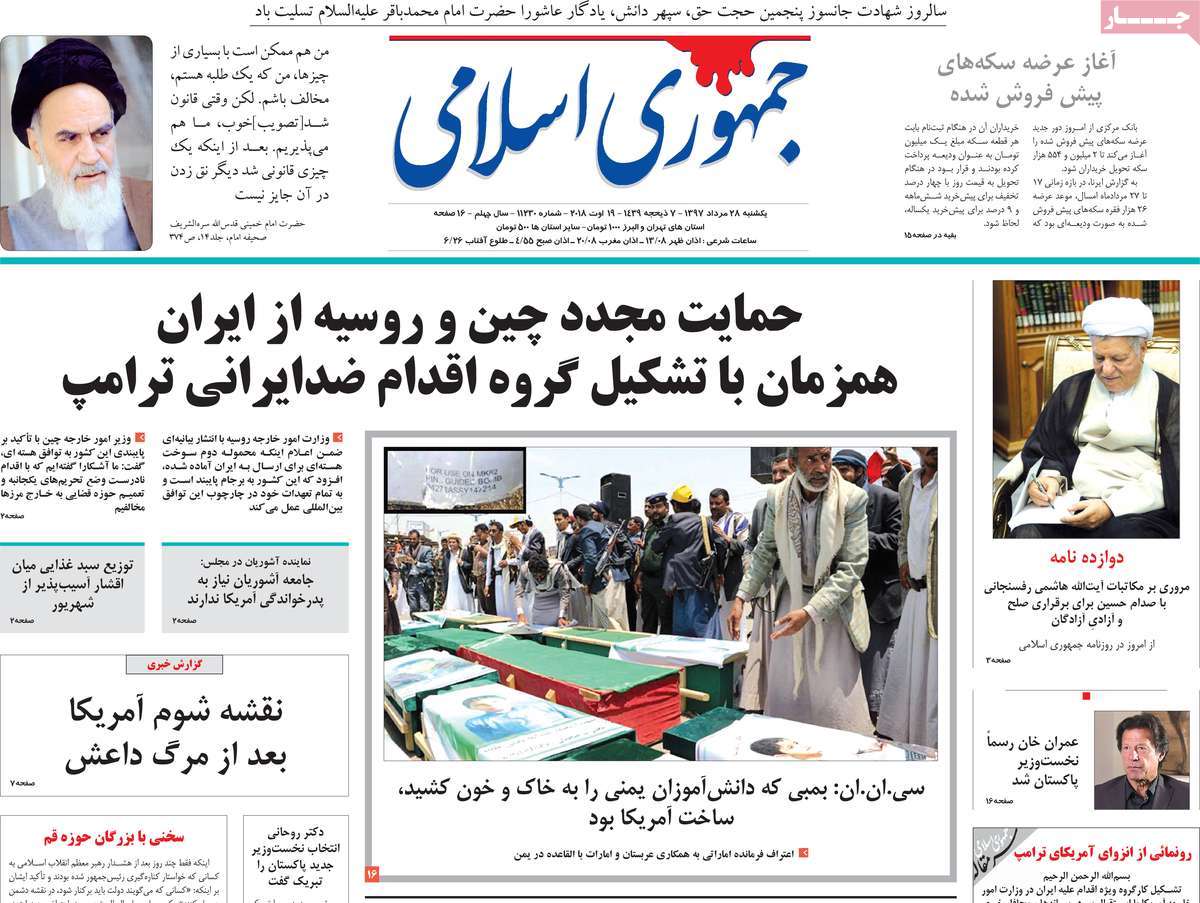
Jomhouri Eslami:

1- Notorious Businessman Jazayeri Arrested While Trying to Escape Iran

  • He’s Made IRR 10 Billion Bribe to Officers

A Look at Iranian Newspaper Front Pages on July 30


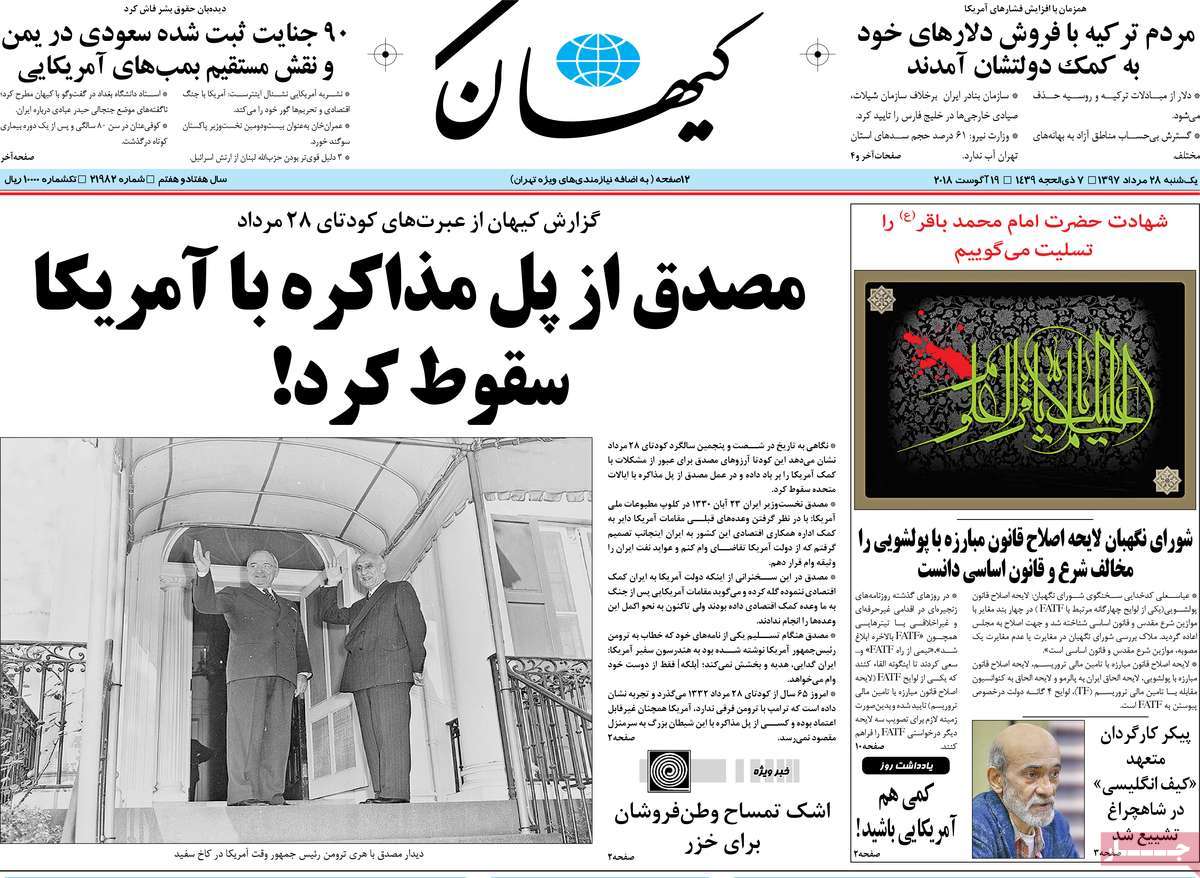
Kayhan:

1- Forex, Gold Coin Market Controlled by Government or Economic Terrorists?

2- Kurdish Militia Ready to Join Syrian Army in Fight against Terrorists

3- Students Hold Protest Rally against IAEA’s Inspection of Iranian Universities

A Look at Iranian Newspaper Front Pages on July 30


Sazandegi:

1- Interior Minister: 4,000 Tonnes of Illicit Drugs to Be Poured into Gates of Europe If Iran Closes Its Eyes for 24 Hours

A Look at Iranian Newspaper Front Pages on July 30


Shargh:

1- Different Moods of Rouhani, Putin

  • Official Talks about Rouhani’s Trips, Foreign Visits

2- Trump Using George W. Bush as Role Model

A Look at Iranian Newspaper Front Pages on July 30


Sobh-e Now:

1- Deputy Judiciary Chief Says 29 Arrested for Disrupting Forex Market

2- Health Minister: US Lying that It Feels for Iranian Nation

  • Qazizadeh Slams US for Sanctions on Pharmaceuticals, Medical Equipment despite Trump’s Humanitarian Gestures

A Look at Iranian Newspaper Front Pages on July 30

Nour Gavan; Ancient Ceremony to Mark Triumph of Light over Darkness

It is called Nour Gavan because people, during the ritual, set fire on milk vetch, a barbed plant with thick stems and tall branches growing mostly in mountainous areas.

The ritual is rooted in the story of Fereydun’s victory over Zahāk (in Ferdowsi’s Shahnameh or Book of Kings). When Fereydun triumphed over Zahāk, at the place of the former’s throne near Mount Damavand people lit fire as a sign of joy and triumph of light over darkness.

The people of Neva village believe that after the defeat of Zahāk as Fereydun had to chain him in a cave on Mount Damavand, he started to head to Damavand peak.

After several days and nights of rest, Fereydun and his army, along with Zahāk, who had snakes on his shoulders, head to Damavand Peak. They promise to light fire on the hillside of Damavand to let everyone know that Zahāk is dead.

The villagers went to the highest point of the village in front of the castle looking at Damavand. Early at night, the light of fire shone from the Damavand range, and the people of Neva also responded by putting some milk vetch on a rope, burning it and turning it around their heads to show a response to Fereydun and his fellows. Then the young people started to dance and serve sweets among people.

Since then the event has turned into a great celebration and every year they come together and celebrate in the same place. They burn milk vetches and turn them around their heads.

What follows are ISNA and Mizan’s photos of the ceremony recently held in Neva village:

Iranian Welder Bravely Struggles for Her Life

La’ya, a 34-year-old woman born in Shiraz in southern Iranian province of Fars, is the only female welder in a massive industrial site somewhere in Iran.

In a recent interview with the Iranian Labour News Agency (ILNA), she has shared the story of the hardships she faced before reaching her current position, encouraging other Iranian women with her success story.


Miserable Life

Years ago, when La’ya was a high school student, her parents got separated after her father became flat broke.

Due to the financial situation of her family, La’ya had no choice but to abandon the dream of studying in a university and rather try to get a job.

“At that time, I used to make leather bags and wallets and sell them,” she said.

But she didn’t want to give up her education. Three years later, La’ya decided not let her family’s financial difficulties deter her path to receiving a degree.

Motivated by her desire to become a tour guide, La’ya attended Iran’s general university entrance exam.

“I took the university entrance exam. I was accepted into a university in Mashhad to study tourism and a university in our city to study architecture. I was stuck between two choices, whether to follow my passion or stay with a family who needed me,” she said.

Upon her mother’s request, La’ya decided to stay in Shiraz and study architecture.

In the final years of university, her father was diagnosed with cancer. Moreover, her father’s financial difficulties had intensified and his creditors sued him.

“I could not attend my classes. I had to study, attend court sessions, work and look after my father in the hospital,” she said. However, despite all difficulties, La’ya managed to become the top student at that semester.


Entering the Welding World

After a few while, her father passed away. La’ya was then in charge of herself. She needed a full-time job to run the family, as she earned small income by making leather bags.
She became aware that the Technical and Vocational Training Organization holds welding workshops and top trainees could land themselves a job.

La’ya attended the workshop. She had so much fire in herself that managed to beat her male rivals and become a top trainee, setting her life on its current trajectory.

One thing I was sure of was that I would become a top trainee, come what may,” she said.

At the end of the course, she was sent to an oil site in a small city in oil-rich regions of southern Iran.


Strange Problems

La’ya started working as a welder and advanced her career well.

Everything was going well for La’ya until people in the small city started objecting her presence over fears she could be corrupt.

“People gathered in front of my workplace. They wanted me to go. That was a small city and I was the only female welder among so many men. People were angry. They didn’t want me to be there. I was afraid what would happen if I lose my job,” she said.

However, La’ya decided to resist and fight for her job. She says the only reason that saved her from being fired was her quality work and the support of chief executives of the company she was working for.

“I had not reached that position so easily. I chose to stay for as long as they tolerate me,” she said. After a few months, people got used to her and the problem was solved.


Work Challenges

Despite her good work, La’ya still faces difficulties in her workplace because she is a single woman.

She says people around her have sometimes tried to sexually harass her.

“At my workplace, I have been under pressure. People have given me annoying offers,” she said.

“Throughout my life, I have faced attempts for sexual harassment and I have resisted them by expressing objection. But here, it is so difficult,” she said.

Despite all the hardships, La’ya does not intend to cave into pressure.

“I won’t be stopped. Today, I’m a senior welder in a big industrial site. I receive good income and stand on my own feet,” she said.

Nardoun Stew; Wedding Dish in North of Iran

The food, which is served in the local areas as a wedding lunch, has a delightful taste. They use chicken, duck, or goose meat to make the food, while sour or sour-sweet pomegranate, onions, pomegranate paste, sugar and garlic make up the other ingredients. Some use plums in this meal as well.


Ingredient serving 2:

3 pieces of chicken thighs (about 600 grams)

1 large onion

2 cloves of fresh garlic

1.5 cups of pomegranate juice

2 tbsp. of pomegranate paste

0.5 cup of pomegranate arils

Salt, pepper, turmeric: as much as needed


Instructions:

At first, marinate chickens after washing them. To do so, place the chicken pieces in a suitable pot and rub the salt, turmeric, black pepper and spices to them as much as desired. Then, add one or two tablespoons of olive oil. Put them in the refrigerator for at least an hour. You can also use paprika powder and a little coriander powder.

After an hour, fry the chicken pieces with a small amount of frying oil. Remove the chickens from the pan and fry chopped onions in the same pan. Then add the garlic and pomegranate paste. Mix it immediately and then add pomegranate juice. Let the mixture boil, and then add chicken pieces.

First, the colour of the mixture is clear, but it gets darker while being cooked. Lower the heat till the chickens cook well. Add pomegranate arils at the end of the cooking process. Do not put the lid because it turns the colour of pomegranate arils white. In the end, we must have a thick sauce. Serve the Nardoun with rice, along with vegetables and pickles to make the food more delicious.


Notes:

  • We can use different spices to make the stew tastier. For example, if you like sour tastes, use verjuice or bitter orange juice and if you are fond of sweet dishes, use sugar or plums.
  • The important point is that the final taste of the food is determined by the sweetness or sourness of the pomegranate.
  • You can add some sugar if the sauce is sour.