Thursday, January 1, 2026
Home Blog Page 351

Nine aid trucks cleared for Gaza ‘a drop in the ocean’: UN

US Gaza aid pier

UN Under-Secretary-General for Humanitarian Affairs and Emergency Relief Coordinator Tom Fletcher stated the Israeli authorities had allowed the limited resumption of aid delivery after intensifying its military offensive.

“This is a welcome development that should remain in place,” Fletcher said in a statement.

“But it is a drop in the ocean of what is urgently needed, and significantly more aid must be allowed into Gaza, starting tomorrow morning,” he added.

According to the UN, Gaza needs at least 500 aid trucks per day to meet the population’s basic needs.

Israel’s Coordinator of Government Activities in the Territories (COGAT) announced five trucks, including food for babies, entered Gaza via Kerem Shalom — the first such delivery since March 2.

UN spokesperson Stephane Dujarric said that nine trucks were “cleared to enter” via Kerem Shalom and are in the process of crossing. He said the trucks were carrying mostly nutrition supplies.

“They’ve crossed from Israel proper into the area from which the UN can pick the supplies up in Gaza. That part has not yet happened — given it’s late in the day, it’s very likely already dark, or soon to be dark there. Because of security concerns, we cannot operate under those conditions and pick them up,” he told reporters during a press briefing.

“Of course, nine trucks is better than no trucks, but we need a massive uptick in humanitarian aid,” Dujarric continued, adding, “We need a massive arrival of food, cooking oil, and fuel to meet these needs.”

Israel has kept all crossings into Gaza closed since March 2, deepening the enclave’s humanitarian crisis. Prime Minister Benjamin Netanyahu’s office said Sunday that a “basic quantity of food” would be allowed in to prevent a hunger crisis.

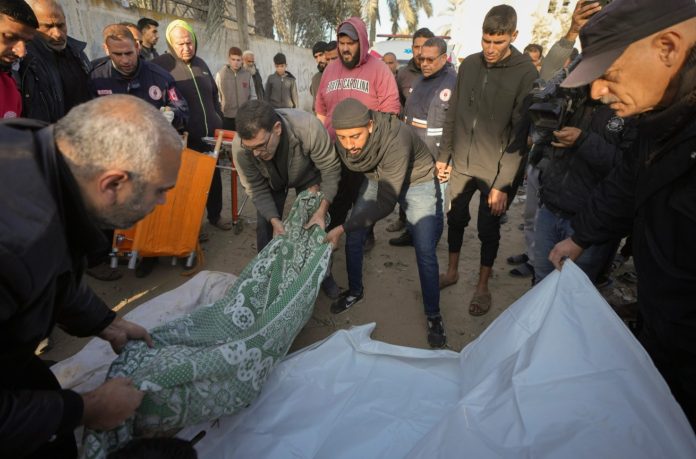
Israel’s brutal offensive on Gaza since October 2023 has killed more than 53,000 Palestinians, most of them women and children.​​​​​​​

Israel has not allowed any humanitarian aid into Gaza for nearly 80 days, the Gaza Media Office said Monday, warning that a crippling blockade and systematic starvation threaten the lives of 2.4 million Palestinians.

“No genuine aid has entered the Gaza Strip for more than 80 days under a complete siege and worsening famine,” the office announced in a statement.

It added that Israeli forces have fully closed all border crossings and “have not permitted a single grain of wheat to enter for nearly three months.”

The statement described the situation as “a deliberate policy of starvation targeting 2.4 million unarmed civilians.”

It stressed Israel has claimed to allow only nine trucks loaded with nutritional supplements for children to enter Gaza — representing just 0.02% of the approximately 44,000 aid trucks that should have reached the Gaza Strip since the blockade intensified on March 2.

Gaza requires around 500 aid trucks and 50 fuel trucks daily to meet the minimum humanitarian needs of its population, the statement read.

The office held Israel and the international community “fully responsible for this ongoing humanitarian crime,” calling for immediate international intervention to open all border crossings unconditionally and allow the entry of essential aid “before it’s too late.”
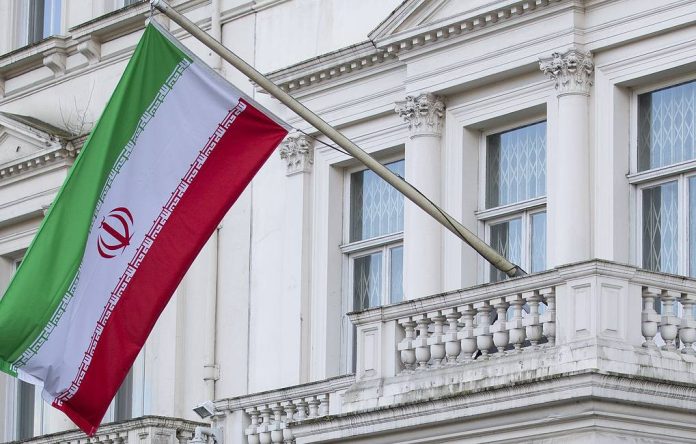
Iran ambassador warns UK of potential false flag operation amid detentions of Iranian nationals

Iran Embassy UK

According to a statement posted Monday evening on X social media by the Iranian Embassy in London, Ambassador Seyed Ali Mousavi met with Dan Jarvis, the UK Home Office’s Deputy Minister for Security. The two officials discussed a range of issues, including recent detention of Iranian nationals in the UK.

During the meeting, Mousavi referred to the release of several Iranian citizens who had been arrested two weeks ago on suspicion of terrorism-related activities but were freed without charge.

He urged British officials to raise the issue in parliament and expressed concern over potential “third-party involvement designed to damage Iran-UK ties.”

The statement added that both sides emphasized the importance of good-faith dialogue and agreed to continue meetings to address misunderstandings and disputes.

The meeting followed recent police operations in which several Iranians were detained on suspicions of preparing terrorist acts and cooperating with a foreign intelligence service. While four were released without charge, three face preliminary accusations such as surveillance activities.

In response to the arrests, Iran summoned the UK chargé d’affaires on May 18, while the UK summoned Iran’s ambassador the following day.

Britian, France and Canada threaten ‘concrete actions’ if Israel does not stop Gaza onslaught

Gaza War

The statement by Keir Starmer, Emmanuel Macron and Mark Carney condemns Israel’s expansion of military operations in Gaza as “wholly disproportionate”, adding that the “level of human suffering in Gaza is intolerable”.

“We will not stand by while the Netanyahu Government pursues these egregious actions. If Israel does not cease the renewed military offensive and lift its restrictions on humanitarian aid, we will take further concrete actions in response.”

It describes the Israeli government’s “denial of essential humanitarian assistance” as “unacceptable” and said it risks breaching international humanitarian law. In addition, it condemns the “abhorrent” language used by Israeli politicians threatening civilians to relocate from Gaza.

The leaders called on the Israeli government to stop its military operations in the besieged enclave and immediately allow humanitarian aid to enter the Palestinian territory.

The Israeli army has pursued a brutal offensive against Gaza since October 2023, killing nearly 53,500 Palestinians, most of them women and children.

The International Criminal Court issued arrest warrants last November for Israeli Prime Minister Benjamin Netanyahu and his former Defense Minister Yoav Gallant for war crimes and crimes against humanity in Gaza.

Israel also faces a genocide case at the International Court of Justice for its war on the enclave.

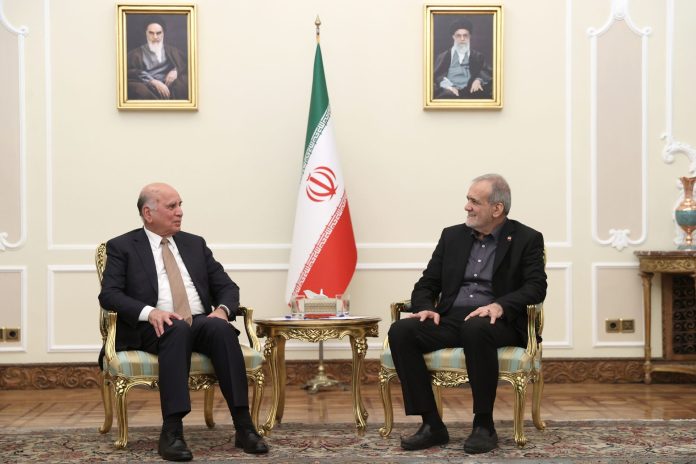
President Pezeshkian: Iran does not seek nuclear weapons

Referring to the ongoing indirect talks between Iran and the US, Pezeshkian said, “If the U.S. is truly concerned about nuclear weapons, we will assure them of our peaceful intentions, but Iran will never submit to coercion.”

He said, “We do not seek permission from anyone to pursue the progress of our nation.”

Pezeshkian also praised the deep historical, cultural, and linguistic bonds between Iran and Iraq, noting that bilateral relations are rooted in centuries-old ties.

He stressed the importance of expanding cooperation in trade, healthcare, science, technology, and rail connectivity.

The Iranian president welcomed growing provincial-level collaboration along the Iran-Iraq border and described it as “vital” for cross-border trade.

Iraqi Foreign Minister Fuad Hussein for his part conveyed warm greetings from Iraqi leaders to Pezeshkian and expressed satisfaction with the trend of strengthening bilateral relations with Tehran.

Hussein underlined Iraq’s commitment to completing joint projects, especially in transportation.

He also pointed to the cultural and religious ties that unite Iran and Iraq, saying, “There are no borders between us…millions of pilgrims travel freely between our countries every year”.

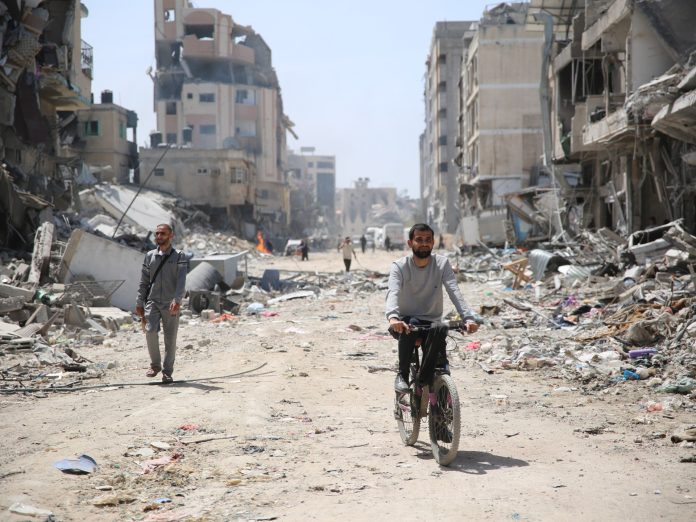
92% of Gaza homes destroyed in Israeli war: UN

Gaza War

“Families in Gaza face unimaginable devastation. According to the Protection Cluster, 92% of homes have been damaged or destroyed,” UNRWA said in a statement.

“Countless people have been displaced multiple times, and shelter is scarce,” it said, renewing its call for lifting the Israeli siege on the Palestinian enclave.

Since March 2, Israel has kept Gaza crossings closed to food, medical, and humanitarian aid, deepening an already severe humanitarian crisis in the enclave, according to government, human rights, and international reports.

On Sunday, the Israeli army began a broad ground offensive in the war-torn territory.

The Israeli army has pursued a brutal offensive against Gaza since October 2023, killing more than 53,300 Palestinians, most of them women and children.

The International Criminal Court issued arrest warrants last November for Israeli Prime Minister Benjamin Netanyahu and his former Defense Minister Yoav Gallant for war crimes and crimes against humanity in Gaza.

Israel also faces a genocide case at the International Court of Justice for its war on the enclave.

US could pass more sanctions on Russia: Bloomberg

The legislation has been authored by Republican Senator Lindsey Graham – a longtime advocate of hardline policies against Moscow.

The US imposed sweeping sanctions on Russia under former President Joe Biden following the escalation of the Ukraine conflict in 2022. Trump has since signaled a willingness to restore bilateral contacts and possibly even lift the sanctions as part of a negotiated peace.

The Trump administration has said, however, that it would not pursue a peaceful resolution of the conflict indefinitely if no progress is made.

According to Bloomberg, US officials have privately told their European counterparts that Trump may allow Graham’s bill to proceed if “Russia doesn’t budge,” and could deliver the warning to President Vladimir Putin during a scheduled call on Monday.

Graham, a prominent Russia hawk, has in the past called for Putin’s assassination, backed extensive military aid to Kiev, and stated that Russians dying in the Ukraine conflict is “the best money we’ve ever spent.” He has also praised Ukraine for fighting what he described as a proxy war on behalf of the US.

In April, he proposed a sanctions package that he said would be “devastating” for the Russian economy, including 500% tariffs on goods from countries that continue trading with Moscow. He claimed that the proposal has majority support in the Senate.

US Secretary of State Marco Rubio also confirmed the possibility of additional sanctions on Moscow in an interview with CBS on Sunday, saying he conveyed this to Russian Foreign Minister Sergey Lavrov the day before, urging an immediate ceasefire.

Russia has rejected calls for an unconditional 30-day ceasefire, saying that while it is open to the idea, it is concerned that Ukraine would exploit the pause to rearm and continue its mobilization efforts. Moscow has instead insisted on negotiating a long-term resolution of the conflict that addresses the root causes.

The EU has also approved its 17th package of sanctions on Russia, attempting to use it as a means of pressuring the country into making concessions to Ukraine.

The Kremlin has described the West’s “language of ultimatums” as unacceptable. Former Russian President Dmitry Medvedev has warned that this rhetoric could result in “unsuccessful negotiations,” leading to a “more terrible stage of the war with new weapons and participants.”

Security chief: Iran, Pakistan not to let regional peace be disrupted

Ali Akbar Ahmadian

Ahmadian underlined that neither of the two countries will allow regional peace to be disrupted by enemies.

He noted that cooperation between Iran and Pakistan will be beneficial to regional security and will serve the interests of both sides as well.

Ahmadian added that Iran and Pakistan will continue their cooperation.

He also congratulated Malek on his appointment as Pakistan’s new national security advisor.

The Pakistani official for his part appreciated Iran’s positive role in the region. Malek declared Pakistan’s readiness to expand security and social ties with Iran.

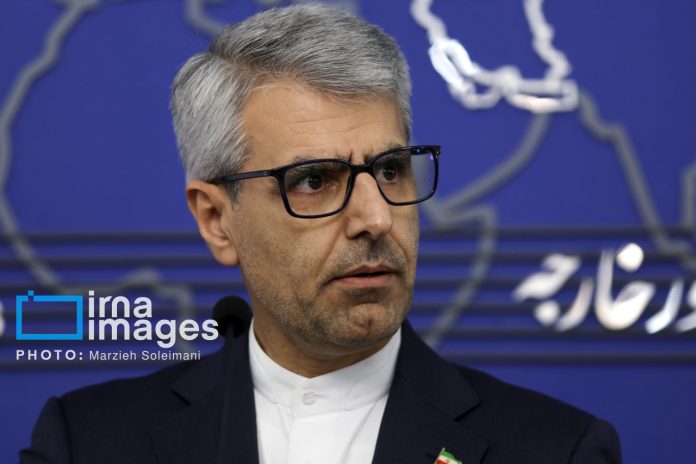
Tehran raps Washington’s flip-flop, scorns US negotiator’s push for zero enrichment

Esmail Baghaei

Speaking to reporters at a weekly press conference on Monday, Esmaeil Baqaei hit back at US special envoy Steve Witkoff for claiming that any deal between the US and Iran must include an agreement not to enrich uranium.

“The issue of enrichment as part of the natural cycle of Iran’s nuclear industry is by no means negotiable,” he underscored.

“Enrichment is not a fantasy. Enrichment is a technology and requirement for making sure that Iran’s nuclear industry will go on uninterruptedly,” Baqaei stated, stressing that Iran will never forgo its legitimate right to enrichment.

Likening the change in the US’ policies to a game of snakes and ladders, the spokesman said whenever Iran conceives that good understanding has been shaped in the talks, the US negotiators change their stances after returning home.

Such a flip-flop raises doubts about the US’ seriousness in the talks with Iran, he added.

Deploring the fresh sanctions imposed by the US against Iran, the spokesman said a difficult part of talks with the Americans is that they do not remain committed to anything.

Every new package of sanctions against Iran amounts to crimes against humanity and proves that the US feels hostility toward Iranians. “One should not trust their (US’) claim of being serious in diplomacy.”

Reiterating Iran’s seriousness in the talks, Baqaei said the country’s nuclear program is totally peaceful and Tehran has nothing to hide, which is why it has opted for a diplomatic approach.

“While the continuation of the (US) sanctions is not going to have any influence on Iran’s determination, it only raises questions about the US’ seriousness,” he concluded.

Iran and the US have held four rounds of talks since April 12, mediated by Oman, with the purpose of reaching a deal on Iran’s nuclear program and the removal of sanctions on Tehran.

Reverse brain drain expected in Iran’s medical sector, says health ministry official

Iran Surgery

In a statement on Monday, Hosseini announced reforms in faculty recruitment and improved working conditions aimed at retaining and attracting academic talent.

“The recruitment process for faculty members at medical universities has been revised,” he said, adding that existing pressures on faculty across medical schools have been reduced. New incentives are also being planned for both basic sciences and clinical professors.

To prevent the outflow of academic talent, the ministry is working to enhance the professional environment in medical universities.

“We’ve encouraged university presidents and educational deputies to hold regular meetings with faculty to foster motivation,” Hosseini noted.

The deputy minister expressed optimism about early signs of change, revealing that some expatriate professors have shown interest in returning. “Although the numbers are still small, we are confident that migration trends will reverse in the coming years,” he said.

Hosseini emphasized that with ongoing policy changes and a shifting academic atmosphere, Iran is on track to retain and even regain its top medical scholars. “I am quite hopeful we’ll soon see a return of elites and professors to the country,” he concluded.

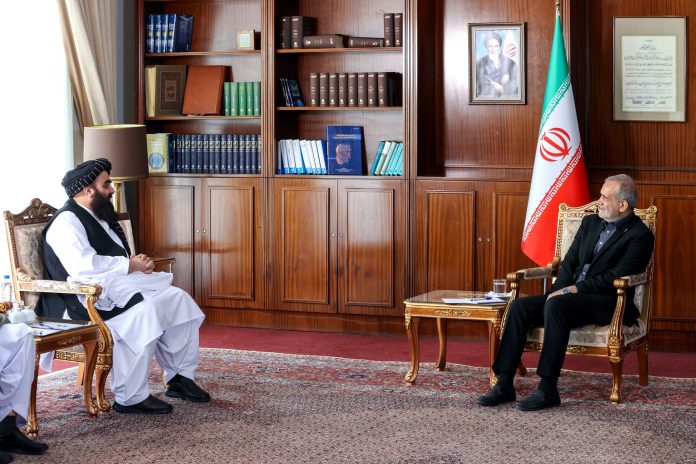
President Pezeshkian says Iran keen to cooperate with Afghanistan to settle disputes

Pezeshkian met with Amir Khan Muttaqi on Sunday on the sidelines of the Tehran Dialogue Forum 2025 which brings together senior officials and diplomats from 53 countries as well as the United Nations. The forum is held in the Iranian capital Tehran on Sunday and Monday.

The Iranian president said that his country considers a duty assisting the people of Afghanistan based on religious principles, adding that Iran is ready to develop cooperation with Afghanistan in different fields.

“Based on our basic and strategic principles, we deem as unfounded any disputes among Islamic countries, and we consider the strengthening of brotherhood and cohesion as a reasonable substitute to any division in the Islamic Ummah,” said Pezeshkian.

Amir Khan Muttaqi, on his part, called Iran a well-intentioned and good neighbor of Afghanistan, saying that his country is seeking to a be a good and trustable neighbor for Iran as well.

He also said that Iran and Afghanistan share deep-rooted religious, cultural and language commonalities, and have common views on international and regional issues including Palestine.

After 47 years, Afghanistan has managed to establish a central government, where the era of occupation has come to an end and all ethnic groups are living in an environment of co-existence and brotherhood, said Muttaqi.

“Adopting a balanced policy, we are seeking a broader and constructive interaction with regional countries, especially the Islamic Republic of Iran,” he noted.

The volume of trade between Iran and Afghanistan now stands at $3 billion, he further said, expressing hope that Afghanistan, with the help of Iran, can turn into a safe place for regional trade and transit now that the cultivation of narcotics has come to zero in Afghanistan and the Daesh terrorist group has completely been driven out from the country.

Muttaqi also expressed gratitude towards Iran for hosting millions of refugees from Afghanistan, and said that his country is making efforts to gradually return those refugees to their homeland.

He also said that Afghanistan intends to turn the borders into common opportunities, and promote trade with Iran to high levels through expanding economic cooperation.