Friday, January 2, 2026
Home Blog Page 3416

This Iranian Girl Is Used to Fighting for Her Life

Shora is crazy to work at heights. Hailed from the northeastern city of Amol, she holds an MA in economy from University of Mazandaran. She is now living and working in the same province.

Like many others who work at heights, Shora loves mountaineering and rock climbing.

“It’s nearly a year that I’m working at heights. Of course, I had been rock climbing two years earlier and underwent some training courses for about eight months to work at heights. Despite having an official certificate in this area, I still feel like an amateur,” she said.

Elaborating on the problems of working at heights, Shora says it is not easy at all and if you don’t follow the safety tips, you may develop Suspension trauma, also known as harness hang syndrome (HHS), which occurs when the human body is held upright without any movement for a period of time.

“To be honest, at first, the work seemed very horrible to me but today, I have no fear and even love it. When you are sure about the safety of the equipment, there would be no fear anymore,” she noted.

This Iranian Girl Is Used to Fighting for Her LifeShora does a variety of works at heights which is hard to imagine. “It depends on my contracts. Sometimes I paint, sometimes I waterproof rooftops, and sometimes I do insulation or install placards.”

Asked whether or not she knows other women having the same job, Shora said, yes there are at least two other women.

“To me, work should not be viewed through a sexist prism. I think women, who are generally delicate and soft-minded, may even be more successful when it comes to works like what I do, but only if they accept the conditions and come to terms with the fact that they may lose their soft skins and get tough in appearance and behaviour.”

“This requires them to always keep their nails and hairs short. Meanwhile, their skin may get dark under the sun. They should also keep themselves in a good shape,” she added.

Shora turned to working at heights after making a deep change in her life. In her teenage years, Shora weighed 125 kg. She was a reclusive girl with rare contacts with people around her. Fed up with the blames of her family and the society, she decided to make a change because even getting the highest scores at school couldn’t make a change to the society’s judgment of her.

“By reading books, I tried to know the world around me. Due to my heavy weight, I couldn’t get a deep understanding of my environment. So, I mostly lived in my imaginary world. But at the age of 18, I decided to face the world in reality. So, I began to decrease my weight and today I’m 62 kg. Resolving such problems is highly significant. I think facing our problems helps us to grow up.”

After losing weight, she began to go for mountaineering and rock climbing. She has already conquered Damavand as well as a number of other peaks in Iran and abroad including Georgia. Shora is now writing her own book instead of going through others’ books.

She is an exemplary case for those who always complain about life’s problems without taking any step to remove them. And also for those who doubt as to whether a girl can work at heights. According to Shora, “most of my relatives who haven’t seen me since a long time ago feel shocked after visiting me. They can’t believe that I’ve considerably lost my weight and turned into a sociable girl who works at heights.”

In response to a question about how long she could put up with working at heights, Shora said “I’m in love with my job and it goes without saying that I have my own big dream which I prefer not to talk about here. But I’m sure that I will keep working at heights as long as my physical condition allows.”

Eight Turkmen Couples Hold Joint Wedding in Traditional Style

More than 2,000 guests attended the wedding ceremony, which also included various traditional games.

The “Kurash” wrestling and horse racing were among the traditional games held on the sidelines of the marriage ceremony, as part of the age-old customs of Turkmen people.

Here are photos of the ceremony retrieved from IRNA:

Iran Prepared to Export Homegrown Fighter Jets

Brigadier General Abdoklarim Banitarafi, head of Iran Aviation Industries Organization (IAIO), made the announcement on Monday, before the air show’s opening ceremony.

“We have already taken the necessary steps to export products that we are authorized to sell,” he told reporters, noting that Tehran will resume selling trainer jets as well.

Iran unveiled its first domestically designed and manufactured fighter jet named “Kowsar” during a defense show in Tehran in August.

The fourth-generation Iranian fighter jet is equipped with “advanced avionics and fire control systems” and can be used for short aerial support missions.

The plane can be manufactured in both single- and double-cockpit types, the latter of which can be used for advanced pilot training missions in addition to its combat capability, according to Fars news agency.

Banitarafi said Iran had already reached export agreements with China, Russia and Indonesia.

US becoming ‘more miserable’

Iran’s Defense Minister Brigadier General Amir Hatami said at the Kish Air Show’s opening ceremony that Iran was steaming ahead and making advancements in all fields despite harsh economic sanctions by the US, which he said is becoming “more miserable” by the day.

“Forty years ago, the Iranian nation purged America as the symbol of imperialism and it will proudly celebrate the 40th anniversary of its independence three months from now,” he said.

New warship armed with domestic CIWS

Iran’s Navy says its new warship, which will be unveiled later this week, comes equipped with a domestically developed close-in weapon system (CIWS).

Dubbed Kamand, the state-of-the-art system is mounted on the Iranian Navy’s Sahand guided-missile destroyer, allowing it to defend itself against anti-ship missiles, helicopters and a range of other incoming threats.

Rear Admiral Hossein Khanzadi, the commander of the Navy, made the announcement during an interview published by Tasnim News on Monday.

Khanzadi said besides Kamand, the warship has also received a range of new weapons and electronics that put it above its predecessors in terms of combat power and operability.

“This frigate is armed with anti-ship cruise missiles and has larger flight decks to carry heavier helicopters,” the commander said.

Sahand is also equipped with other advanced systems that Khanzadi said “perhaps we don’t need to talk about right now.”

According to Khanzadi, the Navy would commission a total of three new destroyers to its northern and southern armadas in the next four months.

The rear admiral noted that a second destroyer was in line to receive Kamand, which is often referred to as the Iranian equivalent to America’s Phalanx CIWS.

The Navy has yet to disclose more details about the weapons system but according to Khanzadi, Kamand can fire anywhere from 4,000 to 7,000 projectiles per minute.

Earlier this year, Khanzadi told reporters that Kamand had been successfully tested and was ready for deployment. He said back then that Iran was among the few countries in the world with the technology to develop such advanced systems.

Iran is set to showcase its latest achievements in maritime technology during the 20th Iran International Maritime and Offshore Technologies Exhibition (IRANIMEX2018) on Kish Island next month.

Chinese Reporters Give Compatriots First-Hand Account of Iran

China has made investments in a number of economic projects in Iran, and has extensive economic cooperation with the country. However, most Chinese people still think Iran is an Arab country with large swaths of deserts, its people speak Arabic and its women wear Burka.

This prompted the China Central Radio program-makers to send a team of five reporters to Iran. The reporters made a five-day tour of the country to know its tourist attractions in person.

During their stay in Iran, they recorded the voices of sportsmen in Zoorkhaneh, drivers stuck in traffic jams, ordinary people and many others. The program made by the group is going to be aired at a prime time by the Chinese radio channel.

Ramin Zabihmand, a senior member of the Iranian Tourist Guides Association (ITGA) who accompanied the reporters during their visit, told ISNA the reporters stayed in Iran for five days and paid a visit to the capital Tehran and Isfahan with the main goal of producing features on Iran’s tourist attractions.

Chinese Reporters Give Compatriots First-Hand Account of Iran

The guide went on to say that the reporters aimed to record various types of voices in Iran and to this end they visited a Zoorkhaneh and some traditional bazaars in the cities and had face to face talks with the ordinary people.

Elaborating on the Chinese reporters’ impression of visiting Iran, he said they were surprised to see various natural and historic attractions of Iran.

“One of the main questions that popped up in their minds was that why there are no sufficient promotional programs about Iran’s tourist attractions. They also said with such a huge number of tourist attractions, Iran can potentially attract a large number of tourists from China,” he said.

Zabihmand also said the reporters are set to visit Iran again but not as journalists. They are expected to visit Iran along with their families to enjoy the attractions of Iran.

Iran’s Cultural Heritage, Handicrafts and Tourism Organization (ICHTO) has recently established a new specialized department in order to boost the number of Chinese tourists visiting Iran. It is also mulling over removing the visa regime for Chinese citizens.

Chinese Reporters Give Compatriots First-Hand Account of Iran

Iran Army Tasked with Guarding Security of Borders with Afghanistan

Speaking to reporters on Monday, Chief of Staff of the Iranian Armed Forces Major General Mohammad Hossein Baqeri said the Army Ground Force has been assigned the task of ensuring security along the common border with Afghanistan in recent months.

“We will definitely have safer borders than before,” he added.

Pointing to the cases of insecurity and issues of concern in Afghanistan, the top general expressed hope that stationing of Army Ground Force troops, establishment of strongholds and formulation of new plans would create the safest frontiers between Iran and Afghanistan.

Iranian military forces and border guards along the eastern and southeastern border areas are frequently attacked by terrorist groups coming from Afghanistan and Pakistan.

Tehran has frequently asked the two neighbors to step up security at the common border to prevent terrorist attacks on Iranian forces.

Iran President Orders Swift Efforts to Help Quake-Hit People

The temblor measuring 6.4 on the Richter scale hit near the city of Sarpol-e Zahab at around 20:07 local time on Sunday at a depth of seven kilometers, according to University of Tehran’s Institute of Geophysics.

In a phone conversation with Kermanshah Governor Houshang Bazvand on Monday, Rouhani said relief efforts must be stepped up to deal with the problems facing the quake-hit people and provide temporary shelters for them.

He also appreciated the affected people’s patience, assuring them that officials are following up on the efforts to address the situation.

Bazvand said 729 people had been wounded in the earthquake, 700 of whom had received treatment for minor injuries, while 18 others are still at hospitals.

No fatalities have been reported in the incident, he said, noting that there are no electricity and gas outages.

The governor also said that 13 groups had been working on the scene to assess the amount of the material damage.

He further stressed that 31 villages are grappling with water turbidity, but tankers have been deployed to the region to provide people with drinking water.

So far, over 160 aftershocks have been recorded since Sunday’s earthquake, which was also felt in Iraq and its semi-autonomous Kurdistan region.

Last November, a 7.3-magnitude quake struck Kermanshah, killing at least 620 people and injuring more than 12,000 others. It was Iran’s deadliest earthquake in more than a decade.

Iranian Mountaineer Conquers Mount Damavand with Artificial Legs

Sajjad Salarvand, 36, is a mountaineering coach who was not disappointed with the loss of his legs in an incident in 2016.

To the surprise of his colleagues and physicians, just two months after receiving prosthetic legs from Iran’s Red Crescent Society, he once again conquered the summit of Mount Damavand, which has a height of 5,609 metres. After Damavand, he broke records one after another

What follows is Shahrvand daily’s interview with this exceptional mountain climber:

Q: Tell us about the incident that caused you to lose both your legs.

A: It was on March 21, 2016.  I was driving to Tehran from Karaj. Another car, moving very fast, crashed into my car and pushed it to one side of the road. I hit the guard rails at a high speed. As a result of the collision, the car was impaled by the guard rails and both my legs were instantly cut off.

That night I was alone and until the arrival of the rescue vehicles, my mountain climbing skills helped me survive and be able to follow my dreams in the future.

Iranian Mountaineer Conquers Mount Damavand with Artificial Legs

Q: How did mountain climbing help you?

A: Fortunately, I had not lost my consciousness. I tied the belt around my left leg that was cut off from my knees, and I tied the other one with a rope that a driver gave me. Then, I pulled my legs upwards to prevent bleeding. As a mountaineering instructor, I had passed medical courses, and I knew when arteries are cut off, the first thing to do is to stop bleeding.

Q: How did you cope with the tragedy as a professional climber?

A: It took me only 24 hours. After the surgery, I decided to do sports and climbing again. Over there, one of my friends introduced me to a centre for making prostheses. Six months later, I went to the centre to receive them. On the same day, I told them that I wanted to climb mountains with the prostheses.

Iranian Mountaineer Conquers Mount Damavand with Artificial Legs

Q: Talk about your first ascent with artificial legs.

A: They told me it may take eight months to walk in the normal way and, at best, I could think of a simple climbing. However, only two months after receiving the prostheses I climbed to Darabad, Tochal, and Kolakchal heights near Tehran. 15 months after the accident, within one and a half days, I managed to climb Mount Damavand Summit from the southern front. Only professional mountaineers in perfect physical health could climb the mountain in such a short period of time.

I had once again managed to be on the roof of Iran just like the days before the accident. Now, I am the first Iranian to climb Mount Damavand with two artificial legs.

Q: How did you feel after standing on Mount Damavand Peak just 15 months after the accident?

A: A few steps to the peak, I was crying tears of joy. I was looking at my feet and at the same time I was looking at the summit.

Q: Have you set any other records or climbed with these prostheses to other peaks?

A: Yes. I was the first Iranian to climb Mount Behistun with two artificial legs. Once again, I successfully climbed Mount Damavand from the northern front, which is the hardest route to the summit in one and a half days. And more interestingly, despite the lack of oxygen at that height and the vascular problems, I slept the night there along with other mountaineers.

Q: What are your future goals?

A: My next goal is to reach the roof of the world, the Mount Everest’s Peak. I will be the third one in the world to conquer the peak with disability, if I’d have the chance to.

Iranian Mountaineer Conquers Mount Damavand with Artificial Legs

‘Foreign Banks Being Connected to Iranian Alternative to SWIFT’

An informed source at the Central Bank of Iran said the issue is being followed up and Tehran is working with some countries in this regard.

The official confirmed that all Iranian banks are connected to this system, which is called Electronic Financial Messaging System, also known as SEPAM.

SEPAM has been implemented for computerizing the banking message interchanges and for creation of an integrated infrastructure for banking services, the central bank of Iran says.

“Of course, SEPAM is not the only mechanism, and the central bank is building new platforms, and we are even launching different channels with some other banks,” the source said.

The Belgium-based financial messaging service SWIFT recently suspended the access of some Iranian banks to its messaging system upon the request of the US government.

Recently, experts from Russia said that they will provide support for the development of Iran’s crypto-economy. The cooperation is part of an agreement reached by representatives of leading industry organizations from the two countries, which are both subject to western sanctions.

The document has been signed by the Russian Association of Crypto-Industry and Blockchain (RACIB) and Iran Blockchain Labs (IBL), an innovation hub tasked with the implementation of digital technologies in the economy of the Islamic Republic.

According to RACIB’s President, Yuri Pripachkin, Iran can take advantage of the expertise of Russian block-chain developers. The situation created by the US sanctions in Iran is much more complicated than in Russia, he remarked.

The country was recently cut off from SWIFT, but Pripachkin revealed that the Iranian alternative to the global interbank network is currently under “active development.”

“In the current geopolitical situation, it is necessary to utilize that potential,” the head of the Russian crypto association added.

Recently, Iran’s Central Bank Governor Abdulnasser Hemmati announced Tehran will use alternative banking options to replace SWIFT.

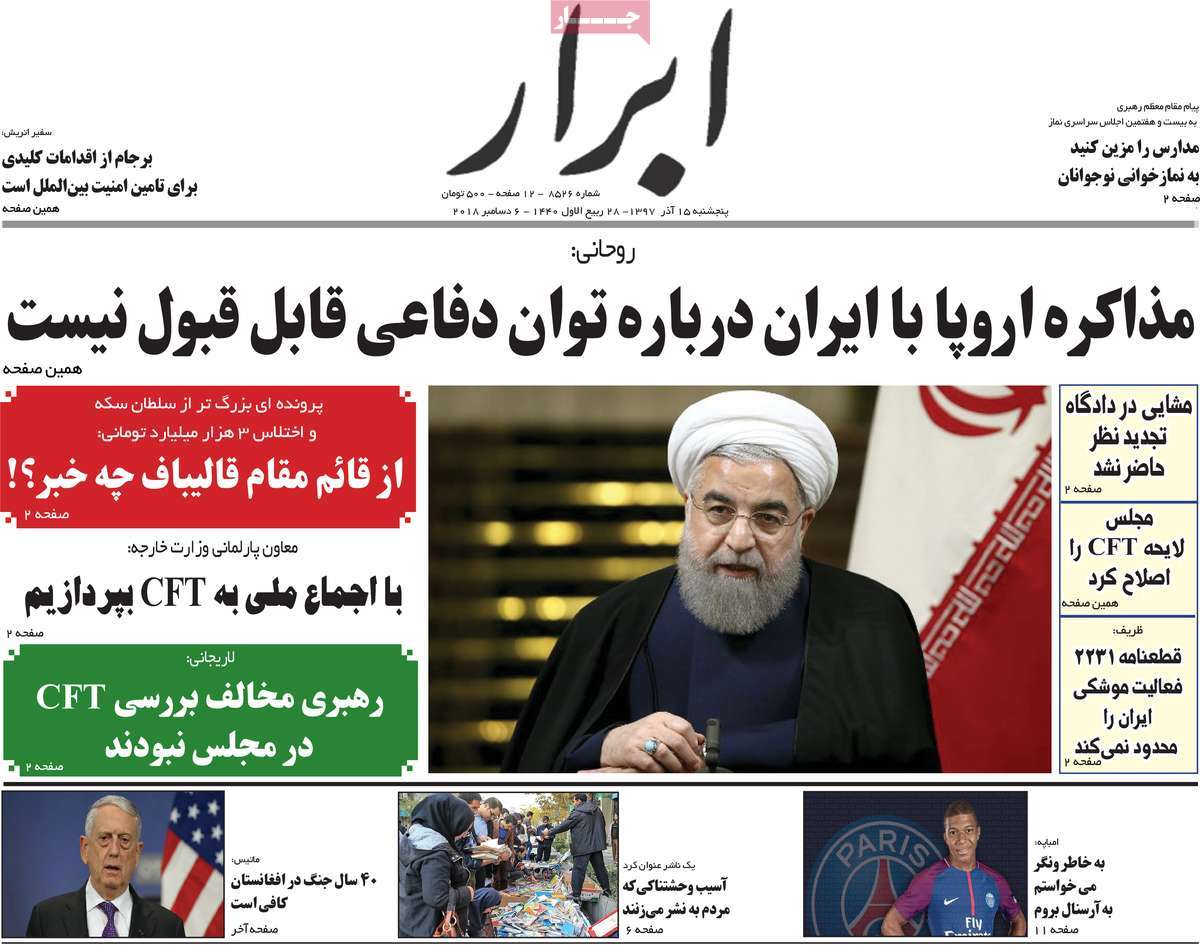
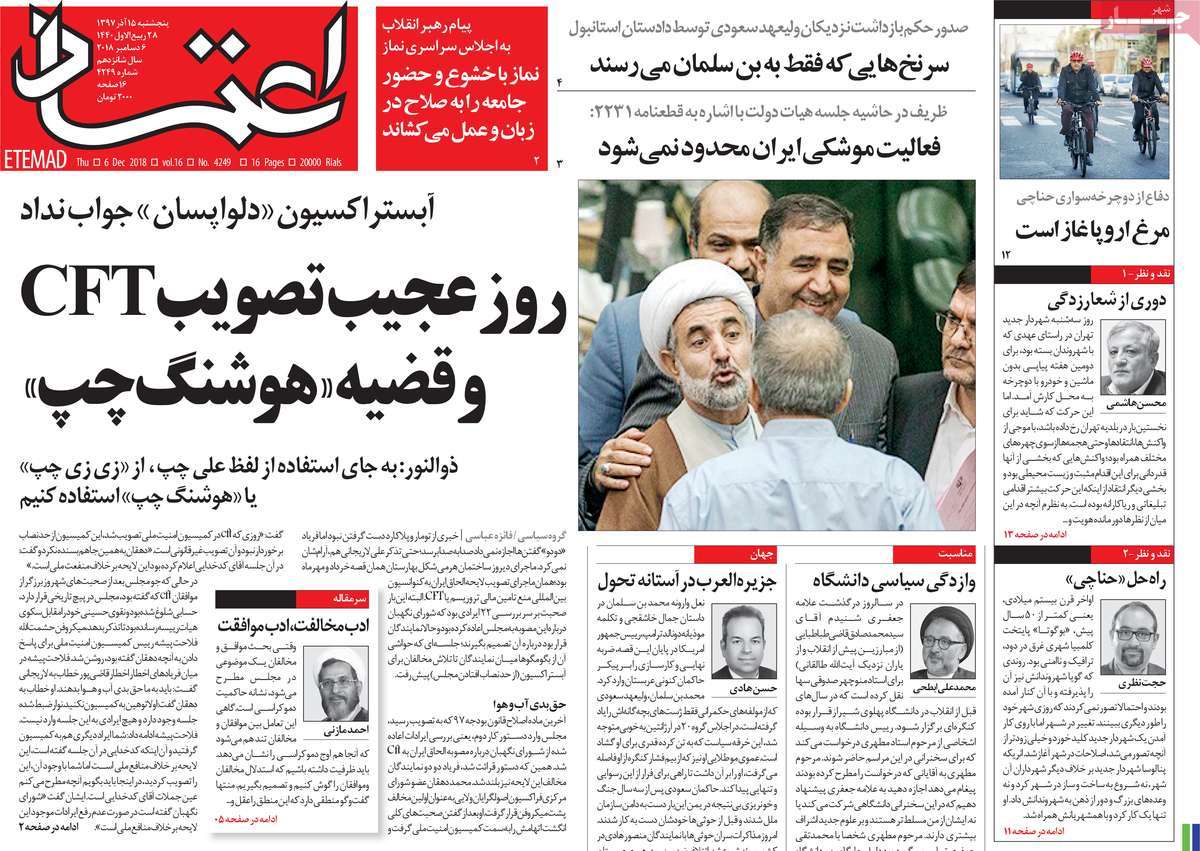
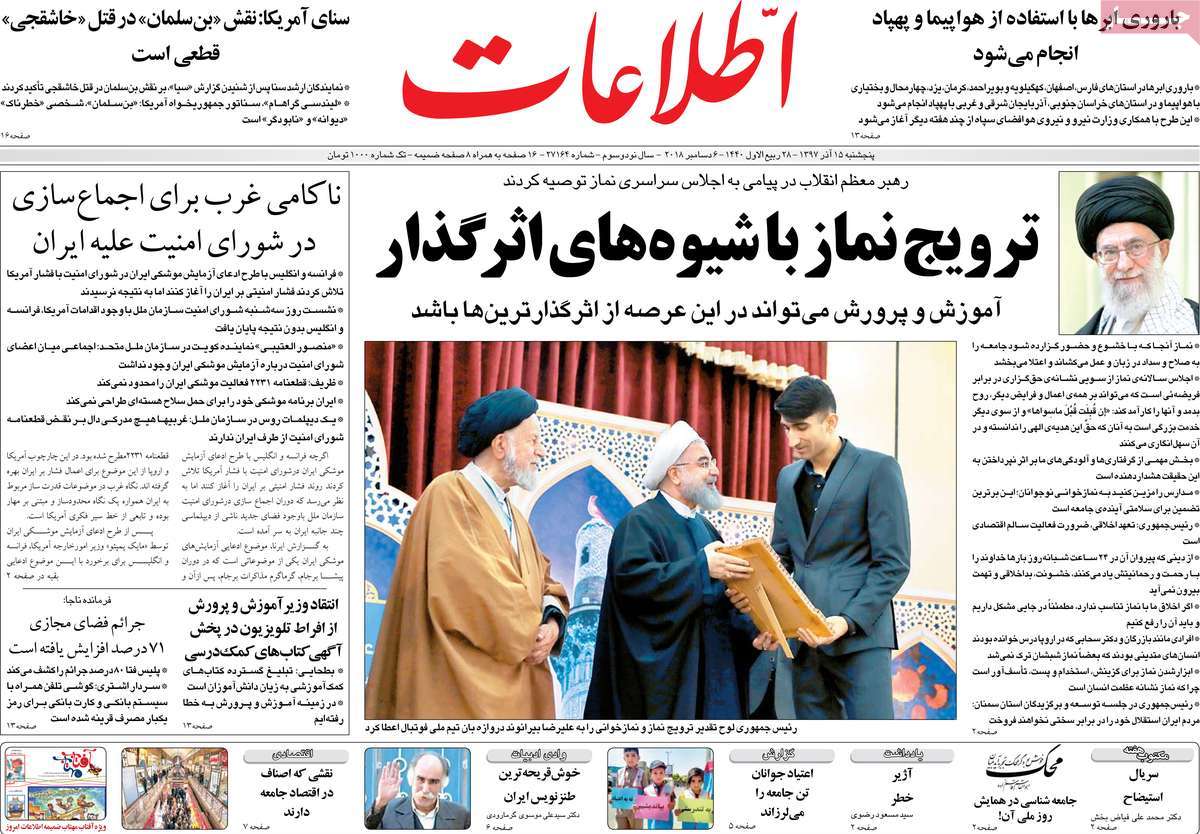
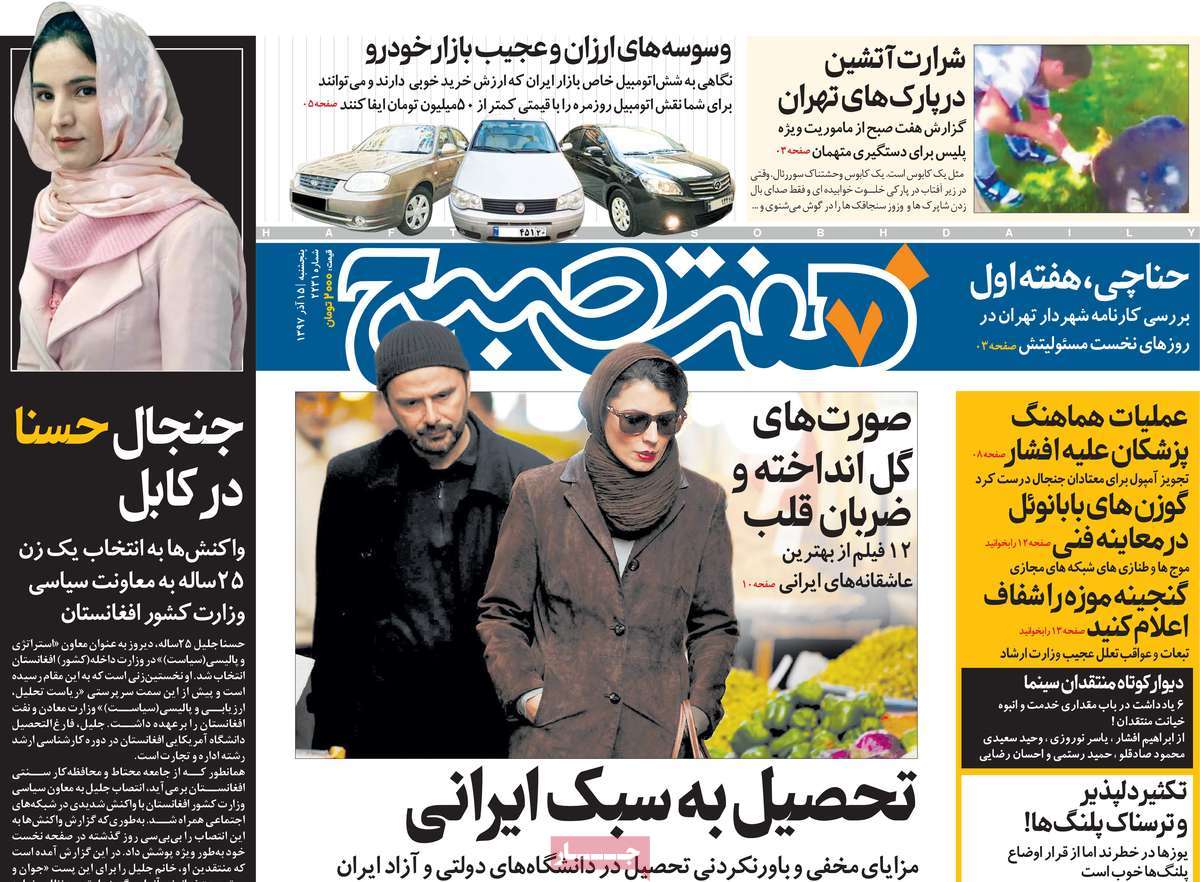
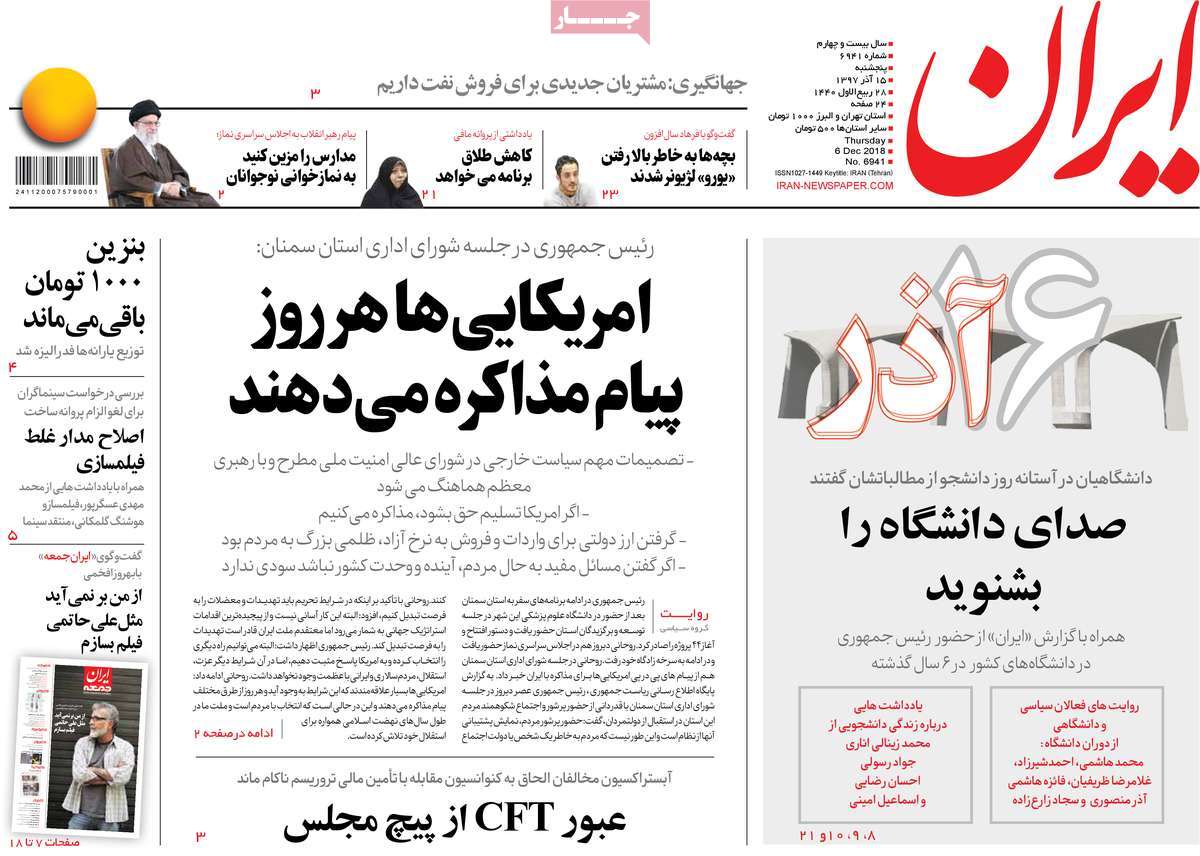
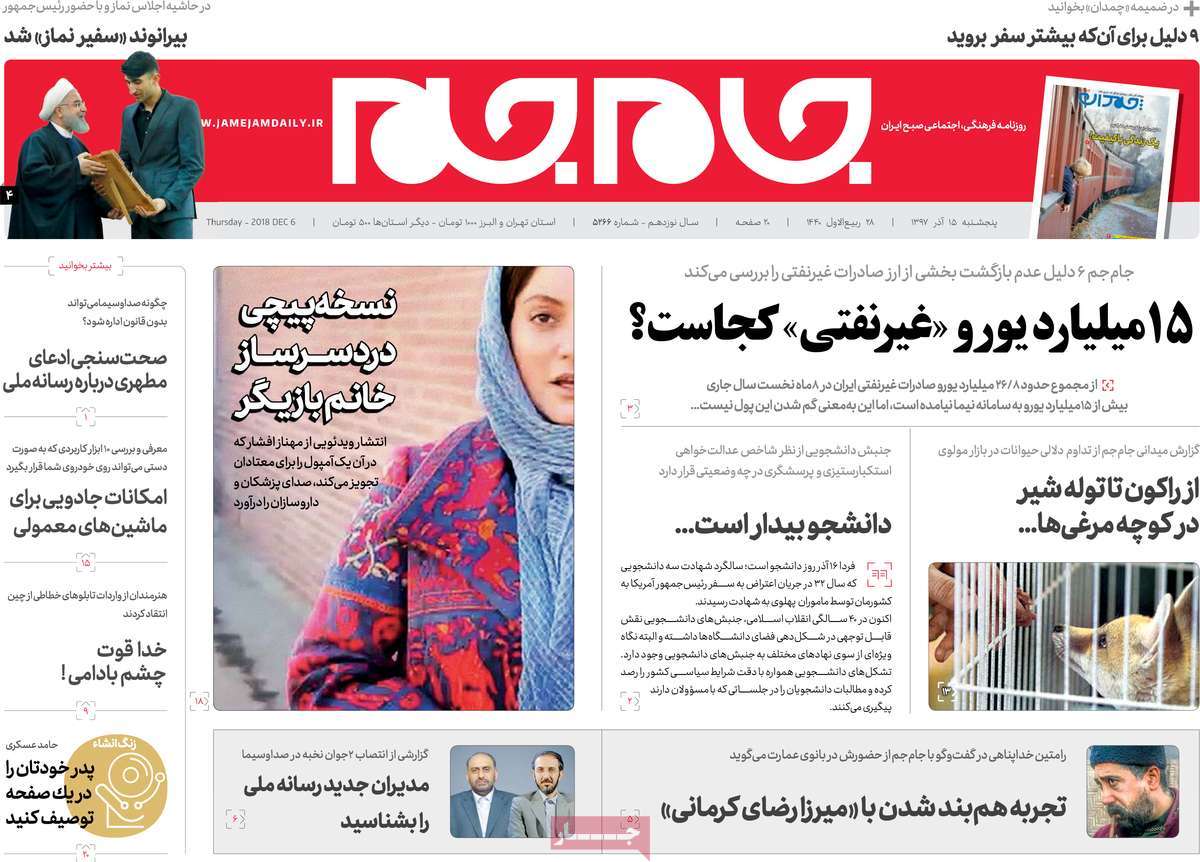
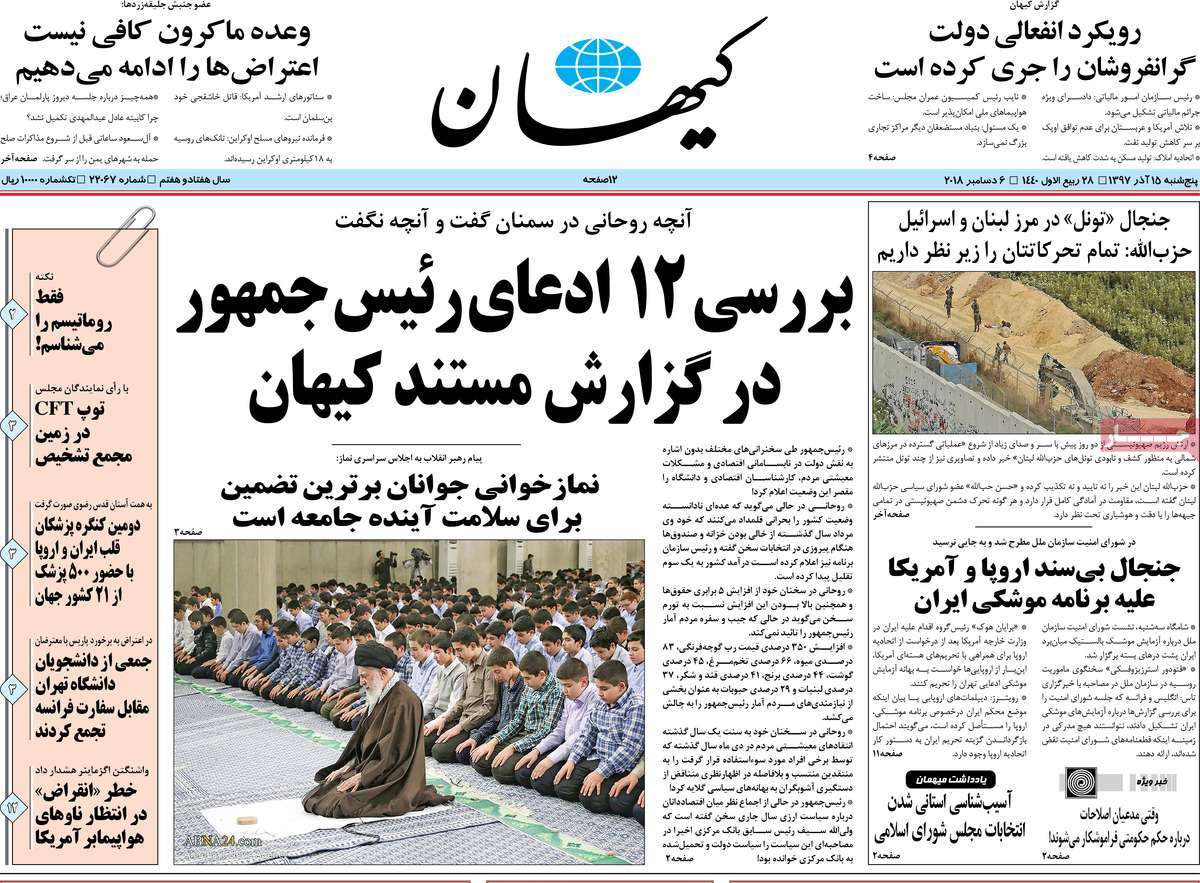
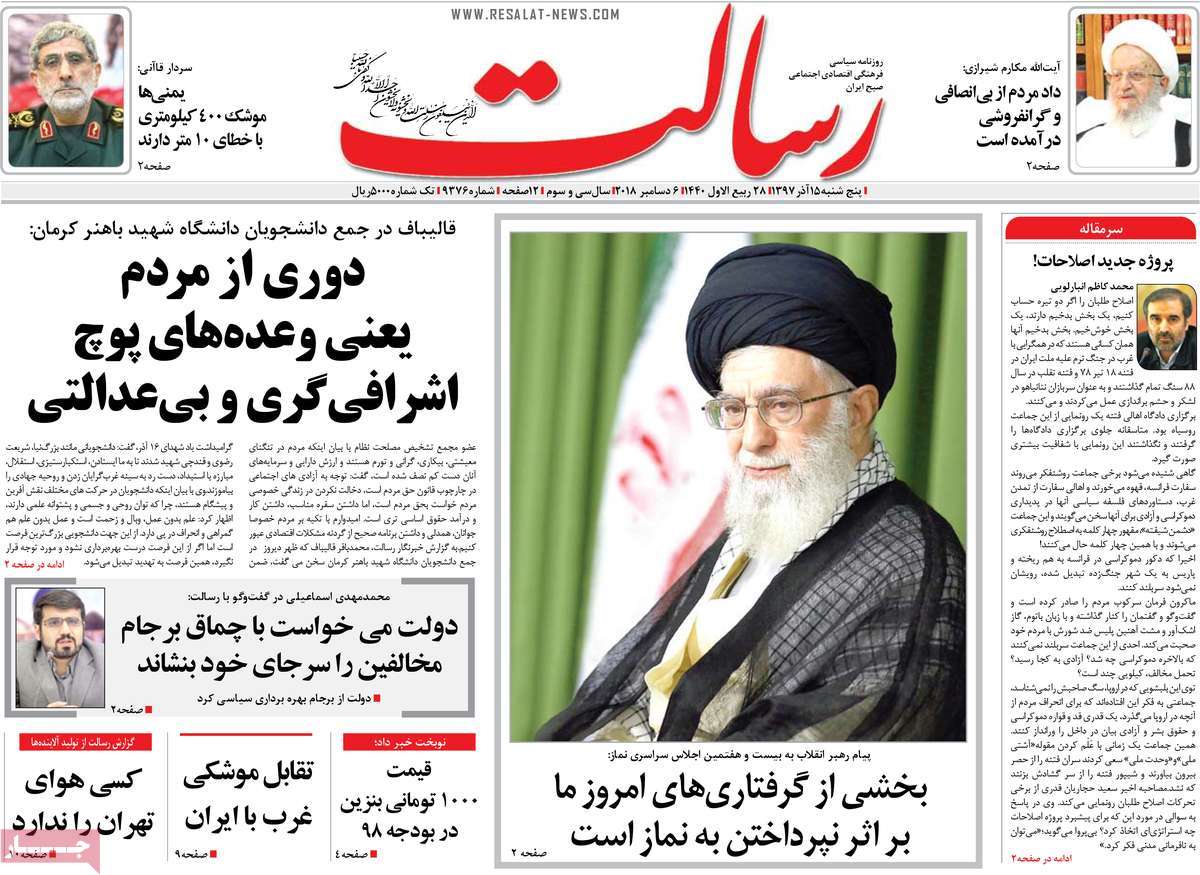
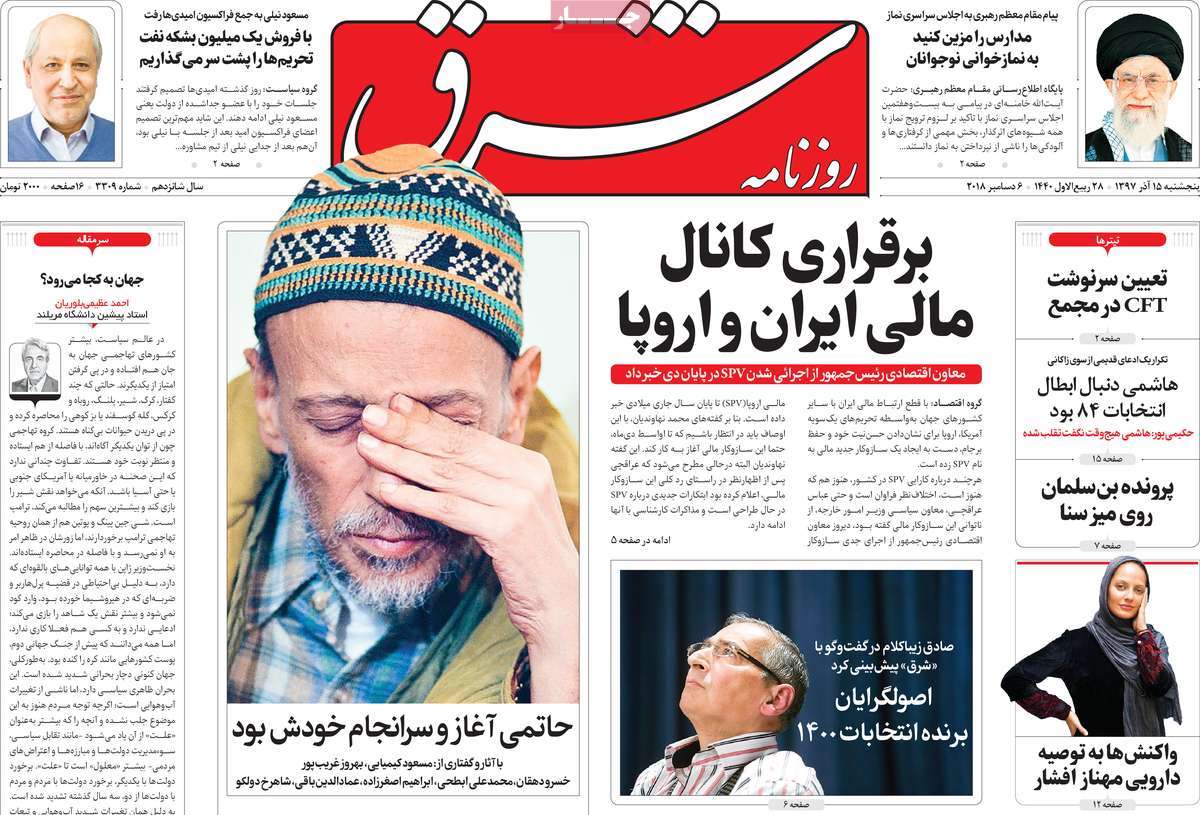
A Look at Iranian Newspaper Front Pages on November 26

A Look at Iranian Newspaper Front Pages on November 19

All papers today covered the remarks made by the Leader of Iran’s Islamic Revolution Ayatollah Seyyed Ali Khamenei in a meeting with a gathering of government officials, ambassadors from Muslim countries and guests participating in the 32nd International Islamic Unity conference in Tehran.

The controversy over Foreign Minister Mohammad Javad Zarif’s comments about ‘rampant’ money laundering in Iran also remained a top story today. At the request of the prosecutor-general, the Iranian foreign ministry has prepared and sent a 12-page response to give more details about the claim made by Zarif. Hardliners, however, are still trying to impeach him over the controversial comments.

The ‘yellow vest’ protest rallies in France against President Emmanuel Macron’s economic policies and fuel price hikes also received great coverage.

Several papers also covered the 6.4-magnitude earthquake which hit Kermanshah province in Western Iran, but fortunately left no one killed.

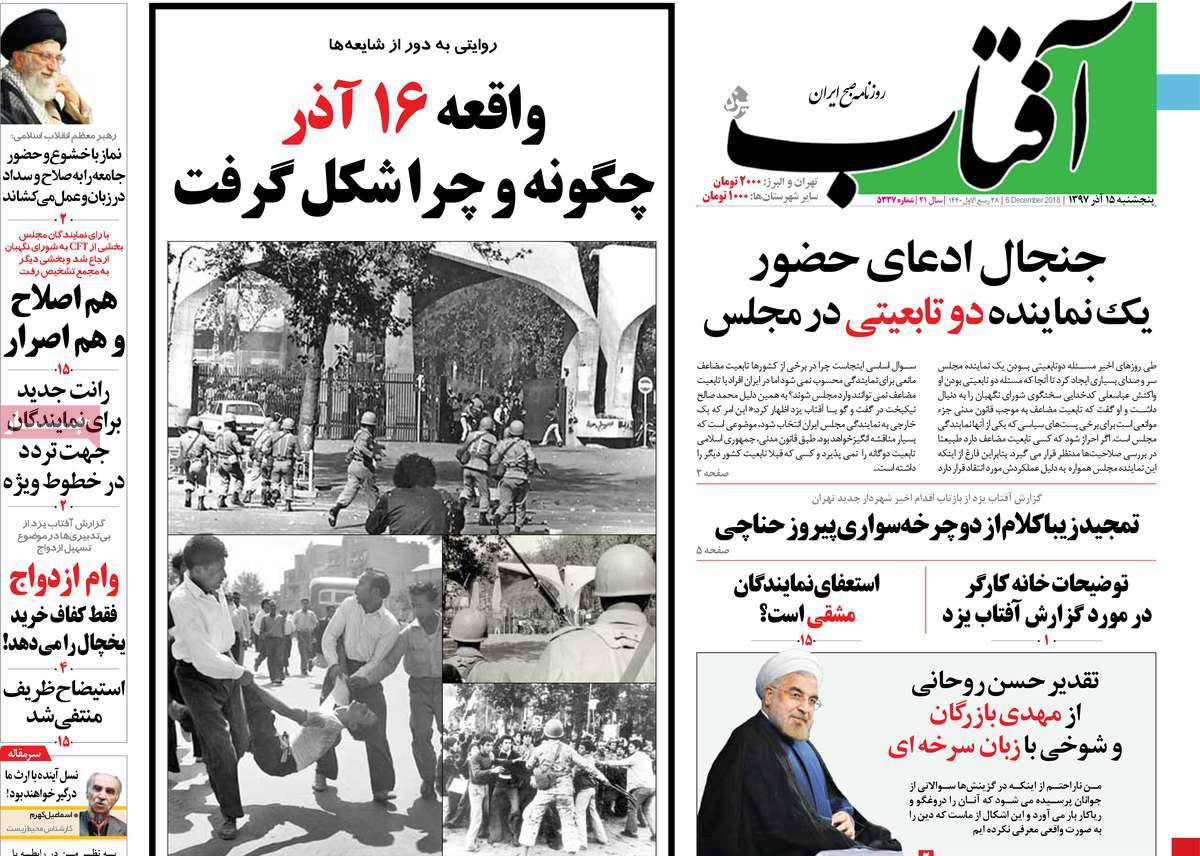
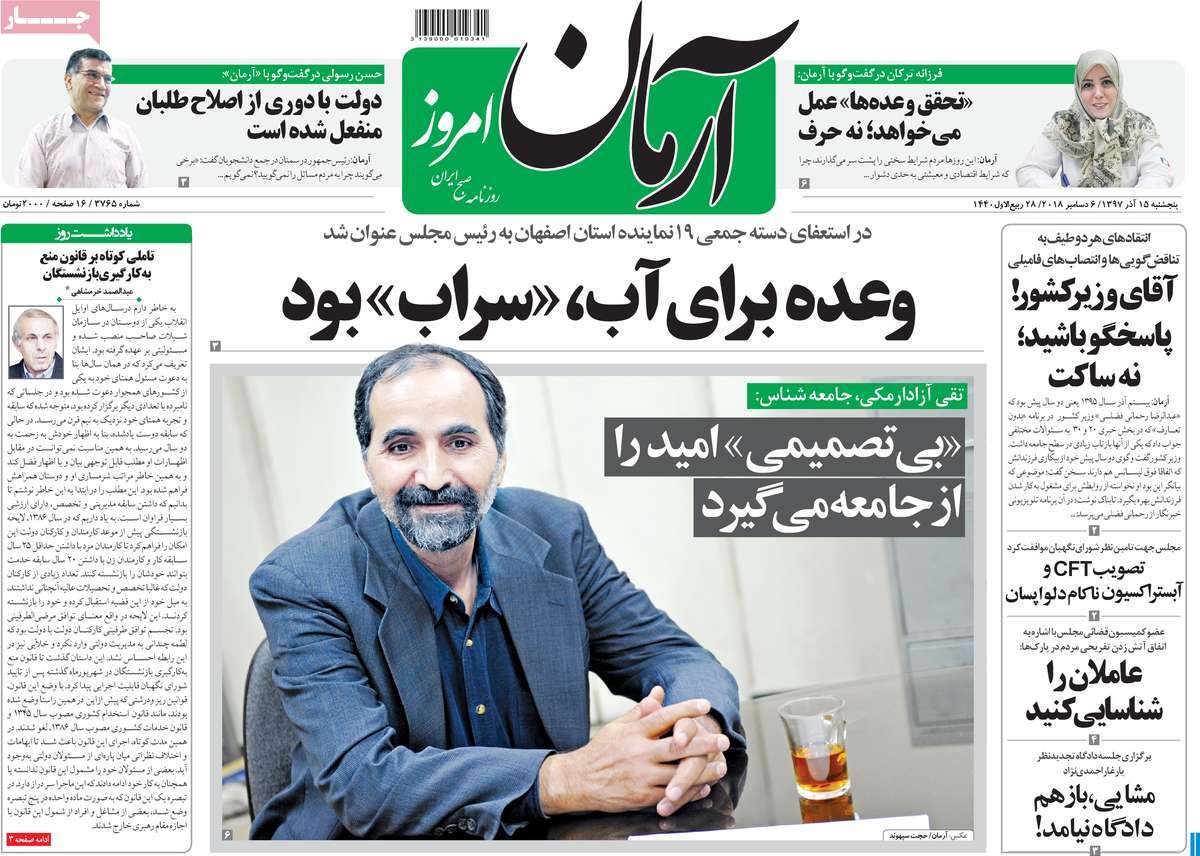
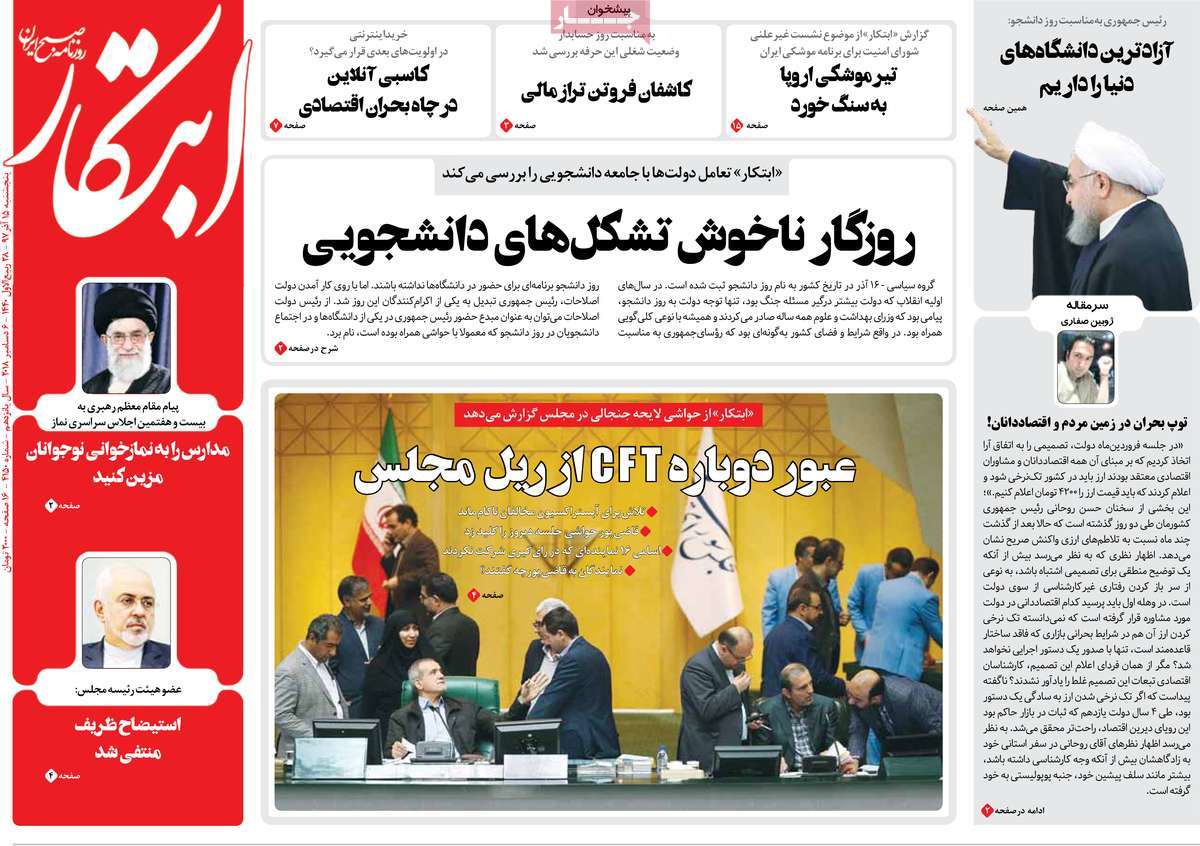
The above issues, as well as many more, are highlighted in the following headlines and top stories:


Abrar:

1- Iran Leader: US Not in a Damn Position to Threaten Iranian Nation

2- Senior MP: CFT Bill to Be Discussed in Parliament Tuesday

A Look at Iranian Newspaper Front Pages on November 26


Aftab-e Yazd:

1- Rouhani: We’re Ready to Defend Interests of Saudi People

2- Rouhani’s Aide Mowlaverdi Nobly Resigns over Ban on Employment of Retired Officials

A Look at Iranian Newspaper Front Pages on November 26


Arman-e Emrooz:

1- Quake in West Makes Iranians Worried: No One Dead, 411 Wounded

2- Iran Leader: Sanctions against Iranians to Fail

3- Zarif Responds to Prosecutor’s Call for Disclosure of Data on Money Laundering

  • 12 Pages of Data Including Documented Information about CFT, Money Laundering

A Look at Iranian Newspaper Front Pages on November 26


Donya-ye Eqtesad:

1- Officials Vow to Get Iran’s Economy Out of Forex Crisis

2- French Protesters Call for Macron’s Resignation in Paris

A Look at Iranian Newspaper Front Pages on November 26


Ebtekar:

1- Rouhani: We Extend Our Hand of Friendship to All Muslims

2- Deal of Losers: Leaders of 27 EU Member States Agree on Brexit

3- Iranian Women Have 37% Share of Higher Education

A Look at Iranian Newspaper Front Pages on November 26


Etemad:

1- Hardliners in Iran Trying to Impeach Zarif When Opposition Groups Also Attacking Him

2- Forced Cabinet Reshuffle: Mowlaverdi, 9 Deputies Resign

3- 6.4-Magnitude Quake in Sarpol-e Zahab, Kermanshah

A Look at Iranian Newspaper Front Pages on November 26


Ettela’at:

1- Iran Leader: Islamic Establishment Prescription of Development for Muslim World

2- Terrorists Attack Syria’s Aleppo with Cholera Gas

3- Rouhani: Slavery Is What US Wants from Region

4- Zarif: It’s Iran’s Right to Return to Uranium Enrichment

A Look at Iranian Newspaper Front Pages on November 26


Haft-e Sobh:

1- Zarif’s One-Man Battle: Is He Best FM Iran Has Had in Past Century?

A Look at Iranian Newspaper Front Pages on November 26


Iran:

1- Kermanshah Hit by Earthquake

A Look at Iranian Newspaper Front Pages on November 26


Jame Jam:

1- Iran Leader to Muslim Leaders: Return to Guardianship of Islam

  • Guardianship of US Will Have No Benefit

2- Iranian Researchers’ Initiative in Cancer Studies

  • Grounds Prepared to Producing Artificial Cancerous Tumours Using 3D Printer

A Look at Iranian Newspaper Front Pages on November 26


Javan:

1- Europe Gets Divorce from Britain in 40 Minutes!

2- Rouhani: Giving in to US Treason against Future Generations

A Look at Iranian Newspaper Front Pages on November 26


Jomhouri Eslami:

1- Iran Leader: Only Way to Save Mideast Is to Promote Spirit of Resistance

2- China to Resume Oil Purchases from Iran

3- MPs Say Attacks on Zarif Unfair

  • We Should Regard His Comments as Chance for Fighting Corruption

A Look at Iranian Newspaper Front Pages on November 26


Kayhan:

1- Foreign Policy: Telegram Devalued Iranian Currency by Spreading Fake News

2- 95% of Saudi Princes Ready to Topple Bin Salman: Whistle-blower

A Look at Iranian Newspaper Front Pages on November 26


Sazandegi:

1- Plan to Control Foreign Currency Rates Hindered by Decreased Oil Sales

2- Street Republic

  • French People Have Started Massive Rallies against Macron’s Economic Reforms
  • Macron Not Going to Back Off, Seeking to Give Concessions on Other Areas

3- Four Corners of Iran Flooded by Heavy Rainfall: 11 Provinces Affected

A Look at Iranian Newspaper Front Pages on November 26


Setareh Sobh:

1- Countering Oil Sanctions: China’s CNPC Replaces Total

2- Britain Leaves EU

A Look at Iranian Newspaper Front Pages on November 26


Shargh:

1- Unsuccessful Negotiations

  • Interview with Veteran Diplomat on Talks with US: From Mosaddegh to Bazargan

2- On Brink of Impeachment

  • MPs Close to Hardliners Call for Zarif’s Impeachment
  • Zarif Gives 12-Page Response to Prosecutor-General’s Call

3- Nothing Bad Happens in Strong Quake in Kermanshah

A Look at Iranian Newspaper Front Pages on November 26


Sobh-e Now:

1- Élysée in Blood and Fire

2- Earthquake Hits Western Iran: Magnitude-6.4 Quake Felt in Iraq, Kuwait as Well

A Look at Iranian Newspaper Front Pages on November 26


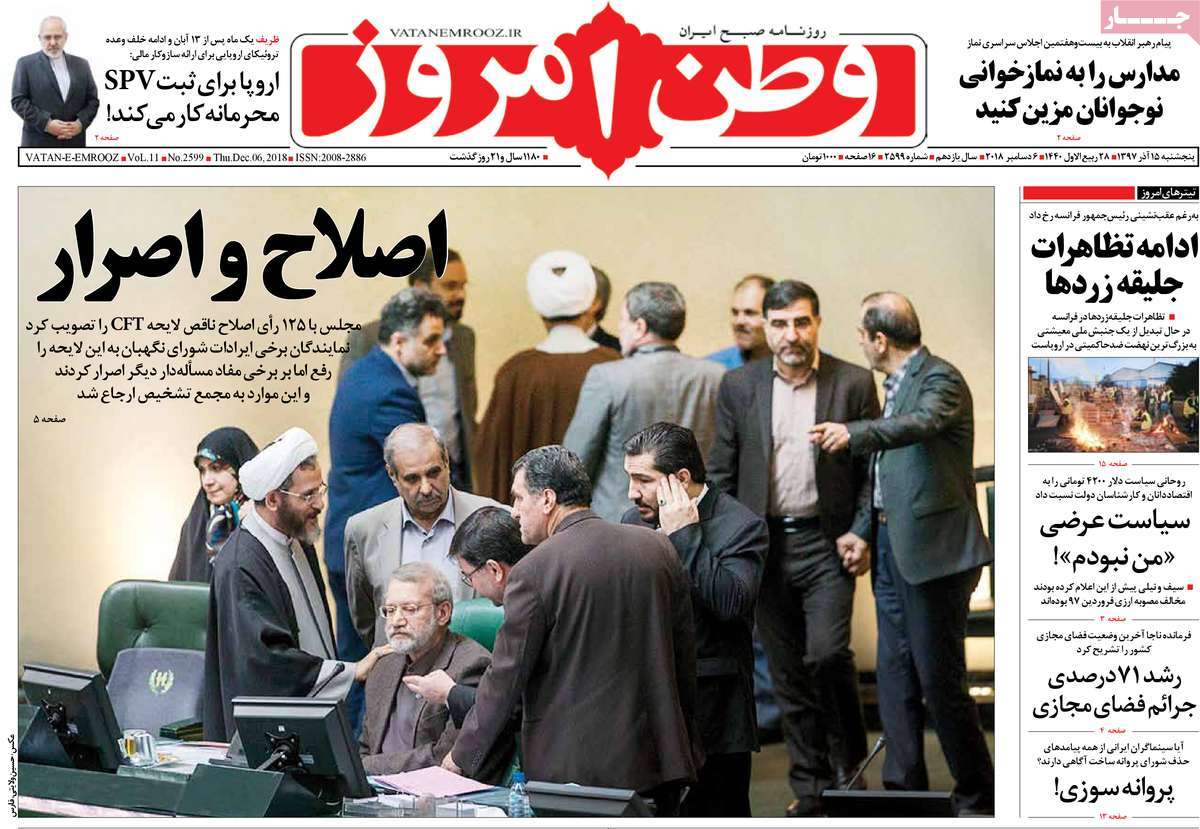
Vatan-e Emrooz:

1- Iran Leader: Palestinian, Yemeni People to Emerge Victorious

2- Paris Burns in Crisis

A Look at Iranian Newspaper Front Pages on November 26

Iran Sympathizes with Iraq over Deadly Floods

Heavy rainfall across the Middle East has caused deaths, displacement and disruption in recent days / Photo by Khalid al-Mousily, Reuters

In a Monday statement, Qassemi also offered sympathy to the Iraqi nation and government and the families affected by the catastrophe.

At least 21 people have died and tens of thousands displaced by torrential rains that have battered Iraq over two days, according to health officials and the United Nations.

Seif al-Badr, spokesperson for Iraq’s health ministry, told the AFP news agency on Sunday that women and children were among the dead.

Some had drowned due to floods, but others had died in car accidents, were electrocuted or were trapped when their houses collapsed.

At least 180 more were injured, he added.

Iraq’s north has borne the brunt of the heavier-than-average rainfall, and the United Nations’ Iraq office said the downpour had forced tens of thousands of people out of their homes.

An estimated 10,000 people in the province and 15,000 people in Nineveh are in desperate need of help, including families living in camps for internally displaced persons, the UN said on Saturday.

“Losses are still being assessed, but initial accounts from flooded areas include the destruction of homes, livestock and household items,” it said in a statement.