Friday, December 26, 2025
Home Blog Page 3400

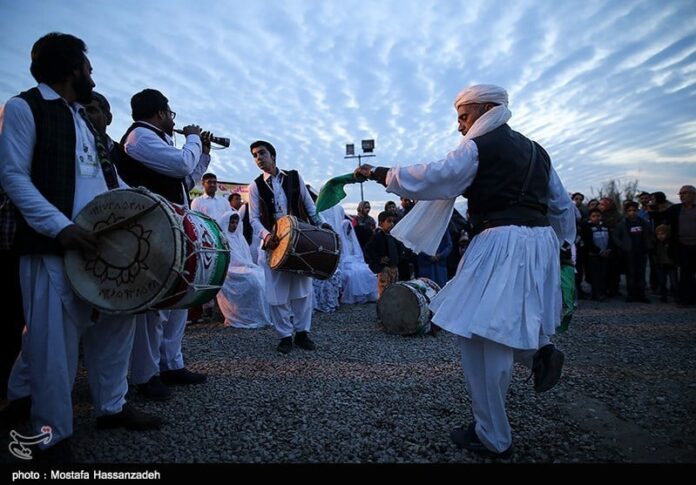
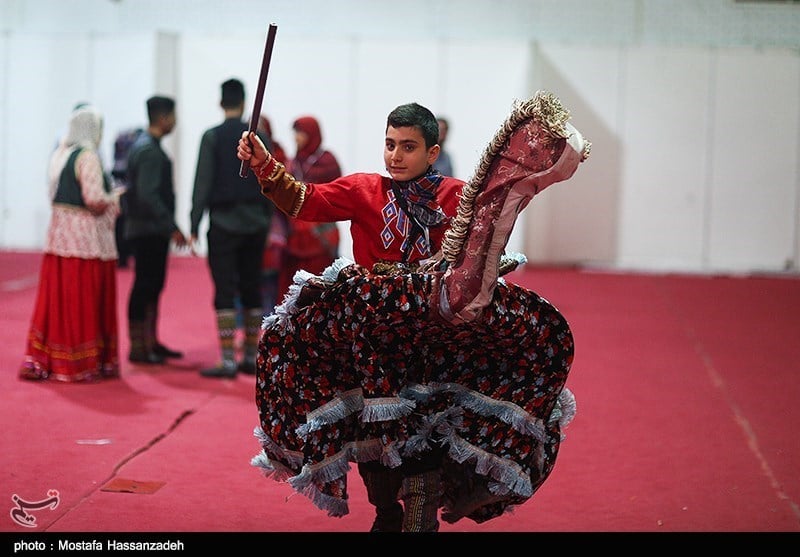
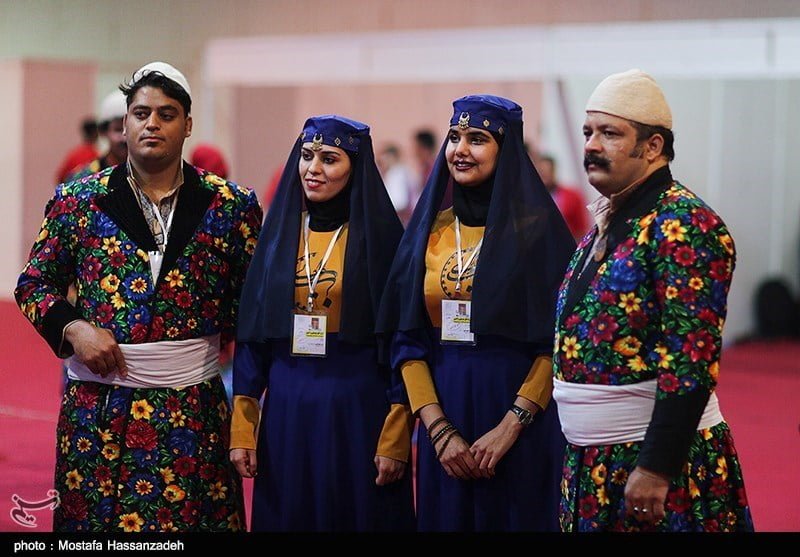
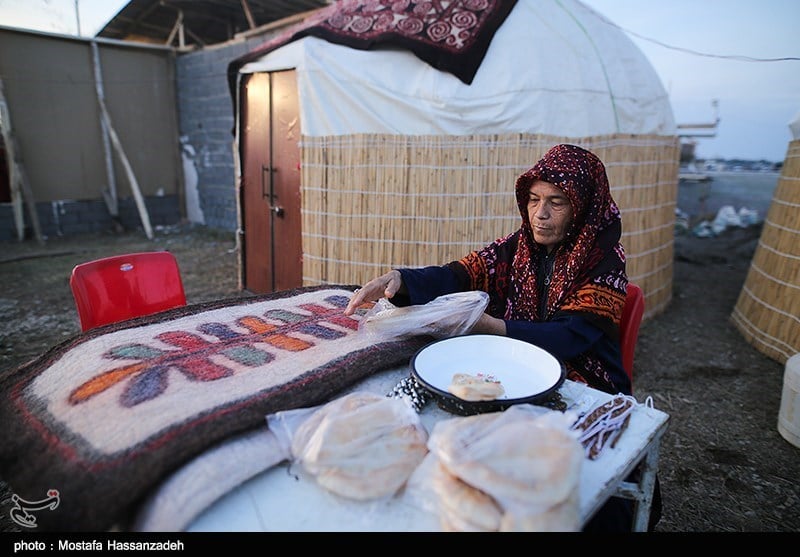
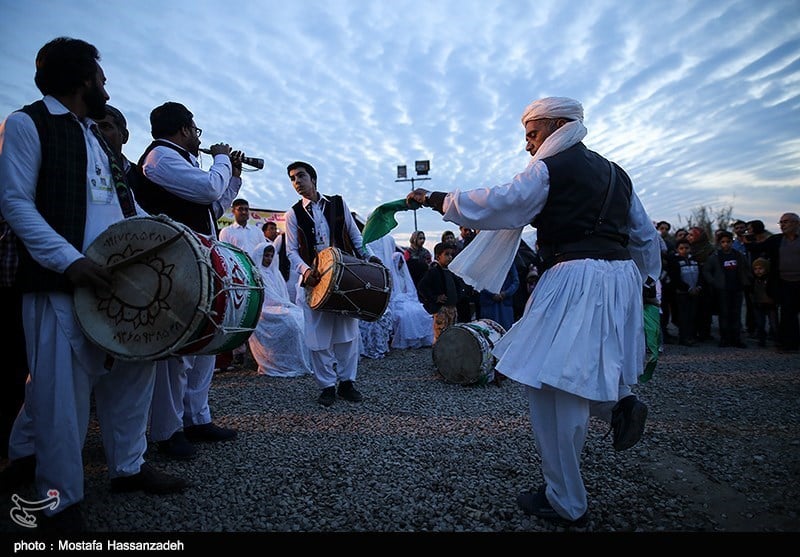
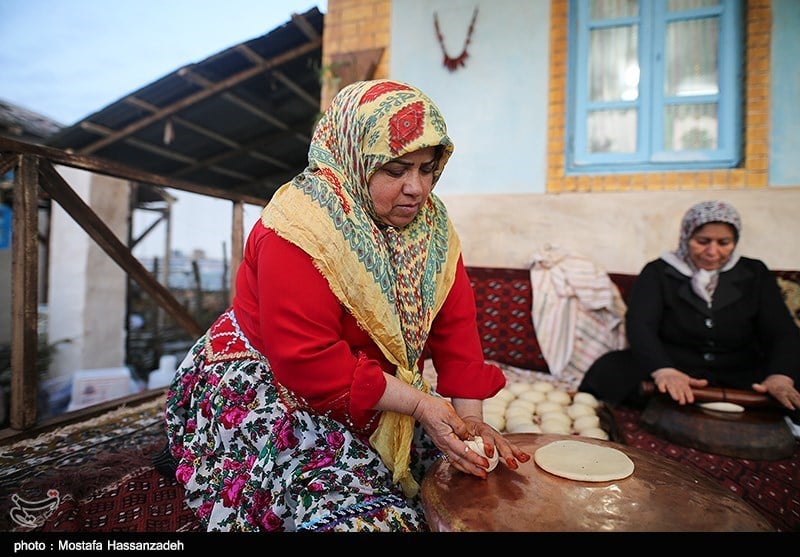
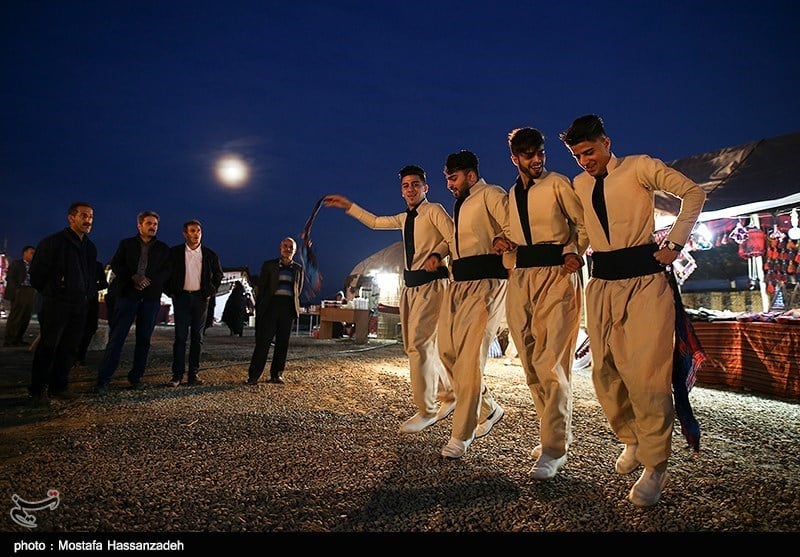
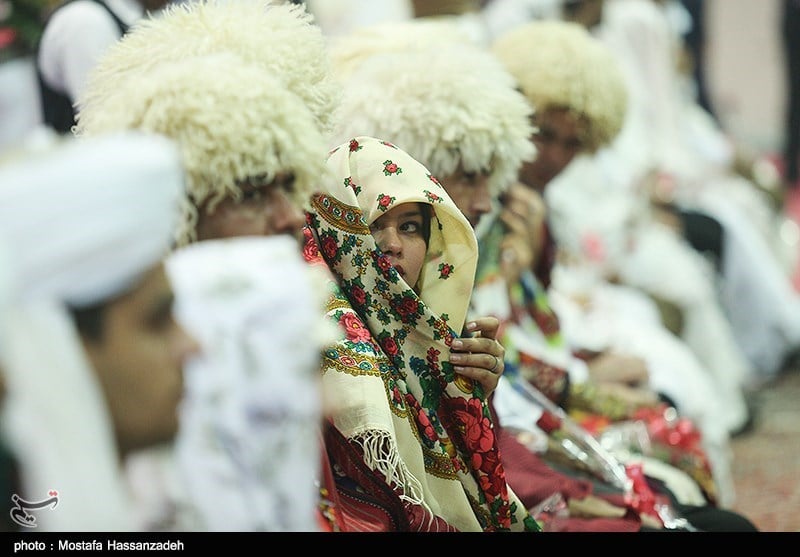
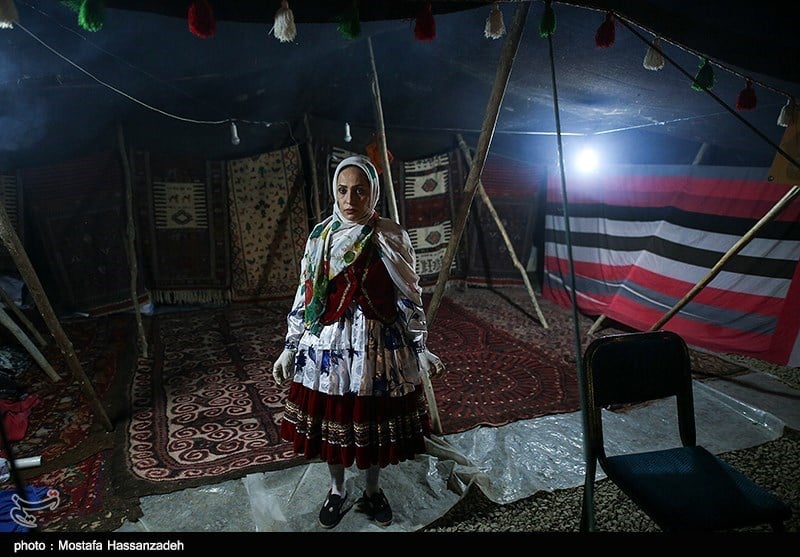
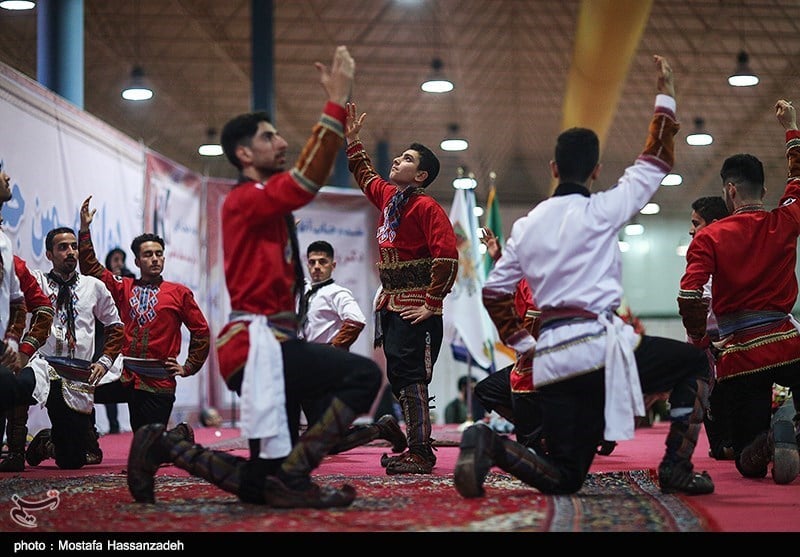
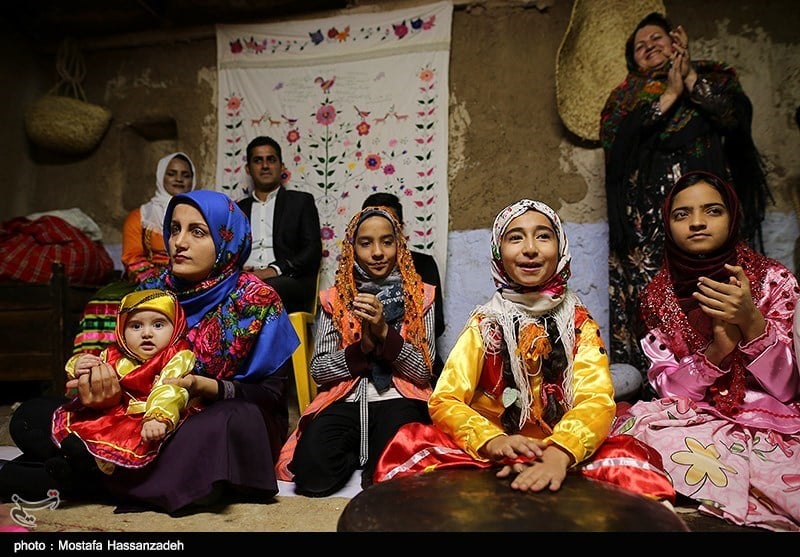
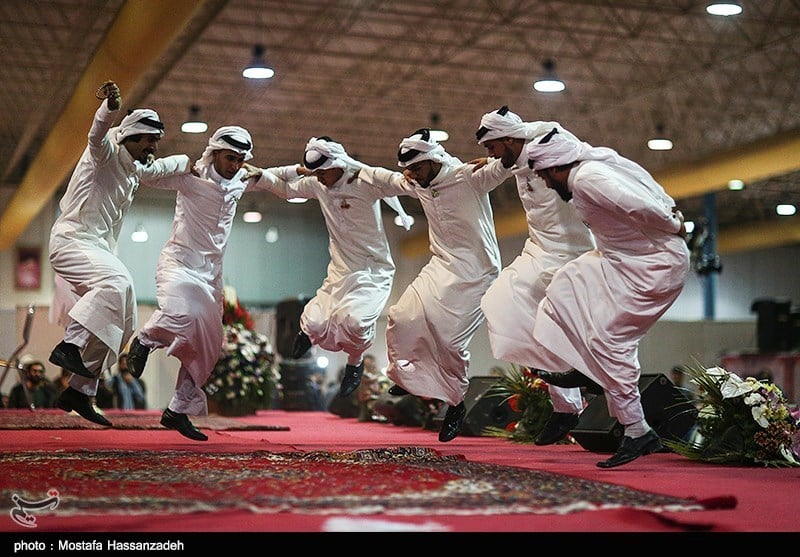
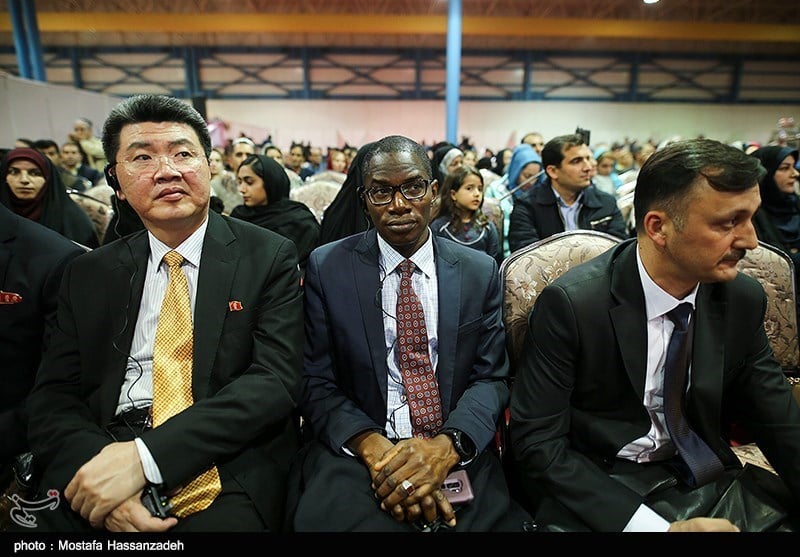
Iran Hosts Int’l Festival of Ethnic Cultures

The festival, which was wrapped up on Nov. 28, was attended by ambassadors, delegations and artists from various countries.

During the festival, 20 local music bands from the Iranian provinces of East Azarbaijan, Bushehr, Charmahal and Bakhtiari , South Khorasan, North Khorasan, Khorasan Razavi, Kurdistan, Khuzestan, Gilan, Lorestan, Mazandaran and Markazi performed live concerts.

Ambassadors, cultural attaches and delegates from Norway, Kazakhstan, China, Pakistan, Senegal, Ecuador, Malaysia, Tajikistan, Indonesia, North Korea, Cyprus and Ghana took part in the festival.

40 reporters from domestic and international news outlets also covered the festival with the main goal of further promoting the natural tourist attractions of Golestan province.

The festival, officially known as International Tribe Festival, was held in Gorgan’s Permanent Fairground from November 20 to 23. The event was also held in the Olympic Stadium of Gonbad-e Kavus from November 25 to 28.

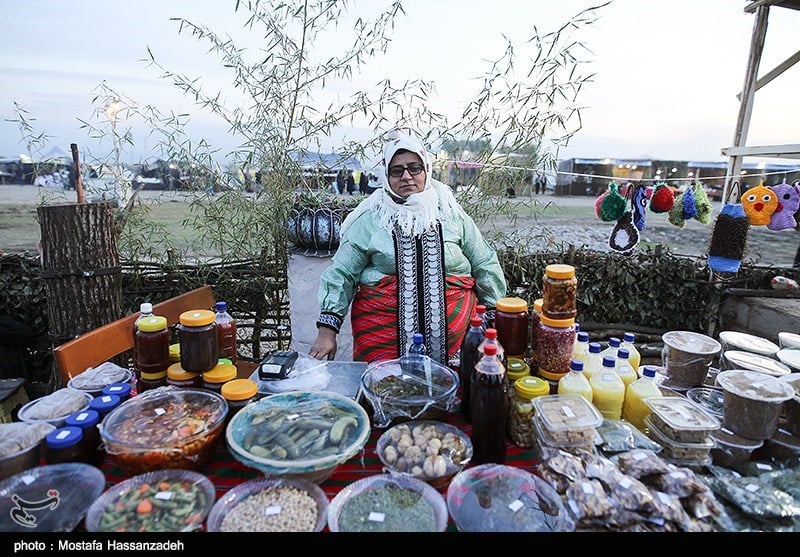
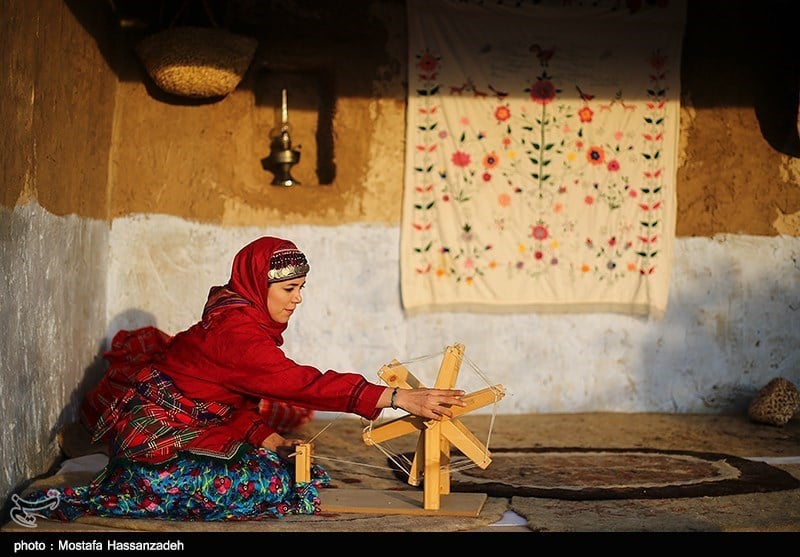
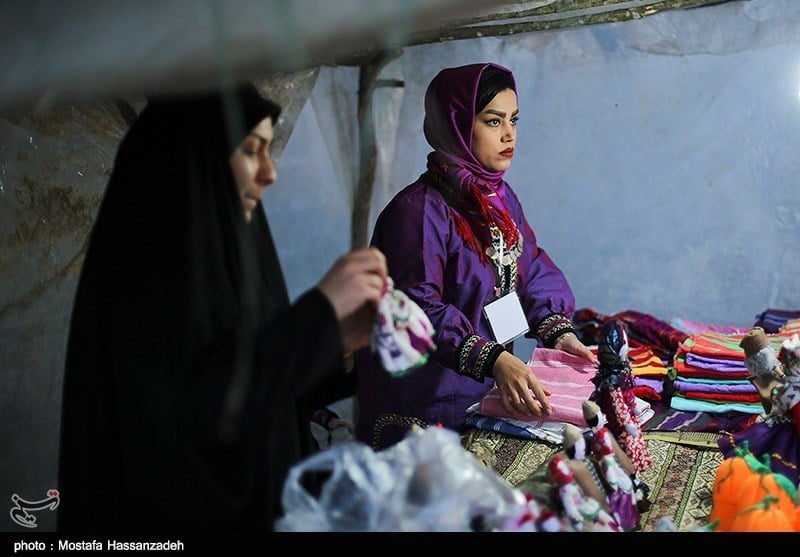
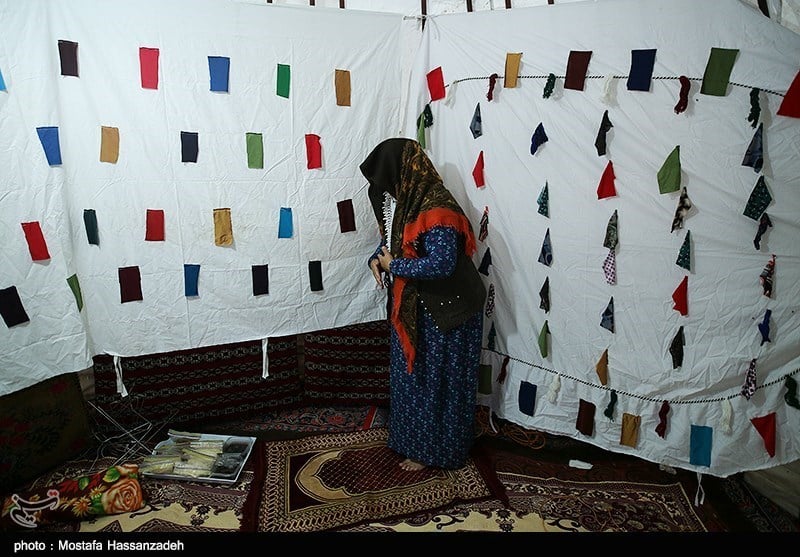
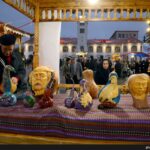
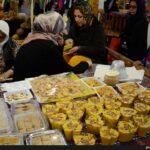
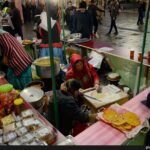
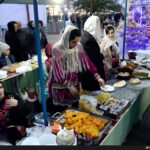
The ethnic cultures were introduced to the visitors in 167 booths, including 136 ones dedicated to Iranian handicrafts.

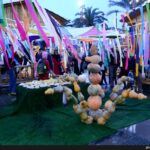
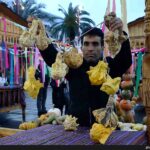
Below you can see a collection of photos of the festival retrieved from Tasnim News Agency:

Iran, Russia, Turkey Wrap Up Fresh Round of Syria Talks

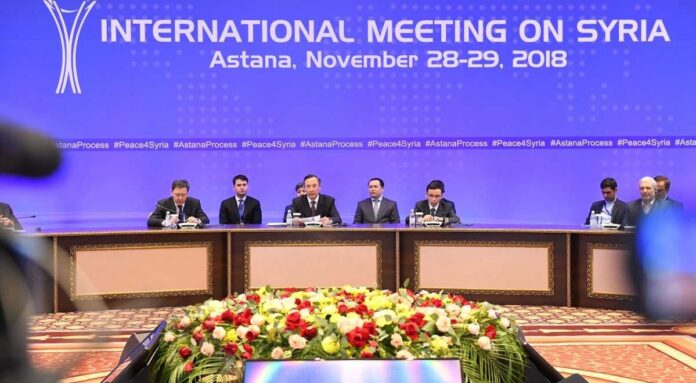
The 11th International Meeting on Syria held in Astana 28-29 November 2018 / Photo by the Kazakh foreign ministry

In the statement, the three guarantor states of a ceasefire regime in Syria, reaffirmed their determination to step up joint efforts to launch a Committee in Geneva tasked with drawing up the Arab country’s Constitution.

The three states reiterated that the new Constitution will enjoy support of the Syrian parties, and comply with the decisions of the Syrian National Dialogue Congress in Sochi. They also decided to intensify their consultations on all the levels to finalize its establishment at the soonest possible time.

The statement was released following intensive talks between the top negotiators of the three countries and the UN special envoy for Syria, Staffan de Mistura, in Astana.

Hossein Jaberi Ansari, a special assistant to Iran’s foreign minister, Turkish Deputy Foreign Minister Sedat Onal, and the Russian president’s special envoy for Syria Alexander Lavrentiev represented their countries in this round of negotiations.
What follows is the full text of the joint statement:

Joint Statement by Iran, Russia and Turkey on the International Meeting on Syria in Astana
(28-29 November 2018)
The Islamic Republic of Iran, the Russian Federation and the Republic of Turkey as guarantors of the Astana format:

1. Reaffirmed their strong commitment to the sovereignty, independence, unity and territorial integrity of the Syrian Arab Republic and to the purposes and principles of the UN Charter;
2. Highlighted that these principles should be universally respected and that any action that might violate them and undermine achievements of the Astana format should be avoided;]

3. Rejected all attempts to create new realities on the ground under the pretext of combating terrorism and expressed their determination to stand against separatist agendas aimed at undermining the sovereignty and territorial integrity of Syria as well as the national security of neighboring countries;

4. Discussed the current situation on the ground in Syria, took stock of the recent developments following their last meeting in Sochi on 30-31 July 2018 and underscored their determination to strengthen their trilateral coordination in light of their agreements;

5. Examined in details the situation in the Idlib de-escalation area and reaffirmed their determination to fully implement the Memorandum on Stabilization of the Situation in the Idlib De-escalation Area of 17 September 2018. In this regard they expressed their concern with the ongoing violations of the ceasefire regime, and declared that, as guarantors of the ceasefire regime, they would step up their efforts to ensure observance with it, including by enhancing work of the Joint Iranian-Russian-Turkish Coordination Center. They stressed the importance of a lasting ceasefire while underlining the necessity to continue effective fight against terrorism. They also emphasized that under no circumstances the creation of the above-mentioned de-escalation area should undermine the sovereignty, independence, unity and territorial integrity of the Syrian Arab Republic;

6. Reaffirmed their determination to continue cooperation in order to ultimately eliminate DAESH/ISIL, Nusra Front and all other individuals, groups, undertakings and entities associated with al-Qaeda or DAESH/ISIL as designated by the UN Security Council. They called upon all armed opposition groups in Syria to completely and immediately dissociate from the abovementioned terrorist groups;

7. Strongly condemned any use of chemical weapons in Syria and demanded that any reports in this regard should be investigated promptly and professionally in full compliance with the Convention on the Prohibition of the Development, Production, Stockpiling and Use of Chemical Weapons and on Their Destruction and by the OPCW as the main international competent authority to establish use of chemical weapons;

8. Underlined their firm conviction that there could be no military solution to the Syrian conflict and that the conflict could be resolved only through the Syrian-led and Syrian-owned, UN-facilitated political process in line with the UN Security Council resolution 2254;

9. Reaffirmed their determination to step up joint efforts to launch the Constitutional Committee in Geneva, that would enjoy support of the Syrian parties, in accordance with the decisions of the Syrian National Dialogue Congress in Sochi and decided to intensify their consultations on all the levels to finalize its establishment at the soonest possible time;

10. Welcomed the successful development of the “pilot project” within the framework of the Working Group on the release of detainees/abductees and handover of the bodies as well as the identification of missing persons. The release of the detainees on 24 November 2018 constituted a step forward in implementing confidence-building measures between Syrian parties to contribute to the viability of the political process and normalization of the situation on the ground. In this regard they reiterated their commitment to further advance the efforts of the Working Group;

11. Emphasized the need to continue all efforts to help all Syrians restore normal and peaceful life as well as alleviate their sufferings. In this regard, they called upon the international community, particularly the United Nations and its humanitarian agencies, to increase their assistance to Syria by providing additional humanitarian aid, restoring humanitarian infrastructure assets, including water and power supply facilities, schools and hospitals;

12. Highlighted the need to create conditions for the safe and voluntary return of refugees and internally displaced persons (IDPs) to their original places of residence in Syria. They reaffirmed their readiness to continue interaction with all relevant parties, including the Office of the United Nations High Commissioner for Refugees (UNHCR) and other specialized international agencies, in particular in the context of rendering assistance to preparing and convening the International conference on Syrian refugees and internally displaced persons (IDPs);

13. Expressed their appreciation to Mr. Staffan de Mistura, the UN Secretary-General Special Envoy on Syria, for his efforts to seek peaceful solution for the Syrian crisis and for his constructive interaction and cooperation with the Astana format during his mission;

14. Expressed their sincere gratitude to the President of the Republic of Kazakhstan, His Excellency Nursultan Nazarbayev and the Kazakh authorities for hosting in Astana the 11th International Meeting on Syria;

15. Decided to hold the next International Meeting on Syria in Astana in early February 2019.

A Look at Iranian Newspaper Front Pages on November 29

A Look at Iranian Newspaper Front Pages on November 19

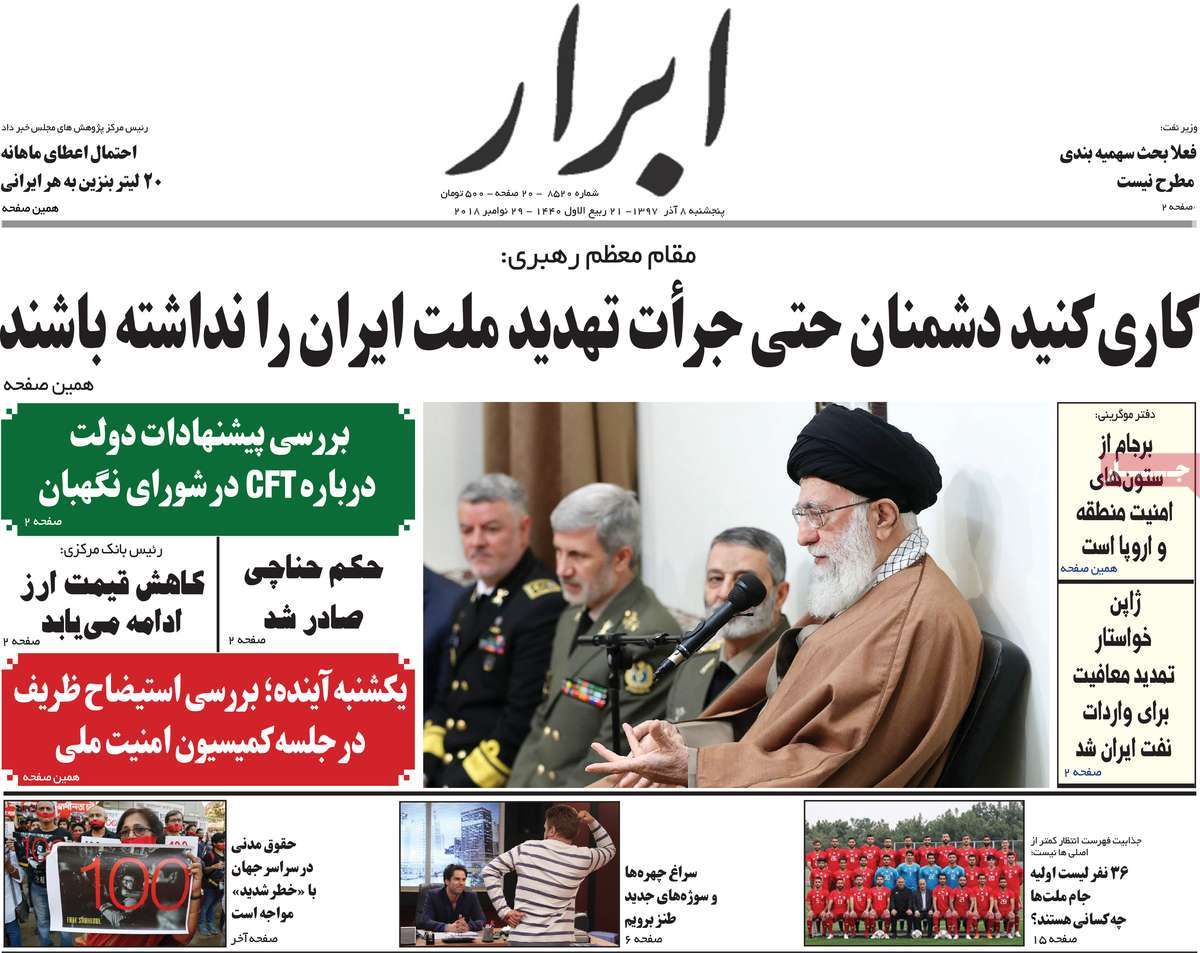
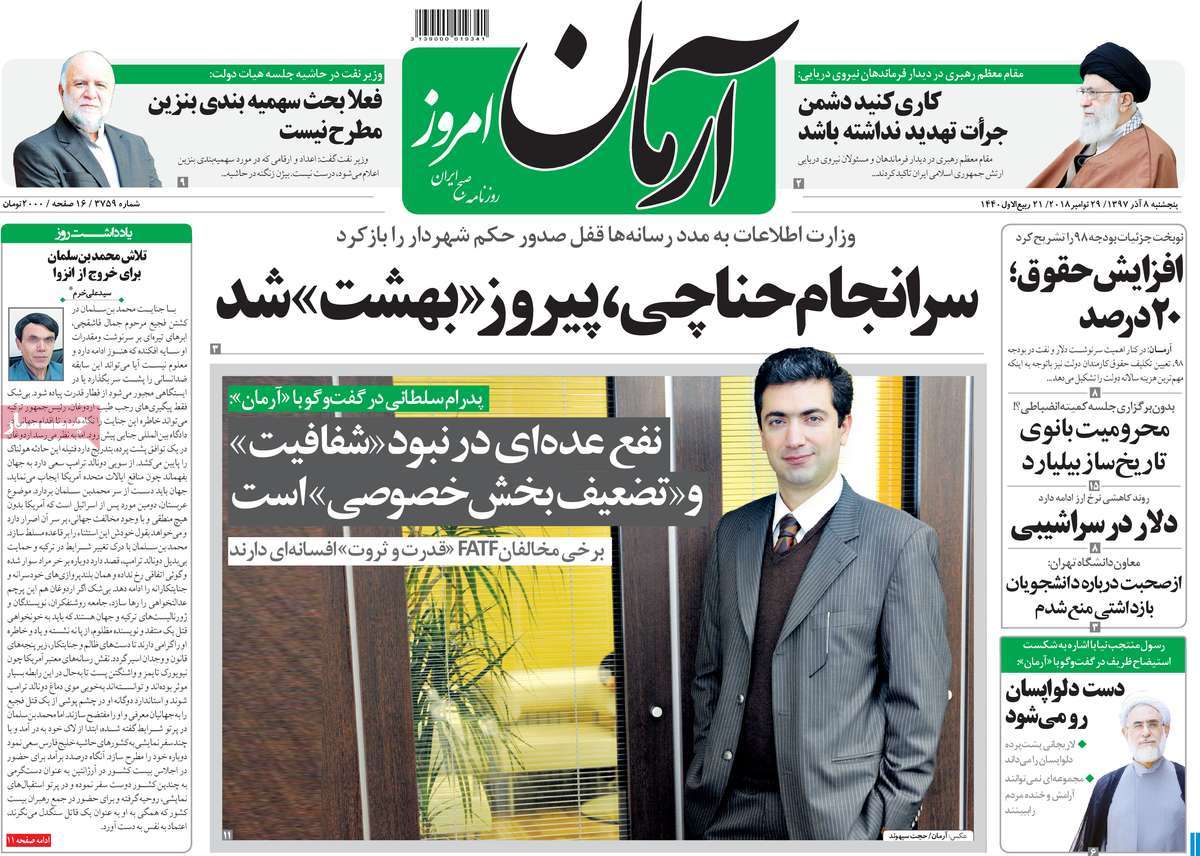
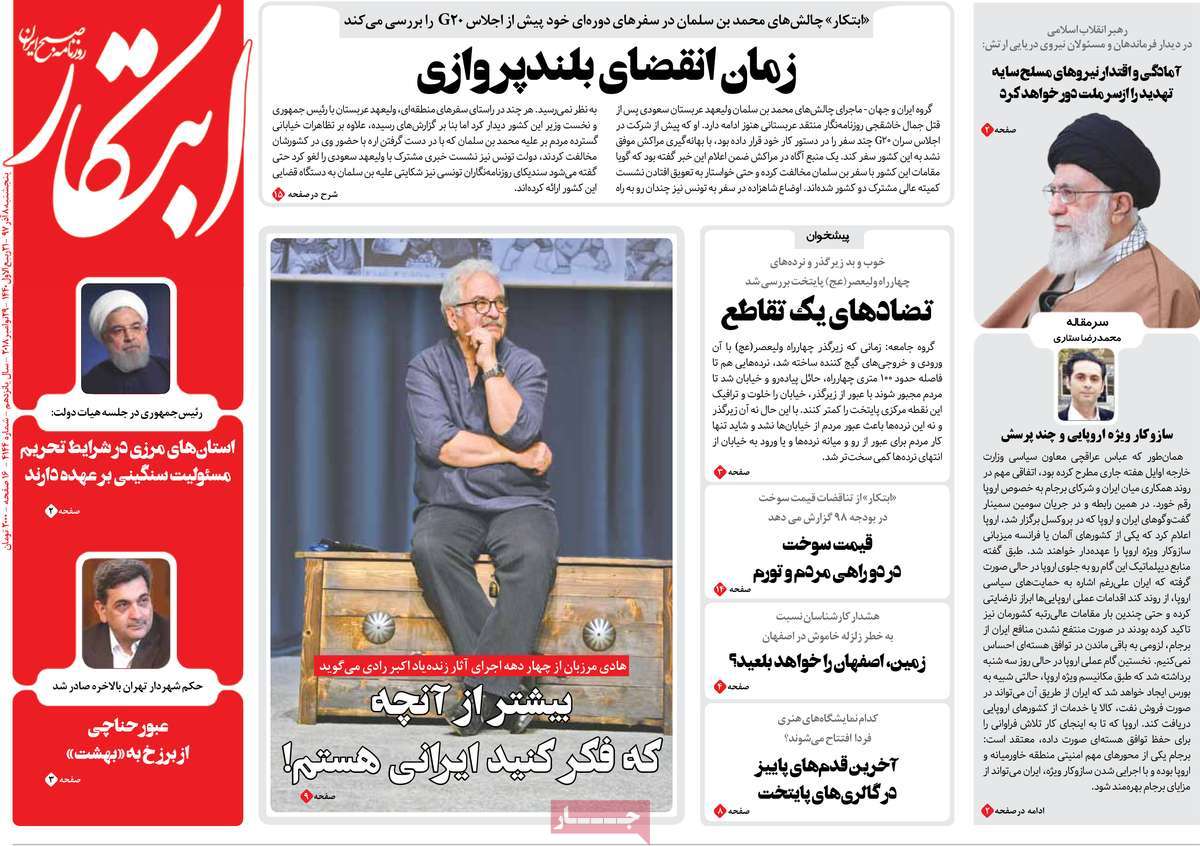
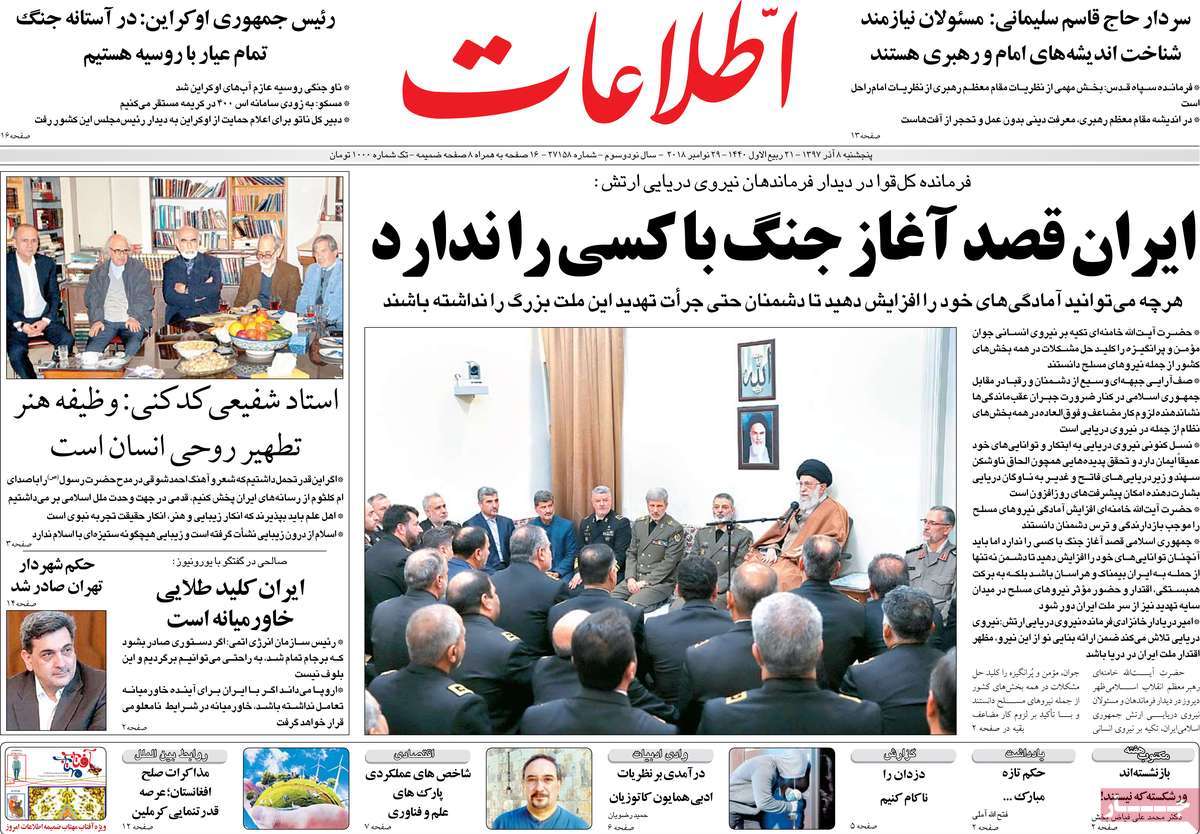
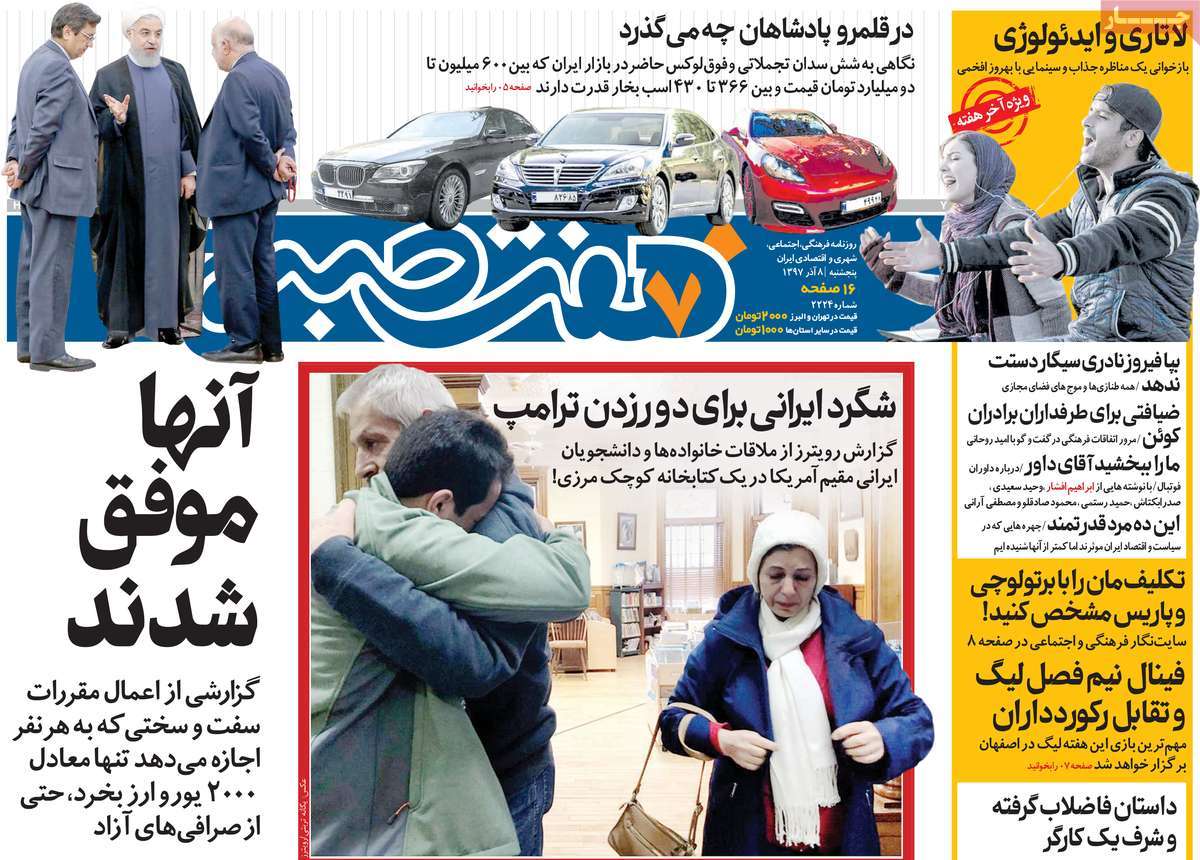
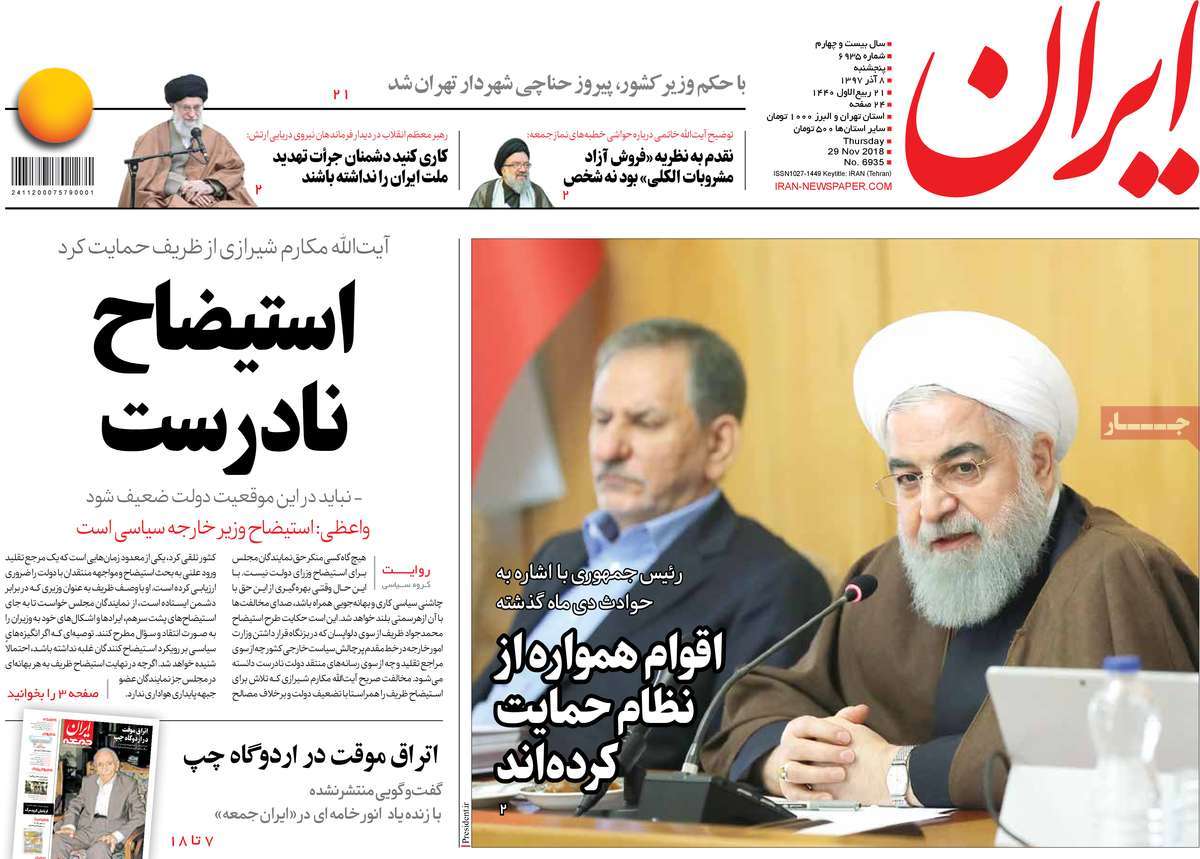
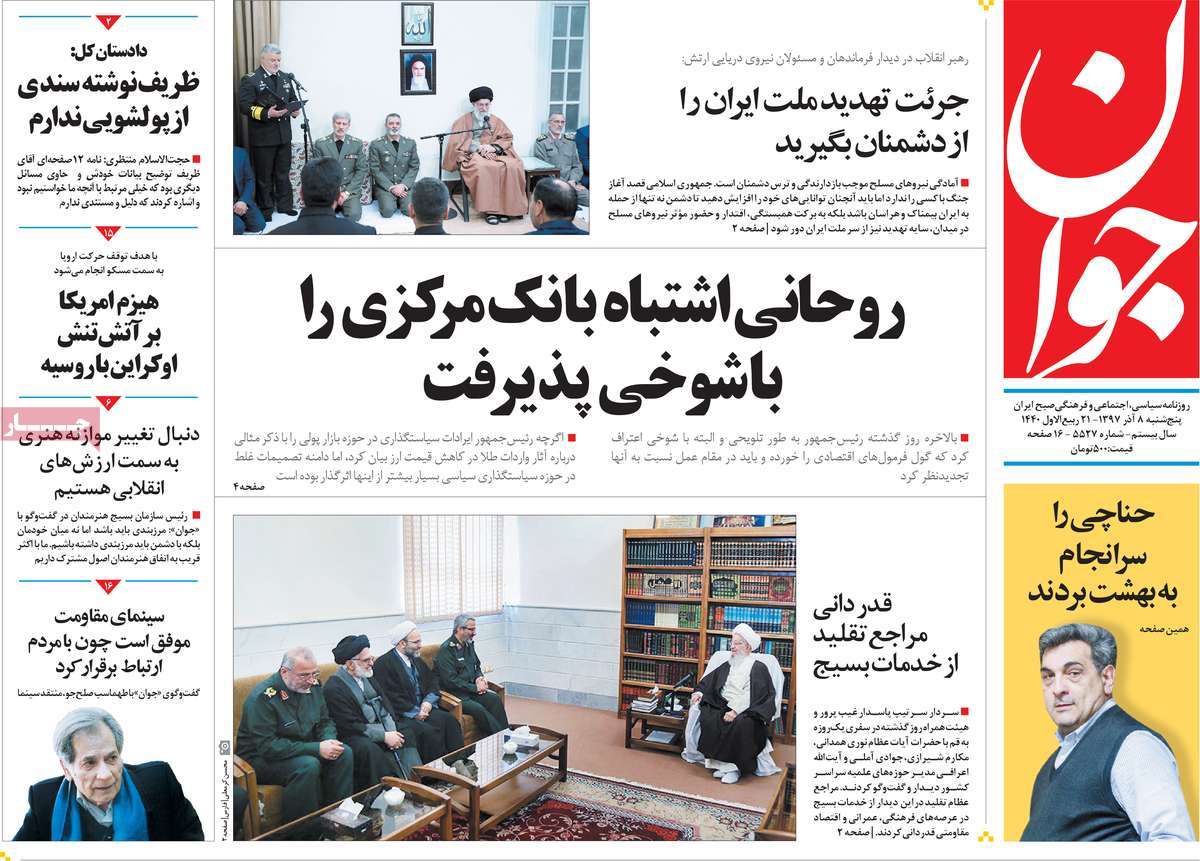
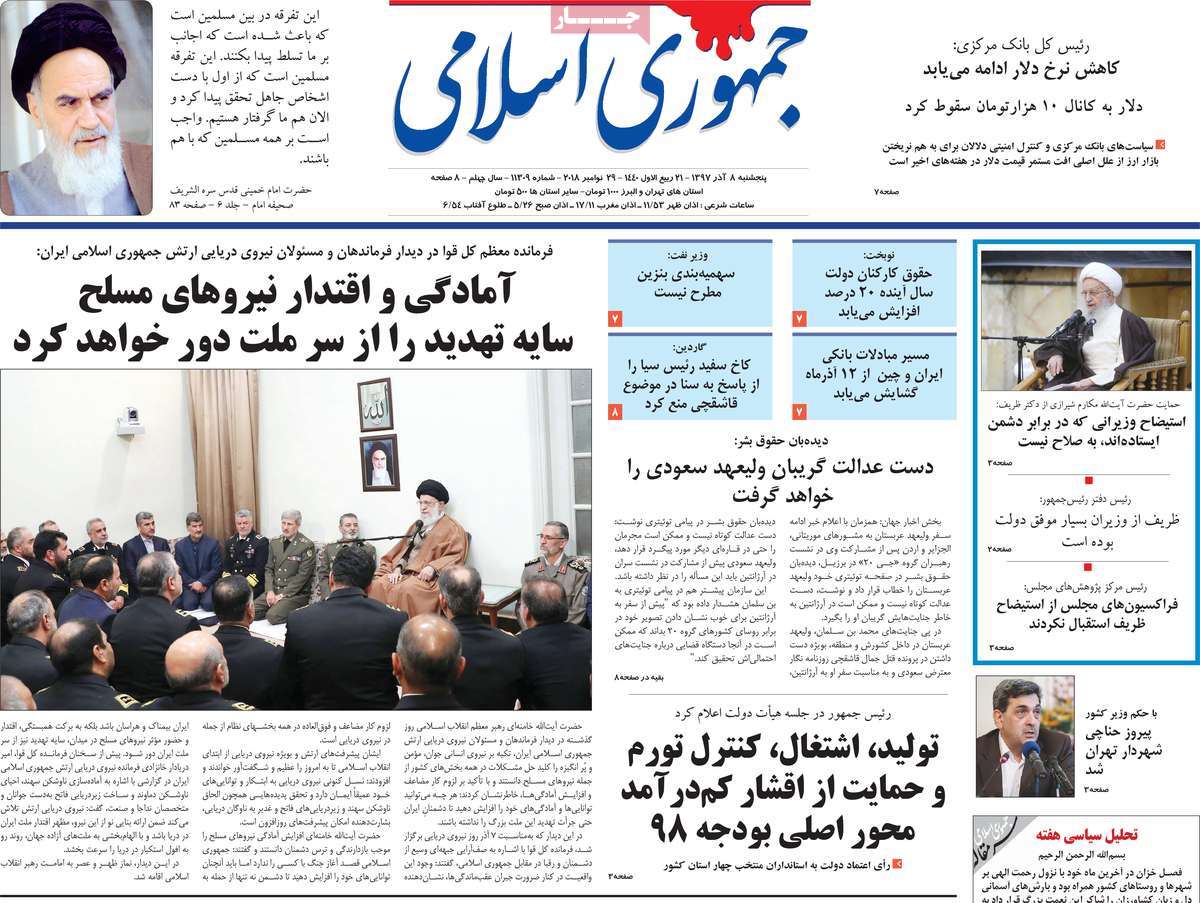
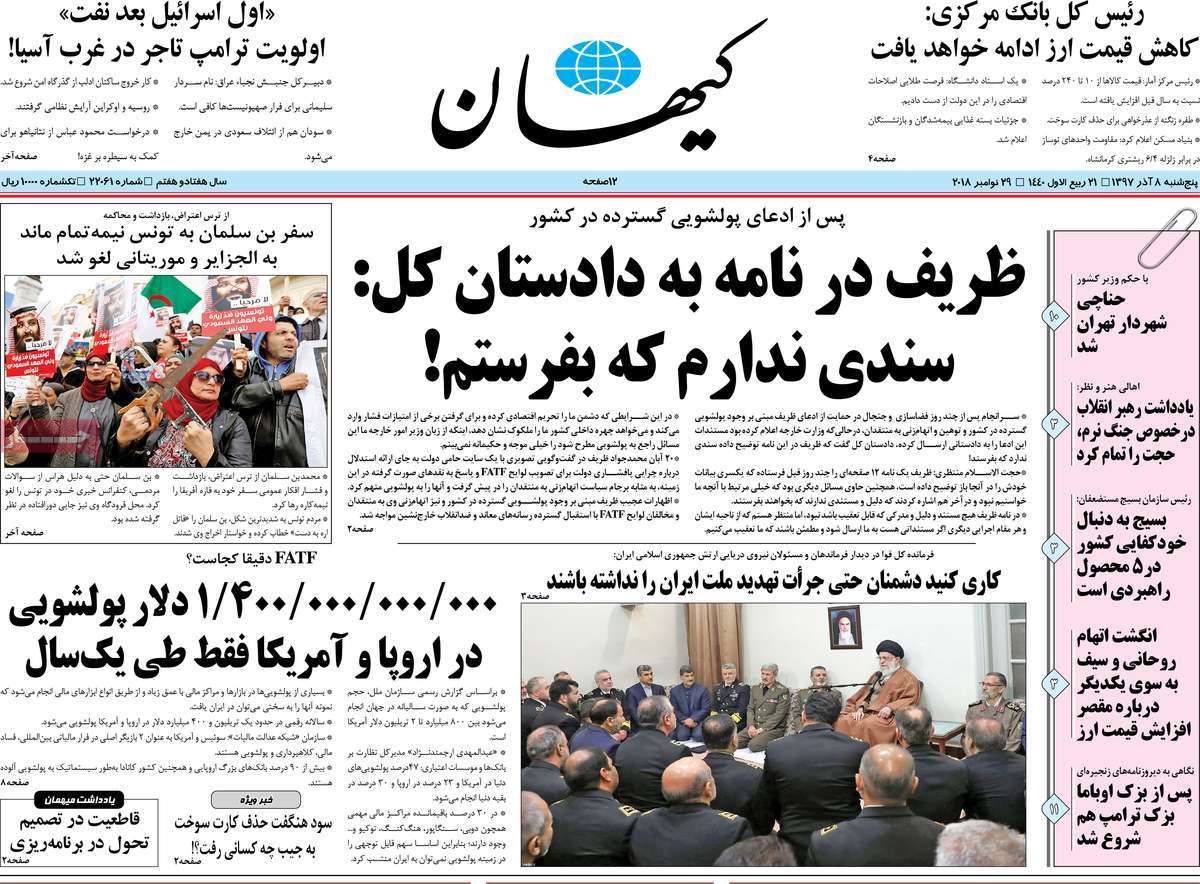
Almost all papers today covered the remarks made by the Leader of Iran’s Islamic Revolution Ayatollah Seyyed Ali Khamenei in a meeting with a group of navy commanders.
Also a top story was the regional tour of Saudi Crown Prince Mohammed bin Salman, which was left unfinished after Morocco refused to host him, and people in Egypt and Tunisia held protest rallies against the prince.

The Parliament’s bid to impeach Foreign Minister Mohammad Javad Zarif over his claim about ‘rampant’ money laundering in Iran also remained a top story, after senior cleric Ayatollah Nasser Makarem Shirazi criticized the lawmakers’ move, praising Zarif for standing against the enemies.

The above issues, as well as many more, are highlighted in the following headlines and top stories:


Abrar:

1- Guardian Council to Review Government’s Proposals on CFT

2- Mogherini’s Office: JCPOA a Pillar of Regional Security

3- Japan Seeks Extension of US Waivers for Importing Iran’s Crude Oil
A Look at Iranian Newspaper Front Pages on November 29


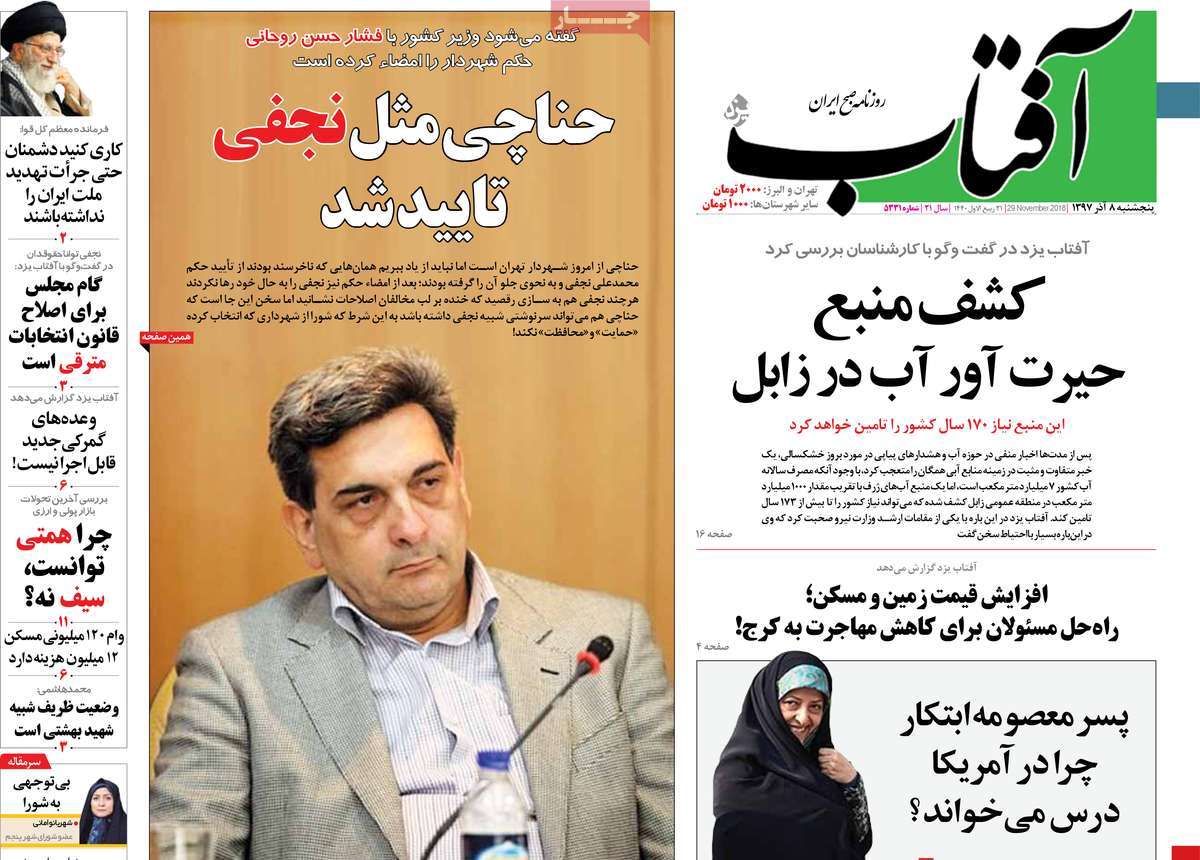
Aftab-e Yazd:

1- Amazing Source of Water Discovered in Zabol, Southeast of Iran

• The Source Can Supply Entire Country’s Water for 170 Years

2- Leader to Armed Forces: Deters Enemies from Even Threatening Iran

A Look at Iranian Newspaper Front Pages on November 29


Arman-e Emrooz:

1- Bin Salman Trying to Get Out of Isolation [Editorial]

A Look at Iranian Newspaper Front Pages on November 29


Ebtekar:

1- Expiration Date of Ambitious Plans

• Challenges Faced by Bin Salman in His Regional Tour ahead of G20 Summit

2- Preparedness of Armed Forces to Deter Threats against Nation: Leader

A Look at Iranian Newspaper Front Pages on November 29


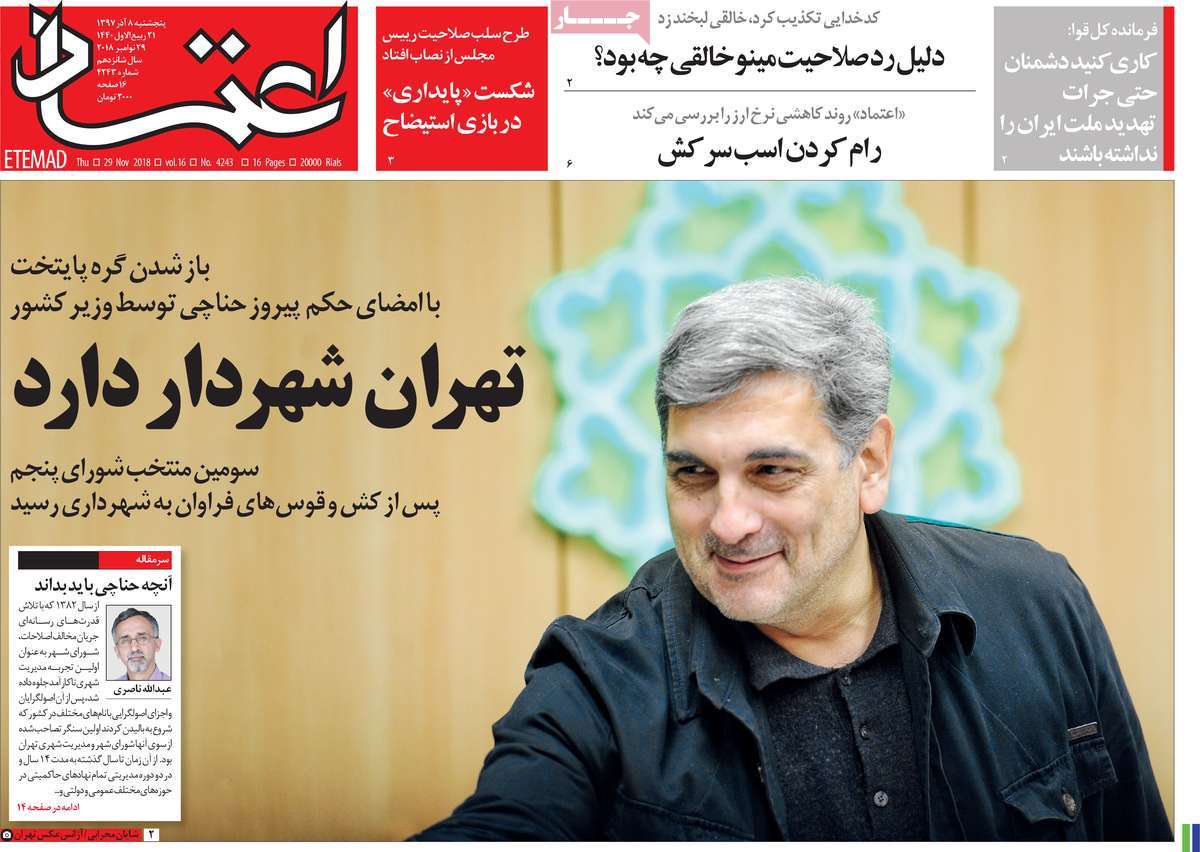
Etemad:

1- Hardliners Defeated in Their Bid to Impeach Larijani

2- A Report on Declining Forex Rates: Taming the Aggressive Horse

A Look at Iranian Newspaper Front Pages on November 29


Ettela’at:

1- Iran Has No Intention of Waging War on Any Country: Leader

2- Ukraine President: We’re on Brink of All-Out War with Russia

3- Iran Is Golden Key of Middle East: Nuclear Chief

A Look at Iranian Newspaper Front Pages on November 29


Haft-e Sobh:

1- Iranian Trick to Bypass Trump

• Families of Iranian Students in US Meet Them in Small Library

A Look at Iranian Newspaper Front Pages on November 29


Iran:

1- Ethnic Groups Have Always Supported Islamic Establishment: Rouhani

2- Impeachment Is Wrong; Ayatollah Makarem Shirazi Supports Zarif
A Look at Iranian Newspaper Front Pages on November 29


Javan:

1- US Fanning Flames of Ukraine-Russia Tension

• Washington Trying to Stop Europe from Moving towards Russia

A Look at Iranian Newspaper Front Pages on November 29


Jomhouri Eslami:

1- Human Rights Watch: Justice Will Finally Be Delivered to Saudi Crown Prince

2- Guardian: White House Prevents CIA from Giving Further Response on Khashoggi Case

3- Channel for Iran-China Banking Ties to Be Opened This Weekend
A Look at Iranian Newspaper Front Pages on November 29


Kayhan:

1- Trump’s Priorities in West Asia: First Israel, Then Oil

2- $1,400,000,000,000 Worth of Money Laundering in Europe, US Only in One Year

3- After Embellishing Obama, Now Reformist Papers Start Embellishing Trump

4- Bin Salman’s Visit to Tunisia Left Unfinished; Visits of Algeria, Mauritania Cancelled

A Look at Iranian Newspaper Front Pages on November 29


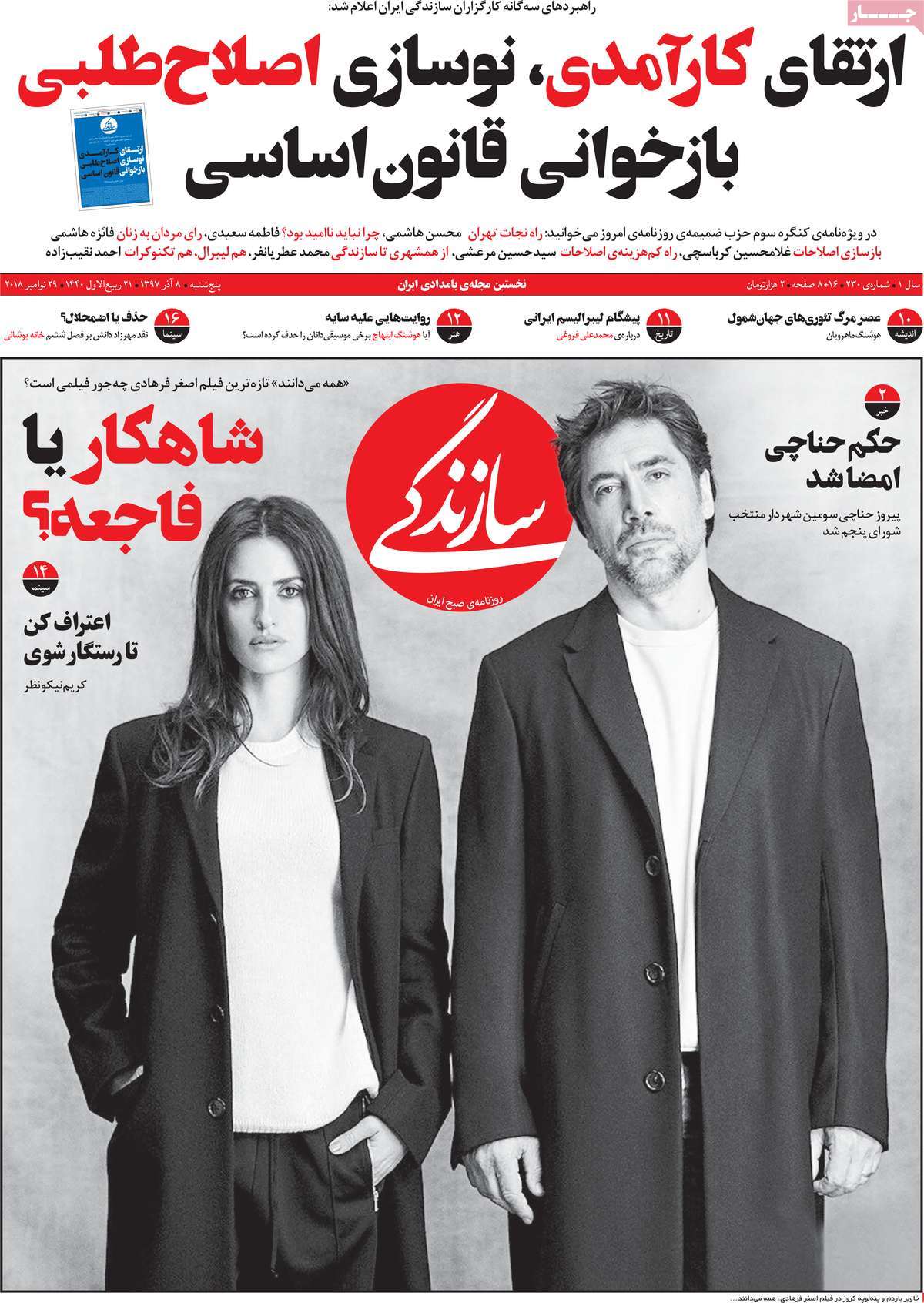
Sazandegi:

1- Tehran Mayor Approved by Interior Ministry

• Hanachi Becomes Third Mayor of Fifth City Council

A Look at Iranian Newspaper Front Pages on November 29


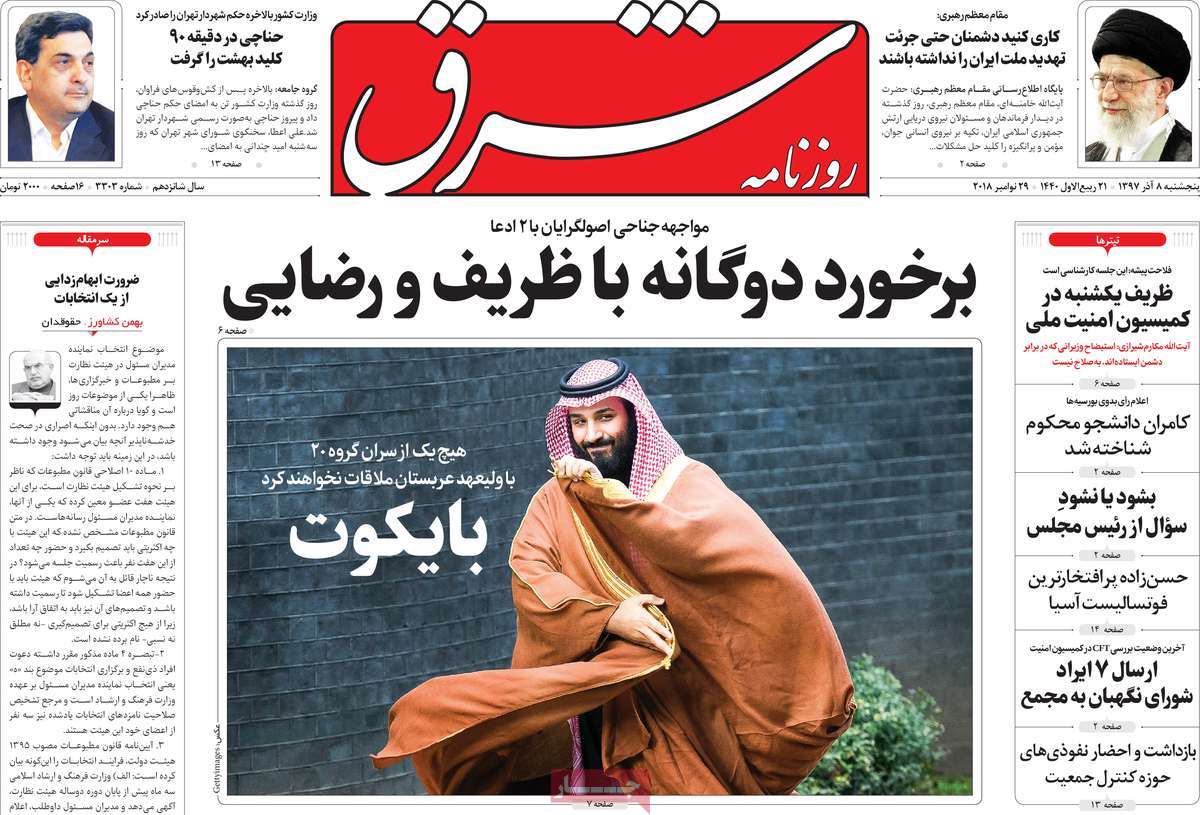
Shargh:

1- Zarif to Appear in Parliament on Sunday

• Ayatollah Makarem Shirazi: It’s Not Right to Impeach Ministers Standing against Enemy

2- Boycott: No G20 Leader Will Meet Saudi Crown Prince
A Look at Iranian Newspaper Front Pages on November 29


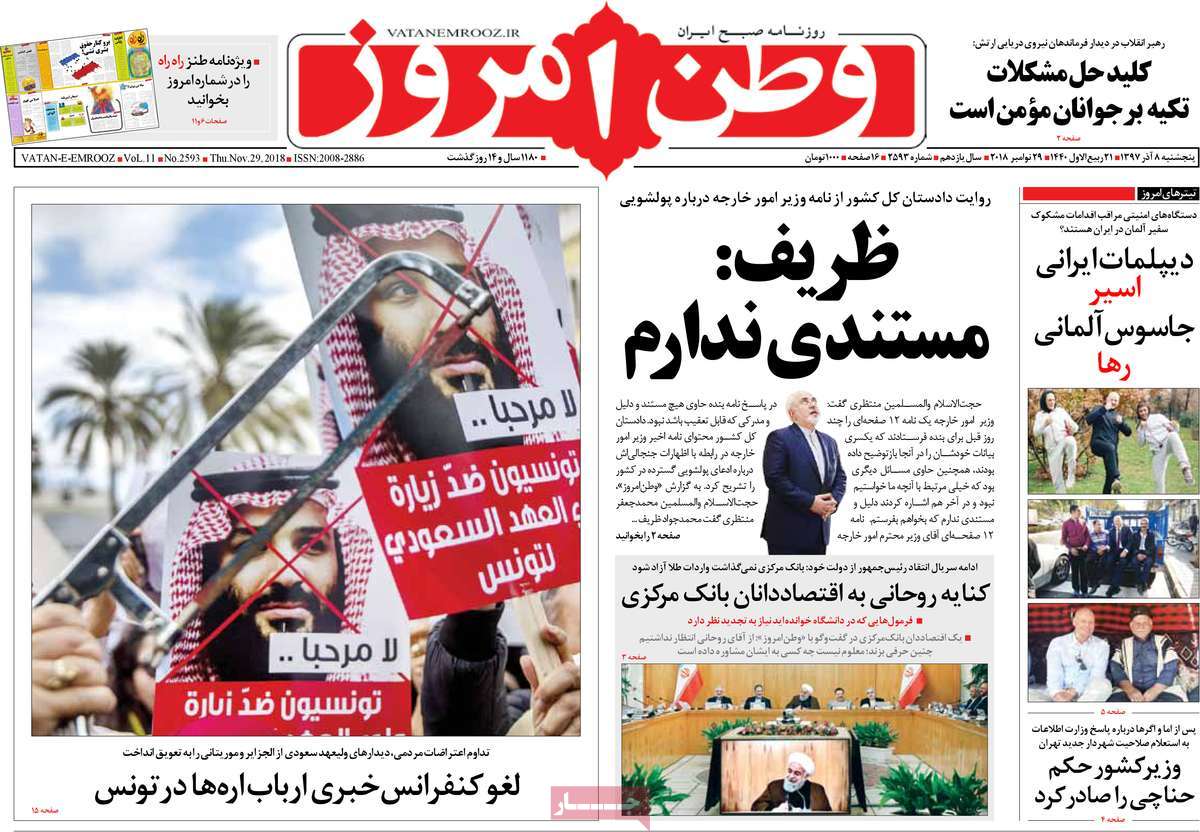
Vatan-e Emrooz:

1- Iran’s Security Forces Must Beware of German Spy

• Suspicious Moves of German Ambassador to Tehran
A Look at Iranian Newspaper Front Pages on November 29

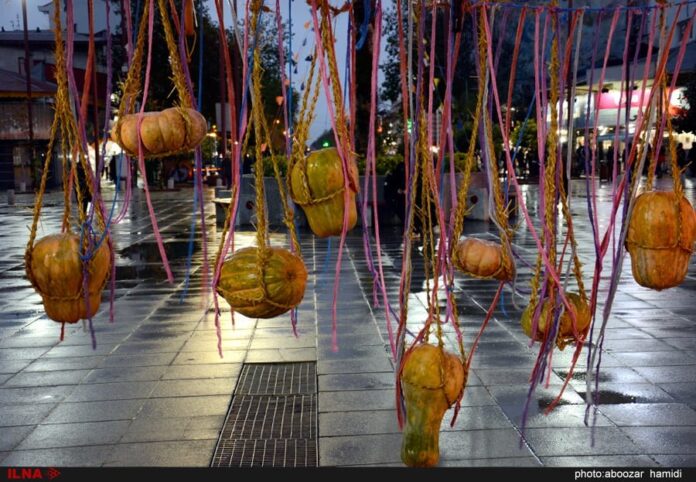
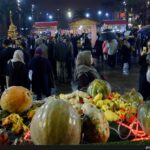
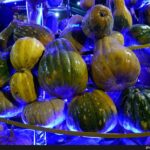
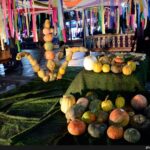
Squash Festival Held in Streets of Rasht, Northern Iran

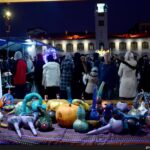
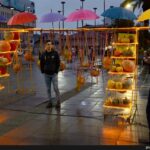
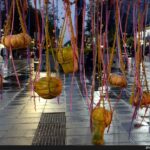
The festival started on Sunday, and was open to visitors until Wednesday on the Cultural Pedestrian Walkway of Rasht.

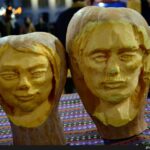
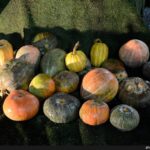
Various kinds of food, dessert and snack made with squash as well as handicrafts made with the vegetable were among the items displayed at the festival.

There are many creative ways to use squash in a dish, including desserts, soups, salads, beverages and even as an alternative to butter.

Encouraging a healthy and traditional diet and promoting the public’s awareness about healthy nutrition and its importance was the main goal of the festival.

Squash contains a lot of nourishing nutrients, is rich in vitamins and minerals, and has low calories.

Squash is one of the best known sources of beta-carotene, which is a strong antioxidant that gives orange colour to fruits and vegetables and is converted into vitamin A in the body.

Beta-carotene-rich foods can reduce the risk of certain types of cancer and protect the body from asthma, heart disease and aging.

Following you can find ILNA’s photos of this festival:


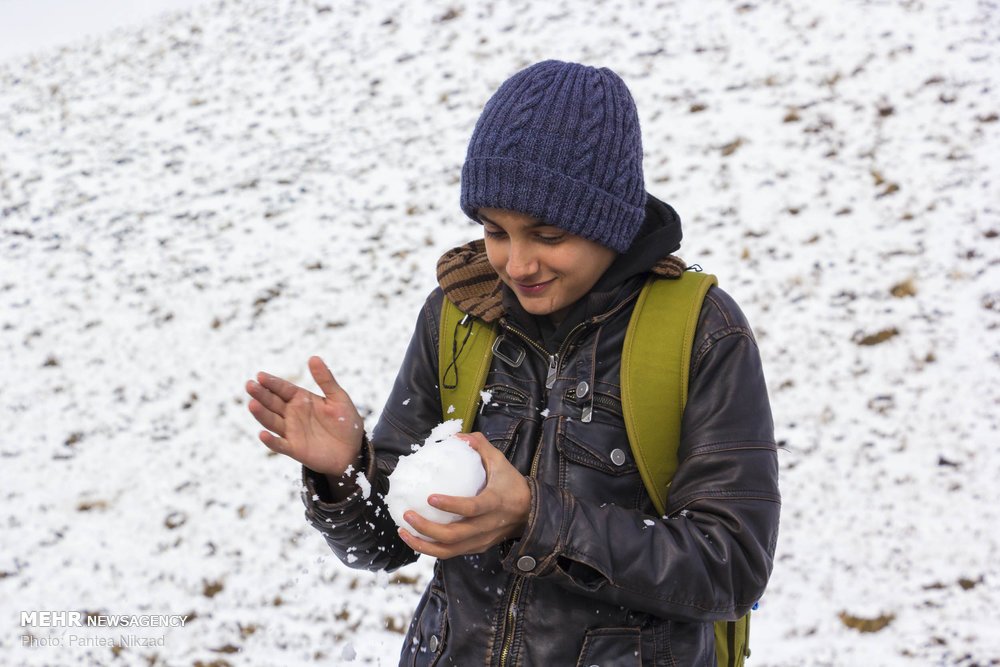
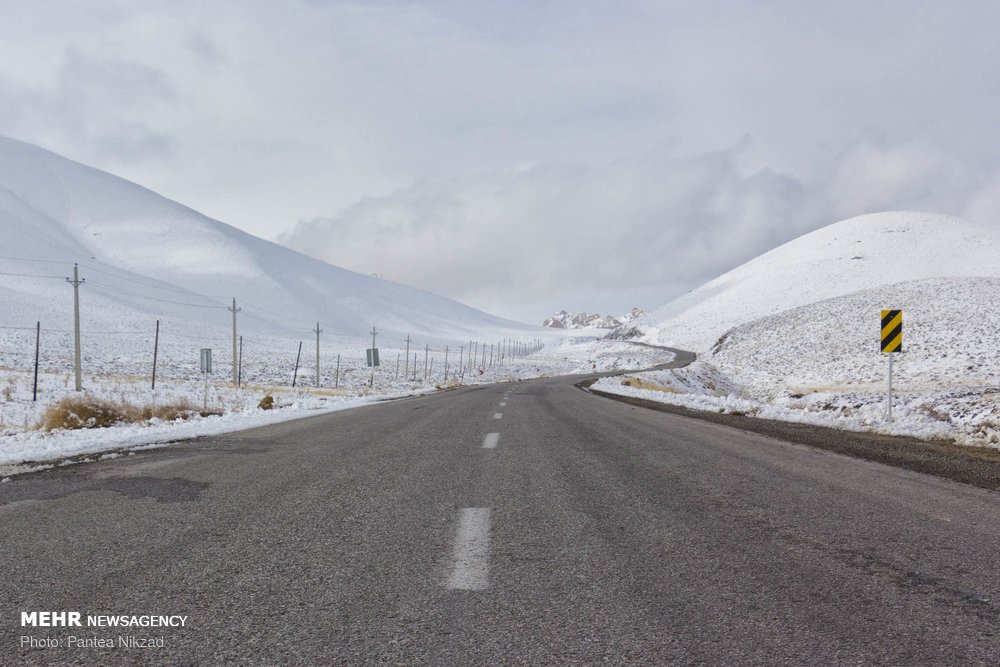
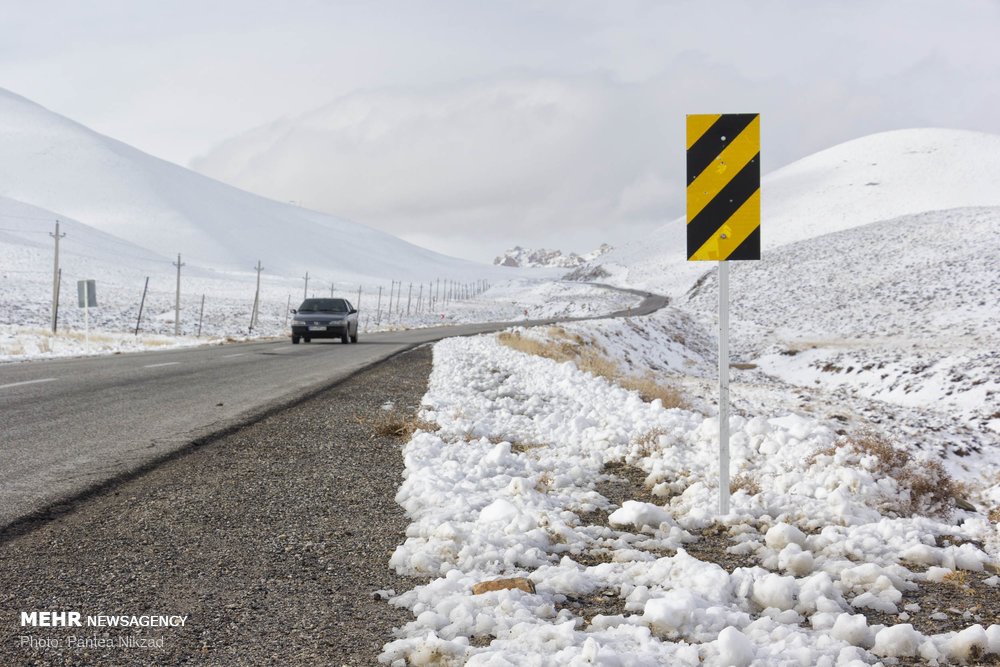
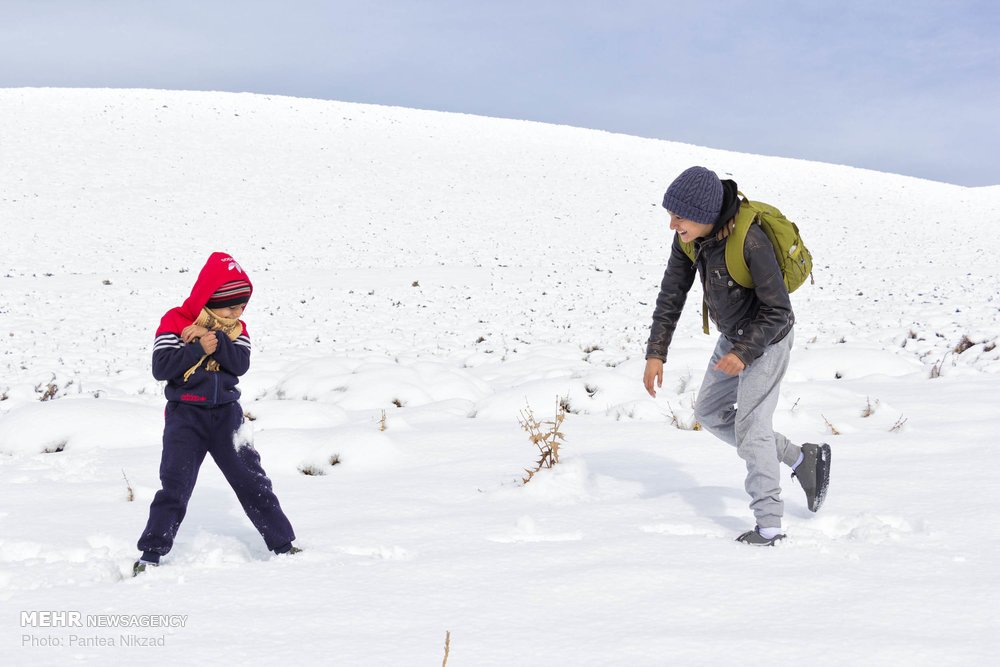
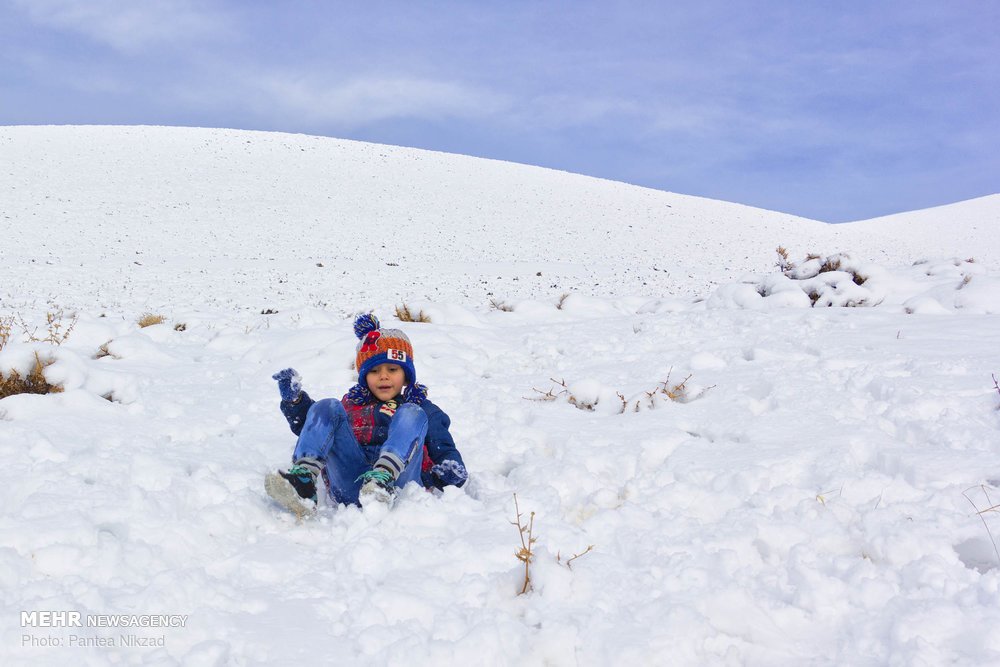
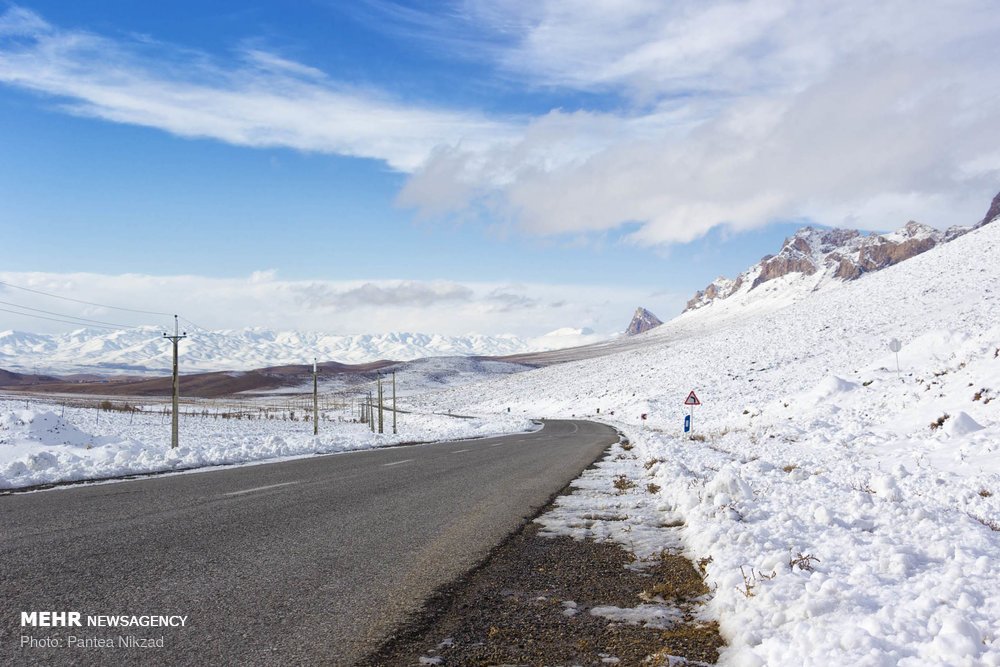
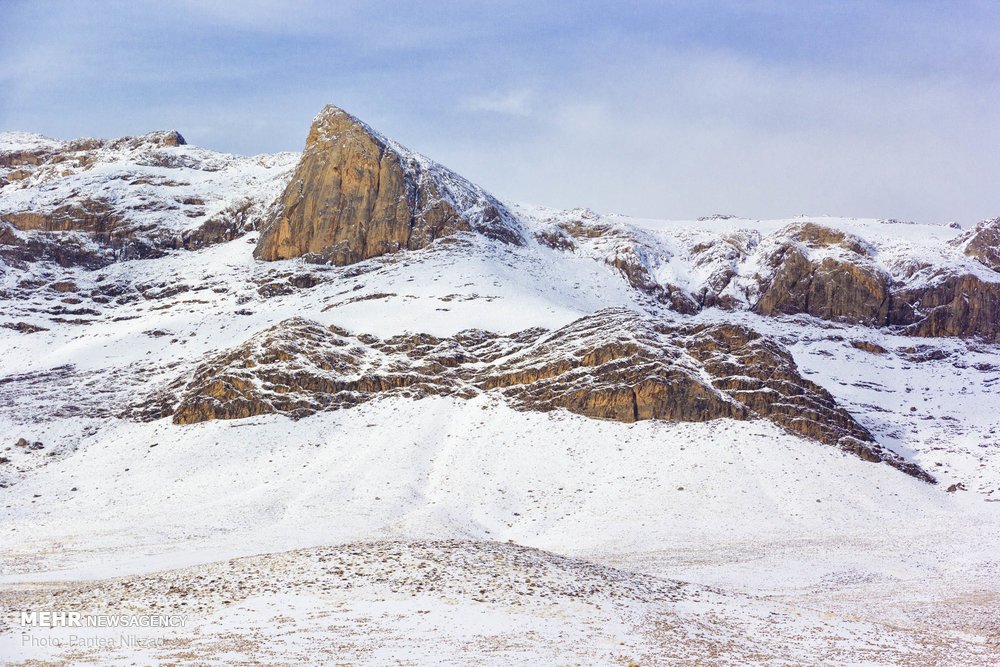
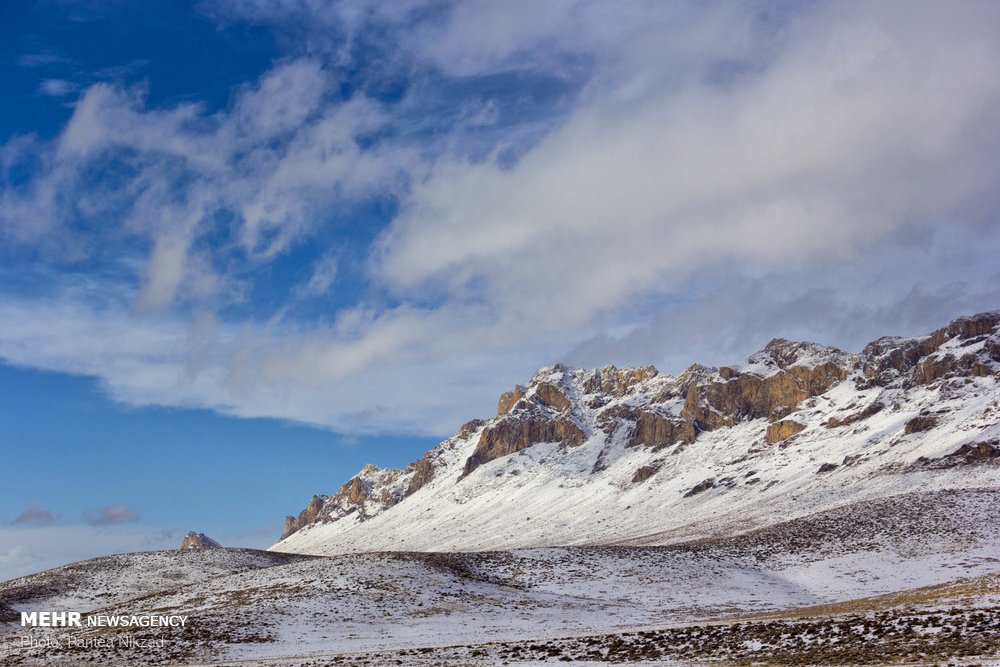
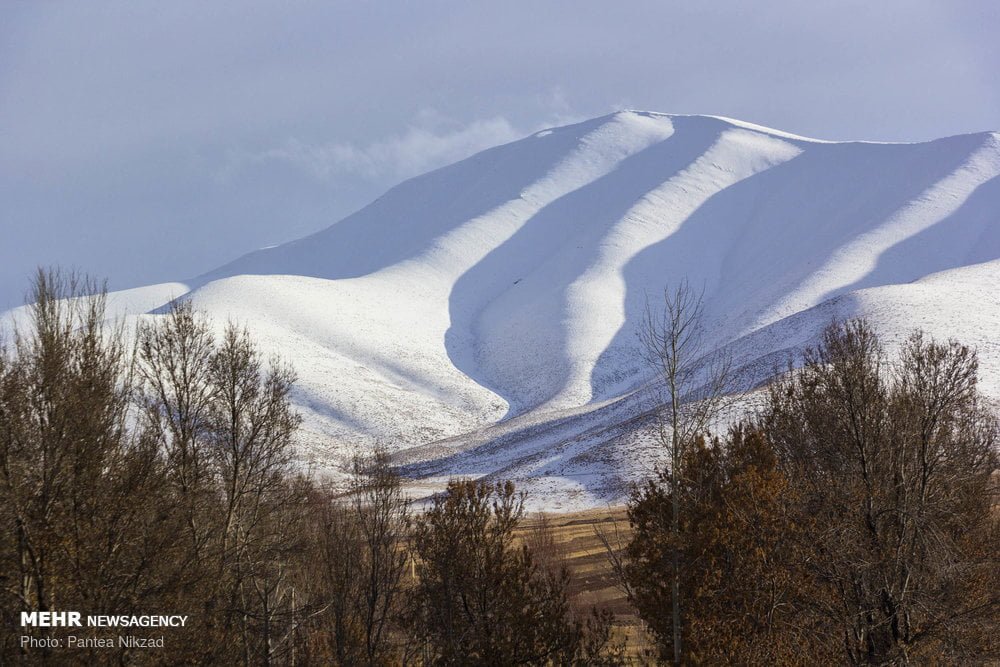
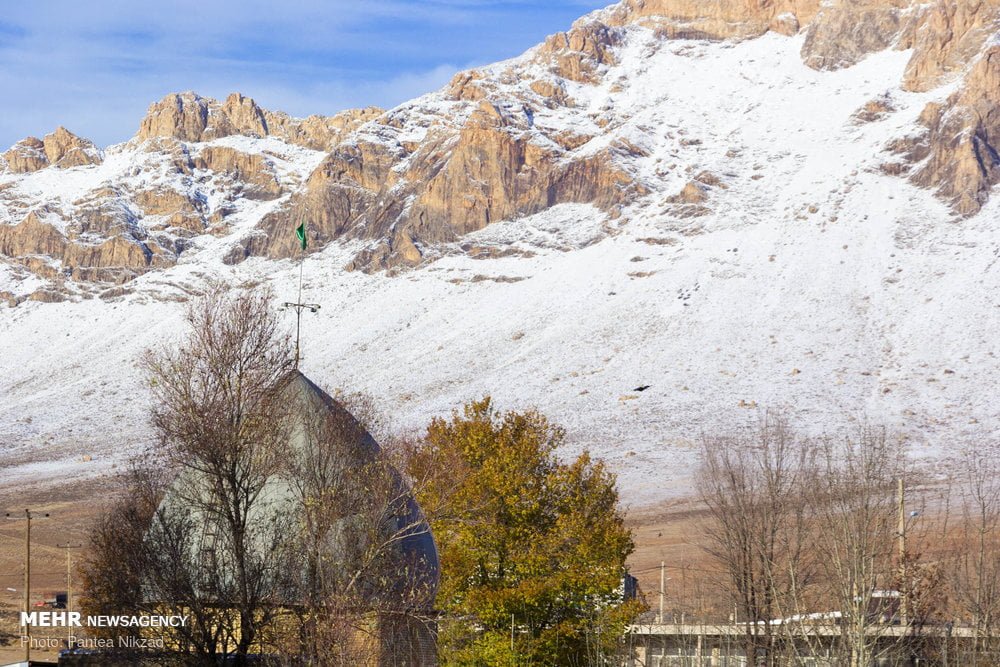
People Rejoice as Snow Covers Iran’s Chaharmahal & Bakhtiari

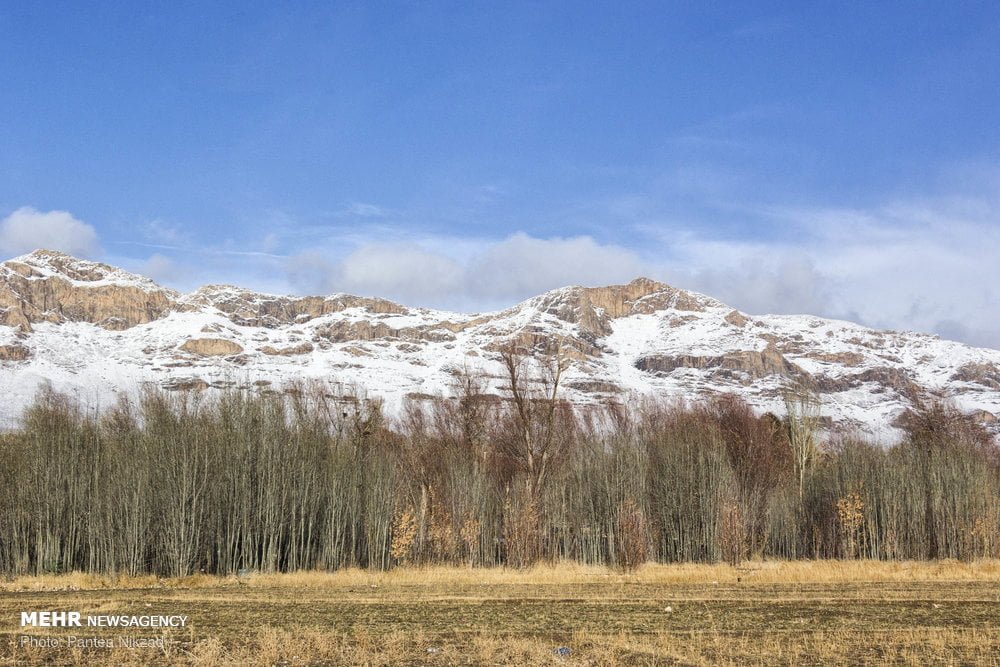
Following several years of drought, snowfall this autumn helped people set aside their problems for a few days and rejoice.

Here’s Mehr News Agency’s Photos of autumn snow and people who are enjoying it:

Forex Rates to Keep Going Down in Coming Days: Iran

Speaking to reporters on the sidelines of the weekly cabinet meeting, Hemmati expressed hope that the forex market could regain its stability once a balance is created between the supply and demand.

“The supply of exporters’ foreign currencies into the market will create the balance and I urge all my fellowmen not to keep their foreign currencies,” he said.

According to Hemmati, any speculation in the foreign currency market may end up in total failure especially for ordinary citizens.

Today the country needs economic boom, the chief banker said, expressing hope that the boom could be achieved with the ongoing decline in foreign currency rates.

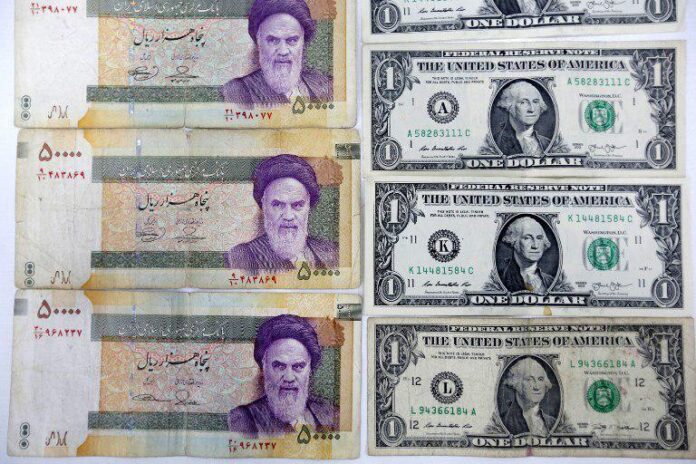
Reports say, as of Tuesday, the US dollar has been offered at 119,000 rials on the unofficial market compared to 120,000 rials on Monday.

Many maintain that the recovery is due to new forex policies and restrictions imposed by the government on banking transactions and purchases of dollars as well as a ban on money send-outs by unauthorized foreign exchange shops.

Foreign currency and gold coin prices witnessed huge rises in recent months, and this led the rial to plunge to a record low (nearly 190,000) against the US dollar in the unofficial market. But now the market seems to be regaining its lost stability.

Europe’s SPV Must Be Implemented as Soon as Possible: Iran

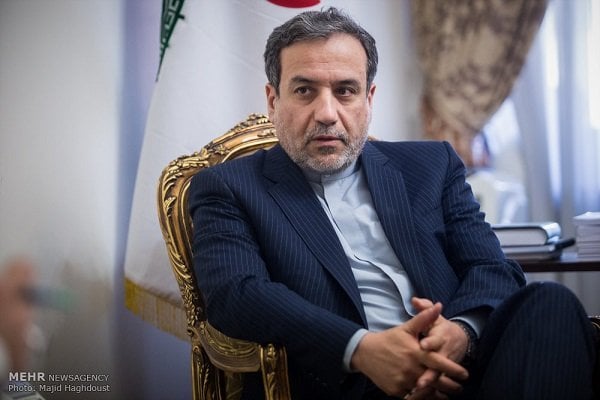
He made the remarks in a meeting with his Belgian counterpart Bruno van der Pluijm on Wednesday.

During the meeting held in the Belgian capital, Araqchi said following the increase in Washington’s illegal pressure and disruption of the balance between Tehran’s commitments and interests, the failure of Europeans and other parties to ease the pressures, as they had promised to, will increase concerns about the future of the nuclear deal.

“The Europeans and other remaining parties to the nuclear deal must adopt the required mechanisms as soon as possible to guarantee Iran’s economic benefits under the deal,” he noted.

For his part, van der Pluijm underlined the permanent commitment of his country and other European states to defending the Iran nuclear deal and its credit and said the nuclear accord plays a key role in international peace and security.

“We are seeking to preserve the Iran nuclear deal and believe that despite the US pullout, the JCPOA should remain intact through our patient and prudent measures because there is no alternative to the 2015 accord,” he noted.

“Accordingly, we hope we would soon be able to develop the special mechanism to preserve the deal,” he said.

The two sides also conferred on Tehran-Brussels cooperation on international issues and other issues of mutual interest.

Iran, Sweden Discuss Yemen Peace in Geneva

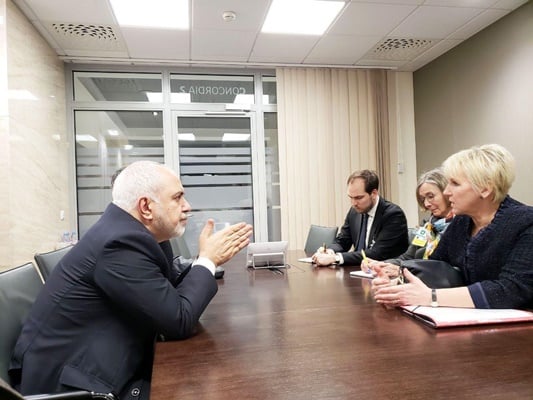
During the meeting, which was held on the sidelines of the Geneva Conference on Afghanistan, the two sides exchanged views on Sweden’s efforts to resolve the Yemen crisis and mutual cooperation on international issues.

Zarif and Wallström also discussed the priority of holding international dialogue on the issue of human rights, and the need for international organizations to avoid taking arbitrary measures.

They also underlined the need for the two countries to remain in close touch on various mutual, regional and international issues.

The meeting came a few days after the two sides held a phone conversation on Yemen peace talks slated for December in the Swedish capital, Stockholm.

The UN special envoy for Yemen is charged with brokering the talks. A previous effort to convene the talks in Geneva in September failed when the Houthi delegation was not allowed to show up.

Two Iranian Cities, One Village Registered by World Crafts Council

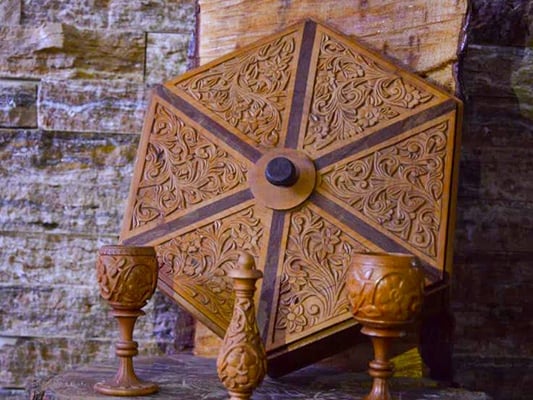
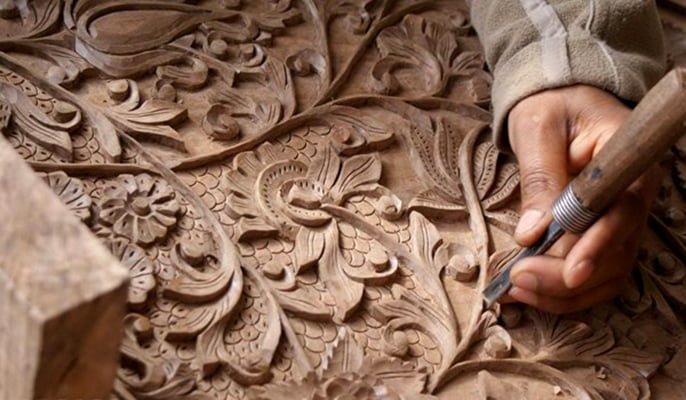
Ali-Asghar Mounesan said the city of Abadeh in Fars province, Meybod in Yazd province, and the village of Khorashad in South Khorasan province have made their way into the WCC’s list as new representatives of the Islamic Republic.

“According to WCC, Abadeh was registered as the world city of wood carving, Meybod as the world city of Zilu (pileless rugs), and Khorashad as the village of Tobafi (towel weaving),” said Mounesan.

Two Iranian Cities, One Village Registered by World Crafts CouncilThe World Crafts Council, an affiliate of the United Nations Educational, Scientific, and Cultural Organization (UNESCO), has started registering world cities since 2014, he noted.
In 2015, Iran’s Tabriz was registered as the world city of handmade carpets and Isfahan as the world city of handicrafts, he added.

“Each year international referees in five regions of the world assess the cities. Iran is located in the Asia-Pacific region of this council.”

Mounesan further noted that at the moment 28 cities in the world are listed as world craft cities and this year international evaluators from India, Kuwait and Oman and an evaluator from Iran travelled to three Iranian provinces and visited different regions to assess them based on international indices.

International evaluators began their trip from Fars Province and Abadeh on the basis of indices including the number of workshops, sales and exports in late October this year. After that, they visited Meybod and finally went to the village of Khorashad in southern Khorasan, underlined Mounesan.

“After the visit of the WCC evaluators, these cities were globally registered and their plaque of registration has been sent to Iran,” added Mounesan.

He also congratulated all the people of Iran, especially the people of the provinces of Fars, Yazd and South Khorasan, on the global recognition, saying that Iran is now ranked first in world with eight cities and two villages registered globally for their crafts.

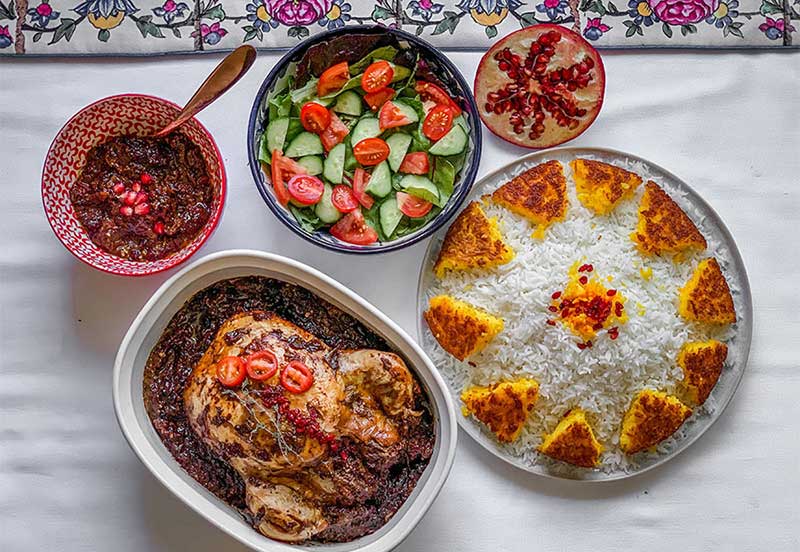
Lavangi Chicken: Yummy Food from Northern Iran

Lavangi Chicken: Yummy Food from Northern Iran

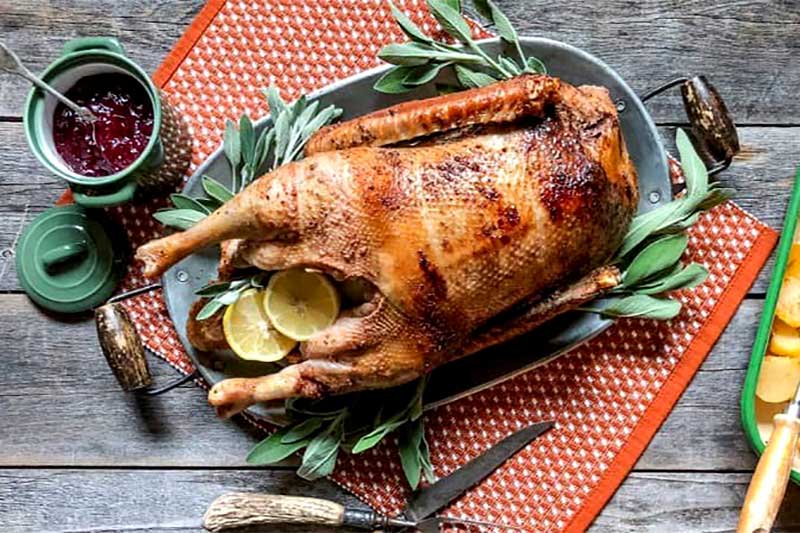
The word “lavangi” in the Taleshi language means “colorful stomach”. This name refers to the decoration and arrangement of trimmings in the belly of chicken or duck.

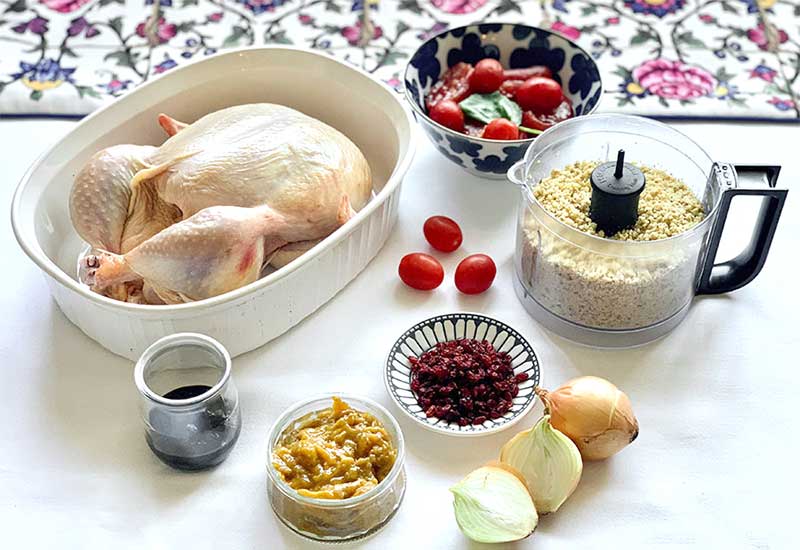
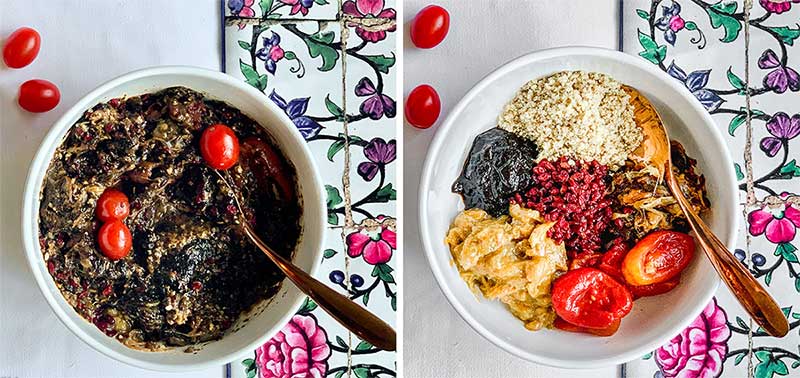
To fill the belly of chicken and duck, they usually use fragrant vegetables, onions, garlic, walnuts, common medlar paste, plum paste, pomegranate paste, sour grape juice, tomatoes, salt and pepper. People in the Republic of Azerbaijan also cook lavangi and they recognize it as the country’s national food.

how to make lavangi chiken

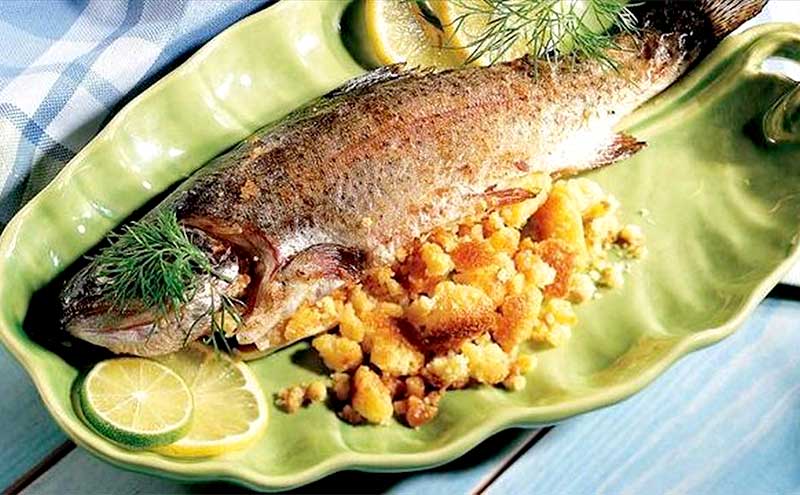
The food is made in a slightly different way and with different ingredients in the Iranian city of Astara and in the Talesh (wikipedia) region in northern Iran. The chicken or duck lavangi is for the Nowruz eve and the fish lavangi for Chaharshanbeh Suri (Read more). The eggplant lavangi is served as snack.

Among the main ingredients of the dish is “sweet medlar paste” and “sour plum paste” or “pomegranate paste” which, when combined, give the food a sweet-sour taste.

The food can be made with duck or fish as well.

lavangi fish

Ingredients for Lavangi Chicken

  • Small Chicken: A whole one
  • Walnut: 100gr
  • Onions: up to 3 onions
  • Salt: as much as needed
  • Pepper: as much as needed
  • Cinnamon: as much as needed
  • Sour Plum Paste: as much as needed
  • Tomatoes: 2 to 3 tomatoes
  • Sour Lemon: as much as needed

Ingredients for Lavangi Chicken

Lavangi Recipe

Wash and skin the chicken the night before and cover the whole chicken with sour plum paste. Fill the chicken with sliced sour lemon.

Before cooking the chicken, grate the onions and put them onto the frying pan on low heat until its water evaporates.

Then crush the walnut and add it to the onions. Sauté the mix before turning off the oven. Add 2 to 3 spoonfuls of sour plum paste (depending on how sour the paste is) plus salt, pepper and cinnamon and mix them well until you get a smooth paste.

Gut the chicken and rub some salt on the inside before filling it with prepared ingredients.

Lavangi Recipe

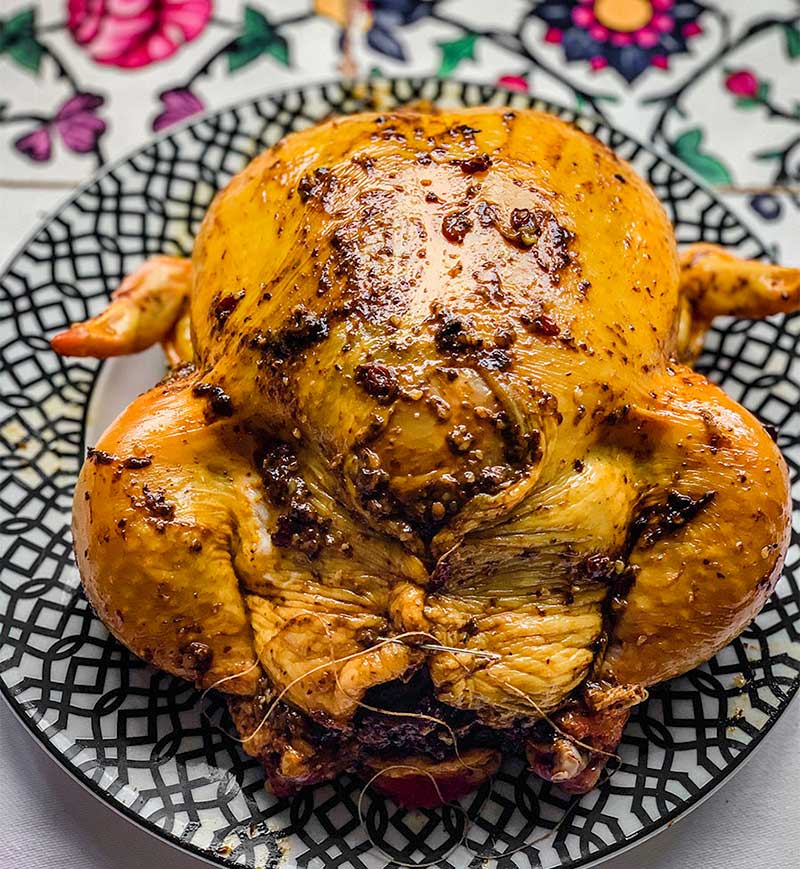
Then sew the chicken’s stomach with a needle and thread, and tie its feet together, so that the ingredients inside will not get out.

Put some oil in a dish and fry the chicken in it on low heat. Peel the potatoes and chop them before putting them onto the dish with chicken, allowing them to be cooked.

When the chicken is half-cooked, put it inside the oven at medium temperature and leave it there until it gets brown in colour and is cooked through. Then bring out the chicken and dish it out.

lavangi chiken -with-rice

Complementary tips to cook lavangi:

1-To make the chicken sour and delicious, you can inject some sour grape juice or lemon juice into the chest meat and thighs during the cooking process by using a clean syringe.

2-Making small holes in those areas of the chicken that have stronger meat is a key step toward cooking lavangi. As a result, the substances that are placed inside the chicken belly absorb heat better. This gives your lavangi a good taste.

3-If you do not have fragrant Gilani vegetables, then you can use whatever fragrant vegetables that are available.

4-To make your lavangi golden in color in the pot, you had better steam it initially and then fry it at the end.

lavangi chicken

Last word for make Lavangi

This food used to be made in pots and on charcoal or in the oven and on the stove in the past.

They would turn the lid of the pot upside down to cook lavangi, and charcoal was poured in the lid so that the food would cook slowly with charcoal.

Today this local food is however cooked in most homes and restaurants using the oven.