Wednesday, December 31, 2025
Home Blog Page 3319

Iranian Users ‘Setting Aside’ iPhone Devices as Apps Become Inactive

Mohammad Javad Azari Jahromi said Iranian people liked Apple phones, but the restrictions recently put in place for Iranian companies led to many Iranians set aside their iPhone devices.

However, he added, a detailed report on the issue should be presented by relevant Iranian authorities.

The minister said mobile phones which do not support Iranian ride-hailing and banking applications are doomed to leave the market.

His comments come as almost all Iranian applications have recently become inactive on iPhone products.

Most apps for Iranian iOS users are no longer working, and the owners of those applications have introduced alternative programs for users.

Apple Inc. does not have a presence in Iran due to US sanctions, but its products including iPhones remain much sought-after devices in the country, meaning several thousand Iranian app developers that produce software in Persian contribute to a local Apple ecosystem.

Iranian media and users alike report that Apple has revoked “enterprise certificates” from Iranian apps, bne IntelliNews reports. That has resulted in iPhone users being unable to access locally-made applications including popular apps providing services such as ride-hailing and banking.

This is not the first time that Iranian Apple users have been hit hard. In 2018, Iranian apps were quietly removed from the Apple iOS store. Iranians were able to sidestep that removal by loading applications onto their phones via technician mode. It appears that option may no longer be available because of the latest block put in place by Apple.

The company last year accounted for an estimated 11% share of Iran’s technology market, according to the telecoms ministry.

Google’s mobile operating system Android is run on 89% of smartphones in Iran. Google allows Android developers to publish apps in Iran as long as they do not relate to purchases. The American company has not to date followed Apple’s action against Iranian apps by targeting products placed in its Google Play store. Android is also catered for by local store Café Bazaar, a Persian-language app store.

There are more than 60mn smartphones currently in use in Iran, a country of around 81mn people. Nearly 80mn SIM cards are active in the country.
‘Iran’s Trade with World to Get More Difficult without FATF’

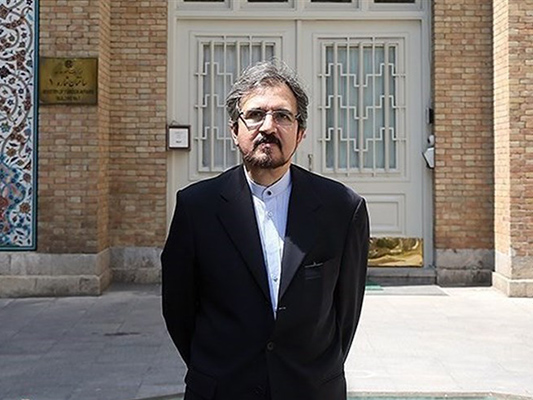
In a Tuesday interview with IRNA, Qassemi said the Foreign Ministry draws on its expertise to insist that accession to the global anti-money laundering body is not expected to eradicate all economic problems of the country completely and overnight.

“But rejecting the FATF will undoubtedly deteriorate the problems we face in establishing trade ties with the world, making it harder, costlier and in some areas impossible,” he said.

The spokesman said by rejecting the FATF, even the Islamic Republic’s partners will face serious and costly problems for establishing legal and transparent ties with Tehran.

“They have explicitly expressed their concern that they might not be able to continue their cooperation with us easily,” he said.

Qassemi then added it seems some factional and political views are contributing to the public concern about the bills proposed by the government to get Iran out of the FATF blacklist.

“But it is critical that all experts and specialists, in concerted efforts, fulfil their national duty to raise [public] awareness and help the respectable members of Iran’s Expediency Council to make the best decision in this regard, guarantee our national interests and promote our security free from any politically-motivated, factional and individual view,” the spokesman said.

According to Qassemi, any decision could undoubtedly leave some positive or negative consequences for Iran. Therefore, he said, the decision makers should accept the responsibility of their decision in full consciousness.

Asked about the Expediency Council’s postponement of its decision on the FATF ahead of the upcoming holidays and the short time left before the deadline set by FATF for Iran to accept or reject the bill, he said the Foreign Ministry never views the issue from narrow partisan or political prisms.

“We raise a view and opinion which puts our national interests as the top priority. So, we have our own expertise-based view which is macro and multilateral,” he said.

The spokesman further noted that any country that seeks to safeguard its interests and status in the world has no way but to accept many international norms and regulations.

Based on the officials’ will and the people’s request, Iran seeks to establish routine ties with other countries and the international community in various areas like economy and trade, he said.

“It should be pointed out that today we are members of many specialized international organizations in various areas including legal, political, disarmament, cultural, trade, economic, air, sea, and land communications. This means we have already accepted to implement special standards of the specialized international bodies and organizations.”

“Now, if we intend to enjoy the least banking and financial exchanges and communications, we have to accept and observe some defined standards which have been accepted by almost all states except for one or two countries,” he noted.

Qassemi then referred to the current special economic conditions and foreign relations of the Islamic Republic in the wake of the US’ re-imposition of its unilateral and illegal sanctions, and said today Iran is engaged simultaneously in negotiations with a number of its neighbors, traditional partners like India, China and Russia, and the European Union to thwart the US illegal sanctions.

“Some good progresses have already been made. The main point is that the mentioned states which have decided not to implement the US’ illegitimate sanctions and keep their trade cooperation with Iran, have joined the FATF. So, they have no way but to work only with those countries which have similarly adopted these standards,” he concluded.

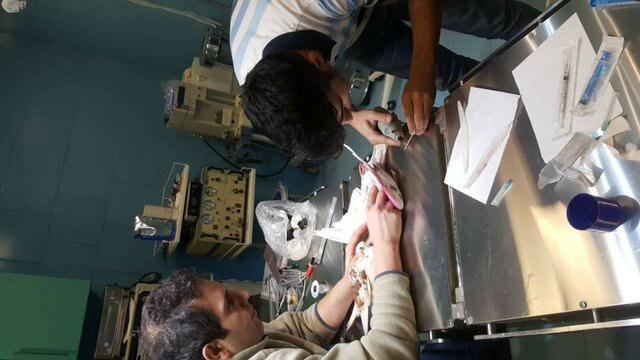
Iranian Vets Perform First Feather Transplant

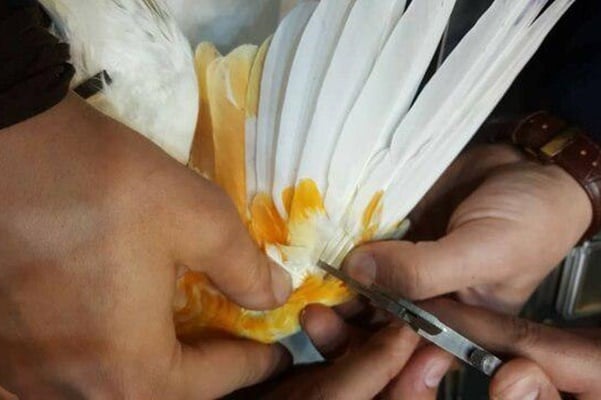
This is the first time that an Iranian team becomes involved in feather transplant in the country.

Saeed Yazdani-Nia, an Iranian vet leading the feather transplant project, says healing the wounds of feathers and the quills, in particular, is overwhelmingly difficult because the birds can’t be allowed to get back to the nature before the healing process is completed and the feathers grow enough.

Birds could be healed through various methods due to the type and grade of the wounds they sustained. There are various methods to perform surgeries and hold special cares before full healing.

“However, before the healing process is completed and the vets consider the birds healthy, there would be no chance for them to get back to the nature even if they have undergone the lengthy recovery process to overcome the first signs of the wounds like those create by bullet hit or bone fracture,” he noted.

Yazdani-Nia went on to say that the process to have the feathers grown enough takes about 12 months.

Feather transplant is a new way to remove the problems created due to long and harsh captivity of birds. British and Australian veterinarian teams have already performed the transplant successfully.

The Iranian vets managed to do the transplant successfully through three various technics: Autograft, Allograft and Xenograft.

The transplants were done on a grey parrot and two pigeons.

The birds underwent and passed a number of tests like bio-mechanical test of feathers.

It’s expected that transplant surgeries could be made on a growing number of wounded birds in the near future. It’s hoped that through the new method, more and more birds could be protected against the dangers from the nature.

Iranian Vets Perform First Feather Transplant

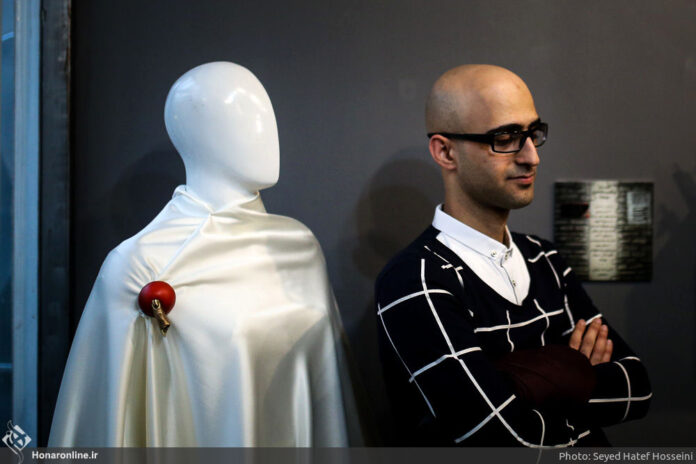
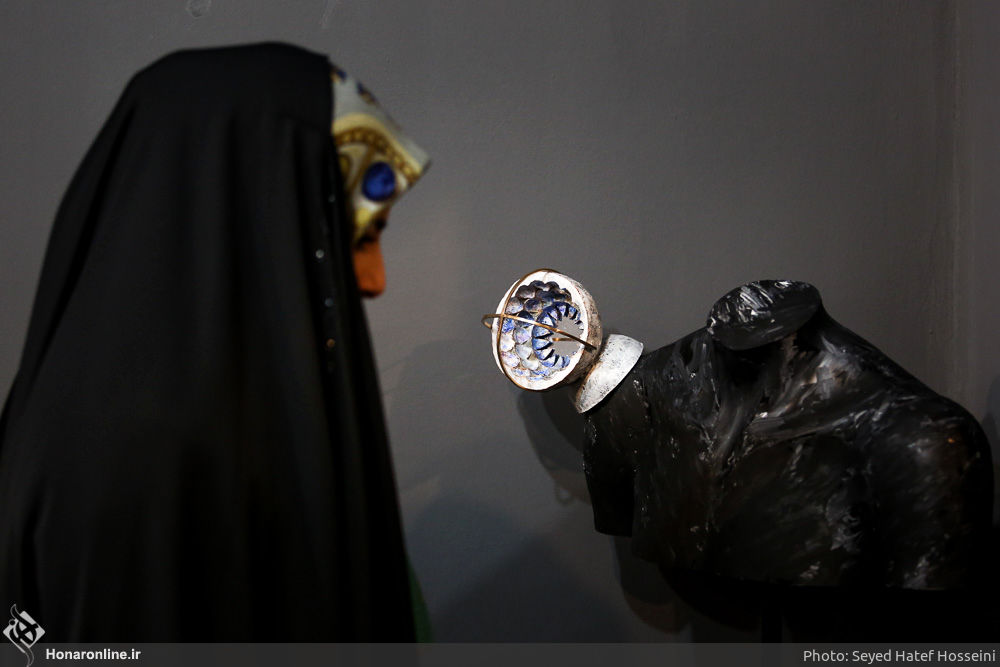
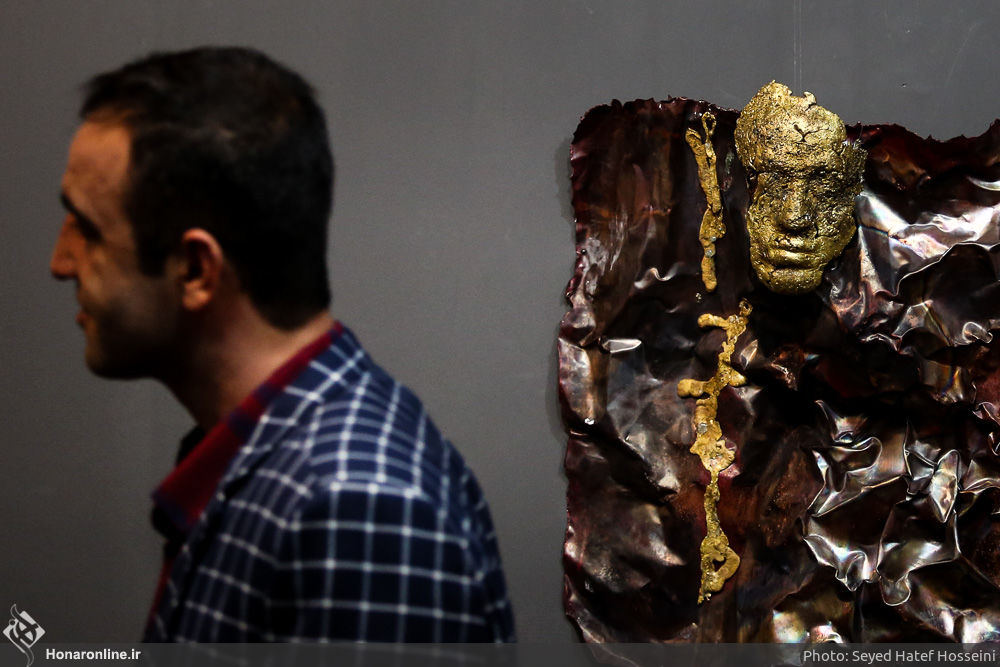
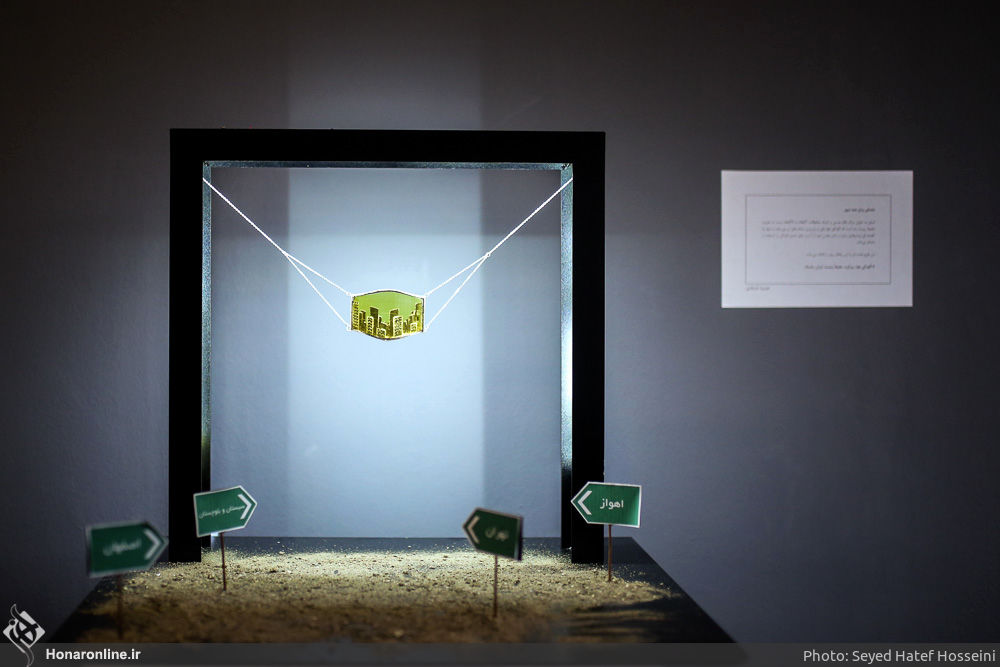
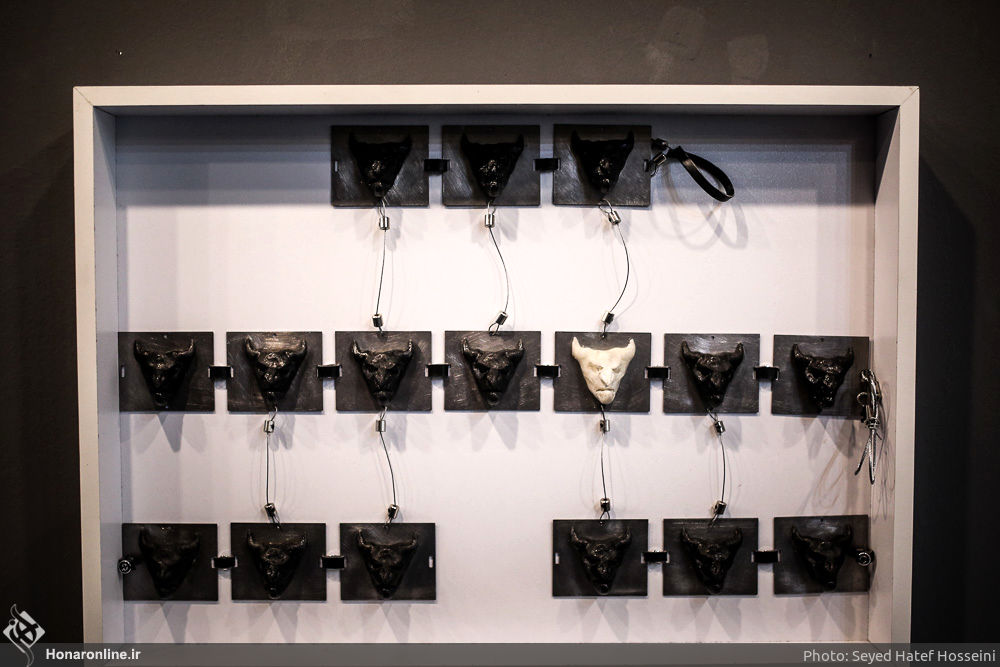
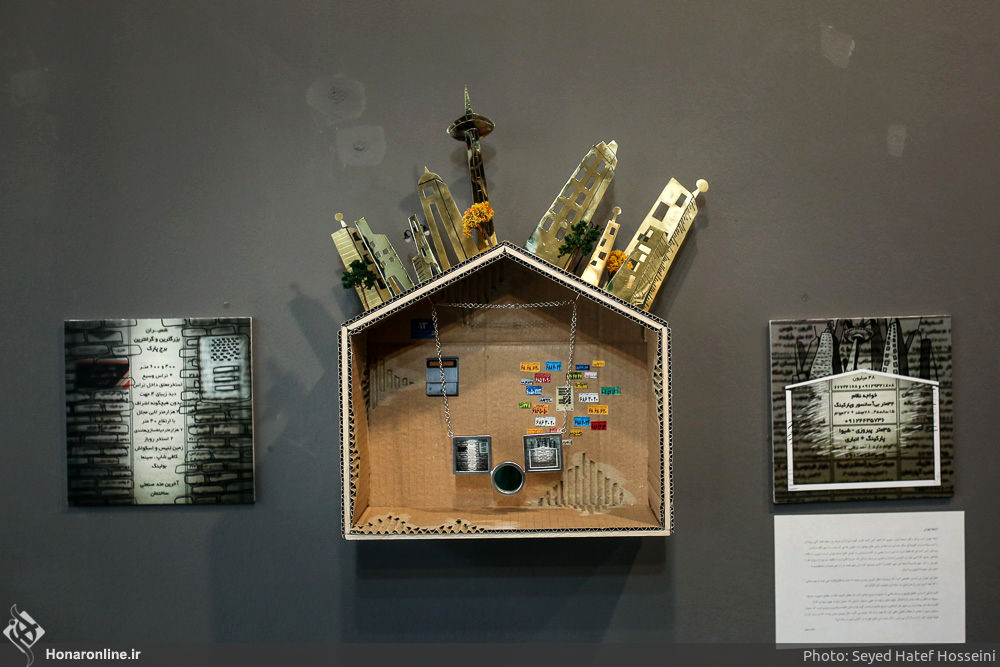
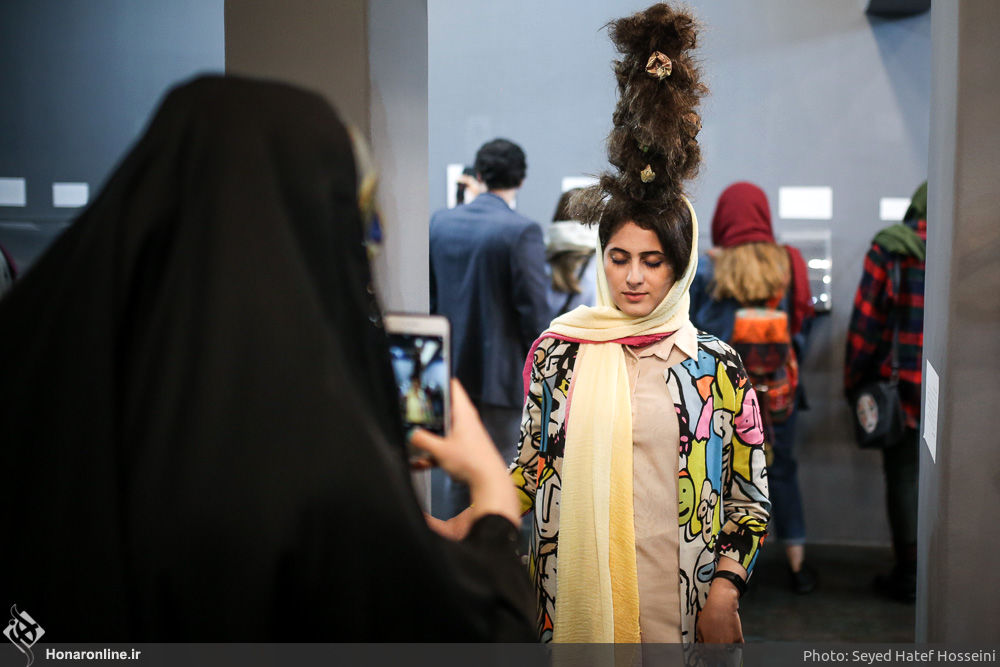
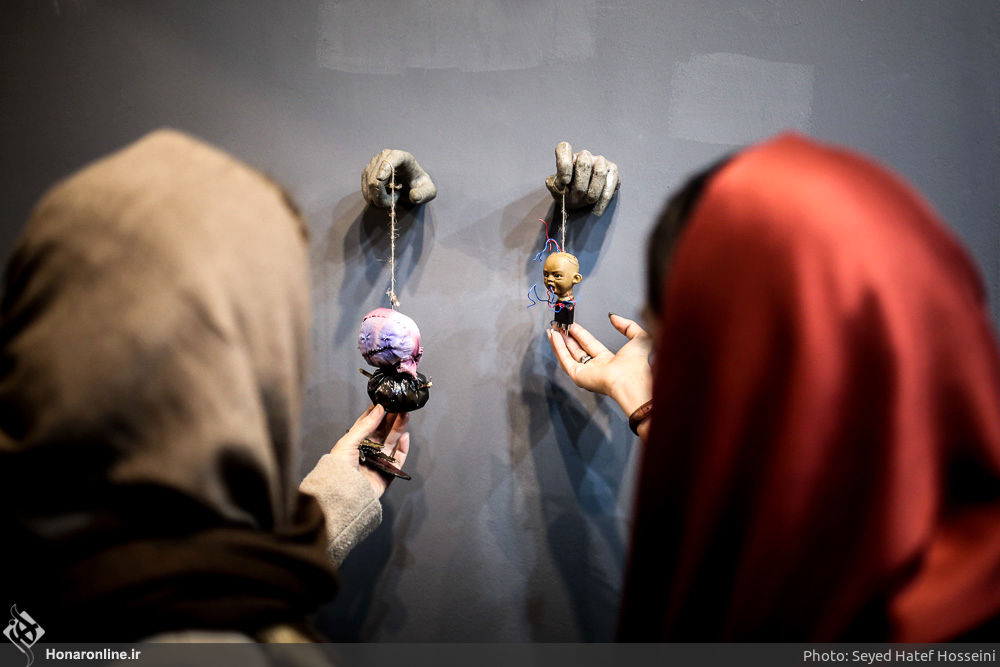
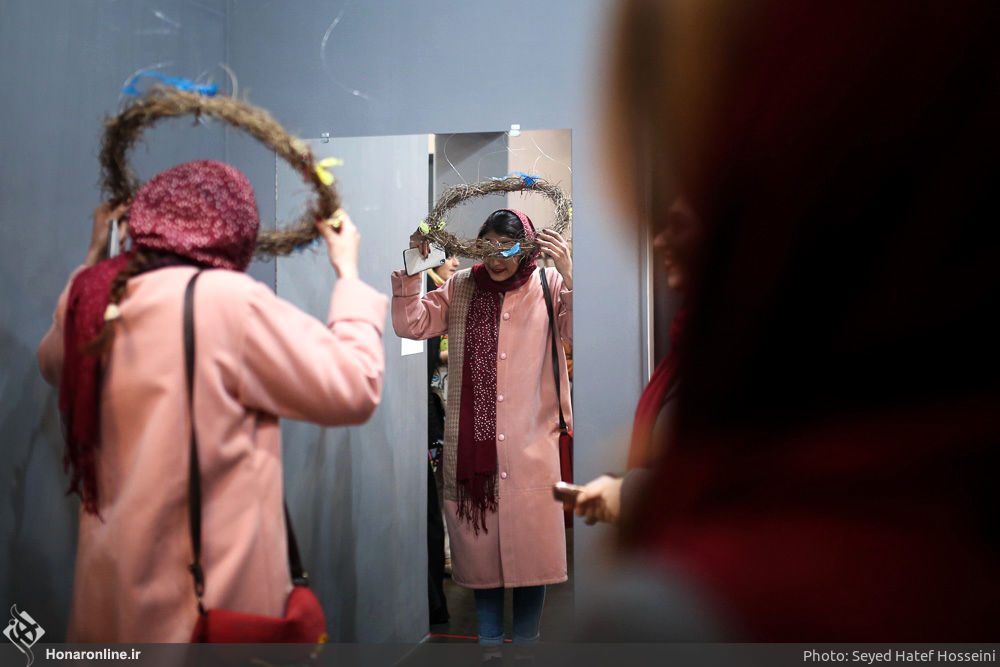
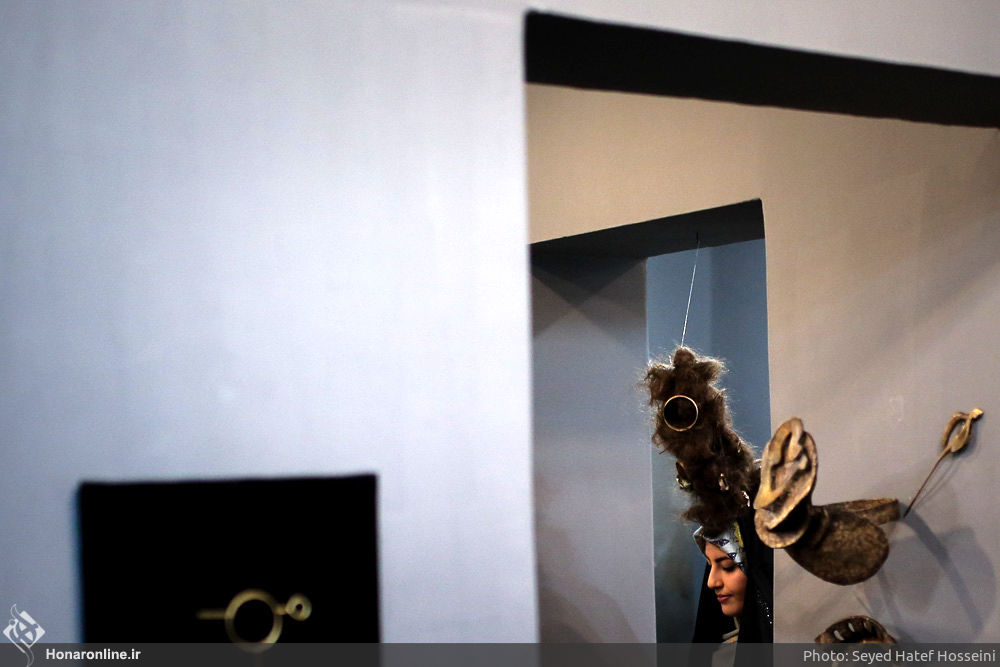
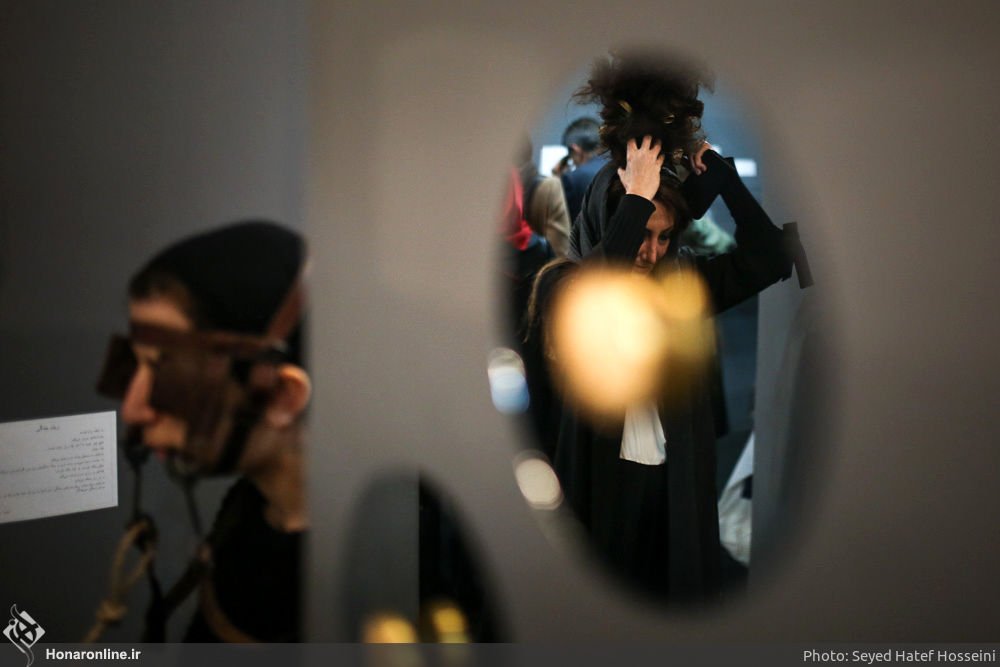
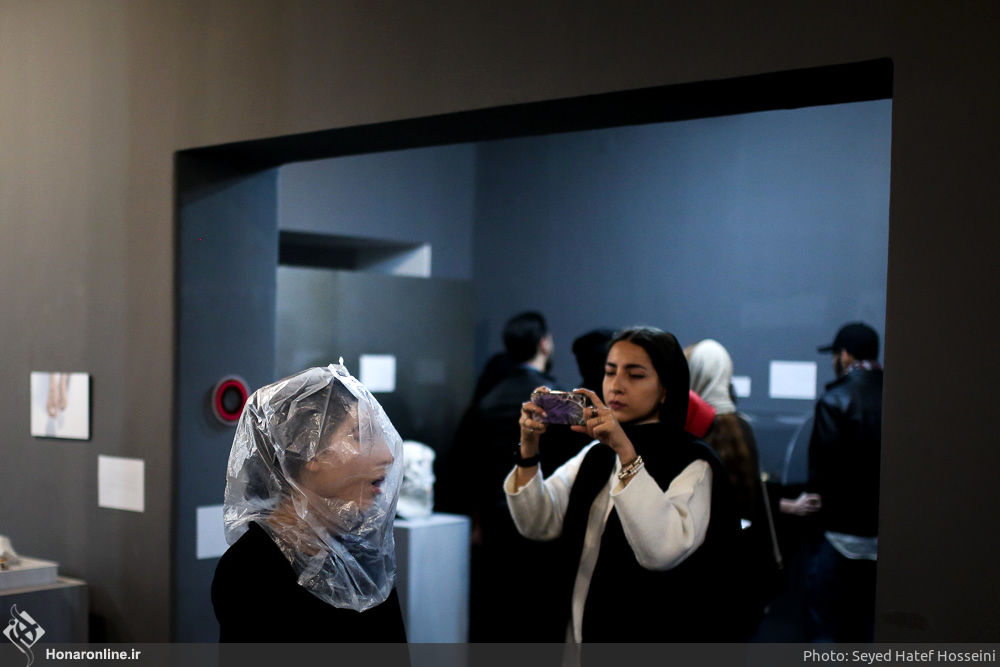
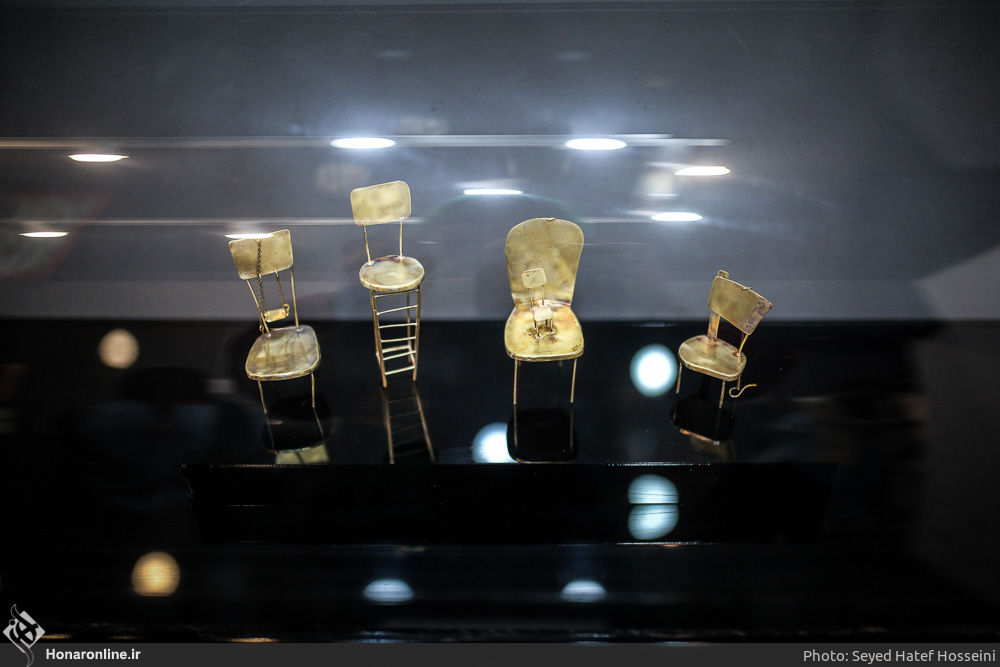
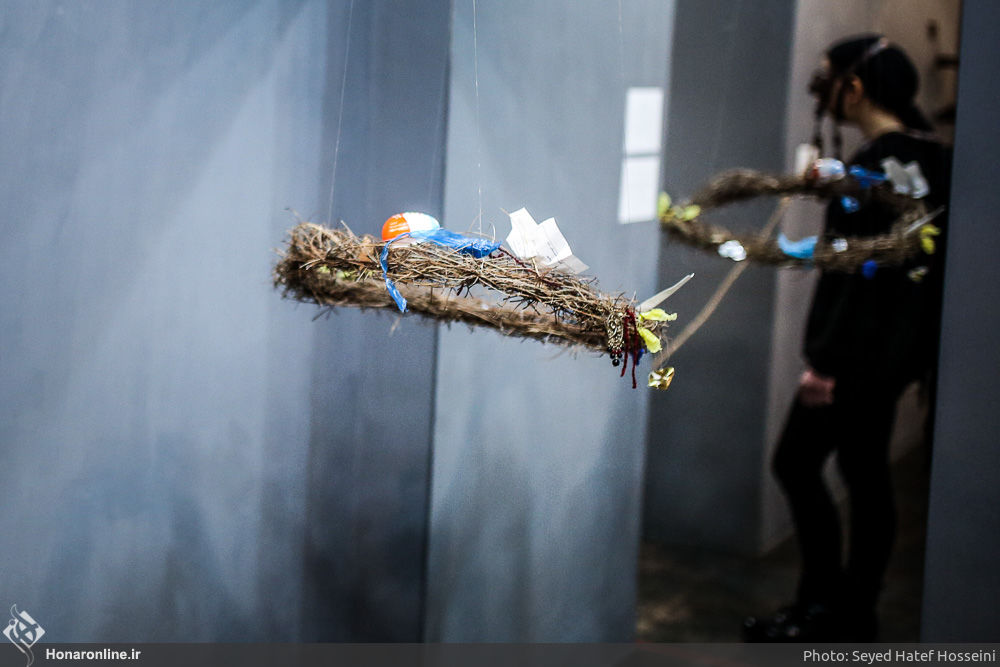
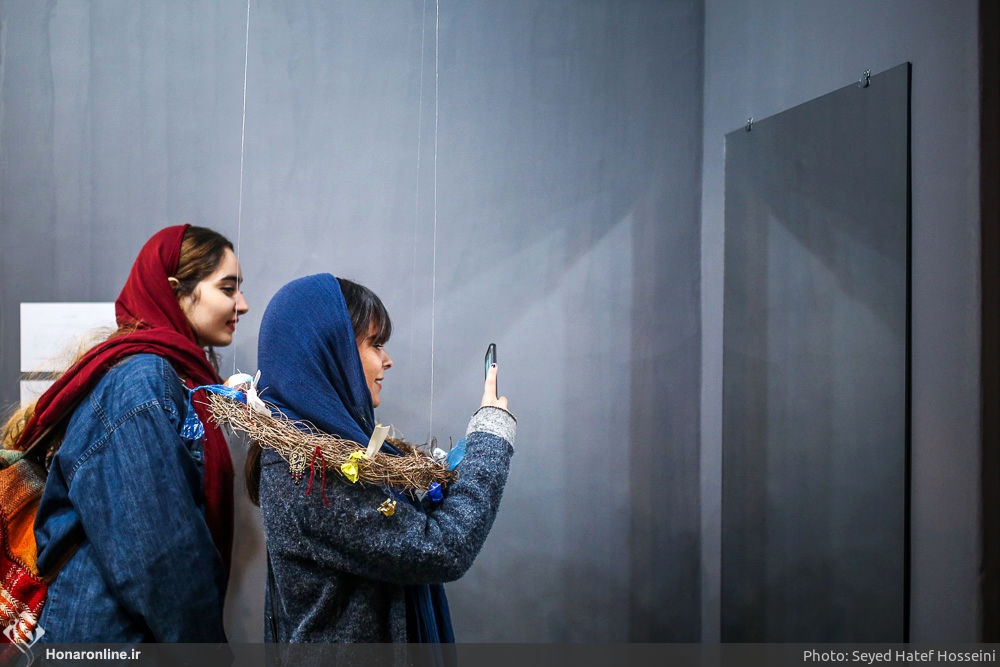
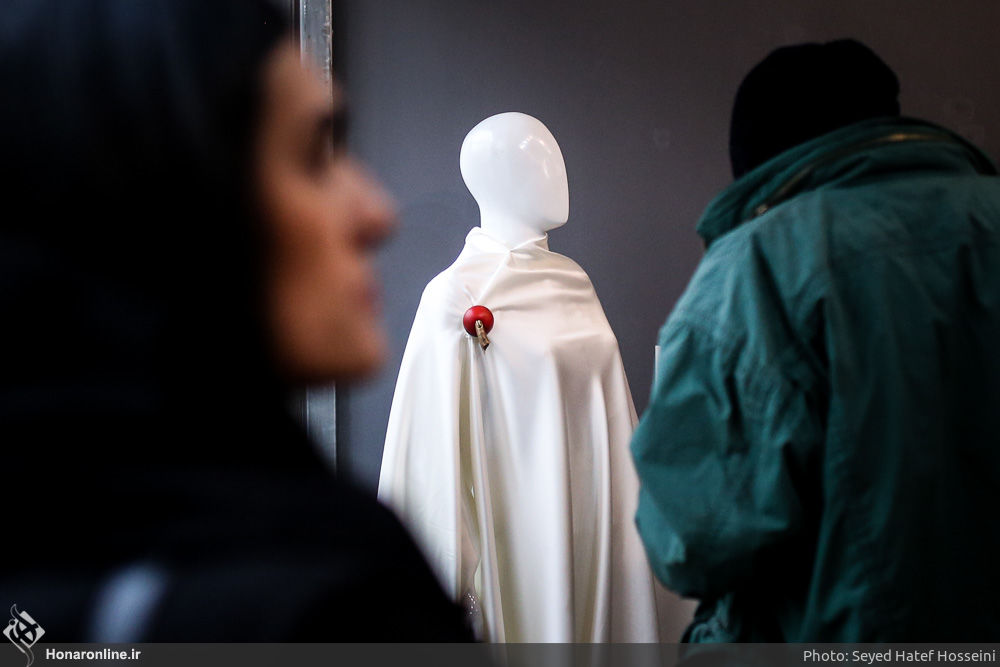
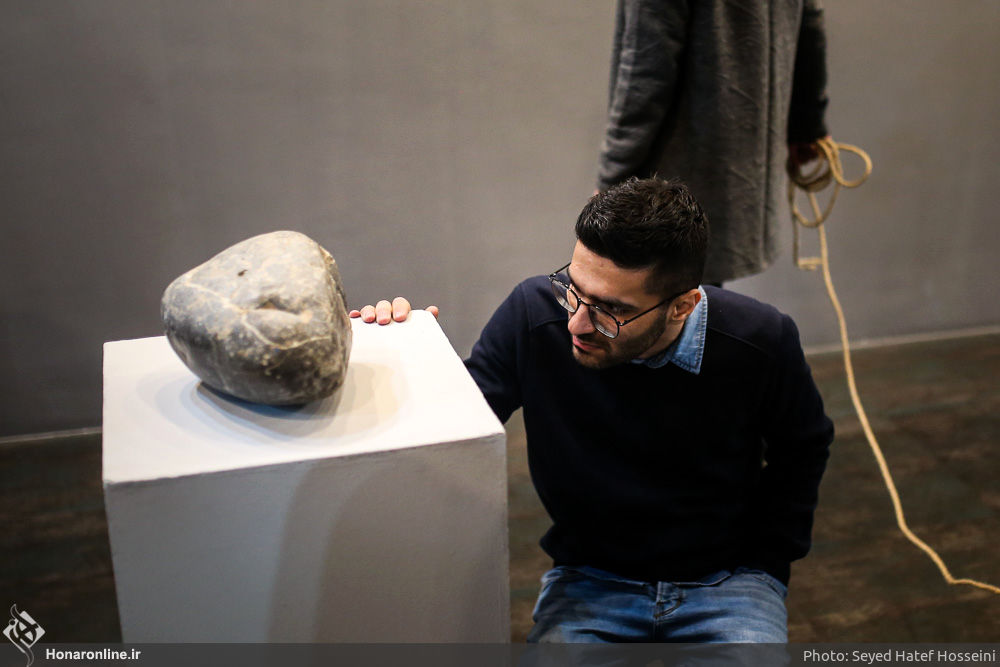
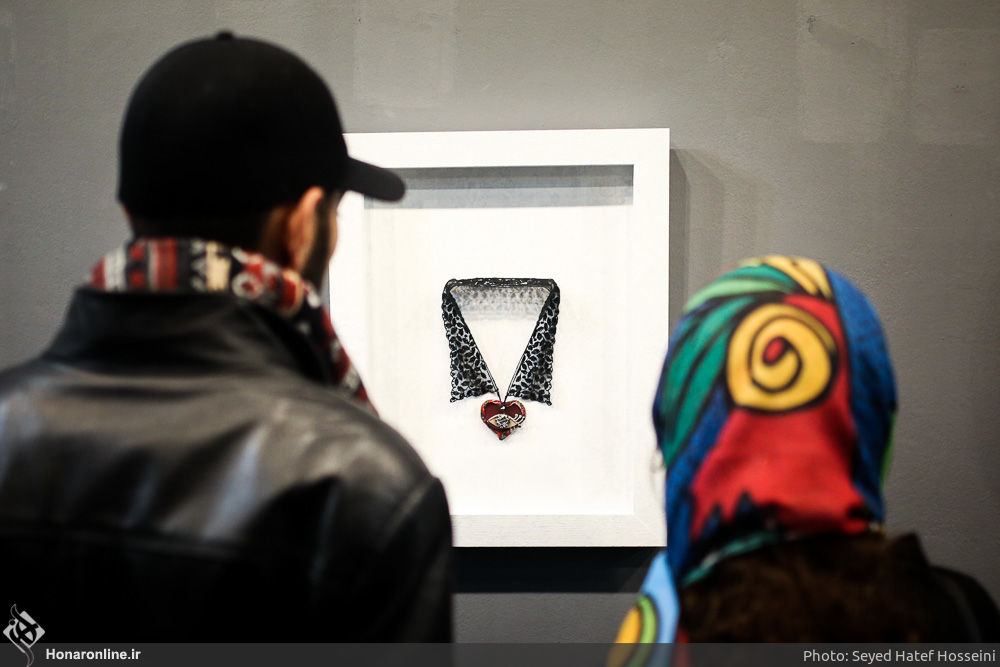
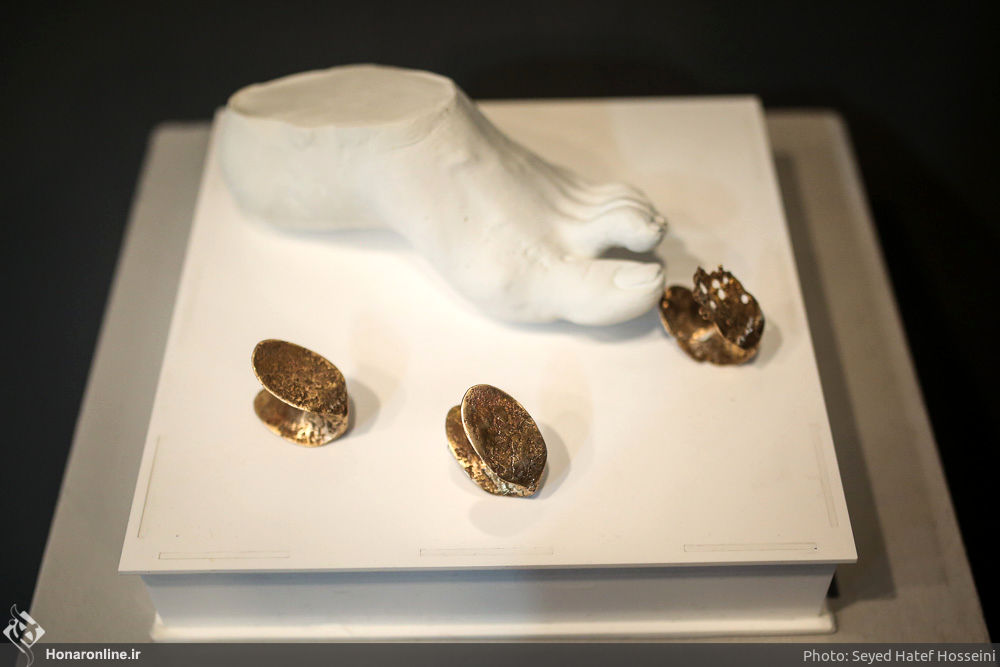
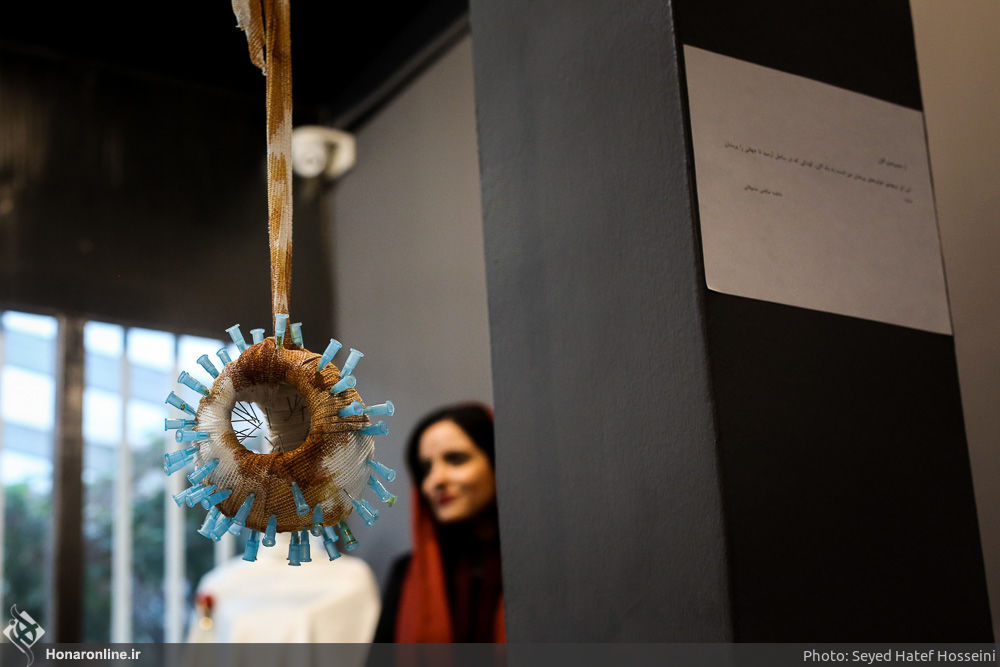
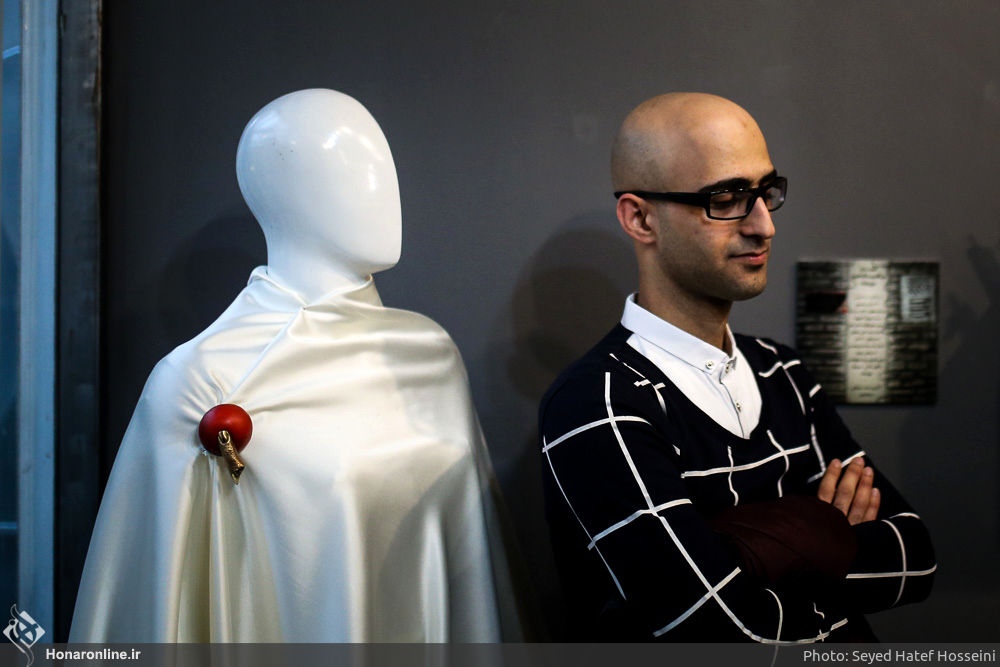
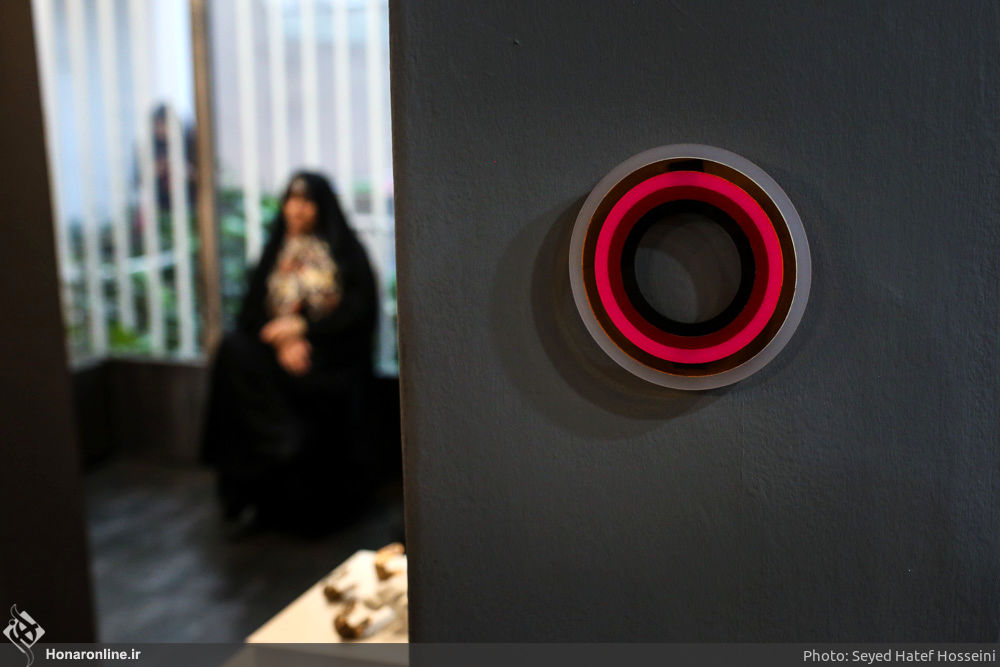
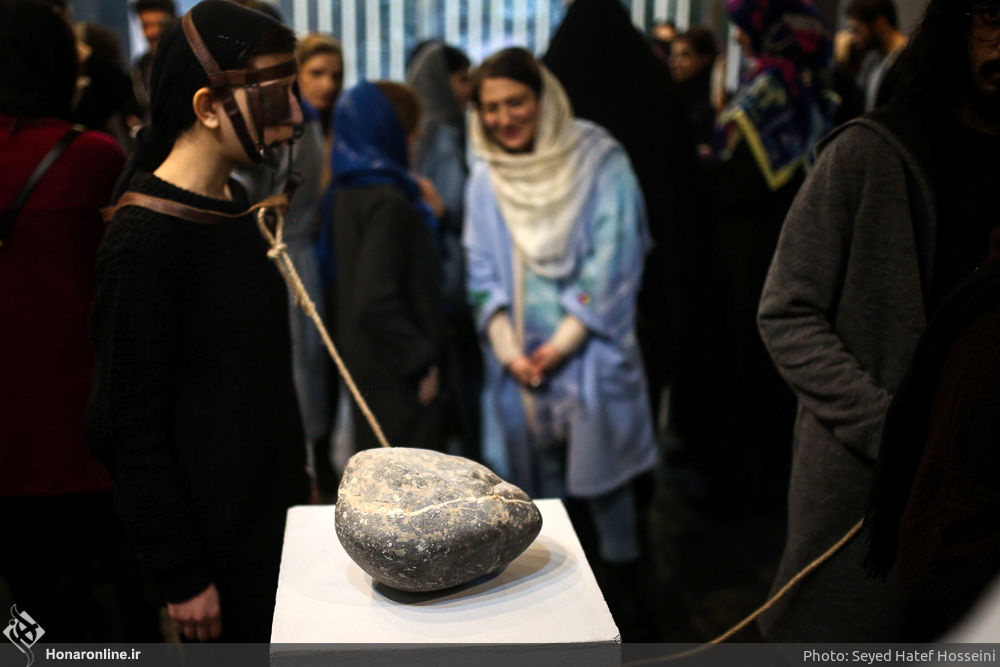
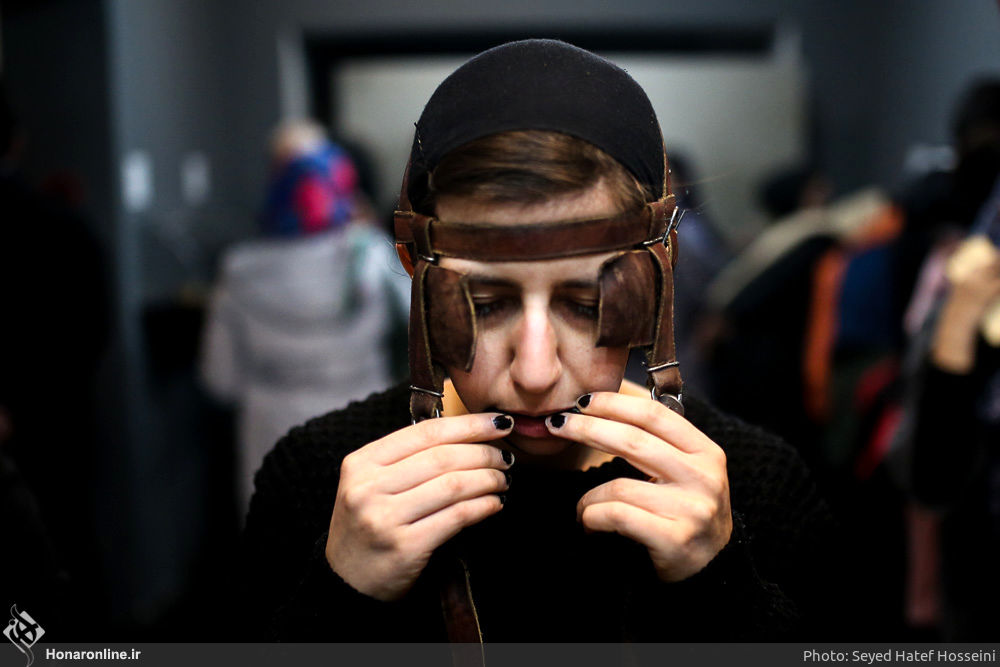
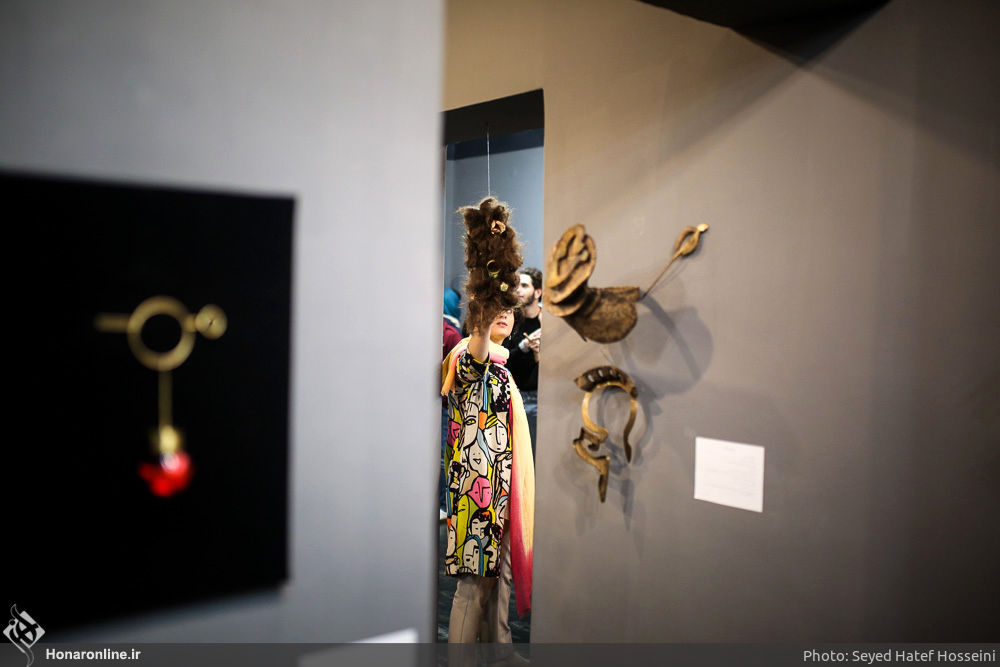
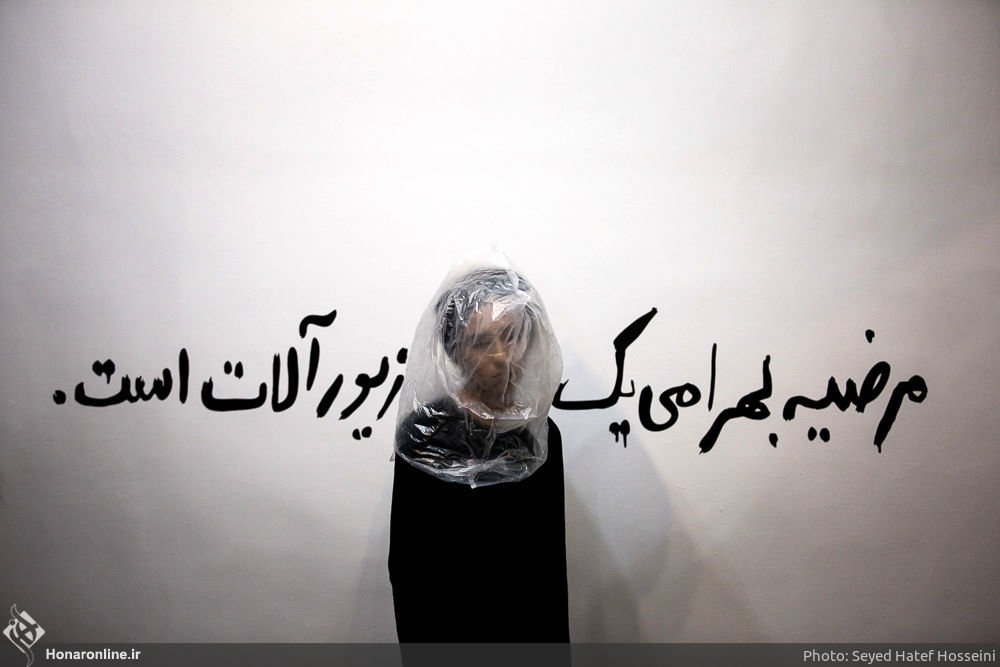
Tehran Hosting Exhibition of Contemporary Art Jewelry

The main goal of the exhibition, the organizers say, is to challenge the modern world’s social, cultural and political issues.

Modern art jewelry builds on the common features of various art forms like sculpture, painting, industrial designing, and fashion designing, and has managed to gain a special and independent status for itself.

Other goals of the event include understanding the current potential in art jewelry, unveiling new trends in this area, getting familiar with the contemporary art practices, ideas, technologies and patterns in art jewelry, offering new insights to visitors with a focus on creativity in choosing raw materials, and combining them together and making unique pieces.

The exhibition also seeks to increase the visual quality of works with a focus on the new concepts of today’s world, pay special attention to non-decorative aspects of jewelry and lay the ground for Iranian artists’ presence in various national and international arenas.

The exhibition will be underway until March 11.

The following photos of the exhibition have been retrieved from Honar Online website:

Iran Must Enjoy Benefits of Implementing Palermo Convention: VP

“Some say there is no need to adhere to the convention when there are similar regulations inside the country. I say the opposite and believe that when we have to meet commitments to the convention inside the country, we should ask other parties to implement the same for Iran,” said Joneydi Tuesday.
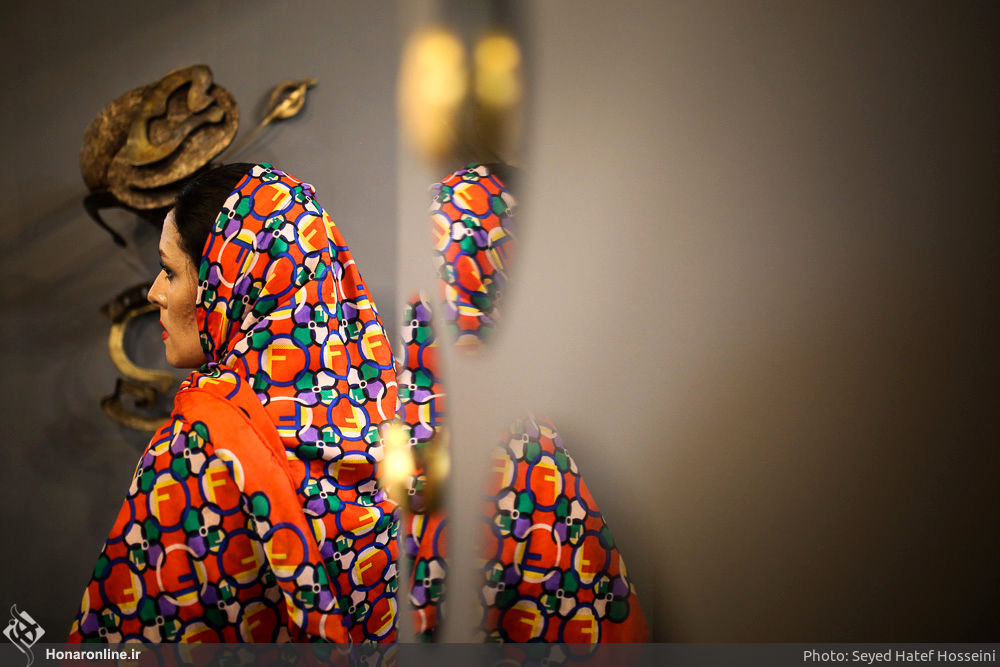
She further noted that when a crime occurs or the perpetrator escapes, we should ask the other member states to extradite the perpetrator or give information about the possible crime based on the Convention. “We can also exchange criminals with other countries if we join it.”
“We should be able to benefit from the conventions and to do so we must join the Palermo Convention,” underscored Joneydi.

The United Nations Convention against Transnational Organised Crime, adopted by General Assembly resolution on November 15, 2000, is the main international instrument in the fight against transnational organised crime. It was opened for signature by member states at a conference convened for that purpose in Palermo, Italy.

The convention is further supplemented by three protocols, which target specific areas and manifestations of organised crime: the protocol to prevent, suppress and punish trafficking in persons, especially women and children; the protocol against the smuggling of migrants by land, sea and air; and the protocol against the Illicit manufacturing and trafficking of firearms.

Pakistan Says Has Warded Off Indian Submarine

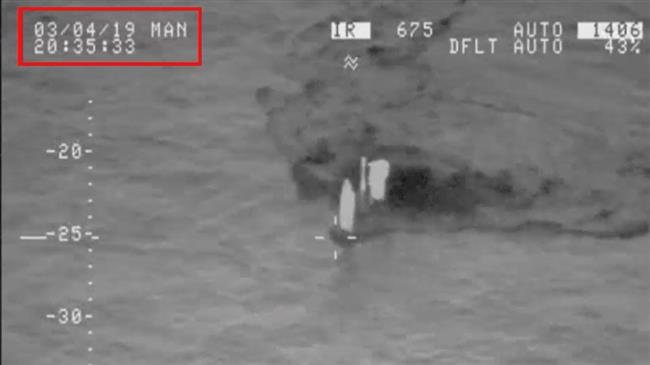
The Pakistani Navy said in a statement on Tuesday that the navy “used its specialized skills to ward off the submarine, successfully keeping it from entering Pakistani waters” on Monday night.

“This great feat is a testament of the Pakistan Navy’s superior skills. The Navy will keep defending Pakistan’s naval border. The force has the capability to respond to any aggression,” it said.

The Navy said its forces did not target the submarine due to a government policy of maintaining peace with New Delhi.

India is yet to comment on the Pakistani allegation.

In another confrontation, Indian media cited unnamed sources as saying that an Indian Sukhoi-30 warplane had shot down a Pakistani drone near the city of Bikaner in the northern Indian state of Rajasthan on Monday.

If confirmed, the submarine incident would be the latest in a series of confrontations since last week, when India conducted “preemptive” airstrikes inside Pakistan against what was said to be a militant training camp belonging to the Pakistan-based Jaish-e-Mohammad (JeM) militant group. The outfit had claimed responsibility for an attack on an Indian security convoy in Pulwama, Indian-administered Kashmir, on February 14. That attack killed more than 40 Indian troops.

India claimed its airstrikes had killed some 300 militants. Pakistan, however, denied that the Indian raids had left any casualties or material damage.

Pakistan retaliated last Wednesday, and also shot down two Indian fighter jets that violated its airspace. It also captured one of the pilots of the warplanes. Two days later, however, it released the pilot in a “peace gesture.”

The two have long been engaged in a conflict over the disputed region of Jammu and Kashmir. They have fought four wars since their partition in 1947, three of them over Kashmir.

‘Iran Doing Whatever It Can to Ease India-Pakistan Conflict’

Zarif said on Tuesday he has talked to the Pakistani foreign minister, and is in contact with Indian officials, too, in order to “do whatever we can.”

He touched upon the flare-up of tensions between New Delhi and Islamabad, saying, “The continuation of this trend is not in the interests of the region.”

He then referred to border issues between Iran and Pakistan.

“We are also following up on issues in this regard. The Pakistanis have said they would take whatever step necessary to keep past problems from happening again,” said the foreign minister.

India last week conducted “preemptive” airstrikes inside Pakistan against what was said to be a militant training camp belonging to the Pakistan-based Jaish-e-Mohammad (JeM) militant group.

The outfit had claimed responsibility for an attack on an Indian security convoy in Pulwama, Indian-administered Kashmir, on February 14. That attack killed more than 40 Indian troops.

India claimed its airstrikes had killed some 300 militants. Pakistan, however, denied that the Indian raids had left any casualties or material damage.

Pakistan retaliated last Wednesday, and also shot down two Indian fighter jets that violated its airspace. It also captured one of the pilots of the warplanes. Two days later, however, it released the pilot in a “peace gesture.”

The two have long been engaged in a conflict over the disputed region of Jammu and Kashmir. They have fought four wars since their partition in 1947, three of them over Kashmir.

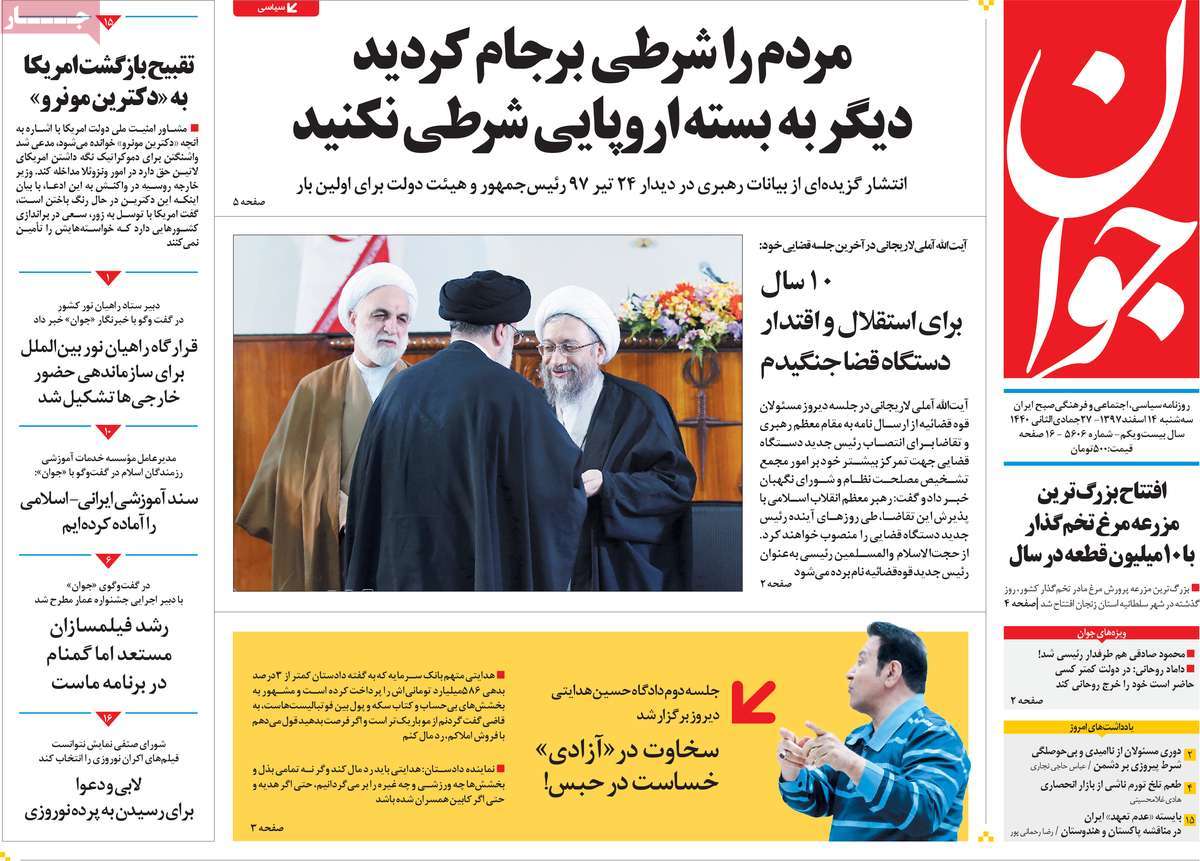
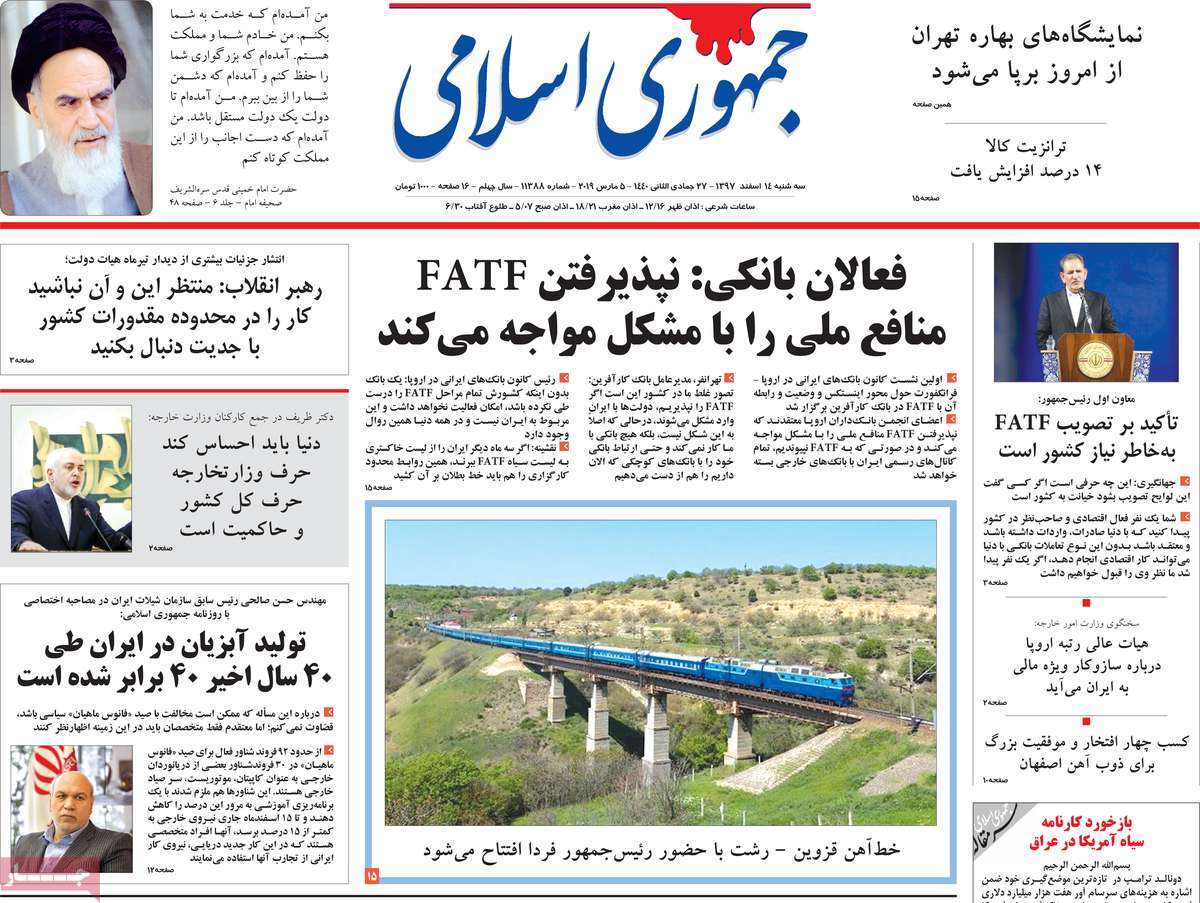
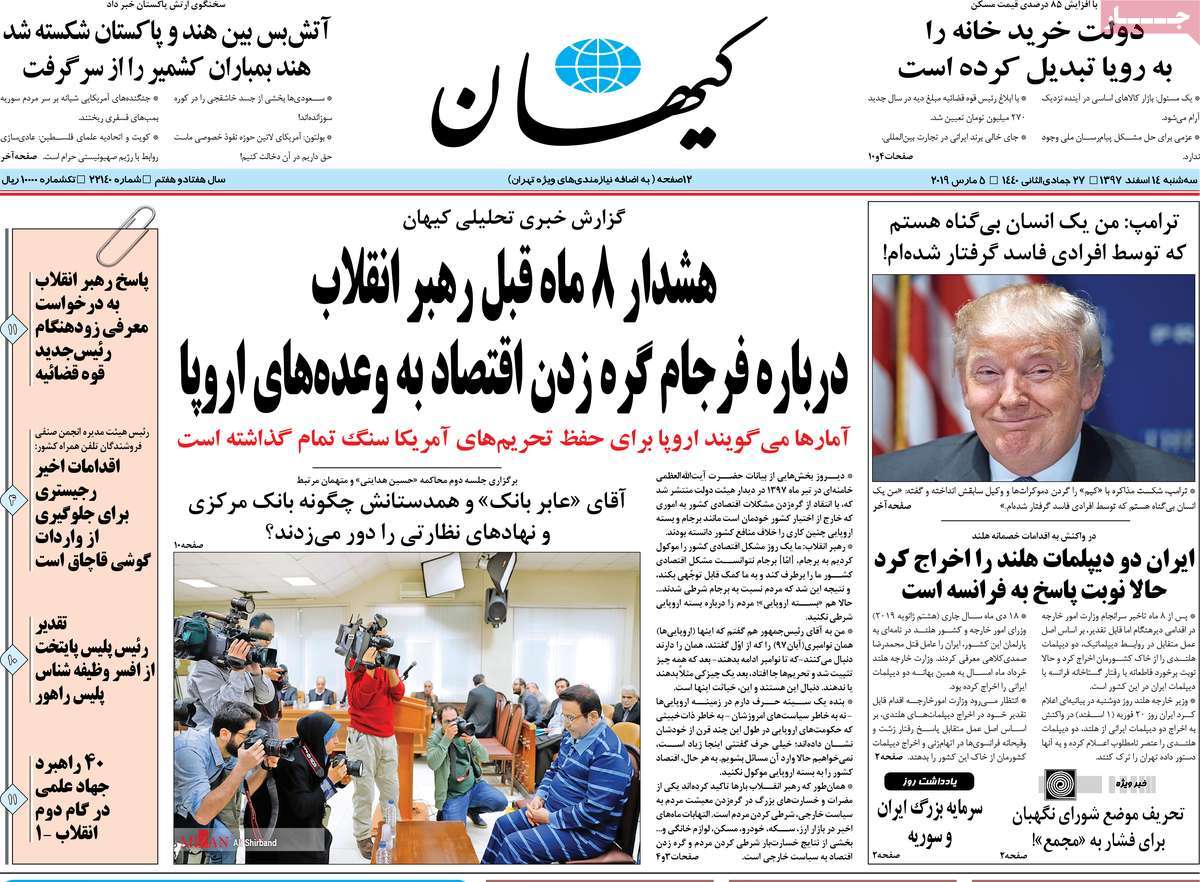
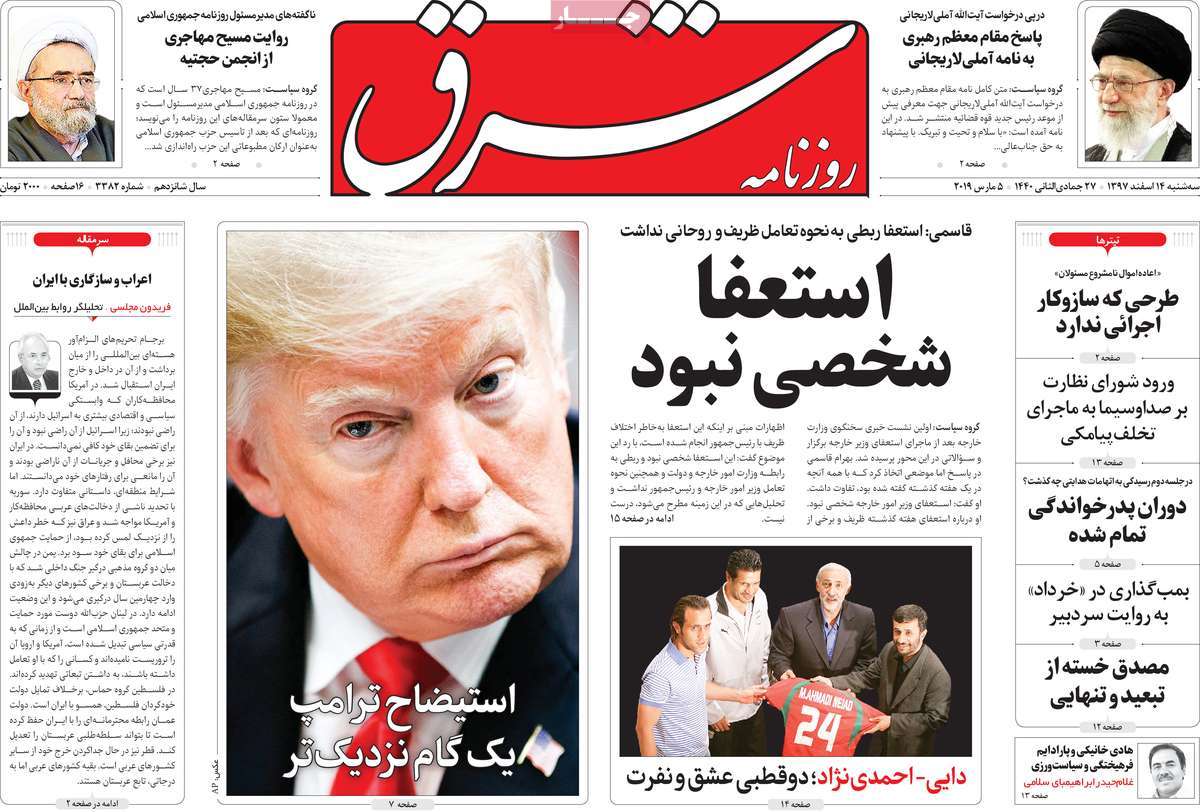
A Look at Iranian Newspaper Front Pages on March 5

A Look at Iranian Newspaper Front Pages on November 19

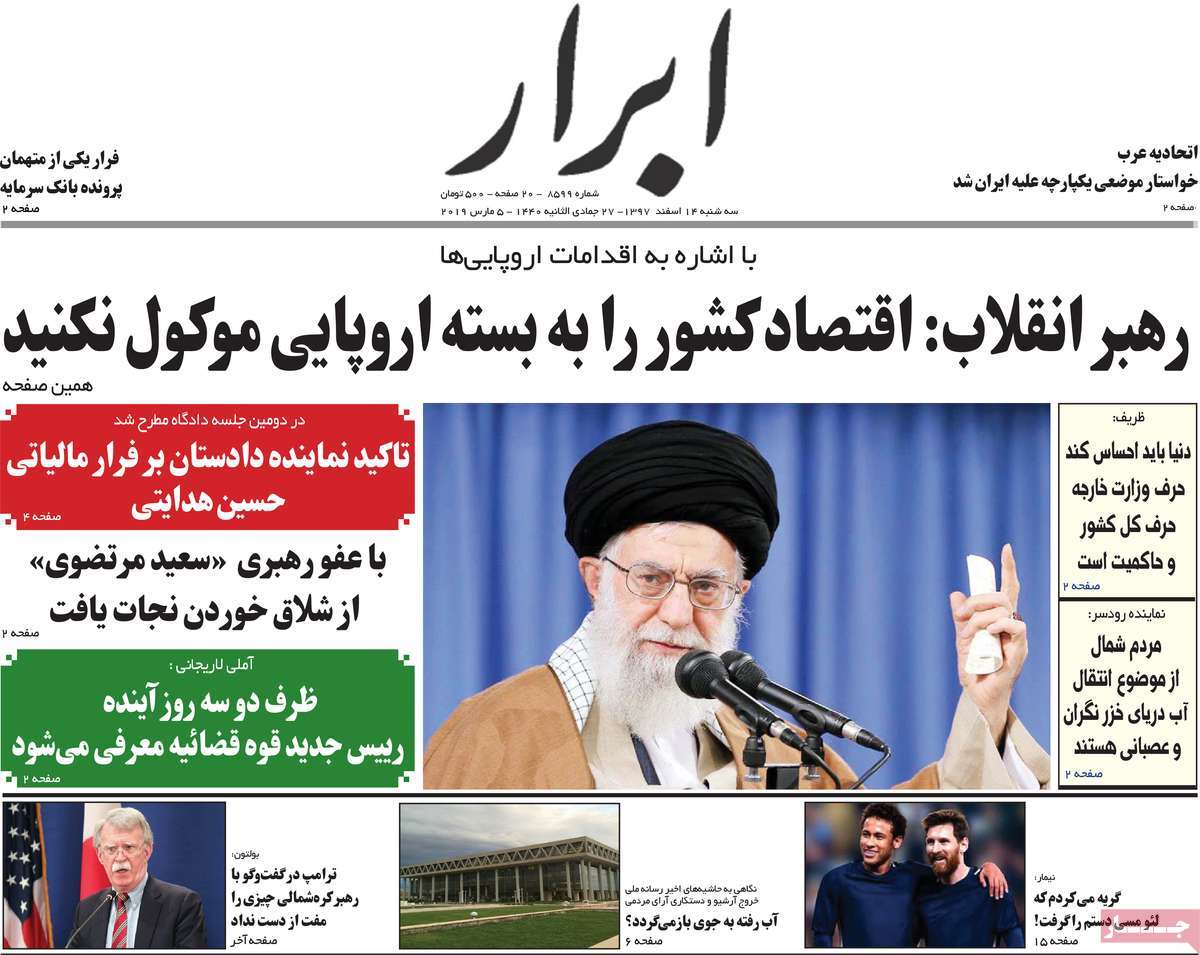
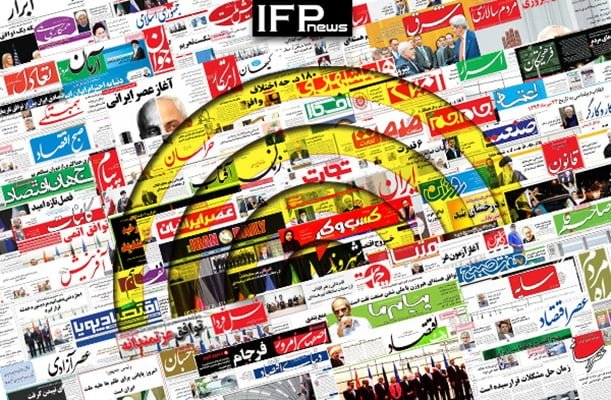
Almost all papers today covered the remarks made by the Leader of Iran’s Islamic Revolution Ayatollah Seyyed Ali Khamenei in a meeting with top government officials eight months ago, during which the Leader warned against making the country’s economy dependent on the European package to save the Iran nuclear deal.

Also a top story today was the last speech of Ayatollah Sadeq Amoli Larijani as the country’s judiciary chief, who is going to be replaced by Seyyed Ebrahim Raisi within a few days.

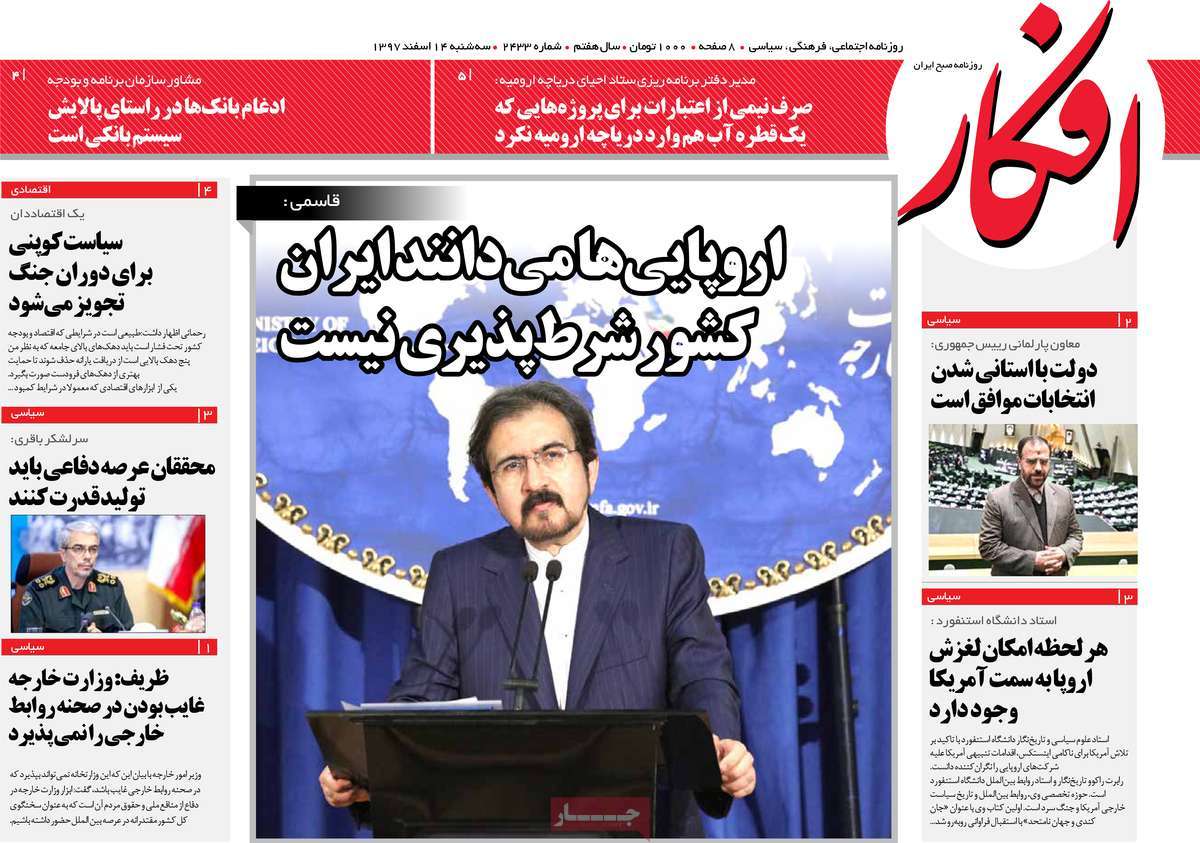
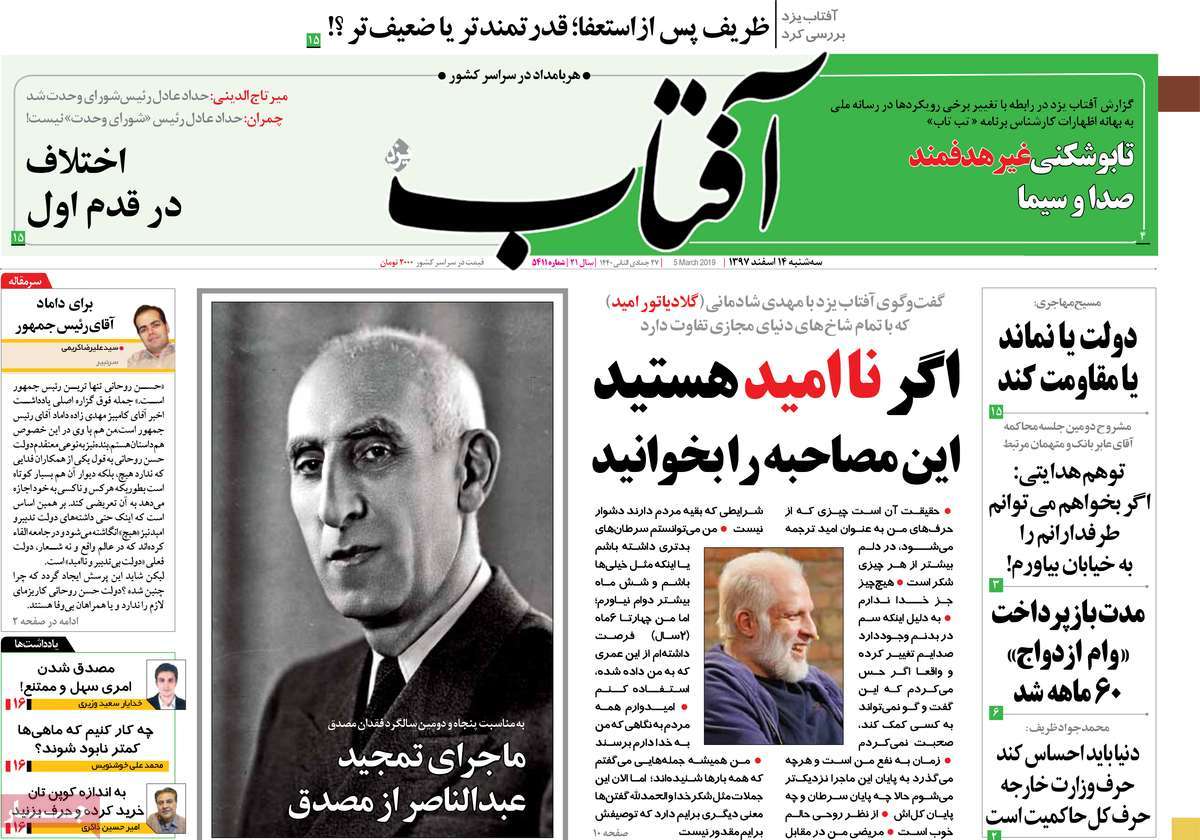
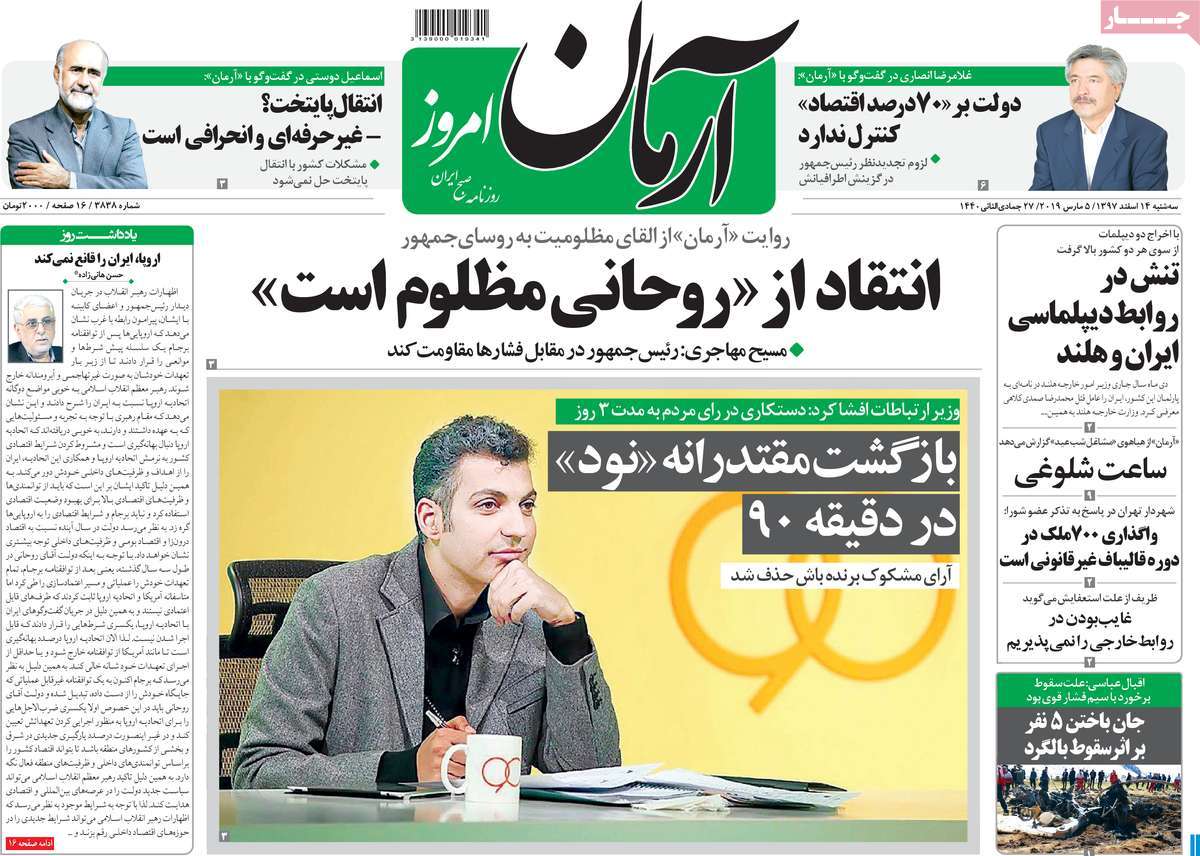
The above issues, as well as many more, are highlighted in the following headlines and top stories:


Abrar:

1- Arab League Urges United Stance against Iran

2- Ayatollah Amoli Larijani: New Judiciary Chief to Start His Work in Next 3 Days

A Look at Iranian Newspaper Front Pages on March 5


Afkar:

1- Europeans Know Iran Doesn’t Accept Conditions

2- Stanford University Professor: Europe May Incline Towards US

A Look at Iranian Newspaper Front Pages on March 5


Aftab-e Yazd:

1- Zarif: World Should Feel Foreign Ministry Says Entire Establishment’s Word

2- Zarif after Resignation: Stronger or Weaker?

A Look at Iranian Newspaper Front Pages on March 5


Arman-e Emrooz:

1- Rouhani Must Resist Pressures: Senior Journalist

2- Europe Not to Convince Iran [Editorial]

3- Tension in Iran-Netherlands Diplomatic Ties

A Look at Iranian Newspaper Front Pages on March 5


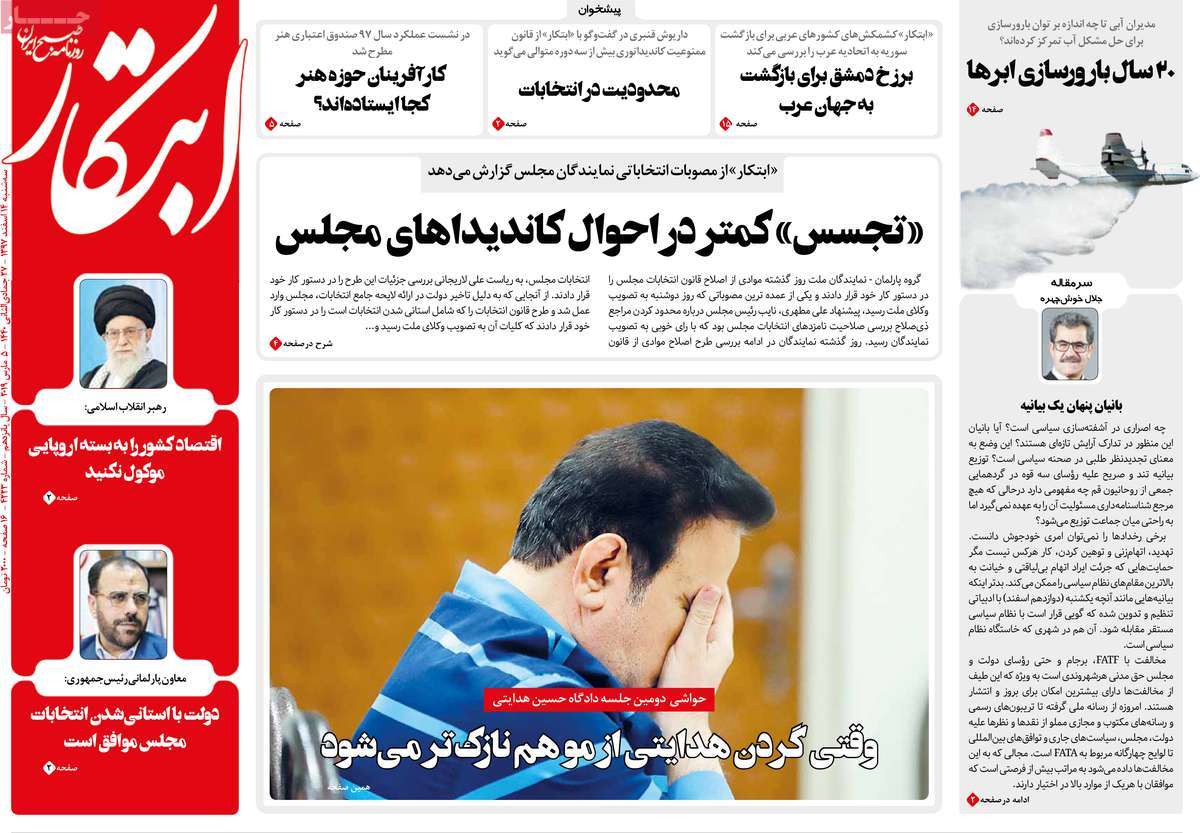
Ebtekar:

1- Damascus’ Return to Arab World in Limbo

2- Iran Leader: Don’t Make Economy Dependent on European Package

A Look at Iranian Newspaper Front Pages on March 5


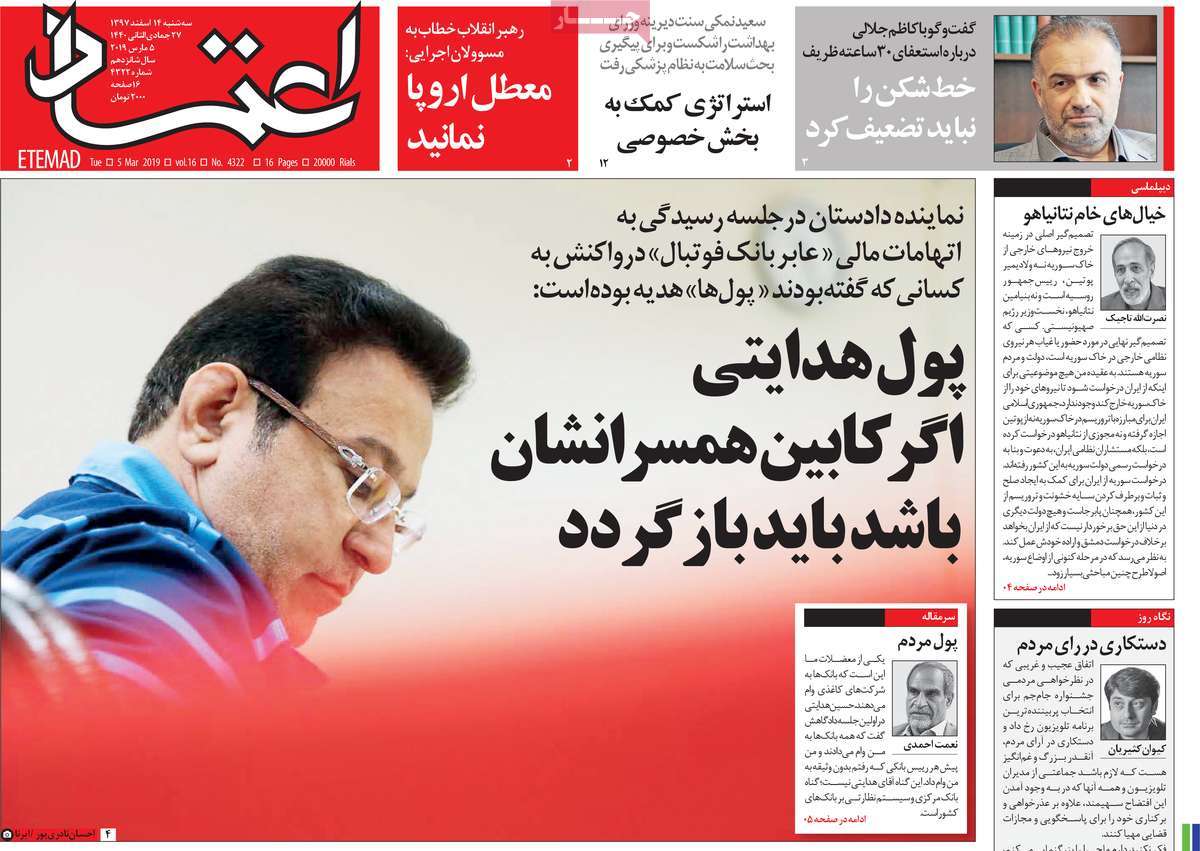
Etemad:

1- Iran Leader to Executive Officials: Don’t Wait for Europe

A Look at Iranian Newspaper Front Pages on March 5


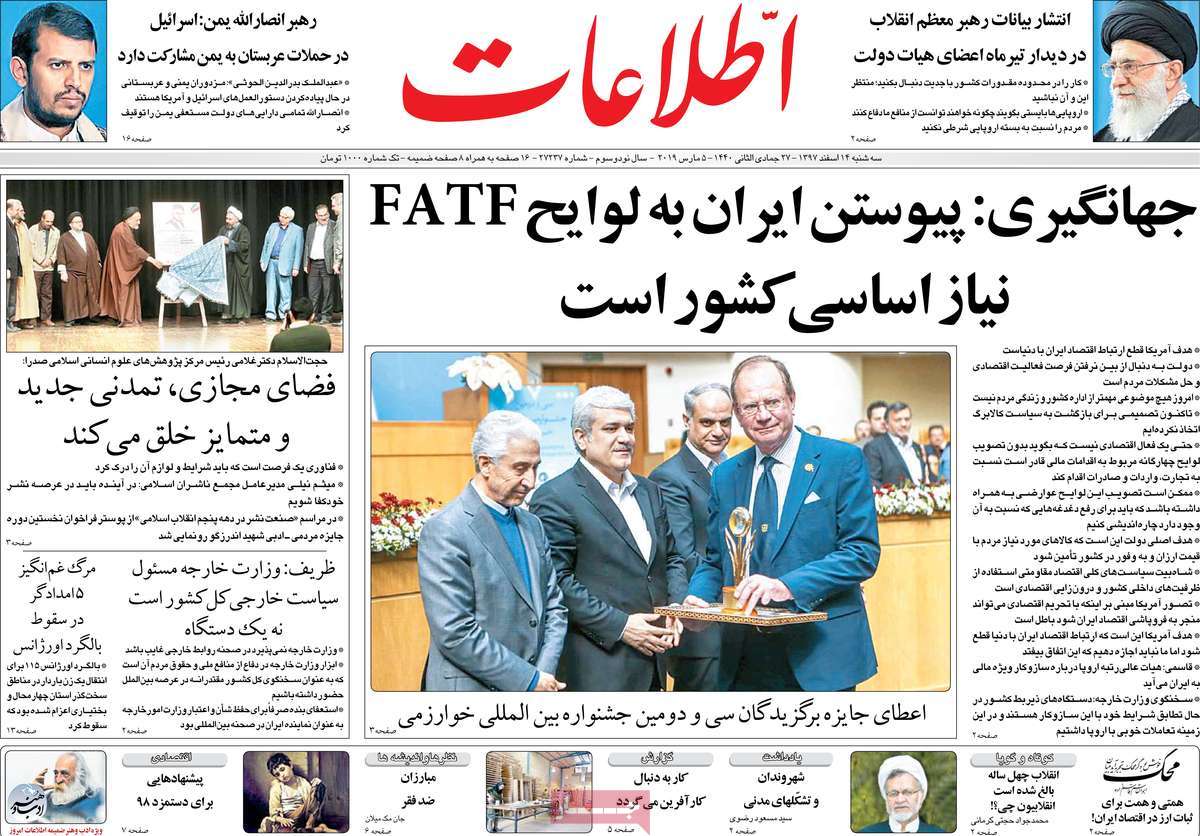
Ettela’at:

1- First VP: FATF Accession Basic Need for Iran

2- Zarif: Foreign Ministry Is in Charge of Entire Country’s Policy, Not Just a Single Body

3- Yemen’s Ansarullah Leader: Israel Cooperating with Saudi in Attacks on Yemen

A Look at Iranian Newspaper Front Pages on March 5


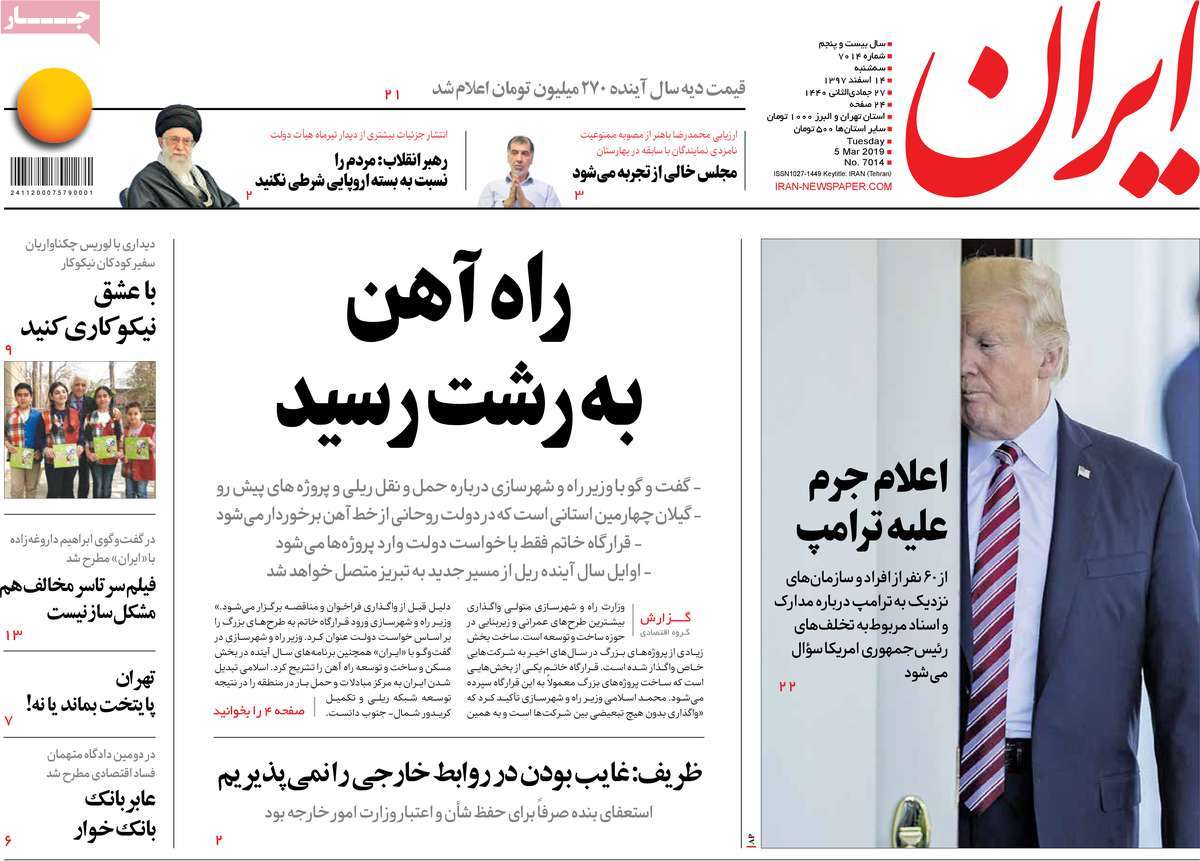
Iran:

1- Indictment of Trump

2- Zarif: I Can’t Accept Being Excluded from Foreign Policy

  • I Resigned Just to Preserve Foreign Ministry’s Dignity

A Look at Iranian Newspaper Front Pages on March 5


Javan:

1- Leader: You’ve Made People Conditioned to JCPOA, Don’t Do It on European Package

2- Amoli Larijani: I Fought for Judiciary’s Independence, Strength for 10 Years

A Look at Iranian Newspaper Front Pages on March 5


Jomhouri Eslami:

1- Bankers: Refusing to Accept FATF Will Create Problem for National Interests

2- Iran Leader: Don’t Wait for Anyone, Do Your Work Seriously

3- Iran: High-Ranking European Delegation to Visit Tehran on INSTEX

A Look at Iranian Newspaper Front Pages on March 5


Kayhan:

1- Leader Had 8 Months Ago Warned about Fate of Making Economy Dependent on Europe’s Promise

2- Ceasefire between India, Pakistan Violated: India Resumes Bombing Kashmir

3- Trump: I’m an Innocent Man Surrounded by Corrupt People

4- Iran Expels Two Diplomats, Now It’s Time to Respond to France

A Look at Iranian Newspaper Front Pages on March 5


Shargh:

1- One Step Closer to Impeaching Trump

2- Zarif’s Resignation Not Personal, Had Nothing to Do with His Interaction with Rouhani

3- Arabs and Compromise with Iran [Editorial]

A Look at Iranian Newspaper Front Pages on March 5

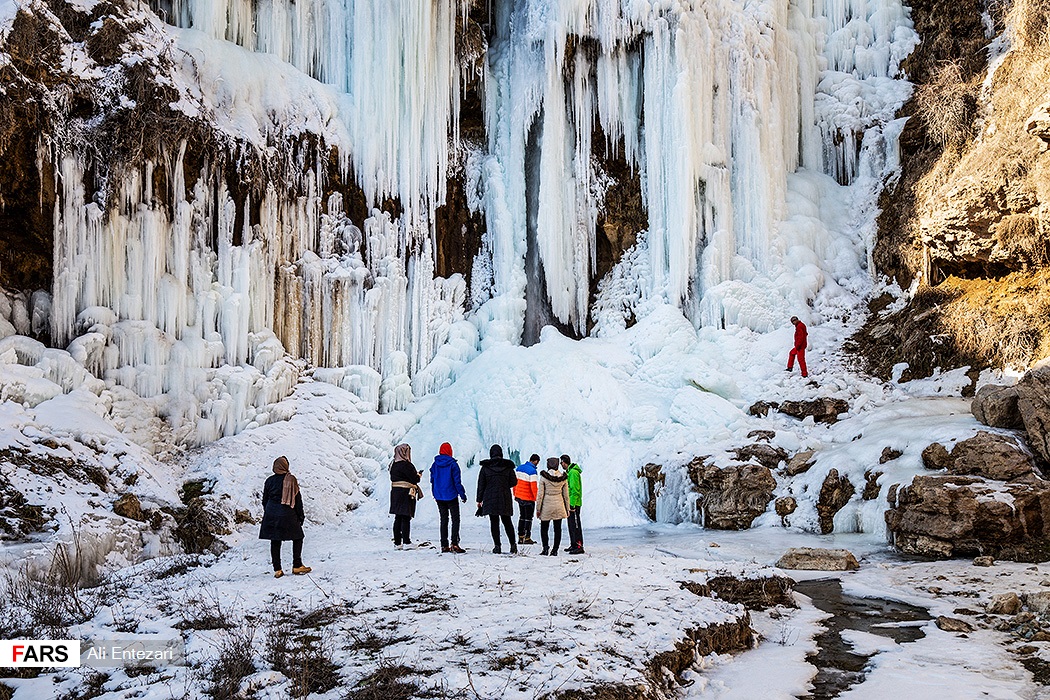
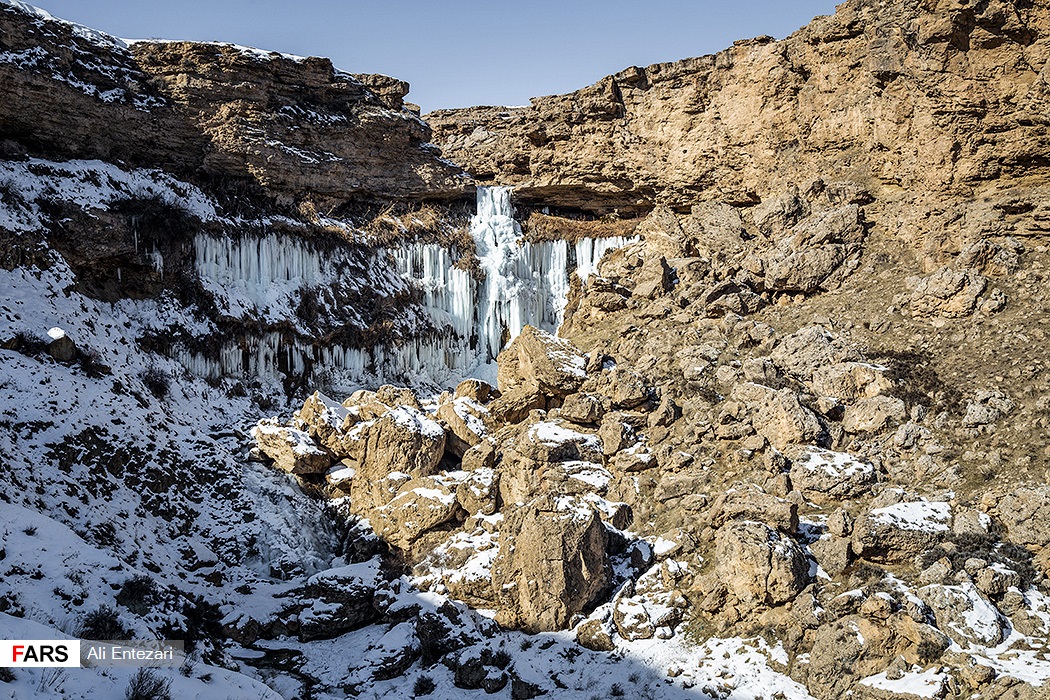
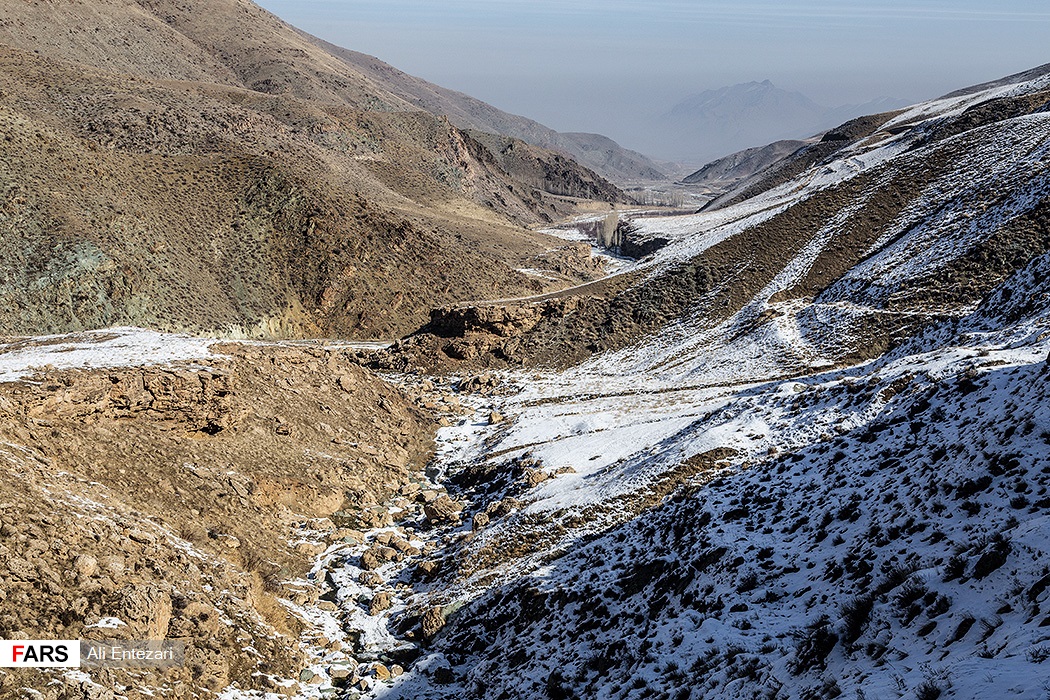
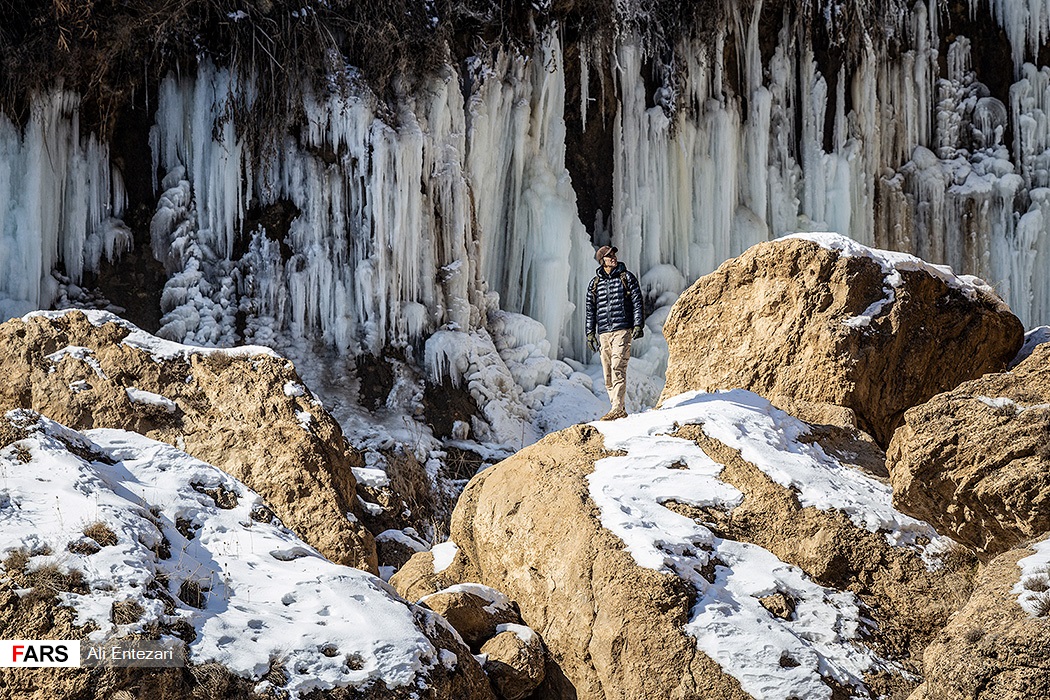
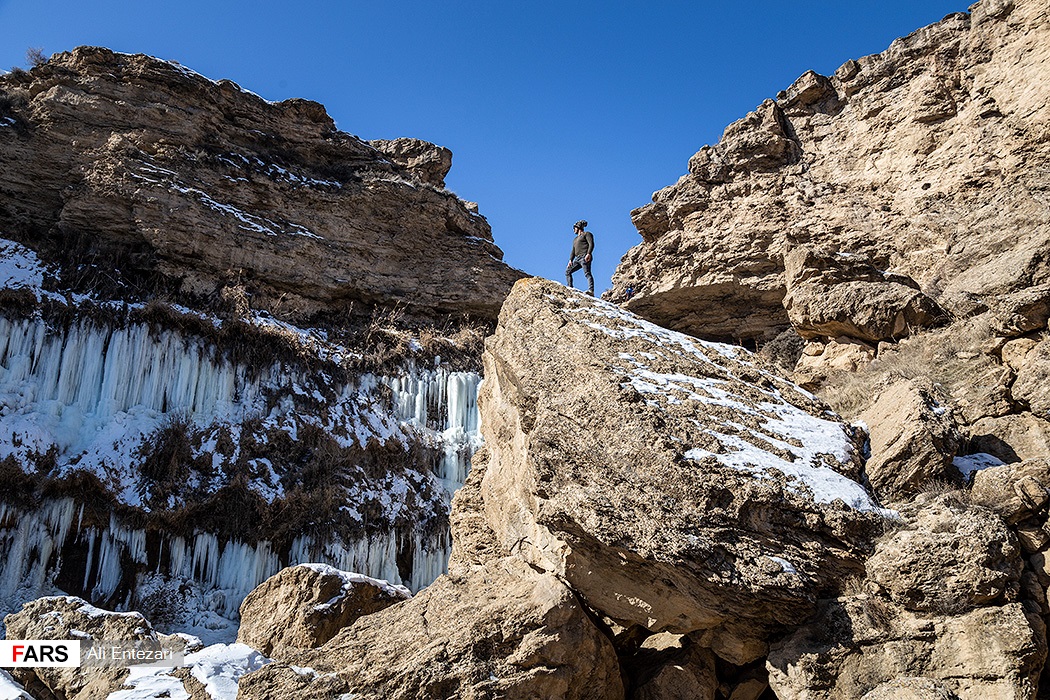
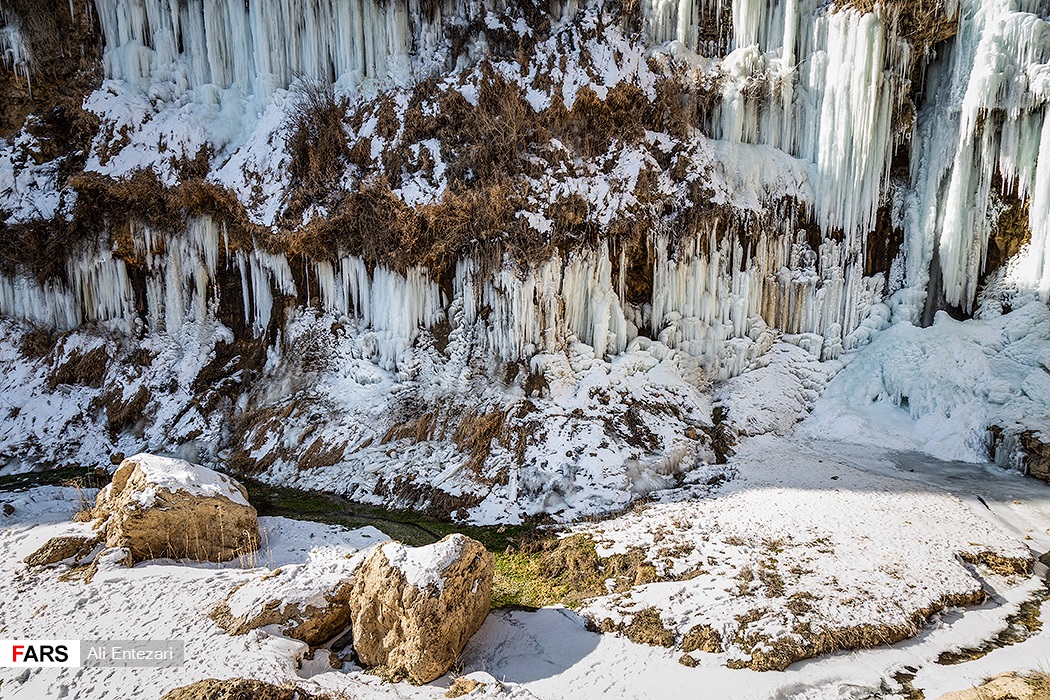
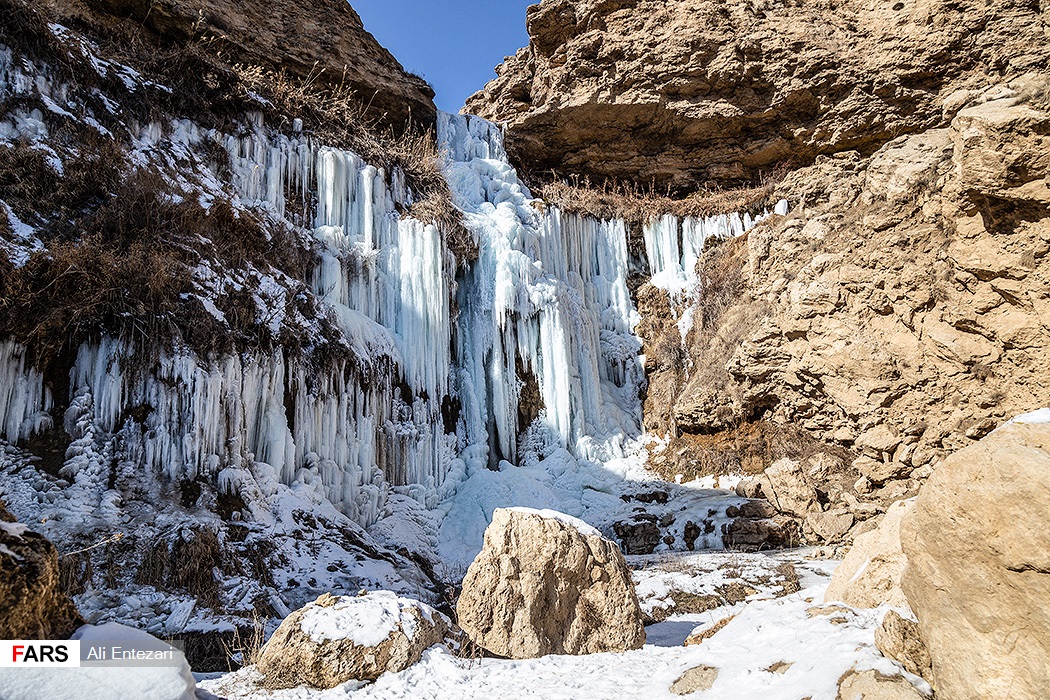
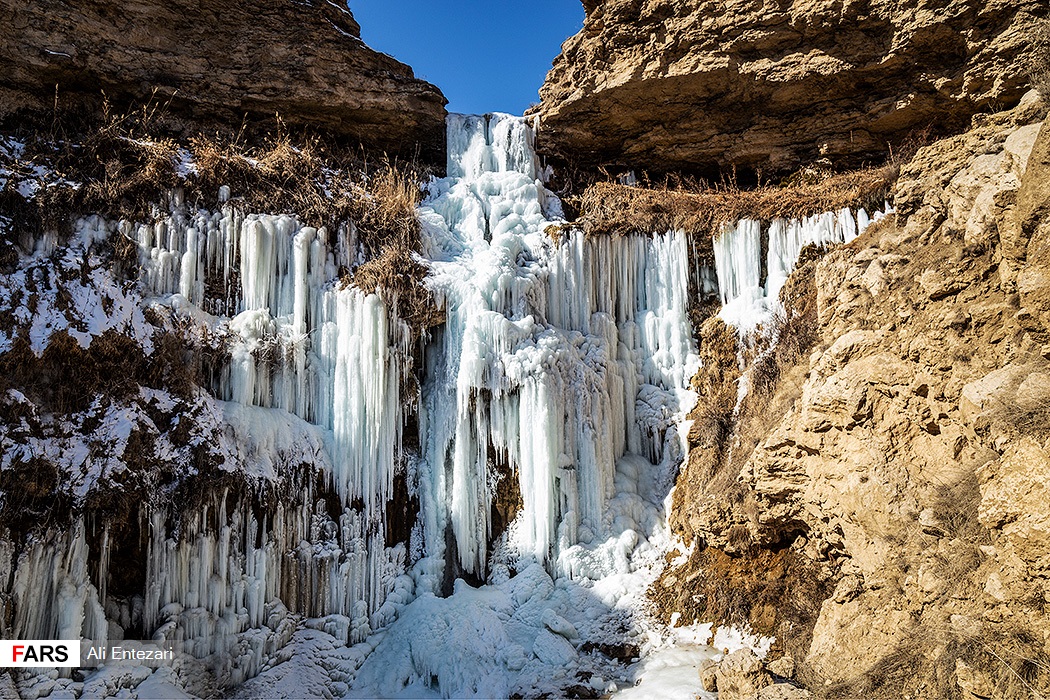
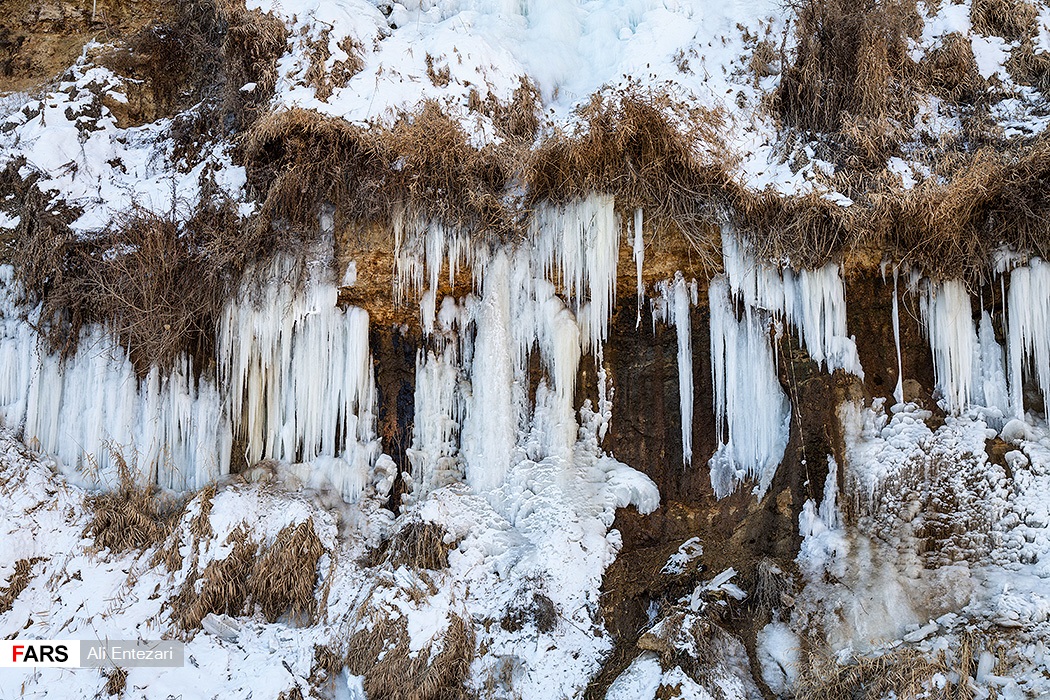
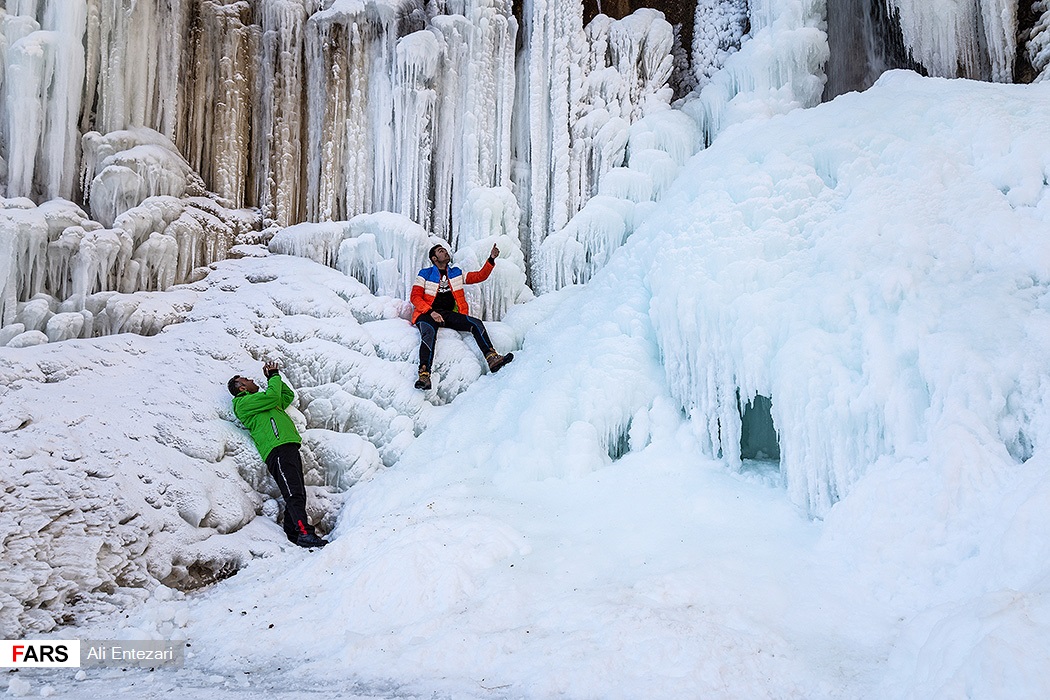
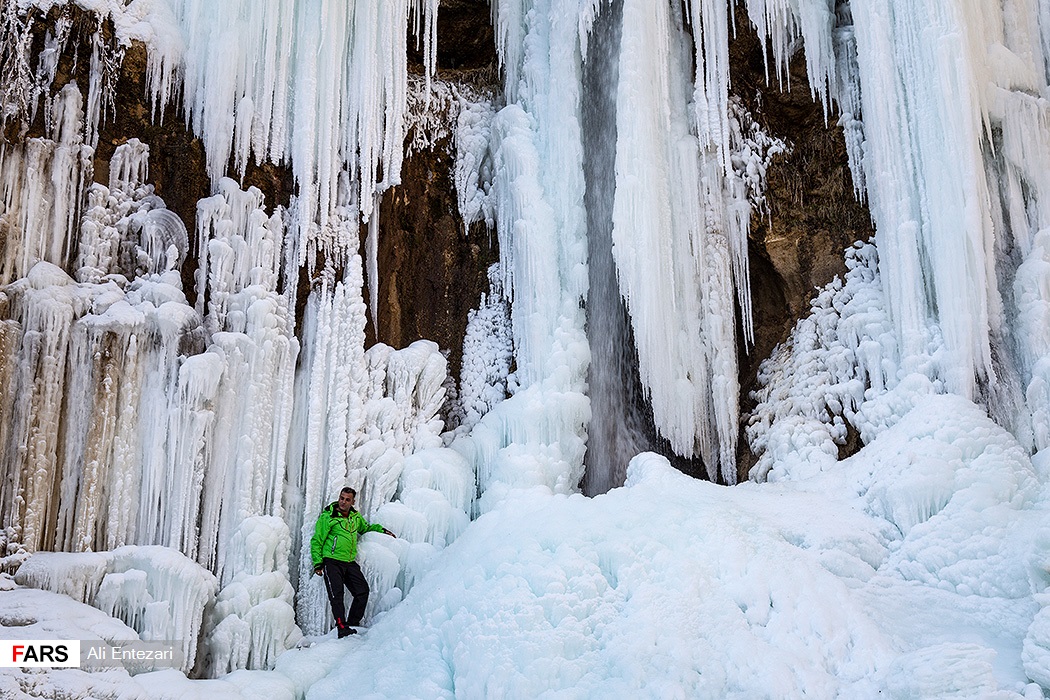
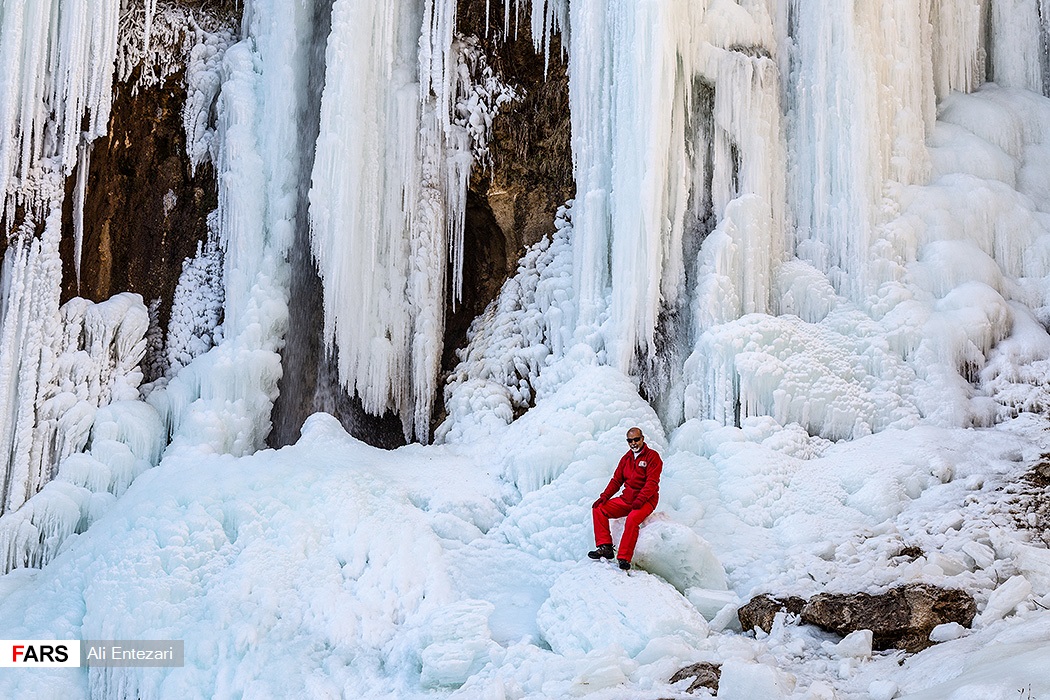
Iran’s Beauties in Winter: Khor Khor Waterfall

The waterfall is situated in a 100-metre-deep valley. During the winter when the temperature sharply goes down, the waterfall freezes, creating an amazing view.

The waterfall attracts people from surrounding areas on weekends for fun and rock climbing.

What follows are Fars News Agency’s photos of the waterfall:

Europe Must Take Practical Measures to Implement INSTEX: Iran

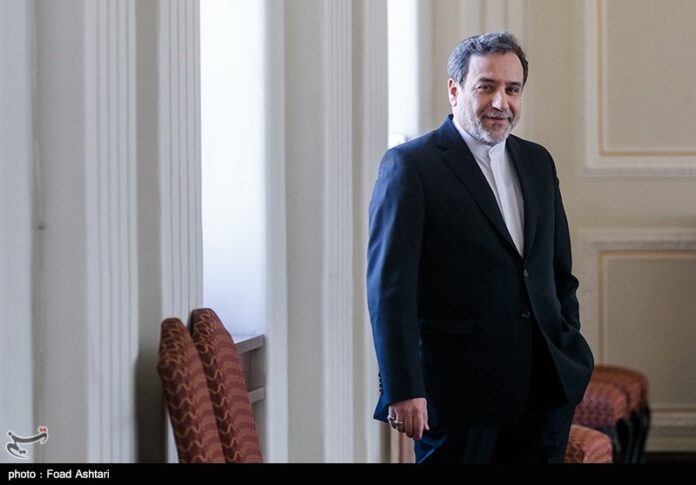
Araqchi on Monday held a meeting with Philipp Ackermann, Director‑General of Germany’s Foreign Ministry, who is responsible for political relations with 110 states in the Near and Middle East, Africa and Latin America.

In the meeting in Tehran, Araqchi criticized the lengthy process of finalization of INSTEX (Instrument in Support of Trade Exchanges), the payment channel that France, Germany and Britain have proposed to continue trade with Tehran and bypass the US embargoes.

Araqchi said creation of INSTEX was only part of the commitments that the EU3 has undertaken under the JCPOA, stressing, “The European side is expected to make more serious efforts for (the achievement of) practical and tangible results of the JCPOA and for the immediate implementation of INSTEX.”

The Iranian diplomat underlined that “political will alone” would not suffice for saving the JCPOA, urging Europe to “take practical measures and pay the price” to salvage the nuclear deal.

Araqchi further deplored Germany’s decision to halt flights by Iranian carrier Mahan Air to its airports, calling on Berlin to review its decision.

For his part, Ackermann hailed the JCPOA as a successful result of diplomacy, decried the US move to withdraw from the nuclear deal, and reaffirmed his country’s determination to support it.

He also said that German companies have become more interested in working with Iran after formation of the INSTEX, stressing that Berlin prioritizes efforts to implement the payment channel.

INSTEX is planned to be based in Paris and be managed by a German banking expert. Britain will head the supervisory board.

The European countries are reportedly going to use the channel initially only to sell food, medicine and medical devices in Iran.

In May 2018, the US president pulled his country out of the JCPOA, the nuclear deal that was achieved in Vienna in 2015 after years of negotiations among Iran and the Group 5+1 (Russia, China, the US, Britain, France and Germany).

Following the US exit, Iran and the remaining parties launched talks to save the accord.