Tuesday, December 30, 2025
Home Blog Page 3318

Chinese President’s Letter Submitted to Top Iran Officials

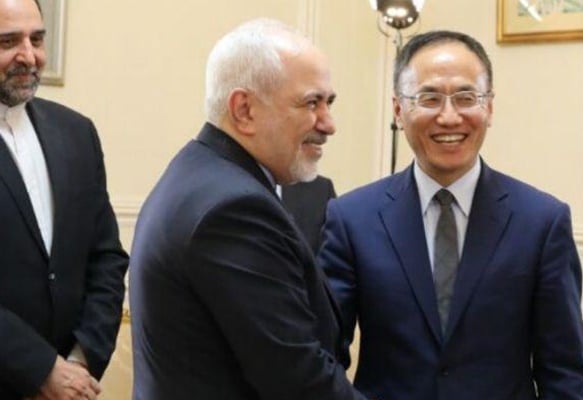
During the meeting, the Iranian foreign minister said relations between Iran and China are long-standing, important, friendly and comprehensive. He also called for development and deepening of these ties.

Referring to the diversity and abundance of capacities and capabilities of the two countries, FM Zarif emphasised that the Islamic Republic is resolved to expand its bilateral ties with China.

The Chinese official, in turn, submitted separate letters of the President of China to the Leader and the President of the Islamic Republic of Iran. He further described the visit of Iran’s Parliament Speaker to China as important and successful.

Stressing the importance and expansion of strategic ties between Iran and China, Xiaodong added that the Chinese president has touched upon the preserving and strengthening of relations with Iran and has issued necessary directives to all state sectors in China.

President Rouhani Says Iran Will Never Give in to US Pressures

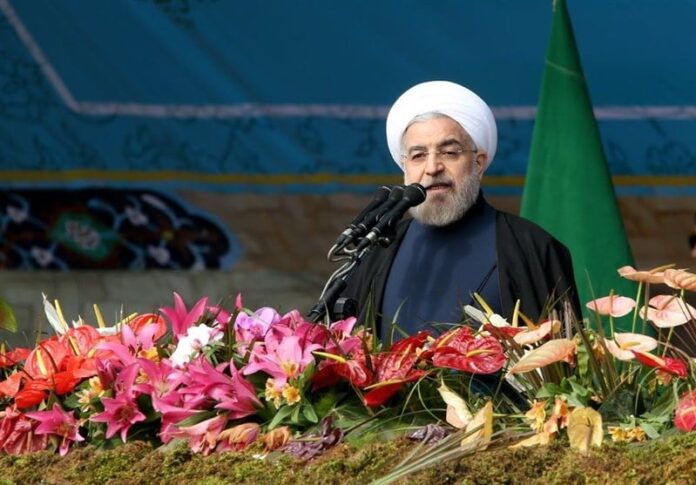
In an address to people in the northern city of Lahijan on Wednesday, Rouhani highlighted the delicate situation that Iran is now facing, saying the great Iranian nation has gained major victories in the “great historical test” over the past year.

Iran is in a “psychological and economic war” situation, the president said, adding that surrendering to the enemy in the current stage would wipe off all democratic achievements of the past decades.

The US wants to force Iran to return to 40 years ago, Rouhani deplored, saying, “But we say that our path is (one of) independence and democracy. (These are not things one) can compromise on.”

Rouhani said the adversaries were seeking to defeat the Iranian nation in the current Iranian year –which ends in two weeks-, but the great nation resisted pressures in all difficult stages.

“The enemy (the US) did not have any success in its plots against Iran at the Warsaw conference,” the president said, stressing that Iranians have emerged victorious despite all plots, acts of sabotage and sanctions by the adversaries.

In comments in December 2018, Leader of the Islamic Revolution Ayatollah Seyed Ali Khamenei highlighted the Iranian nation’s resolve in standing against the US plots over the past decades, saying Washington has been trying to regain control of Iran like the pre-Revolution era and create the same situation that it has established in certain weak regional countries who have been derided as cows milked by the US.

Pointing to the uncovered plots that Americans have hatched over the past two years to harm Iran, such as imposing sanctions and assisting Iran’s foes, the Leader said the US objective was to create bipolarity and division in Iran through sanctions and anti-security measures.

In May 2018, the US president pulled his country out of the Joint Comprehensive Plan of Action (JCPOA), the nuclear deal that was achieved in Vienna in 2015 after years of negotiations among Iran and the Group 5+1 (Russia, China, the US, Britain, France and Germany).

The US had announced plans to drive Iran’s oil exports down to zero, but backed off from its policy and granted waivers to at least 8 countries that import Iranian oil.

Public Wi-Fi Isn’t Safe: Learn How to Keep Your Data Safe

Additionally, public Wi-Fi prevents people from having to use expense data while on mobile devices.

The only downside to public Wi-Fi is the fact that it is incredibly unsafe to those who use it.

The amount of digital attacks that happen over public Wi-Fi are staggering and have people desperately looking for the best VPN service.

Don’t worry! We are here to discuss the ins and outs of public Wi-Fi and how you can protect yourself from cyber-attacks.


Why Public Wi-Fi is Unsafe

Public Wi-Fi is so appealing because it is easy to access, free, convenient, and necessary to a lot of people. Unfortunately, these exact perks are the reason so many cyber-criminals use public Wi-Fi as a means of attack.

When you access a public Wi-Fi connection your data goes out, unencrypted, for anyone with savvy enough eyes to see. Once a cyber-criminal has decided to target users of a particular Wifi connection there are all sorts of havoc they can wreak.

Hackers can create spoof hotspots to confuse users and trick them into connecting to a fake wireless connection being observed by criminals. Additionally, some hackers use the unencrypted connection to plant malware on users which can result in leaked data in the form of private information, passwords, and much more.

There are dozens of ways that cyber-criminals can use public connections to intercept your data and information, but there are just as many ways to protect yourself from these attacks ever taking place.


How Can You Protect your Data?

Being aware of all the dangers of public Wi-Fi might make you want to never use it again, but we are going to show you some tricks to maintaining your digital anonymity while accessing a public network.


Turn Off Sharing

One way to protect yourself is to turn off sharing on all of your devices. This will help prevent your device from sharing personal or private information into nefarious hands.


Use Encrypted Websites Only

Another method is to only use websites that begin with HTTPS, which denotes an encrypted website where your logged information is secure from prying eyes. These types of websites can sometimes be identified through the use of a small lock prefixing the URL.


Use a Virtual Private Network

The last and most effective method is to use a virtual private network or VPN. VPNs offer military grade encryption, true anonymity through spoofed IP addresses, and a totally secure tunnel through which you can safely use any internet – even public.

VPNs are great for protecting yourself from cyber-attacks but also have many more perks. The level of amenities with your VPN will be dependent on whether you want to pay or use a free service.

Even a free service, so long as they are reputable, is capable of providing the security and anonymity needed to protect yourself while using public Wi-Fi.


Conclusion

Public Wi-Fi can be a fantastic thing. It is great to be able to check your bank account when you see that great piece of furniture is on sale. To have the option to facetime a friend before you decide on which outfit to buy. To quickly be able to pull up the address of the next place on your agenda.

With a little effort and the help of a virtual private network, there is no reason to let cyber-criminals deter you from taking advantage of a time and money saving option.

Yes, there are people out there who are waiting for others to use free Wi-Fi connections so they can access their data, but simply giving in to the fear of these criminals lets them win.

Instead, you can take the power back and revel in your privacy and security.

Iraqi Diplomat in Tehran ahead of Iran President’s Iraq Visit

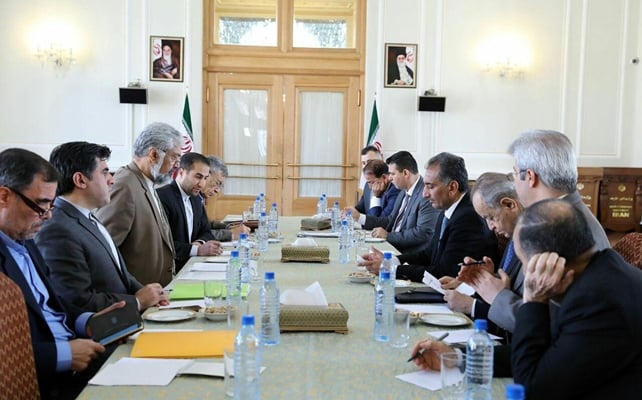
During the Wednesday meeting, the two sides reviewed various issues of bilateral relations and emphasised the importance of the Iranian president’s visit to Baghdad as a historic opportunity to deepen and broaden relations.

At the meeting, the Iraqi official invited his counterpart to visit Baghdad, announcing that there is no limitation in ties between the two countries and nations of Iran and Iraq in all fields, especially security and defence issues, and energy.

He also vowed that the Islamic Republic of Iran will play a key role in the Arab country’s reconstruction.

Khairallah and Sarmadi also exchanged views on border issues between the two countries in Arvand Rud, with the Iranian side touching upon the need for precise and complete implementation of the provisions of the 1975 Algiers Agreement.

As of March 10, Rouhani will start his first-ever official visit to Iraq as the Iranian president.

Earlier, Iranian Foreign Minister Mohammad Javad Zarif, his deputy Abbas Araqchi and head of Iran’s Central Bank Abdolnasser Hemmati had made separate trips to the Arab country to prepare the grounds for the visit.

Last November, Iraqi president Barham Saleh had visited Iran.

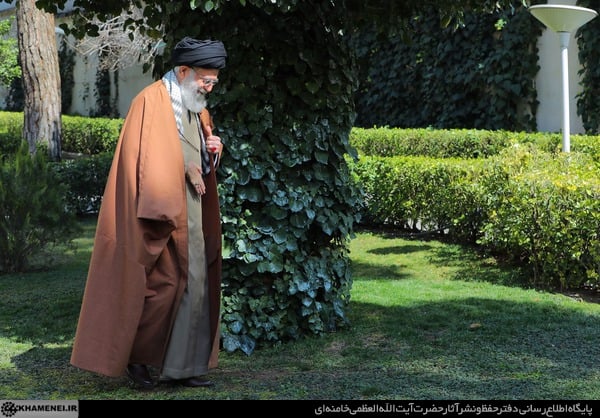
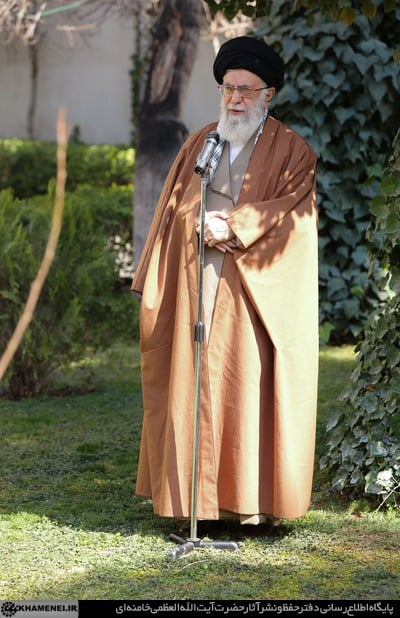
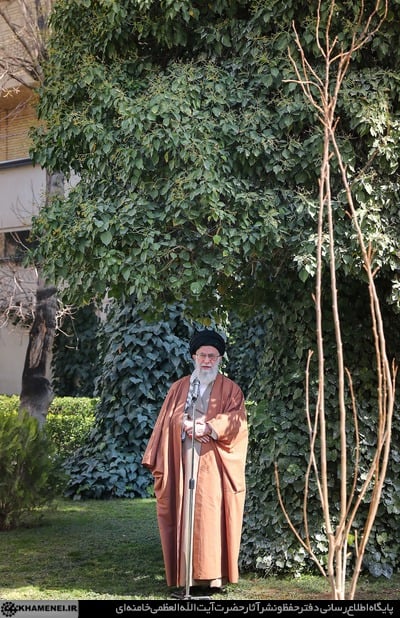
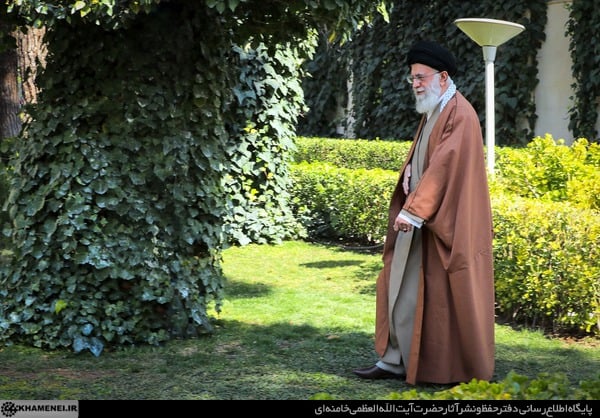
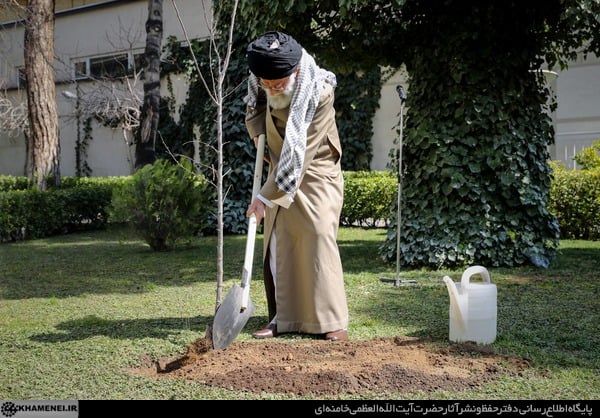
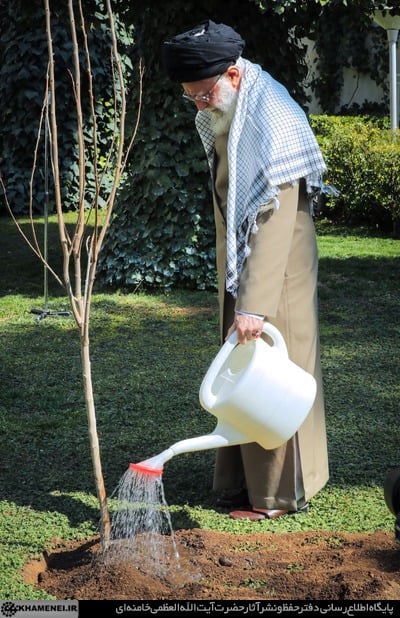
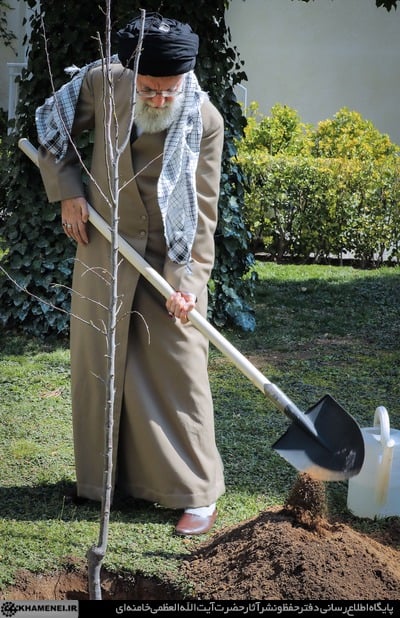
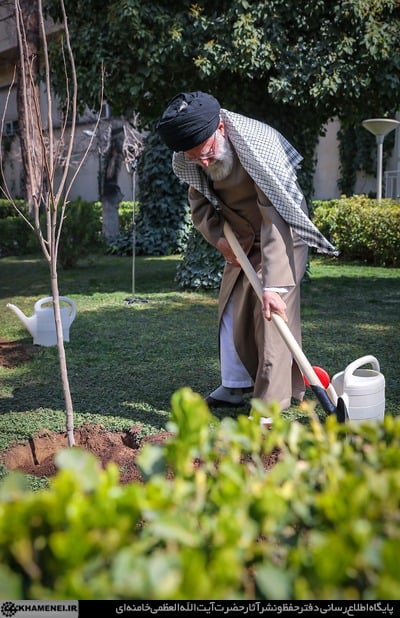
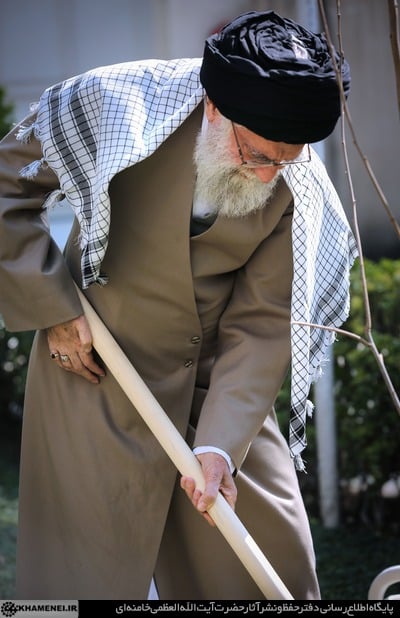
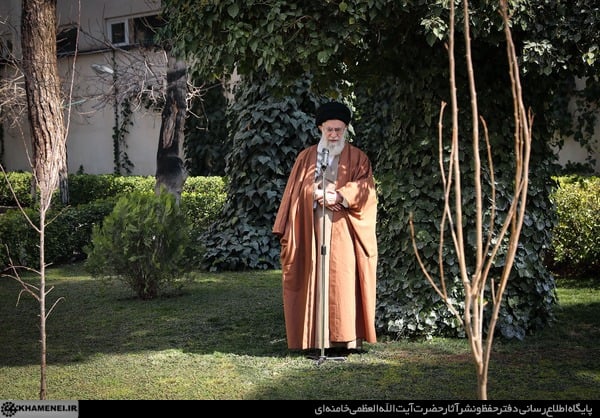
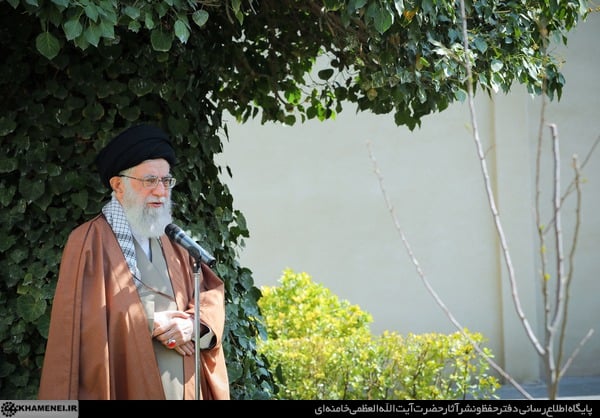
Iran Leader Plants Two Fruit Trees on National Arbour Day

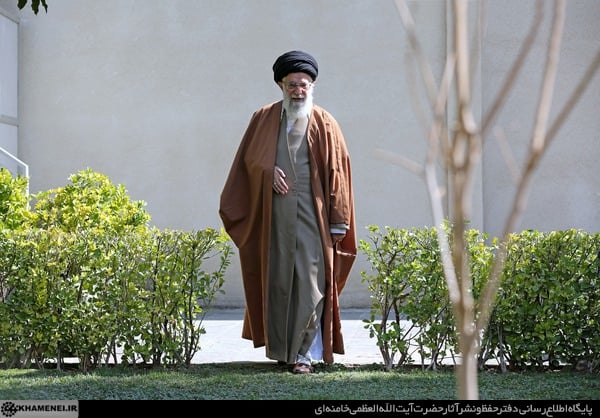
After planting the saplings on Wednesday, the Leader referred to the national arbour day as a herald of spring and reminds people of the significance of vegetation.

Stressing the need to protect plants and warning against the damages caused by disregard for Iran’s forests and grasslands, Ayatollah Khamenei said the issue of trees and protection of vegetation must reach its real position in the public culture.

The Leader also hailed tree plantation as a symbolic move highlighting the significance of trees and natural environment.

Deploring damages to trees in some bosky locations in order to construct buildings, Ayatollah Khamenei underscored, “The organizations in charge must seriously stand against such measures and not permit them.”

The Leader also warned against planting harmful species of saplings in certain parts of the country for the purpose of combating desertification, calling on the relevant organizations to prevent such harmful approaches and to push for the protection of woodlands.

Ayatollah Khamenei further urged the judicial bodies to do their utmost to prevent any harm to forests.

Back in November 2015, in a letter to heads of the executive, legislative, and judicial branches of the Iranian government, Ayatollah Khamenei had outlined 15 environmental policies developed in consultation with the Expediency Council in line with implementing the first paragraph of Article 110 of the Islamic Republic of Iran’s Constitution.

Development of an integrated national environmental system and the necessity for comprehensive, coordinated and systematic management of the country’s vital resources (including water, soil, air, and biodiversity) are among the most important policies underlined in the letter.

The general policies call for criminalization of destruction of the country’s environment and punishment for polluters and destroyers of the environment.

Management of climate change and countering environmental threats including desertification, dust pollution, drought, and bacterial and radioactive transmission factors as well as the study and management of emerging environmental phenomena are also among the key points in the general policies.

INSTC Members Agree to Expand North-South Transport Corridor

Addressing the opening ceremony of the seventh INSTC coordination council in Tehran, Eslami said the capacity of the corridor is set to be raised thanks to efforts to expand its railway and port infrastructures.

“Member states have agreed to create a joint company for the INSTC which will increase its capacity,” he told IRIB News Agency.

Eslamai then said he is sure that with the political will of the member states, the INSTC can remove the obstacles in the way of the corridor’s expansion, further facilitating the regional trades.

The Iranian official said all member states attach significant importance to expansion of the corridor, viewing it as a mechanism to boost their mutual trades.

An Iranian deputy roads minister also told IRIB that each country will appoint a government official in charge of its INSTC affairs.

“The official should be introduced to the secretariat in Tehran in one month,” he said.

The official underlined that the participants agreed to make more use of the corridor to expand their trade exchanges and underlined need for homogenizing tariffs and customs charges in all countries, especially in the railroad area.

The INSTC is a 7,200-km-long multi-mode network of ship, rail, and road route for moving freight between India, Iran, Afghanistan, Armenia, Azerbaijan, Russia, Central Asia and Europe.

The route primarily involves moving freight from India, Iran, Azerbaijan and Russia via ship, rail and road. The objective of the corridor is to increase trade connectivity between major cities such as Mumbai, Moscow, Tehran, Baku, Bandar Abbas, Astrakhan, Bandar Anzali, etc.

Pakistan Bans Operation of Anti-Iran Terror Groups in Its Soil

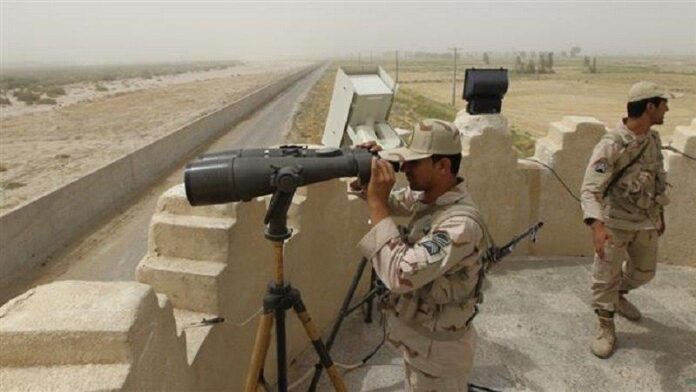
Pakistan’s National Counter Terrorism Authority announced that it will soon launch operations against banned groups, and that terrorists cannot use its territory as a hideout.

The Jaish al-Adl terrorist group has been launching deadly attacks against Iranian border guards.

Last month, the Pakistan-based terrorists attacked a bus carrying a group of Iranian border guards, claiming the lives of 27 forces.

Following the attack, Iran’s Islamic Revolution Guards Corps accused “Pakistan’s security forces” of supporting the perpetrators behind the suicide bombing.

IRGC Chief Major General Mohammad Ali Jafari urged Islamabad to crack down on militants who killed the border guards or expect military action by Tehran “to punish the terrorists”.

A Look at Iranian Newspaper Front Pages on March 6

A Look at Iranian Newspaper Front Pages on November 19

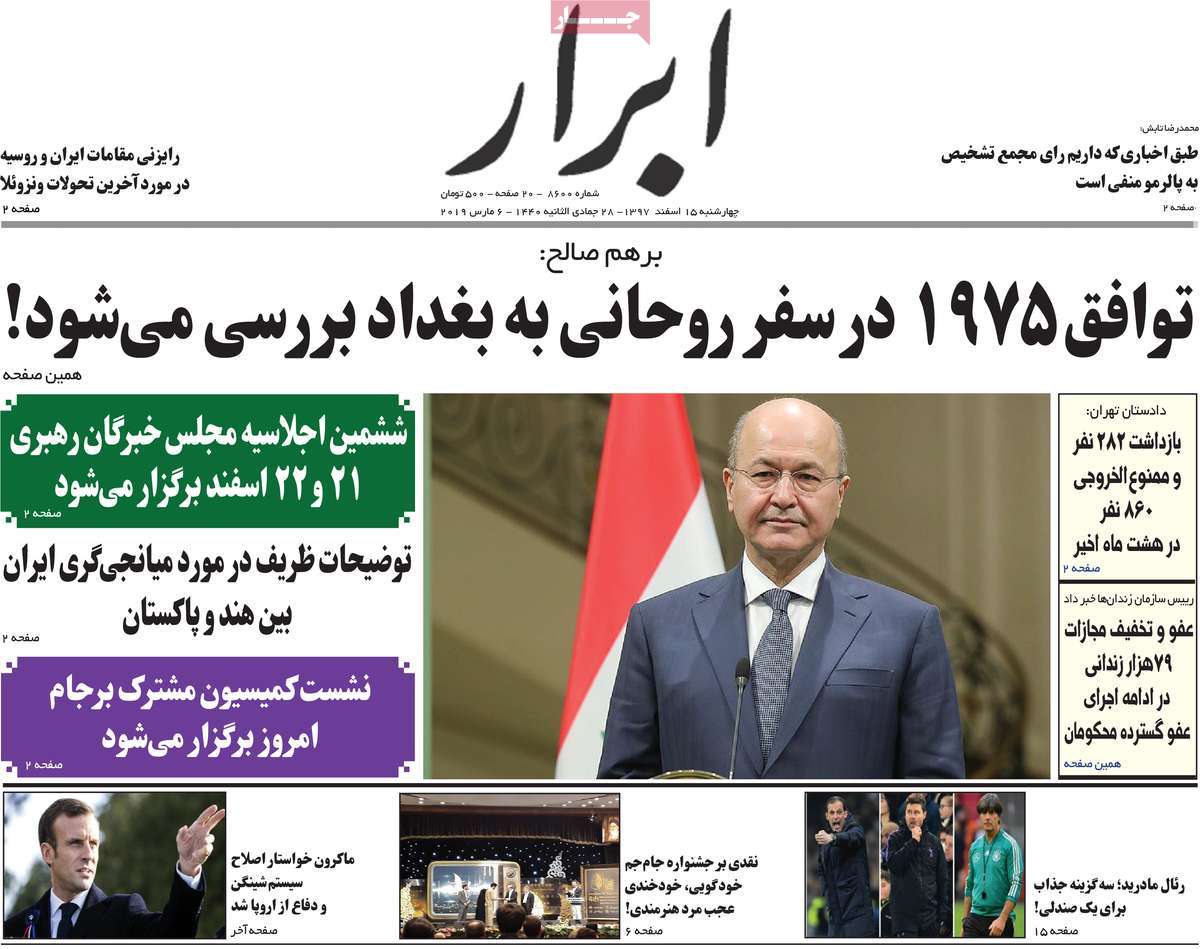
Abrar:

1- Iran, Russia Hold Talks on Latest Venezuela Developments

2- Rouhani to Discuss 1975 Agreement in Baghdad Visit

3- Zarif Talks of Iran’s Efforts to Mediate between India, Pakistan

4- Macron Calls for Revising Schengen System, Defending Europe

A Look at Iranian Newspaper Front Pages on March 6


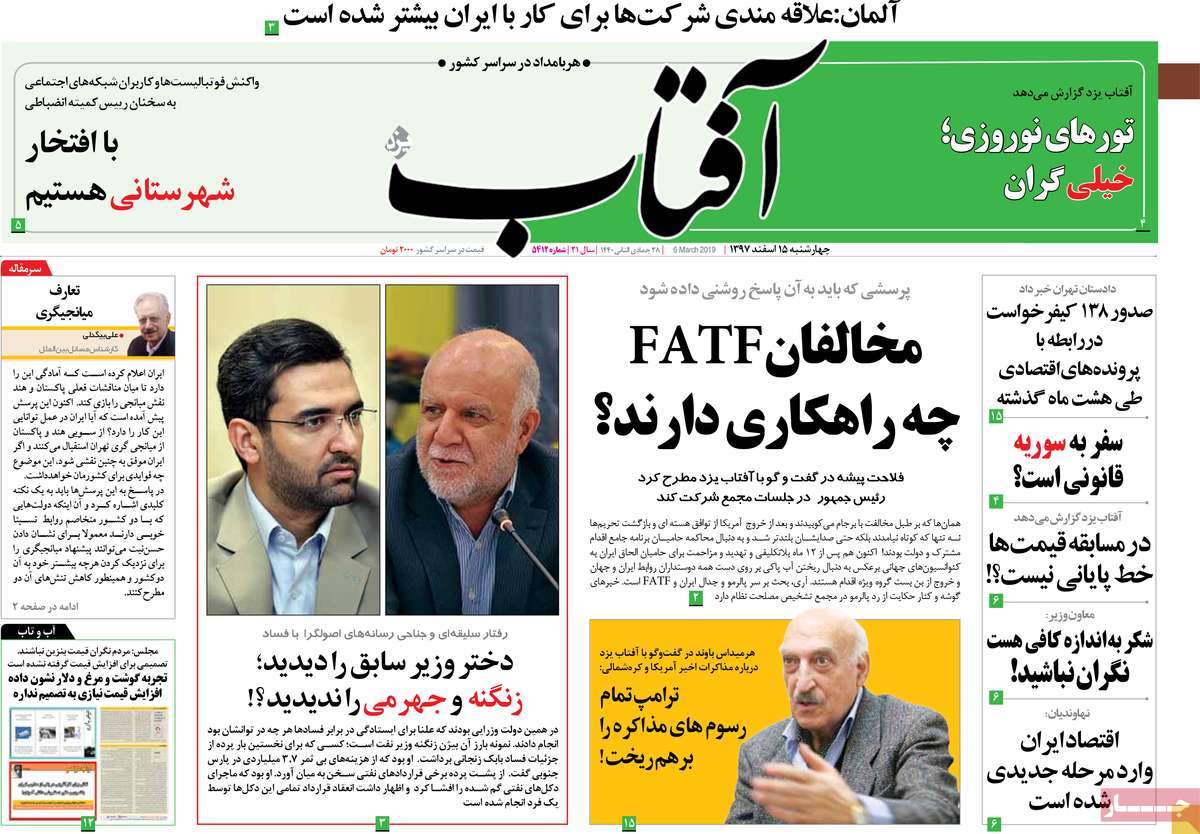
Aftab-e Yazd:

1- Germany: Countries More Interested in Working with Iran

2- Rouhani’s Aide: Iranian Economy in New Level

3- Analyst: Trump Changed All Rules of Negotiation on N Korea

A Look at Iranian Newspaper Front Pages on March 6


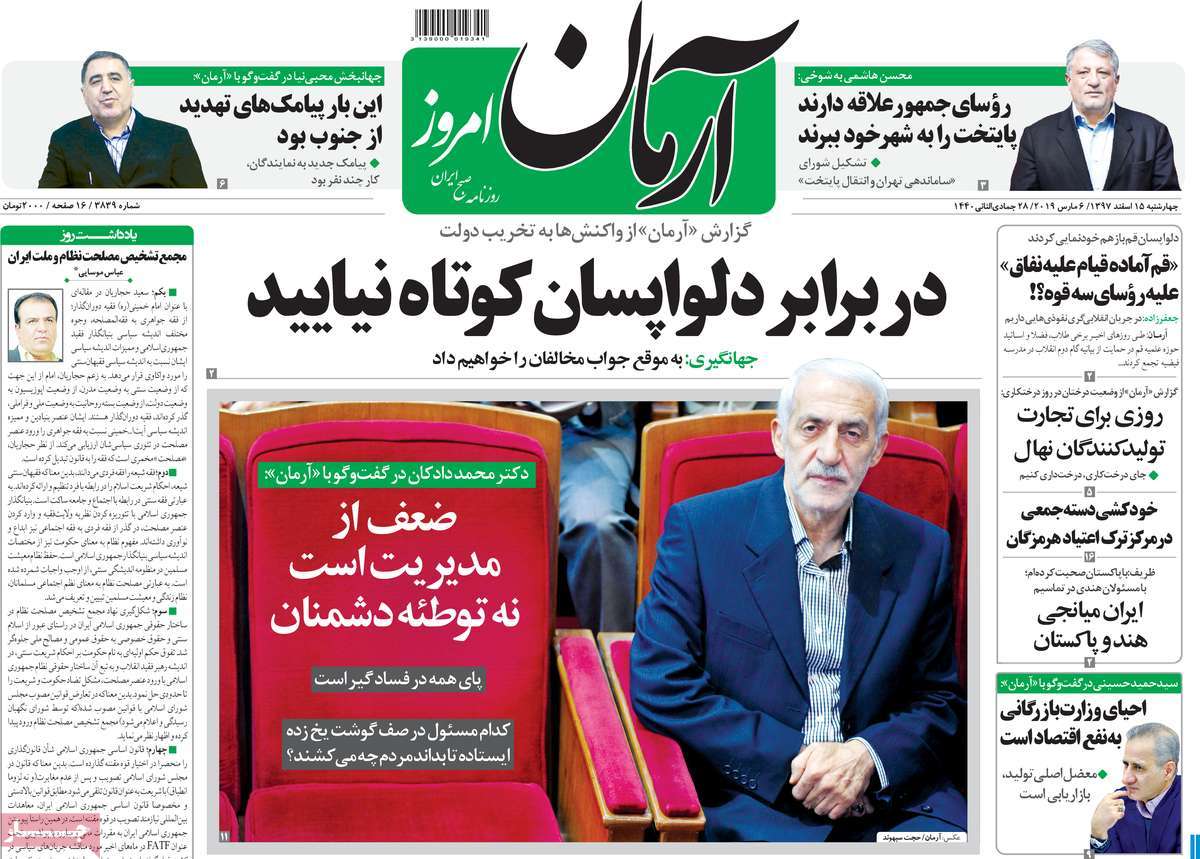
Arman-e Emrooz:

1- Iran Mediating between India, Pakistan

  • We’ve Talked to Pakistan, Are in Contact with Indian Officials: Zarif

A Look at Iranian Newspaper Front Pages on March 6


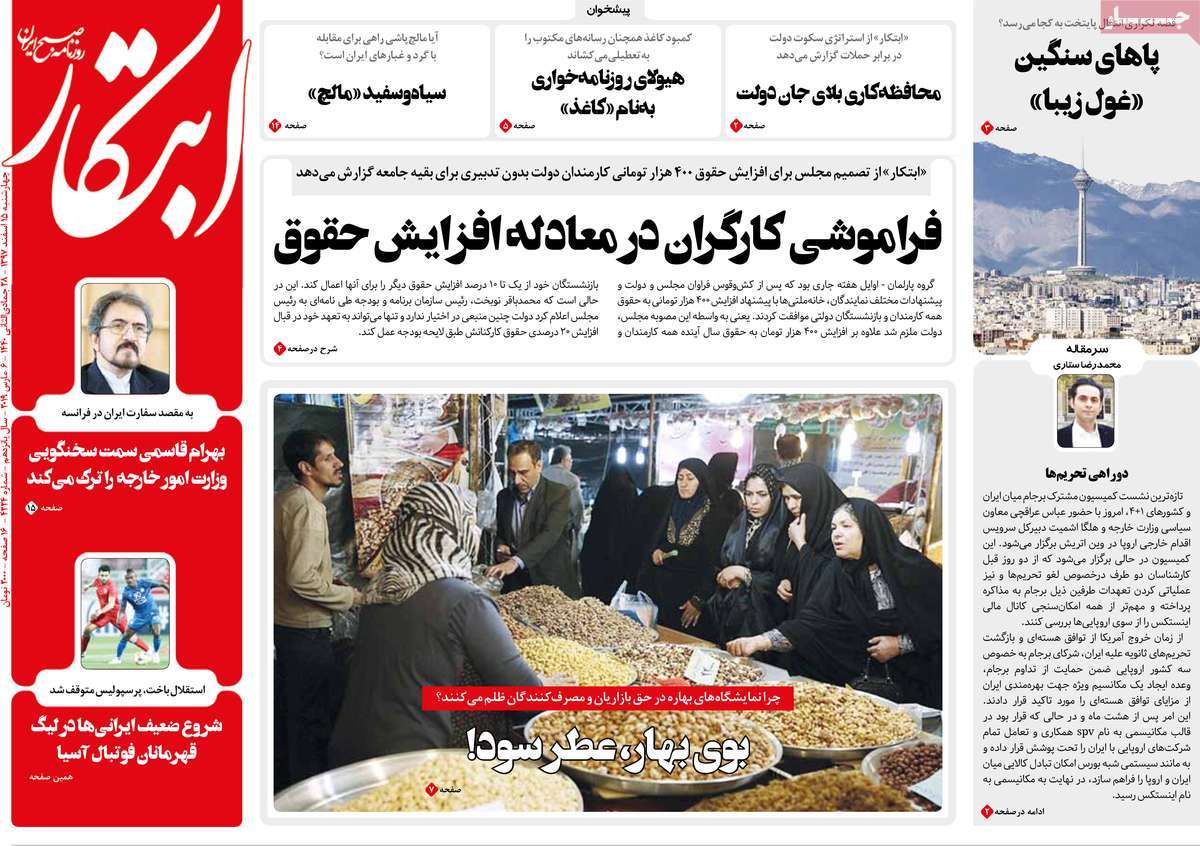
Ebtekar:

1- Foreign Ministry Spokesman Bahram Qassemi to Leave Office, Become Iran Ambassador to Paris

2- Dilemma of Sanctions [Editorial]

A Look at Iranian Newspaper Front Pages on March 6


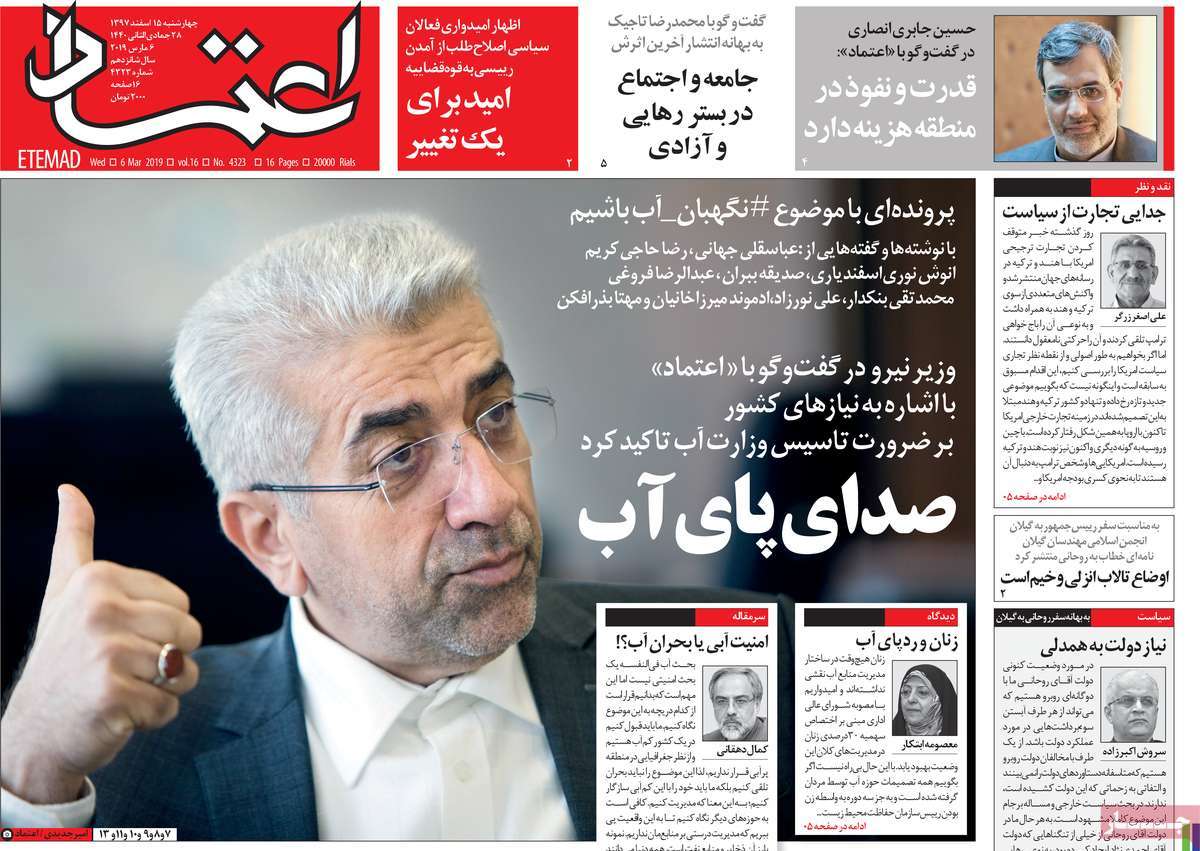
Etemad:

1- There Are Expenses to Pay for Power and Influence in Region: Zarif’s Assistant

2- Trade Apart from Politics: US Stops Preferential Trade with Turkey, India

A Look at Iranian Newspaper Front Pages on March 6


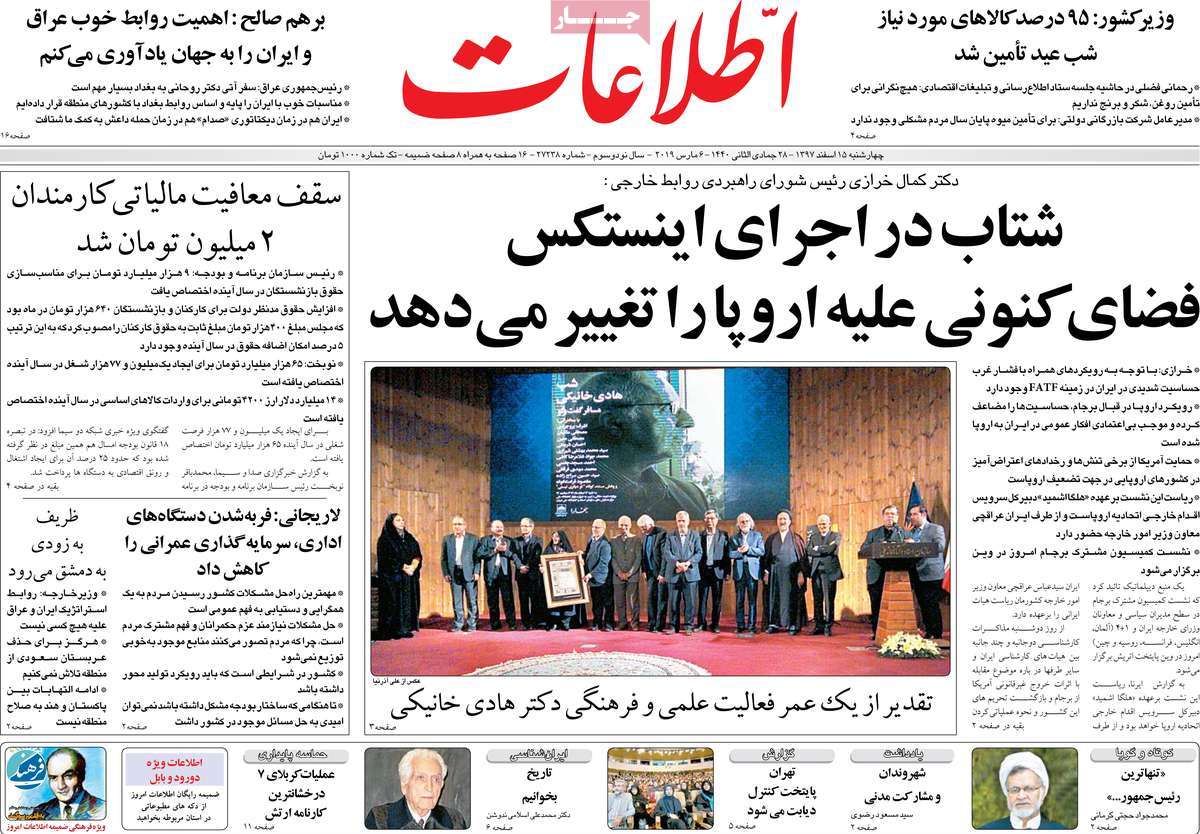
Ettela’at:

1- Barham Salih: I’ll Remind the World of Good Relations between Iran, Iraq

2- Speedy Implementation of INSTEX to Change Current Anti-Europe Atmosphere

3- Tehran to Become Capital of Diabetes Control

A Look at Iranian Newspaper Front Pages on March 6


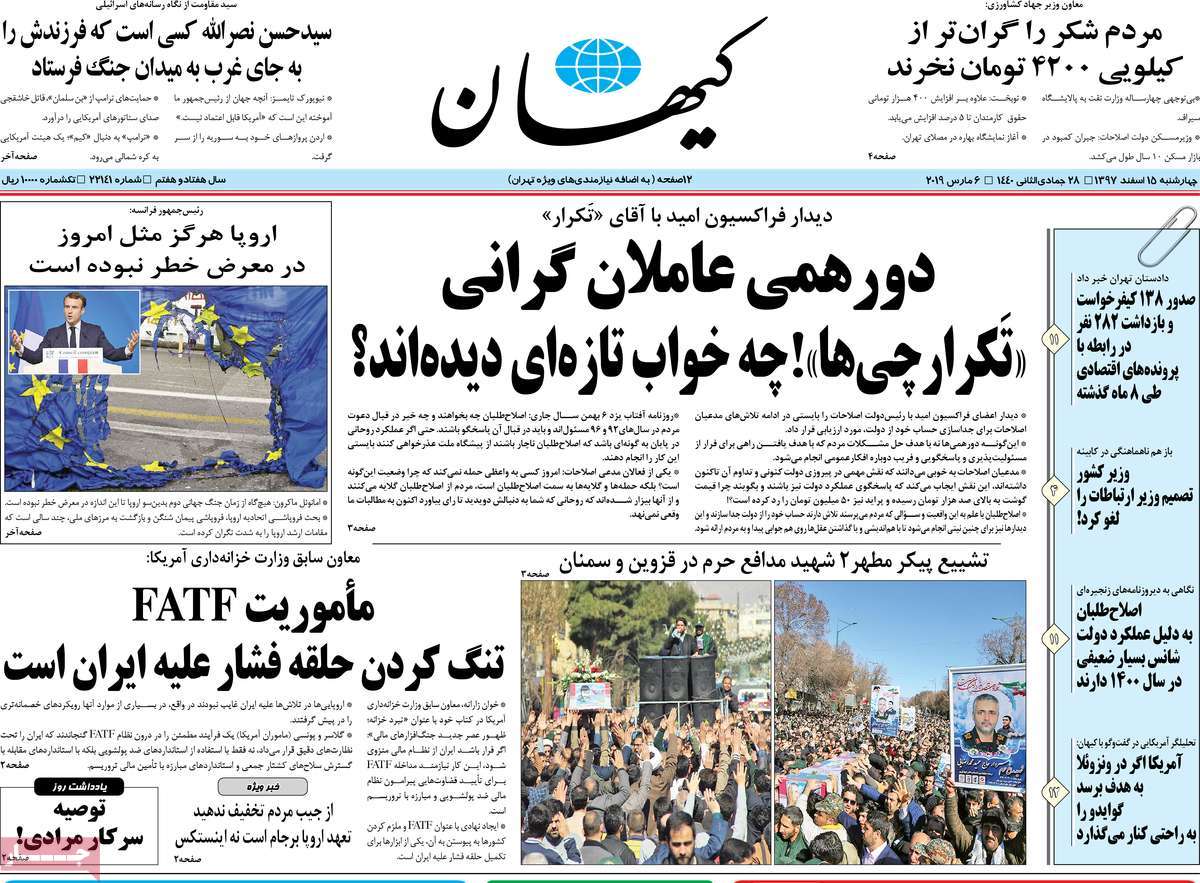
Kayhan:

1- Nasrallah Is the One Who Sends His Son to War Instead of West: Israeli Media

2- French President: Europe Has Never Been in Danger as Much as It Is Now

3- FATF Aimed at Increasing Pressure against Iran: Former US Treasury Official

4- US Analyst: US Will Easily Remove Guaido Once It Achieves Its Goal in Venezuela

A Look at Iranian Newspaper Front Pages on March 6


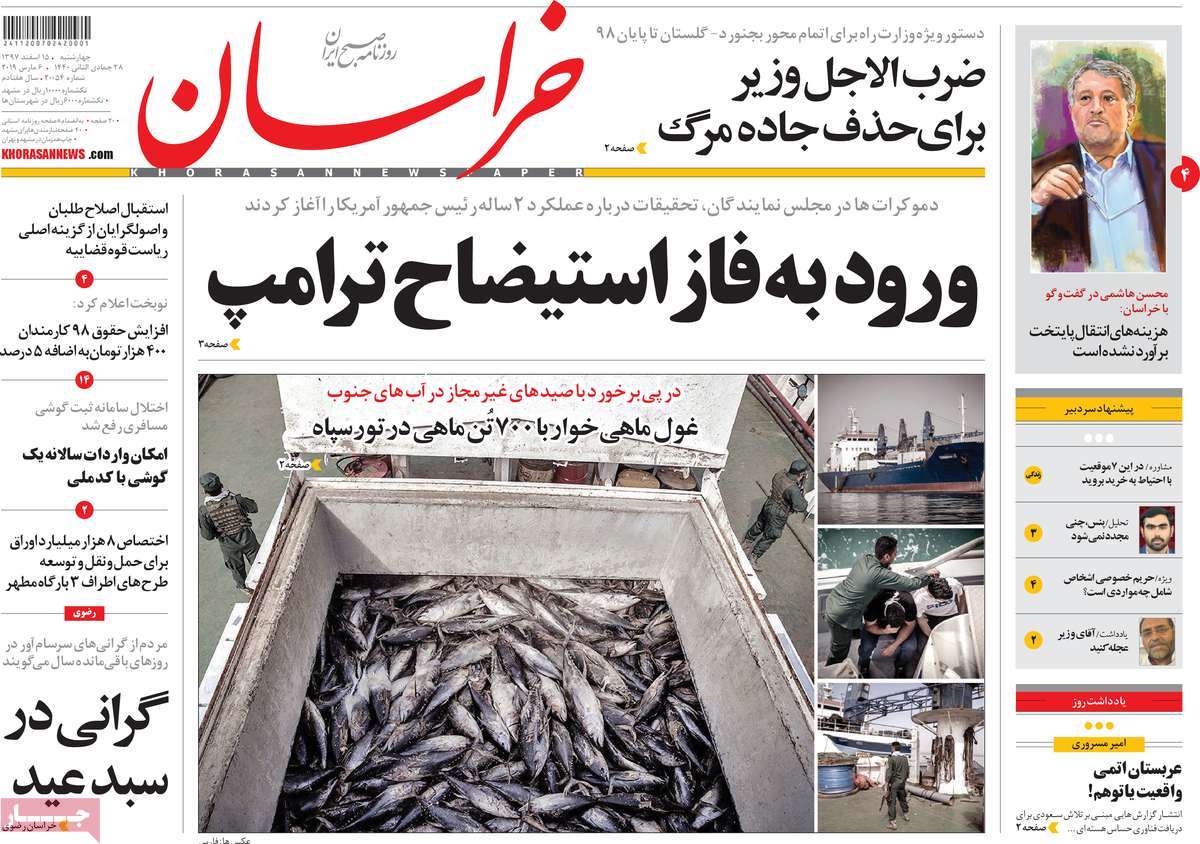
Khorasan:

1- Democrats Start Investigations to Impeach Trump

2- Nuclear Saudi Arabia: Reality or Illusion? [Editorial]

A Look at Iranian Newspaper Front Pages on March 6


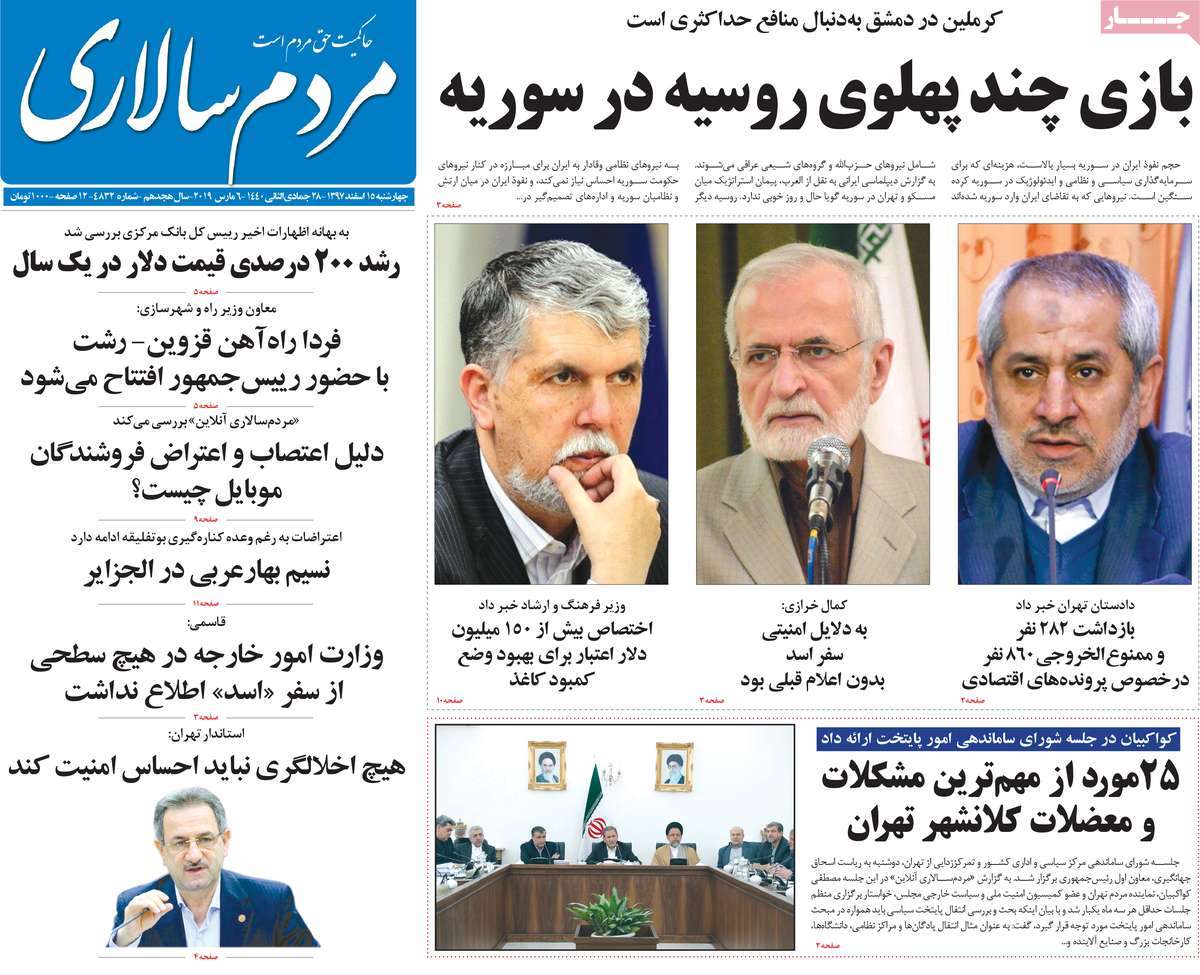
Mardom Salari:

1- Russia’s Multisided Game in Syria: Kremlin Looking for Maximum Benefits in Damascus

2- Iran Leader’s Aide: Assad’s Tehran Trip Was Unannounced over Security Reasons

A Look at Iranian Newspaper Front Pages on March 6


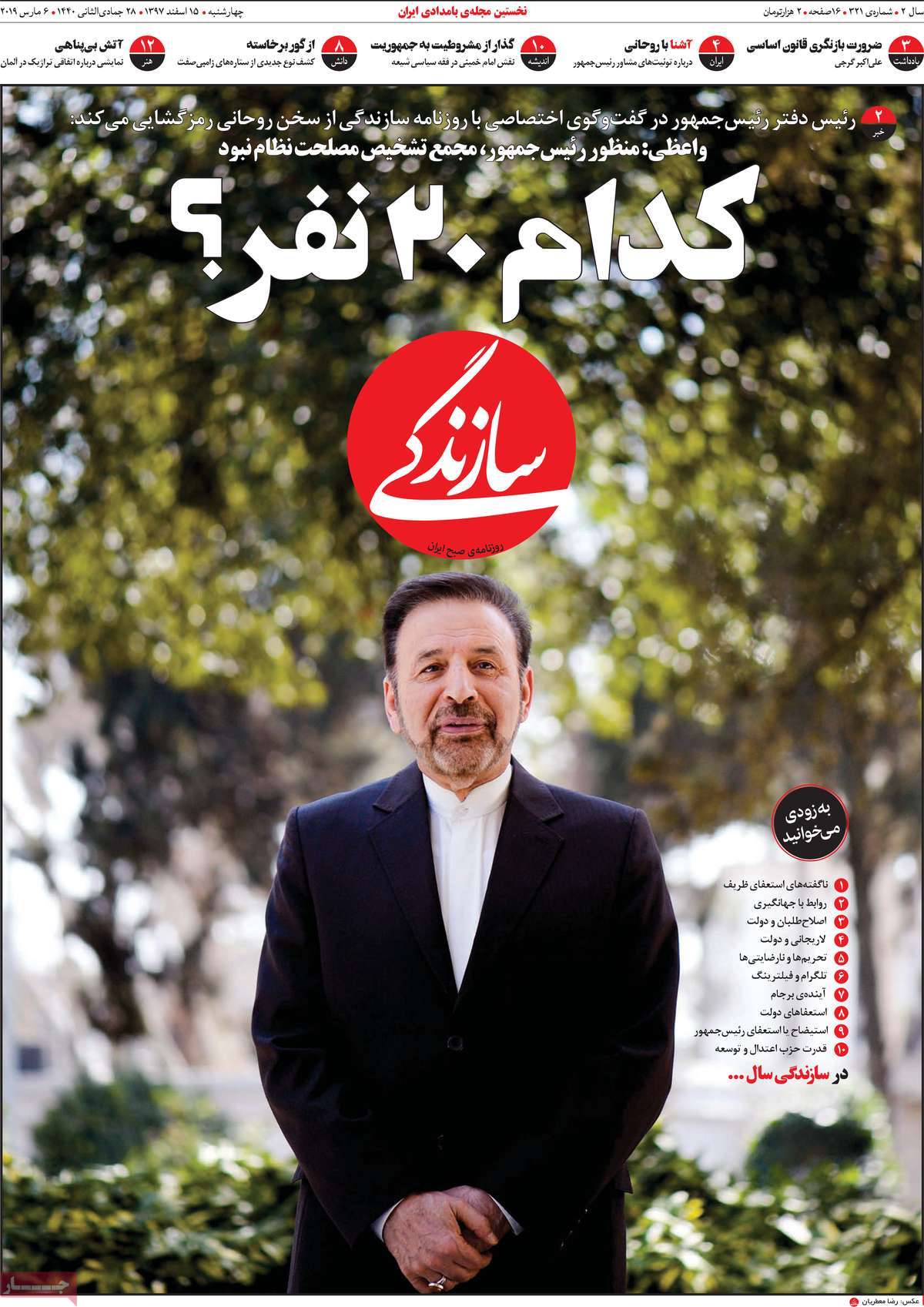
Sazandegi:

1- Rouhani’s Chief of Staff Deciphers Rouhani’s Words about 20 Hardliners

A Look at Iranian Newspaper Front Pages on March 6


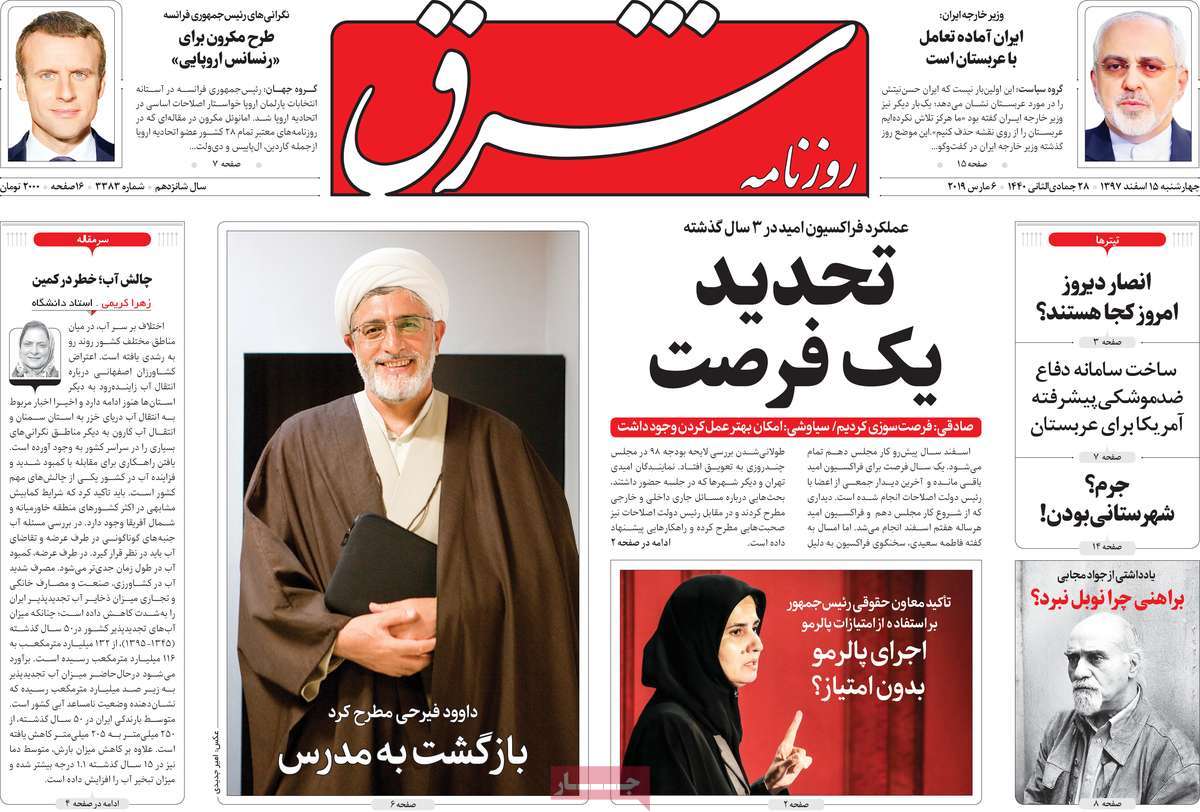
Shargh:

1- FM: Iran Ready for Interaction with Saudi Arabia

2- Macron Calls for European Renascence

3- US to Build Advanced Missile Defence System for Saudi Arabia

A Look at Iranian Newspaper Front Pages on March 6


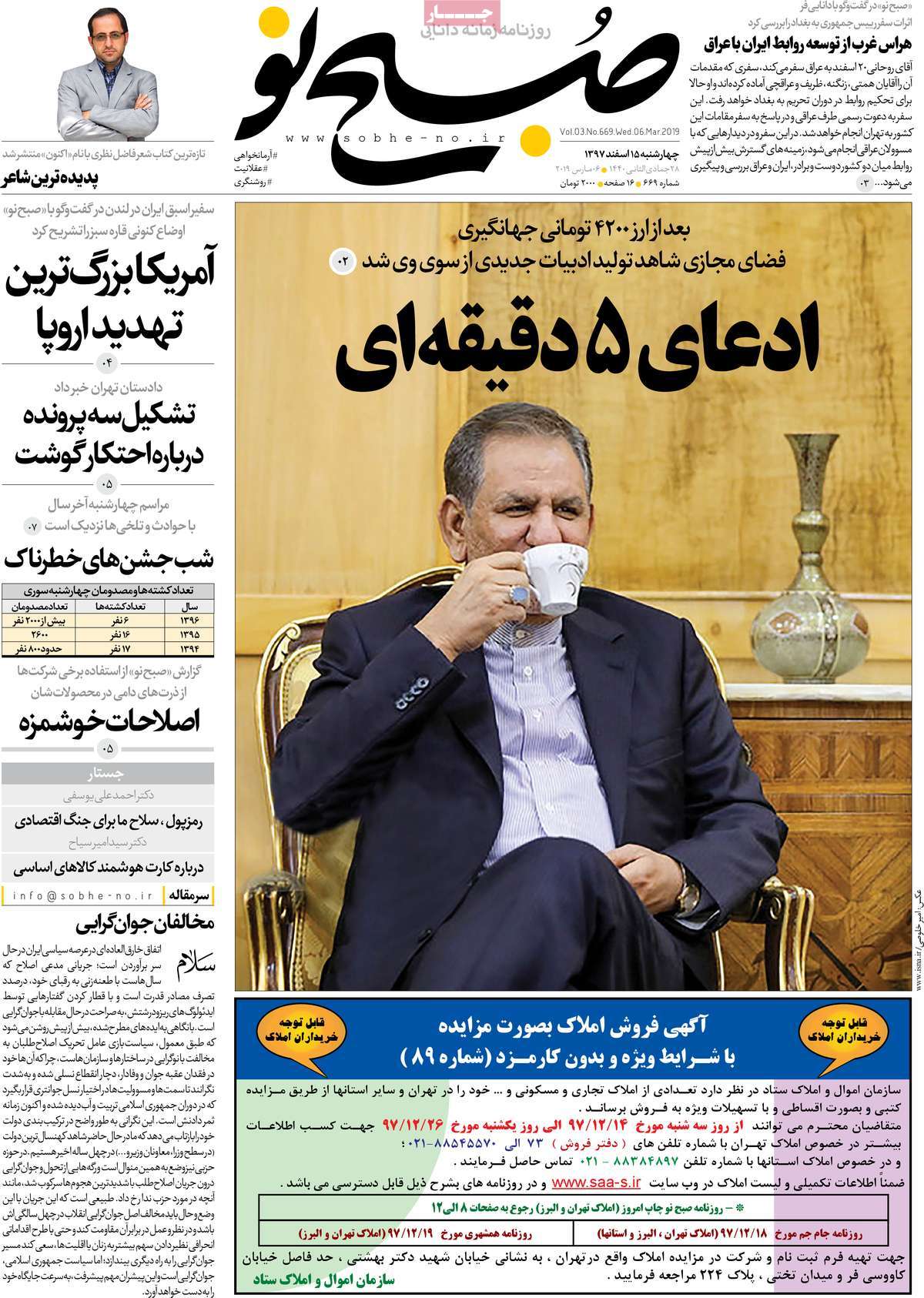
Sobh-e Now:

1- West Afraid of Development of Iran’s Ties with Iraq

2- US Biggest Threat to Europe: Iran’s Former Ambassador to London

A Look at Iranian Newspaper Front Pages on March 6


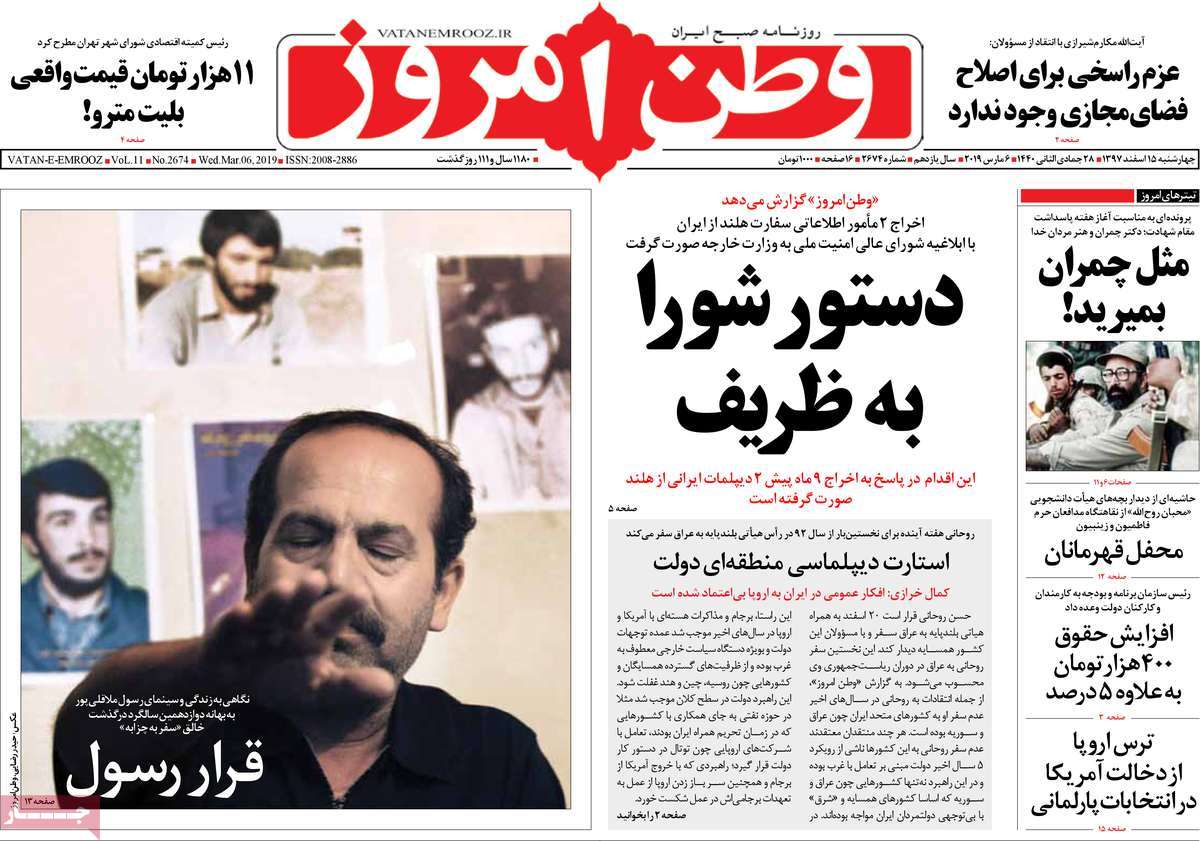
Vatan-e Emrooz:

1- Europe Afraid of US Interference in Parliamentary Elections

2- Supreme National Security Council Orders Zarif to Expel 2 Dutch Diplomats

A Look at Iranian Newspaper Front Pages on March 6

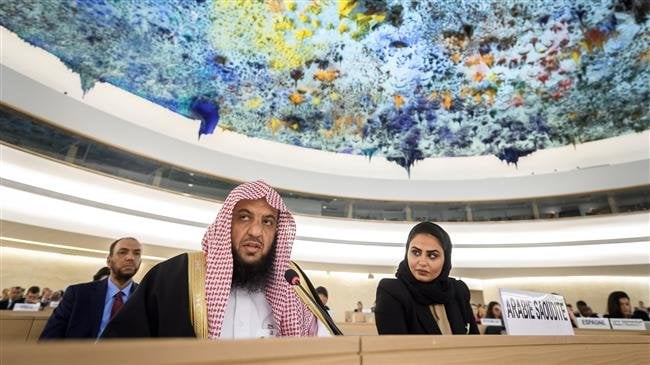
UN to Rebuke Saudi’s Human Rights Violations for First Time

In a joint statement due to be read out on Thursday, European countries will urge Saudi Arabia to release detained activists and cooperate with a UN-led probe into the murder of Khashoggi.

This will be the first rebuke of the kingdom at the Human Rights Council, diplomats and campaigners said.

Iceland has led the initiative, winning support from European countries and possibly delegations from other regions for the criticism of Saudi Arabia, a member of the 47-nation forum, activists said.

“We believe that members of the Council have a particular responsibility to lead by example and put on the Council’s agenda human rights issues that warrant our collective attention,” an Icelandic diplomat told Reuters on Tuesday, adding rights in Saudi Arabia was one such instance and this view was shared by numerous countries.

Iceland was elected last year to take a seat on the council for the first time, replacing the United States which quit because of what it said was an anti-Israel bias.

In a statement welcoming what it said would be the first collective action at the council addressing human rights in Saudi Arabia, Human Rights Watch said rights council members should demand that Saudi Arabia cooperate with probes into Khashoggi’s murder, stop targeting activists, journalists and critics and release wrongfully detained people.

“No State is above the law,” said John Fisher, the group’s Geneva director.

The move comes amid growing concern about the fate of Saudi detainees, identified by watchdog groups as women’s rights activists, after the public prosecutor was reported to be preparing their trials.

Back on Monday, the United Nations human rights experts voiced alarm at Saudi Arabia’s application of its so-called anti-terrorism laws to target activists.

The experts raised the warning during a panel event titled “Saudi Arabia – Time for Accountability,” held on the sidelines of a UN Human Rights Council gathering in Geneva.

They said those being targeted with the laws — which the kingdom has redefined, notably expanding the remit of its security forces and judicial system — included woman. The practice by the kingdom violated the international law guaranteeing freedom of speech, they added.

The kingdom has attracted international opprobrium for its intolerance of dissent. It has nabbed, detained, and reportedly tortured hundreds of dissenters, including civil rights activists, religious rights defenders, and dissident clerics.

Last year, it famously apprehended and incarcerated prominent female activists campaigning in favor of the Saudi women’s right to drive.

Saudis are also under fire for allegations of their role in the assassination of Washington-based journalist and critic of the Saudi government Khashoggi, which was “planned and perpetrated” by Saudi officials at its Istanbul consulate on Oct. 2.

US intelligence agencies believe Crown Prince Mohammed bin Salman ordered the operation to kill Khashoggi, which Riyadh has denied.

Iran Congratulates Ghana on Independence Day

Rouhani extended his “sincere” congratulations in a Wednesday message to Ghana’s President Nana Akufo-Addo.

The Iranian president also expressed the hope that Tehran and Accra would be able to enhance their bilateral relations and mutual cooperation considering the numerous economic capacities.

He also wished health and success for his Ghanaian counterpart, and happiness and prosperity for the people of the African republic.

Ghana was the first western African country to achieve independence. British rule ended on 6 March 1957, when the Ghana Independence Act 1957 transformed the British Crown Colony of the Gold Coast into the independent dominion of Ghana.