Thursday, December 25, 2025
Home Blog Page 3244

Dom-Dom Sahari: Ritual to Wake People at Dawn in Ramadan

Iran not only enjoys geographical and ethnic diversity, but also is replete with ritualistic-ceremonial performances and narratives a major part of which concerns religions, denominations and worshipping God.

One of the most different shows performed during the holy month of Ramadan in Iran is staged in Bushehr in south of the country. The “Dom-Dom Sahari” ritual is performed to wake up those who want to fast for the day.

In this performance, four-strong groups begin walking through local villages and hamlets, singing religious chants and verses to inform people that dawn is fast approaching and they need to say their prayers and eat Suhur as they have to do it before dawn breaks.

During the first half of the month of Ramadan, the “Dom-Dom Sahari” ritual features religious verses and chants, including the “Greetings be upon you Ramadan” phrase. In the second half of the month and as the end of Ramadan starts approaching, that phrase is replaced with “Farewell”. Those performing the ritual prepare people to get ready to say farewell to Ramadan and welcome Eid al-Fitr. They usually perform the ritual ad lib. Their performance normally begins around one or one and a half hours before dawn and continues until 10 minutes before dawn breaks and “Call to Prayers” is heard.

Due to the expansion of the city of Bushehr, the ritual does not get the chance to make its presence felt all across the city. Nevertheless, old neighbourhoods in Bushehr still enjoy the ear-pleasing chants sung performers during this religious ritual.
A Look at Iranian Newspaper Front Pages on May 15

A Look at Iranian Newspaper Front Pages on November 19

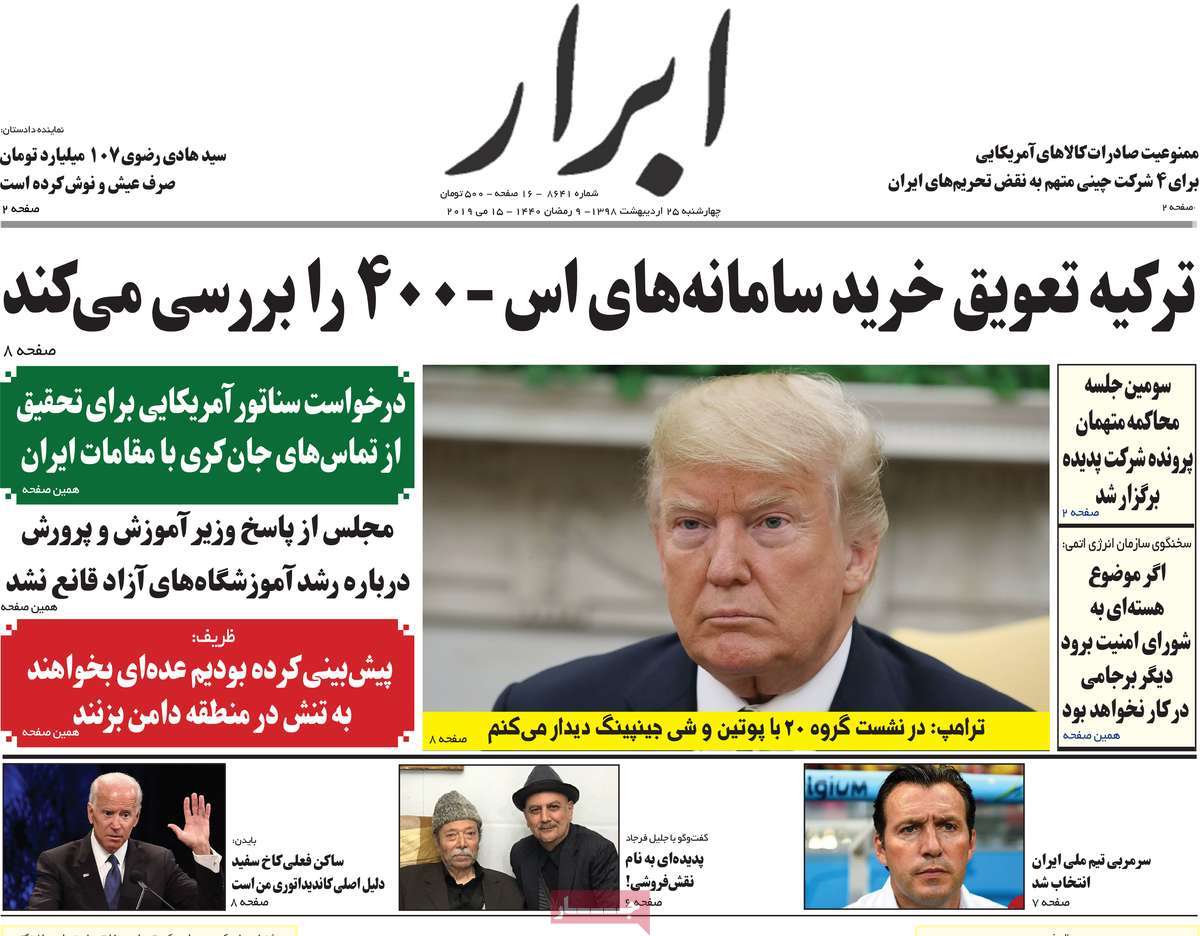
Abrar:

1- Four Chinese Firms Banned for Violating Iran Sanctions

2- US Senator Calls for Probe into Kerry’s Contacts with Iran

3- Trump: I’ll Meet Putin, Xi in G-20 Meeting

A Look at Iranian Newspaper Front Pages on May 15


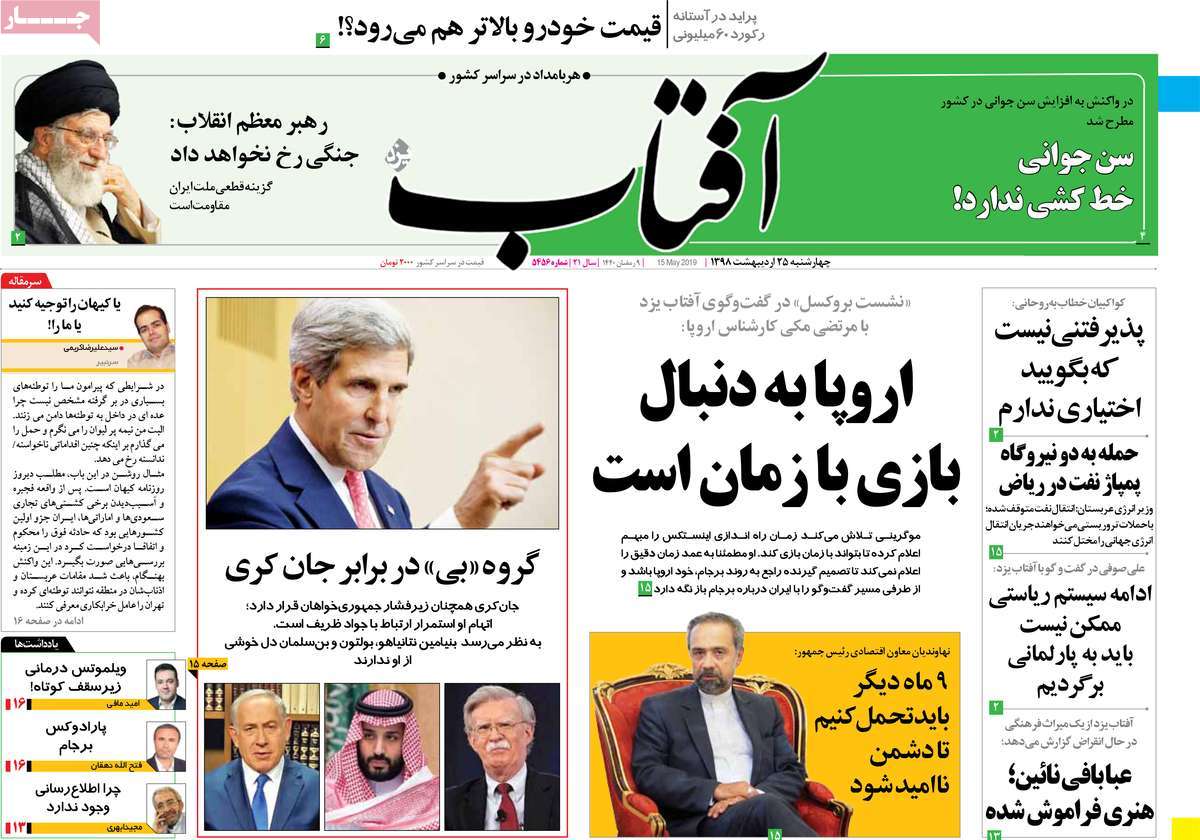
Aftab-e Yazd:

1- Iran Leader: There’ll Be No War between Iran, US

2- Europe Trying to Kill Time: Expert

3- Attack on Two Oil Pumping Stations in Riyadh

* Saudi Energy Minister: Oil Transfer Stopped

4- B-Team against John Kerry: Ex-Secretary of State under GOP Pressure

A Look at Iranian Newspaper Front Pages on May 15


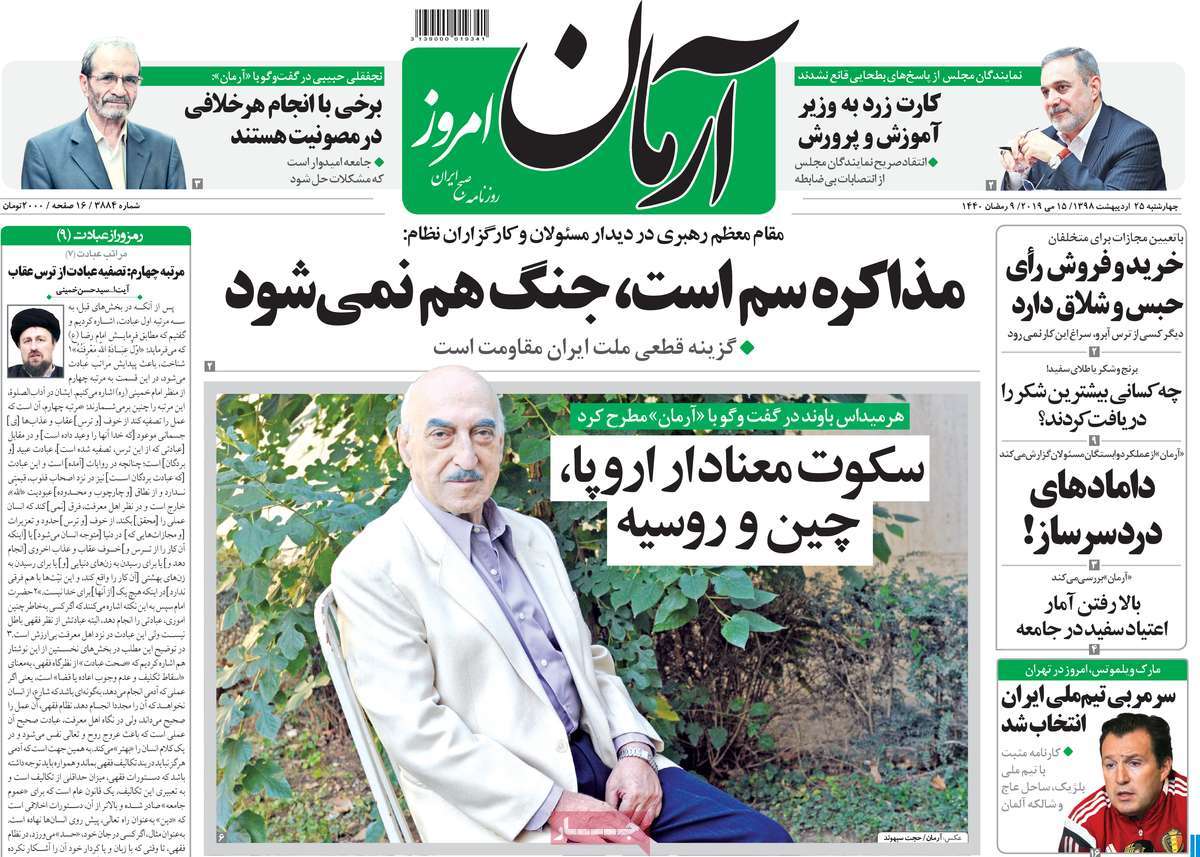
Arman-e Emrooz:

1- Negotiation Is Poison, There’ll Be No War: Leader

2- Europe, China, Russia’s Meaningful Silence

A Look at Iranian Newspaper Front Pages on May 15


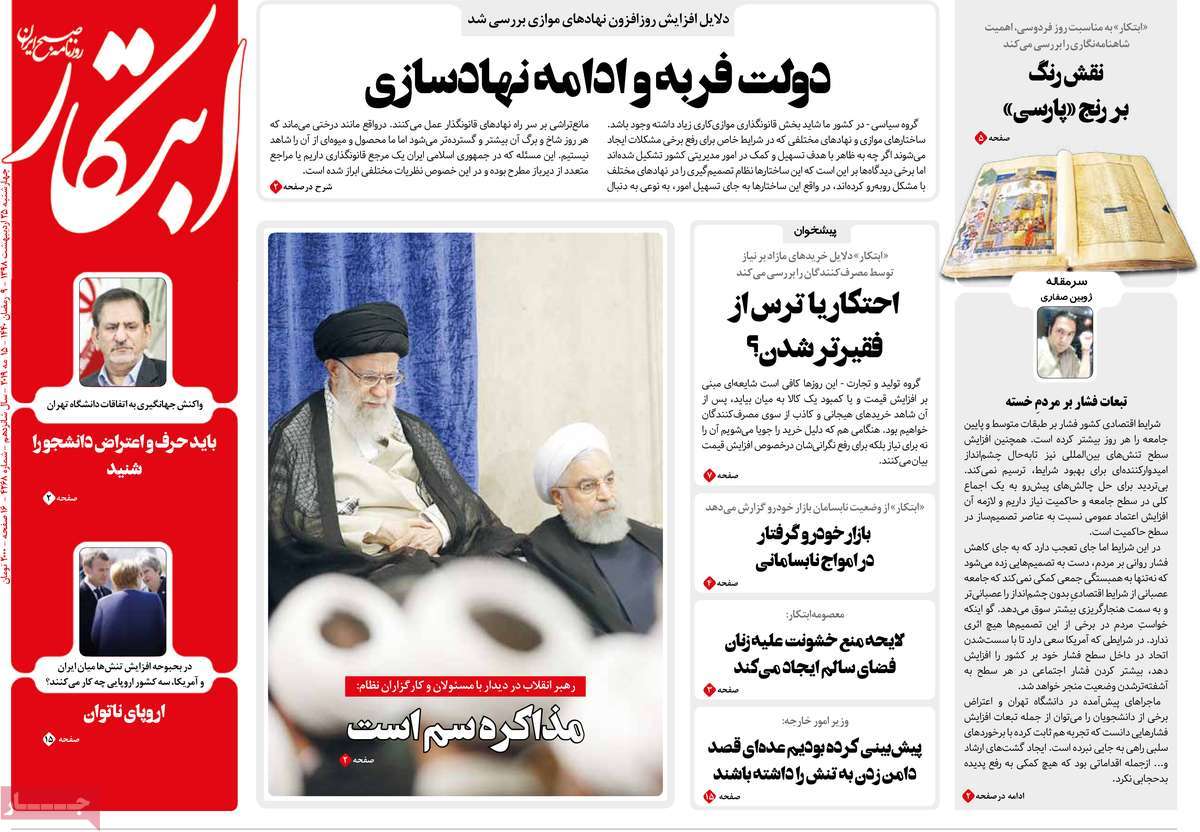
Ebtekar:

1- Negotiation Is Poison: Iran Leader

2- Europe Impotent: What Are E3 Doing amid Rising Tension between Iran, US?

3- FM: We’d Predicted Some Would Escalate Tension

A Look at Iranian Newspaper Front Pages on May 15


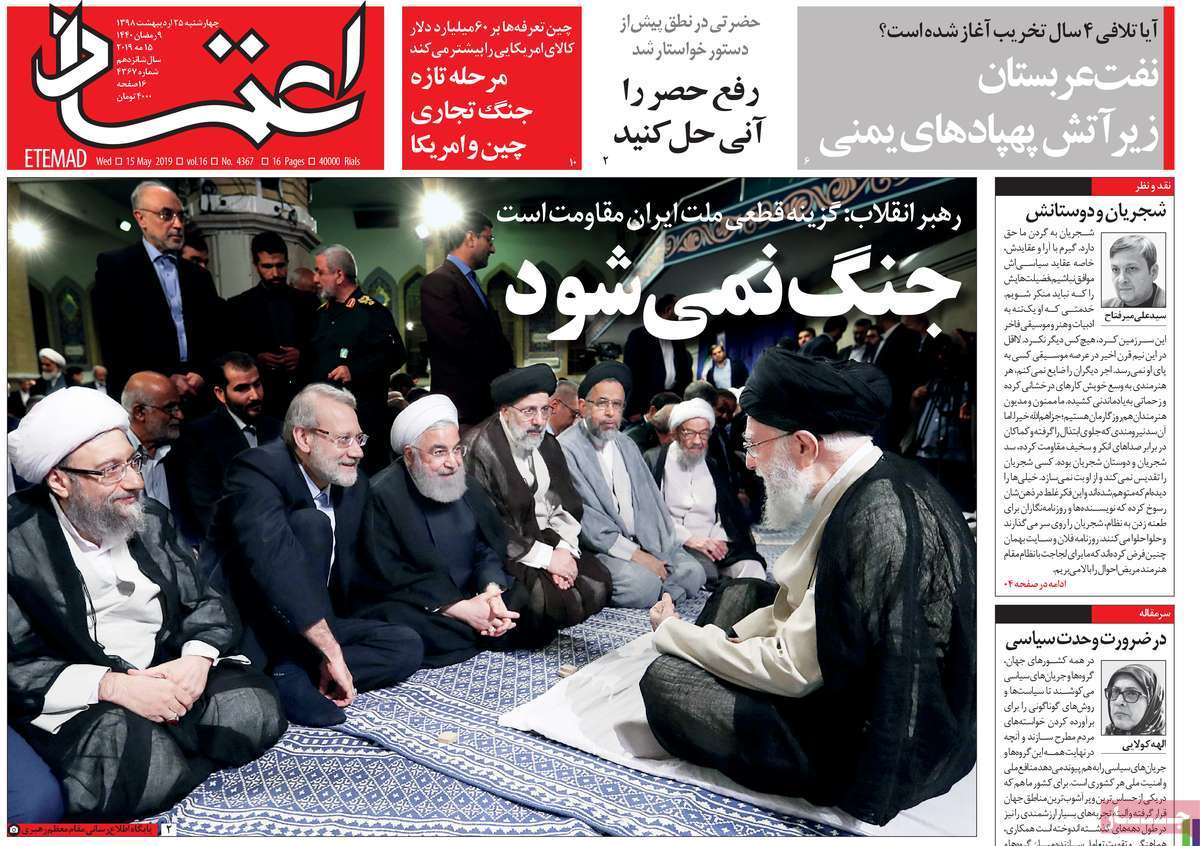
Etemad:

1- New Phase of China-US Trade War

* Beijing to Increase Tariffs on $60 Billion Worth of US Products

2- Saudi Oil under Fire of Yemeni Drones: Is Yemen Retaliating 4 Years of Destruction?

3- There’ll Be No War: Iran Leader

A Look at Iranian Newspaper Front Pages on May 15


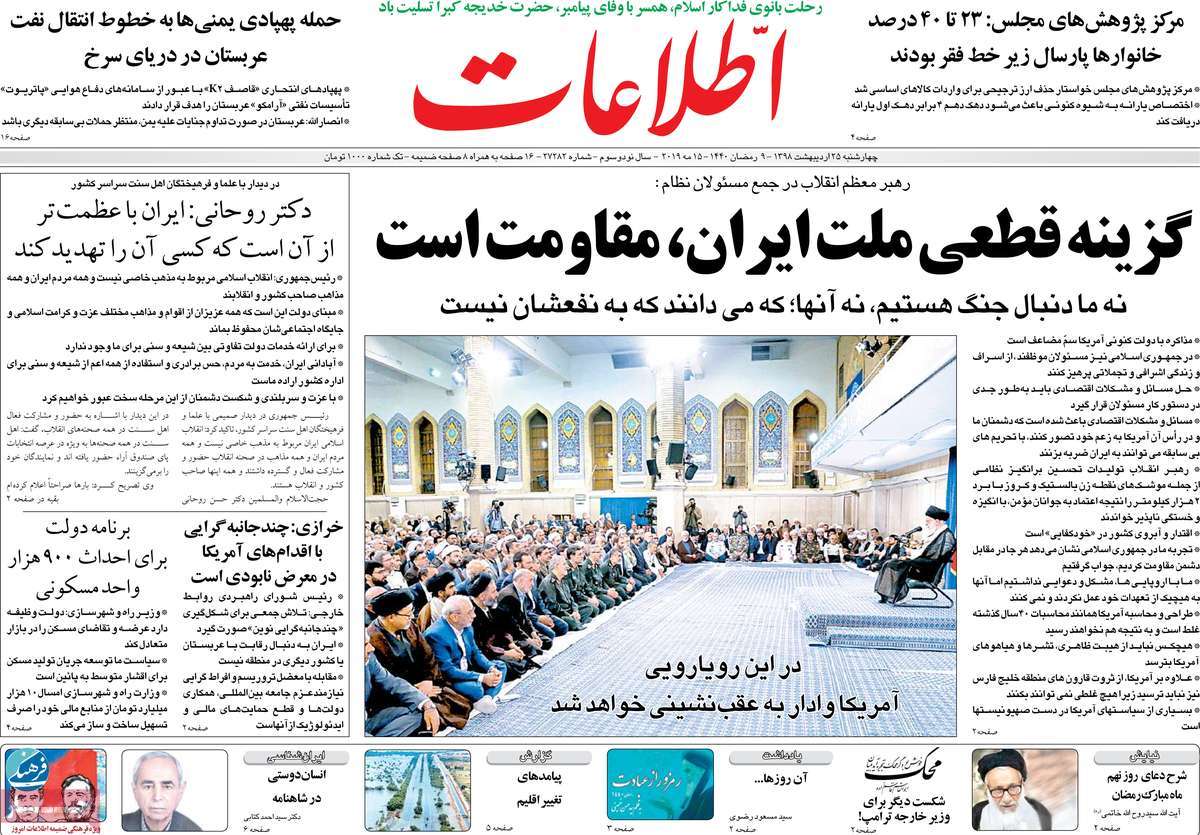
Ettela’at:

1- Yemenis’ Drone Attack on Saudi Oil Pipeline in Red Sea

2- Iran Leader: We’re Not after War; They Know It’s Not in Their Interests

3- Rouhani: Iran Too Great to Be Threatened

A Look at Iranian Newspaper Front Pages on May 15


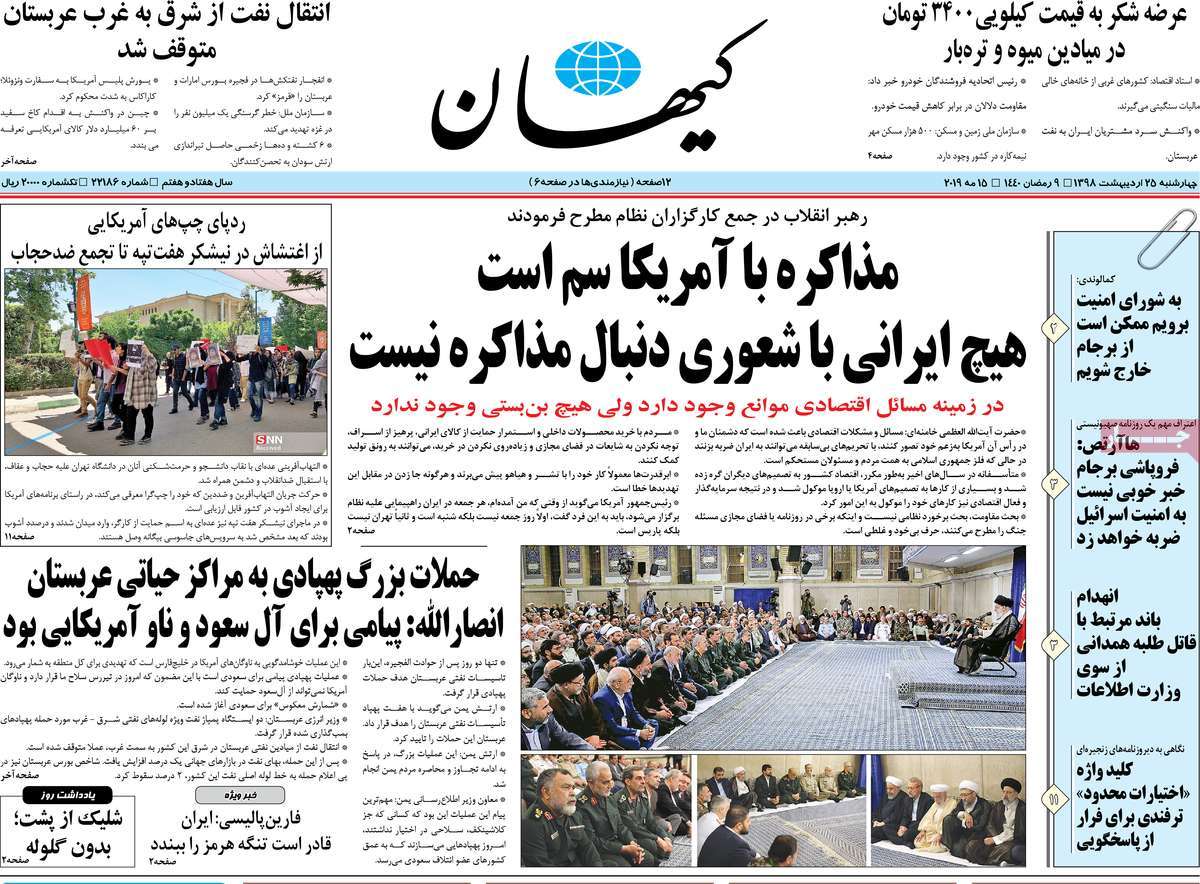
Kayhan:

1- Transfer of Oil from Eastern to Western Saudi Arabia Stopped

2- Haaretz: Collapse of JCPOA Not Good News, Will Harm Israel Security

3- Great Drone Attacks on Major Saudi Infrastructures

* Ansarullah: It’s Message to Al Saud, US Warship

A Look at Iranian Newspaper Front Pages on May 15


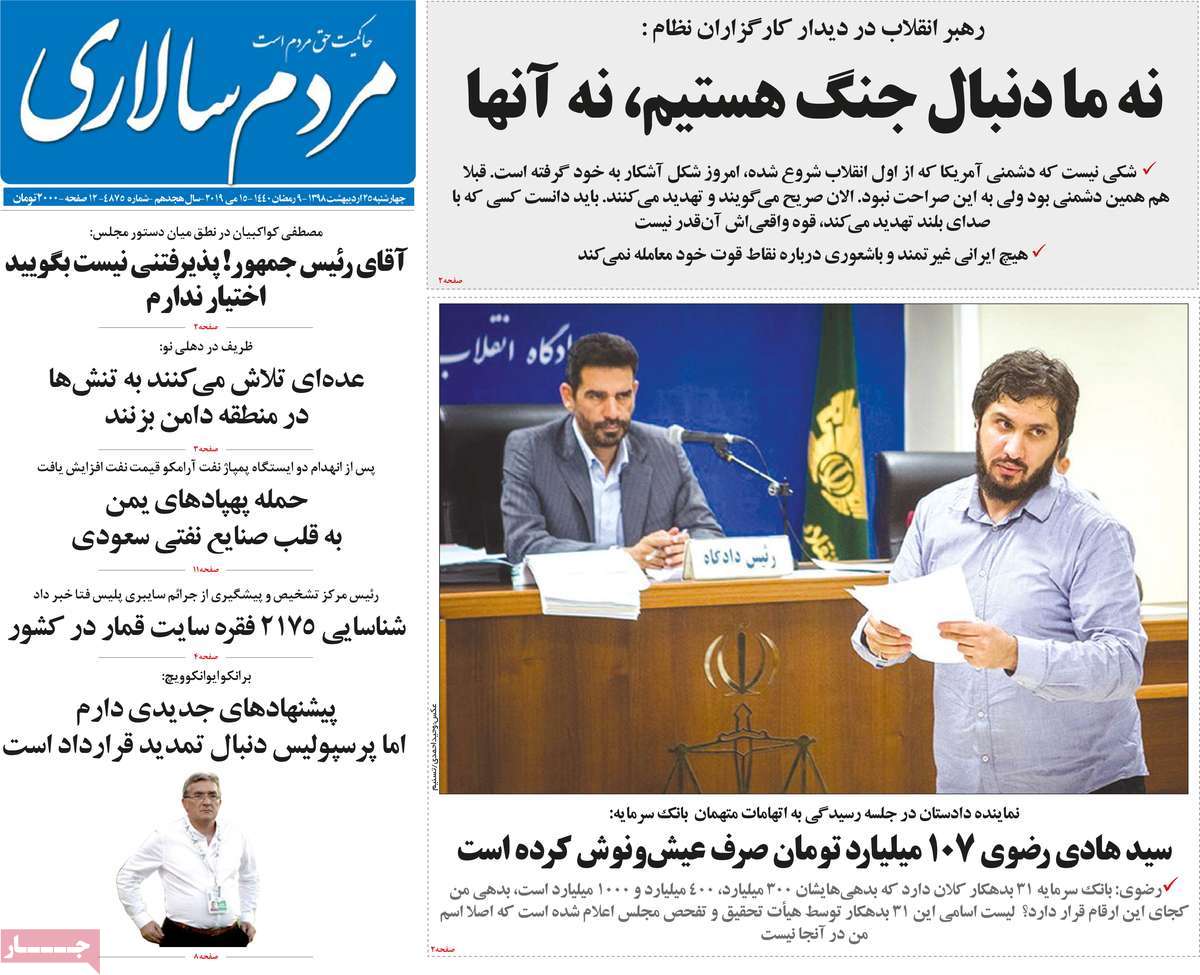
Mardom Salari:

1- Iran Leader: Neither We, Nor They Are after War

2- Yemeni Drones Attack Heart of Saudi Industries

* Oil Prices Up after Destruction of Two Aramco Oil Pumping Stations

A Look at Iranian Newspaper Front Pages on May 15


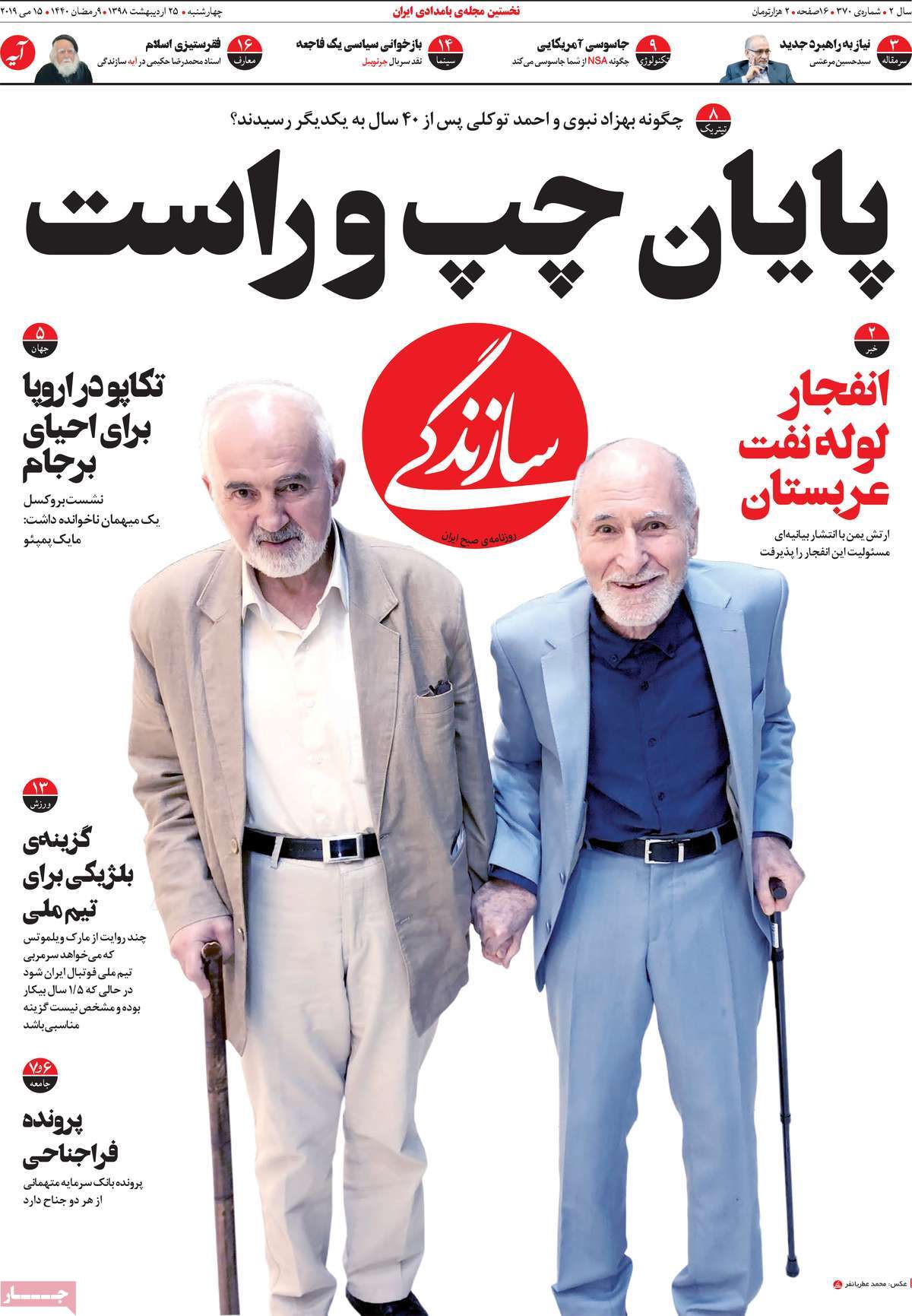
Sazandegi:

1- Explosion of Saudi Oil Pipeline; Yemen Claims Responsibility

2- Pompeo Unwanted Guest of Brussels Summit

A Look at Iranian Newspaper Front Pages on May 15


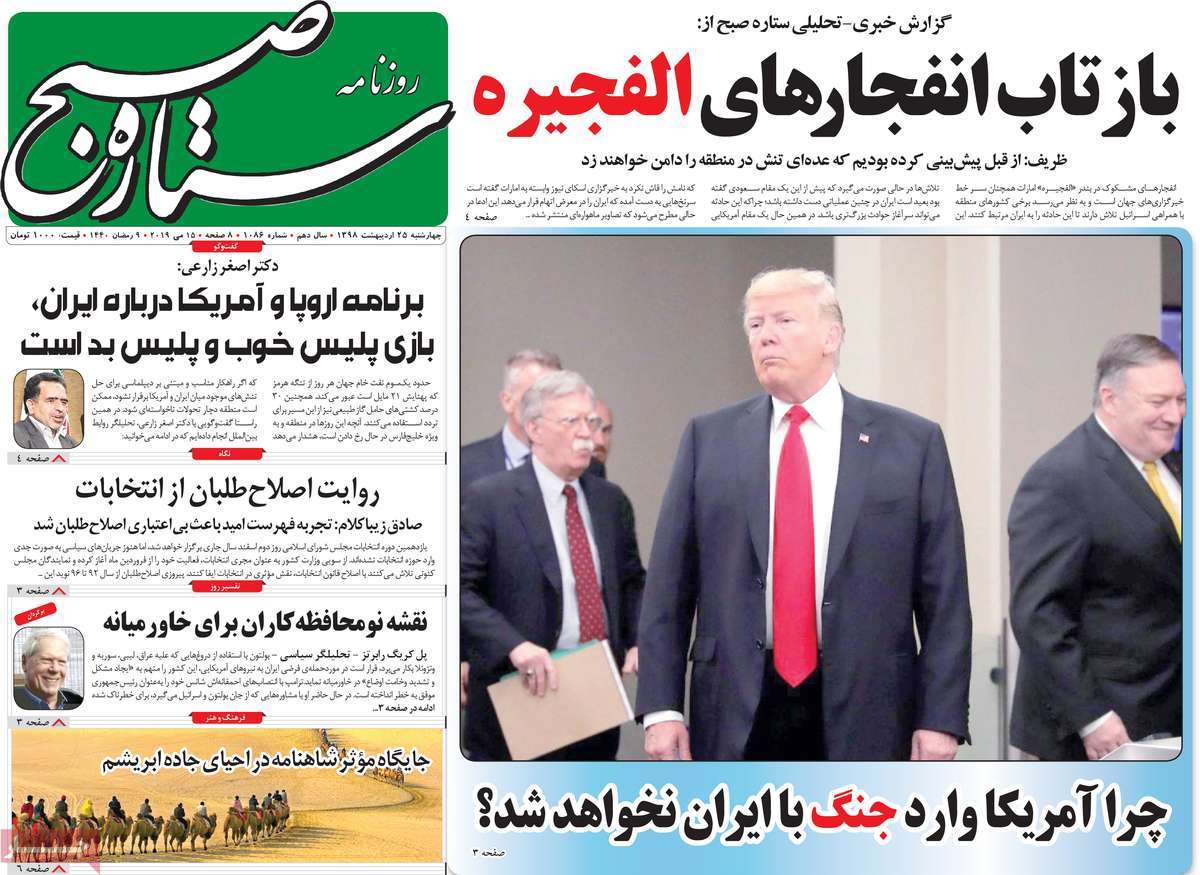
Setareh Sobh:

1- Zarif: We’d Predicted Some Would Fan Fuels of Tension in Mideast

2- US, Europe Trying to Play Good Cop/Bad Cop on Iran

3- Why US Won’t Engage in War with Iran

A Look at Iranian Newspaper Front Pages on May 15


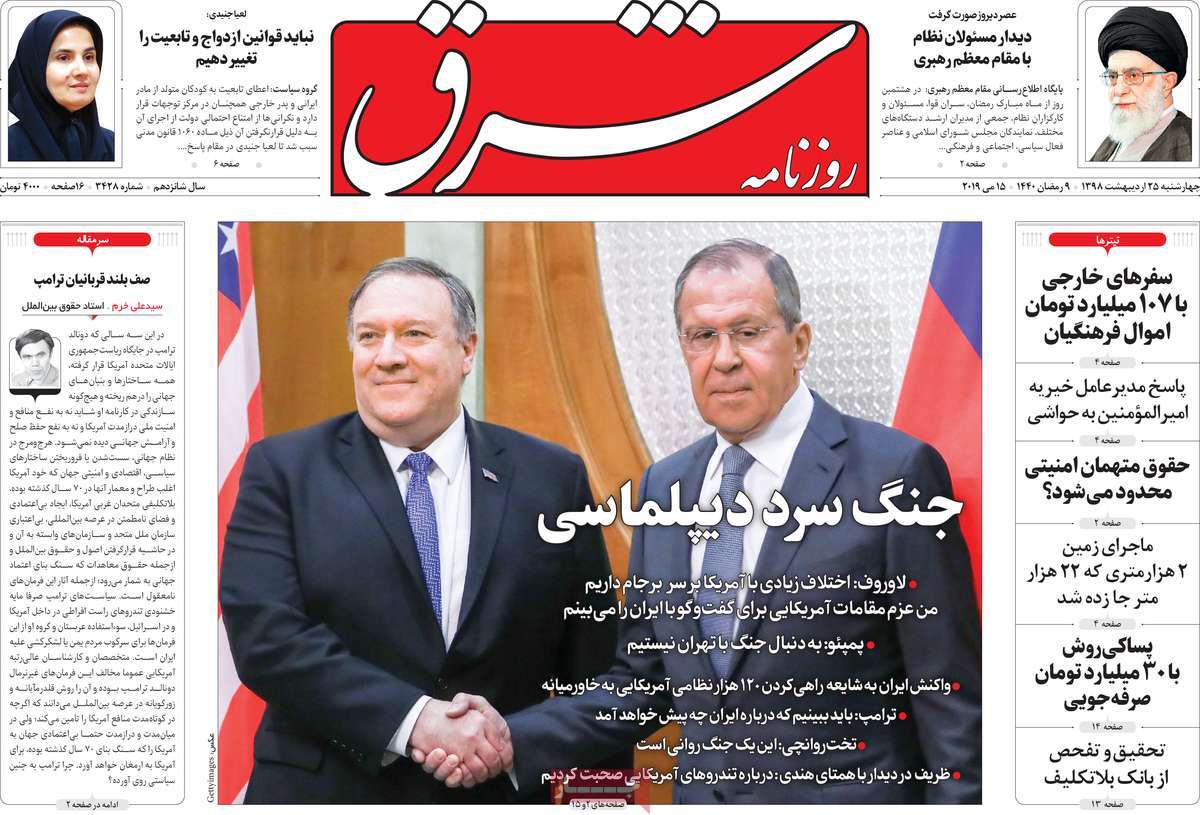
Shargh:

1- Top Iranian Officials Meet with Iran Leader

2- Cold War of Diplomacy

* Lavrov: I See Americans Resolved to Hold Talks with Iran

3- Pompeo: We’re Not after War with Iran

A Look at Iranian Newspaper Front Pages on May 15

World’s Largest Copper Tray Built in Iran’s Zanjan

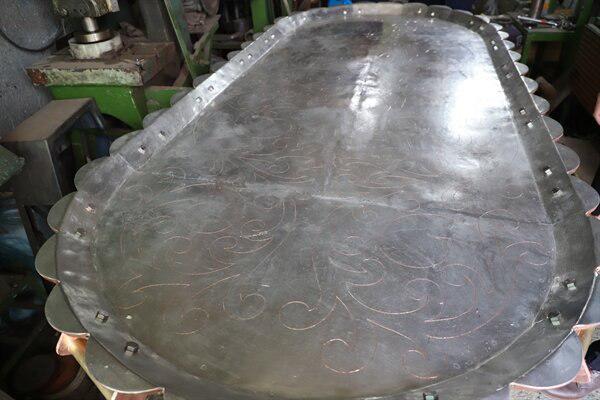
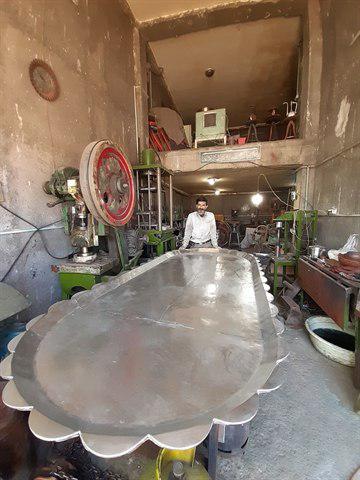
This tray is 3 metres long and 1.32 metres wide, weighs 335 kilograms with its handles and 285 kg without them, said Yahya Rahmati, the director of the Cultural Heritage, Handicrafts and Tourism Department of Zanjan province.

Akbar Qezelbash, the artist who has crafted the tray, explained that his creation far outmatched any other tray in the world both in terms of weight and dimensions.

World's Largest Copper Tray Built in Iran’s Zanjan“Four 8mm thick copper sheets are used in the making of this tray using welding brass, which is a first,” said 51-year-old Qezelbash.

Brass, an alloy of copper and zinc, is not easy to weld on copper sheets mainly because zinc has a much lower melting point.

“The design work on this big project has been impromptu and took 38 days to finish,” he added.

The Zanjani Artist said he was going to make a total of seven trays in three different dimensions.

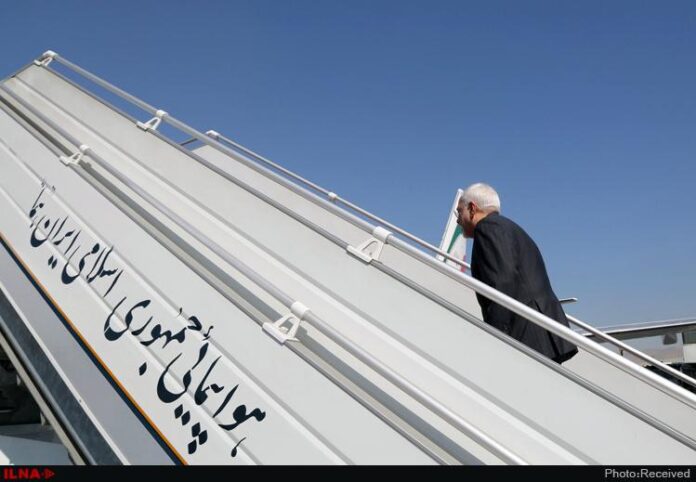
Iran FM Leaves New Delhi for Tokyo

Iran’s Foreign Minister in Beirut for Talks

The Iranian top diplomat is to hold talks with Japanese Prime Minister Shinzo Abe on Thursday morning.

Zarif’s trip to Tokyo comes as Japanese officials recently expressed hope to mediate between Tehran and Washington.

Japan’s Deputy Chief Cabinet Secretary Yasutoshi Nishimura said last Thursday that Tokyo intends to contribute to regional peace and stability, utilising its traditional friendly relations with Iran.

The call came following the recent escalation between Iran and United States over the 2015 nuclear deal.

Iran’s History on Show in Asian Civilization Exhibition

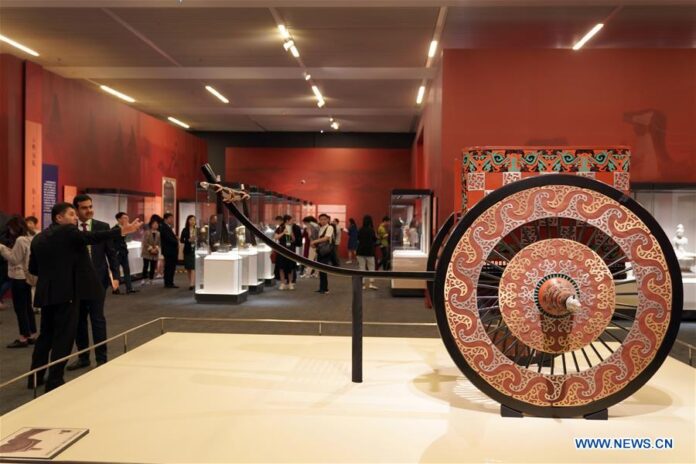
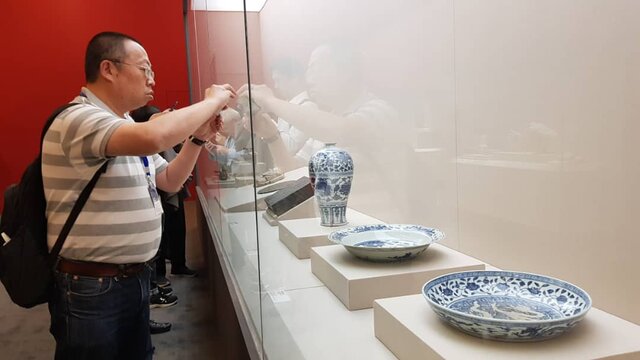
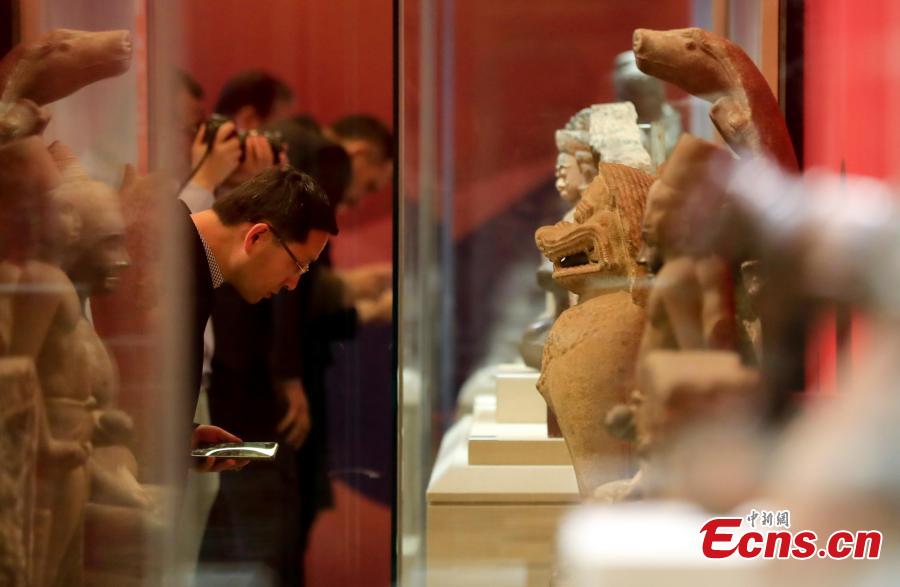
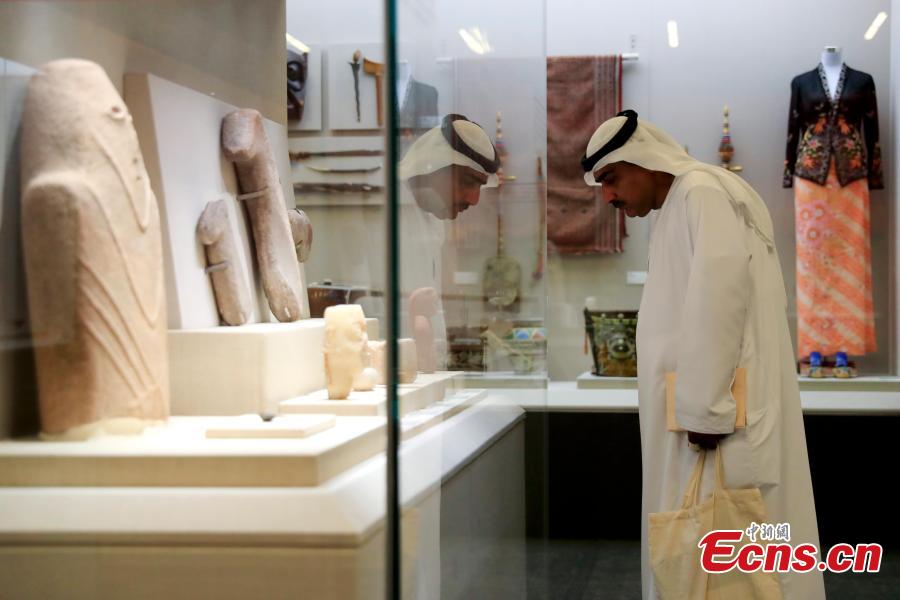
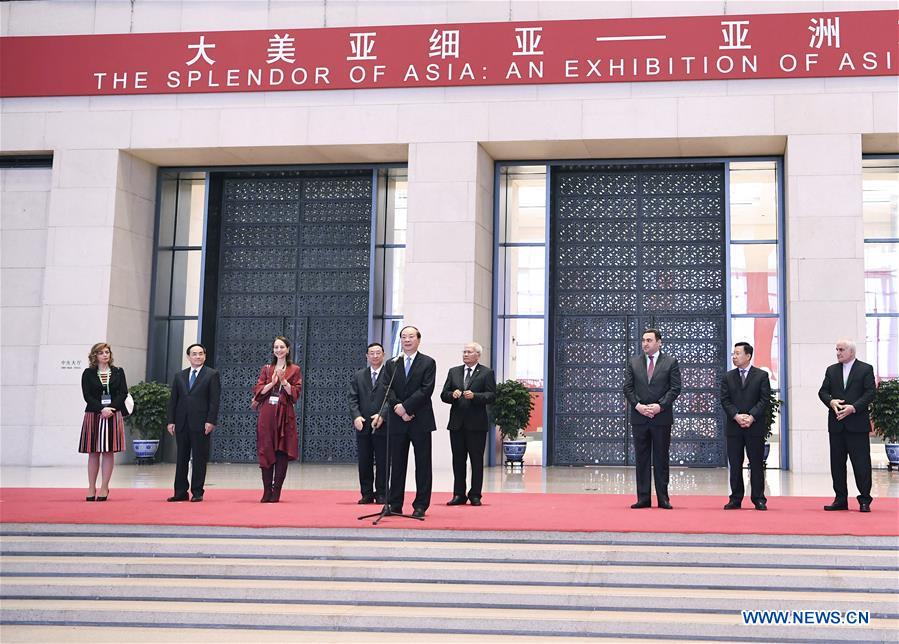
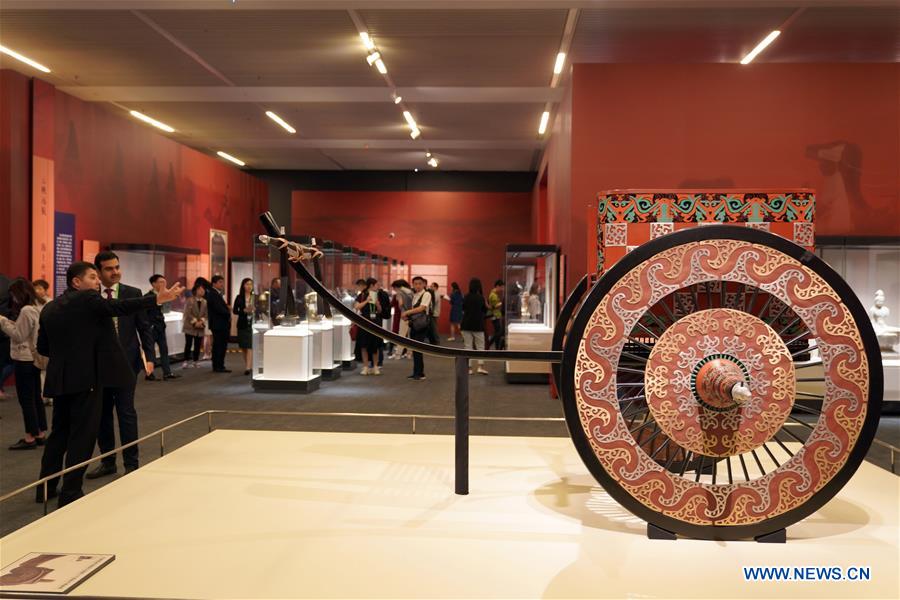
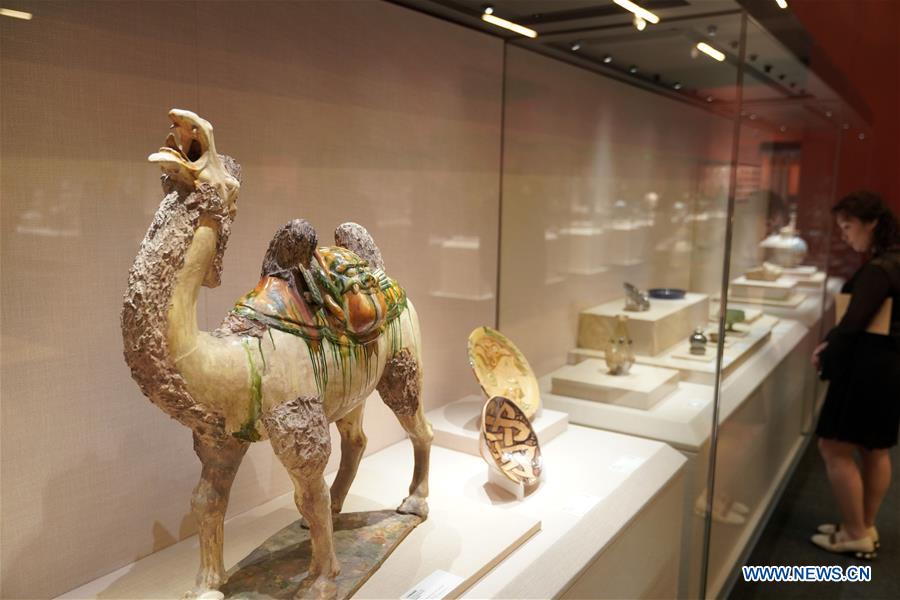
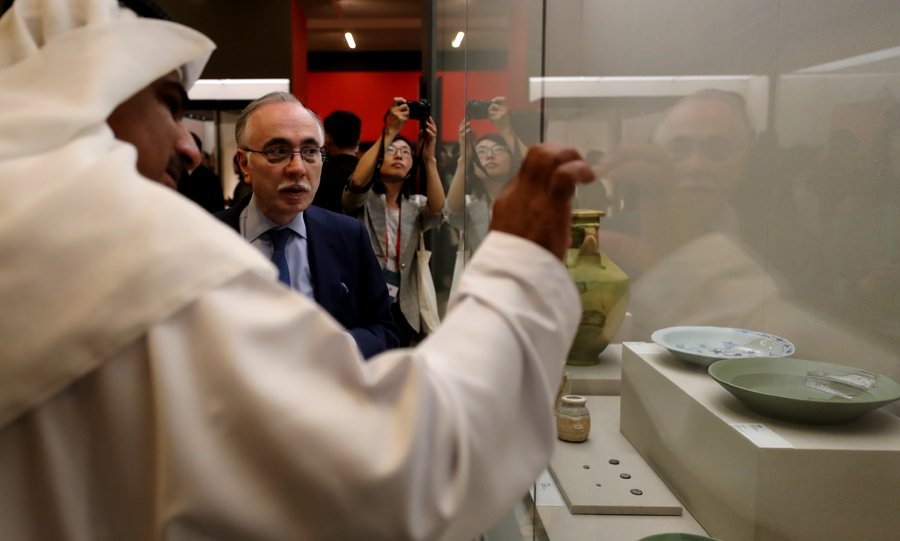
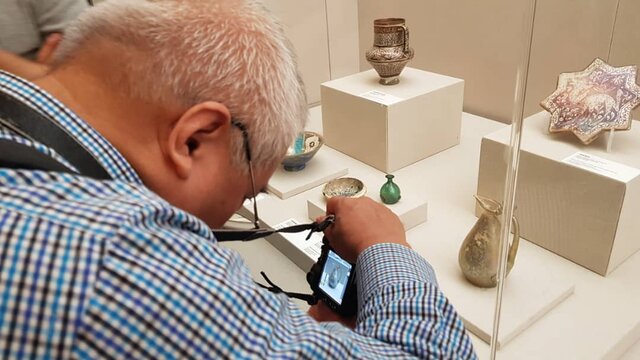
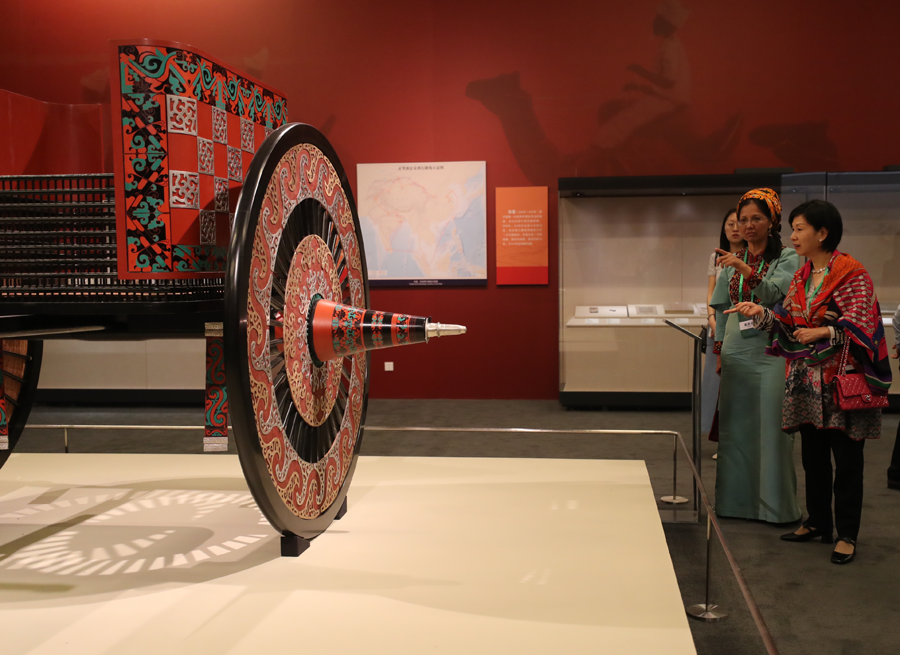
The exhibition, entitled “The Splendor of Asia: An Exhibition of Asian Civilizations”, opened on Monday in China’s National Museum in Beijing in a ceremony attended by delegations from the participating countries including Iran.

15 historical relics from Iran are being showcased in the exhibition.

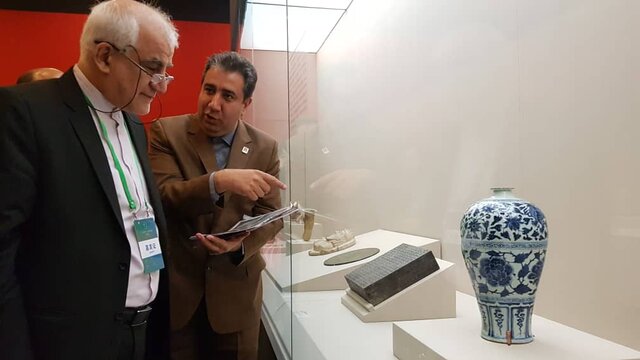
In an address to the opening ceremony, Director of the National Museum of Iran Jebreil Nokandeh elaborated on the Iranian relics which have been put on display during the exhibition dating back to Achaemenid dynasty including a major stone of the Palace of Darius in Susa.

He also provided the participating delegations with information on the Achaemenid’s governance as the first ancient empire in the world.

Elsewhere, Nokandeh referred to some inscriptions from Iran dating back to Safvid dynasty on the close economic and cultural ties between Iran and China.

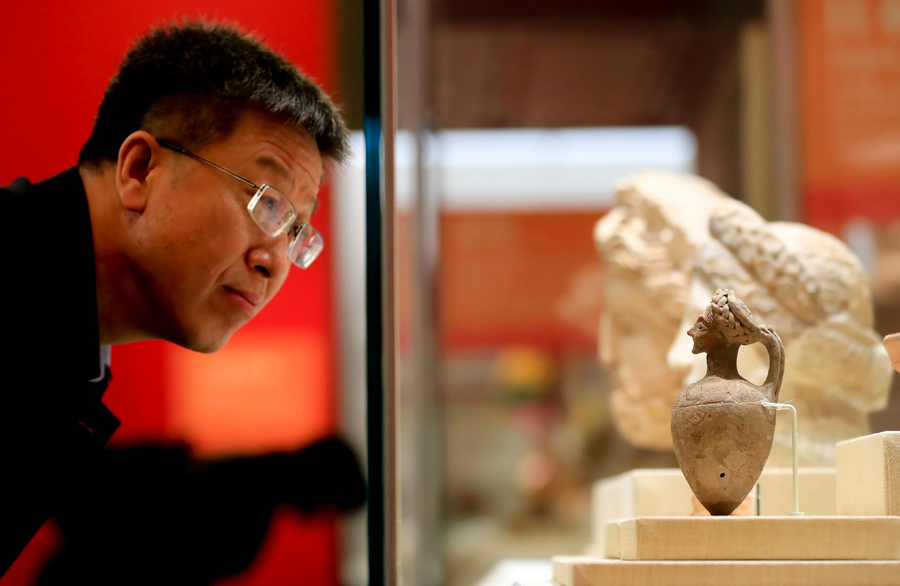
Among other Iranian relics on display in the China’s exhibition, one can also refer to a clay rhyton of Damavand from Parthian dynasty.

The participating countries are as follows: Iran, Pakistan, Armenia, India, Jordan, Tajikistan, Mongolia, Turkmenistan, Myanmar, Sri Lanka, Azerbaijan, Lebanon, the UAE, Cambodia, Japan, Saudi Arabia, Malaysia, Singapore, Laos from Asia and Greece, and Egypt as honorary guests from the Europe and Africa respectively.

The exhibition opened on Monday prior to the upcoming Conference on Dialogue of Asian Civilizations (CDAC). It is displaying over 400 cultural relics from 47 Asian countries as well as Greece and Egypt.

The exhibition also uses the high technologies of 3D restoration, virtual, augmented reality and multimedia imaging to promote further the Asian cultures.

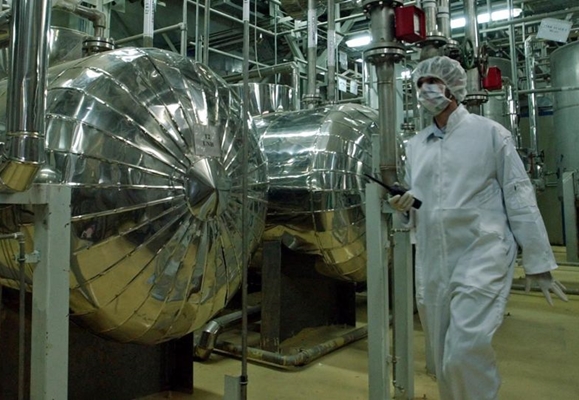
Iran Begins Unlimited Production of Enriched Uranium, Heavy Water

The move which comes on the order of Iran’s Supreme National Security Council (SNSC) is in response to Washington’s illegitimate withdrawal from the agreement.

According to an informed source at the Atomic Energy Organization of Iran (AEOI), the country has begun to stop implementing some of its obligations under the JCPOA as underlined in an SNSC statement.

“Stopping programs related to compliance with the ceiling for production of enriched uranium as well as the unlimited production of heavy water at the Arak facility are programs seriously pursued as stressed during the first 60-day period related to Iran’s first step [in response to the US withdrawal from the nuclear deal],” said the source who was speaking on condition of anonymity.

In order to inform the public of the measures adopted, he said, arrangements have been made for journalists and reporters to visit running installations at the nuclear facilities in Natanz and Arak.

Back on May 8, the Supreme National Security Council of Iran declared the country’s decision to stop implementing some of its commitments under the 2015 nuclear deal in reaction to the US’ withdrawal from JCPOA and Europe’s failure to make up for that.

As of May 8, 2019, Iran does not commit itself to observing restrictions of stockpiling enriched uranium and heavy water given the US’ violations of the nuclear deal, the SNSC said in a statement.

The statement also said that Iran gives other JCPOA parties 60 days to implement their commitments, especially in the banking and oil sectors.

Once they fulfil that, Iran will restart implementing its commitments. It’s now the other parties’ turn to show their good faith, the statement added.

US to Return Remaining Achaemenid Inscriptions to Iran

Mohammad Hassan Talebian, the ICHTO’s deputy chief, said Iran has over the past decades made serious efforts to bring back the inscriptions.

“The process to retrieve the remaining inscriptions from the US has begun since a long time ago and the legal certificates have also been issued by the US Treasury Department,” he said.

Talebian said the Islamic Republic has also filed a complaint at the US judiciary to prevent the Oriental Institute of the University of Chicago from hampering the delivery.

“The institute must return all the inscriptions to Iran in one shipment but due to the time-consuming process of obtaining all the legal permissions, including that of the Office of Foreign Assets Control (OFAC) of the US Treasury, we have agreed to receive 1,780 inscriptions as the first batch,” he said.

According to Talebian, the Oriental Institute first tried to delay the process using insurance and sanctions as excuse.

“But with help from senior Iranian officials, the American sides agreed to get the OFAC certificate or otherwise face legal action by Iran.”

“The institute is legally bound to insure the inscriptions and ship them to Iran,” he said.

“We have asked Iran’s Foreign Ministry to inform the institute that visas would be issued only if it accepts responsibility for the delivery process in its entirety, from insurance to shipment,” he said.

Over 30,000 of Achaemenid inscriptions were sent to the Oriental Institute of the University of Chicago in 1935 based on a mutual agreement. The institute was supposed to return the items after three years.

However, that never happened and it took until 1948 for the institute to begin returning the inscription. More items were returned in 1971 and 2004 after efforts by various Iranian governments.

In 1997, Iran was falsely accused of playing a role in a blast in Jerusalem al-Quds and the US government was demanded to confiscate the inscriptions.

The US even followed up on some requests and launched legal action only to be defeated by Iranian lawyers, who proved that the inscriptions were not part of the country’s financial assets and therefore couldn’t be seized upon court order.

11,000 Ancient Objects to Be Returned to Iran from US

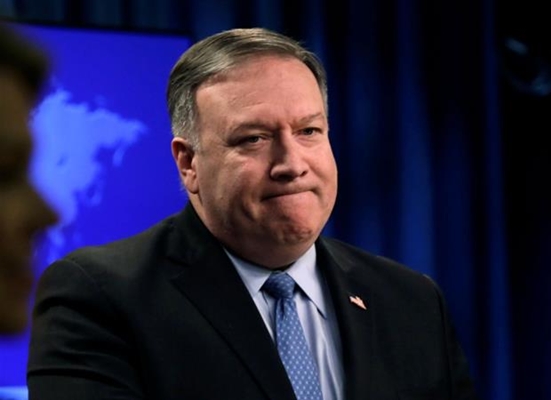
EU Leaders Snub Pompeo, Decline to Join His Anti-Iran Photo Op

Pompeo boarded a plane on Monday to crash the meeting of his European counterparts, who had called an emergency meeting to save the 2015 Iran nuclear deal after Tehran indicated that it was running out of patience with their inaction in the face of US pressure.

But what came in response to the top US diplomat’s last-minute decision was far from what he would have ever imagined.

The EU leaders gave Pompeo the cold shoulder before he even landed, with EU Foreign Policy chief Federica Mogherini saying that she would only meet with Pompeo “if we manage to arrange a meeting” on her busy schedule.

The next snub came from Pompeo’s British, French and German counterparts who said they would only meet him one-on-one, refusing to give him a symbolic group meeting.

After all, the image of three major European leaders rushing to meet Pompeo on an unannounced visit would have sent all the wrong messages of accord and closeness at a time that Washington is chasing away even the closest of its allies under President Donald Trump’s unique style of leadership.

Speaking of images, one diplomat told the Wall Street Journal’s Laurence Norman said that some European officials made a point of snubbing Pompeo by refusing to appear next to him in photographs.

“He wanted a photo op,” the official said. “We declined and stuck to the plan.”

Pompeo tried to contain the damage in an awkward manner after Mogherini apologized to him for not meeting him collectively.

‘‘No, no, this was great,’’ he said. ‘‘You had a busy day.”

Europe Knows Iran Is Serious

Unlike the United States, the EU showed with the recent meeting that it had taken Iran’s message by heart and was exploring all possible ways to meet Iran’s demands and prevent further unraveling of the landmark nuclear accord.

This was best echoed by British Foreign Secretary Jeremy Hunt, who said: “‘We are very worried about the risk of a conflict happening by accident, with an escalation that is unintended really on either side.”

‘‘What we need is a period of calm to make sure that everyone understands what the other side is thinking. Most of all, we need to make sure we don’t end up putting Iran back on the path to renuclearization.’’

Fed up with Europe’s inaction in the face of US pressure to affect Iran’s economy and zero out its oil exports, Tehran announced last week that it was reducing its commitments under the nuclear deal, known as the Joint Comprehensive Plan of Action (JCPOA).

Tehran has given the EU only 60 days before taking further steps, making it clear that nothing is off the table including complete withdrawal from the accord.

The meeting came amid security tensions in the Middle East region, which reached a new peak after the UAE announced Sunday that a number of vessels had been attacked by acts of “sabotage.”

‘‘I once again made it clear that we are concerned about developments and tensions in the region,’’ German Foreign Minister Heiko Maas said after meeting with Pompeo.

European leaders have asked Iran to exercise restraint while they try to figure out a way to save the nuclear deal and deliver on their pledges of trade with Iran while also protecting their businesses from an all-out economic war by Trump, who has warned all allies against doing business with Iran.

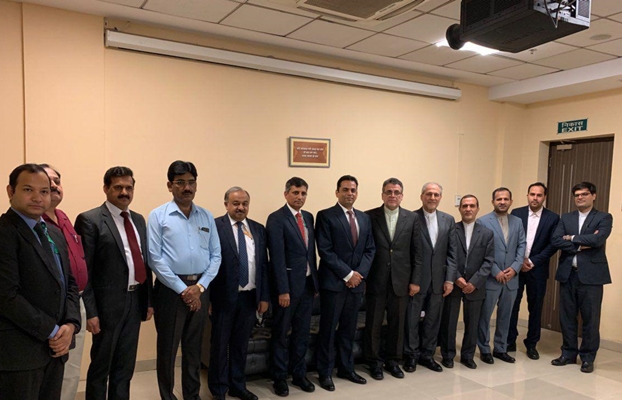
Iran, India Hold 11th Joint Consular Meeting

During the meeting, which was attended by the Iranian and Indian foreign ministries’ director generals for consular affairs, the two sides discussed consular issues of mutual interest.

The participating delegations also expressed satisfaction with the progress made in achieving basic agreements in judicial areas like transferring prisoners, extraditing criminals and establishing judicial assistance in criminal matters.

They also called for the finalization of an agreement made on judicial assistance in civil and commercial areas in the near future and the implementation of these agreements.

The possibility of lifting visa requirements for holders of official and service passports, taking advantage of the available capacities to issue electronic and upon-arrival visas with the aim of facilitating commercial ties and people-to-people communications were among other issues discussed during the meeting.

The delegations then underlined the need to establish security cooperation in fight against human and drug trafficking, terrorism and organized crimes.

They further exchanged views on the situation of the two sides’ prisoners, preventing prolongation of judicial process.

The two sides also conferred on settling the problems of Iranian and Indian  students.

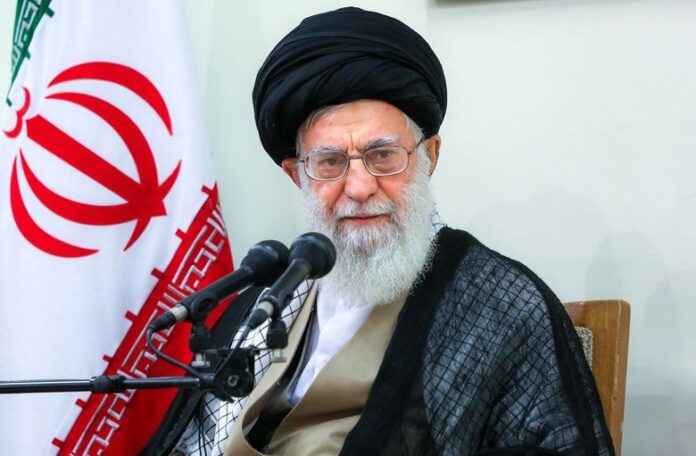
There Will Be No War between Iran, US: Leader

The Leader said the Iranian nation will force the US to retreat in any confrontation.

“The [current] confrontation is not military because there will be no war between Iran and the US. Neither Iran, nor the US is after war,” he said Tuesday.

“They know that their war against Iran will not be in their interest. This is a clash of wills and our will is stronger because in addition to our own will, we also trust in God,” he said.

Ayatollah Khamenei said some people inside Iran maintain that there is nothing wrong with negotiation but “negotiation [with the US] serves as a poison and as long as the current US administration is in power, any negotiation with it is doubly poisonous.”

Iran’s Leader then referred to the US’ call for negotiation with Iran on its defence capabilities. “They say that let’s sit for talks to shorten the range of your missiles so that you can’t hit back if we target you. It’s completely clear that no brave Iranian will sit for talks on its points of strength.”

The Leader added the concept of negotiation is wrong even with a reliable partner, “let alone the American government which is not reliable at all. They are not committed to anything in the world and no logical side in Iran is after negotiation with them.”

Ayatollah Khamenei said American officials serve as the defenders of the interests of Israel and most of their policies are led by the Zionists.

“The Americans say their policies have changed Iran. Yes, they are right. The result of the change is that today the hatred of Iranians of the US has increased by ten times. Today, our youths’ will to protect our country has increased considerably.” he said.