Friday, December 26, 2025
Home Blog Page 3208

A Look at Iranian Newspaper Front Pages on April 25

A Look at Iranian Newspaper Front Pages on November 19

The top story in all newspapers today was the remarks made by the Leader of Iran’s Islamic Revolution Ayatollah Seyyed Ali Khamenei about the US’ sanctions on Iran’s oil exports.

Several papers also covered the comments made by Iranian Foreign Minister Mohammad Javad Zarif during his visit to New York, particularly his offer of a prisoner swap between Tehran and Washington.

Iranian President Hassan Rouhani’s reaction to the support of Saudi Arabia and the UAE for the US’ sanctions on Iran’s oil exports also received great coverage.

The above issues, as well as many more, are highlighted in the following headlines and top stories:

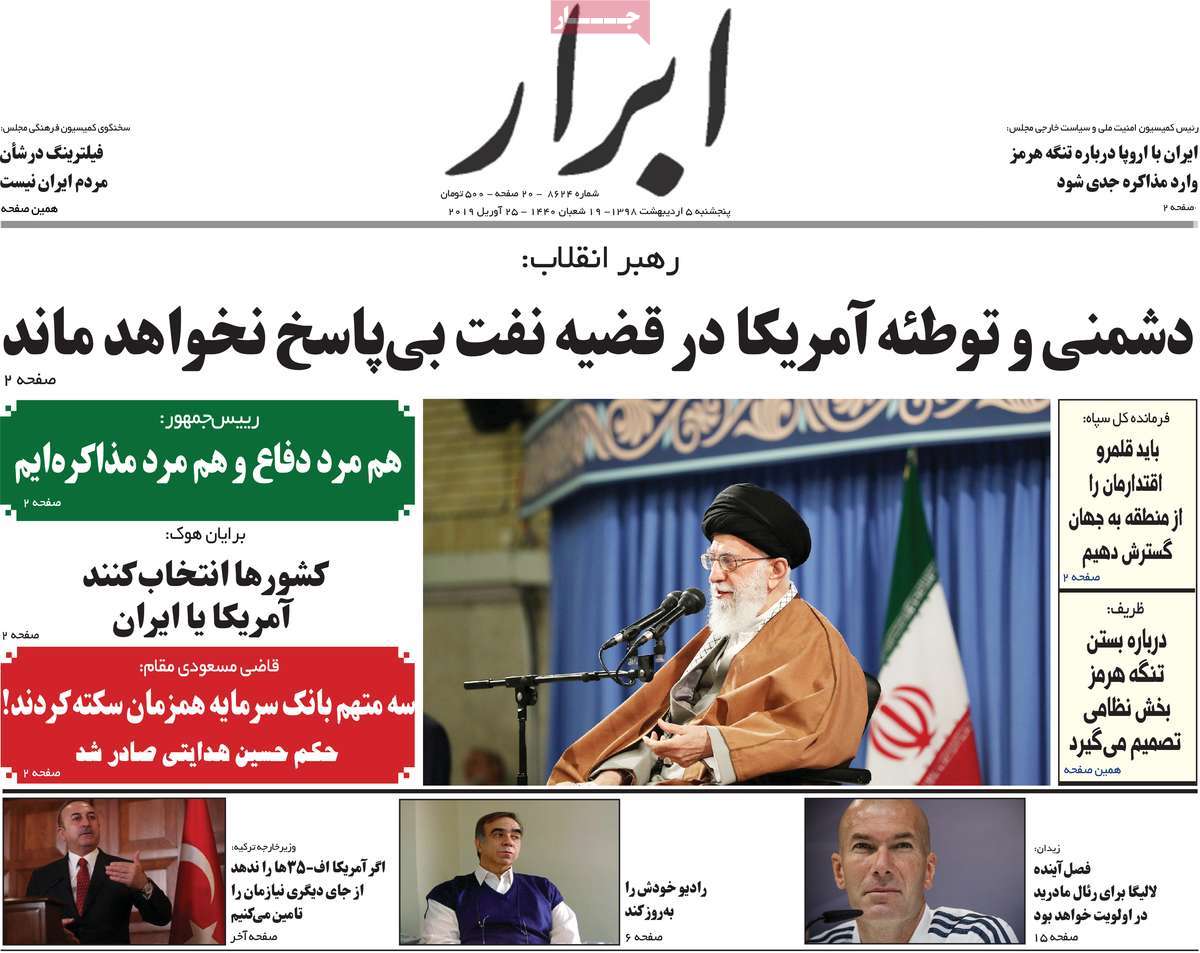
Abrar:
1- Iran Must Engage in Serious Talks with Europe over Hormuz Strait
2- Zarif: Iran’s Military to Decide on Closing Strait of Hormuz
3- Hook: Countries Must Choose between Iran, US
4- Turkey FM: We’ll Supply Our Need from Elsewhere If US Doesn’t Give US F-35
A Look at Iranian Newspaper Front Pages on April 25


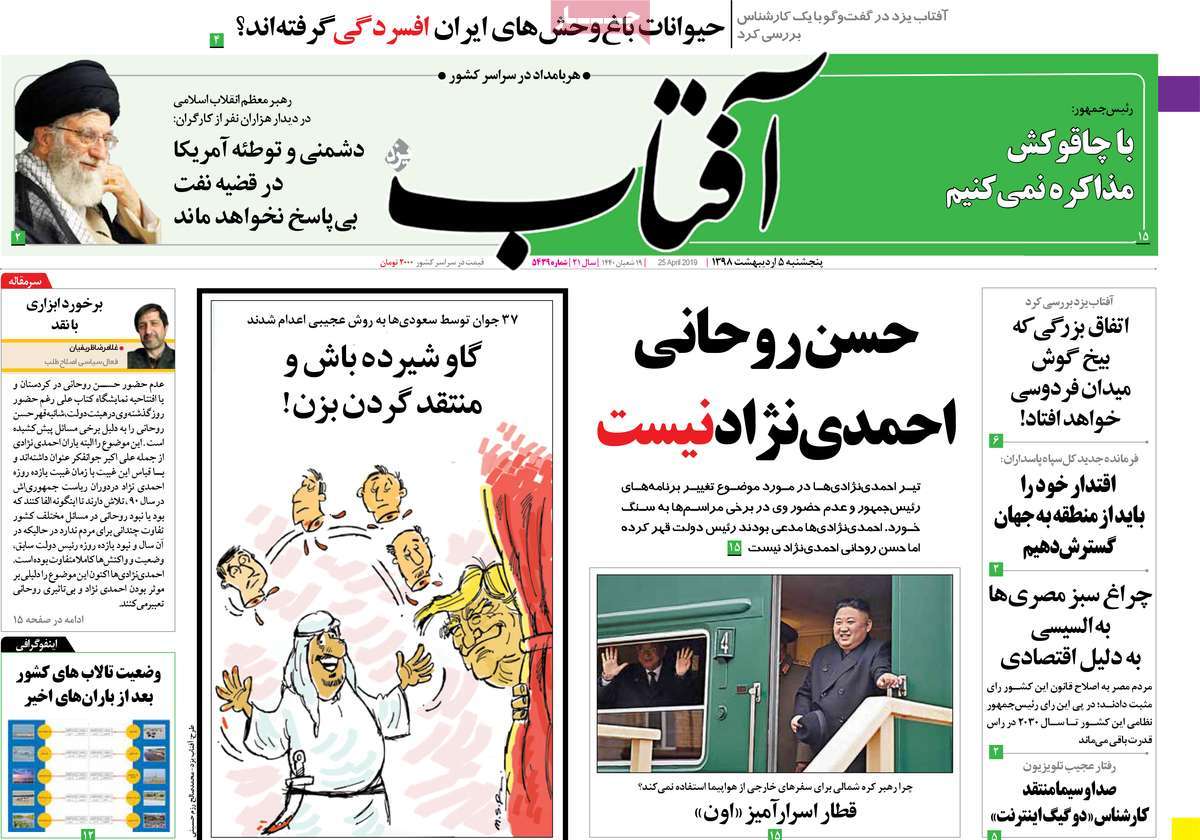
Aftab-e Yazd:
1- Rouhani: We Won’t Negotiate with a Thug
2- US’ Hostility, Plot on Oil Exports Won’t Remain Unanswered: Leader
3- New IRGC Chief: We Should Promote Our Might from Region to Entire World
4- Saudis Can Behead People Freely as Long as They’re Milky Cows
• Saudis Execute 37 Young People in Strange Way
A Look at Iranian Newspaper Front Pages on April 25


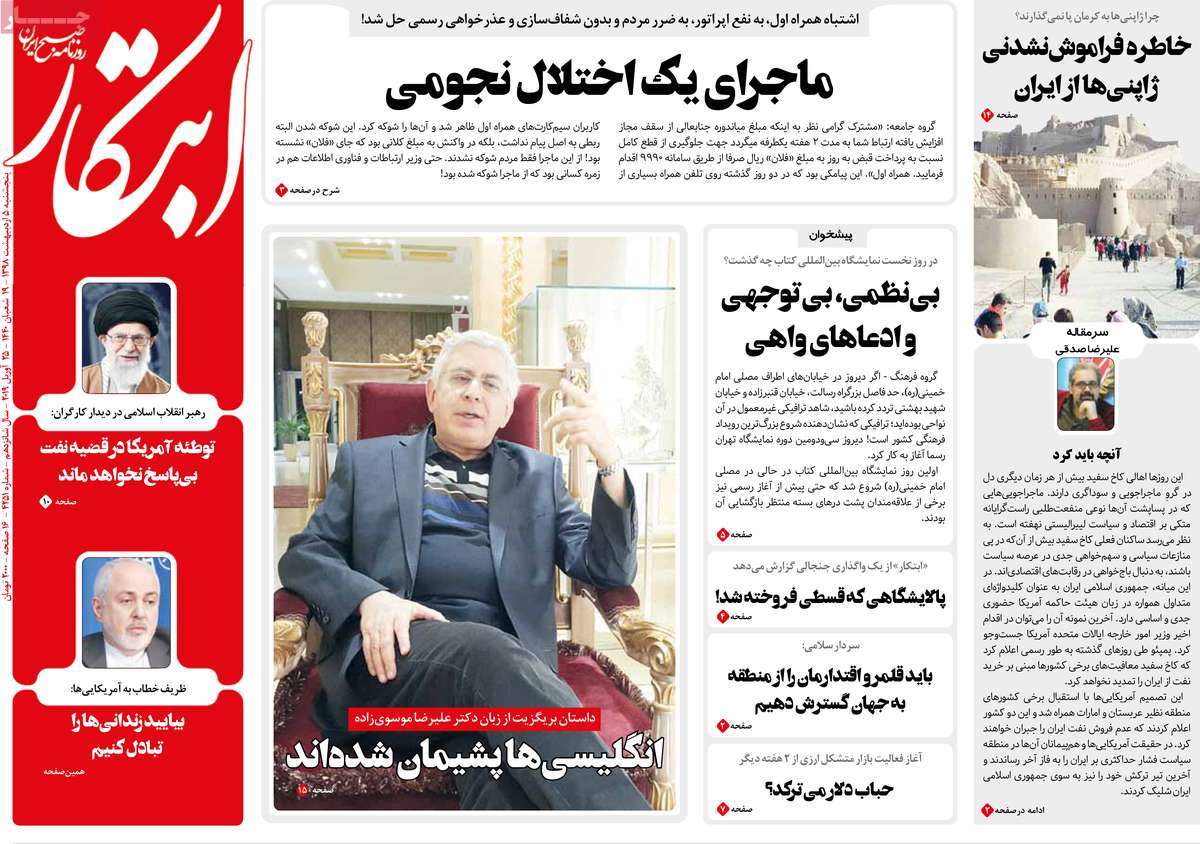
Ebtekar:
1- Zarif to Americans: Let’s Exchange Our Prisoners
A Look at Iranian Newspaper Front Pages on April 25


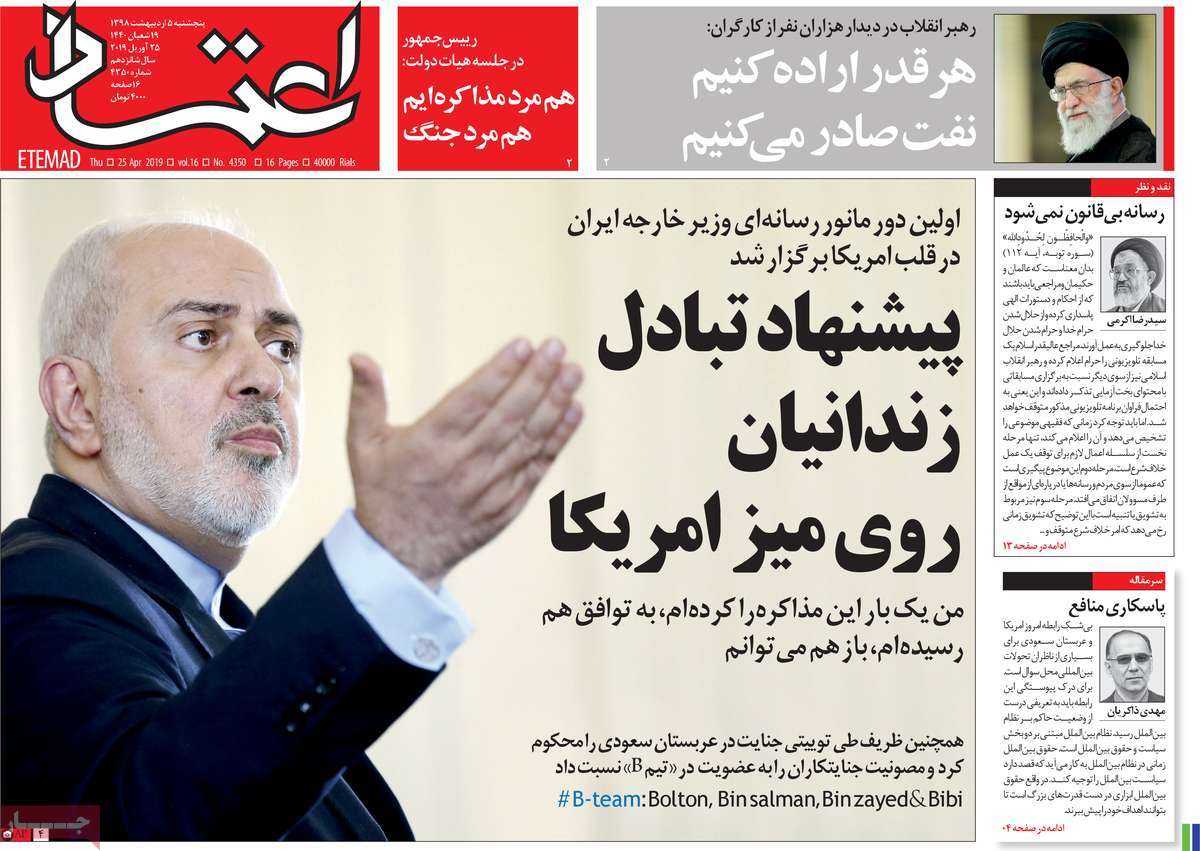
Etemad:
1- Prisoner Swap Offer on US’ Table
• Iran FM’s First Media Gesture in Heart of US
• I Once Negotiated Such a Deal and Succeeded; I Can Do It Again
2- Zarif Condemns Saudi Mass Execution
A Look at Iranian Newspaper Front Pages on April 25


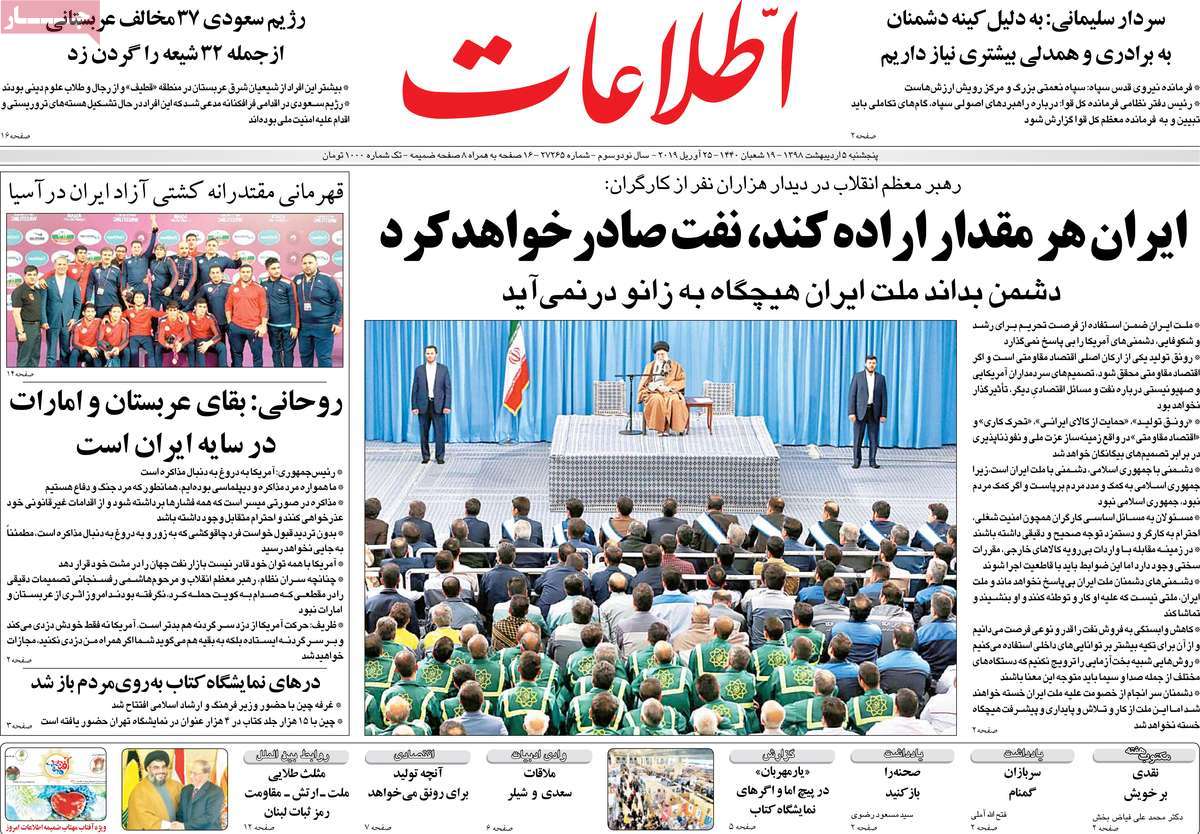
Ettela’at:
1- Saudi Regime Beheads 37 Dissidents, Including 32 Shiites
2- Rouhani: Saudi Arabia, UAE Survived Thanks to Iran
3- Gen. Soleimani: We Need More Brotherhood, Synergy Given Enemy’s Grudge
A Look at Iranian Newspaper Front Pages on April 25


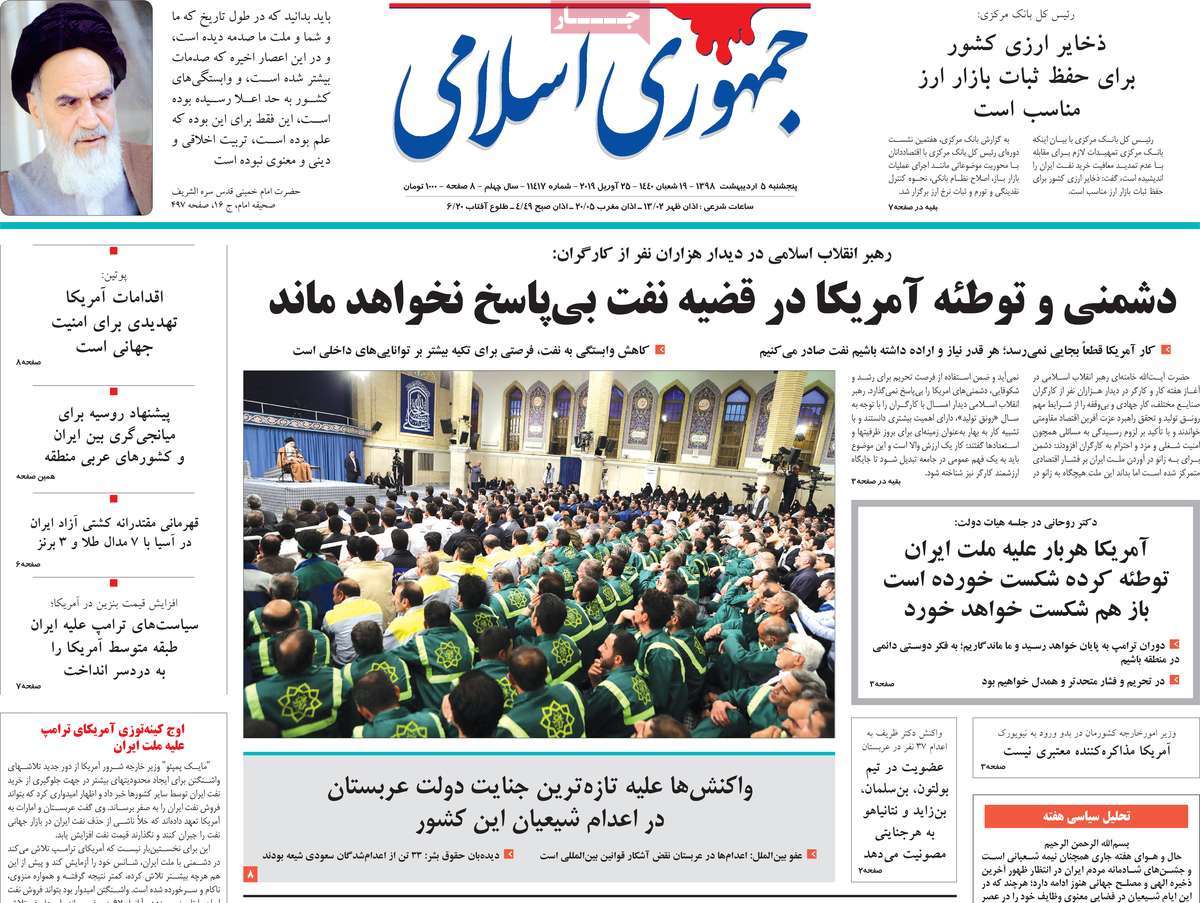
Jomhouri Eslami:
1- Russia Proposes to Mediate between Iran, Arab States
2- Petrol Price Hikes in US: Trump’s Policies against Iran Puts Middle Class in Trouble
3- Reactions to Saudi Government’s Latest Crime
• Amnesty Int’l: Executions in Saudi Arabia Clear Violation of Int’l Law
• HRW: 33 of Those Beheaded Were Shiites
A Look at Iranian Newspaper Front Pages on April 25


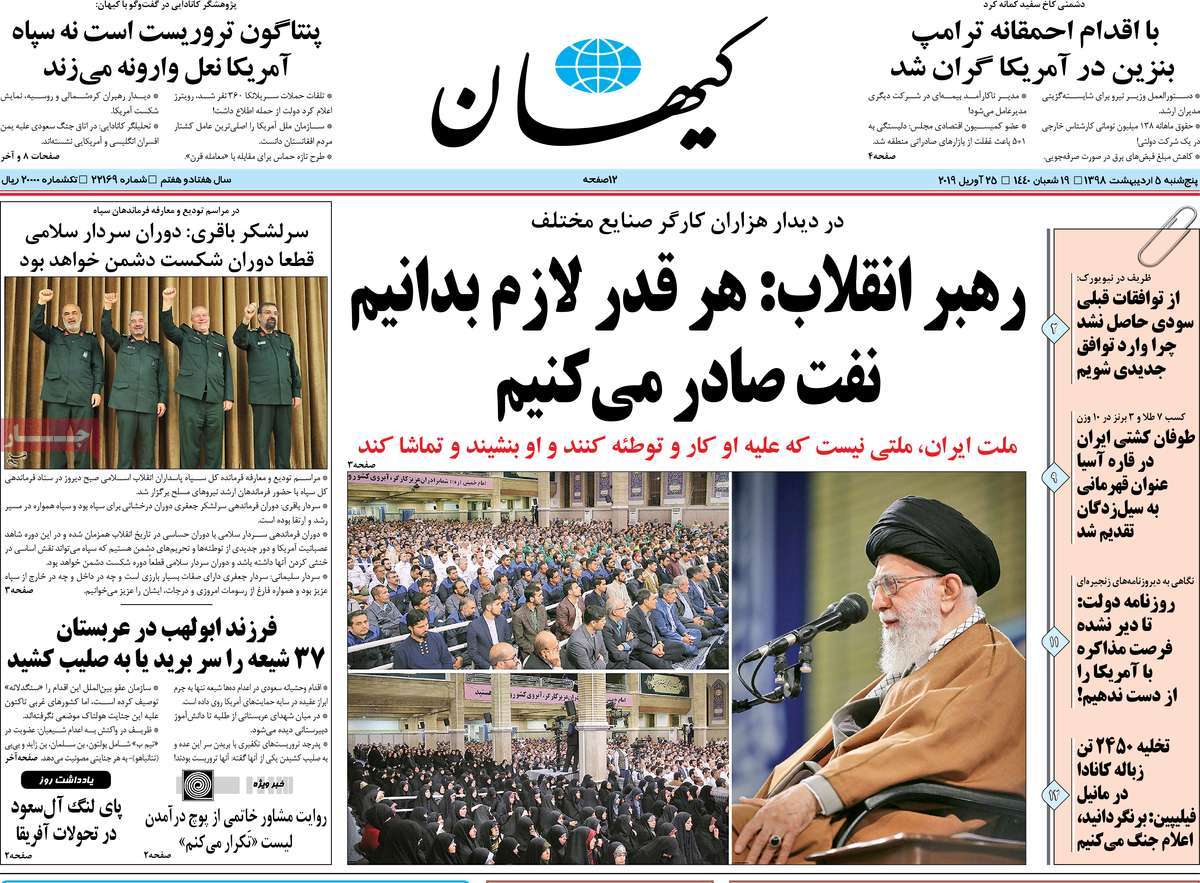
Kayhan:
1- White House Official: Trump’s Stupid Move Increased Petrol Price in US
2- Zarif in New York: We Didn’t Benefit from Previous Deals, Why Should We Engage in New One
3- Leader: Iranian Nation Not to Remain Silent When Others Conspire against It
A Look at Iranian Newspaper Front Pages on April 25


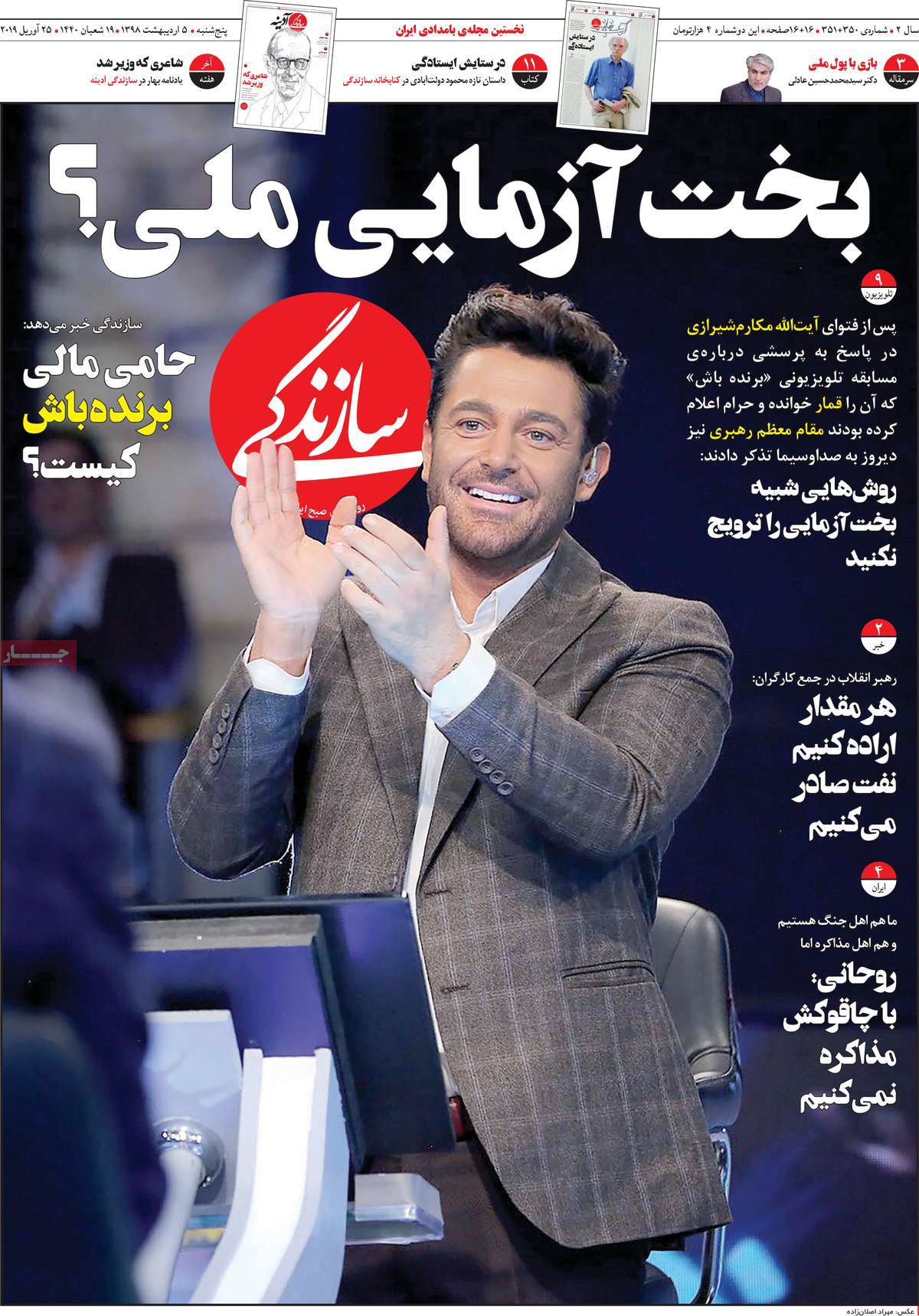
Sazandegi:
1- Iran Leader: We’ll Export as Much Oil as We Wish
2- Rouhani: We’re Both Good at War and Negotiation
A Look at Iranian Newspaper Front Pages on April 25


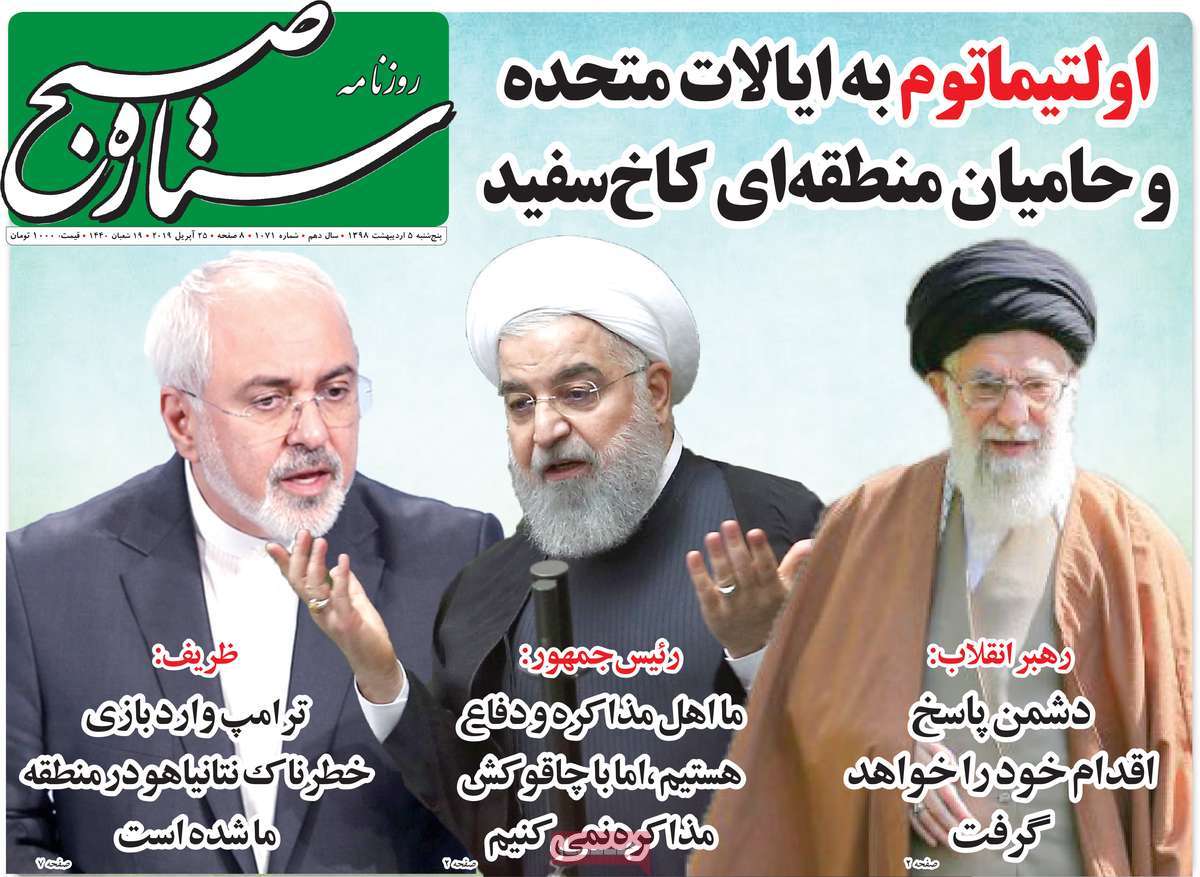
Setareh Sobh:
1- Ultimatum to US, Its Regional Allies
• Zarif: Trump Engaged in Netanyahu’s Dangerous Game in Our Region
A Look at Iranian Newspaper Front Pages on April 25


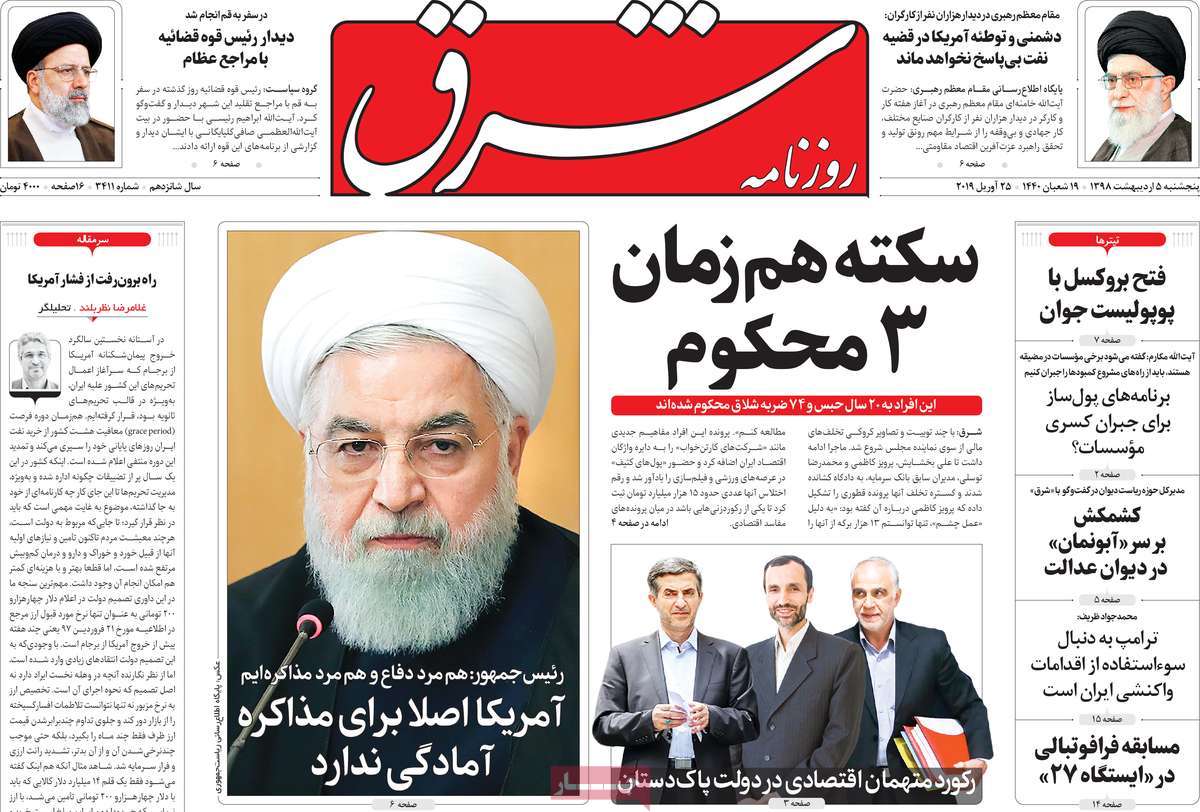
Shargh:
1- US Not Ready for Talks at All: Rouhani
2- Zarif: Trump Seeks to Abuse Iran’s Reciprocal Acts
A Look at Iranian Newspaper Front Pages on April 25


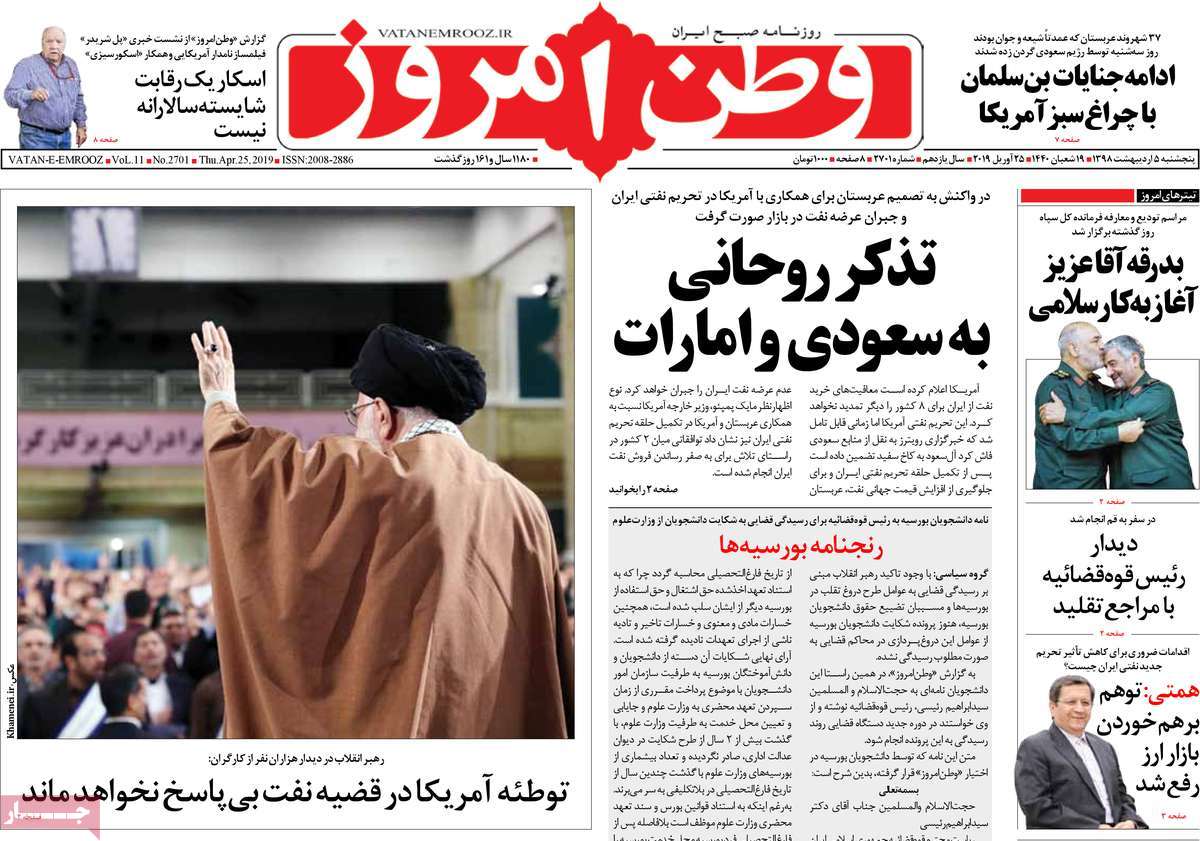
Vatan-e Emrooz:
1- Rouhani Cautions Saudi, UAE after Their Decision to Cooperate with US Sanctions on Iran Oil
2- Bin Salman Continues His Crimes with US’ Green Light
A Look at Iranian Newspaper Front Pages on April 25

Iran Says Not to Let Any Country Replace It in Oil Market

In a Thursday statement, Seyyed Abbas Mousavi said the positions adopted by Riyadh and Manama bear witness to their blind obedience to the United States and their unawareness of the consequences of their move.

“The Islamic Republic of Iran will not allow any country to replace it in the oil market and holds the US as well as the above-named states responsible for any repercussions with regards to that,” he said.

“The Iranian government and nation will not forget the animosity of some countries in this historic situation,” the spokesman noted.

He also touched upon Riyadh’s mass execution of 37 Saudi nationals, calling it a move similar to what would be done during the Jahiliyyah era.

Mousavi also urged the international community to counter such lunatic actions.

“Saudi Arabia commits such acts in line with the policy of triggering sedition in the region and with the support of the US government, and the regional countries should remain vigilant with regards to the dangerous consequences of such seditious moves,” he warned.

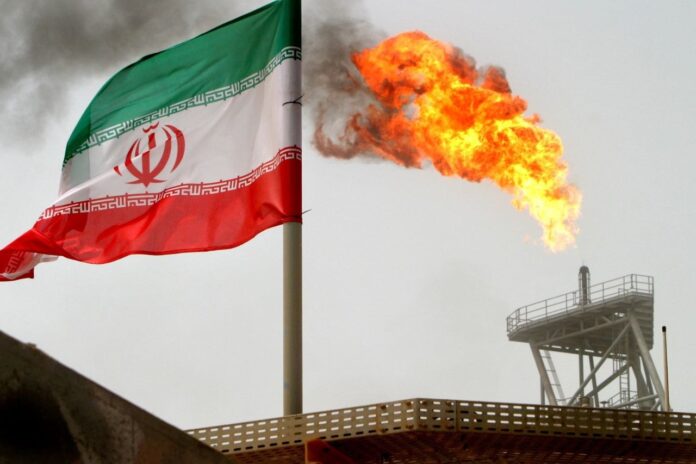
Washington announced days ago that it would not renew waivers that allowed eight countries to buy Iranian oil without facing US sanctions. The White House said in a statement released on Monday that the US president would not reissue Significant Reduction Exceptions (SREs) when they expire in early May, a move aimed at bringing Iran’s oil exports to zero.

Meanwhile, Saudi Arabia and Manama, along with the UAE, have committed themselves to supplying more crude to compensate for any oil shortage that could hit the market due to a possible reduction in Iran’s oil sales because of US sanctions.

Iran’s Judiciary Chief Condemns Saudi Mass Execution

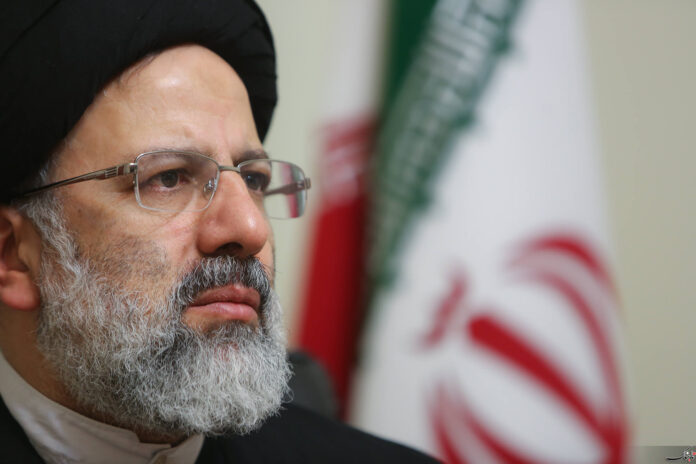
“International organizations should examine which one of the individuals executed by Saudi Arabia under the pretext of terrorism had a terrorist record,” Raisi said in a meeting with heads of justice departments and prosecutors from across Iran.

“Today, what we are seeing [happening] in the Saudis’ unjust judgement system where people are killed in the name of fighting terrorism is a manifestation of selfishness,” he said.

“Based on the reports received, these people were freedom-seeking individuals who sought to fight tyranny and reclaim the rights of people, and today Saudi Arabia has killed them under the pretext of fighting terrorism, and all international organizations have remained silent,” he added.

He said such moves are done by those who claim to be advocates of human rights.

Saudi Arabia executed 37 people in a single day in connection with what it called ‘terrorism crimes.”

The Arabic-language Saudi Arabian daily Okaz, citing a statement issued by the Interior Ministry, said the death penalty was implemented Tuesday “on a number of culprits for adopting extremist terrorist ideologies and forming terrorist cells to corrupt and disrupt security as well as spread chaos and provoke sectarian strife.”

The official Saudi Press Agency (SPA) also said that one of the condemned was crucified after the execution.

Meanwhile, the Arabic-language Ahrar television network, in a post published on its official Twitter page, reported that imprisoned Shiite activists were among those executed by Saudi authorities.

Iran, Venezuela Strongly Reject Any Foreign Interference

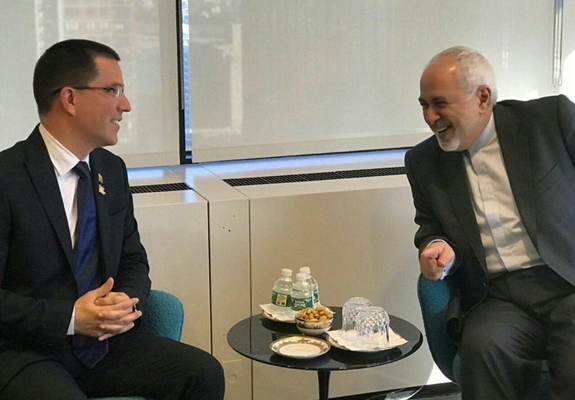
During the meeting, Zarif highlighted Iran’s efforts to expand its economic relations with Venezuela, and underlined Tehran’s continued support for the Latin American state.

He also emphasized the need for non-interference of foreign sides in Venezuela’s internal affairs, the necessity of respecting international law, and the significance of Iran’s cooperation and coordination with other countries opposed to unilateralism at the international order.

Arreaza, for his part, appreciated Iran’s assistance and support for his country, and underlined the importance of continued consultations between the two countries.

He also highlighted the extensive efforts of Caracas to counter the unfair campaign of certain countries, led by the US, to “painfully” interfere in his country’s internal affairs.

He finally stressed the significance of stability in Venezuela, the government’s full control over the situation, the opposition of the majority of Venezuelans to the US’ interventions, an increase in public support for the country’s legitimate government, the opposition groups’ devotion to the US, and the fact that they are not allowed to hold any negotiation.

In recent months, tensions have increased between Caracas and Washington with the US imposing sanctions on Venezuelan President Nicolas Maduro as well as his government.

In January, the US took the lead in recognizing Juan Guaido as Venezuela’s president after the head of the opposition-ruled Congress named himself the country’s interim chief executive. Washington has been pressuring other countries into following suit and has not ruled out using the military option to oust the government of Venezuelan President Nicolas Maduro.

US President Donald Trump also recently received Guaido’s wife at the White House.

Russia, China, and Cuba, however, back Maduro’s government in the face of the US pressure.

Russian Foreign Minister Sergei Lavrov has accused Washington of trying to “organize a coup d’etat” in Venezuela.

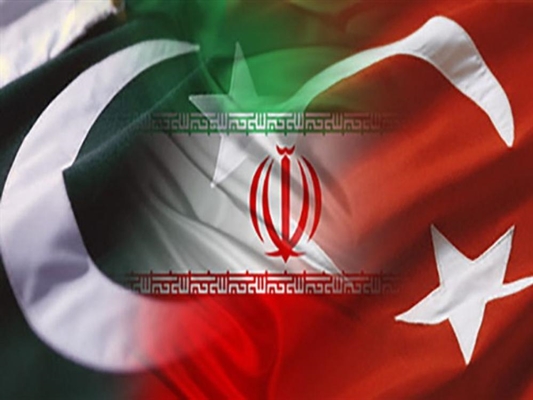
Ankara to Host Turkey-Iran-Pakistan Symposium

The symposium is to be attended by professors, researchers, experts and students from Turkey, Iran and Pakistan.

It is co-organized by the Centre for Iranian Studies in Ankara (iRAM), Yildirim Beyazit University, Institute of Strategic Studies of Islamabad (ISSI) and Institute for Political and International Studies (IPIS), a foreign policy think tank affiliated with Iran’s Foreign Ministry, a report by Anadolu news agency said.

The symposium is aimed at exploring and assessing opportunities for further mutual and trilateral cooperation between the three states.

The organizers maintain that Iran, Turkey and Pakistan enjoy high capacities to create a strong regional alliance to overcome security and development problems. The participants will contribute to the symposiums through articles and research on these opportunities.

The main themes of the symposium deal with economic, security, investment and trade issues among the three states.

Iran Has PhD in Bypassing Sanctions: FM Zarif

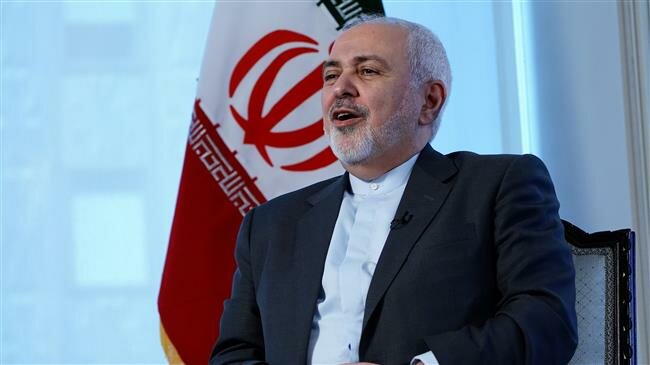
Zarif said in an exclusive interview with Reuters on Wednesday that Washington’s sanctions hurt ordinary Iranians, but that the government would do whatever it could to sell oil to provide for its citizens.

“I mean there are always ways of going around the sanctions. We have a PhD in that area,” he told Reuters during his trip to New York.

Earlier this week, the White House once again took aim at Iran’s oil sector, ending six months of waivers which allowed Tehran’s eight largest customers to continue importing limited volumes.

It threatened the buyers of Iranian oil with sanctions if they fail to stop their purchases by May 1, in a move that quickly sent global crude prices to their highest levels since last November.

The anti-Iran American sanctions had been lifted under a 2015 multilateral nuclear deal with Iran, but they returned in place when the US abandoned the landmark agreement — officially called the Joint Comprehensive Plan of Action (JCPOA).

Asked who else Iran might consider exporting oil to, Zarif replied, “If I told you, we won’t be able to sell it to them.”

Iran has said it may close the Strait of Hormuz if prevented from using the strategic waterway, through which one third of the world’s seaborne oil passes.

Asked whether American warships could still pass through the waterway, Zarif said, “Ships can go through the Strait of Hormuz.”

Read more:

“If the United States wanted to continue to observe the rules of engagement, the rules of the game, the channels of communication, the prevailing protocols, then in spite of the fact that we consider US presence in the Persian Gulf as inherently destabilizing, we’re not going to take any action,” he noted.

Commenting on the US blacklisting of Iran’s Islamic Revolution Guards Corps (IRGC), the top diplomat suggested that Tehran did not plan to respond militarily to the “absurd” move unless Washington changed the rules of engagement.

“We will exercise prudence but it doesn’t mean that if the United States changed the rules of the game, or changed the rules of engagement, it would be able to get away with that,” Zarif said.

On April 8, the White House labeled Iran “a State Sponsor of Terrorism” and the IRGC a “foreign terrorist organization,” claiming that the elite force “actively participates in, finances, and promotes terrorism as a tool of statecraft.”

In a counter-measure, Iran designates American forces in West Asia, known as the United States Central Command (CENTCOM) as terrorists.

‘Iran not after war, but will defend itself’

Commenting on the US administration’s highly hostile Iran policy, Zarif said he believed President Donald Trump does not want war with Iran, but that he could be “lured into” a conflict by the hawkish politicians close to him at home and abroad.

“I don’t think he wants war,” he said. “But that doesn’t exclude him being basically lured into one.”

Zarif added that the hawkish “B-team” ­­— comprising US National Security Adviser John Bolton, Israeli Prime Minister Benjamin Netanyahu, Saudi Crown Prince Mohammed bin Salman and  Abu Dhabi Crown Prince Mohammed bin Zayed Al Nahyan — could goad Trump into a conflict with Tehran.

“Those who have designed the policies that are being pursued do not simply want a negotiated solution. But let me make it clear that Iran is not seeking confrontation, but will not escape defending itself,” he said.

US Plan to Cut Iran’s Oil Exports Down to Zero Not Feasible: DM

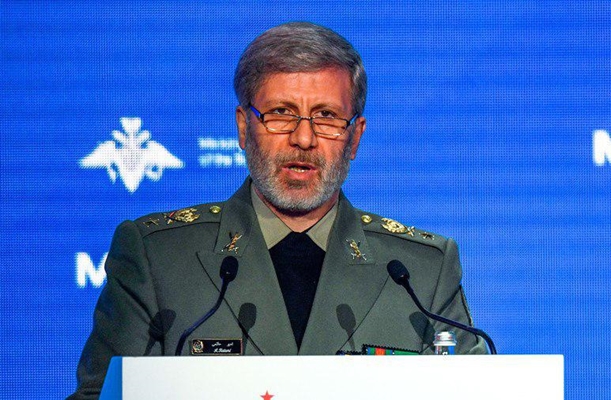
In an address to the eighth edition of Moscow Conference on International Security on Wednesday, Brigadier General Amir Hatami said traditional Western powers suffer from a lack of ability to understand the mechanism of today’s changes.

“Amid the current situation, I think the US claim to drive Iran’s oil exports to zero is almost impossible,” he was quoted as saying in a report by the government’s official website dolat.ir.

He underlined that without a correct and realistic understanding of today’s world, it is impossible to restore peace and security throughout the globe.

“Arrogant security, selfish security and self-oriented security are part of a special understanding of security which gained momentum after the World War II,” he said.

The Iranian minister referred to the latest brutal US sanctions on Iran as part of such an understanding of security and added racism, ethnic and religious extremism and terrorism are the fruits of such understanding.

“The US brutal sanctions have inflicted heavy damages on Iran’s economy but failed to deter the strong will of the Iranian nation. They are determined to follow up with their sacred causes,” he said.

He also noted that the sanctions have unveiled the true face of American regime particularly amid the recent floods which hit our country,” he said.

World Must Prevent Emergence of New Hitler

Elsewhere, the top general cited Trumpism as today’s Nazism and said sitting idle with the hope that the current problems will be removed in the future is a simplistic view.

“Such an approach will lead the world to a gloomy future. So, this is the time to prevent the emergence of a new Hitler in the world,” he said.

The Iranian minister then cited ISIS as the result of such an approach towards security in the world and said the terrorist group was dismantled only through self-sacrifices made by Syrian and Iraqi governments and nations as well as the unconditional support of the Islamic Republic of Iran and Russia.

“Though ISIS has been removed today, insecurity, arrogance and occupation are still alive and there are appropriate grounds for the terrorists’ revival,” he noted.

He blamed foreign interference as the main reason behind shattering of peace and security in Iraq and Syria and added the foreign forces are creating chaos in the region through their meddling in the internal affairs of the regional states.

Brigadier General Hatami stressed that today, the world’s arrogant powers have turned the Middle East into their arsenals, while the Islamic Republic of Iran maintains there is no way but a political solution for the current crises in the region.

The defence minister said the Islamic Republic will never withhold any efforts to protect the interests of the Iranian nation and added the prosperity of Iranian people is among the vital interests of the government and to this end, the government will not leave out any options in defending the legal rights of its people.

He then expressed regret that some states have intentionally closed their eyes on the brutality imposed by the US on the Iranian nation and said the Islamic Republic warns them that the repercussions of their silence will embroil them in future.

The Iranian official also described the US’ move to blacklist Iran’s Islamic Revolution Guards Corps as a terrorist organization as racist and shameful and said the IRGC has served as a pioneering unit in fight against terrorism in the Western Asia. “Meanwhile, the Islamic Republic of Iran has always been the main victim of terrorism over the past decades.”

He accused the US of sponsoring terrorists in the region and facilitating the massacre of innocent people in Yemen and other parts of the region and said Iran warns the American officials and their regional allies including Saudi Arabia to revise their regional policies.

The eight Moscow Conference on International Security organized by the Russian Defence Ministry kicked off Wednesday in the Russian capital.

The two-day event is focused on difficulties in global and regional stability, reconstruction of Syria and Iraq, as well as various security issues in Europe, Asia, Africa and Latin America.

It is also expected to discuss missile defence issues, deployment of weapons in space, international peacekeeping activity and new approaches to military cooperation.

Over 1,000 people have arrived to attend the forum including defence ministers, chiefs of staff of armed forces, delegations from defence ministries and experts from 111 states as well as leaders of such international organisations as CIS, CSTO, SCO, UN, OSCE and ICRC.

Iran’s Fajr Film Festival a Genuine Event: Lebanese Juror

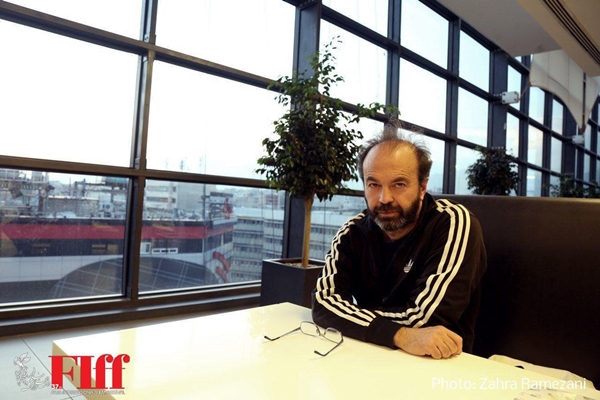
Ghassan Salhab, who is a juror of the First Films section of this year’s Fajr Festival in Tehran, says the character of Iranian filmmakers and the quality of their films keep him interested in Iran’s cinema.

Salhab was born in Dakar, Senegal, and grew up in Lebanon. He sees himself not only a national of Senegal and Lebanon, but from all over the world.

In addition to making his own films, he has collaborated on many screenplays and teaches cinema in Lebanon. He has directed seven feature films all of which have won awards in various international film festivals.

Here is an interview conducted with him:

Q: You have attended many festivals as juror. How do you assess the Fajr International Film Festival?

A: This is the first day I’m here and I’ve only watched three movies but the festival’s atmosphere and the quality of the films I saw prove that we are dealing with a genuine festival; a festival that does its job in the best way possible. Fajr has been held for 37 editions and has a good reputation. I knew Fajr Festival before it screened my first feature film 21 years ago.

Q: Do you know the Iranian cinema?

A: The Iranian cinema is my favourite and I’ve always been engaged with it. The Iranian cinema is serious and we can clearly see a great communication between the audience and the cinema.

Q: How do you assess the three movies you’ve watched so far?              

A: Two films were very good but I can’t name them since I’m a jury member. When I looked at the list of the movies, I realised that most films are Asian and that’s normal.

I think one of the reasons for the absence of Western films is the stupid US sanctions and the Western countries’ irrational compliance. Of course, I was a little bit surprised because there are not many films from the countries of East Asia such as Taiwan, Korea and Japan.

Anyway, I’m so glad to be here, because I’m essentially a curios person and I’m very eager to see the different parts of the world and of course, I was always keen on visiting Iran.

Iran Says Serious about Prisoner Swap with US

Iran Appoints Female Ambassador to Denmark

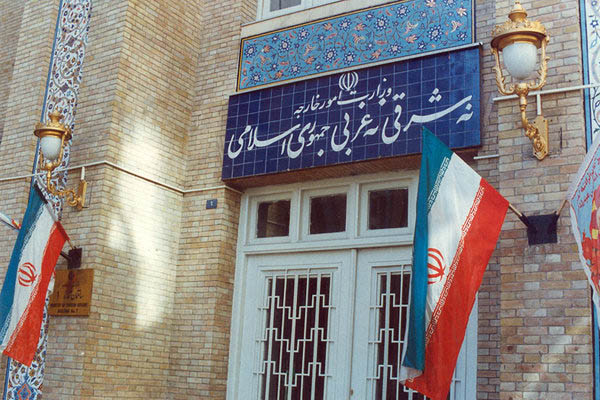
In a Wednesday statement, Mousavi said the Iranian foreign ministry, within the framework of its responsibilities, is prepared to take action on the swap of individuals convicted and imprisoned in Iran by the country’s Judiciary on specific charges.

He underlined that the foreign ministry would do so in exchange for both the release of all Iranians jailed in the United States on illegal charges of violating sanctions, and the granting of nolle prosequis to those detained in various countries on baseless charges of violating the US’ illegal sanctions or under Washington’s pressure.

Mousavi also slammed as “hasty” the US officials’ reaction to FM Zarif’s proposal and their call for the one-sided release of all US prisoners.

The reaction shows they lack a proper understanding of the concepts of negotiation, agreement, and exchange, and that proves they have not been honest in their claims and propaganda in the past months, the spokesman noted.

He reiterated that if there is a will in the US regime, the Iranian top diplomat’s proposal is clear and does not require any interpretation and clarification.

Mousavi’s comments came after FM Zarif said during an interview in New York that the Islamic Republic is ready to swap prisoners with the United States.

“I put this offer on the table publicly now, exchange them, all these people that are in prison inside the United States, on an extradition request from the United States”, Zarif said during an interview at the Asia Society in New York, adding that he had been authorised to conduct talks on prisoners’ swap.

“We believe their charges are phony. The United States believes charges against these people in Iran are phony. Fine, let’s not discuss that. Let’s have an exchange. I am ready to do it and I have the authority to do it,” maintained Zarif.

In reaction, a US State Department Spokesperson said, “We are aware of Foreign Minister Zarif’s recent comments to a NGO in New York regarding wrongfully detained Americans in Iran. We note his reference to a humanitarian resolution of those cases, which we have called for repeatedly.”

“The Iranian regime can demonstrate its seriousness regarding consular issues, including Iranians who have indicted or convicted of criminal violations of US sanctions laws, by releasing innocent US persons immediately,” the spokesperson added in an email interview.

“We call on Iran to free all unjustly detained and missing US persons, including Xiyue Wang, Robert Levinson, Siamak Namazi, and Nizar Zakka, among others,” the spokesperson said.

Iraq Says to Keep Importing Iran’s Gas, Power despite US Bans

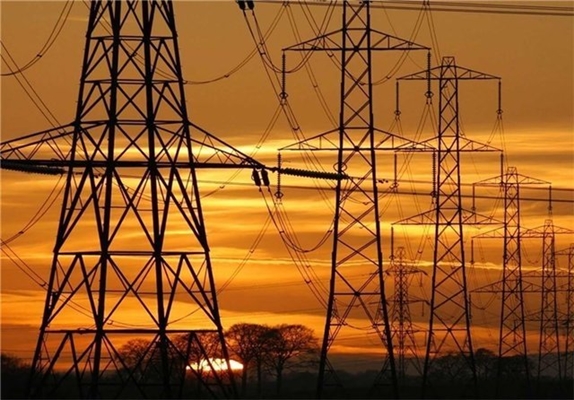
“For us, Iraq, we don’t have any other option right now,” Musaab Mudarris, an electricity ministry spokesman, told reporters on the side-lines of an energy conference in Baghdad.

He said summer season electricity demand in Iraq is 24,000 MW, even with government plans to shut down state-run factories and other attempts at debottlenecking.

Mudarris said demand is increasing at 7% annually. But power supply, from baseload generation to imports from power lines coming from Iran, “will be around 18,000 MW.”

“We import currently from Iran about 28 million cubic meters per day of gas, which generates 2,800 MW,” said Mudarris. “Plus, we are importing 1,500 MW [of electricity on cross-border power lines]. So it will be [over] 4,000 MW generated by imported gas and imported power.”

Mudarris said gas imports for the summer will temporarily increase to 35 million cubic meters per day, adding another 700 MW of electricity generated via Iranian support.

Iraq does not import crude from Iran, but its electricity imports and payments for power and gas could be a potential obstacle to gaining another waiver after its current 90-day reprieve expires in June.

That will depend on whether Washington realizes the severe problems in Iraq if it were to cut off the electricity supplies generated from its trade deal with Iran.

Protests around electricity supply and other lagging basic service provision often escalate in the summer. In the past, electricity ministers have been sacked in response. In 2018, protesters rallied in front of government buildings and oil fields.

That is sure to be worse in a country still so politically fragile as Iraq if supplies from Iran are shut off.