Monday, December 22, 2025
Home Blog Page 2995

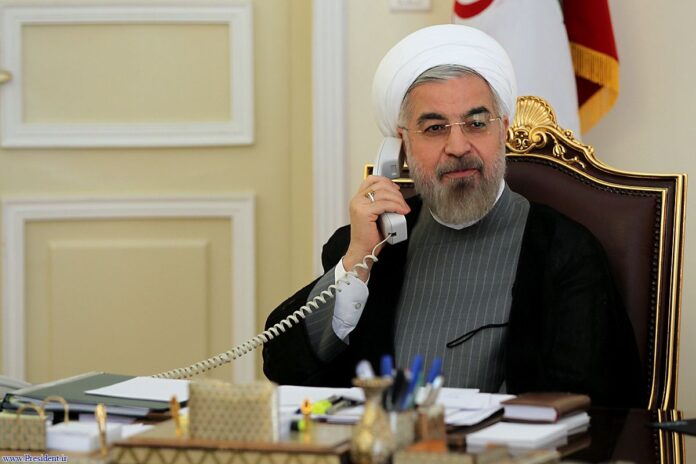
Iran Condemns Any Kind of Pressure on Qatar: Rouhani

Iran President, Emir of Qatar Meet in Malaysia

Rouhani made the remarks in a Thursday meeting with Qatari Emir Sheikh Tamim bin Hamad Al-Thani on the sidelines of the Kuala Lumpur Summit 2019.

Rouhani stressed the importance of enhancing relations in all areas, and said, “We have stood by Qatar and will continue to do so, and we condemn any pressure and tightening the grip on this country.”

He urged Qatar to use its proximity with Iran to boost its economic and trade relations.

“The two countries can have close cooperation in different areas,” he said.

President Rouhani underlined that Tehran and Doha can meet many of each other’s needs under the current economic conditions.

“We can work together in making joint investments,” he said.

The Qatari Emir, in turn, expressed pleasure to have met the Iranian president, saying Tehran and Doha enjoy special relations. He called for more contacts between the two countries.

He also thanked Iran for its stance on Qatar sanctions. He also said Iran and Qatar can weather the current tough situation they are facing.

Rouhani and the Qatari emir met on the sidelines of the Kuala Lumpur Summit 2019, a gathering of Muslim world leaders, also attended by Turkish President Recep Tayyip Erdogan.

Donald Trump Finally Impeached by US House

US House of Representatives Impeach Trump

The Democratic-led House’s passage of two articles of impeachment on a mostly party-line vote sets the stage for a trial next month in the Republican-controlled Senate – friendlier terrain for Trump – on whether to convict and remove him from office.

No president in the 243-year history of the United States has been removed from office by impeachment. That would require a two-thirds majority in the 100-member Senate, meaning at least 20 Republicans would have to join Democrats in voting against Trump – and none have indicated they will.

The Senate’s top Republican, Mitch McConnell, has predicted there is “no chance” his chamber will remove Trump when it holds its trial.

“This lawless, partisan impeachment is a political suicide march for the Democrat Party,” Trump told a raucous rally for his re-election campaign in Battle Creek, Michigan, as the vote was under way in the House.

“They’ve been trying to impeach me from day one. They’ve been trying to impeach me from before I ran,” he said.

Trump, who is seeking another four-year term in the November 2020 presidential election, has denied wrongdoing and called the impeachment inquiry, launched by House Speaker Nancy Pelosi in September, a “witch hunt.”

The first of the articles accused Trump, 73, of abusing his power by pressuring Ukraine to investigate political rival Joe Biden, a leading contender for the 2020 Democratic presidential nomination, as well as a discredited theory promoted by the president and beneficial to Russia that Democrats conspired with Ukraine to meddle in the 2016 election.

Democrats said Trump held back $391 million in security aid intended to combat Russia-backed separatists and a coveted White House meeting for Ukrainian President Volodymyr Zelenskiy as leverage to coerce Kiev into interfering in the 2020 election by smearing Biden.

“President Trump abused his power, violated his oath of office, and betrayed our nation,” Biden said on Twitter, adding, “In the United States of America, no one is above the law — not even the president.”

The second article accused Trump of obstruction of Congress by directing administration officials and agencies not to comply with lawful House subpoenas for testimony and documents related to impeachment.

During a daylong debate before the vote, Pelosi read the US Pledge of Allegiance and said, “We are here to defend democracy for the people.”

“If we do not act now, we would be derelict in our duty. It is tragic that the president’s reckless actions make impeachment necessary,” Pelosi said.

As the debate unfolded, Republicans accused Democrats of seeking to use an unfair, rigged process to nullify the 2016 election and suggested Democrats would pay a price in the 2020 election.

“The matter before the House today is based solely on a fundamental hatred of our president. It’s a sham, a witch hunt – and it’s tantamount to a coup against the duly elected president of the United States,” Republican Representative Mike Rogers said.

Republican Representative Mike Kelly compared the impeachment to the Japanese attack on Hawaii’s Pearl Harbor in 1941, calling the House proceedings another “date that will live in infamy” – similar to the words Democratic President Franklin Roosevelt used to describe the raid that killed about 2,400 people and led to America’s entry into World War Two.

The abuse of power article was passed on a 230-197 vote and the obstruction article was passed by 229-198. All of the House Republicans opposed the articles, and two Democrats, Collin Peterson and Jeff Van Drew, voted no on both. Democrat Jared Golden voted against the obstruction charge but for abuse of power.

“The only part of the vote that was bipartisan was in opposition. The President is just getting stronger while support for the Democrats’ political theater has faded,” Trump campaign manager Brad Parscale said in a statement.

US Representative Tulsi Gabbard, a Democratic presidential candidate, voted present on both articles, declaring in a statement, “I could not in good conscience vote either yes or no.”

Speaking after President Donald Trump was impeached for abuse of power in a historic vote in the US House of Representatives, Speaker Nancy Pelosi calls the date, December 18, “a great day for the constitution of the United States,” but a “sad one for America.”

Muslim World Must Get Rid of Dollar Dominance: Rouhani

Rouhani at KL Summit 2019
Iranian President Hassan Rouhani addresses the KL Summit 2019 in Malaysia on Thursday, Dec. 19, 2019 / Photo by president.ir

The Iranian president made the remarks in a speech at the inauguration ceremony of Kuala Lumpur 2019 Summit in the Malaysian capital.

What follows is the full text of President Rouhani’s Thursday speech:

Your Excellency Dr Mahathir Mohamad, Honourable Prime Minister of Malaysia

Esteemed Presidents and Prime Ministers

Heads of Delegates

Ladies and Gentlemen

Assalamu alaikum wa rahmatullahi wa barakatuh,

At the outset, I would like to appreciate the nation and government of Malaysia for their warm hospitality and organising this summit. Also, I would like to appreciate Tun Dr Mahathir Mohamad for presiding this important initiative and creating a valuable model of peaceful cultural diversity as well as taking new steps for bridging the east and the west of the Muslim world and his foresight in bringing diverse attitudes closer together.

Excellencies,

The Muslim world is facing emerging challenges at the national and international levels which have impeded the track of development and progress. The most important such challenges include the following:

  1. Cultural and identity challenges

The danger of weakening national and Islamic identity, the younger generation distancing from their identity and domination of foreign cultures are the most serious threats to the Muslim world. The western pioneering in the development of new technologies has resulted in their strength in imposing and mainstreaming news, the culture of consumption and western lifestyle. Joint efforts to compensate under-development in information technology, moving towards national and regional communication networks and increasing share of Muslim states in the digital economy constitute the roadmap of our future in combatting these crises.

  1. Security challenges:

It is regrettable that the Muslim world, from the far western spot in North Africa to the farthest area in East Asia, is grappling with serious security threats and problems ranging from the continued threats imposed by the Zionist Regime that is killing our brothers and sisters in Palestine on a daily basis to the military, political, and economic threats by the United States against some Muslim countries, to the threat of terrorism and mental and behavioural radicalism in some Muslim societies which has paved the ground for foreign intervention. The war in Syria, Yemen, and riots and turbulences in Iraq, Lebanon, Libya and Afghanistan is the outcome of the combination of domestic extremism and foreign intervention.

  1. Challenges of under-development:

Maladies as weakening governance, poverty, unemployment, corruption, increasing and eroding violence and extremism have endangered national sovereignty in some parts of the Muslim world. Macro processes such as the globalisation of economy and society, emergence of new discourse in the area of democracy and human rights, increasing attention to semantic and software power, increasing access to information and progressing growth of non-state actors have added to the dimensions of this challenge. Idealistic, but realistic, policy making in the area of development is now an inevitable necessity.

  1. Economic challenges:

Economic sanctions have turned into the main tools of domineering hegemony and bullying. The interconnectedness of international economic, commercial and financial systems with the American economic regime and dollarization of national and global economies have provided the US with the possibility of advancing its hegemony under the threat of sanctions and economic terrorism and impose its illegitimate demands on the other nations. The Muslims world should be designing measures to save it from the domination of US dollar and the American financial regime. The fact of the matter is that Muslim states are complementary to each other in economic terms and therefore, the creation of special mechanisms for banking and financial cooperation among Muslim nations, the use of national money in mutual trade, conclusion of preferential trade agreements in the Muslim world as well as investment in areas with relative advantage and similar ideas should be thoroughly investigated by the economists and experts of Muslim states.

Distinguished colleagues and dignitaries

If we return to our national and Islamic capacity and rely on our own domestic power and strength, we would be able to convert all the above-mentioned challenges to an opportunity of growth and promotion. I consider the following capacity as the main components of power in the Muslim world:

  1. Islam is the central component of identity among us as Muslims. Islam is both a source and destination as well as path and track. The divine will has been based on the foundation that Muslims, following the model and role presented by our holy Prophet, should be adopting and promoting moderation so as to act as a role model for the whole world: “And we have made you a moderate nation to the witness of people and the Prophet will witness you”.
  2. People are the main source of power. Democracy, when coupled with faith in religion, would culminate in people and Muslim Ummah being mobilised. The spread of social justice, political and cultural security, the right to enjoyment of a decent life and good governance are the main essentials of Islamic concepts and teachings as well as the main reasons for people’s alignment.
  3. Science and technology are the key to power and development. Knowledge is power. Whoever finds it, will be victorious. It is the matter of regret that Muslim countries have no alternative at the moment but to resort and refer to others to supply their scientific and technological needs. Our young generation are undying source of creativity and hope, and the movement of education, research and innovation is the priority of the Muslim world’s today and tomorrow.
  4. Cooperation and interaction among Muslim nations is an unreplaceable principle. Consolidation of political and economic capacities could turn the Muslim world into a powerful bloc in international relations. The accumulation of scientific and technological capacities of Muslim countries can compensate many of the present time underdevelopments and eliminate grounds for the imposition of hegemony by the others. The standing mechanisms and institutions of the Muslims world, which have been designed for this purpose, have regrettably failed to accomplish its noble goals and purposes.

Dear friends

When I talk about hope towards confronting the challenges and problems of the Muslim world, I mean to present the success story of the Islamic Republic of Iran. My country for the past four decades has been facing all sorts of threats and conspiracies, but it has managed to overcome successfully any threat or challenge and has gained more strength and experience in a manner that we are now recognised in the world as a model of resilience and steadfastness. After its Islamic Revolution, Iran has overcome three main powerful waves of threats:

  1. Terrorism: Since the beginning of the 1980s, my county has been confronting the scourge of terrorism inside and outside of its soil. I am confident enough to say that the people of Iran have been at the forefront of the fight against terrorism and have attained the highest success in confronting it.
  2. War: Eight years of resistance in the extensive war imposed on Iran incurred heavy material and human costs on our nation. However, it made my country self-sufficient in defence, and today, such indigenous capability guarantees Iran’s defensive deterrence.
  3. Sanctions: The Islamic Republic of Iran has been under oppressive sanctions of the United States of America. Recently, they were seeking the collapse or surrender of the Islamic establishment through the imposition of the heaviest sanctions or so-called crippling sanctions. While only since 8 May 2018, when the US withdrew from the nuclear deal, more than 93 sanctions measures have been imposed against Iran, today the Iranian economy has recovered properly and economic indices are improving. Under such circumstances, economic reforms are underway and the current budget of the country now being reviewed by the parliament is totally independent from oil.

Our reliance on God, enjoyment of Islamic principles and values, contribution of peoples, development of domestic capabilities and ultimately attention to science and technology are the key to success of the Islamic Republic of Iran. I firmly believe that such a success story and model could be transferred to the Muslim world.

Ladies and Gentlemen,

I deem it necessary to refer to the issue of Palestine now. Palestine and resistance against the occupation of the Zionist Regime remains the main issue of the Muslim world. Any ignorance and lack of attention to the issue of Palestine, while highlighting sideline and divisive issues world be a big deviation. Palestine has chosen the path of resistance and in this regard, Palestinians are benefitting from the support of Muslim nations.

Numerous crises in the Middle East, especially in Yemen, Afghanistan, Syria, Libya and Lebanon are clear examples of irresponsible and divisive policies. In order to resolve the internal problems of the Muslim world, we believe we need to provide necessary grounds for dialogue and engagement through tolerance of various Islamic schools of thought and respect to national sovereignty of all nations.

President Rouhani Says KL Summit Must Focus on Plight of Palestine

“Palestine is one of the chronic ulcers in the Islamic world, and this issue must be seriously taken into account at the Kuala Lumpur Summit,” President Rouhani said in a meeting with Malaysia’s constitutional monarch and head of state, Abdullah of Pahang, held in Kuala Lumpur on Wednesday.

Deploring the displacement of Palestinian people during the past 70 years, the Iranian president said the settlement of problems would be impossible without Muslim cooperation and solidarity.

President Rouhani also lauded the Malaysian prime minister’s “timely” move to hold the KL Summit to address the Muslim world’s problems, saying the three main concerns in the Islamic world are the issue of Palestine, the big powers’ interference in the domestic affairs of Muslims, and the necessity for scientific and economic progress.

In turn, the Malaysian king lauded President Rouhani for participating in the summit in Kuala Lumpur, saying Iran’s presence has elevated the level of the conference.

Abdullah of Pahang also highlighted the Malaysian government’s efforts to improve conditions for the Iranian university students in his country.

The two senior officials also discussed the bilateral relations between Iran and Malaysia, and stressed the need to broaden the economic, cultural and popular relations.

The Iranian president is in Malaysia to attend the Kuala Lumpur Summit 2019, also attended by other Asian leaders like Emir of Qatar Sheikh Tamim Hamad Al Thani, and Turkish President Recep Tayyip Erdogan.

A Look at Iranian Newspaper Front Pages on December 18

Newspaper Headlines

Abrar:

1- Pervez Musharraf Sentenced to Death

2- Defence Secretary Claims Iran behind Attacks on US Interests in Iraq

3- Protesters Close Oilfield in Basra

4- Iran First VP: Economy Survived Despite Predictions of Collapse

5- Syrian Kurds Commander: US Has Committed Itself to Defending Us

A Look at Iranian Newspaper Front Pages on December 18


Afkar:

1- Rouhani: US Sanctions Not Sustainable

2- DM: We Surprise Enemy in Decision-Making

A Look at Iranian Newspaper Front Pages on December 18


Aftab-e Yazd:

1- Pervez Musharraf Sentenced to Death: Pakistani Judiciary Independent and Powerful

2- Rouhani’s VP: Iranian Economy Was Collapsing, but Managed to Survive

A Look at Iranian Newspaper Front Pages on December 18


Ebtekar:

1- Araqchi to CGTN: Iran Not Ready for Talks with US at Any Level

2- Fate of Coup General: Pakistani Court Sentences Pervez Musharraf to Death

A Look at Iranian Newspaper Front Pages on December 18


Iran:

1- Ahvaz, Abadan Grappling with Flooding after Heavy Rainfall

2- Democrats Waiting Historic Impeachment of Trump

3- Diplomacy in Far East: In What Conditions Rouhani and Abe Will Meet?

A Look at Iranian Newspaper Front Pages on December 18


Jame Jam:

1- Khuzestan in Red Condition Caused by Flooding

2- Iran-Japan, Opportunities in Shadow: How Can They Use Capacities Better?

A Look at Iranian Newspaper Front Pages on December 18


Jomhouri Eslami:

1- Rouhani-Mahathir Talks in Kuala Lumpur: Iran President in Malaysia

2- Kerry: Trump Cause of Chaos in World

A Look at Iranian Newspaper Front Pages on December 18


Kayhan:

1- ISIS Attacks from Northern Baghdad, South of Mosul Repelled by Hashd al-Shaabi

2- Judiciary Spokesman: The 77 Statement [by Reformists] Not Political, But Support for Rioters

A Look at Iranian Newspaper Front Pages on December 18


Mardom Salari:

1- Iran Threatened by FATF to Be Blacklisted: Tehran on Verge of Sanctioning Itself

2- People’s Houses Flooded with Sewage in Khuzestan

3- We MPs Responsible for Lives of Those Killed in Protests: Lawmaker

A Look at Iranian Newspaper Front Pages on December 18


Setareh Sobh:

1- Will Rouhani’s Japan Visit Resolve Tehran-Washington Deadlock? [Editorial]

2- Should Tehran Be Evacuated for Air Pollution?

A Look at Iranian Newspaper Front Pages on December 18

Iran Says Advocacy for Human Rights Doesn’t Fit in with US

“The US history is full of human rights violations everywhere in the world: from their support for countries and regimes who kill children, women, and patients, to their resort to economic terrorism and economic war against other countries, to provocation of ethnic and national issues in other countries, to causing division among the ethnic groups of an integrated nation,” Mousavi said on Monday.

“We’re witnessing that the US support is behind what’s happening in Hong Kong right now. And the support is expressed in the form of defending human rights,” he went on to say.

However, he added, with such a well-documented track record, such defence of human rights doesn’t fit the US.

Speaking in a press conference in Tehran, Mousavi also dismissed the US’ claim that its sanctions are not hurting ordinary Iranian people.

“While they announce humanitarian goods including medicine and food are not in the list of sanctions, they practically take measures and close the channels in a way that Iran is deprived of access to medicine and food,” Mousavi said.

“On the other hand, they claim to be advocating the Iranian people and human rights, which is definitely hypocritical and deceitful,” he added.

Iran to Further Cut Its Nuclear Commitments, Official Warns EU

Signs of US Decline Clearer Than Ever: Iran Official

In a Wednesday meeting with Secretary of the Security Council of Russia Nikolai Patrushev, Shamkhani lauded Moscow for its firm policies against the US’ illegal measures on the JCPOA and for backing Iran’s decision about the accord.

Iran’s move to reduce commitments to the JCPOA results from the US violation of and the EU’s inaction on the nuclear agreement, the Iranian official stressed, adding, “If Europe keeps failing to honor its (JCPOA) commitments, we will have to take the next steps in order to create a balance in the (implementation of the) commitments.”

Shamkhani further highlighted the successful experience of cooperation between Iran and Russia in the fight against terrorism, calling for stronger interaction to ensure regional stability and security.

An outbreak of unrest in the region is what the outsiders, particularly the US and Israel, are seeking, the Iranian official said, stressing that constant vigilance and collective cooperation in the region would thwart the hostile plots and guarantee stability and calm.

For his part, the senior Russian security official, who is in Tehran for the second Regional Security Dialogue meeting, said the Iranian initiative to hold regional security talks signifies the collective responsibility to establish peace and stability in the region.

The one-day Regional Security Dialogue meeting, attended by the top security officials of Iran, Russia, China, India, Afghanistan, Tajikistan, and Uzbekistan, focuses on the issue of Afghanistan and the fight against various forms of terrorism in the country.

Patrushev also called for concerted cooperation to restore peace and stability to Syria, and for the continuation of political initiatives within the framework of the Astana Peace Process.

Stressing the need for Iran to enjoy its legitimate rights under the JCPOA, he said the other parties to the deal must preserve and honor the nuclear accord.

Evaz Recognized as First Child-Friendly Town of Iran

Evaz Recognized as First Child-Friendly Town of Iran

Evaz is a small town in the south of Fars province, southern Iran. It has been named by UNESCO as one of more than 3,000 town and cities across the world that are safe havens for children.

Evaz has no skyscrapers, no culture houses and no large parks, but it has things that everyone would long for. Evaz could be a perfect example for development.

Imagine as a mother living in Tehran, you have an infant who needs to be breast fed as well as a playful child who is giving you a hard time to take him to the park. You know how hard it would be to take him to the park in such a situation. You would think of small problems such as how you are going to breastfeed your infant or where you are going to change his/her diapers, or whether your child is tall enough to reach the water tap on the sink if he needs to go to the restroom. However, you wouldn’t have such problems in Evaz.

Are you worried that the driver who takes your child home after school may drop him off on the other side of the street, potentially putting him in danger when he wants to cross the street? When you go to the park, do you keep reminding your child that the sports equipment there belongs to grown-ups, or do you push your kid up on the bar with difficulty to force him to do a chin-up like adults? As a physically challenged citizen, do you have problems getting your job done at government institutions? You wouldn’t have such problems in Evaz.

Evaz Recognized as First Child-Friendly Town of IranEvaz: Iran’s First Child-Friendly Town

Back in 2010, a children’s research institute affiliated with UNICEF announced that Evaz had been chosen as the first child-friendly town in Iran because of the efforts made to promote the level of education among women along with state and private sectors’ interest to improve the condition of children. There are also motivated people who are keen on running projects to make towns more child-friendly not to mention the considerable presence of women in social activities. After the designation of Evaz as a child-friendly town, other cities such as Chaloos, District 13 of the city of Tehran, Lahijan and Isfahan took major steps in that regard, too.

In Evaz, almost no state or public building, school, university, street, hospital, refinery, gym or institution has been built with state funds. Every brick in the buildings has been put on another only by local benefactors. However, development does not mean having a huge amount of money; rather, development means having an open mind to think, and an open heart to love and to regard society as one’s own. These features have turned locals in Evaz into people who are enthusiastic about building and development.

UNICEF knows first-hand the developments in Evaz and has reportedly promised to offer more assistance to the town.

“The Association of Children Lovers of Evaz began its work in 2008 and was registered in 2011,” says Khadijeh Faqihinejad, the director of the association.

According to a local architect, public facilities in Evaz have been improved and tailored to the needs of people with physical disabilities, visually challenged individuals, children, the elderly and expectant mothers.

Evaz Recognized as First Child-Friendly Town of IranEvaz Ranks 1st in Iran in Promotion of Book Reading

Evaz, also known as the “Creative City of Books,” has even set up book-reading stalls in petrol stations. In a national book festival, Evas was picked as the number-one town in Iran in terms of promoting book reading.

Special plans are being implemented in one of the town’s schools most of whose students are Afghan immigrants. In this school, programs are under way to teach life skills to students in the form of books and stories.

Evaz is also known as Iran’s Switzerland in terms of cleanliness.

Iran Urges Muslim Unity against Big Powers

Iran President, Malaysian PM Meet in Kuala Lumpur

In a Wednesday meeting with Prime Minister of Malaysia Mahathir Bin Mohamad in Kuala Lumpur, Iranian President Hassan Rouhani said the world Muslims are members of a same family that should behave responsibly towards each other.

“It is necessary for the Muslim countries to cooperate in countering the pressure of big powers,” the Iranian president said.

“Many of the problems of Muslims are caused by the US interference, such as the sanctions against Iran,” President Rouhani added.

Denouncing an intensification of the US’ “cruel and unilateral” sanctions on Iran over the past two years, the president said such sanctions have been imposed in violation of the UN Security Council Resolution 2231 after the US withdrawal from the 2015 nuclear deal.

He also highlighted the futility of the US sanctions in light of the Iranian people’s resistance, saying the Islamic Republic has managed to improve its economy in the past five months despite the US policy of maximum pressure.

The Iranian president further called for efforts to enhance the relations between Tehran and Kuala Lumpur in various fields, adding, “The two countries should promote their scientific and technological cooperation, while the spheres of energy, industry, tourism, maritime cooperation, and the information technology could be suitable arenas for mutual cooperation.”

The foreign sanctions would not erode Iran’s determination to broaden cooperation with Malaysia, he underlined, saying the two Muslim nations can work together in the medical field and also develop a joint brand with industrial cooperation.

He also expressed hope that the KL Summit 2019 in Malaysia would help resolve problems in the Islamic countries, adding, “Such conferences could be effective for the settlement of Muslim problems, particularly in the Middle East.”

President Rouhani finally urged efforts to address the problems that Iranian people residing in Malaysia are facing, and highlighted the significance of holding sessions of Iran-Malaysia Joint Commission on Economic Cooperation.

The Malaysian leader, for his part, called for the expansion of ties with Iran in various fields, saying Malaysia supports Iranians and is resolved to promote trade cooperation with the Islamic Republic.

Mahathir Bin Mohamad also condemned the “illegal” anti-Iran sanctions that violate the UN regulations, saying efforts are underway to give a boost to the trade ties with Iran.

Iran is making headway in spite of the pressures from the US and Europe, the Malaysian leader added, saying his country needs to learn from Iran’s experience of dealing with the foreign pressures.
Describing the KL Summit as an opportunity for the Muslim states to share experiences, Mahathir Bin Mohamed said his country will maintain the trade and economic relations with Iran.

The Iranian president is in Malaysia to attend the Kuala Lumpur Summit 2019, also attended by other Asian leaders like Emir of Qatar Sheikh Tamim Hamad Al Thani, and Turkish President Recep Tayyip Erdogan.

The summit will be held at the Kuala Lumpur Convention Centre from December 18 to 21.

Over 400 people, including 250 leaders, politicians, and thinkers from 52 countries, will attend the event.

The Iranian president is to deliver a speech at the KL Summit and elaborate on the Islamic Republic’s regional and international policies. He will also hold bilateral meetings with some of the leaders and officials attending the event in order to discuss bilateral, regional, and international issues of mutual interest.

The Kuala Lumpur Summit is an international platform for Muslim leaders, intellectuals and scholars from around the world to discuss and exchange ideas about issues revolving in the Muslim world, according to its website.

Iranian Researchers Treat Liver Lesions Using Stem Cells

Iranian Researchers Treat Liver Lesions Using Stem Cells

Mesenchymal stem cells produce secretory vesicles and release them to their environment. Studies have shown that these vesicles have therapeutic effects on other cells.

Due to the tendency of the liver cells to absorb these secretory vesicles, they are widely used to treat liver diseases or to transfer drugs to the liver.

However, rapid destruction of these vesicles in the extracellular environment reduces their effect on the liver.

To overcome this problem, Iranian researchers at Royan Research Institute and Iran University of Medical Sciences designed a method in which polyethylene glycol was combined with the secretory vesicles of mesenchymal cells so that the vesicles were encapsulated in polyethylene glycol.

Thus, with the gradual degradation of the encapsulated polymer, the vesicles were released gradually over a month.

Four weeks after injection of the vesicles to the animal suffering from liver fibrosis, the liver of the animal was removed and examined through laboratory methods.

The results of the study, published in the international journal “ACS Applied Materials & Interfaces” showed that the use of polymer-encapsulated secretory vesicles improves the hepatic status of the animal compared to the conventional method.

Using this new method improved the anti-fibrotic, anti-inflammatory, anti-apoptotic, and liver regeneration effect by secretory vesicles of mesenchymal stem cells by 40 to 50%.

The results showed that MSCs could be used as an effective treatment for liver lesions.

Also, the use of encapsulation of these vesicles in the polymer has been introduced as a method to effectively use them in therapeutic processes.