Wednesday, April 22, 2026
Home Blog Page 2694

Tehran Urges Its Trade Partners to Release Iranian Frozen Assets

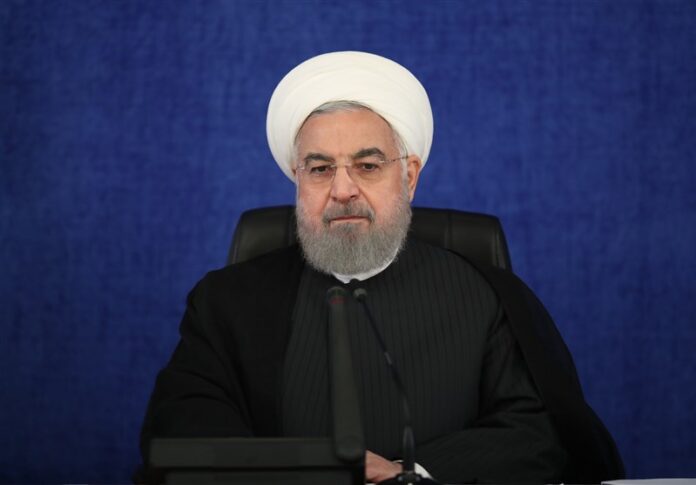
Iran Policies to Remain Unchanged No Matter Who Becomes US President: Rouhani

Otherwise, the president said, scepticism will grow among public opinion regarding the future of Iran’s relations with these countries.

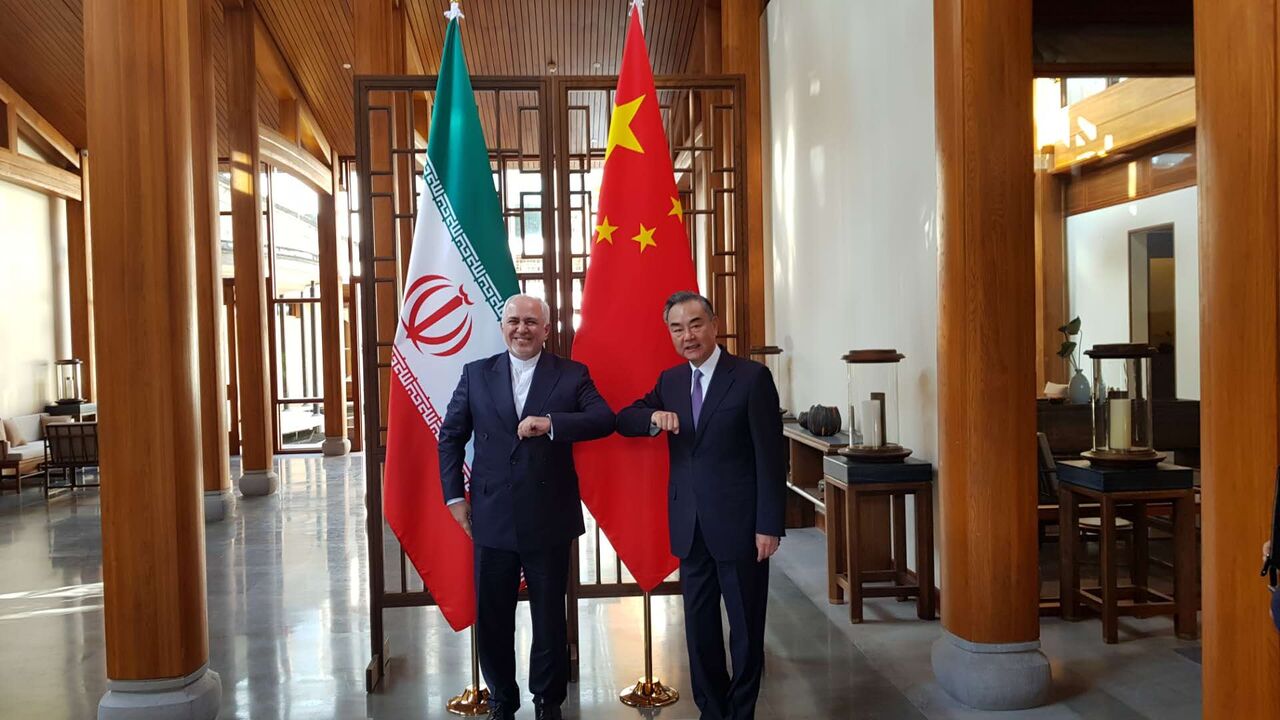
Rouhani made the comments in a Wednesday cabinet session, after he was briefed on the outcomes of Foreign Minister Mohammad Javad Zarif’s trip to China and the visit of Iran’s top banker Abdolnasser Hemmati to Baghdad, where he discussed Iran’s frozen assets in Iraq.

The president expressed pleasure with the achievements of these visits, and tasked all government officials to pursue returning Iran’s money from other countries.

On Monday, Governor of the Central Bank of Iran said his negotiations with the Iraqi officials had yielded “positive” results, and the Arab country had given its approval to release Iran’s frozen assets for the purchase of basic commodities.

Hemmati said he held a trilateral meeting with Governor of the Central Bank of Iraq Mustafa Ghalib Mukheef and Chairman of Trade Bank of Iraq (TBI) Salem Jawad Abdul Hadi Al-Jalabi during his visit to Baghdad.

Iran's Zarif Hails Fruitful Talks in China Trip
Iran’s Zarif Hails Fruitful Talks in China Trip

The Iraqi authorities have agreed to release Iran’s frozen funds for the purchase of basic commodities after extensive talks on trade exchanges, Hemmati added, noting that the Islamic Republic of Iran holds remarkable financial sources in the Iraqi banks earned by the export of electricity and gas.

Under the new agreement, the main obstacle to the release of Iran’s assets in the executive sphere has been removed, as the Central Bank of Iraq and the TBI face no more restrictions, he added.

The assets held in Iraq belong to the Central Bank of Iran, which is the main supplier of the basic demands in various sectors such as industry, agriculture and healthcare, he explained, saying Tehran would begin to withdraw money from those funds according to its needs.

The commodities that are categorized as basic needs are exempted from the cruel and unilateral sanctions imposed by the US, the Iranian official noted.

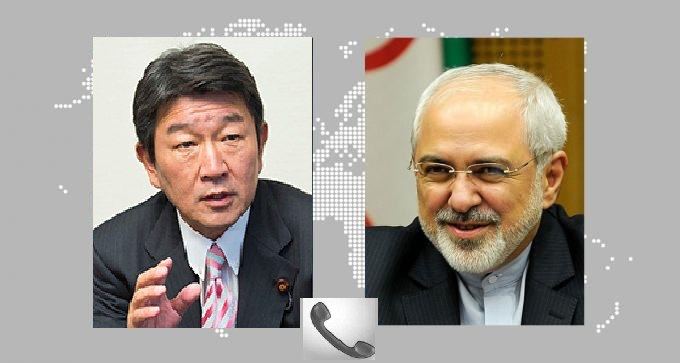
Also on Wednesday, Foreign Minister Zarif held a phone conversation with his Japanese counterpart Toshimitsu Motegi, during which he urged the Japanese top diplomat to prevent the US from blocking Iran’s assets.

“Iran expects the government of Japan to prevent such unlawful American measure within the framework of the general commitment of countries to the implementation of the UN Security Council resolutions, including the Resolution 2231,” Zarif added.

Foreign Minister Zarif stressed that Iran should be able to use its foreign currency resources held in Japan, condemned the US regime’s illegal restriction on Tehran’s access to those funds, and denounced the limits preventing the purchase of medicine and foodstuff for the Iranian people as a crime against humanity.

A Look at Iranian Newspaper Front Pages on October 15

A Look at Iranian Newspaper Front Pages on November 18

Iranian Newspapers

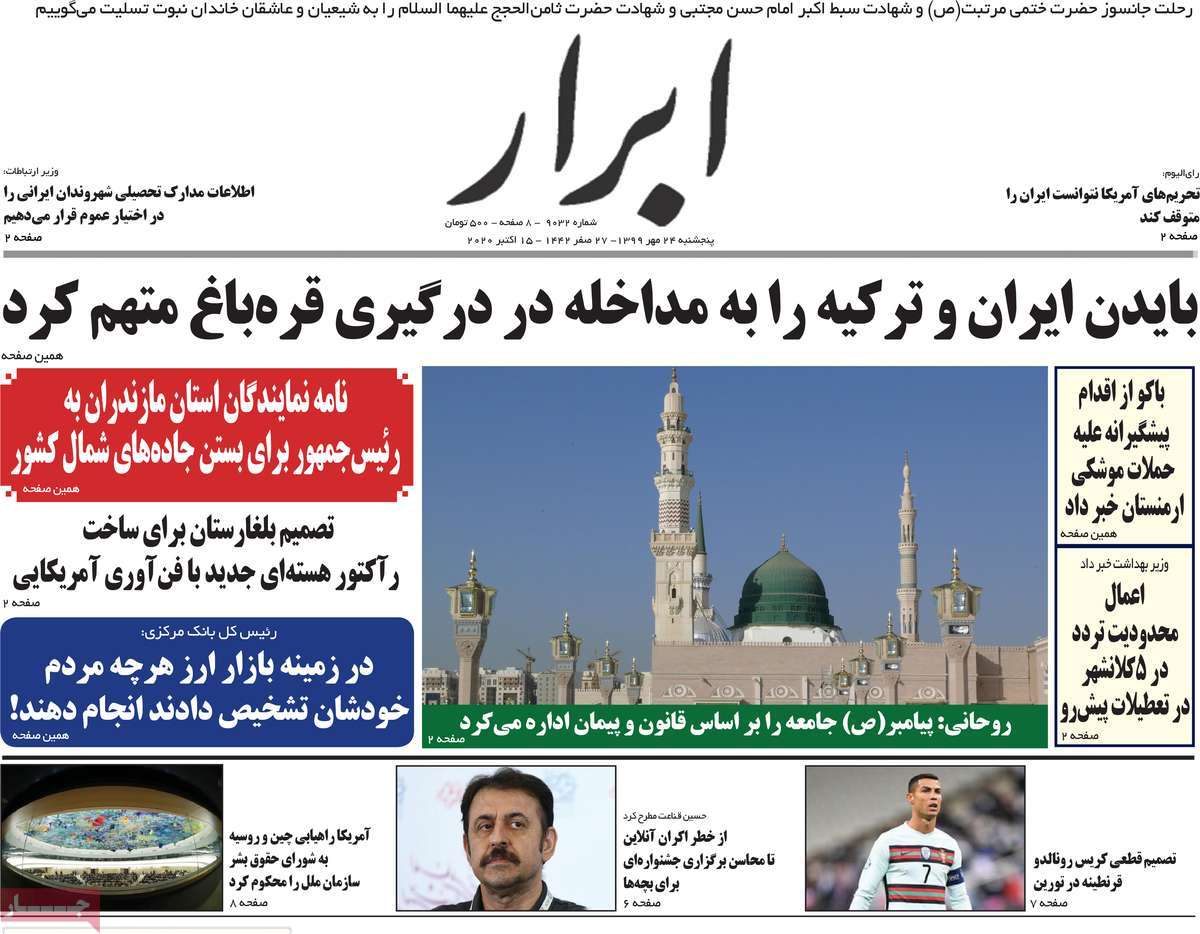
Abrar Newspaper:

1- Biden Accuses Iran, Turkey of Interfering in Karabakh Conflict

2- Baku to Take Pre-emptive Measure against Armenia Missile Attacks

3- Bulgaria to Build New Nuclear Reactor Using American Technology

4- US Condemns Membership of Russia, China in UN Human Rights Council

A Look at Iranian Newspaper Front Pages on October 15


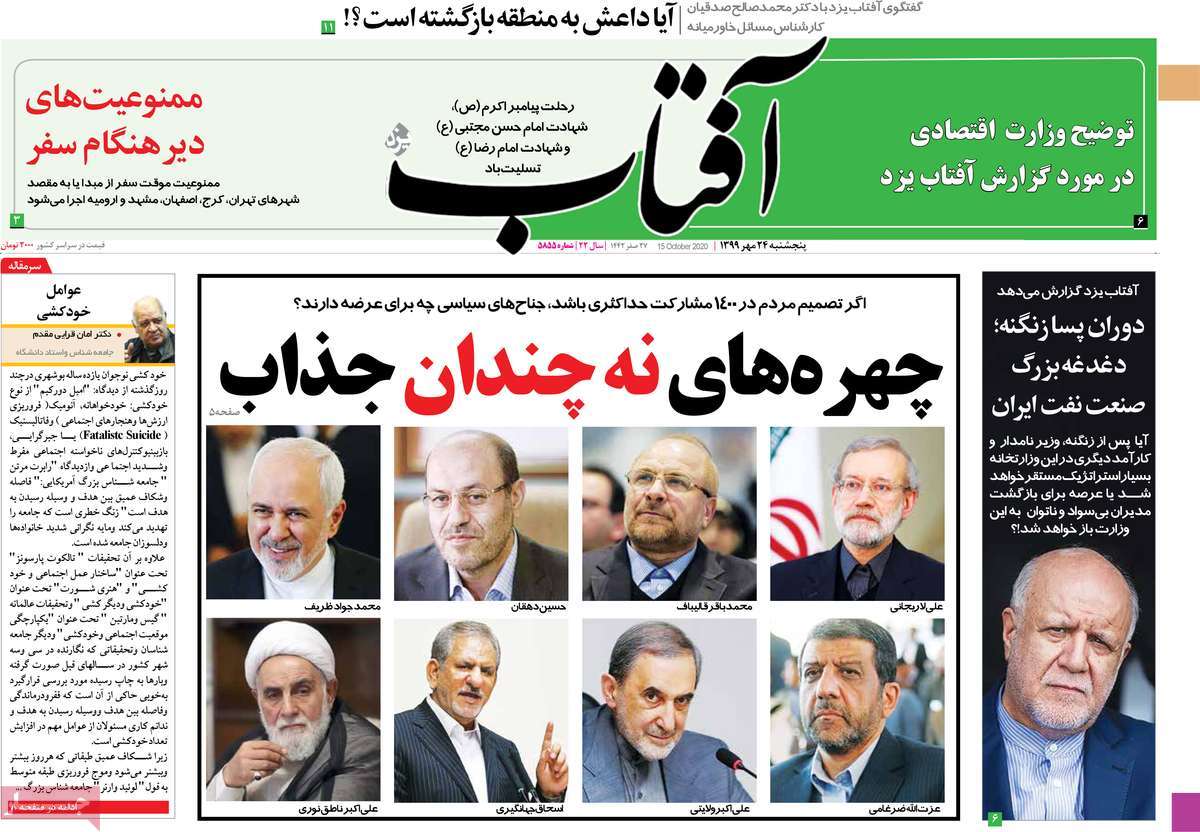
Aftab-e Yazd Newspaper:

1- Has ISIS Returned to Region?

2- Post-Zangeneh Era, Big Challenge for Iran’s Oil Industry

A Look at Iranian Newspaper Front Pages on October 15


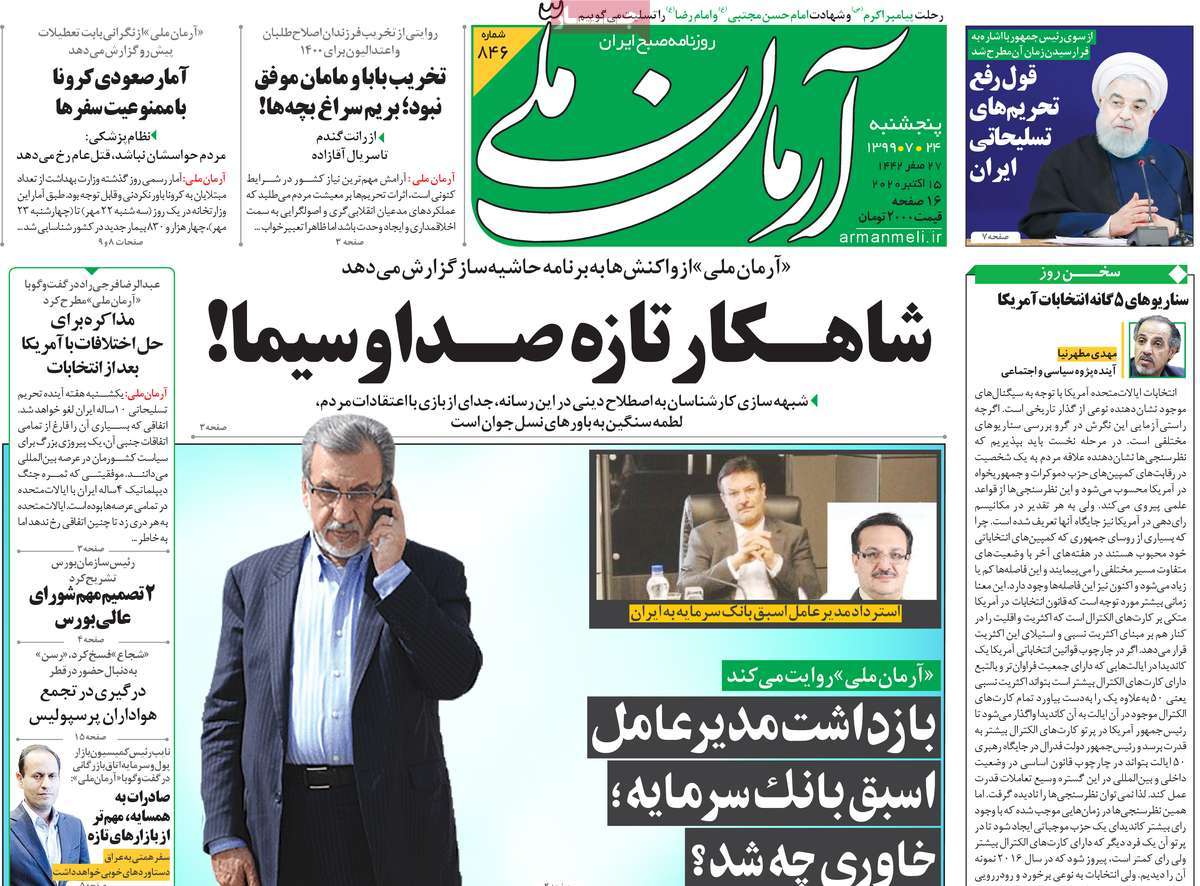
Arman-e Melli Newspaper:

1- Rouhani Promises UN’s Arms Embargo on Iran Will Be Lifted

A Look at Iranian Newspaper Front Pages on October 15


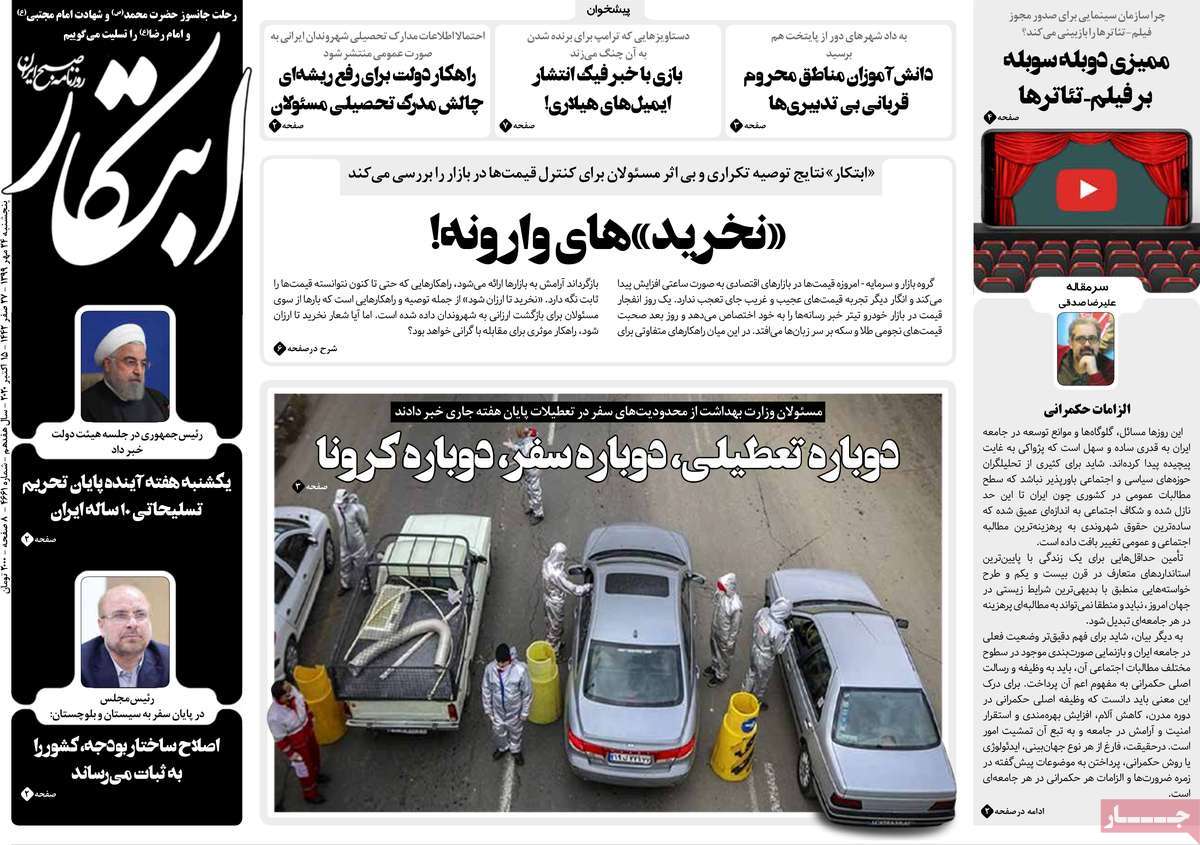
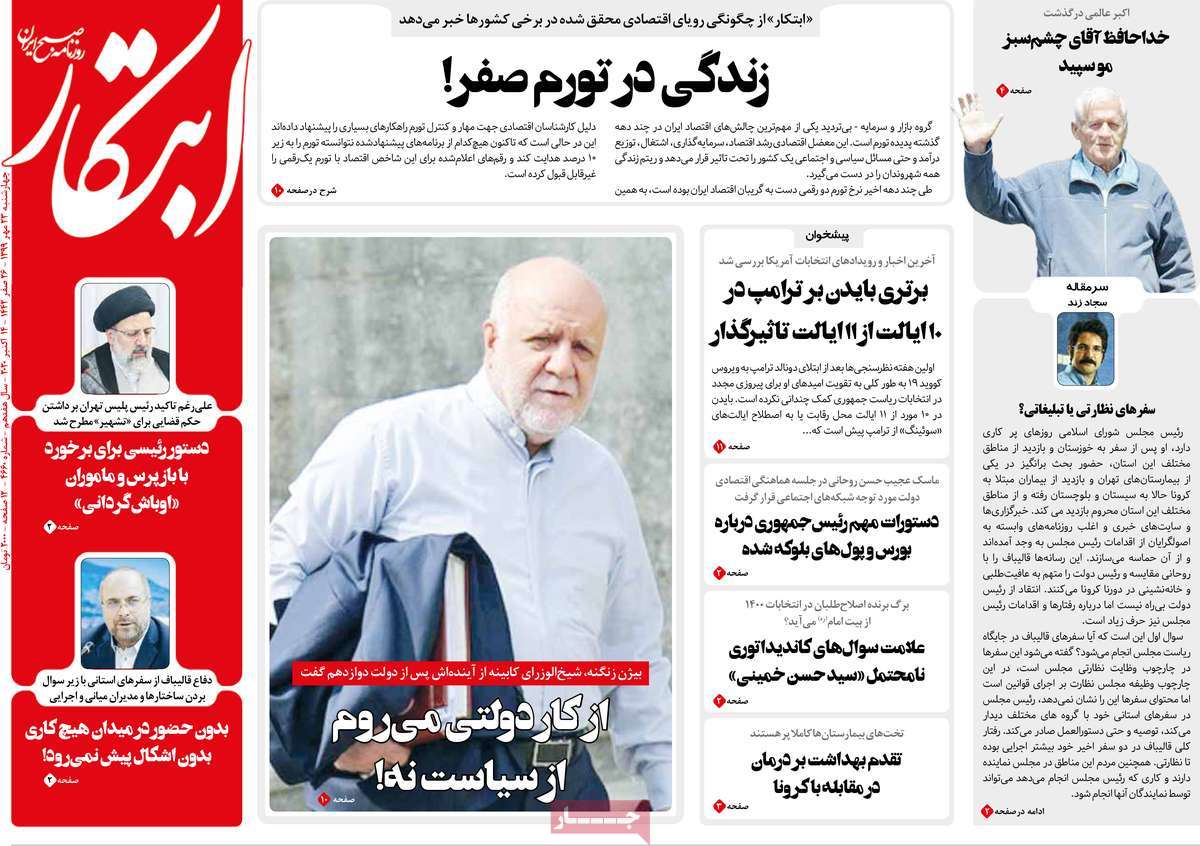
Ebtekar Newspaper:

1- End of UN’s 10-Year Arms Embargo on Iran Will End Sunday: Rouhani

2- Playing with Fake News of Clinton’s Emails: Pretexts Used by Trump to Win Nov. Votes

A Look at Iranian Newspaper Front Pages on October 15


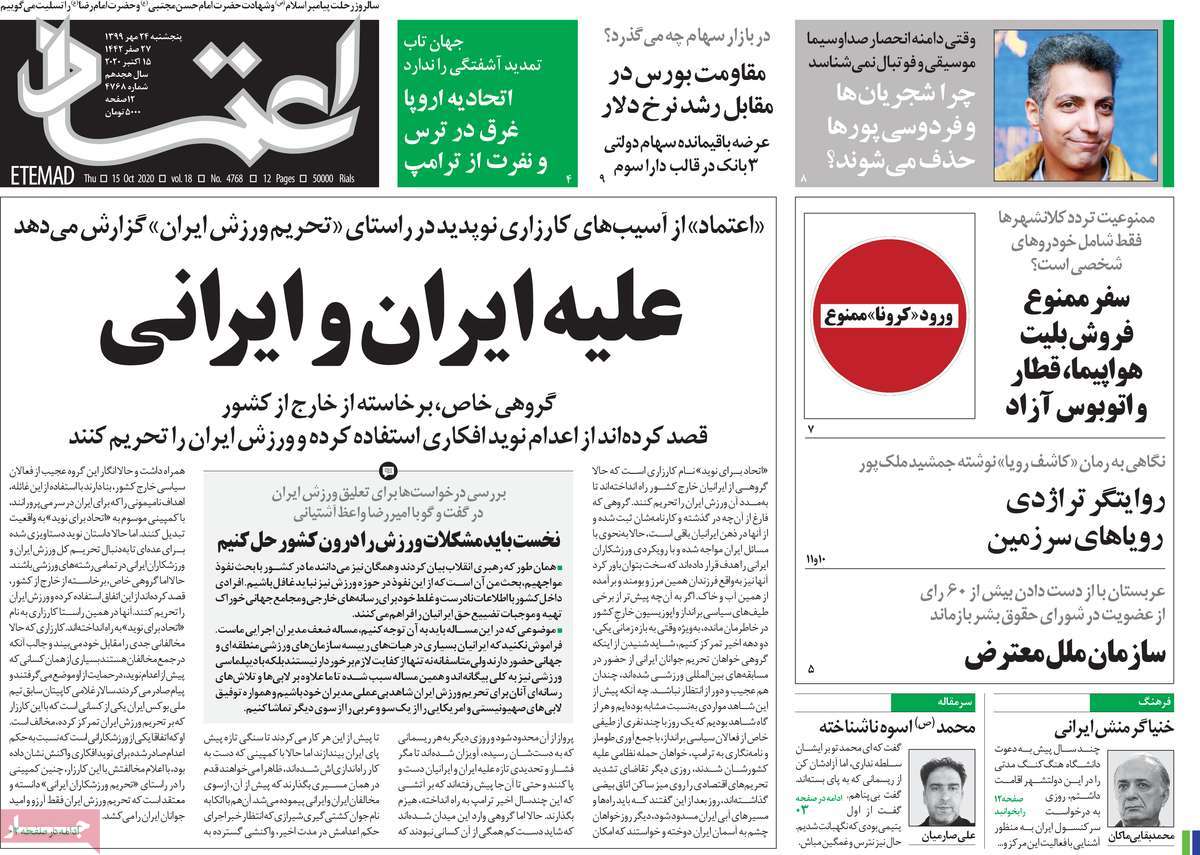
Etemad Newspaper:

1- Fear and Loathing of Donald Trump in the EU

2- Saudi Arabia Loses Its Seat in UN Human Rights Council

A Look at Iranian Newspaper Front Pages on October 15


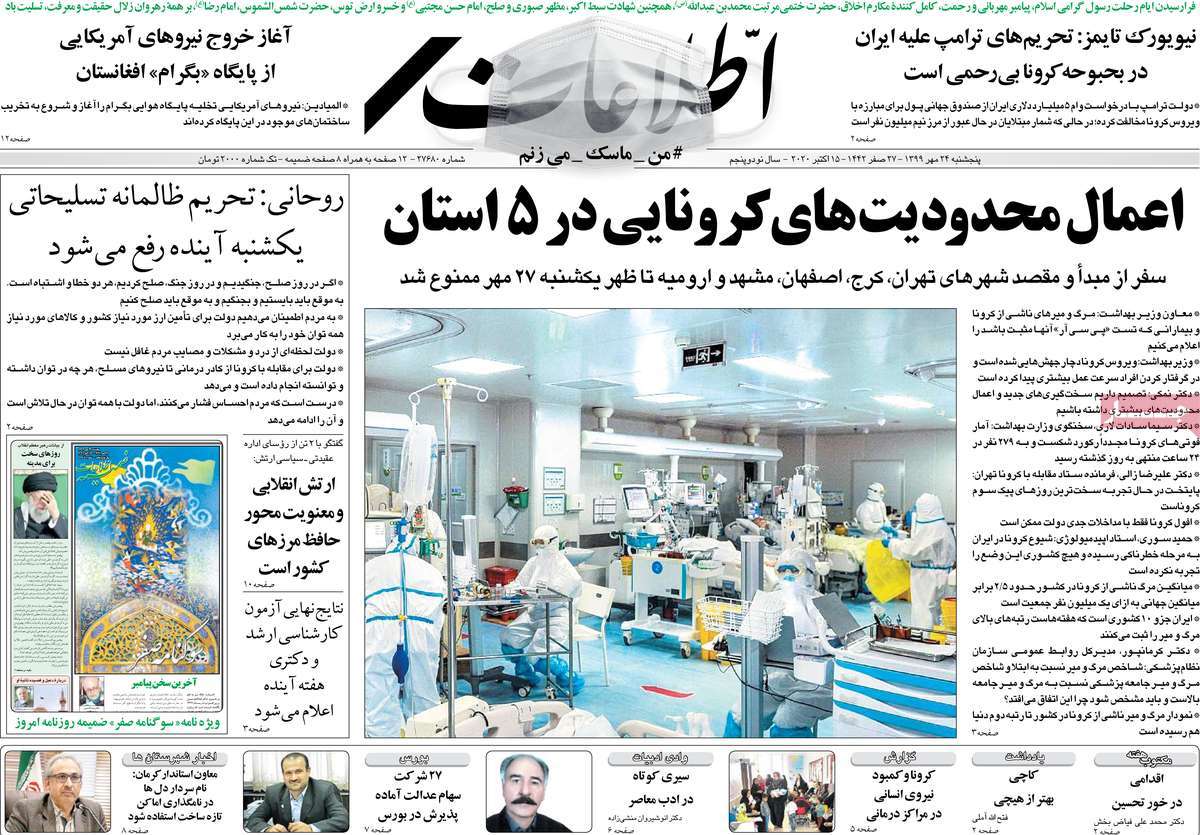
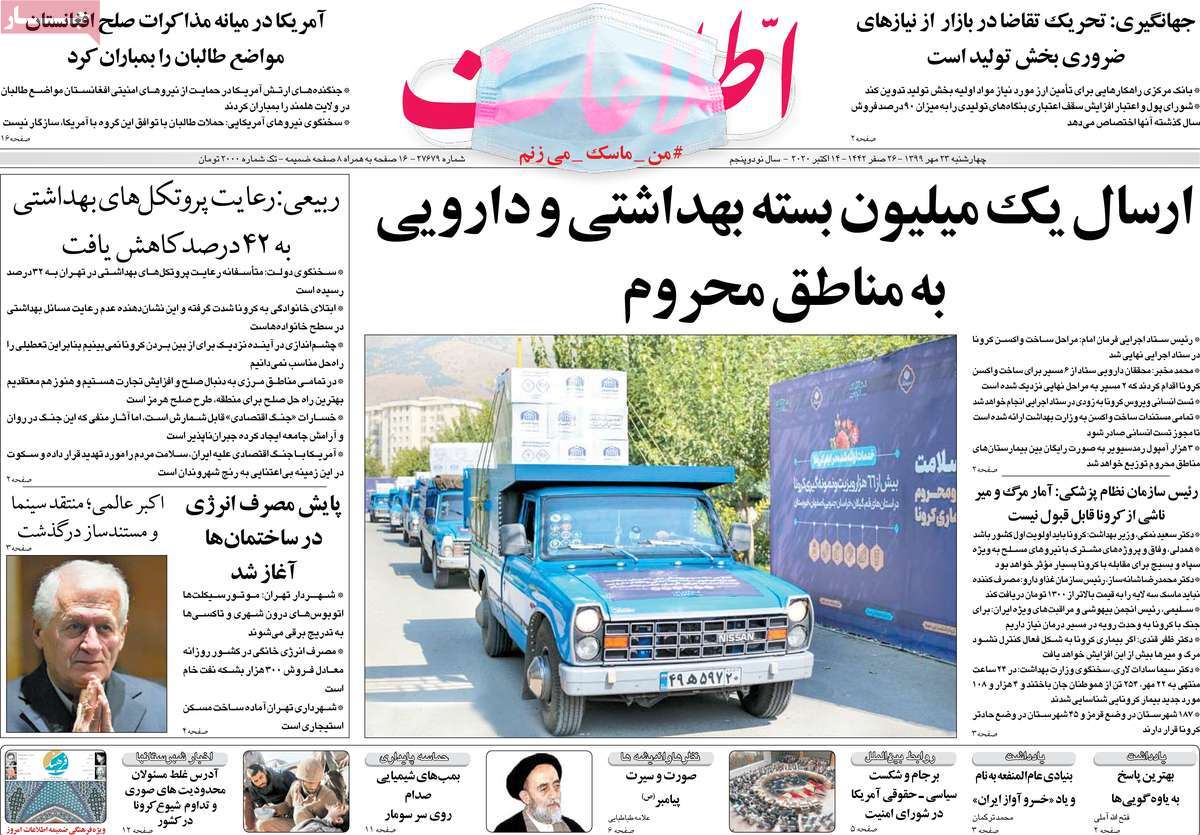
Ettela’at Newspaper:

1- New York Times: Trump’s Sanctions on Iran amid COVID-19 Pandemic Cruel

2- American Forces Start Withdrawal from Afghan Base

3- Rouhani: Cruel Arms Embargo to Be Lifted Sunday

A Look at Iranian Newspaper Front Pages on October 15


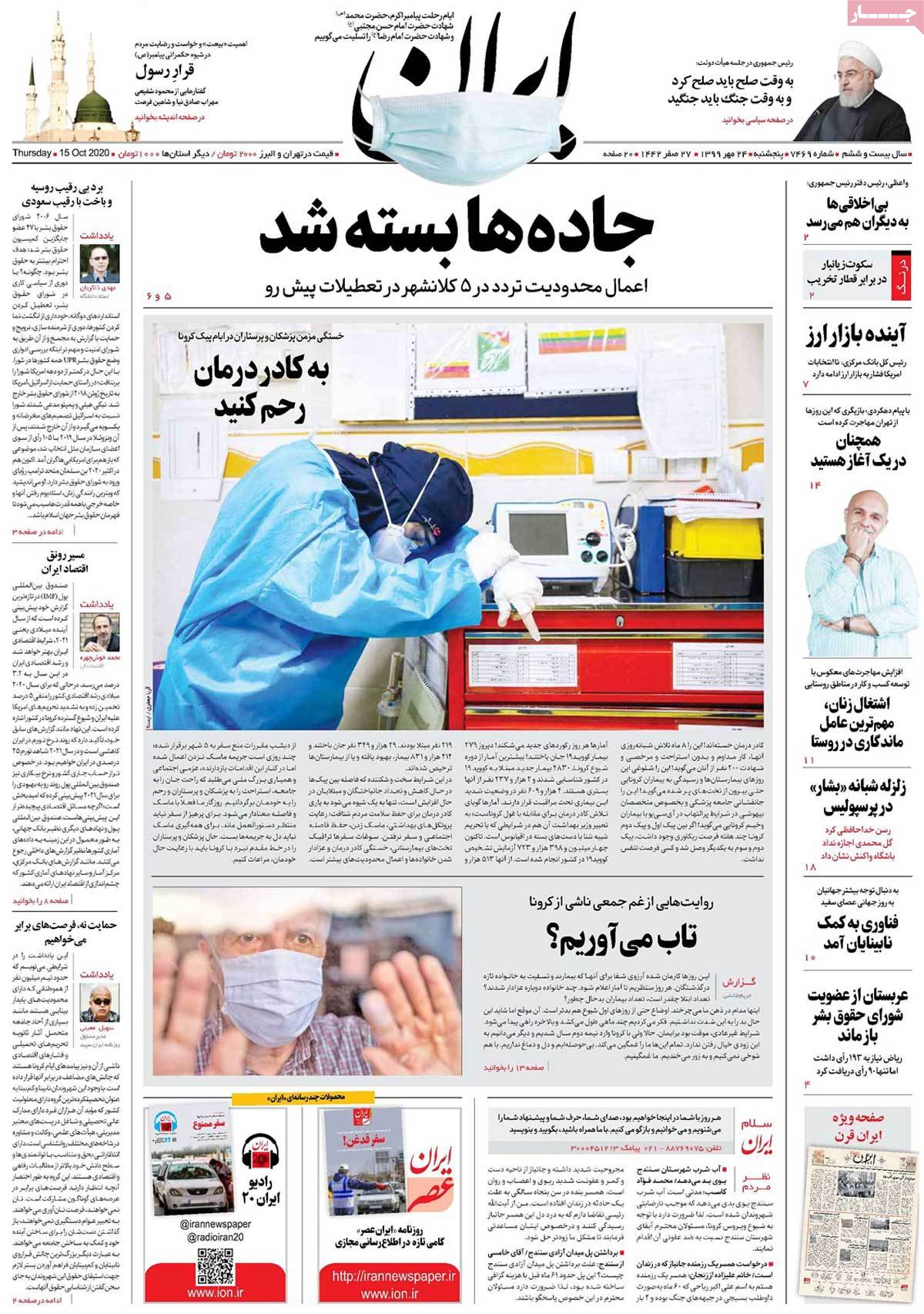
Iran Newspaper:

1- You Must Make Peace When It’s Time for It: Rouhani

2- Saudi Fails to Win UN Rights Council Membership

A Look at Iranian Newspaper Front Pages on October 15


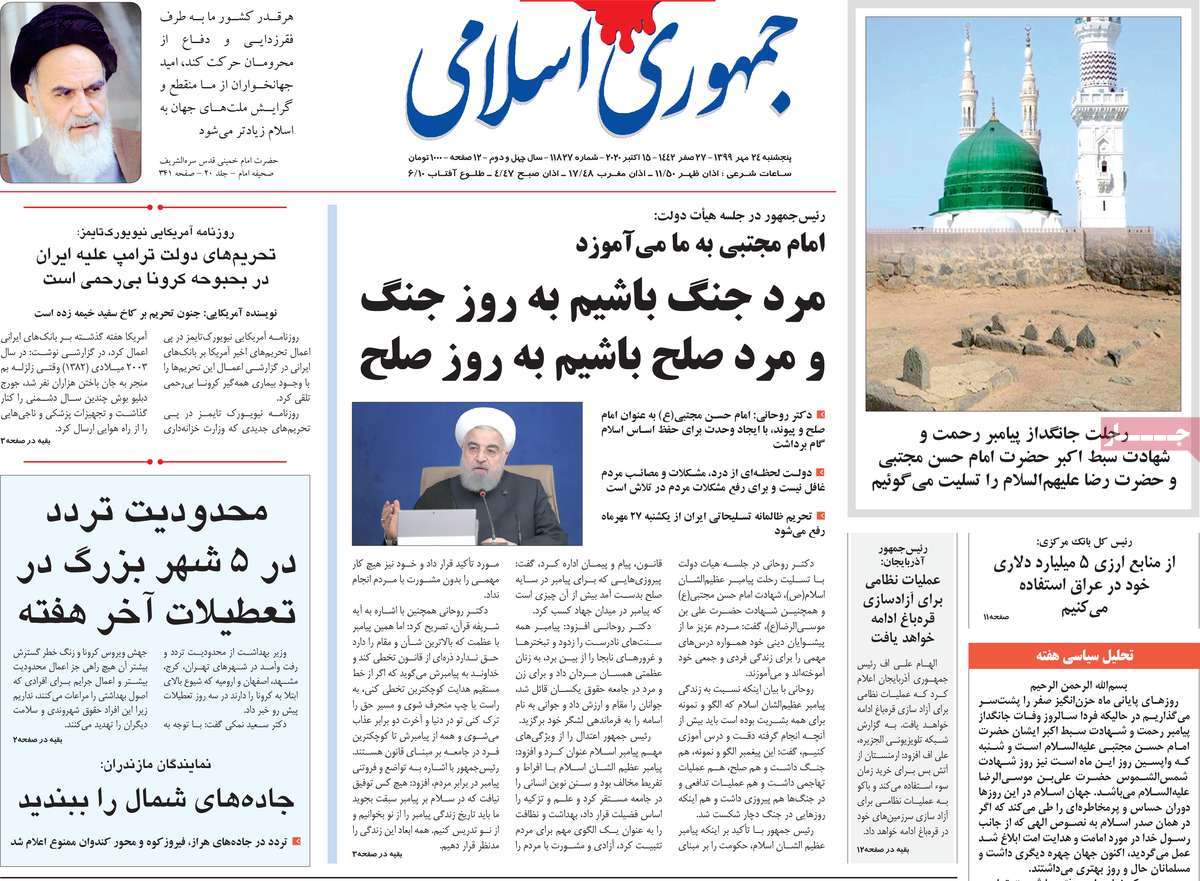
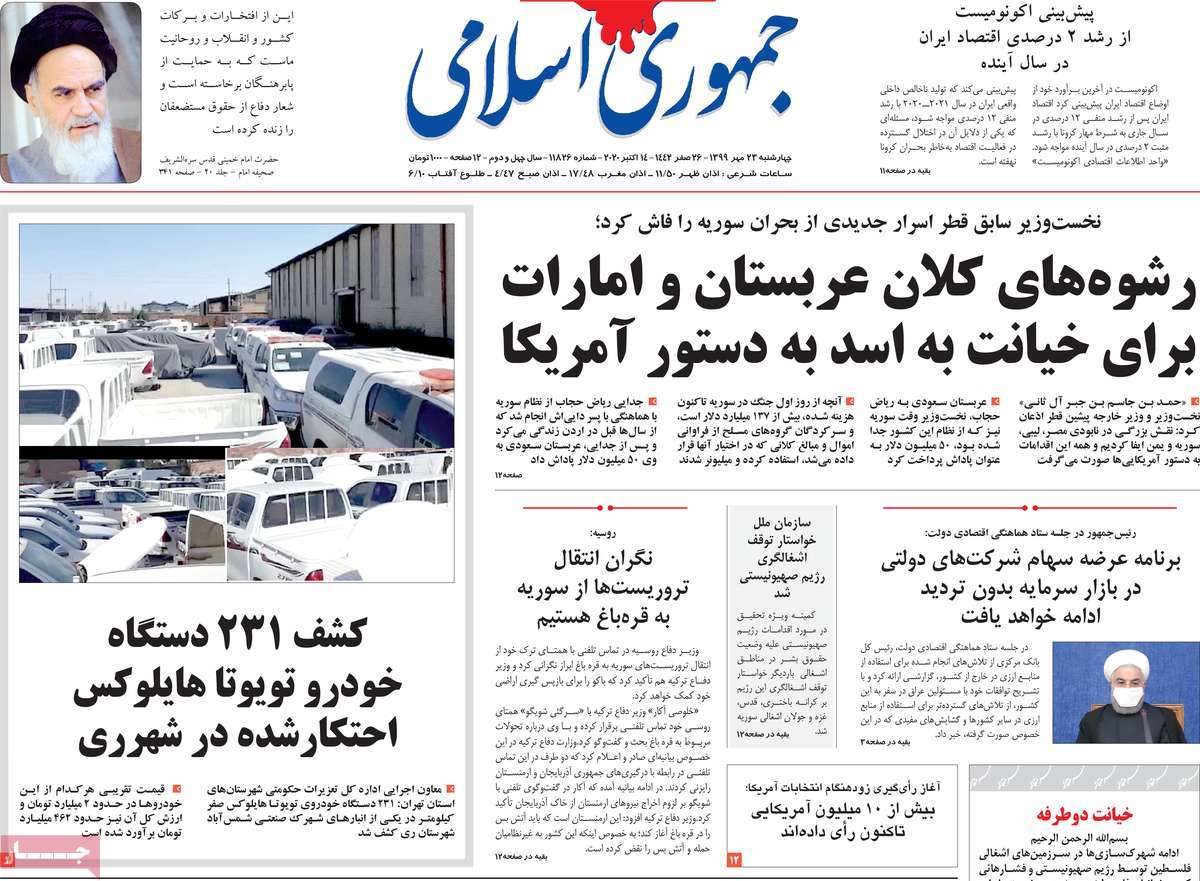
Jomhouri Eslami Newspaper:

1- Iran’s Top Banker: We’ll Use Our $5 Billion Worth of Assets in Iraq

2- Military Operation to Liberate Karabakh Will Continue: Azeri President

A Look at Iranian Newspaper Front Pages on October 15


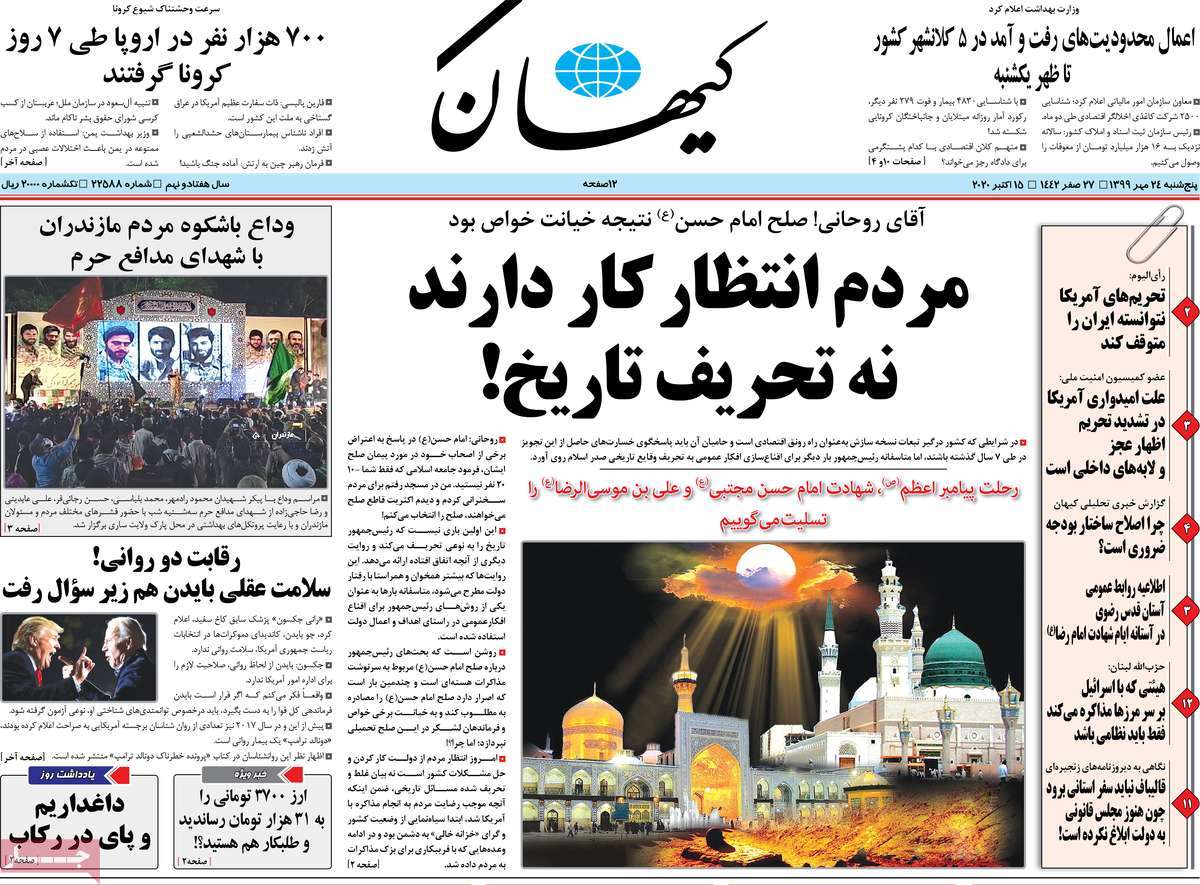
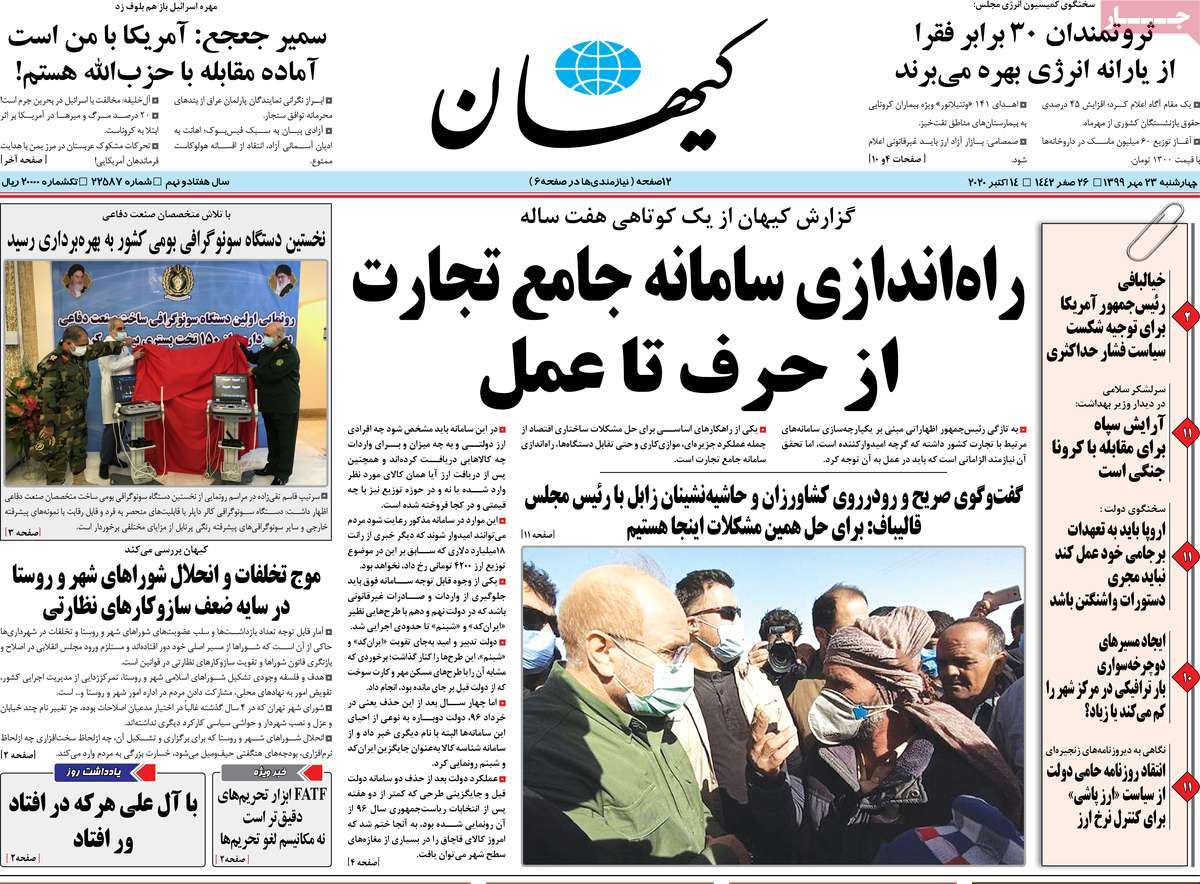
Kayhan Newspaper:

1- Rai al-Youm: US Sanctions Failed to Stop Iran

2- 7,000 People Contract Coronavirus in Europe in 7 Days

A Look at Iranian Newspaper Front Pages on October 15


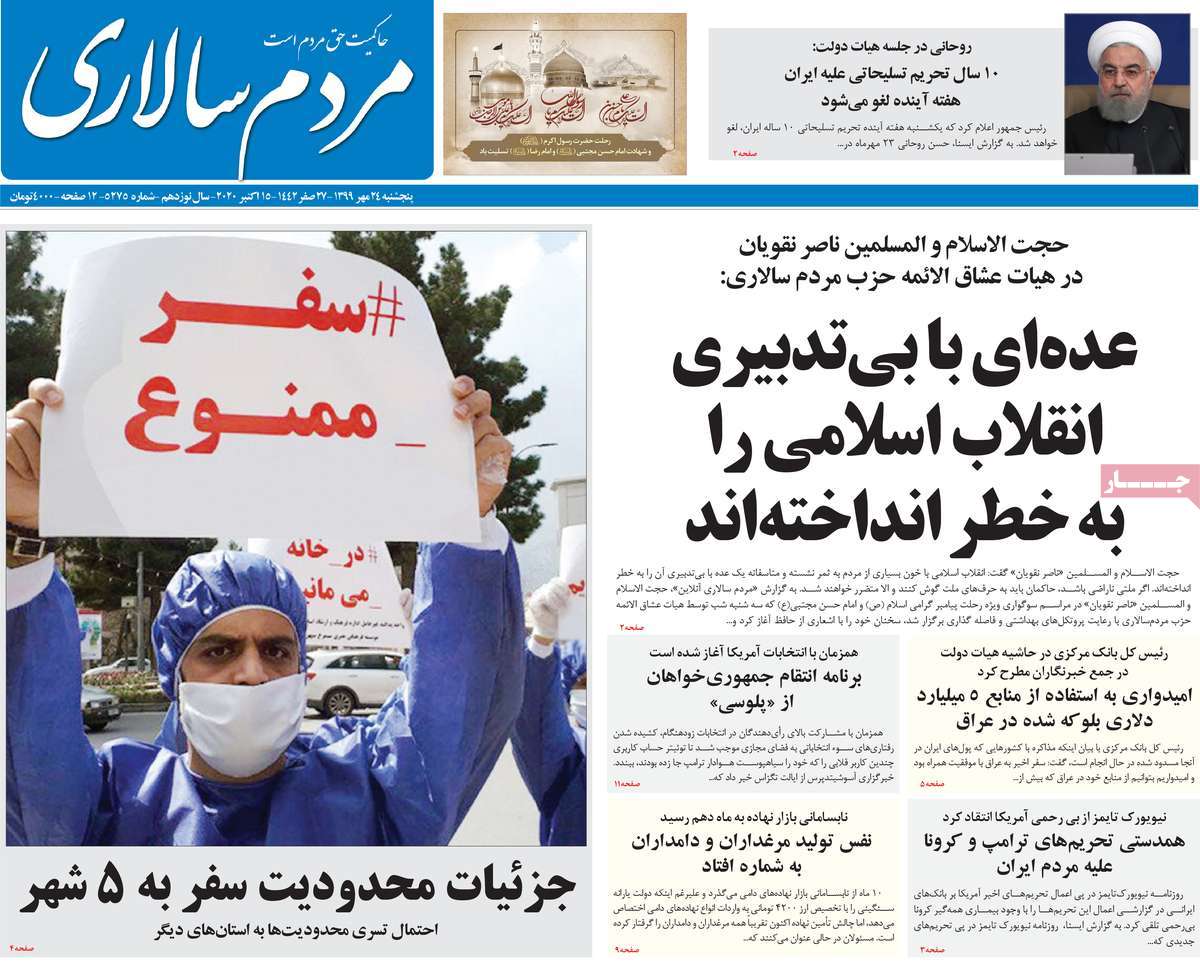
Mardom Salari Newspaper:

1- Rouhani: 10 Years of Arms Embargo to End Sunday

2- Iran Hopes to Use Its $5 Billion Assets Frozen in Iraq

A Look at Iranian Newspaper Front Pages on October 15


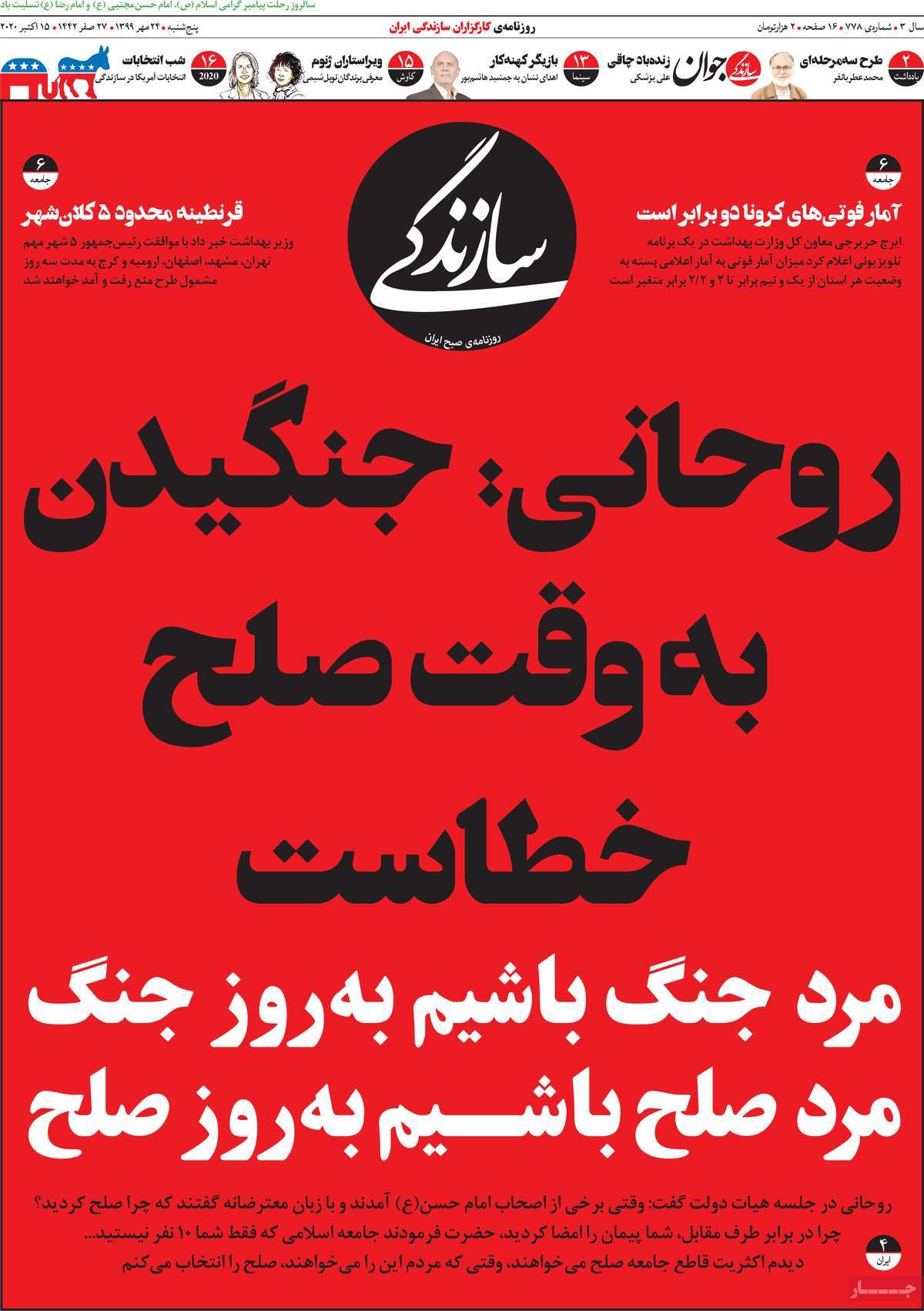
Sazandegi Newspaper:

1- Rouhani: We Should Go to War at Right Time and Make Peace at Right Time; Fighting in Time of Peace Is Wrong

A Look at Iranian Newspaper Front Pages on October 15


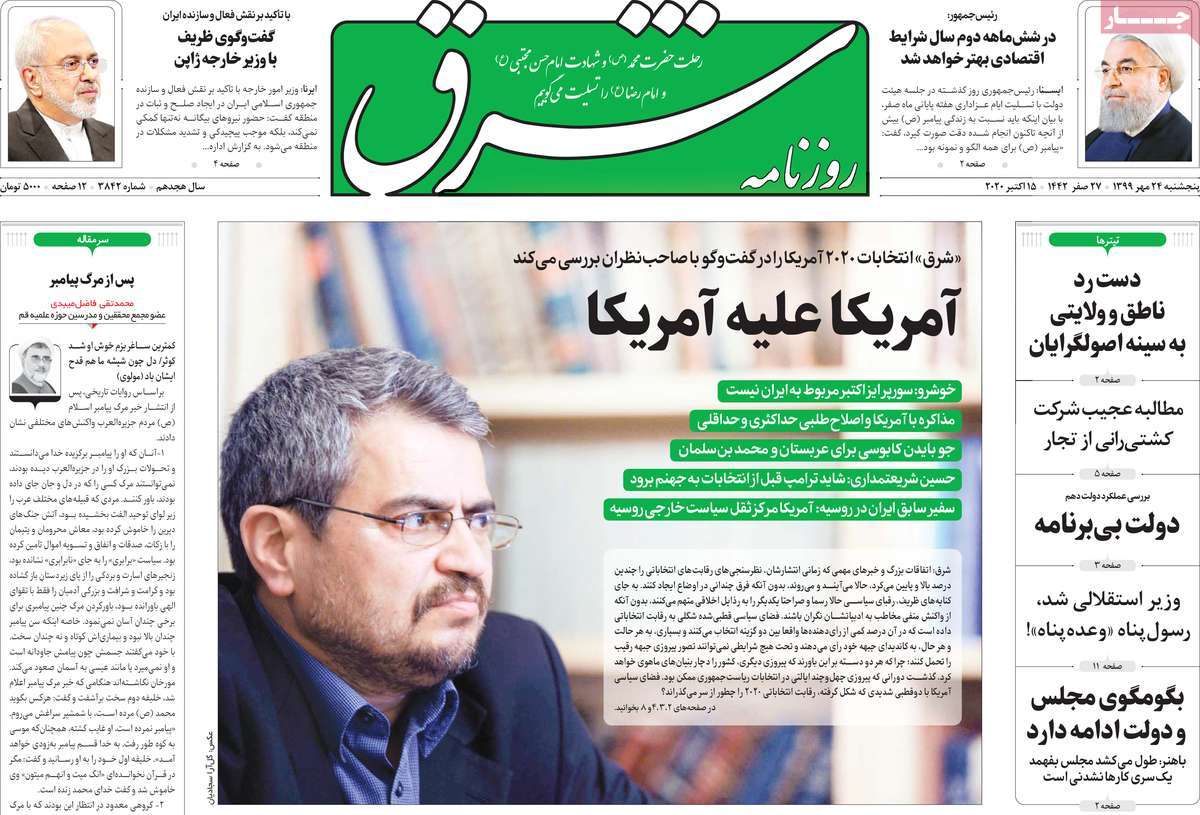
Shargh Newspaper:

1- Economic Situation to Get Better in Coming Months: Rouhani

2- Zarif, Japanese Counterpart Hold Phone Talks

3- US against US: Biden a Nightmare for Saudi, Bin Salman

A Look at Iranian Newspaper Front Pages on October 15

‘Iran’s Average COVID-19 Death Toll 2.5 Times That of World Average’

‘Iran’s Average COVID-19 Death Toll 2.5 Times That of World Average’

Mohammad Tajik, a professor of epidemiology at Shahid Beheshti University of Medical Sciences, has, in an interview with Hamshahri newspaper, weighed in on the developments related to the coronavirus pandemic in Iran.

He said the measures adopted so far have mostly been of a “treatment” nature than “prevention and health.”

Tajik argues that the measures taken so far have not been effective enough, and that can be seen in the high number of Iran’s fatalities, which is 2.5 times that of world average.

The full text of the interview follows.

Given the pandemic situation in the country as well as the numerous ups and downs in the number of people contracting the disease, what is your analysis of the COVID-19 condition in Iran and in the world?

My analysis is that the plans drawn up so far in the country have not produced the desired results. Despite the fact that many countries were gripped by the epidemic after Iran, they managed to control it and contain the peak of the epidemic.

Now, we are facing the third peak of the disease. This comes as the disease was detected in our country earlier; however, Italy and France, where the disease erupted a few weeks after it broke out in Iran, were able to control it, but we have not been able to do so, yet.

If we look at the whole world, it seems that because the epidemic broke out in the southern hemisphere much later, people had more awareness and were more prepared to face the epidemic, and that is why the disease did not spread that much in that part of the world. Although the epidemic has moved from the East to South America, the disease still linger on in our country.

Could you explain why the COVID-19 virus is still there in our country and why there are many ambiguities in the different comments made by officials and experts?

If we want to answer this question in a realistic and documented manner, I think we can categorize into two groups the reasons why coronavirus continues to linger on in our country and why we are the first country in the world to be experiencing the third peak in the disease.

Some contributors are outside our control and some factors are domestic ones. It is natural that when economic sanctions exist and there is the problem of generating income, it is much more difficult to control an epidemic. For example, we cannot make people stay at home for a long time and ignore their need to earn a living.

Many questions have remained unanswered, including what percentage of the society have not contracted the disease yet.

We need comprehensive policy-making and planning. However, when it needs several billions to be done and the government is facing financial problems, then a series of outside contributors will cause policies to move forward cautiously.

On the other hand, our approaches have had problems, too, because our approaches have been more treatment-oriented than geared to prevention. So, we didn’t use the potential of the expert manpower that we have in the domain of prevention.

Given Iran’s population of 83 million, where do we stand now compared to other world countries in terms of infections and the number of deaths?

Unfortunately, our situation is not good.

Italy, where the disease took so many lives, manages to control the disease, and now the daily number of fatalities in that country is fewer than 10. This is while our daily fatalities exceeded 270 over the past days.

Iran is among the few countries in the world where more than 100 people die daily due to the coronavirus infection. Therefore, why this is so is mostly related to the policies and decisions made by authorities.

We are among the top ten countries with the highest rate of deaths from the coronavirus. We have been among the top 10 to 12 world countries for weeks now in terms of infections, which shows our situation is no good.

How do you evaluate the conditions of the coronavirus outbreak in Tehran as the largest province in the country?

Tehran is a cross-section of the different types of behaviour of people of all cities and provinces across the nation. Tehran is a city where confrontations have more complex patterns compared to other locations. It is a city where, due to much travel, the odds of contracting the virus and the spread of the disease and the pattern of contracting the disease differ.

After a contagious disease lingers on in society and becomes native to the community, people gradually become immune to that disease.

Of course, I’m not saying that people won’t contract the disease, but when someone from outside the region with a different epidemic pattern enters that community, he/she can disrupt this relative balance.

This is one of the features of Tehran at the moment, and its pattern is constantly being affected by trips and travel. Moreover, there is a wide variety of lifestyles as well as economic, social and behavioural conditions in Tehran while that is not the case in other areas, which has made the epidemic complicated.

Tehran requires its own specifications and special bahaviour, and it has a more complex situation compared to the national average. It is predicted that if the epidemic begins to die down, it will happen in Tehran with a delay.

How do you predict the end of the epidemic in Tehran and in the world?

This cannot be predicted and depends on global determination. If the whole world is cleared of this virus, but even one single country remains affected, it can spread and transmit the virus again.

In the world of viruses, even if one gene undergoes mutation, that can make a great change to the nature of the virus. We are not very hopeful that this epidemic will go away any time soon.

Iran Denies Allegations against Its Diplomat Arrested in Belgium

Iran Denies Allegations against Its Diplomat Arrested in Belgium

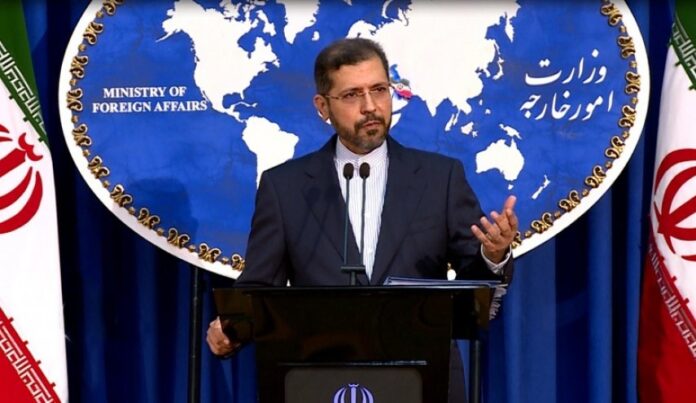
“Such baseless reports are fabricated and published so as to be capitalized on in the future,” Khatibzadeh said in a Wednesday statement, describing such allegations as part of a media campaign.

“The Islamic Republic of Iran considers the arrest of Mr Assadollah Assadi, an Iranian diplomat in Europe, as a move that is basically unlawful and in blatant violation of international practices and the contents of the 1961 Vienna Convention on Diplomatic Relations,” Khatibzadeh said.

Accordingly, he added, Iran has already conveyed its strong official protest to relevant European authorities.

“We believe the violation of Mr Assadi’s diplomatic immunity and his arrest and prosecution in Belgium is an unacceptable heresy. The Ministry of Foreign Affairs still considers the countries involved in this case to be responsible for violating the Iranian diplomat’s rights, and reserves the right to a proportionate response,” he added.

Assadi, who will go on trial in late November, was charged with planning to bomb a Paris rally of the MKO terrorist group.

Tehran says European states harbour MEK, which is responsible for the killing of 17,000 Iranians, according to Iran’s official statistics.

The group was on the United States’ terrorism list from 1997 to 2012, but its rallies in recent years have been headlined by the likes of US President Donald Trump’s lawyer Rudy Giuliani and former US national security adviser John Bolton.

Assadi was arrested while on holiday in Germany and handed over to Belgium. The Western European nation says it arrested two of his suspected accomplices with an explosive and a detonation device.

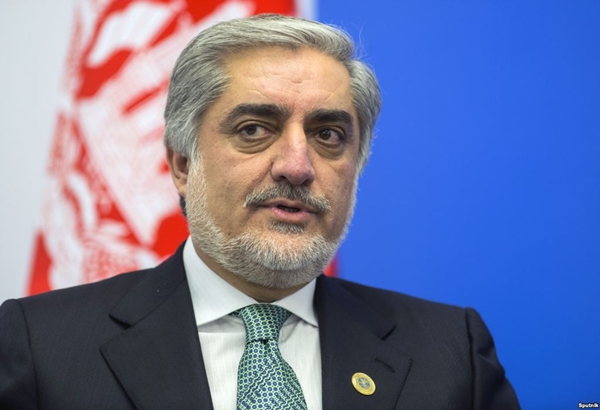
Head of Afghan Reconciliation Council to Visit Iran: Spokesman

Abdullah will lead a delegation of HCNR officials, members of the Afghan National Parliament, and the country’s Foreign Ministry officials during his three-day trip to Tehran, the Iranian spokesman said on Wednesday.

In the visit, the Afghan official will meet with Iranian President Hassan Rouhani, Parliament Speaker Mohammad-Baqer Qalibaf, Foreign Minister Mohammad Javad Zarif, and other high-ranking Iranian officials, Khatibzadeh added.

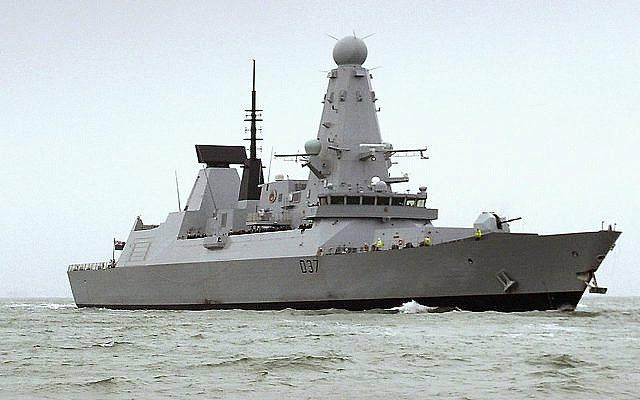
Iran Opposed to Europe’s Military Presence in Persian Gulf: Araqchi

A file photo of the UK's HMS Duncan, a Type 45 Destroyer, which will relieve HMS Montrose in the Persian Gulf / Photo by UK Ministry of Defence via AP

Speaking in a meeting with the new Danish ambassador to Tehran on Wednesday, October 14, Araqchi noted that the security of the Persian Gulf region should be provided by the countries of the region.

Araqchi said the presence of foreign troops will not only not help establish security, but will prepare the ground for the escalation of tensions as well.

The Iranian official underlined that Persian Gulf security is an issue of common interest for all regional countries. He said the establishment of sustainable security in the region is contingent upon dialogue and collective cooperation among regional countries and non-interference by foreign powers.

“Therefore, instead of deploying troops and military equipment or selling massive amounts of arms to certain regional countries, Denmark and other European countries had better tackle the root cause of tensions in the region, namely the United States’ destructive and wrong policies in the Persian Gulf region,” he said.

In the meeting, the two sides also exchanged views on regional and international developments, fighting terrorism, the situation in the Middle East, the Nagorno-Karabakh crisis and potential for economic cooperation between the two countries.

Iran Urges Japan to Prevent US from Blocking Its Assets

In the telephone conversation, Foreign Minister Zarif and his Japanese counterpart talked about Tehran-Tokyo bilateral relations as well as the regional and international developments.

Foreign Minister Zarif hailed the election of Yoshihide Suga as Japan’s prime minister and congratulated Motegi on his re-election as the minister of foreign affairs of Japan.

He also expressed hope that Mr. Suga’s administration would continue Japan’s previous policy of striving to play a role in contributing to regional stability.

Foreign Minister Zarif also stressed that Iran should be able to use its foreign currency resources held in Japan, condemned the US regime’s illegal restriction on Tehran’s access to those funds, and denounced the limits preventing the purchase of medicine and foodstuff for the Iranian people as a crime against humanity.

“Iran expects the government of Japan to prevent such unlawful American measure within the framework of the general commitment of countries to the implementation of the UN Security Council resolutions, including the Resolution 2231,” Zarif added.

The Iranian foreign minister also expressed gratitude to Japan for supporting Iran in the fight against the coronavirus pandemic, hoping for the expansion of cooperation and bilateral ties between the two nations.

On the 2015 Iran nuclear deal, Foreign Minister Zarif said it is highly significant that every effort would be made to have the other parties honour their commitments under the JCPOA.

Highlighting Iran’s active and constructive role in the establishment of peace and stability in the region, Zarif said, “The presence of foreign forces would not only not be of any help, but would further complicate and aggravate the problems in the region.”

For his part, Japanese Foreign Minister Motegi thanked Foreign Minister Zarif for offering congratulations, and stressed the need to strengthen cooperation in the battle against the coronavirus pandemic and delivering medical supplies by using Iran’s financial resources.

Japan’s policy of striving for stability in the Middle East has not changed, he noted, adding that Tokyo has always supported the JCPOA and will continue to do so.

Iran’s Single-Day COVID-19 Fatalities at Highest Level Again

Iran's Single-Day COVID-19 Fatalities at Highest Level Again

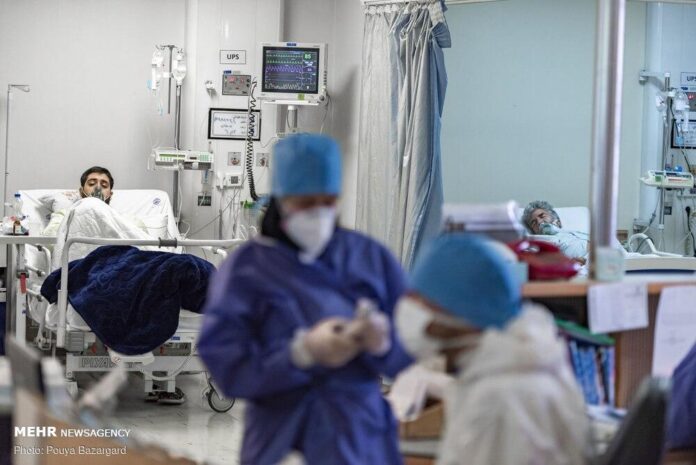
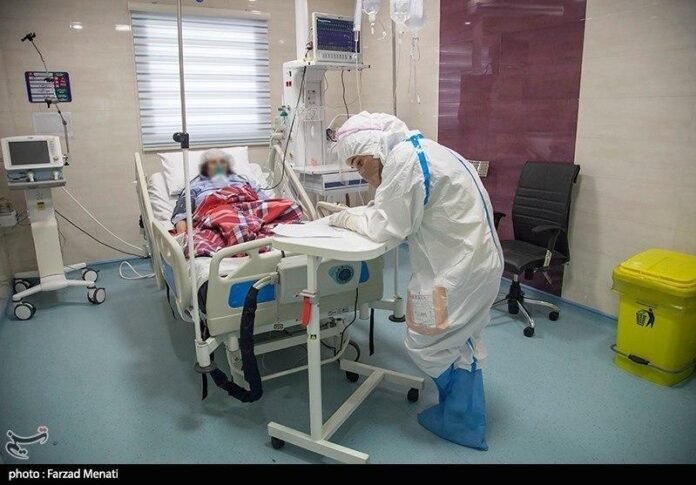
In her press briefing on Wednesday, Health Ministry Spokeswoman Sima-Sadat Lari said the new deaths increase the overall death toll to 29,349.

She further reported 4,830 new cases of COVID-19 infection, raising the total number of cases to 513,219.

So far, she added, 414,831 patients have recovered from the disease or been discharged from the hospital.

Lari said 4,609 patients are also in critical conditions caused by more severe infection.
The spokeswoman noted that 4,398,723 COVID-19 tests have been taken across the country so far.

She said the high-risk “red” zones include Tehran, Qom, Mazandaran, East Azarbaijan, Isfahan, Yazd, Ardabil, Khorasan Razavi, Khuzestan, Hamadan, West Azarbaijan, Bushehr, Chaharmahal and Bakhtiari, Kohgiluyeh and Boyer-Ahmad, Alborz, Lorestan, Markazi, Ilam, South Khorasan, Kermanshah, North Khorasan, Semnan, Gilan, Zanjan, Qazvin, and Kerman provinces.

The “orange” zones also include Golestan, Hormozgan, Kurdistan, and Fars provinces, she added.

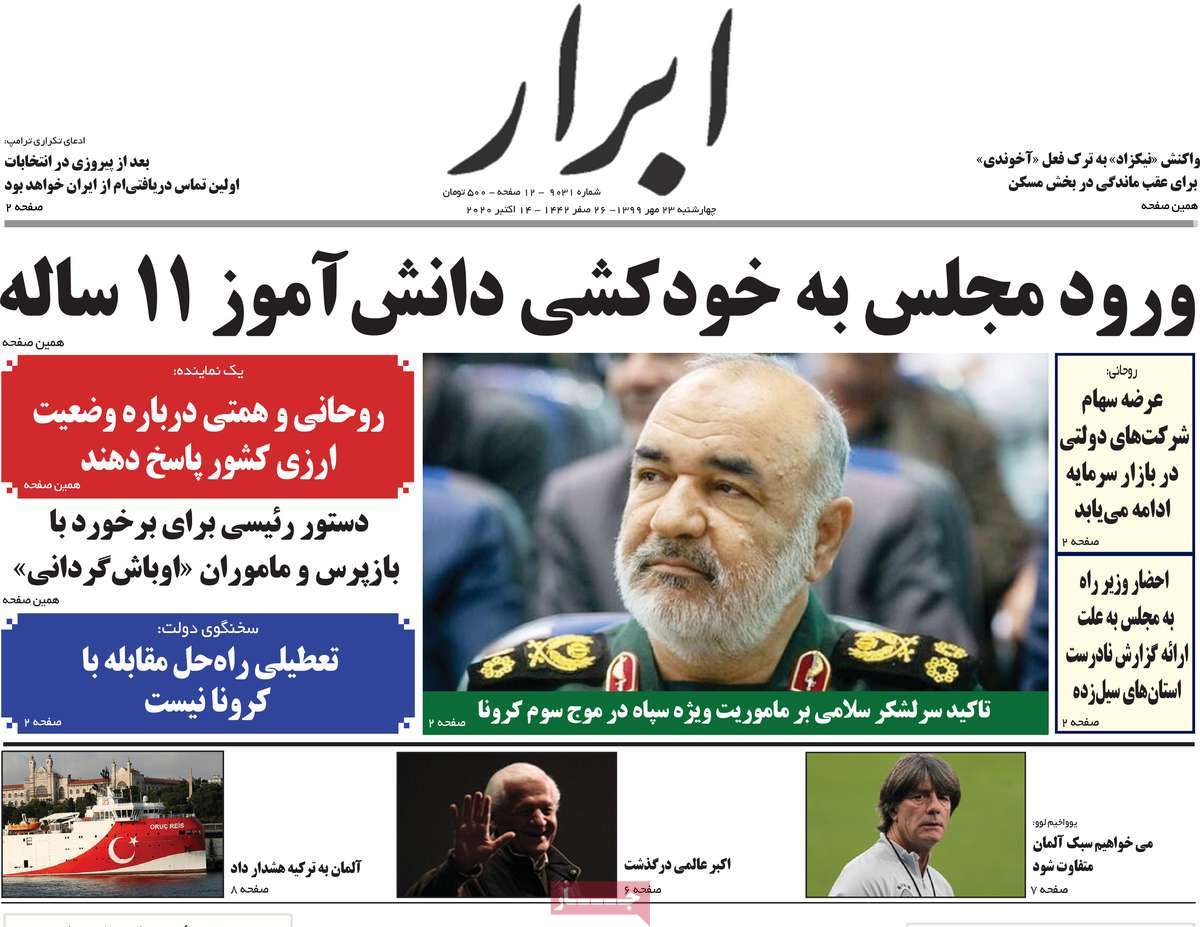
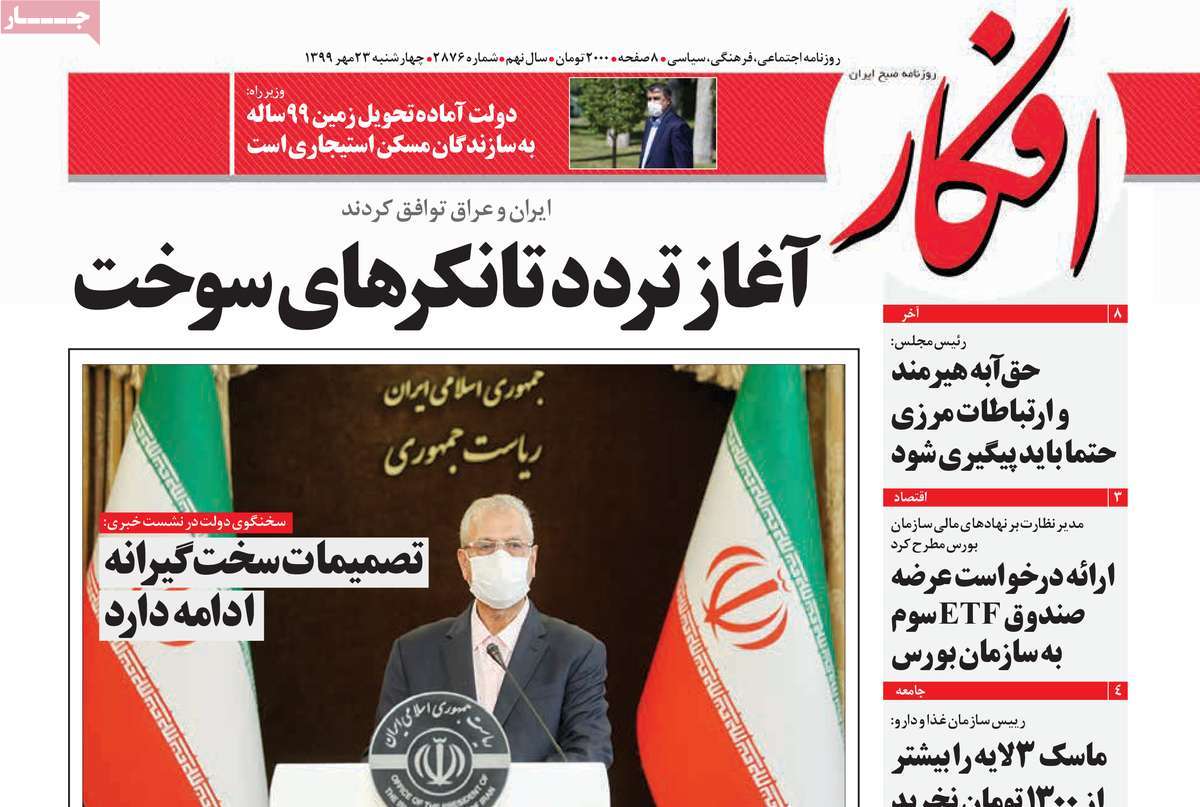
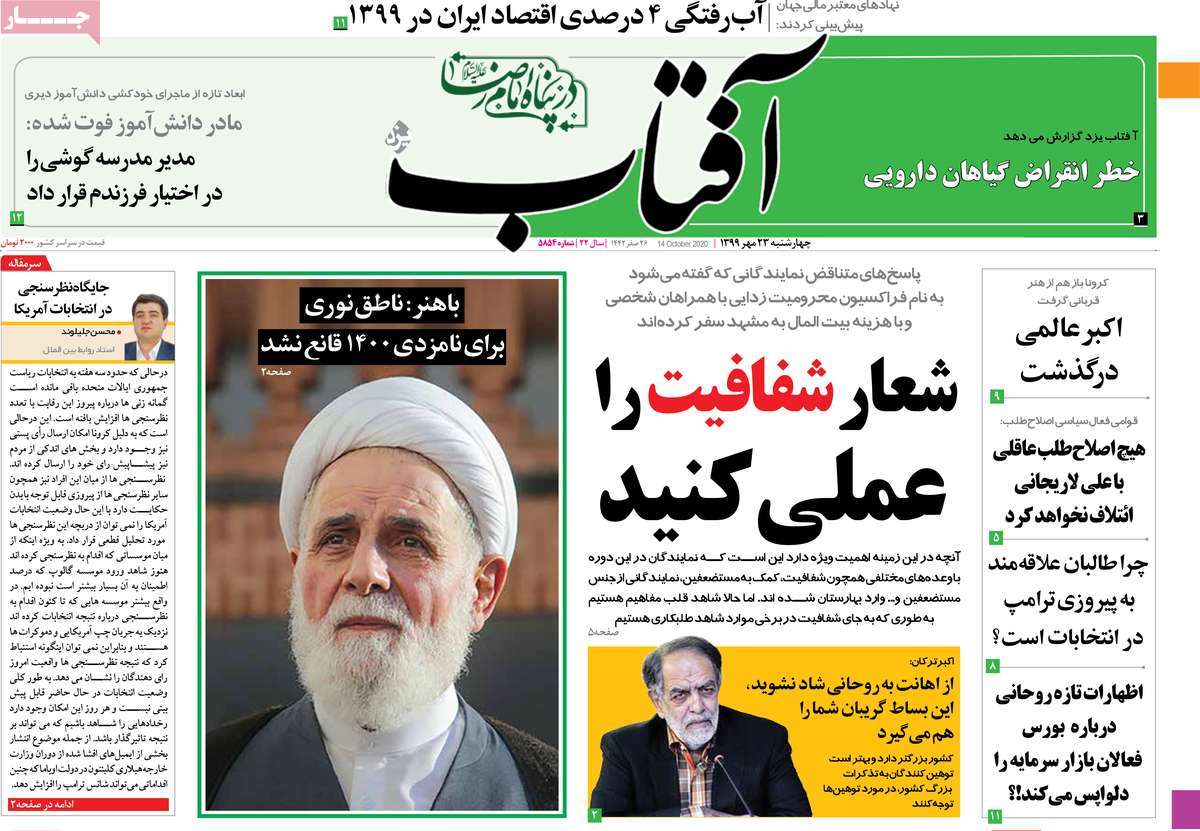
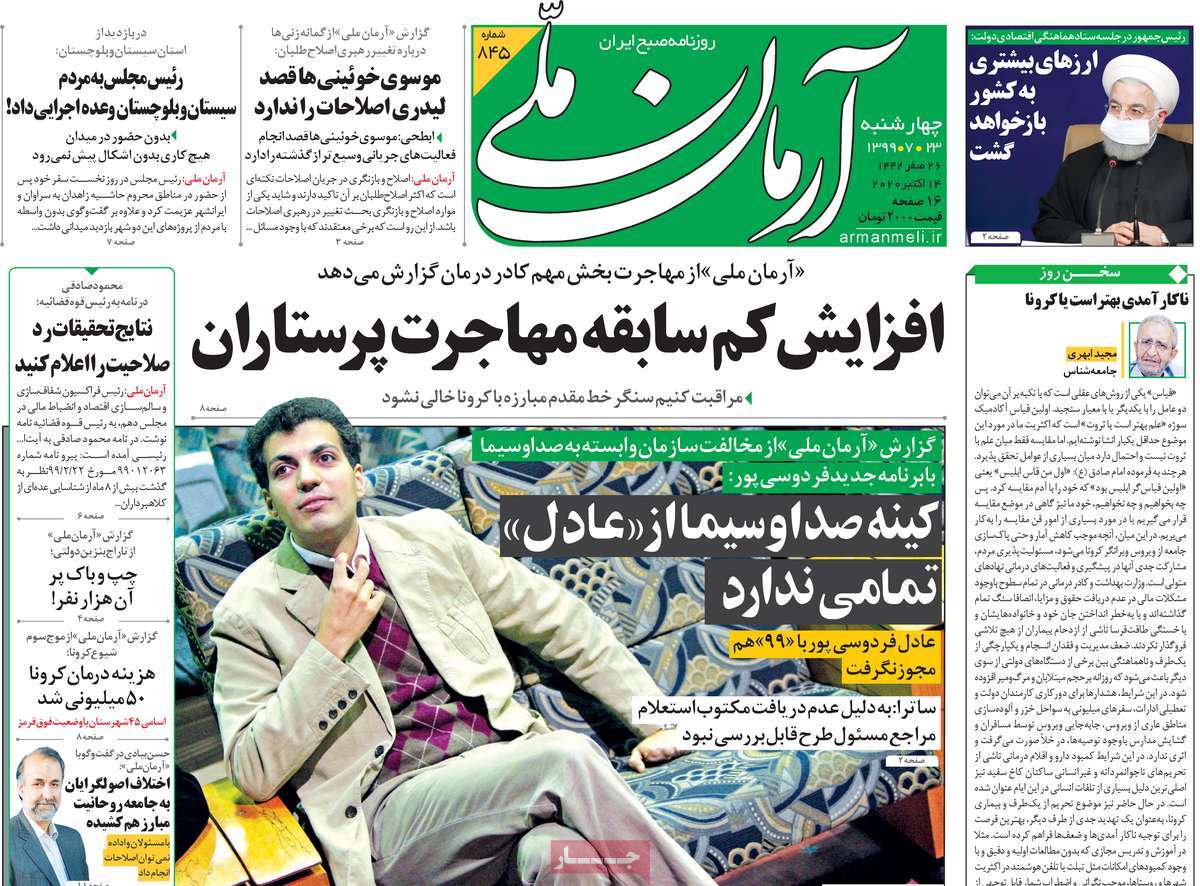
A Look at Iranian Newspaper Front Pages on October 14

A Look at Iranian Newspaper Front Pages on November 18

Iranian Newspapers

Abrar Newspaper:

1- Gov’t Spokesman: Shutdown Not Good Way to Counter Coronavirus

2- Trump Repeats His Claim Iran Will Be First to Call Him after Re-Election

A Look at Iranian Newspaper Front Pages on October 14


Afkar Newspaper:

1- Iran, Iraq Agree Fuel Tankers Start Operation

2- Gov’t Spokesman: Stricter COVID-19 Measures to Be Enforced

A Look at Iranian Newspaper Front Pages on October 14


Aftab-e Yazd Newspaper:

1- Why Is Taliban Interested in Trump’s Victory?

A Look at Iranian Newspaper Front Pages on October 14


Arman-e Melli Newspaper:

1- More Forex Revenues to Be Returned: Rouhani

2- Unprecedented Increase in Migration of Iranian Nurses

A Look at Iranian Newspaper Front Pages on October 14


Ebtekar Newspaper:

1- Biden Maintains Lead over Trump in 10 Out of 11 Key States

2- President’s Important Orders on Stock Market, Frozen Assets

A Look at Iranian Newspaper Front Pages on October 14


Ettela’at Newspaper:

1- IRGC’s New Mission Is to Serve Corona Patients: Chief Commander

2- Nine Private Ports to Increase Iran’s Trade under Sanctions

A Look at Iranian Newspaper Front Pages on October 14


Jomhouri Eslami Newspaper:

1- Saudi, UAE Pay Huge Bribes for Betraying Assad Upon US Order: Former PM

2- Russia: We’re Worried about Transfer of Terrorists from Syria to Karabakh

A Look at Iranian Newspaper Front Pages on October 14


Kayhan Newspaper:

1- US Is with Me, I’m Ready to Counter Hezbollah: Geagea

* Israel’s Pawn Once Again Bluffs

2- IRGC at War Footing for Countering Coronavirus: Chief

3- Gov’t Spokesman: Europe Shouldn’t Just Implement Washington’s Orders

A Look at Iranian Newspaper Front Pages on October 14


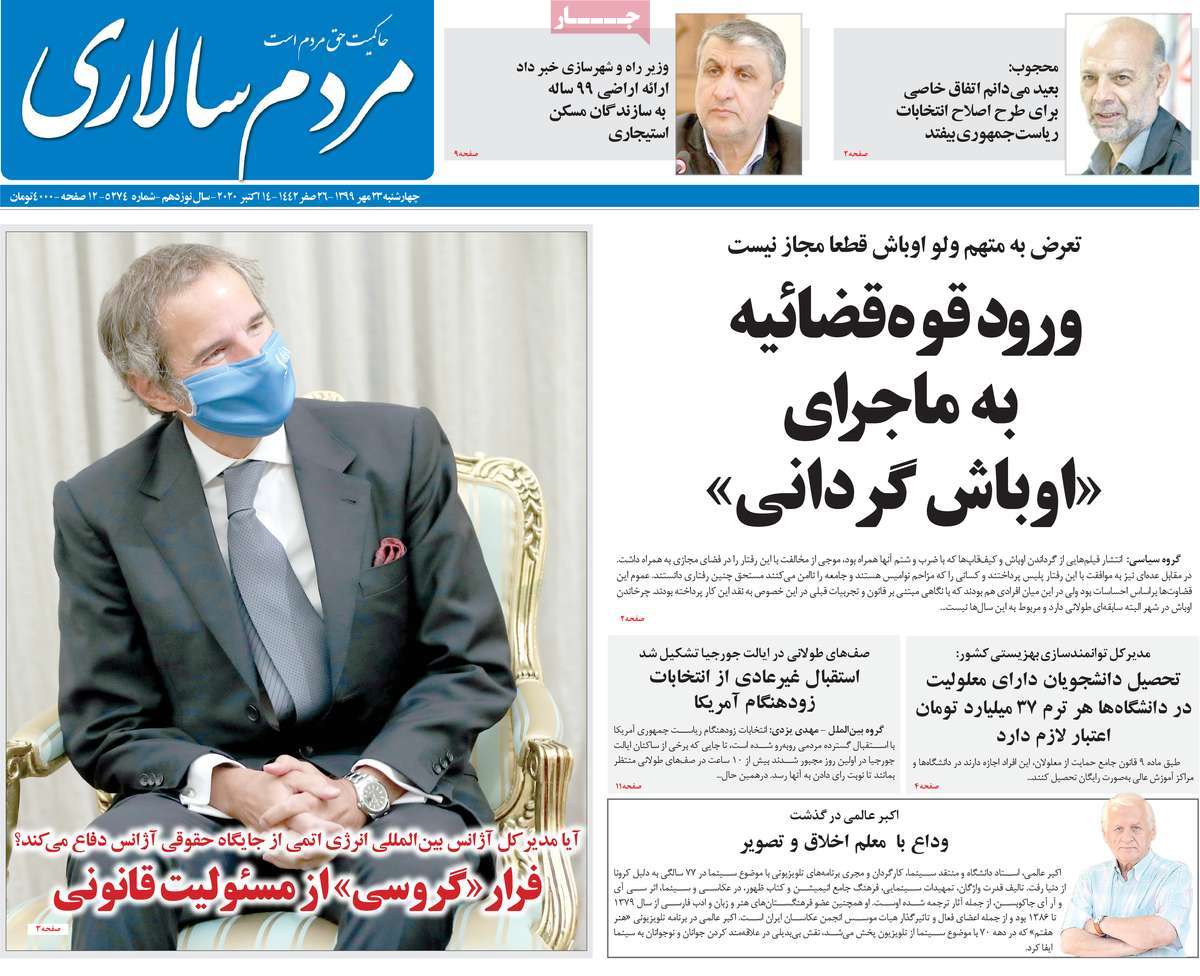
Mardom Salari Newspaper:

1- Grossi Evades His Legal Responsibility: Is IAEA Chief Defending Agency’s Legal Position?

2- Unusual Reception of Early Voting in US: Long Lines in Georgia

A Look at Iranian Newspaper Front Pages on October 14


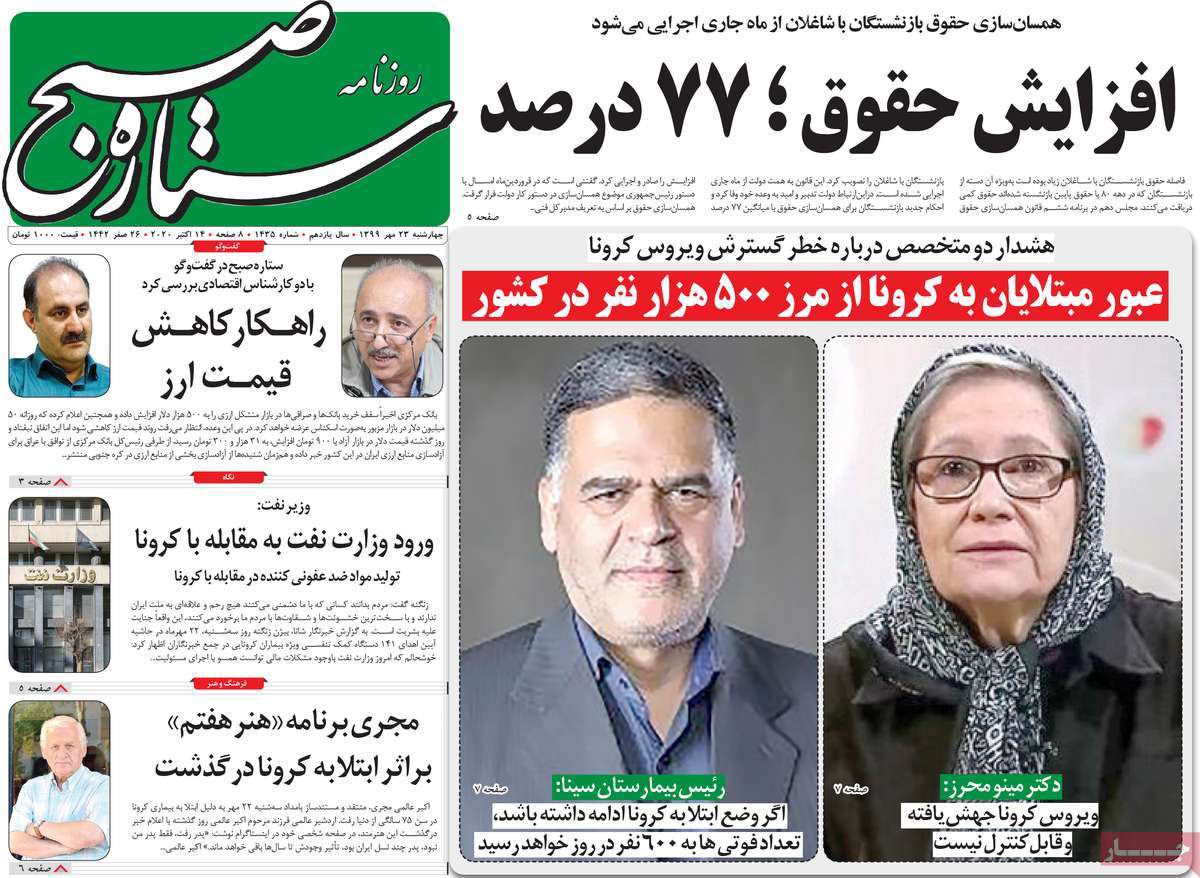
Setareh Sobh Newspaper:

1- Iran’s COVID-19 Patients Exceed 500,000

2- Oil Ministry Joins Fight against COVID-19

A Look at Iranian Newspaper Front Pages on October 14


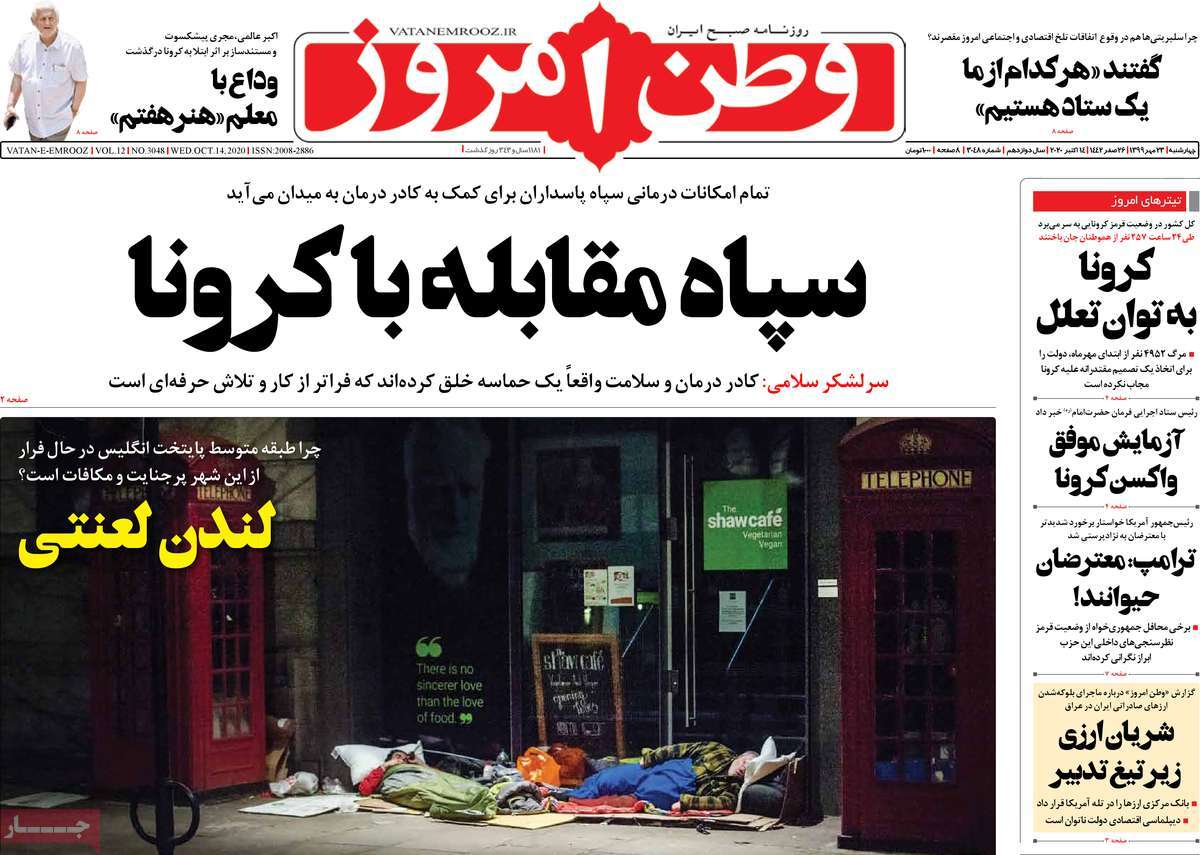
Vatan-e Emrooz Newspaper:

1- Successful Test of Coronavirus Vaccine by Iran’s Setad

2- Trump: Protesters Are Animals

A Look at Iranian Newspaper Front Pages on October 14

US Pressure on Iran a Non-Starter, Official Says

US Pressure on Iran a Non-Starter, Official Says

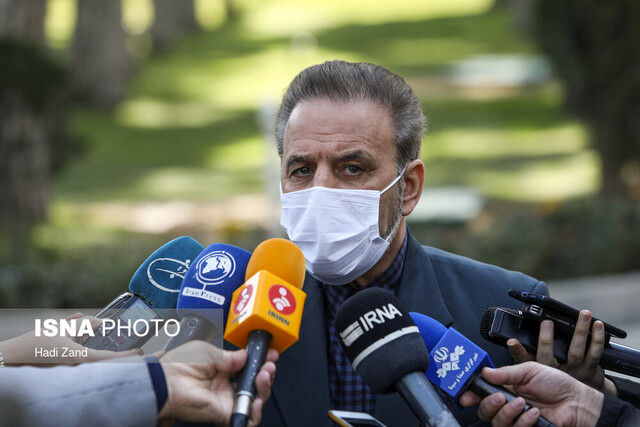
Speaking to reporters on the sidelines of a weekly cabinet session on Wednesday, Mahmoud Vaezi reminded the White House of the “futility” of sanctions and pressures on Iran.

“Whatever happens in the US and whoever takes power –be it the current administration or another president– will be mindful that the US cannot achieve results against this (Iranian) nation, this government and this establishment through pressure,” he underscored.

Pointing to the “tough conditions” resulting from the US sanctions, the president’s chief of staff thanked the people of Iran for “realizing that the administration, the government and the three branches of power do not accept such conditions, as they are doing their utmost, but are not going to give in to the enemy’s pressures or bow down.”

“This is the price we are paying for our independence,” he noted.

While the enemies had formulated plans for Iran’s economic collapse within three months, their plots have gone nowhere after two years and nine months despite all the pressures and sanctions, Vaezi added.

The US has launched a fierce war against Iran with maximum power, he noted, saying, “The fact that the Supreme Leader says ‘we are facing a serious economic war with a person and a group that does not respect any principles’ (is a proof of) what the thugs do.”

He then touched on the recent sanctions the US has imposed on 18 Iranian banks, saying Tehran had made arrangements beforehand to deal with the sanctions since two months ago.

Iran would not make its plans public, because the enemy may block the new ways for Iranian trade, he added, noting that most of the Iranian ministries working with foreigners use “special methods” to bypass the sanctions.

“However, we would pay a higher cost. Under normal situation, we could have handled the exports more easily and our imports would also cost less. All in all, the situation is difficult. We have always maintained that we are sorry for people, we are sorry because of the pressures,” Vaezi stated.

“There is no other option for it (the US) to change stances. Those who had made plans for three months (have gone nowhere) after two years and some nine months now. So I believe that the situation will be better in future, God willing,” he concluded.