Wednesday, April 8, 2026
Home Blog Page 2418

Poll: 51% of Americans prefer Trump to Biden

Trump

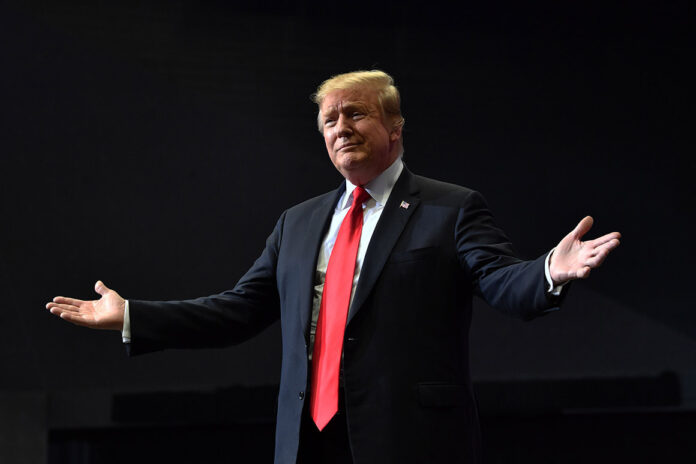
Americans are split on whether Trump was a better president than his successor, Biden. Fifty-one percent of those surveyed say that Trump is the superior commander in chief, while 49 percent prefer Biden, according to a new Harvard CAPS/Harris Poll survey.

Forty-eight percent of respondents say they have a positive view of Trump compared to 46 percent who say they have a favorable opinion of his successor. Biden’s favorability is slightly underwater, however: 49 percent of those surveyed said they have an unfavorable view of the current president, while slightly less — 47 percent — report an unfavorable opinion of Trump.

The findings are a remarkable shift for Biden, who repeatedly outperformed Trump’s favorability numbers throughout the early months of his presidency.

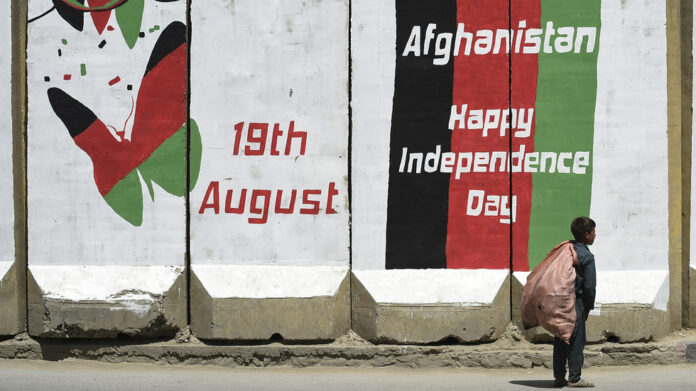
But multiple crises, including a surge in new COVID-19 infections in recent months and the chaotic withdrawal of U.S. troops from Afghanistan, have bruised public perceptions of Biden.

“The mounting issues on all fronts have led to the surprise conclusion that Trump is now seen as good a president as Biden, suggesting the honeymoon is being replaced now with buyer’s remorse,” Mark Penn, the co-director of the Harvard CAPS-Harris Poll survey, said.

“Since Trump lost the popular vote by 5 points, Trump getting 51 percent as a better president is actually an improvement from Election Day,” he added.

The latest Harvard CAPS-Harris Poll survey also shows Biden’s overall approval rating under water for the first time since he took office. Forty-eight percent of those surveyed say they approve of the job he’s doing in the White House, while 50 percent disapprove.

That follows on the heels of a July Harvard CAPS/Harris Poll survey that showed his approval rating sinking to 52 percent from 62 percent in June.

In a sign that the debacle in Afghanistan may be the biggest factor influencing views of his presidency, Biden saw his biggest drops in approval on his handling of foreign affairs and his administration’s efforts to combat terrorism. In both matters, his approval dropped 13 points since July.

Other members of Biden’s administration aren’t faring any better than Biden in the public eye, according to the poll.

Fifty-five percent of those surveyed say that Mike Pence was a better vice president than his successor, current Vice President Harris. Secretary of State Antony Blinken performs even worse, with 63 percent of respondents saying that his predecessor, Mike Pompeo, was the better secretary of State.

Penn noted that for Blinken, in particular, the U.S. withdrawal from Afghanistan has proved particularly tough.

“People see Pence as a better VP by 10 points and overwhelmingly see Pompeo as far better than Blinken, who has been out front on Afghanistan,” Penn stated.

The poll also found Trump is the clear favorite to win the GOP’s 2024 presidential nomination if he decides to mount another bid for the White House.

Nearly 6 in 10 Republican voters surveyed — 58 percent — say they would vote to put the former president back on the ballot in 2024, suggesting the party is ready and willing to give Trump another chance after his 2020 loss to Biden.

No other potential 2024 Republican candidate comes close to matching Trump. Former Vice President Mike Pence notches a distant second place with 13 percent support among GOP voters, while Florida Gov. Ron DeSantis, a rising star in the Republican Party, scored only 9 percent support in a primary field that includes Trump. Former U.S. Ambassador to the United Nations Nikki Haley and Sen. Marco Rubio (R-Fla.) are tied for fourth place, garnering 3 percent support each.

Source: Sputnik
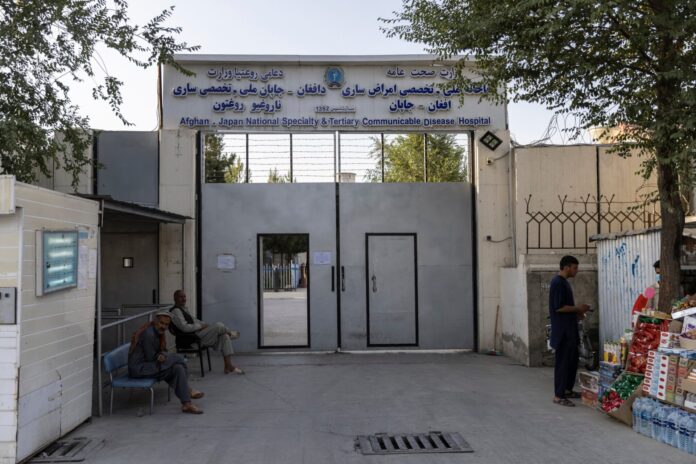
WHO raises alarm over Afghanistan health system

Afghanistan’s health system is “on the brink of collapse” due to international funding cuts since the Taliban took over the country, the WHO official warned.

Nine of Afghanistan’s 37 COVID-19 hospitals have closed and “all aspects” of the country’s pandemic response have declined, including testing and vaccination, per a statement from WHO chief Tedros Adhanom Ghebreyesus following his visit to the capital, Kabul, where he met with Taliban leaders.

Measles outbreaks are spreading and the country’s polio eradication efforts are at risk due to the funding cuts, according to the report.

Afghanistan “faces an imminent humanitarian catastrophe”, Tedros warned.

“Cuts in donor support to the country’s largest health project, Sehatmandi, has left thousands of health facilities without funding for medical supplies and salaries for health staff,” said Tedros in a joint statement with Ahmed Al-Mandhari, the WHO’s regional director for the Eastern Mediterranean.

“Many of these facilities have now reduced operations or shut down, forcing health providers to make hard decisions on who to save and who to let die,” the statement noted, adding, “Only 17% of all Sehatmandi health facilities are now fully functional.”

A report from the UN’s World Food Program has found only 5% of households in Afghanistan have enough food to eat every day.

Martin Griffiths, the United Nations under secretary for emergency relief, has announced that he’s releasing $45 million from an emergency fund in an effort to help prevent Afghanistan’s health care system from collapsing.

Source: Axios

UN chief reiterates support for Iran nuclear deal, slams U.S. withdrawal

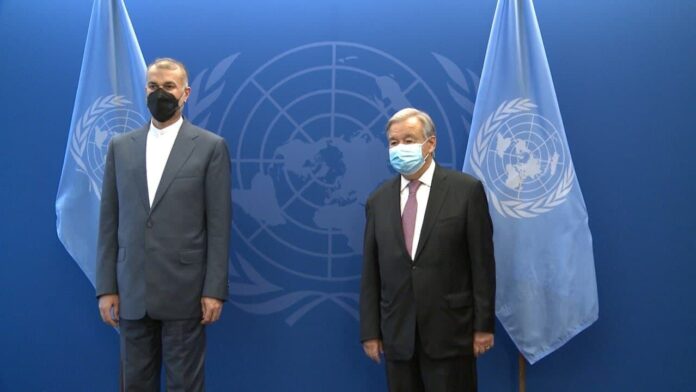
At the beginning of the meeting, which lasted more than 50 minutes, the UN Secretary General stated that he has been familiar with Iran for decades and has traveled to the country in different posts, saying the cooperation between the Islamic Republic of Iran and the United Nations is going well.

Referring to the UN’s principled stance in rejecting the US withdrawal from the Joint Comprehensive Plan of Action, Guterres said he always supported the nuclear deal.

The UN chief noted that consultations and cooperation between the United Nations and Iran on regional issues such as Yemen have always been ongoing, saying that the United Nations welcomes broader cooperation with the Islamic Republic.

Guterres called Iran’s position on Afghanistan a principled stance and said that he believes an inclusive government should be formed in Afghanistan so that all groups have a voice in the government. The UN chief also stressed the need to guarantee the rights of all groups, ethnicities and women in the future of Afghanistan.

Noting that the UN mission in Afghanistan has become much more serious, he clarified that Iran is a close partner in cooperation with the UN on all these issues.

Later in the meeting, Amirabdollahian stated that the relations between Iran and the United Nations, especially its secretary generals, have always been close and respectful, and thanked Guterres for his constructive vision and efforts for the world peace.

Amirabdollahian noted that the Islamic Republic of Iran supports the initiatives of the United Nations and welcomes the impartial and fair stances of the world body.

Stressing the need for the United Nations to play a serious and constructive role in the region, Amirabdollahian said: There is a need for a fair and responsible presence by United Nations everywhere, from Palestine to Syria, Yemen and Afghanistan.

Amirabdollahian added that after decades, the humanitarian situation in Palestine is still grave due to the actions of the occupiers and the crimes of the Zionist regime.

The final solution must be holding a referendum and a vote by the genuine residents of Palestine. Unfortunately, the United Nations has acted passively in the past, and I hope that will change in your tenure, Amirabdollahian told Guterres.

The Iranian foreign minister touched on the situation in Syria and noted that part of Syrian territory is under foreign occupation.

In the case of Yemen, this inhumane siege must end, he added.

The top Iranian diplomat noted that the United States uses sanctions against nations, uses terrorism against nations in order to advance its political goals, and the most obvious example of which was the cowardly assassination of general Soleimani.

In the end, the foreign minister stressed the need for a united voice by the UN against such brazen actions, stating: Of course, Iran is pursuing the case nationally and internationally to bring the perpetrators of the assassination of general Soleimani and his entourage to justice.

US envoy resigns over ‘inhumane’ deportation of Haitians

“I will not be associated with the United States inhumane, counterproductive decision to deport thousands of Haitian refugees and illegal immigrants to Haiti,” Foote wrote in a letter to Secretary of State Antony Blinken.

Foote went on to say that the U.S. approach to Haiti “remains deeply flawed” and added that his input has been marginalized “when not edited to project a narrative different from my own”.

Foote warned that the Haitian government “simply cannot support the forced infusion of thousands of returned migrants lacking food, shelter, and money without additional, avoidable human tragedy”.

“The collapsed state is unable to provide security or basic services, and more refugees will fuel further desperation and crime,” he wrote.

Haiti has reeled in recent months following the assassination of the country’s president, as well as the devastation wrought by a tropical storm and 7.2-magnitute earthquake.

Foote, a career member of the foreign service, had only been serving in the position as special envoy to Haiti since late July. His letter also made clear his distaste for the Biden administration’s friendly stance toward Haiti’s interim leader, Ariel Henry, who won a power struggle this summer in the aftermath of President Jovenel Moïse’s slaying.

“This cycle of international political interventions in Haiti has consistently produced catastrophic results,” Foote wrote, adding, “More negative impacts to Haiti will have calamitous consequences not only in Haiti, but in the U.S. and our neighbors in the hemisphere.”

White House press secretary Jen Psaki alluded to policy disagreements like those he mentioned but characterized them as part of the normal deliberative process.

“That’s certainly part of having discussions and having robust discussions about the best path forward for difficult circumstances,” she said before obliquely adding that “some of those proposals were harmful to our commitment to the promotion of democracy in Haiti.

She also took a swipe directly at Foote, saying that the special envoy had “ample opportunity to raise concerns about migration during his tenure”, but never did.

The deportation and treatment of Haitian migrants on Texas borders, which went viral after border agents were photographed on horseback rounding up travelers with reins, sparked a protest of more than 100 people in Miami and criticism in Congress.

Psaki noted Secretary of Homeland Security Alejandro Mayorkas decided that horses will no longer be used by border agents in Del Rio, Texas.

Federal officials have surged resources to the massive encampment in Del Rio and begun deporting many Haitians back home — infuriating Foote, humanitarian groups and a number of congressional Democrats.

Sources: PBS, POLITICO

Russia: Iran’s SCO membership ‘very useful decision’

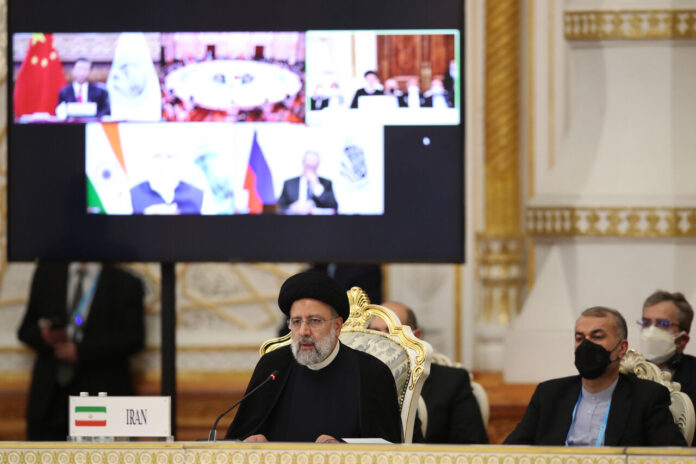
“In the light of the statements and pledges made by Iran’s previous leadership and the speech by Iran’s new president, Ebrahim Raisi, to the effect Iran was prepared to open and share with the SCO all of its potential capabilities there are very serious reasons to believe that it will be very useful. The SCO member-countries made the corresponding decision on the basis of thorough analysis of the entire combination of factors. In this sense we see eye to eye with our partners,” Russia’s special presidential envoy for SCO affairs, Bekhtiyer Khakimov, told an online briefing on Thursday.

Khakimov stressed that Russia proceeded from “the prospects for Iran’s involvement in such activities as struggle against terrorism, drug trafficking, and the work for stability and security in the region and on a wider scale”.

“We proceed from the understanding that Iran is an active participant in the project One Belt-One Road, on the one hand, and North-South, on the other hand. Its well-developed transport infrastructure makes one hopeful that Iran will contribute tangibly to shaping a common transport space and to ensuring transport security,” Khakimov said.

“Iran is prepared to join the work for maintaining food security, too,” he added.

The Russian envoy called for bearing in mind Iran’s “geographic and geostrategic location, as well as its economic, political and other potentials”.

“From the standpoint of Russian politics we see Iran, just like Afghanistan, as part and parcel of the SCO space,” he said, adding, “And we regard Mongolia, which participates in the organization in the capacity of observer, as a natural part of this space as well.”

“Clearly, plugging in Turkmenistan in some way would surely help expand the SCO space,” Khakimov remarked.

On September 17, the Shanghai Cooperation Organization’s summit in Dushanbe signed a document heralding the beginning of Iran’s admission to the organization. Russian President Vladimir Putin stated at the summit Moscow welcomed the beginning of the procedure of Tehran’s admission to the SCO.

Source: TASS

Iran: Serious signs of thaw between Iran and Saudi Arabia

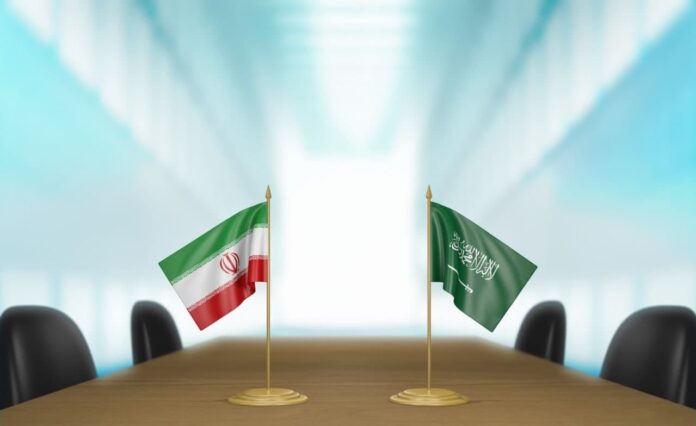
Iran Saudi Flags

Khatibzadeh said Tehran and Riyadh have held regular negotiations over bilateral ties and issues of mutual interest over the past month, describing the talks as positive.

Khatibzadeh added that the negotiations with the Saudis never stopped and messages are being exchanged at a proper level after the inauguration of President Raeisi’s administration in Tehran.

Saudi Arabia’s King Salman expressed hope Wednesday that the kingdom’s direct talks with Iran will lead to confidence building as the two countries take small steps toward dialogue following several years of heightened tensions.

King Salman made the remarks in a pre-recorded speech delivered to leaders who gathered for the U.N. General Assembly in New York.

He said Iran is a neighbor of Saudi Arabia and that the kingdom hopes talks between the two nations can lead to tangible results that pave the way for achieving the aspirations of the region’s people.

Iran and Saudi Arabia have been divided over a range of issues in recent years including the Saudi war on Yemen and its support of the Bahraini regime crackdown on its people.

Saudi Arabia accuses Iran of meddling in the kingdom’s internal affairs.

Iran also says the Saudis helped militant groups that fought decade-long war to bring down the Syrian government but to no avail.

US commander: Russia primary ‘military threat’

Speaking to Air Force Magazine, Glen VanHerck said that China and Russia are “equals” in the field of cyber, but Moscow still has the upper hand when it comes to physical warfare.

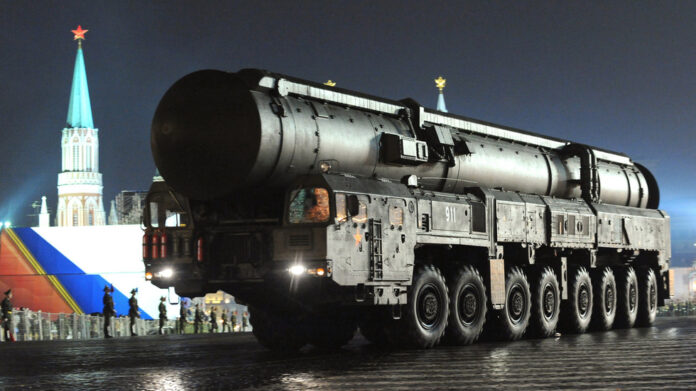
“From a kinetic standpoint – submarines, bombers, cruise missiles, those kinds of capabilities – Russia is the primary military threat,” VanHerck added, noting, however, that China is the “long-term existential threat”.

The American commander also warned that Russia and China would both be able to target the US from space in the near future, calling for America to improve its defensive capabilities against these forms of attack.

For some time, VanHerck has been pushing against the line that China is a more significant threat than Russia, despite the prevailing narrative in the US that a new Cold War with Beijing may be on the cards.

Earlier this year, the military man pointed to Moscow’s array of hi-tech submarines and missiles as another reason for concern.

“They’ve developed capabilities that didn’t exist 20 years ago,” he said, according to the USNI, an American forum focused on naval power.

“[Russia has] very low radar cross-section cruise missiles [and] submarines on par with our submarines,” he added.

China urges lifting of sanctions against Afghanistan

Beijing on Thursday called for the lifting of sanctions against the Taliban-administered Afghanistan and urged the US not to use the frozen foreign exchange reserves of the war-torn country as a “bargaining chip” to exert political pressure on the hardline group.

Addressing the G20 Foreign Ministers via a video link, Chinese Foreign Minister Wang Yi also demanded the rushing of humanitarian assistance to Afghanistan without any delay.

“Humanitarian assistance is a task which brooks no delay. We should redouble efforts on and speed up the provision of assistance to Afghanistan, and in particular, lend the Afghan people a helping hand in time to address their most urgent needs,” a foreign ministry statement quoted Wang as saying.

He highlighted China’s decision to provide 200-million-yuan ($31 million) aid, which included three million vaccines.

Wang also asked the US to release frozen foreign reserves of Afghanistan’s central bank.

According to reports from Washington, the US has frozen about $9.5 billion in assets belonging to Afghanistan’s central bank and stopped shipments of cash to Kabul, in a bid to keep the Taliban government from accessing the money.

“The economic sanctions must be stopped. All kinds of unilateral sanctions or restrictions on Afghanistan should be lifted,” Wang asserted.

“Afghanistan’s foreign exchange reserves are its national assets, and should be owned by and used for the people, rather than being used as a bargaining chip to exert political pressure on Afghanistan,” he stated, adding that G20 members should actively take practical steps to help Afghanistan ease the current liquidity stress.

International financial institutions should also provide financing support for poverty reduction, sustainable development, livelihood and infrastructure projects in Afghanistan, he continued.

After the Taliban’s seizure of power in Afghanistan last month, the International Monetary Fund and the World Bank halted their aid to the war-torn country which largely depends upon the flow of foreign funds.

According to reports from Kabul, Afghanistan’s economy is near collapse even as the United Nations has made hectic efforts to galvanise global efforts to rush food and essential supplies.

The Taliban, whose interim government is yet to be recognised, have earlier asked the US to release its frozen foreign exchange reserves and threatened to take legal action.

“Both the symptoms and root causes of the refugee issue must be addressed. The United States and the North Atlantic Treaty Organization (NATO) countries should take the primary responsibility for solving the issue of Afghan refugees and migrants,” he noted.

Wang also spoke about China, Pakistan and Russia’s initiatives to step up contacts with the Taliban.

The special envoys of the three countries held talks with top Taliban officials in Kabul as well as former Afghanistan President Hamid Karzai and Abdullah Abdullah, President of the Council for National Reconciliation under the previous government, during the past two days.

“First Foreign Ministers’ Meeting on the Afghan Issue among the Neighbouring Countries of Afghanistan and the Informal Meeting of Foreign Ministers of China, Russia, Pakistan and Iran on the Afghan Issue reached a consensus, sending a clear signal of creating a favourable external environment for the peaceful reconstruction of Afghanistan,” Wang said.

Also, the world community support the efforts of Afghanistan “eventually building a broad and inclusive political structure which respects the basic rights of minority groups, women and children, and pursues a foreign policy of peace advocating good neighbourliness with all countries, especially with neighbouring countries”, he added.

The counter-terrorism cooperation needs to be deepened, he added.

“Afghanistan must earnestly honour its commitments by making a clean break with and resolutely fighting all kinds of international terrorist forces,” Wang said.

He stated the international community should build a united front against terrorism, oppose double standards and selective counter-terrorism, and prevent Afghanistan from becoming a breeding ground and shelter for terrorism again.

“Afghanistan should make its administration more inclusive and predictable, and the international community should work in a down-to-earth manner to help Afghanistan accelerate reconstruction so as to fundamentally reduce the number of new refugees and migrants,” he continued.

Source: NDTV

Iran ready to reconstruct liberated Azeri areas

Hossein Amirabdollahian called the reconstruction of the liberated areas a ground for extensive cooperation between the two countries.

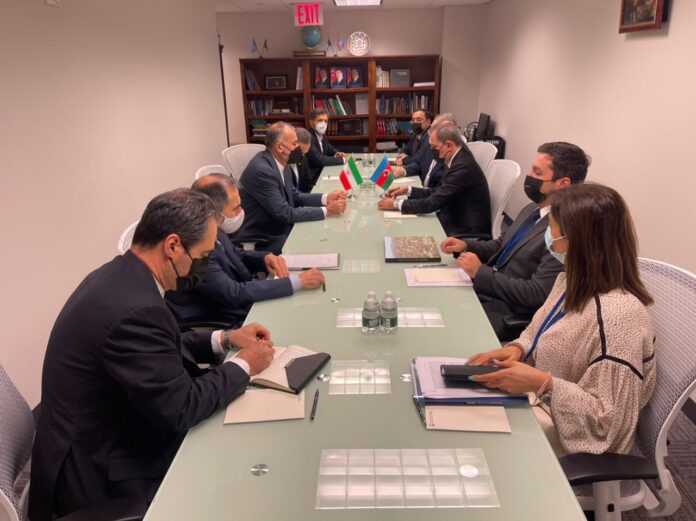
The Iranian Foreign Minister continued his Thursday meetings on the sidelines of the UN General Assembly and discussed bilateral relations with Jeyhun Bayramov, the foreign minister of Azerbaijan Republic.

At the beginning of the meeting, the Azeri foreign minister welcomed the holding of a three-way meeting between Iran, Turkey and the Republic of Azerbaijan in Tehran.

Bayramov described the relations between the two countries as having very positive dynamics and going in the right direction. He also thanked Iran for its support for the territorial integrity of the Republic of Azerbaijan. Emphasizing his country’s readiness to cooperate with the Islamic Republic of Iran in all fields, including political, economic, trade and cultural spheres, the Azeri foreign minister said that on behalf of the Republic of Azerbaijan, Shahin Mustafayev is ready to contact his Iranian counterpart within the two countries’ joint commission. He also said the Azerbaijan Republic is ready to pursue joint projects in the Caspian Sea with Iran, calling for regular interactions and consultations at various levels.

The Iranian foreign minister also said relations between Iran and the Republic of Azerbaijan are highly important and expressed hope that the previous agreements would be implemented. Amirabdollahian noted that the new Iranian government has given special priority to relations with neighbors.

Amirabdollahian said the two countries supported each other in international and regional forums and stressed the need to maintain this spirit. He also called the commonalities of the two countries deep and diverse and reminded that the Islamic Republic of Iran has always supported the territorial integrity of the Republic of Azerbaijan.

The Iranian foreign minister also noted that important projects and cooperation in various fields such as electricity, gas, dam construction, trade and transit, including the Astara railway terminal and cooperation between the private and public sectors of Iran and Azerbaijan Republic have been defined and will be pursued by the two sides.

He also stressed that some third parties should not be allowed to affect the good relations between the two countries.

The foreign minister further discussed with his Azerbaijani counterpart the facilitation of transit and traffic of Iranian trucks, as well as some consular issues, including two Iranian drivers detained by the Azerbaijani police. The two top diplomats agreed to resolve this issue through contacts between the two sides.

Iran FM: Sanctions a terrorism tool, UNGA must stand against US unilateralism

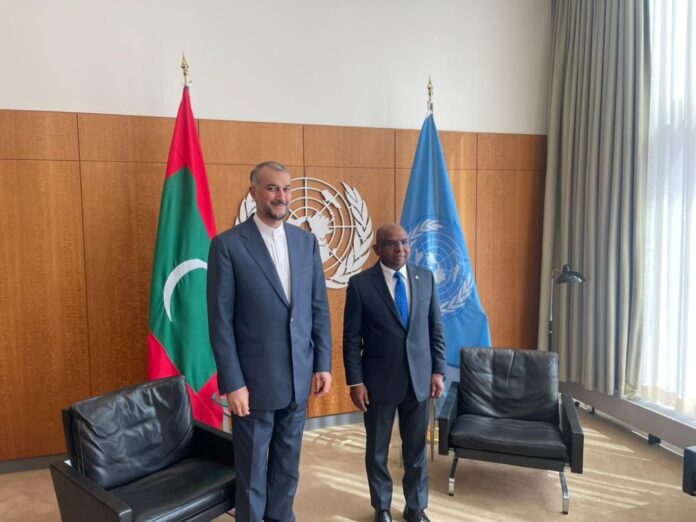
The meeting between Hoseein Amirabdollahian and Abdulla Shahid took place on Thursday on the fringes of the assembly’s 76th session in New York.

Amirabdollahian congratulated Shahid on his appointment as the president of the UN General Assembly and invited him to visit Tehran.

Referring to the importance of the role of the United Nations, the Iranian foreign minister emphasized the support of the Islamic Republic for UN missions and the mission of the president of the General Assembly, and wished him success in his tasks, including the fight against terrorism.

Noting that terrorism is today plaguing the world, Amirabdollahian said the assassination of General Qassem Soleimani, the great general of peace, by the United States on Iraqi soil is one of the most blatant manifestations of this terrorism.

Abdollahian said a legal and international committee has been set up inside Iran to follow up on the assassination with the aim of bringing the perpetrators of this assassination to justice, but the United Nations certainly has an important role to play in this regard.

During the meeting, the top Iranian diplomat touched on the constructive role of the Islamic Republic of Iran in cooperating with the regional governments in the fight against terrorism, from Lebanon to Iraq and Afghanistan.

He expressed regret that the United States, despite its slogans, has linked economic terrorism to health and medicine terrorism, and stressed the need for a serious response from the international community to this approach.

The president of the UN General Assembly also congratulated Amirabdollahian’s appointment as foreign minister and described as unforgettable his visit to Tehran to attend the summit of the Organization of Islamic Cooperation in 1996.

Shahid described the multilateral system as the only path and choice for the international community, saying that the coronavirus pandemic showed how interconnected countries are and that no one will be safe until everyone is safe.

Shahid called the United Nations and its General Assembly the best mechanism ever developed in the field of multilateralism. He also stressed that the General Assembly is making every effort to be successful in fulfilling its missions.