Friday, January 2, 2026
Home Blog Page 2143

NIOC: Iran has regained part of oil market share

Iran to Publicly Sell Shares of Four State-Owned Oil Refineries

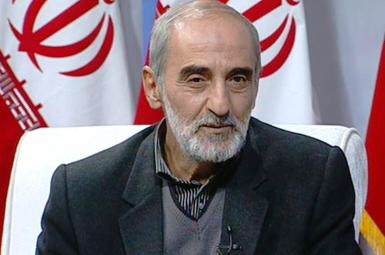
However, the CEO of the National Iranian Oil Company refused to provide any figures, saying, “I only can say that the sale of oil and gas condensates has grown very well compared to the previous administration.”

Khojasteh Mehr spoke about how Iran neutralizes oil sanctions, saying Iran does not believe that there are only a few countries on earth, so there are other ways to communicate with the world.

He added, “If we succeed and follow exactly the rules and mechanisms of the international market, we can lift the sanctions and sell our oil”.

Managing editor of Iranian paper convicted

“The managing editor of the Kayhan daily (Hossein Shariatmadari) appeared in court after Head of the Society of Students against Poverty Sharmin Meimandinejad filed a lawsuit against him,” the khabaronline website quoted Kayhan as saying.

“In court, Meimandinejad defended himself by presenting dozens of written documents taken from the website and written papers of the society itself,” Kayhan added.

“But much to everyone’s amazement, it was announced yesterday that the court had convicted Hossein Shariatmadari, the managing editor of Kayhan, of insulting the mentioned society as well as its director Sharmin Meimandinejad,” Kayhan added.

“The so-called Society of Students against Poverty was closed down and its director Sharmin Meimandinejad arrested for the promotion of corruption, deceiving the youth, and insulting Islam, the Establishment, dignitaries and esteemed martyrs of the Revolution,” Kayhan wrote.
“Meimandinejad is now free on bail,” it added.

“The shutting down of the society and the detention of its manger was due to these very offenses that Shariatmadari had also mentioned in court,” said kayhan.

“This begs the simple question, and that is, if what Kayhan wrote about this society and the relevant documents presented to the court were not true, then why was the society closed and its director arrested?” said the newspaper.

“And if those documents were true – which indeed were – why was the managing editor of Kayhan found guilty on the basis of the same documents?” Kayhan said.

“Isn’t this a double standard?” asked the website newspaper.

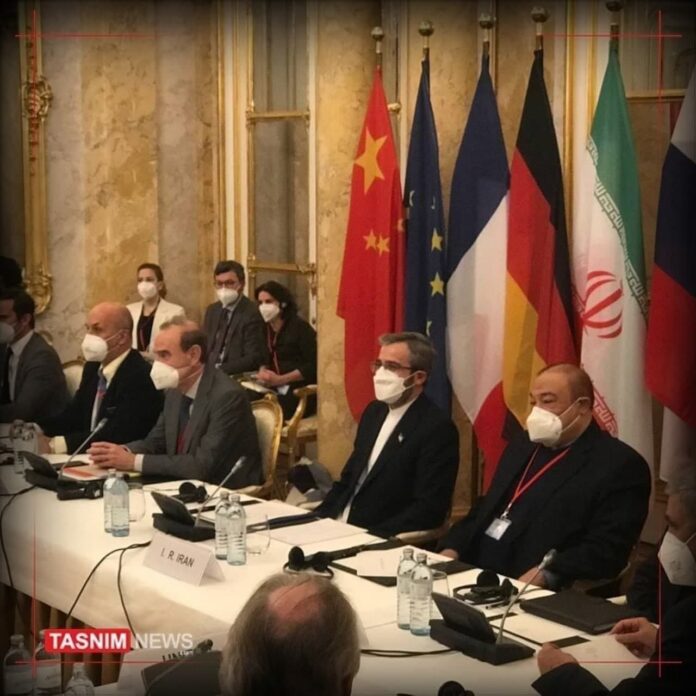
Iran rejects report about temporary deal in Vienna

Tasnim News Agency quoted the source as describing the report by the Arabic langujage newspaper al-Rai al-Youm as totally wrong and fabricated.

The newspaper claimed that under the purported deal Iran agreed to transfer its enriched uranium stockpile to Russia.

Iran has repeatedly said it will not accept a temporary deal. It also says any deal must result in the removal of all sanctions against the country.

Tehran and the P4+1 group – Russia, China, France, Britain and Germany, have been engaged in talks in Vienna in a bid to revive the 2015 nuclear deal that plunged into disarray after the US’s unilateral withdrawal in 2018.

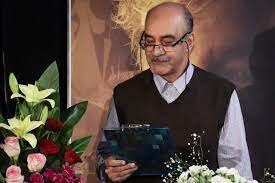
Iranian director Hamid Labkhandeh passes away

“He had an operation some time ago and unfortunately the surgery caused adverse effects and Embolus and he passed away at 6 PM on Saturday,” his son said.

Labkhandeh was born in 1951 in the southern city of Ahwaz and was introduced to theater when just 15. He then studied directing and acting at the Faculty of Fine Arts of the University of Tehran.

Labkhandeh shot to fame after he directed the TV series “Dar Panah-e To” – Under Your Protection – in the 1990’s. He went on to direct another highly popular TV series, “Dar Ghalb-e Man” – In My Heart – before he directed his sole movie for cinema, “Abi” – Blue – in 2000.

Over the past years, he was mainly focused on managing Samandarian Academy, after his long-time teacher and mentor Hamid Samandarian passed away.

Labkhandeh is also remembered by his theatrical production, Misunderstanding, and TV series “Mehr o Mah” – Moon and Love – and Stay With Me.

Palestine new envoy to Iran appointed

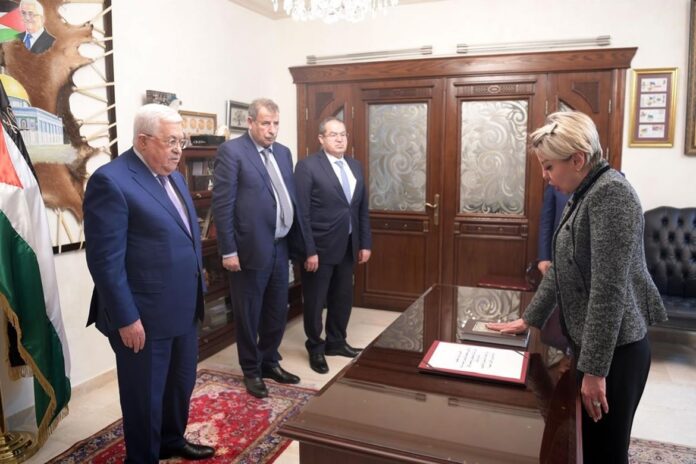
President’s Adviser for Diplomatic Affairs Majdi Al-Khalidi and Director General of the Palestinian National Fund, Minister Ramzi Khoury, were present at the swearing-in event, which took place at the President’s residence in the Jordanian capital, Amman.

Salam is daughter of Salah Al-Zawawi, the former Palestinian ambassador to Tehran.

Al-Zawawi is one of the founding members of the Fatah movement and was the second Palestinian ambassador to Tehran since the 1979 Islamic Revolution. He had served as the Palestinian ambassador to Algeria, Brazil, and Kenya before being appointed to Iran in 1980.

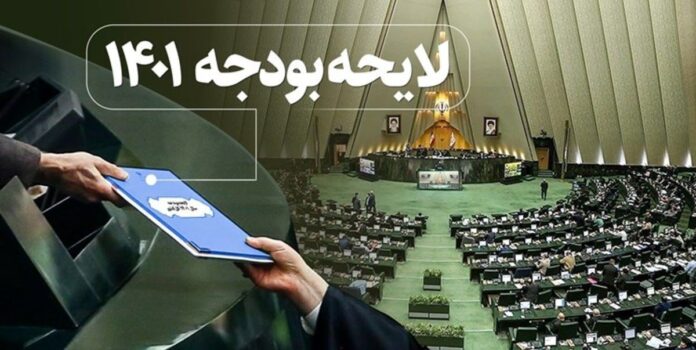
Iran parliament approves generalities of next year’s budget bill

According the parliamentary procedure, the 864-billion-dollar budget bill (with the official rate of 42,000 rilas each dollar) is submitted to a cross-committee commission for expert work on its details.

The commission has a 15-day window to examine the details of the bill. Meanwhile, lawmakers have a 10-day window to present their possible proposals for any change in the budget bill to the experts committees.

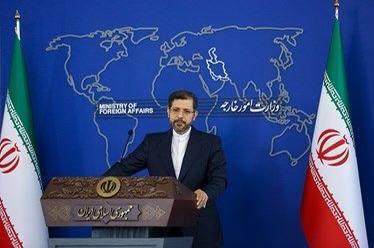
Iran foreign ministry dismisses report on Afghan embassy operations

Earlier, Iranian news website Asr Iran reported that the Iranian government has decided to hand over Afghanistan’s embassy in Tehran to the Taliban without recognizing the Taliban government.

“Diplomatic operations of the Afghan embassy in Tehran, just like all other foreign embassies, fall within the framework of the principles and regulations defined in the 1961 Vienna convention on diplomatic relations, and no change in them is possible,” Khatibzadeh said in a statement.

Asr Iran also claimed that the ambassador of former Afghan government to Tehran has already left Iran for a European country.

The foreign minister of the provisional government of the Taliban is now in Tehran for meetings with Iranian officials, which are focused on economic relations between Iran and Afghanistan.

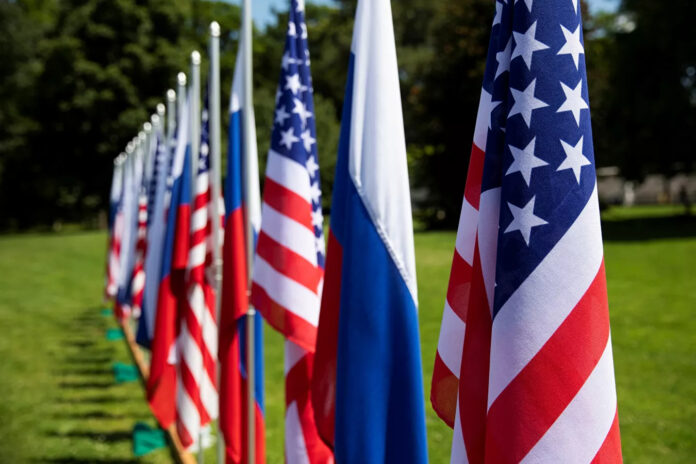
Russia says not optimistic about talks with US

“We will, of course, make no concessions under the constant pressure and threats coming from the Western side of the upcoming negotiations,” Ryabkov told Sputnik.

He noted concessions under duress were “entirely impossible”, stating that “this would mean going against our own interests, our security interests”.

The diplomat stressed that Moscow is “very disappointed” by signals from Washington and Brussels ahead of the meeting on the security guarantees proposed by Russia last month.

“In a nutshell, they reflect a lack of understanding of what we need. And we need legal guarantees, legal guarantees that NATO will not expand further; elimination of everything that the alliance has created driven by anti-Russian phobias and all sorts of misconceptions about the essence of Russian policy since 1997,” Ryabkov explained.

The deputy foreign minister lamented the fact that the United States is continuing to insist that Moscow make unilateral concessions, and said that Russia is not optimistic about the forthcoming talks.

The unilateral approach promoted by the US and NATO cannot serve as a basis for the discussion on security guarantees, Ryabkov added.

He stressed that Moscow’s main goal in Geneva is to discuss the non-expansion of NATO and the non-deployment of offensive weapons near Russia’s borders.

“Unfortunately, we have been hearing all kinds of speculations about what Russia must do and what steps it must take. We have repeatedly reacted to such statements – at all levels – and there can be no basis for any agreement, let alone a productive discussion,” the official stated.

The security guarantee talks will be held in three formats: between Russia and the US in Geneva on 10 January, followed by a Russia-NATO Council meeting on 12 January, and Russia-OSCE consultations on 13 January. Ryabkov will face off with US Deputy Secretary of State Wendy Sherman in Geneva to discuss Russia’s security proposals for the US and NATO. Moscow wants legally-binding guarantees from the military alliance that it will not expand eastward.

In the lead-up to the security talks in Geneva, US Secretary of State Antony Blinken noted the US and Germany believe Russia’s actions in Eastern Europe pose “an immediate challenge” to stability in the region.

At the same time, Blinken claimed that the US remained ready to resolve the issues via diplomacy, stressing that if Russia is serious about de-escalating tensions, the United States could take steps to build greater confidence and address the issues, even though some of them will take time.

NATO Secretary General Jens Stoltenberg also asserted that the alliance will not compromise during the talks with Russia on its basic principle that any country may choose its own defence alliances.

In mid-December, the Russian Foreign Ministry laid out two comprehensive drafts of agreements on security guarantees between Russia, the United States, and NATO.

In these proposals, Russia suggests that the US commit to not setting up military bases in former Soviet republics that are not NATO members and refrain from expanding the alliance further to the east.

“The Parties shall refrain from deploying their armed forces and armaments, including in the framework of international organisations, military alliances or coalitions, in areas where such deployment could be perceived by the other Party as a threat to national security, with the exception of such deployment within the national territories of the Parties,” the document says.

The proposals also stipulate the creation of “hotlines” for emergency contacts between the parties, among others.


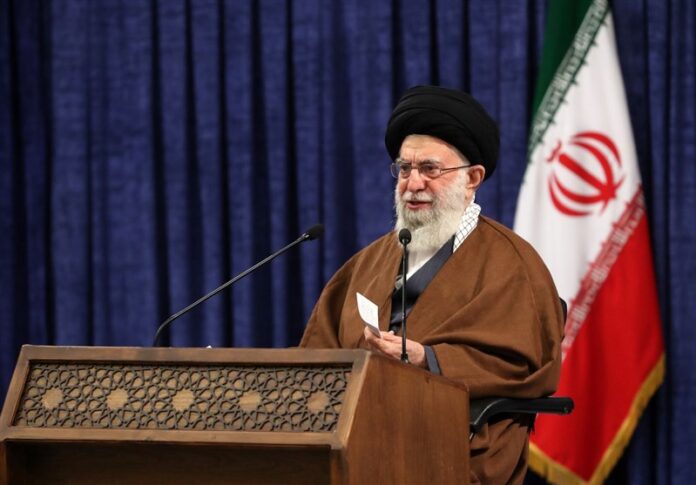
Iran Leader: We might sit down with enemies, but won’t submit to bullying

Ayatollah Seyyed Ali Khamenei said “Sometimes we sit down for talks with the enemy and engage with it.
This is another matter. But we should not submit to the enemy’s bullying, as we haven’t so far, and we won’t, either, from now on,” he said.

Ayatollah Khamenei also said the US assassination of Lieutenant General Qassem Soleimani only further strengthened the movement that he had set in motion.

The Leader said Washington was under the delusion that the martyrdom of General Soleimani would stop his struggles.

However, the he added, the US later found out that it had made a miscalculation as the slaying of the top commander only further promoted his campaign.

Elsewhere in his remarks, Ayatollah Khamenei added Washington’s profound animosity toward the Islamic Republic of Iran emanates from the religious nature of the country’s Establishment.

He said tyrants have always been opposed to movements and establishments with a religious foundation.

“The country’s independence, fighting corruption and tackling injustice are among the principles of the Revolution,” the Leader underlined.

“This is part of the country’s soft, extensive and diversified war,” he said.

The Leader made the comments on the anniversary of the January 9, 1978 uprising in Iran against the dictatorial rule of the then Iranian monarch, the Shah.

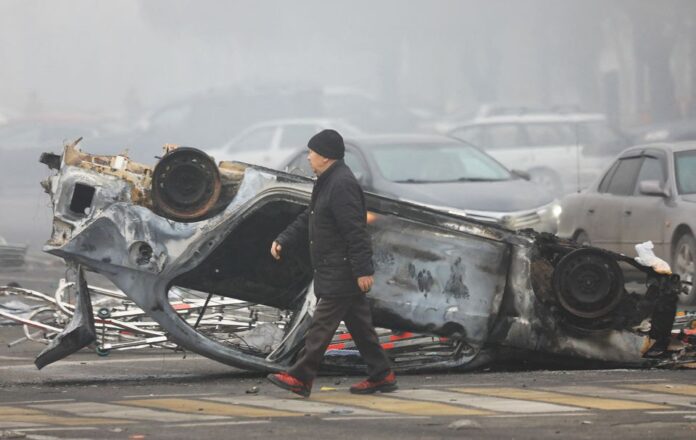
Kazakh government says situation ‘stabilized’ following unrest

“The anti-terrorist operation to restore law and order in the country continues,” he stated.

“As of today, the situation has been stabilized in all regions of the country,” the report said, adding that law enforcement officers have retaken the earlier seized buildings of local administrations.

“The work of communal facilities and vital services is being restored,” Turgumbayev noted.

Law enforcement agencies of Kazakhstan have detained over 5,100 people who took part in the riots in several regions of the country, the press service of the republic’s Interior Ministry reported on Sunday.

“By this time, 5,135 people have been detained throughout Kazakhstan,” the press service added.

According to the ministry, 125 pre-trial investigations have been launched into murders, violence against government officials, robberies, hooliganism and thefts.

As Turgumbayev told the Khabar 24 TV channel, during the riots, more than 400 vehicles were damaged and destroyed, including 346 police vehicles. The looters have plundered more than 100 large trade facilities and banks.

Protests erupted in several Kazakh cities on January 2, escalating into mass riots with government buildings getting ransacked in several cities a few days later. The ensuing violence left scores of people injured, with fatalities also being reported. Subsequently, Kazakh President Kassym-Jomart Tokayev turned to the Collective Security Treaty Organization (CSTO) requesting assistance from the Russia-led bloc. As a result, peacekeepers have already been deployed to Kazakhstan. Law and order, Kazakh authorities affirm, was restored to all of the country’s regions by the morning of January 7. However, the situation remains tense in Almaty. Tokayev declared January 10 as the day of national mourning in the republic.