Friday, December 26, 2025
Home Blog Page 2102

U.S. says major issues in nuclear talks remain unresolved

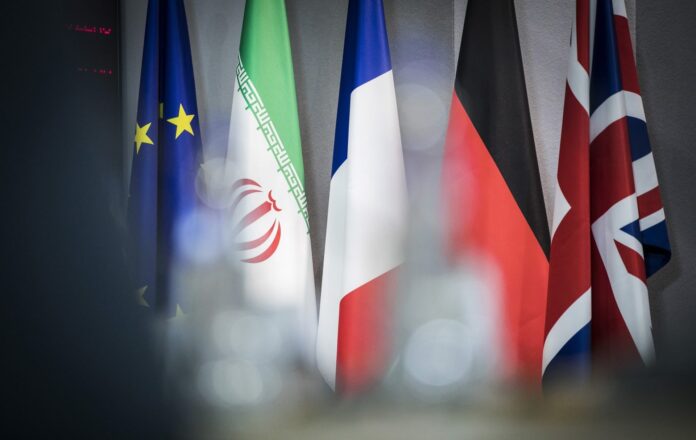
Talks between Tehran and world powers over revitalizing the Iran nuclear agreement have reached their final stage and are expected to conclude one way or the other by the end of this month, according to participants.

“I don’t know if it’s one, two or three weeks,” European Union foreign policy chief Josep Borrell said this week during a visit to Washington. But the latest round of meetings in Vienna, he added, are “certainly the last steps.”

The Joe Biden administration has announced that only a “handful” of weeks remain before ongoing advances in Iran’s nuclear program will make agreement impossible.

Iran, Russia and China have pushed back on the need to establish a fixed deadline for the nuclear negotiations to conclude. Iranian officials have rejected western diplomats’ remarks about a deadline for reaching an agreement in Vienna talks, and stressed Tehran is only after a good agreement.

While there is general agreement that negotiations are reaching an end state, opinions differ widely on the likely outcome.

A senior U.S. official noted that major issues on the table remain unresolved.

Negotiations are both “closer than we have been to a deal,” in that some progress has been made, and “closer than we have been to breakdown,” as time for agreement runs out, the official added.

“Both outcomes are still very possible,” said the official, speaking on the condition of anonymity to comment on the sensitive diplomacy.

But “based on where we are, it is more likely than not that we don’t succeed,” the official stated.

In 2018, the U.S., under President Donald Trump, pulled out of the pact and reinstated sanctions under the so-called ‘maximum pressure campaign’ against Tehran, effectively depriving Iran of the deal’s benefits by forcing third parties to stop doing business with Iran.

Iran remained patient for an entire year, after which it began to take incremental steps away from its nuclear obligations, especially after Europeans failed to salvage the deal under the U.S. pressure.

“So far, we haven’t heard from Iran positions we believe are consistent” with full compliance, the U.S. official claimed.

“They are still making demands that go beyond [U.S. positions] on the sanctions side and not reaching what we believe we need to reach on the nuclear side,” the official continued.

“There is no reason to be overly optimistic about the outcome,” the official said, adding, “We haven’t been able to bridge the gaps.”

Intensive talks are underway in Austria, with the western side still failing to put forward any meaningful initiative to speed up the process aimed at revitalizing the embattled agreement.

Although the U.S. is blamed by all sides as the party behind the crisis, the western side has been attempting to put the ball in Iran’s court.

Iran insists that the talks must lead to the removal of all American sanctions that were imposed against Tehran following Washington’s unilateral withdrawal from the landmark agreement in May 2018. Tehran has also demanded credible guarantees that Washington will not abandon the deal again.

On Thursday, Iranian Foreign Minister Hossein Amir Abdollahian said that “today in Vienna, the United States and the western parties are faced with a litmus test in which they must show their real behavior to the world.”

“The termination of the negotiations will be determined by the western side’s resolve to remain fully committed to the removal of sanctions and return of all sides” to full compliance “with their commitments,” he added.

President Ebrahim Raisi has also stressed that the Biden administration was no different from its predecessor in its policies and actions.
As Vienna talks continue, EU calls for full implementation of JCPOA

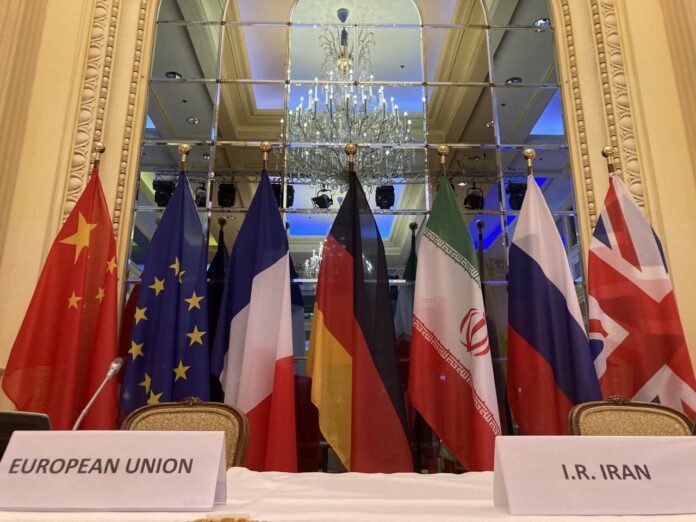
The meeting is taking place in Vienna’s Coburg Hotel.

Meanwhile, the European Union has underlined the need for the full implementation the JCPOA. “Given the importance of time, intensive consultations continue and our goal is to ensure the full implementation of all aspects of the JCPOA,” wrote Stephen Clement, EU Ambassador and Permanent Representative to the Vienna-based International Organizations.

He chaired the meeting of the nuclear measures action group.

Earlier, Russia’s top negotiator Mikhail Ulyanov said on Twitter intensive work is being done on the nuclear deal in Vienna.

The eighth round of talks between Iran and the P4+1 began on December 27, 2021. Nearly all sides agree that the talks have made headway despite complexities.

The US and its European allies, namely, Britain, France and Germany say time is running out for a deal but Iran insists that it will negotiate as long as needed to reach a good deal with the other parties which will realize its interests.

The talks aim to pave the way for the return of the US to the deal. Iran says it will also return to full compliance with the JCPOA once all sides stick by their parts of the agreement.

‘Iran wants guarantees next US govt. won’t re-impose bans’

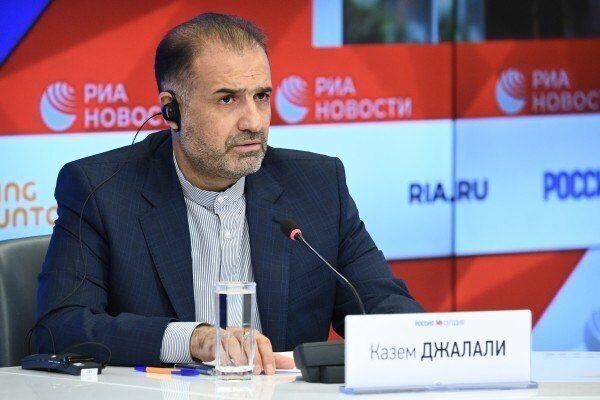
Addressing a presser in the Russian capital on Friday, Kazem Jalali said, “We tell the West that the sanctions you have put in place are tough, violate the Iranian nation’s rights, and must be fully terminated.”

The envoy said if the Western sides move toward the removal of the US sanctions in the course of the talks underway in the Austrian capital aimed at restoring the 2015 nuclear deal, “the negotiations will be fruitful and effective.”

“In the course of the efforts to revitalize the JCPOA, Iran seeks guarantees that no new sanctions will be imposed on Tehran in case of an administration change in the US,” Jalali said, using an acronym for the official name of the deal, the Joint Comprehensive Plan of Action.

He called for the removal of the “cruel” unilateral sanctions and said the “ball is now in the court of the West and America.”

The ambassador criticized the West for admitting Tehran’s right to use peaceful nuclear energy but trying, in practice, to prevent Iran from treading that path.

“We view negotiations as the most suitable way, but [we don’t want] negotiations for the sake of negotiations. We seek results,” he added.

U.S. says to help UAE refill missile defense interceptors

“We will help with replenishment of interceptors. And we’ll do everything we can to assist UAE in defending themselves,” General Frank McKenzie, head of U.S. Central Command, told Reuters after a trip to Abu Dhabi earlier this week.

McKenzie did not offer further specifics.

The UAE has privately requested U.S. replenishment of missile defense interceptors, including for its THAAD and Patriot system, a source familiar with the matter said, speaking on condition of anonymity.

The latest U.S. move would be in addition to the Pentagon’s announcement last week of a deployment of a guided missile destroyer and advanced U.S. F-22 fighter jets to the UAE. It would also stick closely to defensive support, amid stiff opposition to the war in Yemen among many lawmakers in Congress due to civilian deaths.

McKenzie, who has also expressed concern about Houthi attacks against ally Saudi Arabia, acknowledged that the United States has been grappling with significant limits on U.S. surveillance capability over Yemen, noting its size.

“We’re very limited in ISR over Yemen. It’s hard to see into Yemen,” McKenzie stated, using an acronym for military intelligence, surveillance and reconnaissance capabilities, which include drones.

“It’s a large country, and you have to make decisions on priorities,” he added.

Experts say it can be difficult to help allies detect and destroy Houthi launch sites without adequate ISR, particularly when dealing with mobile missile launchers.

Aware of their value, Houthis target U.S. drones. The Houthis have shot down two U.S.-operated drones since McKenzie took command in March 2019 and far more drones operated by regional allies.

With tensions simmering around the world, from North Korea to Ukraine, the Pentagon has to deal with competing priorities for ISR resources, which also include satellite imagery.

“I communicate with partners where we are with Yemen. I communicate with our (U.S. defense) secretary all the time about the resources that we need,” McKenzie said, without identifying any specific request.

“So it’s an informed dialogue that goes on within the department of defense,” he added.

McKenzie declined to speculate whether the Pentagon might dedicate additional ISR to Yemen, noting, “Anything is possible.”

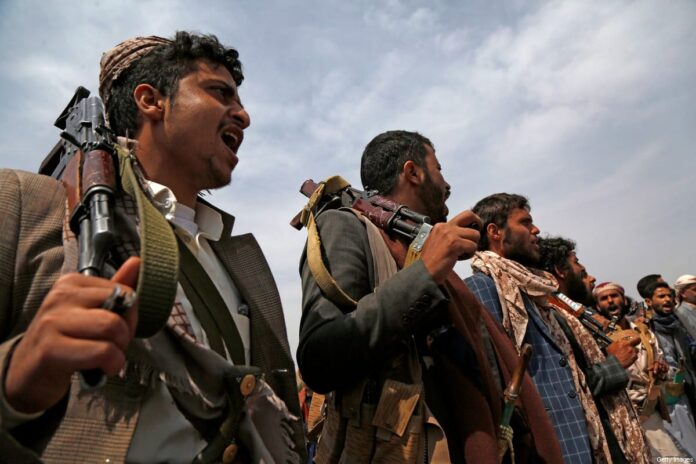
The Houthis have recently begun directly targeting the UAE, a key ally of Saudi Arabia in the region, while intensifying their attacks against the kingdom.

On Thursday, US National Security Adviser Jake Sullivan condemned a Houthi drone attack on the Saudi city of Abha that injured 12 people.

Without referring to the crimes of the Saudi-UAE coalition on Yemeni civilians, Sullivan described it as a “terrorist attack” and vowed to work with allies to hold the Yemeni rebels “accountable”.

“America will have the backs of our friends in the region,” Sullivan said in a statement.

Pentagon Spokesperson John Kirby also told Al Jazeera on Thursday that Washington is in “constant communication” with Persian Gulf partners to ensure their defensive needs are met.
Kirby accused Iran of providing weapons and training to the Houthis.

Iran has repeatedly dismissed allegations about supplying weapons to Yemeni forces.

“Medicine and medical goods are sent to Yemenis with difficulty; then how could military equipment go through and sent to them?” an Iranian foreign ministry spokesperson had asked.

The spokesman noted that the Yemeni nation has made astonishing progress in the military field and manufacturing weapons and military equipment after facing the Saudi-led aggression.

President Joe Biden had delivered a similar message to Saudi Arabia’s King Salman bin Abdulaziz Al Saud during a phone call on Wednesday, according to the White House.

Saudi Arabia and its allies launched a war against the Arab world’s most impoverished nation in March 2015. The war has been seeking to restore power in Yemen to Riyadh’s favorite officials.

The death toll of the war, now in its seventh year, will reach an estimated 377,000 by the end of 2021, according to a recent report from the UN’s Development Programme.

The fighting has seen some 80 percent of the population, or 24 million people, relying on aid and assistance, including 14.3 million who are in acute need.

The war has enjoyed nearly uninterrupted American arms, logistical, and political support.

Iran Covid: 143 new deaths; vaccination continues

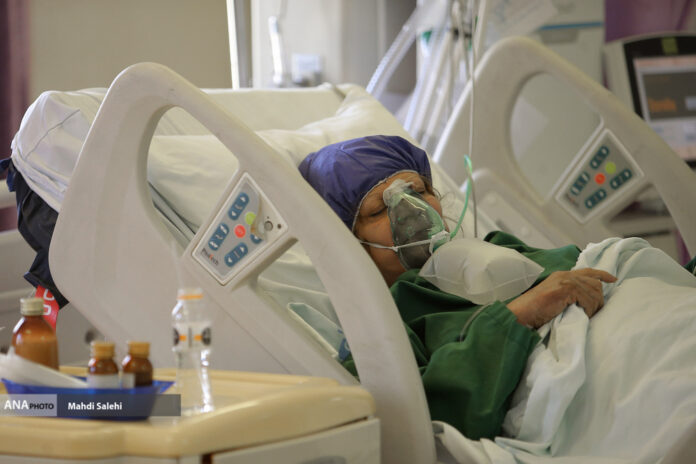
The deaths push to 133,437 the number of those killed by the Coronavirus in Iran since the pandemic engulfed the world.

According to the Health Ministry, 31,247 new infections from Covid were logged in the past day. They include 2,761 hospitalizations.

The dominant variant is now Omicron which first popped up in South Africa and then spread like wildfire across the world.

Now 120 Iranian cities are marked red, which means they face the highest level of danger from Covid. Many others are orange. There are only 8 blue cities across Iran. These are areas where people face the lowest level of threat from the virus.

With the number of new Covid cases rising, healthcare workers in Iran are busy inoculating people.

Over 13 million Iranians are now triple-vaxxed. Authorities are urging all citizens to get their third doses, also known as boosters. They say people may need to get a fourth dose of Covid vaccine as well in the future.

Taliban say committed to Helmand River Treaty

Zabihullah Mujahid said the Taliban, as rulers of Afghanistan, are ready to fully implement the 1972 Helmand River Treaty.

Under the treaty, Afghanistan is committed to sharing the water from the Helmand River with Iran and will supply 26 cubic meters of water per second, or 850 million cubic meters per annum.

A disagreement over the interpretation of a 1973 treaty between Iran and Afghanistan on water from the Helmand River has plagued relations between the two countries for decades.

Afghanistan started building a dam over the river in 1974, but war and related issues delayed completion until last year.

Raisi: Iran never pins hopes on US, Vienna talks

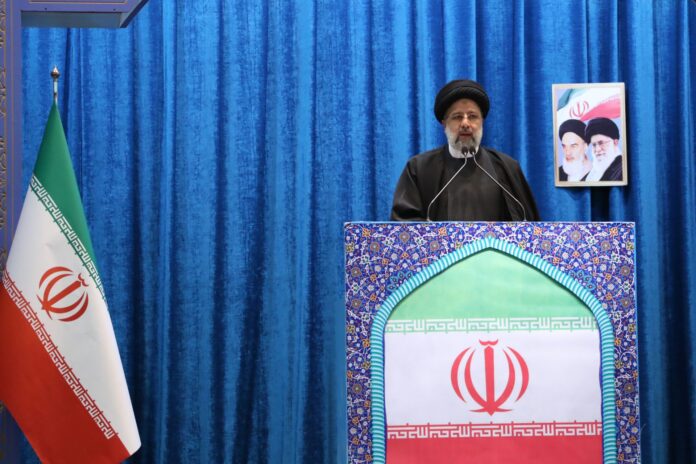
Raisi delivered a speech ahead of Friday prayers to mark the 43rd anniversary of the 1979 Islamic Revolution, as mass rallies were underway countrywide to celebrate the occasion.

He said the ‘Look to the West’ policy pursued by former administrations had “rendered the country unbalanced.”

“We should take note of all countries and the capacities existing in the neighbors. We have faith in God, in Khuzestan, Khorasan, Azarbaijan, and the country’s east, west, north and south,” he said. “We never pin hopes on Vienna and New York.”

His administration, he said, is becoming more and more hopeful of the future in the light of the numerous capabilities and capacities existing inside the country.

Raisi praised the Iranian nation for having stood firm by the mottos of the 1979 Islamic Revolution, unlike what happened in other revolutions and uprisings worldwide, where initial mottos and principles gradually faded into oblivion.

“In [the case of] the Islamic Republic, the slogans still live on. If ‘independence’ and ‘freedom’ were called for back then, those slogans continue to be emphasized to this day,” he said.

“We neither accept oppression, nor do we give up on our independence, nor do we accept to oppress anyone across the globe. These are among the principles of the Islamic Revolution, which are still in place.”

The president enumerated the unique characteristics of the Islamic Revolution rooted in the school of thought of Imam Khomeini, who led the uprising to victory and founded the Islamic Republic.

“Thank God, on the path to political independence, the Islamic Republic’s establishment has reached a point where everyone across the world sees the Islamic Republic of Iran as the most independent state on Earth,” he said.

“Everyone knows and acknowledges that Iran is the primary decider in the region, speaks its opinion independently at political and international bodies, and always stands on its own feet,” Raisi said.

The president stressed, however, that the country should work to develop a strong “economic independence” in harmony with its political self-determination.

“There is a long road ahead and all capacities are ready” to be employed to achieve that objective, he said.

“Having expectations from foreigners, who do nothing for us, has created some problems,” he said, expressing hope, however, that “great steps” will be taken by the administration, in cooperation with the nation, to realize Resistance Economy.

Raisi called on all Iranians to stand united behind the country and the Islamic establishment, as advised by Leader of the Islamic Revolution Ayatollah Seyyed Ali Khamenei, so that Iran can make further progress and grow stronger.

Poachers slaughtering more migratory birds in N Iran

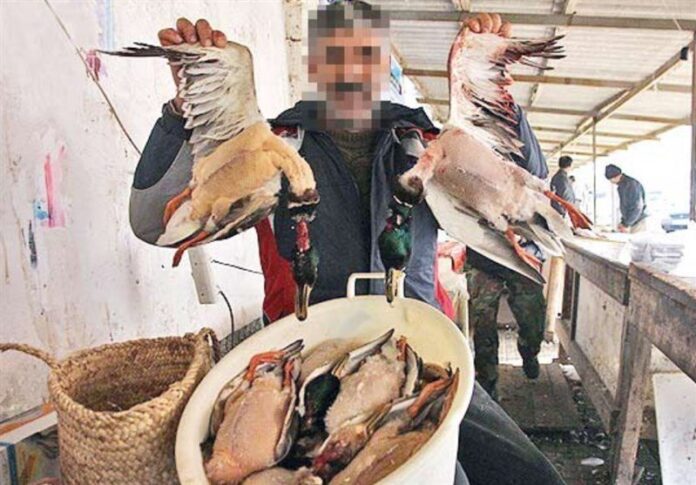
Every year, around 1.5 million migratory birds of different species winter in the wetlands and dams in Iran’s northern province of Mazandaran. Some 300,000 of them, however, never return home since they fall victim to illegal hunting.

Ducks, geese, vultures, terns and swans are among the birds that get poached, despite the ban in place on hunting them.

According to Tasnim News Agency, in the course of the three months that the birds spend in Mazandaran, poachers make huge sums of money by shooting the birds and selling them in impunity at local markets, especially the one in the city of Fereydunkenar.

The illegal business has become very profitable despite the passage of several laws against poaching and numerous protests held against the atrocity, amid a lack of proper official supervision in the area.

Tasnim adds, the governor of Fereydunkenar even tried to justify the slaughter by placing the blame on “unemployment” in the region.

The report said a group of poacher recently attacked the shores of Ashuradeh, the only island of the Iranian coast of the Caspian Sea, with masked faces and firearms and started massacring the migratory birds.

The poachers are said to have even opened fire on the rangers in the region.

Official: Iranian vaccine reduces Covid transmission

Dr. Reza Bani Hashemi also says injecting a dose of the jab increases the amount of antibodies in the nasal and mucosal areas and reduces the entry of the virus into the upper respiratory tract, resulting in less transmission of the virus.

According to him, Razi CovPars vaccine is used both by injection and by inhalation.

Bani Hashemi added that by injecting two doses of the vaccine and 14 days after the injection of the second dose, complete protection is created, which shields the person against acute illness.

“The key point that many vaccine producers ignored was that when you inject the vaccine, you may not get an acute illness, but you might still spread the virus,” he added.

Bani Hashmei reiterated that the Iranian-made vaccine eliminates the need for the least amount of virus to be transmitted through an asymptomatic person.

He added that Razi Institute is capable of producing 100 million doses of the jab by September.

Bani Hashemi said the institute is trying to register Razi CovPars with the World Health Organization and has already held two meetings with the body, adding this process is time consuming.

The director of Razi Institute said so far, two or three countries have requested vaccines from the company, but the institute must first meet domestic needs.

Russia says not bound by restrictions on technical, military cooperation with Iran

iran-russia flag

The Russian Foreign Ministry has also stressed that Moscow is not bound by any restrictions on technical and military cooperation with Tehran.

“In the case of Iran, there are opportunities for the full implementation of the Joint Comprehensive Plan of Action (JCPOA) in the near future, but there is still a long way to go,” Russian Foreign Minister Sergei Lavrov told a news conference on Thursday after talks with British Foreign Secretary Liz Terrace.

Russia, along with China, has supported Iran’s stance during the Vienna talks aimed at reviving the JCPOA.