Ukraine received over $12 billion in weapons, financial aid since start of war
Ukraine has received over $12 billion in weapons and financial aid since the start of Russia’s full-scale invasion on February 24, Ukraine’s Prime Minister Denys Shmyhal has stated.
Speaking at a high-level donors’ conference in Warsaw alongside the leaders of Poland, Sweden, and the head of the European Commission, Shmyhal thanked them for their unwavering support of Ukraine throughout the war.
NATO chief says alliance will increase presence in Baltic sea if Sweden applies
NATO will increase it’s presence around Sweden’s borders and in the Baltic sea while a potential application to join the alliance is processed, NATO Secretary-General Jens Stoltenberg has told Swedish public broadcaster SVT.
“From the potential moment Sweden is applying, and NATO says that they want Sweden to join, there is a very strong obligation from NATO to be able to guarantee Sweden’s security,” Stoltenberg stated, adding that it would include increased presence around Sweden and in the Baltic sea.
Moscow has warned Sweden and Finland of “serious consequences” and that it could deploy nuclear weapons and hypersonic missiles in the European exclave of Kaliningrad if Sweden and Finland become NATO members.
Japan to add 140 individuals to Russian sanction list: PM
Japanese Prime Minister Fumio Kishida says 140 individuals will be added to a Russian asset freeze list while an export ban will be expanded to Russian military firms.
Kishida, speaking in London via a translator after a meeting with British Prime Minister Boris Johnson, added that now was the time for the Group of Seven leading nations to solidify its unity.
Chinese, Russian central banks to discuss use of national payment systems
The Chinese and Russian central banks will discuss the use and promotion of their respective national payment systems in both countries, Beijing’s envoy to Moscow has told the TASS news agency.
“Regarding the promotion and use of the Mir and China UnionPay national payment systems in both countries, this question will be decided by the two sides’ central banks at consultations,” Zhang Hanhui stated.
Mir and UnionPay are among the few options left for Russians to make payments abroad since Russian banks were isolated from the global financial system in response to what Moscow calls its “special military operation” in Ukraine.
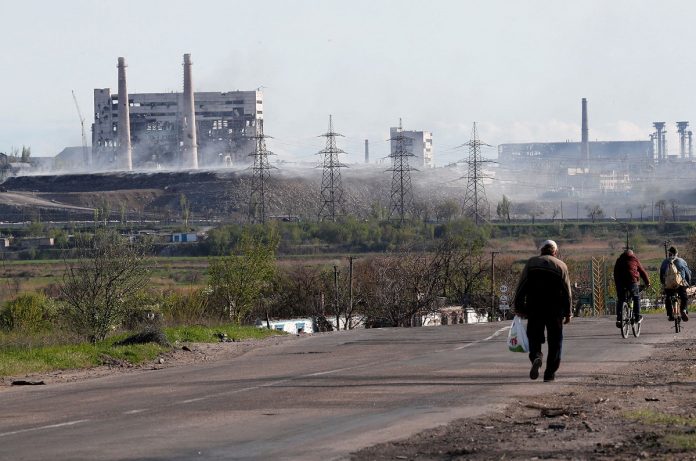
Putin says ready to provide safe passage for civilians in Mariupol’s Azovstal
Russian President Vladimir Putin has told Israeli Prime Minister Naftali Bennett in a phone call that Russia is still ready to provide safe passage for civilians from the besieged Azovstal steel works in the Ukrainian port of Mariupol.
Putin, Israel’s PM discuss Ukraine, Holocaust: Kremlin
Russian President Vladimir Putin and Israeli Prime Minister Naftali Bennett have discussed the Ukraine crisis and the Holocaust amid tensions over Moscow’s remarks regarding Adolf Hitler.
“A thorough exchange of views on the situation in Ukraine continued,” the Kremlin said, adding the two leaders also discussed “historic memory” and the Holocaust.
Ukrainian President Volodymyr Zelensky invited Germany’s President Frank-Walter Steinmeier and Chancellor Olaf Scholz to visit Kiev during his phone call with Steinmeier, the Bild reported Thursday, citing the German Chancellor’s office.
According to the report, Zelensky invited the German President and the entire federal government led by Scholz to visit Kiev. No specific dates for the visit were provided, but the Bild speculates that the visit may take place on May 8 or 9.
Russia’s parliamentary commission probing into the activity of US biolaboratories in Ukraine has documentary proof these laboratories worked with hantaviruses, the commission’s co-chair, State Duma Deputy Speaker Irina Yarovaya, said on Thursday following the first meeting of the commission’s scientific and consultative council.
“One of the first presentations by the Defense Ministry produced evidence that the laboratories were focused on hantaviruses first and foremost and were conducting active research in this field. The experiments in which military personnel was used concerned hantaviruses. The questions about the purposes, scale, and effects will be answered later. But this is official information the Russian Defense Ministry has made public. It is proven with documents,” Yarovaya stated.
Today’s meeting of the scientific and consultative council brought together Russia’s leading specialists in the field of biology, virology and chemistry.
“We believe that interaction and consultations with you, with the scientific community, are an essential and important element of the parliamentary inquiry, because the very subject of this probe is very specific. The focus is not just on the creation of biological laboratories funded by the US Department of Defense, but on the tasks and objectives of the parliamentary inquiry, on ensuring the security of Russian and Ukrainian citizens,” Yarovaya noted at the council’s meeting on Thursday.
She added that for the commission’s members, it was “fundamentally important” that “all invited experts confirmed Ukraine is being used for military biological purposes.”
“Regrettably, we are witnesses to large-scale efforts by the United States on the territories of different countries for building a supranational system of not just controlling the epidemiological situation, but of exploiting, in this particular case, the territory of Ukraine as a test site to the benefit of US pharmaceutical companies that work on Pentagon projects,” Yarovaya continued.
She stressed that Russia strictly complied with international security agreements, including the 1972 Biological Weapons Convention, and systematically pressed for equal and indivisible security. Yarovaya recalled that the United States had for many years objected to the adoption of documents building up from that convention, which might enhance real control of biotechnologies.
Russian Defense Ministry spokesman Igor Konashenkov earlier said the special military operation in Ukraine produced evidence the Kiev regime was urgently eliminating traces of a US Department of Defense-funded military biological program in Ukraine. He added that according to staffers of Ukrainian biolaboratories a number of extremely dangerous pathogens, such as those causing plague, anthrax, tularemia, cholera and other lethal diseases were urgently eliminated on February 24.
On March 9, US Under Secretary of State for Political Affairs Victoria Nuland, while testifying before the US Senate’s foreign relations committee, acknowledged that in Ukraine there were some facilities conducting clandestine biological research and Washington was keen to prevent Russian forces from gaining control of these facilities. She stated the US Department of State was “quite concerned that Russian troops, Russian forces, may be seeking to gain control of [those labs], so we are working with the Ukrainians on how they can prevent any of those research materials from falling into the hands of Russian forces.”
The Russian Defense Ministry announced that in fact it was a confirmation of the Pentagon’s involvement in military biological programs in Ukraine.
Russia compares Ukrainian forces to terrorists
Kremlin spokesperson Dmitry Peskov has compared the terms for a civilian evacuation allegedly put forward by Ukrainian troops besieged at the Azovstal steelworks in Mariupol to demands made previously by terrorists in Syria.
Speaking on Thursday, Peskov reacted to reports that the Ukrainian forces holed up at the plant wanted to exchange civilians held there for food and medicine.
Earlier an unnamed representative of the Russian Command in charge of the operation at the vast Azovstal plant made the claim to Russia’s Ria Novosti news outlet. The official told journalists that “we’ve seen such methods before, for instance in Syria,” where terrorists also tried to exchange people for food.
According to the Ria Novosti report, “more than 200 civilians, including women, children and the elderly could be held in Azovstal’s underground tunnels and bunkers.”
Vyacheslav Volodin, the Chairman of Russia’s State Duma, also commented on the report on Thursday. In his Telegram post, he claimed that the “militants at Azovstal had suggested swapping the remaining civilians there for food and medicine.”
Volodin also revealed the terms of the alleged deal – “fifteen hostages for a ton of food, as well as medicine.” He also added that the Ukrainian troops supposedly “warned that they would no longer release anyone to Ukraine,” but rather exchange for goods.
The Russian politician accused the Ukrainian forces of having first lured civilians into the steelworks, only to later use them as human shields and attempt to trade them for food.
According to Volodin, the besieged pro-Kiev troops effectively equated a human life with 66.6 kilograms of goods. The Russian official claimed that the Ukrainian fighters were only interested in saving their own hides.
He described this behavior as typical of “terrorists.”
Russian forces claim to control the entire port city of Mariupol, except for the Azovstal steelworks – the last Ukrainian stronghold there.
EU calls for confiscation of frozen Russian assets
Russian assets that have been frozen in the EU as part of sanctions against Moscow over the conflict with Kiev should be seized and allocated for the reconstruction of Ukraine, European Council President Charles Michel said on Thursday.
“I’m absolutely convinced that this is extremely important not only to freeze assets, but also to make it possible to confiscate them, to make them available for rebuilding the country. I’m personally convinced,” Michel insisted in an interview with Interfax-Ukraine news agency.
He revealed that he had already told the Council’s legal service to come up with “some possible ideas in order to find a legal solution in line with the principles of the rule of law, that would facilitate and make possible the confiscation of the assets of the people who are sanctioned by the EU or by other countries in the world.”
Acting in such a manner should be “a question of fairness, a question of justice” for Brussels, he added.
However, Michel acknowledged that implementing his plan on a “legal level is not so simple.”
“There are 27 legal systems across the EU and, in many EU member states, this needs a decision taken by a court in order to make it possible. It takes time, it’s a difficult and long process,” he explained.
The European Council president’s ideas echoed those previously voiced by Washington. In late April, the White House presented a set of “comprehensive proposals” aimed at supposedly holding Russian “oligarchs” accountable for the events in Ukraine.
The proposals included “establishing a streamlined administrative authority” that would be able to confiscate sanctioned assets and transfer them to Kiev to “remediate harms of the Russian aggression.”
Moscow decried those American plans as “nothing but simple expropriation of private property that [the US] seeks to falsely justify.”
Kremlin spokesman Dmitry Peskov said it would become “a very dangerous precedent,” showing “just how fragile all the universally accepted foundations have become” in the field of private property rights, economics and politics.
Japan will use nuclear reactors & renewables to reduce dependence on Russian energy: PM
Japan will diversify energy procurement, utilizing nuclear reactors and renewables to reduce its dependence on Russian energy, said Japanese Prime Minister Fumio Kishida in a speech Thursday in London’s financial district.
Kishida promised to accelerate innovation and stated 150 trillion yen (about $1.15 trillion USD) in investment would be raised in the next decade to meet energy needs and make the most of pro-growth carbon pricing.
Kishida added that Japan’s economy would continue to grow and urged people to invest in it.
Later today, Kishida will meet with British Prime Minister Boris Johnson; the two are expected to discuss the situation in Ukraine.
No Ukrainian counteroffensive expected before mid-June: Kyiv
Ukraine is unlikely to launch a counteroffensive in its war with Russia before mid-June, when it hopes to have received more weapons from its allies, according to an adviser to President Volodymyr Zelensky said.
Political adviser Oleksiy Arestovych also stated he did not expect Russia’s offensive in Ukraine to produce any “significant results” by May 9, when Russia celebrates victory over Nazi Germany in World War II.
Arestovych spoke about the latest situation in the Azovstal steel works in Mariupol, saying Ukrainian forces “repelled” Russian troops at the plant.
He told Ukrainian television that “we can say that yesterday Russian troops entered the territory of Azovstal and were repelled by our defenders.”
He added a lot of contradictory information was circulating, but noted: “We can say that there are ongoing combats. All other information is being clarified.”
“Negotiations with Russia are ongoing [on new evacuation corridors], and all the diplomatic authorities are involved,” he stated.
There is no sign that any civilians have been able to leave the ruins of the steel complex Thursday despite the Russian Ministry of Defense saying it would open evacuation corridors from the plant today.
Brazil’s ex-president says Zelensky is as much to blame as Putin for war in Ukraine
Two-time former Brazilian President Lula Inacio da Silva has told TIME magazine that Ukrainian President Volodymyr Zelensky and Russian counterpart Vladimir Putin share the blame for the war in Ukraine.
“And now, sometimes I sit and watch the President of Ukraine speaking on television, being applauded, getting a standing ovation by all the [European] parliamentarians,” said Da Silva.
“This guy is as responsible as Putin for the war. Because in the war, there’s not just one person guilty,” he added.
Speaking to TIME in an interview to mark the May 7 launch of his pre-candidacy for a third presidential term, Da Silva stated Putin shouldn’t have invaded Ukraine, but blame also lies with the United States, NATO and the European Union.
“What was the reason for the Ukraine invasion? NATO? Then the US and Europe should have said: “Ukraine won’t join NATO.” That would have solved the problem,” he said.
“The other issue was Ukraine joining the EU. The Europeans could have said: ‘No, now is not the moment for Ukraine to join the EU, we’ll wait.’ They didn’t have to encourage the confrontation,” he added.
Da Silva went on to call Zelensky’s behavior “a bit weird,” citing the Ukrainian president’s frequent television appearances.
“It seems like he’s part of the spectacle,” he said, adding, “He is in the UK parliament, the German parliament, the French parliament, the Italian parliament, as if he were waging a political campaign. He should be at the negotiating table.”
Russia ‘trying to destroy’ last Ukrainian units in Azovstal: Kyiv
Ukraine announced Russia is “trying to destroy” its remaining soldiers holed up in Mariupol’s Azovstal steel plant, with Kyiv’s last defenders in the battered city saying Moscow forces have broken into the giant factory.
“Russian occupiers are focusing on blocking and trying to destroy Ukrainian units in the Azovstal area,” Kyiv’s army said in a statement, adding: “With the support of aircraft, Russia resumed the offensive in order to take control of the plant.”
The statement came as a Russian-announced ceasefire was due to begin at the besieged plant, where hundreds of Ukrainian soldiers and some civilians have been trapped for weeks.
Russia expels seven Danish diplomats in tit-for-tat move
Russia has declared seven employees of the Danish Embassy in Moscow personae non gratae, the Russian foreign ministry said on Thursday.
“The [Danish] ambassador was informed that, as a response measure, seven employees of the Danish Embassy in Russia were declared personae non gratae. They must leave the country within two weeks. A diplomat of the Danish diplomatic mission was also denied visa,” the ministry announced in a statement.
Russia also reserves the right to take additional steps in response to the unfriendly actions of Copenhagen, which will be communicated to the Danish side later, the statement added.
French minister expects EU consensus on Russian oil ban by end of week
The French environment and energy minister, Barbara Pompili, says she is confident European Union member states will reach a consensus on how to end Russian oil imports by the end of this week.
“Some countries are more dependent on Russian oil than others, and so we must try to find solutions so that they can come on board these sanctions,” she told France Info radio.
“But I think we should be able to do it,” she added.
France has this week hosted an emergency meeting of EU energy ministers to discuss how to deal with Moscow’s decision to halt gas supplies to Bulgaria and Poland for not paying in roubles.
German economy minister anticipates gasoline shortage due to embargo on Russian oil
Germany may face a shortage of gasoline due to the embargo on Russian oil, Economy Minister Robert Habeck said on Wednesday, adding that the government is working on possible solutions.
“Unfortunately, it cannot be ruled out that there will indeed be a deficit. We can solve this, but it is possible that there will be too little oil and therefore too little gasoline for some time. This cannot be ruled out. Of course, we are working to ensure that this does not happen,” the minister stated on the air of the RTL broadcaster.
Kremlin: US giving intel to Ukraine won’t stop Russian special military operation
The Russian military knows well that the United States, Britain and NATO permanently supply the Ukrainian army with intelligence data, Russian presidential spokesman Dmitry Peskov told the media on Thursday.
“Our military is well aware that the US, the UK, NATO as a whole, are constantly transmitting intelligence and other parameters to the Ukrainian armed forces,” Peskov said.
“This is well known, and of course, coupled with the flow of weapons that these same countries and the alliance send to Ukraine, these are all actions that, let’s say, do not contribute to the quick completion of the operation, but at the same time, are not capable of hindering the achievement of the goals set during the special military operation,” he added.
Russia claims it killed 600 Ukrainian fighters
Russia’s defence ministry has said its artillery struck multiple Ukrainian positions and strongholds overnight, killing 600 fighters.
The statement also added its missiles destroyed aviation equipment at the Kanatovo airfield in Ukraine’s central Kirovohrad region and a large ammunition depot in the southern city of Mykolaiv.
Russia ‘stole’ 400,000 tonnes of grain: Ukraine
Ukraine’s defence ministry claimed Russia’s occupying forces have “stolen” 400,000 tonnes of grain from the south of the country.
“At least 400,000 tons of grain were stolen by russia in the occupied south of Ukraine. That’s over 6,000 hoppers. russian thieves are bringing death and famine to the world,” the ministry wrote on Twitter.
Two Russian villages shelled by Ukraine: Governor
Two villages in Russia’s Belgorod region bordering Ukraine have been shelled by Ukraine, according to Governor Vyacheslav Gladkov, who added that there were no civilian casualties.
“Non-stop” shelling of Azovstal plant overnight: Mariupol official
Intense attacks continued on the besieged Azovstal steel plant in Mariupol overnight into Thursday, an official said. As of now, if there is hell in the world, it is in Azovstal,” said Petro Andriushchenko, an adviser to the Mariupol mayor on Thursday morning.
“There is non-stop shelling and assault, even at night with the adjustment of fire from drones. In some areas, hostilities are already beyond the fence of the plant,” he continued.
Andriushchenko added that residential areas close to the plant “had to evacuate urgently on their own without warning.”
“The last 11 square kilometers (four square miles) of freedom in Mariupol have been turned into hell”, he added.
Fighters inside the plant stated Wednesday that Russian forces had breached its perimeter.
“No success” for Russians in trying to break through front lines: Ukrainian military
The Ukrainian armed forces say the Russians have had “no success” with efforts to break through front lines in the Luhansk and Donetsk regions over the past 24 hours.
Some Russian soldiers had refused to take part in further hostilities, according to the General Staff.
Russian actions appear to have been largely missile and artillery fire in the past 24 hours.
221 children have died in Russia’s invasion of Ukraine: Ombudsman
Since Russia’s invasion of Ukraine on February 24, 221 children have died and 408 have been injured, Ukraine’s ombudsman has claimed.
“It is not possible to establish the actual number of dead and wounded children due to the fact that the occupying forces are actively fighting in Ukrainian cities,” Lyudmyla Denisova wrote on Telegram.
Russia may use Belarus military exercises as decoy: UK
Russia may try to inflate the threat that Belarusian military exercises pose to Ukraine in order to drive Ukraine’s forces north of the country and away from fighting in the Donbas, the UK’s defence ministry has announced.
In its latest intelligence briefing, the ministry said that the sudden exercises of the Belarusian army are “in line with seasonal norms” as Belarus enters the culmination of its winter training cycle.
“Deviation from normal exercise activity that could pose a threat to allies and partners is not currently anticipated,” the ministry added.
Shelling kills five in Luhansk: Governor
Russian shelling killed five civilians in the Luhansk region in the past 24 hours, governor Serhiy Haidai has said.
Haidai added the shelling focused on Severodonetsk and Popasna, Hirske and Lysychansk.
Japan says difficult to immediately follow Russia oil embargo
Japan would face “difficulty” to immediately follow a move to cut off Russian oil imports over the invasion of Ukraine, its minister of economy, trade and industry Koichi Hagiuda has said.
Hagiuda made the remark during a visit to Washington after the EU proposed a new round of sanctions that included an oil embargo.
President Joe Biden stated he would discuss further sanctions against Russia with other leaders from the Group of Seven (G7) advanced economies this week, which could pressure Japan which is wary of the impact of the oil embargo.
“Given Japan has its limit on resources, we would face some difficulty to keep in step immediately” with other countries, Hagiuda told reporters.
Shelling hits centre of Kramatorsk, wounds six: Mayor
Shelling in residential areas of the centre of Kramatorsk city damaged several multi-story buildings, a school and a kindergarten, the city’s mayor has claimed.
At least six people were wounded in the attacks, Alexander Goncharenko wrote on the Facebook.
Russia lost control over settlements on Mykolaiv and Kherson border: Ukraine’s army
Russian forces lost control over several settlements on the border of the Mykolaiv and Kherson regions due to “successful actions of Ukrainian defenders”, the Ukrainian army has claimed.
The latest update from the General Staff of the Armed Forces of Ukraine said that over the past day, the Russian military continued to shell the city of Kharkiv and the area north of the city of Izium.
The Russian army have also been trying to conduct offensive operations in Lyman, Severodonetsk and Popasna, but have been unsuccessful, the general staff announced.
“In the Mariupol area, Russian occupiers are focusing their efforts on blocking and trying to destroy Ukrainians’ units in the Azovstal area. With the support of aircraft, the enemy resumed the offensive in order to take control of the plant,” the statement added.
UN: A new operation to evacuate civilians from Mariupol completed
The UN Office for the Coordination of Humanitarian Affairs (OCHA) confirmed a new operation to evacuate civilians stranded in Mariupol and other communities was completed on Wednesday.
“Once again, our team from the United Nations and colleagues from the International Committee of the Red Cross worked together to bring people who wanted to leave areas experiencing hostilities to safety, with the agreement of the parties to the conflict,” said Osnat Lubrani, UN OCHA’s humanitarian coordinator for Ukraine.
More than 300 civilians from Mariupol and the surrounding towns of Manhush, Berdiansk, Tokmak and Vasylivka were in Zaporizhzhia and receiving humanitarian assistance.
“Many came with nothing but the clothes they were wearing, and we will now support them during this difficult time, including with much-needed psychological support,” Lubrani added.
This was the second evacuation of civilians from areas in Mariupol coordinated by the UN and Red Cross, according to the statement. Last weekend, more than 100 civilians were evacuated from the Azovstal steel plant and arrived safely in Zaporizhzhia.
On Wednesday, Ukrainian President Volodymyr Zelensky stated that 344 people were evacuated from Mariupol and surrounding areas to Zaporizhzhia.
Report: US intelligence helped Ukraine kill Russian generals
The United States provided Ukraine with intelligence which allowed its troops to target and kill many of the Russian generals who have died in the current war, the New York Times has reported, citing senior American officials.
“The targeting help is part of a classified effort by the Biden administration to provide real-time battlefield intelligence to Ukraine,” the NYT reported the officials as having said.
The report added that the US provided Ukraine with location and other details about the Russian military’s headquarters, which are frequently relocated, and that Ukraine combined this with its own intelligence, which included intercepted conversations, which helped locate senior Russian officers. Then Ukraine conducted strikes and other attacks on these locations.
Ukrainian officials have stated they have killed around 12 generals on the front lines – a very high number, according to many military analysts.
Russian forces have destroyed over 700 Ukrainian unmanned aerial vehicles (UAVs) and almost 300 air defense systems since the start of their special military operation in Ukraine, Defense Ministry Spokesman Major-General Igor Konashenkov said.
“Overall, the following targets have been destroyed since the start of the special military operation: 146 aircraft, 112 helicopters, 712 UAVs, 287 air defense systems, 2,817 tanks and other combat armored vehicles as well as 323 multiple launch rocket systems,” the spokesman stated.
In addition, 1,292 field artillery guns and mortars and 2,624 special military motor vehicles were destroyed, he added.
Moscow: Finland, Sweden to become space for confrontation with Russia if they join NATO
In case Finland and Sweden join NATO, they will turn into a space for confrontation of the alliance with Russia, Foreign Ministry Spokeswoman Maria Zakharova cautioned in an interview with Spain’s ABC daily.
“In case Finland and Sweden join the alliance, they will turn into a space for confrontation of the North Atlantic bloc with Russia will all the ensuing consequences, including for our time-tested good-neighborly relations. Is it what the peoples of Sweden and Finland are seeking?” the diplomat asked.
“We have been warning our neighbors from Northern Europe on a regular basis and for quite a long time that their being pulled into the NATO’s orbit threatens to unbalance the system of European security. This is not the ‘topic of the past few weeks’,” noted Zakharova, quoted on the website of the Russian Foreign Ministry.
Russia ‘already lost war’: White House
White House press secretary Jen Psaki has stated that Russia “already lost the war in Ukraine”.
Pressed by a reporter to define what victory looked like for Ukraine, Psaki instead said Russian President Vladimir Putin had failed in his own objectives by invading the neighbouring country.
“He wanted this to be a moment to divide NATO, to divide the west,” Psaki continued, adding, “Clearly that is not what is happening.”
Air alert sirens blare across Ukraine
Air alert sirens have been activated throughout every region and most cities of Ukraine overnight.
“Everyone is in hiding: an air alert has been declared throughout Ukraine,” the country’s Channel 24 wrote on Twitter.
EU targets Russian Patriarch Kirill in new proposed sanctions
The European Commission has proposed freezing the assets of Patriarch Kirill, head of the Russian Orthodox Church, a diplomat has noted.
The Patriarch has been added to a draft blacklist that includes hundreds of military officers and businessmen close to the Kremlin whom the EU accuses of supporting the war in Ukraine, Reuters reported.
The sanction, which would entail an asset freeze and a travel ban, needs the backing of EU states to be adopted. Members will meet later this week to discuss the EU’s sixth package of sanctions against Russia announced on Wednesday, which includes an oil embargo.
Ukraine accuses Russia of ‘missile terrorism’
Ukrainian Foreign Minister Dmytro Kuleba has accused Russia of “missile terrorism” as authorities said Russian forces bombarded cities across Ukraine.
Attacks were reported near Kyiv; in Cherkasy and Dnipro in central Ukraine, and in Zaporizhzhia in the southeast. In Dnipro, authorities claimed a rail facility was hit.
Russia may hope to capture Azovstal by May 9: Think-Tank
Russian forces reportedly entered the Azovstal steel plant in Mariupol, rather than its outskirts, for the first time on Wednesday, the Institute for the Study of War (ISW) has said.
“The extent of this Russian advance remains unclear, and Russian forces likely face further costly fighting if they intend to clear the entire facility,” the ISW wrote in its latest assessment on Russia’s offensive.
It added that the “Kremlin likely hopes” to capture Azovstal to “cement the Kremlin’s growing effort to claim complete control of Mariupol by May 9”, which is the date Russia celebrates its victory over Nazi Germany.
Moscow boycotts Security Council meeting due to ‘Russophobic policy’
Russia refused to participate in Wednesday’s informal meeting of the UN Security Council with the European Union “in light of the hostile and Russophobic policy of the European Union”, Russia’s representative to the UN has stated.
Dmitry Polyansky wrote on Telegram that the EU policy was “actively trying to extinguish the fire of the Ukrainian crisis by pouring gasoline on it”, adding that there was no other explanation for the “open warmongering” by the EU leadership.
The Security Council’s annual meeting with the EU’s Political and Security Committee on Wednesday is the first since 2019 due to the pandemic.
Zelensky asks UN chief to help ‘save’ wounded from Mariupol plant
President Volodymyr Zelensky has asked the head of the United Nations to help “save” the lives of the remaining wounded Ukrainians trapped underneath the giant Azovstal steel plant in battered Mariupol.
“The lives of the people who remain there are in danger. Everyone is important to us. We ask for your help in saving them,” Zelensky told Antonio Guterres by phone, after thanking him for a successful UN and Red Cross-led evacuation this week.
He called on the UN to “assist in the removal of all the wounded from Azovstal”.
Russia has announced its forces would cease fire at the Azovstal steel plant in the Ukrainian port city of Mariupol and open a humanitarian corridor for civilians for three days beginning Thursday.
“The Russian armed forces will from 8am to 6pm [Moscow time] on May 5, 6 and 7 open a humanitarian corridor from the territory of the Azovstal metallurgical plant to evacuate civilians,” the defence ministry said.
Pentagon trained over 23,000 Ukrainian armed forces since 2015: US General
The United States has trained over 23,000 of Ukraine’s armed forces between 2015 and January 2022, US Brig. Gen. Joseph Hilbert stated on Wednesday.
“Since the beginning of that mission [the Joint Multinational Training Group Ukraine] up until January 2022, we have trained a total of 23,000 plus armed forces of Ukraine soldiers from 17 Different battalions and 11 different brigades. They participated in training there at the Combat Training Center Yavoriv,” Hilbert said during a press briefing.
Since the beginning of that mission in 2015, the Pentagon invested $126 million into the training of Ukrainian military personnel, Hilbert added.
The United States is currently training the second group of about 50 Ukrainian military trainers on how to operate howitzers, radars and armoured vehicles pledged by the United States to Kiev amid Moscow’s special military operation in the country. The training sessions are taking place in a number of locations outside of Ukraine.
US pressure will not reach its goals, Russian economy stable under sanctions: Embassy
US pressure will not reach its goals, the strengthening of the ruble indicates the stability of the Russian financial sector and economy as a whole, the Russian Embassy in the United States said in a statement.
“We urge our American colleagues to abandon such a counterproductive course. Pressure measures will not achieve their goals. The continued strengthening of the ruble testifies to the stability of the Russian financial sector and the economy of the Russian Federation as a whole. Experts from Western countries themselves admit this,” the embassy added.
It also announced the United States recognizes that sanctions against Russia in the energy sector lead to instability on the hydrocarbon market and an increase in the cost of fuel.
Azov regiment claims Ukrainians fighting ‘bloody battles’ in Mariupol
Ukrainian forces inside Mariupol’s Azovstal steel plant are fighting “difficult bloody battles” against Russian troops for a second day, after they broke into the territory of the plant, the commander of the far-right Azov regiment has claimed.
“I am proud of my soldiers who are making superhuman efforts to contain the pressure of the enemy … The situation is extremely difficult,” commander Denis Prokopenko said in a brief video message released on Telegram.
Russia meeting ‘stiff’ resistance in eastern Ukraine: US
The Russian military has not been able to advance as far into the Donbas region of Ukraine as planned due to Ukrainian resistance, Pentagon spokesman John Kirby has said.
“Russians have not made the kind of progress in the Donbas and in the south that we believe they wanted to make. And we do believe it’s been slow. And at every turn they have met a stiff Ukrainian resistance,” Kirby told a media briefing at the Pentagon.
“What we’re focused on is making sure that resistance remains as stiff as possible,” he added.
Russian strikes in western Ukraine aimed at critical infrastructure: Pentagon
Pentagon spokesman John Kirby has said recent Russian strikes in western Ukraine were aimed at critical infrastructure sites.
“They are attempting to hit what we assess to be critical infrastructure targets out towards the west – electrical power, transportation hubs, that kind of thing. We think this is an effort to try to disrupt the Ukrainians’ ability to replenish and reinforce themselves,” Kirby told reporters.
“Particularly these most recent strikes, we are still assessing the degree to which they hit what they were targeting. They are not good at precision strikes. They are not discriminant with how they target,” he added.
Russia practices ‘nuclear-capable’ missile strikes amid Ukraine war
Russia has simulated nuclear-capable missile strikes in the western enclave of Kaliningrad in the Baltic Sea, in a potential signal to the West, which has been heavily backing Ukraine, and an indication of how the conflict in Ukraine could escalate.
In a statement, Russia’s Defense Ministry announced that Moscow had simulated “electronic launches” of nuclear-capable Iskander mobile ballistic missile systems during military maneuvers in Kaliningrad, situated between Poland and Lithuania.
It said Russian forces had conducted single and multiple strikes at mock enemy missile launchers, airfields, protected infrastructure, military equipment, and command posts.
After performing the launches, the military personnel carried out a maneuver to change their position in order to avoid “a possible retaliatory strike,” the ministry added.
The combat units also practiced “actions in conditions of radiation and chemical contamination,” it continued.
More than 100 service members were involved in the drill.
Treasury Secretary: US in constant discussions about further Russia sanctions
The United States is in constant talks with its partners about further sanctions against Russia and could take “additional actions” to pressure Moscow to halt its aggression against Ukraine, Treasury Secretary Janet Yellen has stated.
Yellen told a Wall Street Journal conference she would not preview any specific actions, but said further measures were likely “if Russia continues this war against Ukraine”.
After the European Union announced additional sanctions on Russia, US President Joe Biden stated, “We are always open to additional sanctions.”
“I’ll be speaking with the members of the G7 this week about what we’re going to do or not do,” Biden told reporters at the White House while discussing the US economy.