Erdogan aide discusses NATO bids with Sweden, Finland counterparts
Progress on Finland and Sweden’s NATO membership bids will only be possible if concrete steps are taken addressing Turkey’s national security concerns, President Tayyip Erdogan’s spokesman has told his Nordic counterparts in calls.
Ibrahim Kalin, who is Erdogan’s chief foreign policy adviser, held calls with counterparts from Sweden, Finland, Germany, the UK and the US to discuss the proposed NATO enlargement, according to a readout from Erdogan’s office.
“It was underlined that if Turkey’s expectations were not met, the progress of the process would not be possible,” it added.
Blinken: Food insecurity has been “exacerbated dramatically” by Russia’s war in Ukraine
US Secretary of State Antony Blinken blamed Russia’s invasion of Ukraine for “adding another 40 million people to those who are food insecure.”
“There was a preexisting condition, as it were, when it comes to food insecurity in many places. It’s been exacerbated dramatically by Russia’s aggression against Ukraine, adding another 40 million people to those who are food insecure,” said Blinken in remarks before a meeting with Pakistani Foreign Minister Bhutto Zardari.
Blinken is in New York to attend a ministerial on food security in the afternoon.
“We’re coming together… to look at concrete steps we can take to address the food insecurity issues, to help people in need around the world,” added Blinken.
Biden says ‘strongly’ supports Finland, Sweden NATO bid
President Joe Biden has expressed strong backing for the bid by Finland and Sweden to join NATO and offered US support in the event of “aggression” during the application process.
“The United States will work with Finland and Sweden to remain vigilant against any threats to our shared security, and to deter and confront aggression or the threat of aggression” while their bid is considered, Biden said in a statement.
“I warmly welcome and strongly support the historic applications,” he added.
Biden stated the United States will work with Finland and Sweden to stay vigilant against any threats to their shared security while the two countries’ NATO membership is being considered.
Biden said he strongly supports the two countries’ applications to join the organisation. He added the moves would “benefit the entire Transatlantic Alliance”.
Russia will rebuild ‘freed’ territories in Ukraine: Deputy PM
Russia will finance the reconstruction of territories in Ukraine that it has taken control of and will repair roads that link those areas with Russia, the country’s RIA Novosti news agency has quoted Deputy Prime Minister Marat Khusnullin as saying.
Khusnullin also stated the Zaporizhzhia nuclear power plant, the biggest in Europe by capacity, will supply energy to Russia and to Ukraine if the latter pays for it, RIA reported.
Russian troops seized control of the Zaporizhzhia plant, located in southeastern Ukraine, in early March.
Swiss court snubs Russian requests for legal assistance
Switzerland’s Federal Criminal Court has upheld two appeals by defendants arguing that Russia did not deserve legal assistance in criminal cases given its invasion of Ukraine, the court says.
The judgements are not final and may be appealed to the Swiss Supreme Court. They concerned cases in which Russia accused the unnamed defendants of illegal exports to Israel via Switzerland of materials that could be used to make weapons.
“The legal requirements and those developed by case law in the area of international mutual legal assistance are no longer present in order to be able to trust – even with diplomatic guarantees – that Russia will comply with international law, in particular with regard to human rights,” the court said in a statement.
Russia says Q1 economic growth seen at 3.5 percent
Russia’s state statistics agency says it expects economic growth to stand at 3.5 percent in the first quarter of this year.
The figures released by Rosstat were the first estimate of Russian economic growth since Putin sent troops to Ukraine on February 24 and the West slapped several rounds of unprecedented sanctions against the country.
The growth is expected to be driven by passenger transport and the extraction of mineral resources, according to Rosstat.
US treasury secretary claims Russia sanctions have had ‘enormous impact’
US Treasury Secretary Janet Yellen stated that Western sanctions against Russia have already had an enormous impact.
Turkey blocks negotiations on Finland and Sweden’s NATO entry
Turkey has blocked NATO’s decision to process requests by Finland and Sweden to join the bloc, Financial Times reported, citing a person “with direct knowledge of the matter”.
According to the publication, NATO envoys met on Wednesday with the eye to launching accessions talks on the same day that Finland and Sweden submitted their applications but Turkey’s opposition stopped any vote.
Earlier in the day, Turkish President Recep Tayyip Erdogan called on NATO allies to “respect” his country’s concerns over Finland and Sweden’s membership in the alliance.
All 30 NATO member countries must ratify the applications of Finland and Sweden, but the process can only begin when the alliance issues a protocol of acceptance and formally invites these countries to join NATO.
Russia soldier pleads guilty in war crimes trial
A Russian soldier facing the first war crimes trial since the start of the war has pleaded guilty to charges of killing a Ukrainian civilian.
Vadim Shyshimarin, 21, pleaded guilty to the charges during his trial in Kyiv on Wednesday. He could be handed a life sentence in prison if convicted of shooting a Ukrainian man in the head through an open car window in a village in the northeastern Sumy region on February 28, four days into Moscow’s invasion.
Ukraine’s Prosecutor General Iryna Venediktova has previously stated her office was readying war crimes cases against 41 Russian soldiers for offences including bombing civilian infrastructure, killing civilians, rape and looting.
It was not immediately clear how many of the suspects are in Ukrainian hands and how many could be tried in absentia.
EU Commission proposes up to $9.5 billion in extra aid to Ukraine
European Commission President Ursula von der Leyen proposed on Wednesday new macro-financial assistance to Ukraine of up to 9 billion euros ($9.5 billion) this year.
“We will continue to be by their side throughout this war and when they will rebuild their country,” von der Leyen said during a broadcast statement.
“Of course we need to think about the day after and the wider reconstruction efforts,” she stated, adding that the EU has “a strategic interest in leading this reconstruction effort.”
Moscow expels 24 Italian, 27 Spanish diplomats
Russia’s foreign ministry says Moscow has expelled 24 Italian and 27 Spanish diplomats in tit-for-tat responses to the expulsion of Russian envoys over the war in Ukraine.
The ministry announced in a statement that 27 employees of the Spanish embassy in Moscow and the Spanish Consulate General in Saint Petersburg “have been declared persona non grata”, while foreign ministry spokeswoman Maria Zakharova told Russian news agencies that 24 Italian diplomats had also been ordered to leave the country.
EU plans 300-billion-euro investment to quit Russian fossil fuels
The European Union intends to mobilise up to 300 billion euros ($315bn) of investments by 2030 to end its reliance on Russian oil and gas, European Commission President Ursula von der Leyen says.
The investments will include 10 billion euros ($10.5bn) for gas infrastructure, two billion euros ($2.1bn) for oil, with the rest for clean energy, von der Leyen told reporters, adding that Brussels was also proposing higher legally-binding EU targets for renewable energy and energy savings by 2030.
“RePowerEU will help us to save more energy to accelerate the phasing out of fossil fuel and, most importantly, to kickstart investments on a new scale,” she continued, noting, “So I would say this will be the speed-charging of our European Green Deal.”
Russia says negotiations with Ukraine ‘not progressing’
Kremlin spokesman Dmitry Peskov has said there is currently no movement in negotiations with Ukraine over ending the war, and accused Kyiv of showing a total unwillingness to continue the talks.
“Negotiations are not progressing and we note the complete unwillingness of Ukrainian negotiators to continue this process,” he stated.
Peskov’s remarks came after officials from Ukraine and Russia noted separately on Tuesday that negotiations between the two sides had stalled, with Kyiv and Moscow blaming each other for the breakdown.
Russia would only use nuclear weapons in ‘retaliatory strike’: Deputy PM
Russia’s deputy prime minister says Moscow’s military doctrine determines it can only use nuclear weapons in a “retaliatory strike” for an attack on the country.
“According to the doctrine, we do not attack first,” Yuri Borisov said.
Erdogan calls on NATO allies to ‘respect’ Turkey’s concerns over Finland, Sweden membership
Turkish President Recep Tayyip Erdogan has called on NATO allies to “respect” his country’s concerns over Finland, Sweden membership in the alliance.
Regarding the two Nordic countries’ bid to join the North Atlantic Treaty Organization, he said it was “controversial for countries to support terrorism and expect our approval.”
Sweden should not expect Turkey to approve its NATO bid without returning “terrorists”, the president added, speaking at the ruling Justice and Development Party’s (AK Party) parliamentary group meeting in Ankara.
NATO is a security formation, a security organization, so we cannot say “yes” to depriving this security organization of security, Erdogan added.
According to him, the visit of the delegations of Finland and Sweden to Turkey, scheduled for Monday to discuss NATO membership, is pointless.
“I have already said that they should not bother themselves. There is no need for this. We will not make the same mistake twice,” the president continued.
Turkey has accused the two Nordic states – Sweden and Finland – of failing to extradite dozens of suspected “terrorists,” in a reference to Kurds allegedly linked to the Kurdistan Workers’ Party (PKK), which Ankara designates as a terrorist organisation.
Russia expels 34 French diplomats in retaliatory move
Russia’s Foreign Ministry has announced that it was expelling 34 French diplomats in a retaliatory move.
France kicked out 35 Russians with diplomatic status as part of a broader wave of expulsions that saw more than 300 Russians sent home from European capitals.
Later that month France’s foreign ministry declared six Russian agents posing as diplomats as “persona non grata” after an investigation by the domestic intelligence services concluded they were working against French national interests.
Top commanders at Azovstal ‘haven’t surrendered’
Top-ranking Ukrainian commanders at Mariupol’s Azovstal steelworks are still inside the plant and have yet to surrender, pro-Russian separatist leader Denis Pushilin claimed.
DAN news agency quoted Pushilin as saying that the hundreds of fighters who had given themselves up did not include any commanders of the highest level.
“They have not left (the plant)” as of now, he added.
Russian rocket strikes kill three civilians in Kherson: Local official
Russian forces used rocket launchers to fire at a column of civilians attempting to drive from the city of Kryvyi Rih to the town of Beryslav in Ukraine’s southern region of Kherson, killing at least three people, according to a local lawmaker.
Several other people were wounded by the strikes on Tuesday, Ihor Iosipenko, a member of Kherson’s Regional Council, said in a Facebook post.
He added those who were part of the convoy of about 100 cars had ignored warnings from Ukraine’s military about “crossing the line of fire”.
“The consequences are horrifying,” Iosipenko stated.
There was no immediate response to the claims from Moscow. could not independently verify Iosipenko’s report.
Israel delivers helmets, vests to Ukraine
Israel’s defence ministry says it has delivered 2,000 helmets and 500 protective vests for emergency and civilian organisations in Ukraine following a request from Kyiv for the supplies.
Defence Minister Benny Gantz last month said he would authorise the delivery of helmets and vests, signalling a shift in Israel’s position on providing such equipment.
Russia: Nearly 1,000 Ukrainians surrendered at Azovstal steel plant
The Russian Defense Ministry says nearly 1,000 Ukrainian soldiers have surrendered at the Azovstal steel plant in Mariupol since Monday.
Ministry spokesman Maj. Gen. Igor Konashenkov stated Wednesday that a total of 959 Ukrainian soldiers, including 80 wounded, had laid down their arms and surrendered since May 16.
He reaffirmed that 51 wounded were sent to the hospital at Novoazovsk, which is in the self-declared region of the Donetsk People’s Republic (DPR).
Konashenkov added that in the past day alone 694 Ukrainian “militants” had surrendered at Azovstal.
The Ukrainian side has not given an update on the number who have left Azovstal nor on the status of negotiations for their exchange for Russian prisoners.
War in Ukraine is “a wake-up call” to fix global energy system: UN chief
UN Secretary-General António Guterres has announced a plan to speed up the world’s switch to renewable energy, saying that the war in Ukraine was a wake-up call for the globe to ditch fossil fuels.
Speaking at the launch of the World Meteorological Organization’s State of the Global Climate 2021 report, Guterres described the findings as “a dismal litany of humanity’s failure to tackle climate disruption.”
“The global energy system is broken and bringing us ever closer to climate catastrophe. Fossil fuels are a dead end — environmentally and economically,” he will say, according to prepared remarks.
“The war in Ukraine and its immediate effects on energy prices is yet another wake-up call. The only sustainable future is a renewable one. We must end fossil fuel pollution and accelerate the renewable energy transition, before we incinerate our only home,” he stated, adding “time is running out.”
In his plan, Guterres proposed:
- 1. That renewable energy technologies, such as battery storage, be treated as “essential and freely-available global public goods.” He called for a global coalition on battery storage to fast-track innovation and deployment, driven by governments and bringing together tech companies, manufacturers and financiers.
- 2. To secure, scale up and diversify the supply of critical components and raw materials for renewable energy technologies.
- 3. Governments must build frameworks and reform bureaucracies to level the playing field for renewables.
- 4. Governments must shift subsidies away from fossil fuels to protect the poor and most vulnerable people and communities.
- 5. Private and public investments in renewable energy must triple to at least $4 trillion dollars a year.
HRW claims Russian troops carried out executions, torture in Ukraine
Human Rights Watch says it has documented a litany of alleged crimes against civilians in the Kyiv and Chernihiv regions of northern Ukraine.
A HRW team visiting the area in April and May said it “investigated 22 apparent summary executions, nine other unlawful killings, six possible enforced disappearances, and seven cases of torture,” according to a report released Wednesday.
The alleged crimes are believed to have been carried out in February and March by Russian troops as they controlled much of the area.
HRW announced it had interviewed 65 people between April 10 and May 10, including the families of victims and people who said they had been detained and tortured by Russian troops.
The group added it has compiled physical evidence further implicating Russian troops in “numerous violations of the laws of war that may amount to war crimes and crimes against humanity.”
Among testimonies collected by HRW was that of 66-year-old Anastasia Andriivna from the Kyiv region, who said she found her adult son’s body in a barn after he was apparently executed.
“He was lying there in a fetal position, with his hands tucked under his head, and his jacket draped over his shoulders,” Andriivna told HRW.
The organization also reported testimony from villagers who stated they were among 350 people kept for 28 days in a cramped and squalid basement in Yahidne, near Chernihiv. Other villagers there were killed by Russian troops, HRW added.
HRW’s Europe and Central Asia director Giorgi Gogia called the alleged Russian atrocities “abhorrent, unlawful and cruel.”
These abuses against civilians are evident war crimes that should be promptly and impartially investigated and appropriately prosecuted,” Gogia noted.
Russia deploys helicopters in Luhansk, tries to encircle key town in Donetsk: Ukrainian officials
Ukrainian military officials say the Russians have stepped up their efforts to destroy Ukrainian defenses in the Luhansk region, bringing in 15 helicopters to reinforce the offensive.
Ukrainian defenses around the cities of Severodonetsk and Lysychansk remain under intense pressure from artillery bombardments and air attacks, which have also increased in villages further south, such as Vrubivka.
Russian forces are trying to break through Ukrainian lines in this area and complete the seizure of Luhansk. They control about 90% of the region, according to most estimates.
Serhiy Hayday, head of Luhansk region military administration, said four civilians had been killed in the latest fighting and the nitrogen plant in Severodonetsk had been hit again.
“The Russian world destroys everything in its path trying to impose that kind of life in Luhansk region — without people, houses, factories,” he added.
Hayday stated the city had withstood 15 artillery attacks on Tuesday.
The General Staff of the Ukrainian armed forces also acknowledged fresh attacks by Russian forces toward Sloviansk in the Donetsk region.
For weeks, Russian forces have been trying to push south to complete the takeover of Donetsk. The General Staff announced Russian forces were trying to encircle Ukrainian units around the town of Lyman and were trying to gain full control over the nearby settlement of Drobysheve.
If they succeed, Ukrainian defenses in Lyman would be vulnerable to attack from three directions. There was heavy artillery fire in the area on Tuesday.
In Kharkiv, the General Staff said the Russians continued to shell villages north of the city to hinder Ukraine’s counteroffensive, which has taken Ukrainian troops to the Russian border in several places.
Elsewhere, without giving details, the General Staff added “the enemy continues to shell artillery positions of our troops and civilian infrastructure in the border settlements of Chernihiv and Sumy regions.”
Ukraine: 229 children died in war
Ukraine’s human rights ombudsman Lyudmyla Denisova has claimed that at least 229 children have died and 424 have been injured since Russia invaded Ukraine on February 24.
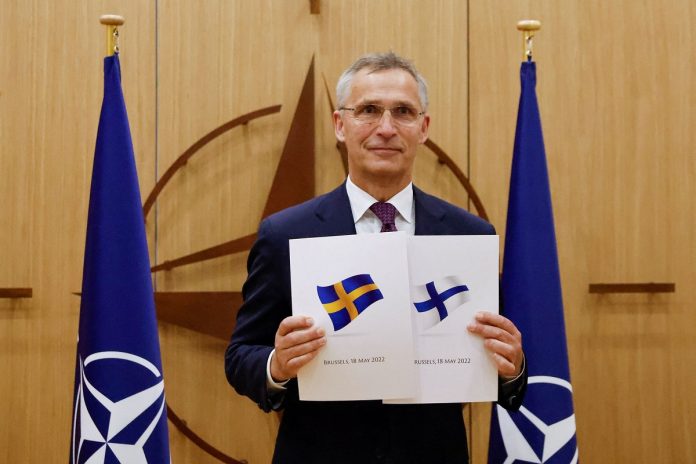
Finland, Sweden submit NATO membership application
NATO Secretary-General Jens Stoltenberg said Wednesday that Finland, Sweden have officially applied to join the world’s biggest military alliance, a move driven by security concerns over Russia’s war in Ukraine.
“I warmly welcome the requests by Finland and Sweden to join NATO. You are our closest partners,” Stoltenberg told reporters after a receiving their application letters from the two Nordic countries’ ambassadors.
“This is a good day at a critical moment for our security,” he added.
The application must now be weighed by the 30 member countries. That process is expected to take about two weeks, although Turkish President Recep Tayyip Erdogan has expressed reservations about Finland and Sweden joining.
Turkey’s list of demands to NATO revealed
Turkey’s list of demands for NATO and its prospective members Finland and Sweden includes the removal of sanctions imposed on Ankara over its purchase of S-400 missile defense systems from Russia, as well as re-inclusion in the F-35 advanced aircraft program, Bloomberg reported, citing “three senior Turkish officials.”
On May 15, Finland and Sweden officially announced their intention to join NATO in the wake of the ongoing Russian military offensive on Ukraine. To make it possible, all members of the alliance would have to unanimously support their bids. Turkey, however, announced it would not say “yes” to Helsinki and Stockholm because they do not have “a clear unequivocal stance” against the Kurdistan Workers’ Party (PKK) and the Revolutionary People’s Liberation Front (DHKP/C), groups that Ankara considers terrorist organizations.
Sweden and Finland have a record of granting political asylum to people from Turkey, particularly ethnic Kurds, fleeing internal conflicts – something that Ankara finds unacceptable. According to Bloomberg, Turkish leadership demands that Sweden and Finland “publicly denounce not only the PKK, but also its affiliates before being allowed to join the bloc.”
As Turkish Foreign Minister Mevlut Cavusoglu confirmed on Monday, his country also wants Sweden and Finland to cancel trade restrictions they imposed on Turkey.
However, as Bloomberg’s sources stated on the condition of anonymity, Turkey’s wish list is long.
“Turkey wants to be re-included in the F-35 advanced aircraft program, from which it was barred after it bought S-400 missile-defense systems from Russia. It also has an outstanding request to the US to purchase dozens of F-16 warplanes and upgrade kits for its existing fleet,” Bloomberg writes.
Ankara also wants the US to lift sanctions that Washington imposed on it for purchasing the S-400 missiles.
The news agency’s sources, however, refuted the suggestions that Turkey’s objections against Finland and Sweden’s NATO membership were in any way related to Ankara’s ties with Moscow. Russia has warned Helsinki and Stockholm against joining the bloc and promised an appropriate response should they create threats.
On Monday, NATO Secretary General Jens Stoltenberg noted that “Turkey is a valued ally and any security concerns need to be addressed.”
Russia: West crossed even its own red lines
Western nations scrapped their own values and even crossed their own red lines, Russian Foreign Ministry spokeswoman Maria Zakharova stated.
“It appears to me that the West crossed not only our red lines. In essence, it crossed its own red lines as well,” she said in a video, posted on YouTube by Belarusian news agency BelTA.
“They declared freedom of speech, international law, democracy and freedom in general to be their ultimate values. They trampled upon it all, they crossed it all out, all by themselves,” she added.
In her words, Russia used every opportunity to preserve the international balance, achieved after World War II.
The diplomat went on to say that Russia was ready to compromise and negotiate with the West until the very last moment, despite anti-Russian sanctions and “derogatory attitude to our history.”
Zakharova drew attention to the fact that there is no unity, solidarity and shared outlook within NATO.
“We have been persuaded for many years that it is an alliance of like-minded countries, that they come together solely because they have common interests, ideology, approaches to key issues, and at the same time they differ from the rest of the world that has not yet matured to these high standards,” the diplomat noted.
“Today we see that these civilized foundations don’t differ much from barbarism, based on what they profess, namely the culture of cancellation, aggression, and all kinds of phobias you can think of,” Zakharova added.
“The second point is that there is no solidarity, common grounds and unity. First, there is no unity in their own ranks. This is not just a difference in views on the development prospects. These are claims against each other, verging on hatred. Look at the statements they allow towards the countries members of the alliance not over the past month or weeks, but for the past years,” she said, citing such statements as “the brain death of NATO”.
She also stressed that there is no unity among the political leadership of these countries and the people.
“After all, the decisions that were made are presented as the decisions of freedom-loving Finland and Sweden, while in fact they mean that these countries are being drawn into NATO. And they are by no means based on the opinion of the population of these countries,” Zakharova continued.
UN confirms 3,752 civilian deaths in Ukraine
The UN has confirmed 3,752 civilian deaths in Ukraine since Russia’s invasion began on February 24.
In its latest civilian casualties update, the Office of the UN High Commissioner for Human Rights (OHCHR) confirmed 7,814 civilian casualties in the country: 3,752 killed and 4,062 injured.
“Most of the civilian casualties recorded were caused by the use of explosive weapons with a wide impact area, including shelling from heavy artillery and multiple launch rocket systems, and missile and air strikes,” the OHCHR said, adding the actual number of deaths is far higher.
Russia’s Ukraine army has ‘resourcing problem’ and ‘disunited command’: UK
Russia has a “significant resourcing problem” in Ukraine and a “disunited command” which hampers its operations, the UK’s defence ministry has announced.
In its latest intelligence briefing, the ministry said that despite Russian troops having circled the port city of Mariupol for more than ten weeks, Ukraine’s stiff resistance delayed them gaining full control of the city.
The ministry said Russia “made significant use of auxiliary personnel” to overcome the resistance, which included the deployment of Chechen forces. While Chechen leader Ramzan Kadyrov maintains oversight over deployment, his cousin acts as field commander of the forces in Mariupo, it added.
This disparate structure “is contributing to a disunited command which continues to hamper Russia’s operations,” the ministry added.
Australia sanctions Russian journalists and other ‘purveyors of propaganda’
Australia has sanctioned 11 individuals and 12 entities it says are “purveyors of propaganda and disinformation who have sought to legitimise Russia’s illegal invasion of Ukraine,” according to a statement from the foreign minister.
Individuals sanctioned include the First Deputy Director of Russia’s Federal Security Service (FSB), Sergei Korolyov, and All-Russian State Television and Radio Broadcasting Company journalist, Yevgeny Poddubny.
Among the entities is the Wagner group, described as Putin’s de-facto private army, and two Belarusian enterprises, the statement from Marise Payne said.
Canada introduces bill to ban Russia’s Putin and others from entering country
Canada has introduced a bill in the Senate that will ban Russian President Vladimir Putin and some 1,000 other members of his government and military from entering the country as it continues to ratchet up sanctions after the invasion of Ukraine.
“Banning close associates and key supporters of Putin’s regime, including those responsible for this unprovoked aggression, from entering our country is one of the many ways in which we’re holding Russia accountable for its crimes,” Public Safety Minister Marco Mendicino said in a statement.
Canada has imposed a number of sanctions against Russia, along with other Western allies, since Russia began what it calls a “special military operation” in Ukraine in February.
Canada has sanctioned the Russian defense sector and hundreds of individuals and entities while at the same time sending weapons to Ukraine. Earlier this month during a trip to Kyiv, Prime Minister Justin Trudeau promised more weapons and equipment.
In response to sanctions, Russia has banned Trudeau, Finance Minister Chrystia Freeland and almost 600 other Canadians from entering the country.
Russia won’t allow World War III to break out but is able to give an immediate and “super powerful” response in the event it comes under attack, Deputy Chairman of the Russian Security Council Dmitry Medvedev said.
He added the country’s nuclear shield consists of an arsenal of state-of-the-art and reliable weapons that “cools the ambitions of those who is ready to unleash World War III with their own and someone else’s hands.”
“We won’t allow this situation,” he continued, stating, “But we are forced to always say as a reminder that in the event of an attack on our country we are able to give an immediate and super powerful response, repel any aggression that threatens our state.”
He noted Russian science needs support in the conditions of sanctions.
“We will increase import replacement, introduce original domestic solutions and train high-potential specialists,” he said, adding, “Large state corporations and private companies must get involved in this work as customers and organizers.”
Russia was open to scientific cooperation with friendly countries, Medvedev continued.
The US government believes that a conversation between US Secretary of State Antony Blinken and Russian Foreign Minister Sergey Lavrov would not be constructive at this point, but is possible in the future if it has the potential to facilitate de-escalation in Ukraine, US Department of State Spokesperson Ned Price has told reporters.
“The Secretary has not spoken to his Russian counterpart since February,” he said, adding, “The Russian Federation <…> has not afforded us any reason to believe that a conversation at that level between Secretary Blinken and Foreign Minister Lavrov would be constructive in the current environment.”
“If we make the judgment that a conversation between them could advance the cause of a dimunition of violence or easing the humanitarian plight of the Ukrainian people that they may have going forward,” the Department of State spokesman continued.
According to Price, his country “demonstrated many times that we have no bones about picking up the phone” if doing so has the potential to lead to a “more constructive outcome.”
“Everything we have heard from our Ukrainian partners, everything we have heard publicly from the Russians gives us no indication that a conversation at this time would be a useful exercise,” the US diplomat noted.
In his words, lines of communication between Russia and the United States still exist. For example, US Ambassador to Moscow John Sullivan, “continues, as he did last week, to meet with and to speak with his MFA counterparts,” while US Department of State officials continue “have occasional contact with Russian officials who are based here [in Washington].”
War entering ‘protracted phase’: Ukraine’s DM
The war with Russia is entering “a protracted phase”, Ukrainian Defence Minister Oleksii Reznikov has said, as Moscow’s troops are now trying to take full control of the east and south of the country.
“Russia is preparing for a long-term military operation,” Reznikov told EU defence ministers and NATO Secretary General Jens Stoltenberg.
“The war is entering a protracted phase,” he added in the speech, the text of which was published on his Facebook page.
According to Reznikov, Russian troops are currently building fortifications in the Zaporizhzhia and Kherson regions in order to “move to defence if necessary”.
European Commission to unveil plan to wean region off Russian energy: Report
The European Commission is expected to unveil a 210 billion euro ($221bn) plan for how Europe can end its reliance on Russian fossil fuels by 2027, the Reuters news agency has reported.
To wean countries off those fuels, Brussels will propose a three-pronged plan: a switch to import more non-Russian gas, a faster rollout of renewable energy, and more effort to save energy, according to draft documents seen by Reuters.
The draft measures, which could change before they are published, include a mix of European Union laws, non-binding schemes, and recommendations national governments could take up.
Sanctions succeeding in cutting off Russia’s access to technology: US
US Commerce Secretary Gina Raimondo has said concerted efforts by the EU and the US to cut off Russia’s access to technology over its war on Ukraine have greatly succeeded.
“We’ve essentially stopped sending high-tech to Russia, which is what they need for their military,” stated Raimondo, after returning from a meeting near Paris of the EU-US Trade and Technology Council.
Representatives of the EU Commission, the bloc of 27 nations’ executive body, and the Biden administration agreed to further coordinate their actions “to mitigate the negative impacts” of Russia’s war in Ukraine on the global economy.
US says it will not define Ukraine’s objectives in war
US State Department Spokesperson Ned Price has said it is up to Ukraine to define its own objectives in talks with Russia to end the war.
“It is not for us to define the objectives that our Ukrainian partners seek to achieve,” Price told reporters, adding, “It is the task of the Ukrainian government, which is in turn expressing the will of the Ukrainian people.”
He noted that Washington’s “task” is to support Kyiv.
Fate of hundreds of Ukrainian fighters uncertain after surrender
The fate of Ukrainian defenders of Mariupol’s Azovstal steel plant remained uncertain on Tuesday after hundreds surrendered and were transported to Russian-controlled territory.
While Ukrainian Deputy Defence Minister Hanna Malyar said “an exchange procedure will take place for their return home”, President Volodymyr Zelensky cautioned that “the work of bringing the boys home … needs delicacy and time”.
The speaker of Russia’s parliament stated it will consider banning the exchange of Russian prisoners of war for captured members of Ukraine’s Azov regiment.
Vyacheslav Volodin, the speaker of the State Duma, noted its members were “Nazi criminals” who should not be included in prisoner exchanges.
The fall of Mariupol appears at hand as Ukraine is moving to abandon the Azovstal steel plant where its soldiers had held out for months. The port city would become the largest in Ukraine to be fully captured by Russia.
Zelensky said Ukraine is working to get its remaining troops safely out of the steel plant.
In his nightly video address to the nation, he noted the evacuation mission was being supervised by Ukraine’s military and intelligence officers and added that “the most influential international mediators are involved”.
Russian shelling hits Lviv, Sumy and Chernihiv regions: Zelensky
President Volodymyr Zelensky has said Russian missiles struck the regions of Lviv, Sumy and Chernihiv on Tuesday.
Russian forces had also carried out air raids in the Luhansk region, in the east of the country, Zelensky stated in a late-night video address.
He noted the attacks were Russia’s attempt to “compensate” for failures in the east and south of the country.
“They cannot demonstrate success with general military action in the areas where they are trying to advance. So they are trying to show success through their missiles and other activities,” Zelensky added.
Russia holding civilian Mariupol evacuees in prison colony: Ombudsman
Ukraine’s human rights ombudsman said the Russian military was holding more than 3,000 civilians from Mariupol at another former penal colony near Olenivka in the Donetsk region of eastern Ukraine.
Seven buses carrying an unknown number of Ukrainian soldiers evacuated from the Mariupol steel plant were seen arriving Tuesday at former penal colony No 120 near Olenivka.
Ombudsman Lyudmyla Denisova stated on Telegram earlier on Tuesday that the civilians were being held at former penal colony No 52, also near Olenivka. She added most civilians are held for a month, but those considered “particularly unreliable,” including former soldiers and police, are held for two months.
Denisova noted those held include about 30 volunteers who delivered humanitarian supplies to Mariupol while it was under Russian siege.
Ukrainian fighters killed high-ranking Russian officers: Officials
Ukrainian fighters have reportedly killed several high-ranking Russian officers in the southern city of Melitopol, the regional administration has claimed.
Russian forces have occupied the city since early in the war.
According to the regional administration, the occupiers are trying to conceal the situation but Russian troops were more actively checking private cars in the city on Tuesday, most likely looking for the fighters.
No details of the killings were given and the report could not immediately be confirmed, according to The Associated Press news agency.
Ukraine ordered Mariupol fighters to surrender after negotiations with Russia: Think-Tank
Ukraine, in negotiating to evacuate its fighters from the Azovstal steel plant, likely agreed to Russia’s probable condition of surrender and ordered its troops to do so, the Institute for the Study of War has suggested.
Cannes Film Festival opens with Zelensky
The 75th Cannes Film Festival has kicked off with a live satellite video address from Ukrainian President Volodymyr Zelensky, who called on a new generation of filmmakers to confront dictators as Charlie Chaplin satirised Adolf Hitler.
Zelensky, streamed live and dressed in his signature olive green shirt, drew a thunderous standing ovation and spoke at length about the connection between cinema and reality.
He quoted Chaplin’s final speech in The Great Dictator, which was released in 1940, in the early days of World War II: “The hate of men will pass, and dictators die, and the power they took from the people will return to the people.”
“We need a new Chaplin who will demonstrate that the cinema of our time is not silent,” implored Zelensky.