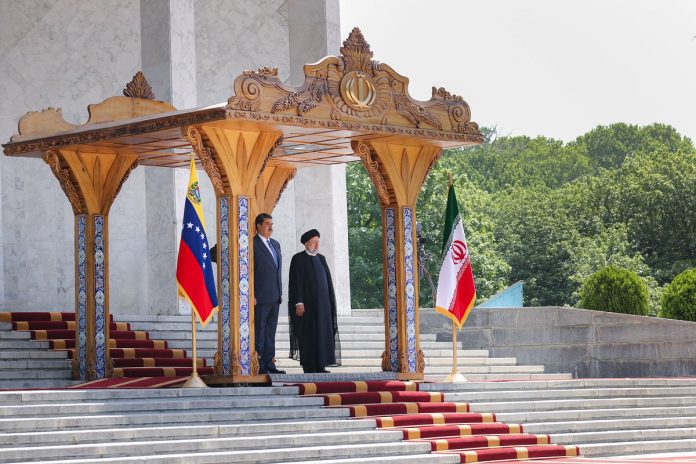
Rezan Tabatabai told ISNA that Maduro’s trip, which is part of his regional tour, is likely to see several agreements clinched between Tehran and Caracas, particularly in the area of trade.
“After this trip, Iranian President Ebrahim Raisi will, in response to his counterpart’s visit, most probably visit Venezuela,” said the expert.
“Trips to Tehran and Caracas by the presidents of both countries indicate senior officials of the two states have the political will to conduct major economic activities,” he added.
The former Iranian diplomat noted that Venezuela is notorious for suffering from “hyperinflation,” and that the value of the paper used to print money in the country is more that the money itself.
“Based on statistics and figures, Venezuela has got out of this situation to a great extent over the past one and a half years, and tried to tackle this problem by using certain solutions,” he explained.
Accordingly, he said, Venezuela has tried to open up its borders to foreign goods, reduce customs tariffs and sell more of its oil.
He added Venezuela has capitalized on the energy crisis caused by the Russia-Ukraine war and increased its oil exports.
The expert also urged Iran and Venezuela to do more serious planning to boot ties and also re-establish flights between the two countries.
The resolution was approved late on Wednesday by 30 votes in favor, three abstentions, and only two – Russia and China – against.
Johmouri Eslami, in an article on Saturday wrote that diplomatic efforts by the administration of former Iranian president Hassan Rouhani had cornered the US.
It noted that thanks to the Iranian diplomats during the former administration, the United Nations blocked a controversial bid by the US to re-impose sanctions on Iran in August 2020. Only Washington and a tiny nation voted for the move, the daily pointed out.
The daily also said the “ongoing plot” by the US and the European troika – namely Germany, France and Britain – against Iran can be rendered ineffective provided the Iranian delegation to the Vienna talks deals with the issue intelligently and the country forges a united front.
After the Board of Governors adopted the anti-Iran resolution, some Iranians raised the idea of quitting the UN Non-Proliferation Treaty (NTP), while some others said Iran should ignore the hostile move altogether.
Johmouri Eslami said that the wide range of disparity shows lack of a cohesive stance among the decision-makers, warning that walking down the path could put Iran under Chapter Seven of the United Nations Charter, which can ultimately put Iran and the West on a collision course.
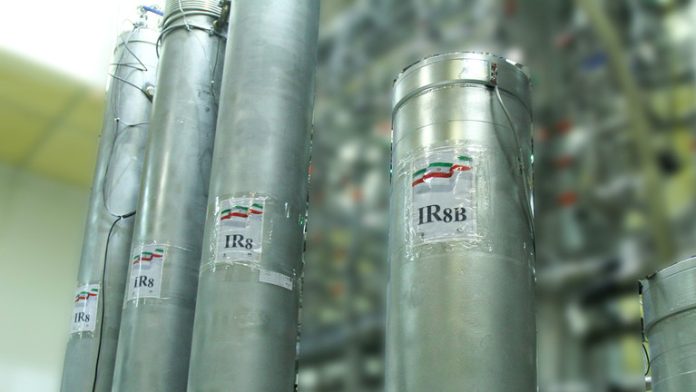
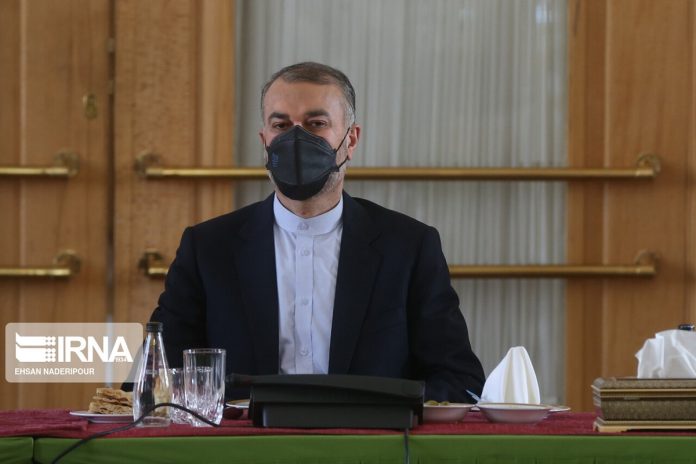
“Nuclear technology is a complex one. Only when a country develops its knowhow in the domains of physics, mathematics, chemistry and different dimensions of science and technology can it achieve nuclear technology,” said Hossein Amirabdollahian.
“Today, anyone who is in possession of nuclear knowhow enjoys the highest scientific status,” he explained.
“A country which has nuclear knowhow enjoys knowhow in all technical-engineering fields as well as all areas of science and technology,” he added.
The top diplomat noted Iran wants nuclear knowhow for the welfare of the nation.
“Under no circumstances will we give up developing nuclear technology,” he stressed.
Elsewhere in his remarks, the foreign minister underlined Iran has also made great breakthroughs in its defense sector.
“Today, we have missiles with pinpoint accuracy in order to defend the country,” he said.
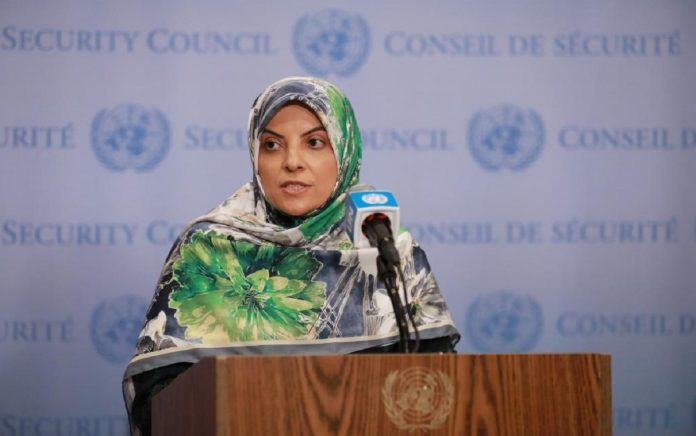
Addressing the UN General Assembly on eliminating AIDS/HIV on Friday evening, Zahra Ershadi said, “Unfortunately, the unilateral hostile measures, including those sanctions imposed on economic, financial and banking sanctions in Iran, have seriously violated the Iranians’ right to access healthcare.”
She added the punitive measures spearheaded by the US, have blocked the channels for international cooperation and are a source of concern as they have hampered Iran’s efforts to combat AIDS/HIV, as well as the timely and effective access to diagnosis and medicine.
The Iranian envoy said, “Iran condemns such illegal and unjust actions and such illegitimate policies that affect the health sectors of countries and interrupt healthcare services to patients.”
Iran has been subject to a broad scope of unilateral economic, trade, and financial sanctions by the US since the victory of Iran’s Islamic Revolution in the late 1970s.
United Nations Special Rapporteur, Alena Douhan, who was on a mission to Iran from May 7 to 18, described US sanctions on Iran as unjustifiable and inhumane.
Zelensky warns all of Europe a ‘target’ for Russia
Ukrainian president Volodymyr Zelensky has warned that “all of Europe is a target for Russia”.
“This is why a positive EU response to the Ukrainian application for membership can be a positive answer to the question of whether the European project has a future at all,” he said.
Zelensky made the comments during a meeting with European Commission president Ursula Von der Leyen in Kyiv.
She told him the EU executive’s opinion on Ukraine’s membership bid will be ready by the end of next week.
Zelensky called for a new round of “even stronger” EU sanctions against Russia.
He expressed his gratitude for the sanctions the bloc had already put in place against Moscow.
“I am grateful to the European Union for its sanctions policy against the Russian Federation, which is very helpful in our struggle,” he said, adding, “However, the war, unfortunately, is still going on, so the seventh package of sanctions is needed.”
EU assessment on Ukraine membership to be ready next week: Top diplomat
European Commission President Ursula von der Leyen has told President Volodymyr Zelensky in Kyiv that the EU executive’s opinion on Ukraine’s request to join the European Union would be ready by the end of next week.
In a press conference, Von der Leyen stated discussions with Zelensky “will enable us to finalise our assessment by the end of next week,” about whether to recommend Ukraine as a candidate for membership.
“You have done a lot in strengthening the rule of law but there is still need for reforms to be implemented, to fight corruption for example,” she told the Ukrainian president.
High risk for cholera in Mariupol: WHO
The World Health Organization has warned it sees a “high” risk for a cholera outbreak in the devastated Ukrainian city of Mariupol, but that so far there has been no confirmed cases.
“WHO has not received an alert or notification of any suspected or confirmed cases,” a spokesperson stated in Geneva.
Mayor Vadym Boichenko, who is no longer in the Russian-occupied port city, and the British Defence Ministry recently warned that Mauripol faced a looming cholera outbreak.
Zelensky warns of food crisis, urges end to Russian blockade
Ukrainian President Volodymyr Zelensky has urged international pressure to end a Russian naval blockade of Black Sea ports that has choked off his country’s grain exports, threatening a global food crisis.
“The shortage of foodstuffs will inexorably lead to political chaos, which can result in the [collapse] of many governments and the ousting of many politicians,” he said in a video address to the Shangri-La Dialogue security summit in Singapore.
“This looming threat is plain to see by just looking at the skyrocketing prices of basic products in the world markets and in certain countries. This is the direct consequence of the acts of the Russian state,” he added.
Kyiv is in discussion with the UN, Turkey and other countries to open a way to allow the grain exports, and Zelenskyy said the talks are focused on the “format” of the corridor.
Macron says France unwilling to make concessions to Russia
France is unwilling to make concessions to Russia and wants Ukraine to win the war against Moscow’s invading forces with its territorial integrity restored, a French presidential official has said, as Paris seeks to assuage concerns over its stance in the conflict.
President Emmanuel Macron has been criticised by Ukraine and eastern European allies after an interview quoted him as saying it was vital not to “humiliate” Russia so that when the fighting ends there could be a diplomatic solution.
“As the president has said, we want a Ukrainian victory. We want Ukraine’s territorial integrity to be restored,” the official told reporters when asked about Macron’s comments.
“There is no spirit of concession towards Putin or Russia in what the president says. When he speaks to him directly, it is not compromise, but to say how we see things,” the official added.
Up to 300,000 tonnes of grain in destroyed warehouses in Ukraine
Up to 300,000 tonnes of grain may have been stored in warehouses that Kyiv says were destroyed by Russian shelling last weekend, deputy agriculture minister Taras Vysotskyi has said.
Speaking on national television, Vysotskyi stated, according to records, at the start of the war on February 24 the warehouses at one of Ukraine’s largest agricultural commodities terminals in the Black Sea port of Mykolaiv held 250,000-300,000 tonnes of grain, mainly wheat and corn.
Zelensky adviser concedes huge Ukrainian military losses
The Ukrainian Armed Forces can admit to having lost around 10,000 personnel since the beginning of the Russian military offensive in late February, presidential aide Alexey Arestovich indicated, while claiming Moscow’s losses are significantly higher.
Russian sources believe that Kiev is significantly underestimating its casualties.
In an interview with activist and YouTuber Mark Feygin, Arestovich revealed that “at the beginning of the conflict, 100 people died per day on average.”
“But in the Russian army, 1,000 per day died in the first 20-30 days. Now 200-300 die, no less,” he stated, without proving any evidence to support his assertion.
He claimed that Friday was an “unusual day” for the Ukrainian Army, as “600 people [died] in one day, no less.”
“It will be like this: one to five, one to three, one to six, it will fluctuate like this,” Arestovich added.
Feygin asked if it is possible, based on these calculations, to say that the Ukrainian Army had lost up to 10,000 soldiers.
“Yes, something like that,” he replied.
Zelensky says new air strikes launched in Russian-held Kherson
Ukrainian President Volodymyr Zelenskyy said Kyiv has launched new air strikes in the captured southern region of Kherson, one of the first areas to be taken by Russia after the February 24 invasion, as “very difficult battles” are ongoing in the eastern Donbas region.
He added that Ukraine must “not allow the world to divert its attention away from what is happening on the battlefield”.
Britain says Russian forces have not made advances into the south of Severodonetsk
Russian forces around Ukraine’s Severodonetsk have not made advances into the south of the city, Britain’s Defence Ministry has said in its daily intelligence update.
“Intense street to street fighting is ongoing and both sides are likely suffering high numbers of casualties,” the ministry wrote on Twitter.
It added Russian medium bombers have likely launched dozens of 1960s era Kh-22 (NATO designation, AS-4 KITCHEN) air-launched, heavy anti-ship missiles, which are “highly inaccurate and can therefore cause significant collateral damage and civilian casualties.”
Russian passports to be distributed in parts of Zaporizhzhya
Russian passports will be distributed in parts of Zaporizhzhya starting on Saturday, a member of the occupying authority has announced.
Recipients will be considered full Russian citizens, Vladimir Rogov told Russian broadcaster Rossiya-24.
Rogov stated more than 70,000 people had submitted applications in the region. Moscow simplified the process for receiving a Russian passport in May and proceeded to distribute the documents in occupied areas.
Ukraine reports deaths of 24 more children in Mariupol
The office of Ukraine’s prosecutor general claims it has learned about the deaths of 24 more children in Mariupol, bringing the total to 287 children killed since the start of the Russian invasion.
“During the recording of criminal offences, it has become known that 24 more children died in Mariupol, Donetsk region, as a result of the indiscriminate shelling by the Russian military,” the office said on the Telegram messaging app.
“These figures are not final, as work is underway to establish them in places of active hostilities, in the temporarily occupied and liberated territories,” it added.
Russia has denied targeting civilians and has rejected allegations of war crimes.
Zelensky calls for weapons, says world must not look away
Ukrainian President Volodymyr Zelensky stated Kyiv has launched new air strikes in the captured southern region of Kherson, one of the first areas to be taken by Russia after the February 24 invasion, as “very difficult battles” are ongoing in the eastern Donbas region.
“Ukrainian troops are doing everything to stop the offensive of the occupiers,” Zelenskyy said in an address.
“As much as the heavy weapons, modern artillery — all that we have asked and continue to ask our partners for — allow them to,” he continued.
He added that Ukraine must “not allow the world to divert its attention away from what is happening on the battlefield”.
Growing concerns about Russian artillery superiority: ISW
The Institute for the Study of War says Ukraine is making more urgent requests for sophisticated Western weaponry as a result of concerns about Russia’s superiority in artillery.
It cites a senior military intelligence official saying that Russian troops have 10 to 15 artillery pieces for every one held by Ukrainian forces.
“Considering the current prevalence of protracted positional battles, especially in the Severodonetsk- Lysychansk area, Ukrainian forces urgently need fresh supplies of artillery systems,” ISW announced in its latest update on the war.
“As Ukrainian forces use the last of their stocks of Soviet-era weapon systems and munitions, they will require consistent Western support to transition to new supply chains of ammunition and artillery systems. Effective artillery will be increasingly decisive in the largely static fighting in eastern Ukraine,” it added.
Mariupol mayor: Russia demolished 1,300 high-rise buildings in city without removing dead bodies of residents
Russian forces occupying the ruined Ukrainian city of Mariupol have demolished 1,300 high-rise apartment buildings without carefully removing hundreds of dead bodies buried under the rubble, Ukrainian mayor of Mariupol Vadym Boychenko said on Friday.
Speaking on the city council’s Telegram, Boychenko — who has fled Mariupol for Ukrainian controlled territory — stated people remaining inside the city have told him, “Initially, the occupiers involved Mariupol residents in dismantling the rubble carefully.”
But Boychenko noted when the Russians saw the actual number of bodies found under the rubble, they immediately moved the local residents away from the area.
“The real number of bodies under the rubble of destroyed houses is frightening. Almost 50 to 100 people were killed under almost every destroyed house, and 1,300 high-rise buildings were destroyed in Mariupol,” Boychenko added.
Boychenko stated that because demolition of buildings has been carried out indiscriminately, the bodies of Mariupol residents killed in the fighting have been removed to landfill together with the concrete rubble.
On May 25, an adviser to the mayor, Petro Andriushchenko — who has also moved to Ukrainian-held territory — told CNN that Mariupol town hall officials believe at least 22,000 residents of the city were killed during three months of war.
Boychenko on Friday stated “Unfortunately, the real numbers of those killed in the city may be much higher than we reported.
The Ukrainian presidency has described the number of civilians killed in the city as being in the “tens of thousands.”
Biden says Zelenskyy ‘didn’t want to hear it’ on Russian invasion
US President Joe Biden has said that President Volodymyr Zelensky “didn’t want to hear it” when US intelligence had information that Russia was preparing to invade, according to the Associated Press.
“Nothing like this has happened since World War II. I know a lot of people thought I was maybe exaggerating. But I knew we had data to sustain he (Russian President Vladimir Putin) was going to go in, off the border,” Biden told Democratic donors in Los Angeles.
“There was no doubt. And Zelensky didn’t want to hear it,” he added.
37,000 women are in Ukraine army: First lady
Ukrainian first lady Olena Zelenska has said on Telegram that 37,000 women are in the Ukrainian army and over 1,000 women have become commanders.
“Most of our doctors are women, as well as 50 percent of our entrepreneurs, who work to support the economy at war,” she added.
Serbian president appears to reject call for sanctions on Russia
Serbian president Aleksandar Vuvic appears to have rejected calls from German chancellor Olaf Scholz for his country to join the European Union in imposing sanctions on Russia over its invasion of Ukraine.
Scholz had previously said that Serbia, which is vying for EU membership, should join the European bloc in imposing harsh measures against Moscow.
“As far as sanctions are concerned we have different position…. We remember sanctions [against Serbia] and we do not think sanctions are efficient,” Vuvic added.
Serbia is in a complicated position given its long-standing special relationship with Russia.
Biden blames Russia’s war on Ukraine for continued high inflation
United States President Joe Biden has reacted to Friday’s Consumer Price Index report, which revealed continuing high inflation in the country, by blaming the high prices on Russia’s war on Ukraine.
“Even as we continue our work to defend freedom in Ukraine, we must do more—and quickly—to get prices down here in the United States,” Biden said in a statement.
“Putin’s Price Hike hit hard in May here and around the world: high gas prices at the pump, energy, and food prices accounted for around half of the monthly price increases, and gas pump prices are up by $2 a gallon in many places since Russian troops began to threaten Ukraine,” Biden added.
Nine European countries ask NATO to strengthen its eastern flank
The leaders of nine central and eastern European countries have asked NATO to strengthen its eastern flank following Russia’s invasion of Ukraine.
The leaders of Romania, Slovakia, Bulgaria, the Czech Republic, Estonia, Hungary, Latvia, Lithuania and Poland met in the Romanian capital, Bucharest, less than three weeks ahead of a NATO summit later this month in Madrid, Agence France-Presse reported.
Russia wants to destroy every city in the Donbas: Zelensky
President Volodymyr Zelensky has stated his army’s ability to hold off Russian forces in the Donbas region depends on the supply of Western weapons.
“The Ukrainian troops are doing everything to stop the offensive of the occupiers, as much as is possible. As much as the heavy weapons, modern artillery – all that we have asked for and continue to ask for from our partners – allow them,” he said in his nightly video address.
He added that Russia wants to destroy every city in the region.
“Every city – that’s not an exaggeration. Like Volnovakha, like Mariupol. All of these ruins of once-happy cities, the black traces of fires, the craters from explosions – this is all that Russia can give to its neighbours, to Europe, to the world,” he noted.
During a phone conversation, Amirabdollahian underlined that the Islamic Republic of Iran has always been and will always stand with the government and people of Syria.
The top Iranian diplomat said the continuation of the Zionist regime’s attacks against the infrastructure installations of Syria including airports, ports and other key and vital centers of the country constitutes not only a violation of Syria’s sovereignty and territorial integrity, but also a breach of all international rules and norms as well as humanitarian laws.
He described as regrettable and shameful the unacceptable silence of world countries and the international community as well as regional and international bodies.
During the telephone conversation, Syrian Foreign Minister Faisal Mekdad said the Zionist regime’s attacks are aimed at strengthening the remnants of terrorist groups including Daesh and al-Nusrah Front in Syria.
Mekdad reiterated the Zionists are bent on disrupting peace and stability in the region with the aim of covering up their unstable and fragile situation.
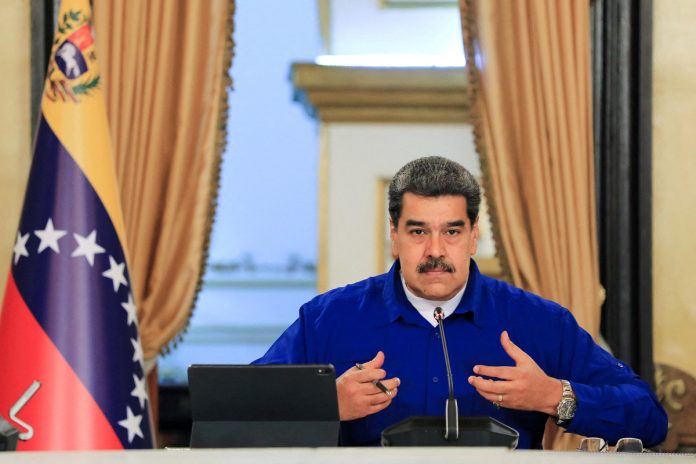
FILE PHOTO: Venezuelan President Nicolas Maduro speaks during an event at Miraflores Palace, in Caracas, Venezuela, June 6, 2022. Miraflores Palace/Handout via REUTERS
Maduro, who arrived in Tehran on Friday at the head of a high-ranking politico-economic delegation, made the remarks in an exclusive interview with Iran’s Spanish-language television channel Hispan TV.
Venezuela and Iran are on the frontline of shaping a world free of imperialism and dominant powers, Maduro stated.
The era of the United States’ military dominance of the world is over, the Venezuelan president added.
Venezuela and Iran should share knowledge in all fields to create a new world, Maduro noted, underscoring the fact that humanity is transitioning and a new geopolitical system would be established in the world.
The president hailed Iran’s courageous move to send fuel tankers to his energy-hungry nation, saying Tehran’s delivery of oil to Caracas was great help to the Venezuelan people.
Iran sent fuel to Venezuela despite US sanctions and threats, Maduro underlined.
Iran and Venezuela have managed to withstand economic pressure from the United States, and have closely cooperated to offset the impact of illegal sanctions, particularly those targeting their energy sectors.
Iran has supplied fuel shipments and equipment needed in crude refineries to Venezuela in the face of US pressure on the country’s shipping and trade services. Venezuela has also received major shipments of condensate, a diluent of heavy oil, from Iran.
Oil industry analysts announced in January that Venezuela had doubled its oil production thanks to Iran’s help in defiance of US sanctions against Caracas. The Venezuelan oil production reached an estimated average of 900,000 barrels per day (bpd) in December and could reach 850,000 bpd in January, oil industry sources told the Miami Herald.
Venezuelan oil experts confirmed the significant growth in the country’s production, underlining that the Iranian naphtha is essential for the government in Caracas to be able to sell crude from the Orinoco Oil Belt, which needs to be diluted to be sold on world markets.
Elsewhere in his interview, Maduro said Venezuela and Iran have enjoyed brotherly ties for decades, reiterating his country’s resolve to achieve a higher level of cooperation with Tehran. He added Caracas and Tehran have revolutionary backgrounds and they have always supported one another in hard times.
Maduro also stated that the two countries are working to expand cooperation in tourism sector and establish direct flights between Caracas and Tehran.
He said Venezuela welcomes and invites investments from Iran, noting that a delegation, which is currently accompanying him, aims to find ways to improve relations. Venezuela and Iran would open a new era in mutual relations, Maduro added.
He noted many companies are willing to work in Venezuela, which by itself vindicates the fact that resisting the US sanctions will eventually bear fruit.
The Venezuelan president underscored the need to well inform the Iranian and Venezuelan nations about the war of sanctions and find ways to counter them with steadfastness. Maduro stated Caracas and Tehran have shaped the strategy of resistance economy and are working to expand it.
He underlined the incorporation of people in the governments’ efforts is among key strategies to counter sanctions.
Bahram Einollahi urged people to get their booster shots and also do their utmost to observe health protocols.
According to Einollahi, people need to stick to those protocols when they take part in gatherings.
Einollahi thanked Iran’s healthcare staff for their enormous efforts to contain the pandemic and appreciated Iranian scientists, too, for producing 6 kinds of vaccine for Covid.
Iran’s Health Ministry announced Friday zero deaths from Covid over the past 24 hours, the second time since the outbreak of the pandemic in early 2020.
The country experienced 700 deaths and more than 50,000 infections daily just a few months ago.
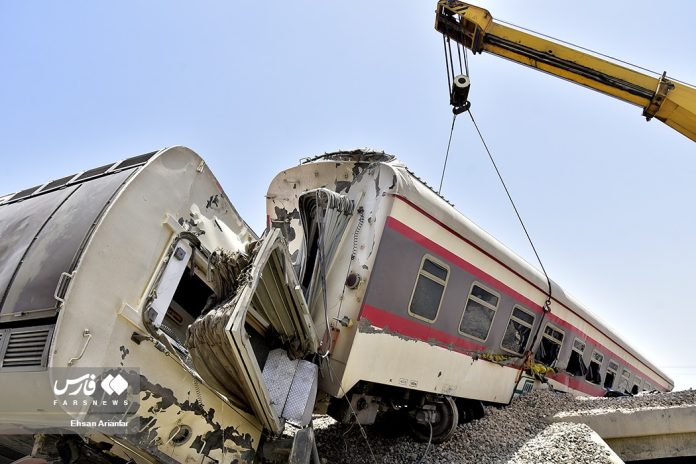
In the video, workers were trying to lift a derailed car using a crane but the car’s huge weight caused the crane to lose balance and get titled to one side.
There is no word on any injuries following this incident.
The train derailed after hitting an excavator that was on the railroad in Iran’s South Khorasan province.
22 people died and dozens sustained injuries in the derailment. The derailed train was travelling from the northeastern city of Mashahd to Yazd.
Hassan Beheshtipour said the resolution that was approved by the agency’s Board of Governors several days ago is important in terms of its legal effect.
Beheshtipour acknowledged that China and Russia will veto any attempt against Iran at the UN Security Council even if the IAEA resolution sends the Iranian case to the council.
However, he noted that the agency’s resolution could help European members of the Iran nuclear deal to trigger the snapback mechanism, which will automatically reinstate the Security Council sanctions on Iran.
Beheshtipour said the fact that 30 out of 35 members of the IAEA board of governors voted for the anti-Iran resolution shows that the motion has been substantiated.
He stressed that Iran should avoid letting the gap between the country and the IAEA go deeper because this will provide an opportunity to exploit the gap.
The political expert also said the Islamic Republic should make an effort to prevent similar resolutions to be passed as the Zionist regime would be more than happy to see Iran and the agency pitted against each other.
According to Beheshtipour, Tehran should also avoid repeating its past bitter experiences. The expert then pointed to a demand by some observers inside Iran that Tehran consider leaving the NPT if the case is referred to the UN Security Council.
Beheshtipour said this is a repeat of Tehran’s policy under a former Iranian administration that was in office from 2006 to 2010.