Sunday, December 28, 2025
Home Blog Page 180

President Pezeshkian says Iran not seeking war, vows to resist assault

In a candid conversation with a number of Iranian political activists from across the spectrum, Pezeshkian said: “We do not want war, and we have said this from the very beginning. But we are not afraid of war either. Our people have also shown that if war is imposed, national unity and solidarity will emerge even more strongly.”

Pezeshkian warned that the United States and Israel are seeking to divide and overthrow Iran.

He emphasized the necessity of unity among political factions as well as the people in confronting adversaries, saying: “We must foster cohesion and solidarity inside the country. If we achieve unity, our strength will be inexhaustible, because when the people stand together, no power will so easily dare to covet our country.”

Referring to the recent 12-day war waged by the United States and the Zionist regime against Iran, he added that the enemies believed Iran was at its weakest point.

“They assumed that once they attacked, on the second or third day the people would flood the streets, and soon the system, the revolution, and the country would collapse.”

The President continued: “Iran belongs to all of our people; it is not the property of one particular group. The enemies never thought we would endure, but we stood firm. We are not seeking war, but if anyone seeks to invade, we will resist with strength.”

Iranian FM highlights diplomatic efforts amid regional tensions

In an article published by the Iran newspaper, Araghchi said more than 60 phone and video calls were held with foreign ministers worldwide during the 12-day conflict, emphasizing Iran’s right to self-defense under the UN Charter.

“Iran was not and will not be the initiator of war,” he noted, adding that Tehran would “never hesitate to defend its people and territory.”

He highlighted that nearly 120 countries and several international organizations condemned the Israeli attacks, calling it a sign of Iran’s growing diplomatic influence.

The minister also pointed to strengthened regional ties, particularly with Persian Gulf states, Turkey, and Pakistan, while maintaining strategic channels with Syria and Lebanon to secure access to the Mediterranean.

Araghchi said Iran’s foreign policy remains focused on “active, inclusive, and effective diplomacy,” balancing crisis management with economic initiatives.

These include expanding trade with neighboring countries, boosting regional connectivity, and deepening cooperation within blocs such as BRICS, the Shanghai Cooperation Organization (SCO), and the Eurasian Economic Union.

Trump admin. to revoke visas for PLO and PA members ahead of UN General Assembly 2025

Secretary of State Marco Rubio announced on Friday that he would be denying and revoking visas to Palestinian officials who wish to attend the 80th UNGA session in New York City, which opens on 9 September 2025.

“The Trump Administration has been clear: it is in our national security interests to hold the PLO and PA accountable for not complying with their commitments, and for undermining the prospects for peace,” the announcement read.

It’s unclear if PA President Mahmoud Abbas, who is supposed to attend the UNGA session to deliver an address, is included in the restrictions.

The PA is the governing body that has overseen areas of the occupied West Bank since 1994, as part of the Oslo Accords peace agreement between Israel and the PLO. The PLO is an umbrella political coalition that is internationally recognised as the official representative of the Palestinian people in both the Palestinian territories and the diaspora.

The Trump administration on Friday demanded that the PLO and PA “consistently repudiate terrorism”, citing the 7 October 2023 attacks on southern Israel, and that they must stop “incitement to terrorism in education”, according to a US State Department press release.

The Palestinian Authority on Friday announced it felt “deep regret and astonishment” at the decision of the US State Department not to grant visas to the Palestinian delegation scheduled to participate in next month’s United Nations General Assembly in New York City.

Part of the agreement with the UN is that the host country for its headquarters allows all heads of state to address the annual gathering.

The Palestinian Authority “stressed that this decision stands in clear contradiction to international law and the UN Headquarters Agreement, particularly since the State of Palestine is an observer member of the United Nations,” the Palestine Mission to the UK posted on X.

Abbas condemned the attacks on Israel in June this year in a letter to French President Emmanuel Macron and Saudi Crown Prince Mohammed bin Salman ahead of a UN conference on a two-state solution.

Rubio’s announcement added the PA must halt efforts “to bypass negotiations through international lawfare campaigns”, including appeals to the International Criminal Court and International Court of Justice, and efforts to secure the unilateral recognition of a conjectural Palestinian state”. The Trump administration cites these two actions as having “materially contributed to Hamas’s refusal to release its hostages, and to the breakdown of the Gaza ceasefire talks.”

The ICC issued arrest warrants for Israeli Prime Minister Benjamin Netanyahu and former Defence Minister Yoav Gallant in 2024, while the ICJ found a plausible case for genocide in 2024.

On 31 July, the US first announced it was imposing sanctions and would deny visas to PLO members and PA officials.

US federal judge refutes Saudi Arabia’s efforts to dismiss 9/11 lawsuit

11 September

US district judge George Daniels, in a 45-page opinion, rejected Saudi Arabia’s effort to claim sovereign immunity, saying that while the kingdom “attempts to offer seemingly innocent explanations or context, they are either self-contradictory or not strong enough to overcome the inference” that Saudi Arabia employed two men to assist the hijackers involved in the attacks.

Daniels found that the plaintiffs, the families of the 9/11 victims, offered credible evidence that two men, Omar al-Bayoumi, an accountant for a Saudi aviation company, and Fahad al-Thumairy, a diplomat stationed in the Saudi consulate in Los Angeles, had a role in assisting the hijackers.

Daniels said it was “more likely than not” that there was “some connection” between the employment of Bayoumi and Thumairy by Saudi Arabia and the assistance they allegedly provided to the hijackers who lived in the US.

He added that the evidence presented by the plaintiffs “casts doubt” on whether Bayoumi was merely sent to pursue studies in the US, as lawyers for the Saudi government claim.

“By getting himself involved into the hijackers’ preparation for a terrorist attack, Bayoumi appears to have done much more than what a typical accountant or data processing technician would do,” Daniels wrote, referring to what his official job titles were.

Daniels did not make any decision on Saudi Arabia’s potential culpability.

Saudi Arabia can still appeal Daniels’ decision or reach a settlement with the victims’ families to prevent the case from going to trial.

Saudi Arabia has long attempted to quash the case. The kingdom is pursuing liberalising social reforms under Crown Prince Mohammed bin Salman. He has curbed the power of the religious police and has tried to lure investment firms and tourists to the country.

At the same time, the 39-year-old crown prince has cracked down on any form of political dissent.

Daniels’ decision was welcomed by lawyers and other representatives of the 9/11 victims’ families.

“Today’s decision is another powerful step toward justice,” Terry Strada, the chair of a coalition representing victims’ families and survivors, stated.

Almost 3,000 people were killed in the 9/11 attacks. The victims’ families and survivors have waged a 23-year legal battle to take Saudi Arabia to trial over the attack. The Gulf state is one of the world’s largest oil exporters and home to a sovereign wealth fund valued at over $1 trillion.

The Saudi Public Investment Fund (PIF) owns approximately $20bn in US-listed stocks alone, not including real estate and other investments.

The decision by Daniels was made possible because of a 2016 law passed by Congress called the Justice Against Sponsors of Terrorism Act, which allowed the 9/11 victims’ families to sue Saudi Arabia.

The law gives a broad scope for foreign governments to be sued in US federal court if they played any role in terrorist attacks that killed Americans on US soil.

It has real-world implications.

Oftentimes, it can be difficult for US courts to enforce their rulings against defendants abroad. The law allows for US courts to seize any Saudi assets held in the US to pay the 9/11 victims’ families if their suit is successful.

Former Iranian FM warns parliament against pushing for leaving NPT 

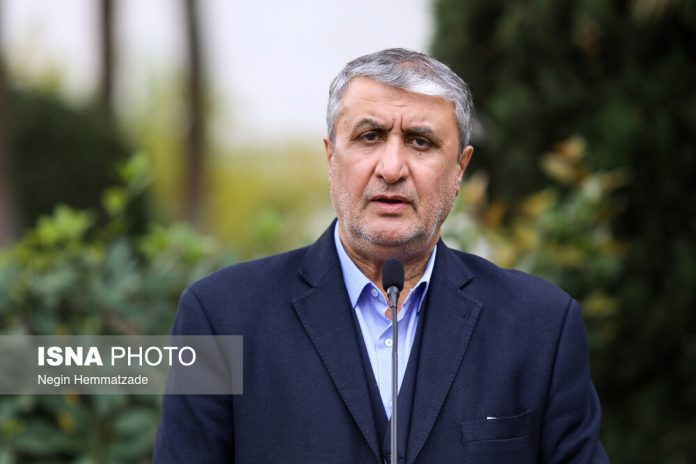
Salehi made the remark in an interview with Entekhab onlione news outlet when he was asked about the parliamentary initiative to withdraw from the NPT.

The ex-head of the Atomic Energy Organization of Iran also said the issue of leaving the NPT has both a religious dimension and a governmental dimension. He added that, in his view, discussing this matter is exclusively within the leader’s jurisdiction, as his decree carries both religious and governmental authority.

Salehi underlined that individuals or governmental bodies, such as parliament, should not express opinions on such matters without consulting the leader, because such statements could be exploited by enemies due to Iran’s unique position in the international arena, potentially complicating the country’s diplomatic efforts.

Kayhan editor-in- chief: E3  snapback move continuation of 12-day war

as a continuation of the recent 12-day war waged by the Zionist regime against Tehran.
He slammed the E3 after the three European powers submitted a letter to the UN Security Council to trigger the “snapback” mechanism and reinstate UN sanctions on Tehran.

In an editorial, Shariatmadari described the move as “illegal, humiliating, and extortionate”, opposing continued negotiations with Europe under such conditions.

He noted that Washington’s concern lies less with Iran’s nuclear program and more with its growing technological and military power.

He further welcomed a decision by Iranian lawmakers to draft a triple urgent bill to compel the government to withdraw from the Nuclear Non-Proliferation Treaty (NPT). Shariatmadari said the move is a necessary “retaliatory measure”.

Iran urges EU to stop “selective interpretations” of JCPOA

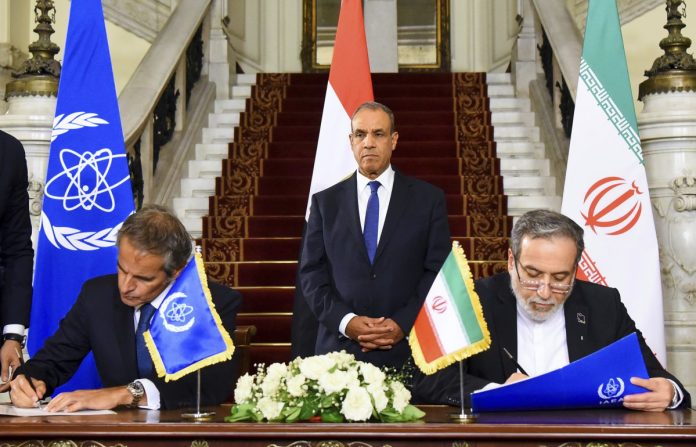
Abbas Araghchi

In a letter to EU foreign policy chief Kaja Kallas, who serves as coordinator of the JCPOA Joint Commission, Araghchi criticized “biased and distorted narratives” regarding the implementation of the deal and its dispute-resolution mechanism.

The remarks followed the decision by the three European parties to the JCPOA to trigger the snapback mechanism at the UN Security Council in order to reinstate sanctions on Iran.

He reiterated that Iran activated the mechanism in May 2018 after the US withdrawal from the JCPOA and Europe’s “failure to fulfill commitments to normalize trade and economic ties with Iran.”

He added that Russia and China also reject European attempts to trigger the mechanism or reinstate UN sanctions.

Araghchi also said the EU and the E3, France, Germany, and the UK, have failed to meet key obligations, including those tied to the JCPOA’s “transition day” in October 2023, ignoring illegal attacks on Iran’s nuclear sites by the US and Israel.

Despite the criticism, Araghchi emphasized that Iran “remains committed to diplomacy” and is prepared to resume “fair and balanced negotiations,” provided other parties demonstrate seriousness.

Iran’s ambassador denies Australia’s anti-Semitism allegations

Speaking to reporters at Sydney Airport, Sadeghi also dismissed Australia’s renewed travel warning advising citizens not to visit Iran, stating that Australians “will be safe” if they travel to the country.

The move follows comments by Australian Prime Minister Anthony Albanese, who reiterated his government’s advice against travel to Iran and announced plans to designate Iran’s Islamic Revolution Guard Corps (IRGC) as a “terrorist organization,” citing alleged links to anti-Semitic incidents in Melbourne and Sydney last year.

Sadeghi said the accusations were “part of a conspiracy” aimed at undermining relations between the two countries and said Australia’s actions were influenced by “the anger of the Zionist regime” over Canberra’s stated intention to recognize an independent Palestinian state.

The ambassador added that despite the diplomatic tensions and his expulsion, “Iran has very good feelings toward Australia,” highlighting a “positive mission” during his two-and-a-half-year tenure.

Sadeghi condemned last year’s anti-Semitic attacks in Australia but denied any Iranian involvement.

Iranian lawmaker chides European move on JCPOA dispute mechanism

In an interview with Tasnim News Agency, Boroujerdi said the European action is “mainly an attempt to exit political isolation and to project influence in international affairs,” adding that its primary purpose is to exert “psychological and economic pressure” on the Iranian public.

He noted that the US unilaterally withdrew from the deal in 2018 and argued that European signatories have also failed to uphold their commitments. “If there is any violator of the JCPOA, the US comes first, with the Europeans in second place,” he said.

Boroujerdi added that Russia and China, both permanent members of the UN Security Council, have openly rejected the European move, making a return of pre-2015 UN sanctions unlikely.

He emphasized that Iran will not yield to external pressure and remains committed to the peaceful use of nuclear technology.

Spox: E3 Move Against Iran Follows Orders of JCPOA Violator

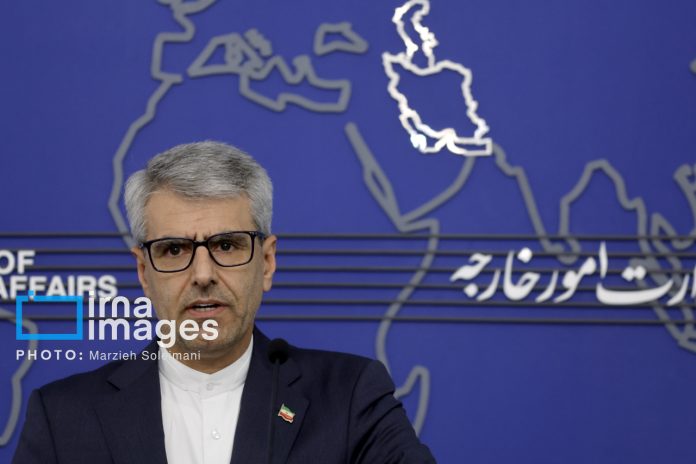
Esmael Baghaei

In a post on the social media platform X, Ismail Baghaei, questioned the independence and “credibility” of the three European states, the UK, Germany, and France, as “negotiating partners.”

He stressed that their attempt to revive the annulled UN Security Council resolutions against Iran reflects a distorted notion of a “credible negotiating partner” in a so-called rules-based international order—one in which force creates rights and the “chief violator” dictates the rules of the game.

According to Baghaei, the decision of the three European countries to initiate the process of reimposing the canceled Security Council resolutions against Iran stems neither from a legal obligation nor from a rational assessment.

He added that, as US Secretary of State Marco Rubio admitted in his August 28 press statement, the move is based on a directive from the US President under Presidential Memorandum No. 2 dated February 4, 2025.

Baghaei underlined that this is being driven by a party that is not a JCPOA member, has been the main violator and destroyer of the agreement, unilaterally withdrew from it in 2018, and triggered a chain of adverse developments that continues to this day.