Zelensky: Ukraine will retaliate against every Russian strike
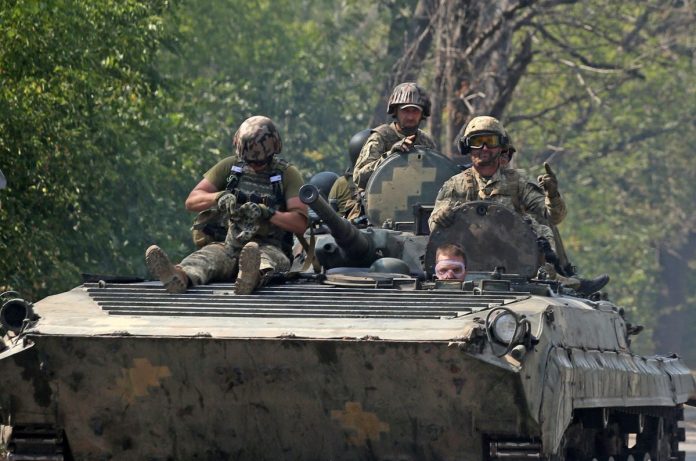
Ukraine’s President Volodymyr Zelensky has promised that every Russian strike on his country would be answered.
In a video address to the nation, Zelensky said: “We will not leave any of these [Russian] strikes unanswered. We will establish the identity of every occupier who gives orders and executes these strikes at cities.
“And we will bring them all to justice in one way or another. No murderer will hide,” he added.
Attacks rock Russian-held areas far from Ukraine war front lines
Russia has reported new Ukrainian drone attacks, a day after explosions erupted near military bases in Russian-held areas of Ukraine and Russia itself, apparent displays of Kyiv’s growing ability to pummel Moscow’s assets far from front lines, Reuters reported.
The latest incidents followed huge blasts last week at an airbase in Russian-annexed Crimea. In a new assessment, a Western official stated that incident had rendered half of Russia’s Black Sea naval aviation force useless in a stroke.
Russia’s RIA and Tass news agencies, citing a local official in Crimea, reported it appeared Russian anti-aircraft forces had been in action near the western Crimean port of Yevpatoria on Friday night. Photos and Videos showed what appeared to be a ground-to-air missile hitting a target.
Tass cited a local official as saying Russian anti-aircraft forces knocked down six Ukrainian drones sent to attack the town of Nova Kakhovka, east of the city of Kherson. Ukraine says retaking Kherson is one of its main priorities. Separately, an official in Crimea noted defences there had downed an unspecified number of drones over the city of Sevastopol.
“The Ukrainian armed forces treated the Russians to a magical evening,” added Seriy Khlan, a member of Kherson’s regional council disbanded by Russian occupation forces.
The night before, multiple explosions had been reported in Crimea, including near Sevastopol, the headquarters of Russia’s Black Sea Fleet, as well as at Kerch near a huge bridge to Russia.
Inside Russia, two villages had been evacuated after explosions at an ammunition dump in Belgorod province, more than 100 kilometres from territory controlled by Ukrainian forces.
Russian-occupied part of Zaporizhzhia says it’s exporting 7,000 tonnes of grain per day
The Russian-occupied part of Ukraine’s region of Zaporizhzhia is exporting up to 7,000 tonnes of grain per day, Russian-installed authorities there have said.
Ukraine has accused Russia, the world’s largest wheat exporter, of stealing grain from territories that Russia’s army has seized since the invasion began on Feb. 24. Moscow denies this.
The Russian-controlled part of Zaporizhzhia, located southeast of Ukraine, is transporting up to 5,000 tonnes of grain per day by railway, and between 1,500 and 2,000 tonnes per day by vehicle, Yevgeny Balitsky, the head of the Russian-installed administration there stated, Reuters reported. He did not say where the exports were heading.
He noted supplies should rise when the Russia-controlled Ukrainian port of Berdyansk on the Azov Sea starts handling grain soon.
“The issue is about to be resolved, and we will also start loading dry cargoes to Turkey. Farmers will be able to sell their grain to Turkey, Saudi Arabia, the Middle East, Egypt – the standard markets,” Balitsky added.
US to buy about 150,000 metric tonnes of grain from Ukraine in coming weeks
The United States is planning to buy about 150,000 metric tonnes of grain from Ukraine in the next few weeks for an upcoming shipment of food aid from ports no longer blockaded by war, the World Food Programme chief has told the Associated Press.
The final destinations for the grain are not confirmed and discussions continue, WFP’s chief David Beasley added.
But the planned shipment, one of several the UN agency that fights hunger is pursuing, is more than six times the amount of grain that the first WFP-arranged ship from Ukraine is now carrying toward people in the Horn of Africa at risk of starvation.
The keenly awaited first aid ship from Ukraine is carrying 23,000 metric tonnes of grain, enough to feed 1.5 million people on full rations for a month, Beasley said. It is expected to dock in Djibouti on Aug. 26 or 27, and the wheat is supposed to be shipped overland to northern Ethiopia, where millions of people in the Tigray, Afar and Amhara regions have faced not only drought but deadly conflict.
Ukraine was the source of half the grain that WFP bought last year to feed 130 million hungry people. Russia and Ukraine signed agreements with the UN and the Turkish government last month to enable exports of Ukrainian grain for the first time since Russia’s invasion in February.
But the slow reopening of Ukraine’s ports and the cautious movement of cargo ships across the mined Black Sea won’t solve the global food security crisis, Beasley continued. He warned that richer countries must do much more to keep grain and other assistance flowing to the hungriest parts of the world, and he named names.
Two more ships carrying grain have left Ukraine: Turkey
Two more ships carrying grain have left Ukraine’s Chornomorsk port, Turkey’s Defence Ministry announced on Saturday, bringing the total number of vessels to leave Ukraine’s Black Sea ports under a UN-brokered grain export deal to 27.
The Zumrut Ana and MV Ocean S, which are authorised to depart on Aug. 20, were loaded with 6,300 tonnes of sunflower oil and 25,000 tonnes of wheat respectively, the joint coordination centre set up to enable safe passage said in a statement, Reuters reported.
The Authority said Ukrainian-origin food would be delivered to France, Sudan, Turkey and the Netherlands.
Only minimal changes in territorial control along Ukraine front line: UK
The last week has seen only minimal changes in territorial control along the front line, a UK Ministry of Defence Intelligence update has said.
In the Donbas, after small advances from early August, Russian forces have approached the outskirts of the town of Bakhmut, but have not yet broken into the built-up area, the ministry announced in its report.
“It is unlikely that the situation will significantly change in the next week. Russian forces are, for now, probably only prepared to undertake limited local assaults, rarely involving more than a company of troops,” the update added.
However, over the coming months the initiative will go to whichever side manages to generate a credible, committed force for offensive operations, the ministry predicted.
Ukraine conflict is at an “operational standstill” and Russia faces munitions shortages: Western officials
The conflict in Ukraine is near an operational standstill, with neither side able to generate sufficient ground combat capability to influence the course of the war, according to Western officials.
At a briefing on Friday, the officials said both sides were having manpower issues, with nearly six months of conflict bringing serious attrition of their forces. Those manpower problems are a contributing factor to the strategic deadlock, they added.
Speaking about the pace of the Russian offensive in the Donbas, the officials noted, “There was a real high point. We aren’t at that high point any more; the tempo has slowed down.”
The officials said Russia was having a “terrible time” in trying to reconstitute its forces — for example, by merging battalion tactical groups.
They also added that a “looming issue” for Russia is an increasingly acute shortage of stocks, even of basic munitions, with evidence that older munitions are being taken out of storage.
“Ultimately, that will impair the Russians’ ability to launch offensives,” they continued.
US has doomed EU to hunger and cold: Russia
The United States has doomed the EU to hunger, cold and isolation by pressuring the bloc to cut its ties with Moscow, Russian State Duma Speaker Vyacheslav Volodin said.
He wrote on Telegram that Washington would “stop at nothing to cling to its power over the world as it throws under the bus the citizens’ welfare and the economies of European countries to achieve this end.”
He noted that natural gas in the US costs $333 per 1,000 cubic meters.
“At the same time, Washington sells it to Europe for a price which is 7.3 [times] higher, rendering the EU economy uncompetitive,” he stated, adding that the eurozone’s annual inflation rate had hit a record 8.9%.
Volodin said Europe had been hit by a heatwave that triggered huge problems in the agriculture sector, as well as an energy crisis which had seen prices soar six times in one year.
The EU’s decision to phase out Russian energy supplies and cut economic ties with Moscow “have been made under Washington’s pressure,” the State Duma speaker claimed.
“US policies in Europe are enforced by England that has left the EU high and dry, as well as by a number of countries that are sovereign in name only – Lithuania, Latvia, Estonia, Ukraine – with Poland, the Czech Republic and Finland joining this Russophobic coalition in the hopes of getting an American handout,” Volodin continued.
Satellite images show no signs of “systemic shelling” at nuclear plant despite Russia’s claim
There are no signs of “systemic shelling” at the Zaporizhzhia nuclear power plant, new satellite images from Maxar Technologies show.
This counters Friday’s claims by Russian President Vladimir Putin that the Ukrainian military was conducting repeated military strikes at the plant.
The latest satellite images from Maxar Technologies were taken Friday morning.
CNN has analyzed a number of satellite images of the nuclear power plant complex located in Enerhodar, Ukraine, and it shows little to no change in damage or destruction since July 19, when a Ukrainian military strike on three tents just under 1,000 feet from one of the nuclear reactors.
Putin made the comments to French President Emmanuel Macron, according to a Kremlin readout of the phone call.
Putin has agreed to a mission from the International Atomic Energy Agency (IAEA) to access the Zaporizhzhia Nuclear Power Plant via territory controlled by Ukrainian forces during a call with Macron, according to a source from the Élysée Palace.
Western officials say Russian Black Sea fleet is in defensive posture after setbacks, including Crimea attack
Western officials said that the Russian Black Sea fleet had gone into a defensive posture after a series of setbacks. They said that at least half of the Black Sea Fleet’s naval aviation arm had been taken out of action in the attack on Saki air base in Crimea last week.
The naval aviation arm of the fleet, the 34th Naval Ground Attack Aviation Regiment, has two squadrons of roughly two dozen combat aircraft altogether (including Su-24M and Su-30SM aircraft), according to published accounts. Previous assessments suggested at least seven — and maybe as many as 10 — aircraft had been damaged or destroyed in last week’s attack.
Russia still has dozens of combat planes at two other bases in the Crimea, but they are not specifically assigned to the Black Sea fleet.
The officials stated at a briefing on Friday that the Russian “system” was seeking to apportion blame for the losses, which the Russian defense ministry attributed to an accidental explosion of ammunition at the base.
The officials noted the Ukrainian side was probably able to bring several assets to bear in Crimea and that Ukrainian forces do have the ability to operate behind Russian lines. Whether Ukrainian attacks in the south would have a strategic effect on the conflict would depend on whether Ukraine can sustain the level of activity, they added.
The officials said that Russian forces were experiencing problems in resupplying troops in the southern Kherson region, and they estimated that somewhere in the “low thousands” of additional Russian troops had been moved to the region in preparation for a possible Ukrainian offensive.
It remained to be seen, they added, how and when that offensive might take shape.
The officials announced that the rise in rocket attacks by the Russians against Kharkiv, which have killed more than a dozen people in recent days, did not presage a Russian offensive in the area but a desire to prevent the redeployment of Ukrainian defenses elsewhere.
US monitoring Zaporizhzhia nuclear plant situation “very, very closely”: Defense official
As the US government closely watches the situation at the Zaporizhzhia nuclear power plant in Ukraine, a senior US defense official says Russia has shown a “complete disregard” for the security of Ukraine’s nuclear facilities and that its actions around the plant now are “the height of irresponsibility.”
“This is a situation that the US government across the board and the national security community is watching very, very closely. We are very concerned about military operations at or near any of Ukraine’s nuclear power facilities and very concerned about any reports of damage to specifically Zaporizhzhia power lines,” the official stated, speaking to reporters in a news briefing on Friday.
“We’ve been very clear that fighting near a nuclear power plant is dangerous, is irresponsible and we want the fighters and Russia to operate with extreme caution and conduct no actions that would result in a potential radiological release,” the official continued.
“We see Russia’s current actions in and around the plant as really the height of irresponsibility,” the official added.
The US expects Russia to return full control of the plant to Ukraine and to comply with International Atomic Energy Agency safeguards, as well as provide access to the plant, noted the official.
Zelensky thanks Biden for new $775 million military aid package
Ukrainian President Volodymyr Zelensky on Friday expressed his gratitude to US President Joe Biden following news that the United States would give an additional $775 million in military assistance to Ukraine through his presidential drawdown authority.
With this latest package, the Biden administration has now committed more than $10 billion in security assistance to Ukraine. This is the 19th package the US Department of Defense has provided Ukraine since August 2021.
The package includes equipment such as howitzers, ammunition, armor and drones.
US Treasury official to visit India amid Ukraine tensions
A top Treasury Department official is set to make his first official trip to India since the start of the war in Ukraine, amid tensions over New Delhi’s neutral stance on the Russian invasion.
Treasury Deputy Secretary Wally Adeyemo will travel to Mumbai and New Delhi next week for meetings with officials from the Prime Minister’s Office, the finance ministry, the Reserve Bank of India, and the Ministry of Petroleum and Natural Gas.
The visit will aim to deepen ties with the South Asian nation, which will lead the Group of Twenty intergovernmental forum in 2023.
India has maintained its business ties with Russia, depending on the Kremlin for energy and other exports.