IAEA board passes resolution to demand Russia leave Zaporizhzhia
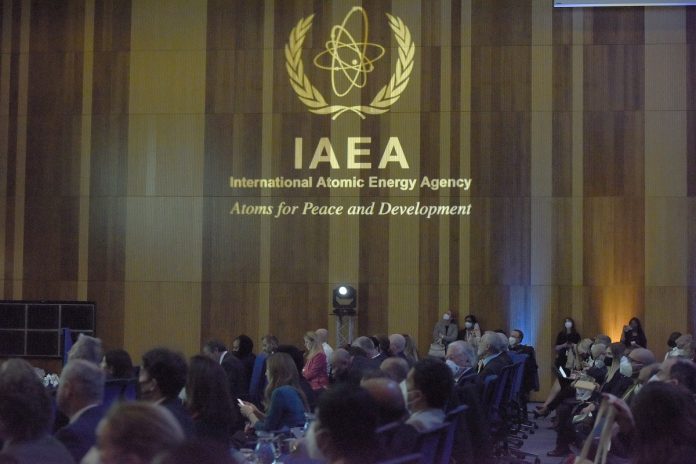
The United Nations (UN) nuclear watchdog’s 35-nation Board of Governors has passed a resolution demanding that Russia end its occupation of the Zaporizhzhia Nuclear Power Plant in Ukraine.
The resolution, which says the board calls on Russia to “immediately cease all actions against, and at” the Zaporizhzhia plant and “any other nuclear facility in Ukraine”, was passed with 26 votes in favour, two against, and seven abstentions, diplomats said.
Russia and China were the only countries that voted against the resolution.
US imposes new sanctions on facilitators of Russia’s war in Ukraine
The United States on Thursday imposed new sanctions on individuals and groups that have facilitated Russia’s war in Ukraine, the Treasury Department said on Thursday.
The new sanctions target 22 individuals and two entities that advanced Moscow’s objectives in Ukraine both before and after Russia’s February invasion of its neighbor, the department announced in a statement.
The new sanctions are being imposed in coordination with the Commerce Department, which is imposing new export controls on Russia, and the State Department, which is targeting Russia’s defense and high-technology industries, the statement added.
“As Ukraine presses forward with defending its freedom, today we’re taking steps to further degrade Russia’s ability to rebuild its military, hold perpetrators of violence accountable, and further financially isolate Putin,” Treasury Secretary Janet Yellen noted.
Air defences a priority to protect Ukraine: Zelensky
Speaking at a joint news conference with EU Commission President Ursula von der Leyen, President Volodymyr Zelensky said Ukraine’s air defence systems were a priority to protect the country from Russian strikes.
Zelensky added that Ukraine had not yet received a positive response from Israel on the possible supply of aerial and air defence systems promised previously by Germany, and the United States had not yet arrived in Ukraine.
Ukraine could receive $1.4bn in emergency aid: IMF
The International Monetary Fund says it could provide about $1.4bn in emergency aid to Ukraine almost immediately if its executive board approves a new “food shock window”.
The additional funds were discussed earlier this week.
In Sarajevo, IMF officials met Ukrainian officials this week as they prepare to launch an in-person mission to start technical discussions, likely in Vienna, on a potential full-fledged programme in the “near future”, IMF spokesman Gerry Rice told reporters on Thursday.
Freedom is ‘priceless’: EU chief
Supporting Ukraine comes at a high cost, but “our freedom, the international peace order, and democracy, is priceless,” the EU chief Ursula von der Leyen has said when asked by Reuters about the potential impact of Europe’s unfolding cost of living and energy crises.
The EU’s sanctions on Russia are having a deep and visible impact, she also told the news agency during an interview in Kyiv, shortly after she met Ukraine’s President Volodymyr Zelensky.
The European commission president noted she is impressed with the speed at which Ukraine is proceeding to become an EU member.
“The accession process is well on track. It’s impressive to see the speed, the determination, the preciseness with which you are progressing”, she stated during a news conference with Zelensky in Kyiv.
US to send more Ukraine security aid soon: White House
The United States is preparing to send Ukraine another package of security assistance, according to John Kirby, Coordinator for Strategic Communications at the National Security Council in the White House.
He declined to give further details in an interview with MSNBC, but noted that the United States is still very worried about the situation at the Zaporizhzhia nuclear power plant.
More settlements in Kherson region liberated: Ukrainian officials
While most of the Beryslav district in the southern Kherson region remains under Russian control, several villages have been liberated — including Novovorontsovka on the Dnipro river — according to Dmytro Slyvchenko, head of the district council.
The village had 6,500 people before the war, but the population has gone down to only 400, he said.
“People have already started to come back to these liberated villages, to their homes, and started renovating their damaged houses, even though there is still shelling from the occupiers from time to time,” Slyvchenko added.
In Russian-controlled Beryslav, he stated there is no gas and electricity is intermittent, but the hospital is still open.
Ukrainians don’t want to cede territory
Some 87 per cent of Ukrainians oppose any territorial concessions to Russia, according to a poll released today by a top Ukrainian pollster, marking an increase on earlier surveys.
The survey conducted by the Kyiv International Institute of Sociology showed an absolute majority of Ukrainians in every region were opposed to their country giving away territory under any circumstances, even if this meant prolonging the war.
The figure marks an increase in the number of people opposed to territorial concessions recorded in previous KIIS surveys, from 84 per cent in July and 82 per cent in May.
The latest survey, which canvassed the views of 2,000 people on Sept. 7-13, coincided with a Ukrainian counter-offensive that has recaptured swathes of land in the northeast Kharkiv region, lifting national morale and raising hopes of further territorial gains before the winter sets in.
Despite the recent gains, however, Russian forces still hold around 20 per cent of Ukrainian territory.
EU chief talks Ukraine ‘accession’ with Zelensky in Kyiv
EU commission president Ursula von der Leyen is in Kyiv to work out a roadmap for Ukraine’s long-standing aspiration of joining the European Union.
Von der Leyen visit is her third to Ukraine since Russia invaded in February.
“So much has changed. Ukraine is now an EU candidate,” she said on social media.
“I’ll discuss with [President Volodymyr] Zelensky and (Prime Minister) Denys Shmygal how to continue getting our economies and people closer while Ukraine progresses towards accession,” she added.
Ukraine gained EU candidacy status in June at the same time as ex-Soviet state Moldova, which borders Ukraine and like its neighbour has had Russian troops stationed in an eastern breakaway region.
1,000 bodies discovered in Izyum
Ukrainian officials say that 1,000 bodies have been found in Izyum after the city was liberated from Russian occupiers.
The death toll is higher than in Bucha, the scene of appalling Russian war crimes against civilians earlier this year.
Ukraine needs $350bn to rebuild: Germany
German Economy Minister Robert Habeck has stated that Ukraine needs 350 billion dollars for reconstruction, according to Kyiv’s estimates.
Habeck welcomed G7 trade ministers during a meeting at Neuhardenberg Castle in the state of Brandenburg on Thursday.
Ukraine continues to consolidate its control in Kharkiv area: UK
Ukrainian forces continue to consolidate their control of newly liberated areas of Kharkiv Oblast, Britain’s defence ministry announced.
Russian forces have largely withdrawn from the area west of the Oskil River, the MoD said in its daily intelligence bulletin on Twitter.
High-value equipment abandoned by retreating Russian forces included capabilities essential to enable Russia’s artillery-centric style of warfare, the tweet added.
Ukrainian FM calls missile strike a ‘war crime’
Ukraine’s Minister of Foreign Affairs, Dmytro Kuleba, tweeted about the missile strike on the water dam in Kryvyi Rih and said, “Russian missile strike on Kryvyi Rih hydraulic structures is a war crime and an act of terror.
“Beaten by Ukrainian army on the battlefield, Russian cowards are now at war with our critical infrastructure and civilians. Russia is a terrorist state and must be recognised as such,” he added.
Path to return of all our territories getting clearer: Zelensky
President Volodymyr Zelensky addressed supporters and commented on the success of the counteroffensive and said, “The path to the return of all our territories is getting clearer.”
“We see the contours of restoration of our state’s territorial integrity. We know this is a hard path, but it is possible to pass it. And we are doing that,” he added.
Xi: “China is ready to work with Russia” on respective “core interests”
In his first face-to-face meeting with Russian President Vladimir Putin since Moscow’s invasion of Ukraine, Chinese President Xi Jinping pledged “strong support” for their “respective core interests,” according to according to Chinese state news agency Xinhua.
“China is ready to work with Russia in extending strong support to each other on issues concerning their respective core interests,” Xi said to Putin during the Shanghai Cooperation Organization summit in in Samarkand, Uzbekistan.
“China is also willing to deepen pragmatic cooperation in such areas as trade, agriculture and connectivity,” and the two countries should “expand pragmatic cooperation, safeguard security and interests of the region, and preserve the common interests of developing countries and emerging market countries,” Xi added.
Xi called for both China and Russia to “strengthen coordination” within the SCO, the Conference on Interaction and Confidence Building Measures in Asia, the BRICS — Brazil, Russia, India, China and South Africa — and “other multilateral mechanisms to promote solidarity and mutual trust among related parties.”
Putin slams “unipolar world” attempts in Xi meeting
Russian President Vladimir Putin has hit out at “attempts to create a unipolar world” after meeting Chinese counterpart Xi Jinping at the Shanghai Cooperation Summit in Samarkand, Uzbekistan.
Putin also thanked Beijing for its “balanced position” on Ukraine, admitting its concerns over the crisis are understandable.
The Russian president told Xi that Moscow backs Beijing’s “One China” policy, opposes “provocations” by the United States in the Taiwan Strait.
China’s leader stated Beijing was willing to work with Moscow as “great powers”.
Residents asked to evacuate areas of Kryvyi Rih after Russian missiles hit reservoir
Residents in districts across Kryvyi Rih were asked to evacuate their homes on Thursday, after Russian missile strikes destroyed a water pumping station, causing the Inhulets River to break through a dam.
“Dear residents of Kryvyi Rih, today the Russians committed another terrorist act. Eight cruise missiles hit a very large hydrotechnical structure in Kryvyi Rih. The effort is to simply wash away part of our city with water,” the head of the city’s civil military administration Oleksander Vilkul said in a Telegram post.
“We are monitoring the situation…all services are involved; everyone is on the ground. But the water level in the Inhulets River has risen. In order to avoid unnecessary risks, I am asking people [to evacuate],” Vilkul added, urging residents in almost two dozen districts to wait for communal buses to take them out of at-risk areas.
On Wednesday, Ukrainian President Volodymyr Zelensky stated Russian missile strikes had targeted and hit the dam of the Karachunivske Reservoir in Kryvyi Rih.
The strikes destroyed a water pumping station and flooded the embankments, which are just a few meters from residential buildings, according to Ukrainian legislator Inna Sovsun.
US would cross ‘red line’ if they supply Ukraine with HIMARS missiles: Russia
Russia’s foreign ministry said that if the United States decides to supply Kyiv with longer-range missiles for US-made HIMARS systems in use by Ukraine, it would cross a “red line” and become “a party to the conflict”.
In a briefing on Thursday, Foreign Ministry spokeswoman Maria Zakharova added that Russia “reserves the right to defend its territory”.
Russia’s Putin meets with Iran’s Raisi
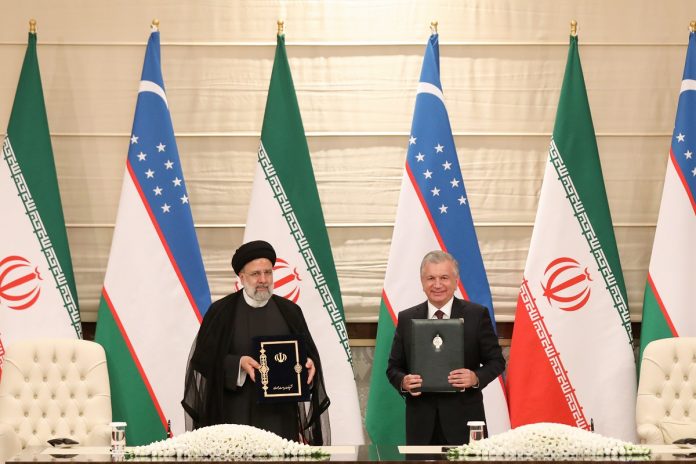
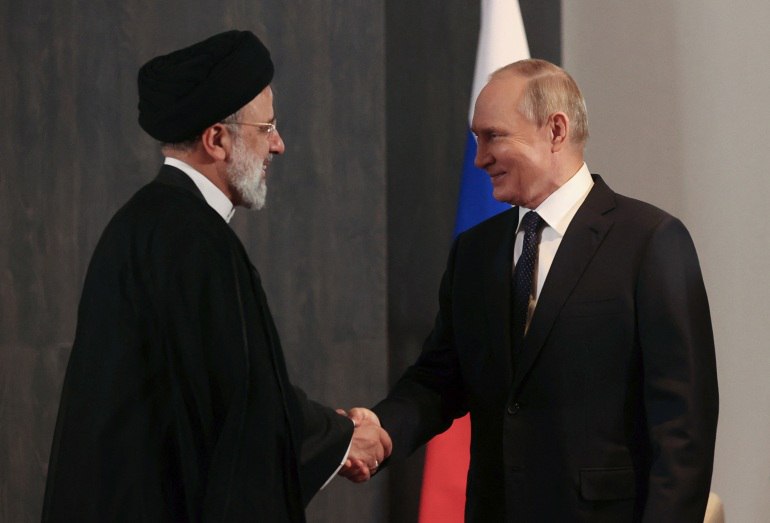
During the Shanghai Cooperation Organisation (SCO) summit in Uzbekistan, Russian President Vladimir Putin met with Iranian President Ebrahim Raisi.
A delegation of 80 large companies will visit Iran next week, Russian state-owned news agency RIA reported citing Putin.
Ukrainian military says there has been a significant decline in Russian shelling in some areas
The Ukrainian military announced that Russian shelling in the Kharkiv region has significantly decreased since the success of the counteroffensive there.
However, in its operational update, the military’s General Staff said that Russian artillery fire continued to bombard areas of Donetsk, especially around Bakhmut and Avdiivka. It also added Russian efforts to push forward in several districts of Donetsk had been rebuffed.
It also reported widespread Russian shelling of settlements in the Zaporizhzhia region, where Russian forces are resisting efforts by Ukrainian forces to take territory in the direction of Mykolaiv and Kherson.
The military said that the Russians were trying to withdraw S-300 air defense systems “deep into the temporarily captured territories and into the territory of the Russian Federation.”
Russian air defenses have become more vulnerable since Ukraine acquired US-made the High-Speed Anti-Radiation Missile (HARM).
The General Staff noted the Ukrainian Air Force had been active, carrying out 11 strikes, and Ukrainian missile units had attacked “areas of concentration of manpower and combat equipment of the enemy,” including in Kherson.
The threat of Russian cruise missile attacks still persists.
Kyrylo Tymoshenko, deputy head of the Ukrainian President’s Office, stated on Telegram that eight Russian cruise missiles had been aimed at the city of Kryvyi Rih Wednesday. He said they targeted critical civil infrastructure, but there were no civilian victims.
Ukraine’s Volodymyr Zelensky was involved in a minor car crash in Kyiv: President office
Ukrainian President Volodymyr Zelensky was involved in a minor car crash in Kyiv on Wednesday, according to a statement from the president’s press secretary.
The president was examined by a doctor and did not have any serious injuries, the statement said.
“In Kyiv, a car collided with the car of the President of Ukraine and escort vehicles. Medics accompanying the Head of the state provided the driver of the car with emergency aid and transferred him to an ambulance,” the statement read.
“The president was examined by a doctor, no serious injuries were found. The law enforcement officers will find out all the circumstances of the accident,” it added.
Town near Kherson city cleared of Russian forces: Local Ukrainian official
The head of the Kherson city council says that Ukrainian forces have liberated a town on the northern approaches to the city.
The town of Kyselivka was liberated “in close proximity to the regional center itself. The occupiers are panicking, and the local population is in a state of expectation,” Oleksandr Samoilenko told Ukrainian television.
Samoilenko’s comments were not confirmed by the Ukrainian military.
Natalia Humeniuk, the spokeswoman for Operational Command South was asked about the reports and would only say that it is “really bad and dangerous for military personnel when officials and the media say anything about settlements that were not confirmed as liberated by the command.”
Recent satellite imagery showed a number of Russian military vehicles still in Kyselivka, which is on the main road linking Mykolaiv —which is held by the Ukrainians — and Kherson city, which is still occupied.
On Monday, the Institute for the Study of War announced that satellite imagery of known Russian positions in Kyselivka, which is 15 kilometers northwest of Kherson city, showed that all but four Russian vehicles had left previous forward positions.
“The apparent withdrawal of Russian troops from this position may compromise the Russians’ ability to defend the northwestern outskirts of Kherson City and suggests that Russian troops in this area perceive an imminent threat to their positions,” the ISW added.
Kyselivka is about 12 kilometers from Kherson’s airport, which has been used as a command post and base by Russian forces.
Putin gave “no indication” of change in his attitude on Russia’s war in Ukraine: German chancellor
There is “no indication” that Russian President Vladimir Putin’s attitude regarding the war in Ukraine has changed, said German Chancellor Olaf Scholz during a news conference on Wednesday.
“Unfortunately, I can’t tell you that he has now come to realize that it was a mistake to start this war, and there is no indication that new attitudes are now emerging,” Scholz said about his phone call with Putin on Tuesday.
Scholz added he urged Russia to withdraw its troops from the region.
“It is still right to talk to each other and to say what I have to say on these issues from my point of view, because I am strongly convinced that Russia must withdraw … so that peace has a chance in the region,” Scholz said, adding, “And every day it becomes clearer that this is the only chance. We have to talk about that, and that is what I have done.”
Biden administration discussing new Russia measures with Congress: State Department
The Joe Biden administration is discussing with Congress “analogous measures” to impose on Russia in place of those carried by a “state sponsorship of terrorism” designation, US Department of State spokesman Ned Price has said.
“We’re discussing with Congress analogous measures,” Price told a news briefing, noting Biden’s recent statement that he would not approve designating Russia as a “state sponsor of terrorism”.
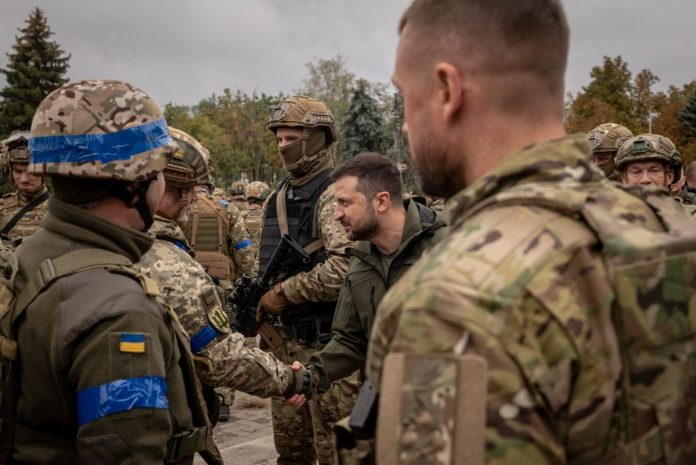
Zelensky pledges ‘victory’ on visit to liberated Kharkiv region
President Volodymyr Zelensky has promised “victory” on a visit to the strategic city of Izyum.
“Our blue-yellow flag is already flying in de-occupied Izyum. And it will be so in every Ukrainian city and village,” Zelensky said in a statement on social media.
“We are moving in only one direction – forward and towards victory,” he added.
Putin says ‘priority’ to send Ukraine’s grain to countries in need
President Vladimir Putin has told United Nations Chief Antonio Guterres during a phone call that the “priority” should be to send Ukrainian grain to countries in greatest need, the Kremlin has said.
During the conversation between the two men, “the attention was mainly focused on implementing the Istanbul agreements on exporting Ukrainian grain… Both sides emphasised the importance of meeting the needs, as a priority, of those in Africa, the Middle East and Latin America who need food,” the Russian presidency added in a statement.
Chance for peace ‘minimal’: UN chief
The prospects for peace in Ukraine are “minimal” at present, the United Nations chief has lamented after a telephone conversation with Vladimir Putin.
“I have the feeling we are still far away from peace. I would be lying if I would say it could happen soon,” Secretary General Antonio Guterres told a press conference.
“I have no illusion; at the present moment the chances of a peace deal are minimal,” he added, noting that even a ceasefire is “not in sight”.
US senators introduce bill to designate Russia ‘state sponsor of terrorism’
Democratic and Republican US senators have introduced legislation that would designate Russia as a “state sponsor of terrorism”, a label pushed for by Ukraine but opposed by President Joe Biden’s administration.
“The need for this measure is more pressing now than ever before,” Democratic Senator Richard Blumenthal, one of the bill’s sponsors, told a news conference, citing the killings of civilians and other “brutal, cruel oppression” in Ukraine since Russia’s invasion.
Republican Senator Lindsey Graham, another bill sponsor, said the designation would send a strong signal of support for Ukraine to Kyiv but also to US allies, while imposing stiff penalties on Russia like allowing it to be sued in US courts for its actions in Ukraine and tightening sanctions.
Putin hails ‘constructive cooperation’ with IAEA on Ukraine nuclear plant
President Vladimir Putin has hailed “constructive cooperation” with the UN’s nuclear watchdog over Ukraine’s Zaporizhzhia Nuclear Power Plant.
The International Atomic Energy Agency (IAEA) inspected the plant in early September following repeated bombardment.
The Kremlin announced that in a phone call with UN chief Antonio Guterres, “Vladimir Putin made a positive assessment of the constructive cooperation with the agency.”