Ukraine claims over 54,000 Russian troops killed since start of war
More than 54,000 Russian soldiers have so far been killed during the war in Ukraine, Kyiv claimed on Saturday.
Ukraine’s ministry of defence has given its latest update on Russia’s total combat losses since the war started in February this year.
The figures show that Vladimir Putin’s military forces have lost 54,250 troops, 2,202 tanks, and 4,701 armoured combat vehicles.
Ukrainian forces have also downed 251 military jets, 216 helicopters and 911 drones.
Russian troops ‘likely too weak’ to halt Ukraine advance: ISW
The Washington-based Institute for the Study of War (ISW) said in its Saturday report that satellite imagery suggested Ukraine troops crossed over to the east bank of the Oskil in the Kharkiv region, placing artillery there.
The river, which flows south from Russia into Ukraine, had been a natural break in the newly emerged front lines since Ukraine launched its push about a week ago.
“Russian forces are likely too weak to prevent further Ukrainian advances along the entire Oskil River if Ukrainian forces choose to resume offensive operations,” the institute added.
UK military: Russia scrambles to set up new defensive line
As Ukraine continues offensive operations in the northeast of the country, Russian forces have established a defensive line between the Oskil River and the town of Svatove, British military intelligence announced.
“Russia likely sees maintaining control of this zone as important because it is transited by one of the few main resupply routes Russia still controls from the Belgorod region of Russia,” the defence ministry said in a regular Twitter update.
“Any substantial loss of territory in Luhansk will unambiguously undermine Russia’s strategy. Russia will likely attempt to conduct a stubborn defence of this area, but it is unclear whether Russia’s front line forces have sufficient reserves or adequate morale to withstand another concerted Ukrainian assault,” it added.
Ukraine receives $1.5bn in new financial aid: PM
Ukraine’s Prime Minister Denys Shmyhal thanked the United States for its support after Ukraine received a further $1.5bn in international financial assistance.
“The state budget of Ukraine received a grant of $1.5bn. This is the last tranche of $4.5bn aid from the United States from World Bank Trust Fund,” Shmyhal tweeted.
He added the funds would be used to reimburse budget expenditure for pension payments and social assistance programmes.
US military intelligence says Putin unable to attain Ukraine goal
Setbacks for Russian forces and stretched resources in Ukraine show that Moscow’s forces are incapable of achieving President Vladimir Putin’s initial invasion aims as things stand now, the Pentagon’s intelligence chief has said.
“We’re coming to a point right now where I think Putin is going to have to revise what his objectives are for this operation,” Lieutenant General Scott Berrier, director of the Defense Intelligence Agency, told a conference.
“It’s pretty clear right now that he’s … not going to be able to do what he initially intended to do,” he added.
Russian forces have suffered major setbacks since the launch last week of a Ukrainian counteroffensive, which has forced Moscow’s troops back from large swaths of Ukraine’s northeast.
“The Russians planned for an occupation, not necessarily an invasion, and that has set them back,” Berrier stated, citing Putin’s reluctance so far to fully mobilise Russian forces to get more manpower into the fight.
US President Joe Biden and other administration officials have taken care not to call Russia’s latest retreat a Ukrainian victory or turning point in the war, and analysts caution that it is impossible to assess what may lie ahead in the conflict.
“He’s coming to a decision point,” Berrier said of Putin.
“What that decision will be we don’t know. But that will largely drive how long this conflict lasts,” the official added.
Berrier spoke at a panel with other senior officials at the intelligence community’s Intelligence and National Security Summit at National Harbor in Maryland just outside Washington.
CIA Deputy Director David Cohen said that Putin’s “risk appetite” should not be underestimated.
“I don’t think we should underestimate Putin’s adherence to his original agenda, which was to control Ukraine. I don’t think we’ve seen any reason to believe he has moved off that,” he added.
Biden warns Putin against escalating the fighting in Ukraine
President Joe Biden warned Russian President Vladimir Putin against escalating the fighting in Ukraine, saying that there will be consequences if the Kremlin uses chemical or nuclear weapons.
“Don’t. Don’t. Don’t. It would change the face of war unlike anything since World War II,” Biden stated during a 60 Minutes interview.
Asked by Scott Pelley what the US response would be if Russia used a chemical or nuclear weapon, Biden said it would be “consequential.”
“You think I would tell you if I knew exactly what it would be. Of course, I’m not going to tell you. It’ll be consequential. They’ll become more of a pariah in the world than they ever have been. And depending on the extent of what they do will determine what response,” Biden added.
Ukraine official: 99 percent of exhumed bodies had ‘violent death’
Ninety-nine percent of exhumed bodies had signs of violent death, Ukraine’s regional administration head said of the mass burial site discovered after Kyiv’s forces recaptured the east Ukrainian town of Isyum.
“Among the bodies that were exhumed today, 99 percent showed signs of violent death,” Oleg Synegubov, head of Kharkiv regional administration, stated.
“There’s likely more than 1,000 Ukrainian citizens tortured and killed in liberated territories of Kharkiv region”, he added.
Ukraine: urgently needed spare parts delivered to Zaporizhzhia nuclear plant
Ukraine’s state nuclear company Energoatom said urgently needed spare parts and diesel fuel had been delivered to the Zaporizhzhia atomic power station, which is occupied by Russian troops.
In a statement, Energoatom announced the parts would be used to repair damaged power lines and power generating blocks.
Both Moscow and Kyiv regularly accuse each other of shelling the facility, the largest of its kind in Europe.
Ukraine is “consolidating their gains” around Kharkiv: US
The US assesses that the Ukrainians are “consolidating their gains” from retaking territory in the area of Kharkiv, according to the Defense Department.
“In the north, what we assess is that the Ukrainians are consolidating their gains after taking back significant territory, and that the Russians are attempting to shore up their defensive lines after having been pushed back,” said Pentagon Press Secretary Air Force Brig. Gen. Pat Ryder at a briefing with reporters.
Ryder also noted that Ukrainian forces are making “deliberate, calculated forward movement” with their counteroffensive in the Kherson area.
“As always, our focus continues to remain on providing them the support that they need in their fight,” Ryder added.
Evidence of war crimes in Ukraine’s northeast: Zelensky
Ukrainian President Volodymyr Zelensky has said there is evidence that Russian forces committed torture and killed civilians in parts of the country’s northeast prior to withdrawing from the territories, likening the aftermath there to the one seen following Russia’s pullback from near Kyiv months ago.
In an interview at his office, Zelenskyy told the Reuters news agency an investigation was under way with international assistance and that there was clear evidence of Russian war crimes in the areas retaken by Ukrainian troops during a multipronged counteroffensive.
“As of today, there are 450 dead people, buried,” he stated, in an apparent reference to a reported mass grave in Izyum.
“But there are others, separate burials of many people. Tortured people. Entire families in certain territories,” Zelensky added.
Ukraine says over 1,000 people tortured, killed in Russia-occupied areas
The Ukraine parliament’s human rights commissioner announced that more than 1,000 people had been tortured and killed in Russian-occupied areas of Kharkiv region, according to Interfax news agency.
Dmytro Lubinets also stated that in the coming days Ukrainian authorities would release the exact number of people found at a mass burial site in the city of Izium.
Putin says Moscow not to blame for EU energy crisis
President Vladimir Putin has denied his country had anything to do with the energy crisis in Europe, and said that if European Union countries wanted more gas, they should ask Ukraine to open gas pipelines, and lift sanctions preventing the opening of the Nord Stream 2 Baltic pipeline.
Putin also blamed what he called “the green agenda” for the energy crisis, and insisted that Russia would fulfil its energy obligations.
Russia has cut off gas supplies to Bulgaria and Poland because they refused to pay in roubles rather than the currency of the contract. It has also shut down the Nord Stream 1 gas pipeline, which takes gas to Germany and other European buyers, arguing that Western sanctions are preventing vital repairs.
Western customers reject this justification as a spurious pretext for economic retaliation against countries that have imposed sanctions on Russia.
Blinken says China, India concerns on Ukraine put pressure ‘to end aggression’
US Secretary of State Antony Blinken has said that concerns on Ukraine heard by Putin at a summit from Chinese and Indian leaders put pressure on him to end the war.
“I think what you’re hearing from China, from India, is reflective of concerns around the world about the effects of Russia’s aggression on Ukraine, not just on the people of Ukraine,” Blinken told reporters.
“I think it increases the pressure on Russia to end the aggression,” he added.
UN General Assembly to allow Zelensky to speak by video
UN member states have voted to make an exception to allow Ukrainian leader Volodymyr Zelensky to address next week’s General Assembly by video.
Of the 193 member states, 101 voted in favour of allowing Zelensky to “present a pre-recorded statement” instead of in-person as usually required at the UNGA. Seven members voted against it, including Russia, and 19 abstained.
White House calls reports of mass burial site in Ukraine “repugnant” and “horrifying”
The White House said reports of a mass burial site in the eastern Ukrainian city of Izium are “horrifying” and “repugnant.”
John Kirby, the strategic communications adviser at the National Security Council, said the discovery of what Ukrainian officials say is at least 440 graves at the site was “in keeping with the kind of depravity and the brutality with which Russian forces have been prosecuting this war against Ukraine and the Ukrainian people.”
Kirby added the United States would continue to “actively support efforts to document war crimes and atrocities that Russian forces commit in Ukraine and assist national and international efforts to identify and hold Russians accountable.”
Ukraine’s Center for Strategic Communications said on Thursday that some of the graves discovered at Izium were “fresh” and that the bodies buried there were “mostly civilians.”
Izium was subject to intense Russian artillery attacks in April, and the city, which sits near the border between the Kharkiv and Donetsk regions, became an important hub for the invading military during five months of occupation.
Putin says West wants breakup of Russia, he invaded Ukraine to stop it
President Vladimir Putin has accused the West of wanting to break up Russia, adding he sent forces into Ukraine in February to prevent this.
Speaking at the Shanghai Cooperation Organisation (SCO) summit, and discussing the war publicly for the first time since Ukraine routed Russian troops in the Kharkiv region last week, Putin threatened strikes on Ukrainian infrastructure, and stressed, “We will see how.”
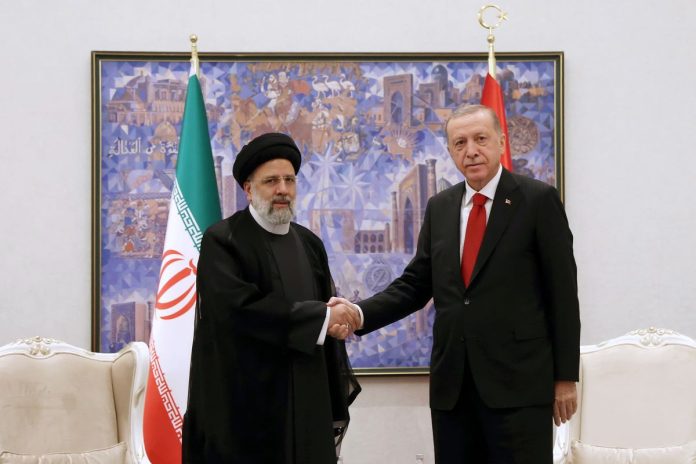
Putin has praised Turkish President Recep Tayyip Erdogan’s efforts to end the war in Ukraine, but said Ukrainian President Volodymyr Zelensky was not prepared to hold peace talks.
The Russian president noted Erdogan was always proposing meetings with Zelensky – although he had not done so at their meeting this time in Samarkand – and that the Turkish leader had made a “significant contribution” to attempts to end the conflict.
Putin added there were no plans to adjust Russia’s military operations in Ukraine despite a counteroffensive, stating Moscow was in no rush to finish the campaign.
“The plan is not subject to adjustment,” Putin told reporters.
“Our offensive operations in Donbas itself do not stop. They are going at a slow pace … the Russian army is occupying newer and newer territories,” Putin said, adding, “We are not in a hurry … there are no changes.”
Macron condemns ‘atrocities’ in Izyum
French President Emmanuel Macron has condemned what he described as the “atrocities” committed in the eastern Ukrainian city of Izyum, which Kyiv’s forces have recaptured from Russian troops.
Those responsible “will have to answer for their acts”, he tweeted,noting, “There is no peace without justice.”
Sanctions on Russia working: Italy’s PM
International sanctions on Russia are working and support for Ukraine must continue until it has won the war, Italy’s prime minister has said.
“Sanctions work. Russian propaganda has tried to show that they do not work, but they do work,” Mario Draghi told a news conference, adding, “It is necessary to continue supporting Ukraine until the liberation war is won.”
Bodies with tied hands found at Izyum mass grave: Governor
Bodies with their hands tied have been unearthed from a mass burial site in the recaptured town of Izyum, in Ukraine’s northeastern Kharkiv region, according to a regional official.
“We are at the site of the mass burial of people, civilians who were buried here, and now according to our information they all have the signs of violent death,” Oleg Synegubov, the governor of the Kharkiv region, said from the area.
“There are bodies with hands tied behind [their backs]. Each fact will be investigated and will be properly and legally evaluated,” he added.
Ukraine has accused Moscow’s forces of carrying out a slew of war crimes during their offensive, including the torture and killing of civilians in various parts of the country – charges Russia has routinely denied as false.
Blinken says Russia acting ‘horrifically’ after mass graves in Ukraine
US Secretary of State Antony Blinken has noted Russia was behaving “horrifically” and was likely responsible for war crimes after the discovery of mass graves in Ukraine.
“This is part, horrifically, of a continuing and ongoing story whenever we see the Russian tide recede from the parts of Ukraine that it’s occupied. We see what’s left in its wake,” Blinken told reporters.
Rosneft says it could challenge Germany in court over subsidiary move
Rosneft has announced it could go to court to challenge a decision by Berlin to take the firm’s German subsidiary under trusteeship.
In a statement, Rosneft said the move was illegal. Germany, citing the need to protect the economy, is taking over the business’s Schwedt refinery, which supplies 90 percent of Berlin’s fuel.
Modi tells Putin now ‘is not an era of war’
India’s prime minister has told President Vladimir Putin that now is not a time for war, with food, fertiliser and fuel security among the major concerns of the world at present.
“I know that today’s era is not an era of war, and I have spoken to you on the phone about this,” Modi told Russia’s leader on the sidelines of the Shanghai Cooperation Organisation (SCO) meeting in Uzbekistan.
India has not publicly criticised Moscow’s offensive since Russia launched its invasion in late February and in recent months has moved to increase its purchase of Russian oil, coal and other exports.
Putin has told Modi that he wants the war in Ukraine to end “as soon as possible”, adding he understands that India has concerns about the war.
“I know about your position on the conflict in Ukraine, and I know about your concerns. We want all of this to end as soon as possible,” the Russian president told the Indian PM.