Ukraine declares 4 organizers of “pseudo referendum” as criminal suspects
The Security Service of Ukraine (SBU) said on Monday that it had notified four Russian-backed officials in occupied Ukraine that they are criminal suspects for their role in organizing so-called secession referendums in the Donetsk and Luhansk regions.
“The Ukrainian special service established that these individuals played key roles in the organization and holding of a fake plebiscite in eastern Ukraine,” the SBU added.
Authorities in Kyiv and other western countries say that the so-called referendums are a “sham” whose outcome has been preordained, and which are carried out often literally at the barrel of a gun. International observers and the Ukrainian government expressed similar concerns in 2014, when Russia unilaterally annexed Crimea after a referendum carried out in the presence of Russian troops.
The four men are suspected of violating Ukraine’s criminal code on “collaboration” and “encroachment on the territorial integrity and inviolability” of Ukraine.
The SBU said that the four men, “in collusion with other persons,” appealed to the self-declared Luhansk and Donetsk People’s Republics “with the initiative of holding a fake referendum on the territories temporarily occupied by the enemy, and also proposed immediate separation from Ukraine and joining the Russian Federation.”
The SBUT named the men as Volodymyr Vysotsky, “head of the Central Election Commission of the DPR”; Olena Kravchenko, “head of the Central Election Commission of the LPR”; Oleksandr Kofman, “head of the Public Chamber of the DPR”; and Maryna Filipova, “adviser to the head of the Luhansk People’s Republic”.
The SBU added that the men would be “declared wanted in the near future.”
US announces $457.5m in civilian aid for Ukraine
The United States will provide $457.5m in new civilian security aid for Ukraine, Secretary of State Antony Blinken has said.
The aid is designed to help Ukrainian law enforcement and criminal justice agencies, Blinken tweeted.
“We share their commitment to a democratic, independent and sovereign Ukraine,” he added.
Moscow-backed authorities claim massive turnout for referendums they held in Russian-occupied regions
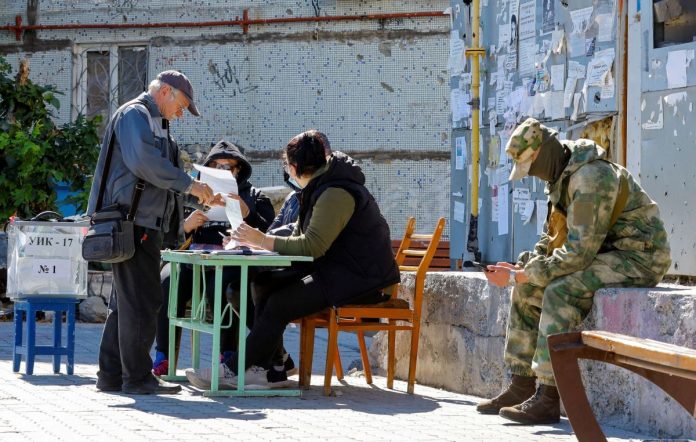
Russian-backed authorities in occupied portions of four Ukrainian regions holding ongoing so-called referendums on accession to the Russian Federation claim that voter turnout has been massive.
Authorities in Kyiv and the West say that the so-called referendums are a “sham” whose outcome has been preordained, and which are carried out often literally at the barrel of a gun. International observers and the Ukrainian government expressed similar concerns in 2014, when Russia unilaterally annexed Crimea after a referendum carried out in the presence of Russian troops.
In the Kherson region, the deputy head of the Russian-backed administration stated Monday that there is already enough of a margin to say that that region has approved seceding from Ukraine and joining Russia.
“The current votes cast are enough for a positive outcome of the referendum,” Vladimir Saldo, the Russian-backed head of the Kherson region administration, said on Telegram on Sunday.
“However, voting will continue for two more days, not counting today, so that those voters who, for various reasons, have not voted yet, can express their will,” he added.
The Russian-backed authorities in Ukraine’s Donetsk region – much of which is still controlled by Ukraine – claimed Monday that turnout so far has been 77%. Russian-backed authorities in the Luhansk region said that it is already 76.09%.
Ukrainian officials scoffed at those numbers.
Serhii Hayday, the Ukrainian head of the Luhansk region military administration, stated that authorities were going door to door, trailed by armed guards, to collect votes.
“If someone checked ‘against’ joining Russia, the data is recorded in some notebooks,” Hayday said on Telegram, adding, “Rumors are being spread that people who vote against are being taken away somewhere. This is deliberately done to intimidate the local population.”
US Ambassador to the OSCE Michael Carpenter on Monday noted the “sham” referendums are “merely propaganda stunts” to try to legitimize their seizure of territory and added that residents remaining in these regions were being forced, sometimes at gunpoint, to vote for annexation.
This is “not a real vote,” Carpenter said on a briefing call, and reiterated that the United States would not recognize the results.
EU sanctions on Russia have ‘backfired’: Hungary PM
Hungary’s prime minister has criticised European Union sanctions on Russia, saying the moves have “backfired” by driving up energy prices.
Viktor Orban told Hungary’s parliament that it was no surprise that governments were falling in Europe amid the crisis, referring to the Italian election on Sunday.
He added Hungary should prepare for a prolonged war in neighbouring Ukraine, where Russia’s invasion has destroyed swaths of infrastructure, killed thousands of people and forced millions of others to flee from their homes.
Zelensky meets with military commanders and discusses “further de-occupation”
President Volodymyr Zelensky met with his top security and military staff on Monday and discussed plans for “further de-occupation” of Ukrainian territory.
“The participants heard information about the operational situation on the frontline,” the president’s office said in a statement, adding, “Decisions were made regarding the active actions of the defense forces with the aim of further de-occupation of the territory of Ukraine.”
Among those in attendance were Defense Minister Oleksiy Reznikov and Commander-in-Chief of the Armed Forces of Ukraine Gen. Valery Zaluzhny.
Momentum swung in Kyiv’s favor earlier this month, after the Ukrainian military drove back Russian forces in the northeastern Kharkiv region and liberated huge swathes of territory.
Ukraine’s successful offensive marked an unwelcome collapse for Russian President Vladimir Putin, who has since been the subject of pointed criticism by Kremlin loyalists.
Putin subsequently announced increased military conscription to boost Moscow’s invasion, a strategy that has prompted fierce backlash in parts of Russia in the form of protests.
Kremlin says no decisions taken on border closures
The Kremlin says that no decision has been taken on closing Russia’s borders following an exodus of military-age men since President Vladimir Putin declared a partial mobilisation of reserve troops last week.
In a call with reporters, Kremlin spokesman Dmitry Peskov also acknowledged that some call-ups had been issued in error, and that mistakes would be corrected.
Ukraine’s military losses revealed in Russian MoD briefing
The Russian Ministry of Defense has released its official figures regarding destroyed Ukrainian equipment in the special military operation.
302 airplanes, 55 helicopters, 2,087 UAVs and 377 air defense systems have reportedly been destroyed since February.
On the ground Kiev’s forces have purportedly lost 5,114 tanks and other combat vehicles, 845 mobile missile systems and 3,417 units of field artillery.
On Putin’s nuclear threat, Zelensky says “I don’t think he’s bluffing”
Russian President Vladimir Putin’s threat of using nuclear weapons in Moscow’s invasion of Ukraine “could be a reality,” according to Ukrainian President Volodymyr Zelensky.
“Maybe yesterday it was bluff. Now, it could be a reality,” Zelensky told CBS in an interview, adding, “I don’t think he’s bluffing.”
Putin announced his military escalation during a national address on Wednesday, in an effort to strengthen Moscow’s floundering military campaign in Ukraine.
He called for increased military conscription, with Defense Minister Sergei Shoigu later confirming that the country will summon 300,000 reservists to serve in the conflict — a strategy that has already been met with backlash in the form of heated protests at home.
Addressing the potential use of nuclear weapons, Putin warned that “those who try to blackmail us with nuclear weapons should know that the prevailing winds can turn in their direction.”
Following Putin’s comments last week, Zelensky said Russia was trying to leverage its occupation of the Zaporizhzhia Nuclear Power Plant in southern Ukraine.
“He wants to scare the whole world. These are the first steps of his nuclear blackmail,” he continued.
“I think the world is deterring it and containing this threat. We need to keep putting pressure on him and not allow him to continue,” he noted.
FM says “formalized” Russian territories would have Kremlin’s “full protection”
Any territory that is formally incorporated into the Russian Federation will “benefit from full protection,” Russian Foreign Minister Sergey Lavrov said.
“The entire state territory of Russia that has already been or can additionally be formalized in the constitution of our country will certainly benefit from full protection,” Lavrov stated
“How can it be otherwise? All the laws, doctrines, concepts, and strategies of the Russian Federation are applicable throughout its territory,” he added.
Lavrov’s comments came after four Russian-occupied areas of Ukraine started voting in referendums on joining Russia, according to their separatist leaders — a process that continues Monday. The referendums are illegal under international law and dismissed as “a sham” by Western governments and Kyiv.
Last week, Russian President Vladimir Putin announced immediate ramped-up military measures in Moscow’s invasion of Ukraine, noting, “If the territorial integrity of our country is threatened, we will certainly use all the means at our disposal to protect Russia and our people.”
IAEA chief says he is ready for talks on Zaporizhzhia plant this week
The head of the United Nations’s nuclear watchdog has said he is ready to hold talks with Ukraine and Russia this week on setting up a protection zone at the Russian-occupied Zaporizhzhia nuclear power plant.
“There is a plan on the table to do it. Last week I had an opportunity to start consultations with Ukraine and with the Russian Federation … and I am ready to continue these consultations in both countries this week,” Rafael Grossi told a meeting of International Atomic Energy Agency (IAEA) member states at the agency’s headquarters in Vienna.
The Zaporizhzhia plant was captured by Russian troops in early March, within weeks of Moscow launching its offensive, but it is still being operated by Ukrainian staff.
It sits close to areas where fighting is taking place and has come under repeated fire in recent weeks, heightening international concern about the potential for a nuclear accident. Moscow and Kyiv have traded blame for the raids on and near the site.
Japan bans chemical weapons-related goods to Russia
Japan’s chief cabinet secretary says it has decided to ban exports of chemical weapons-related goods to Russia in an additional sanction against Moscow for its invasion of Ukraine.
“Japan is deeply concerned about the possibility of nuclear weapons used during Russia’s invasion of Ukraine,” Hirokazu Matsuno told a media briefing, adding the Japanese government would continue to work with the international society in supporting Ukraine and sanctioning Russia.
Zelensky says two more mass graves discovered in Izium
President Volodymyr Zelensky has said two more mass graves have been discovered in Izium, northeast Ukraine, following their liberation from Russian occupation earlier this month.
“Today I received more information,” Zelensky told CBS in an interview, adding, “The journalists are on their way. They found two more mass graves, big graves with hundreds of people.”
“Also and we’re talking about a little town of Izium. Do you know? There are two more mass graves in a small town. This is what’s going on,” the president continued.
On Friday, Ukrainian authorities completed the exhumation of over 400 bodies from a previously discovered mass burial site in Izium. Most of the bodies showed signs of violent death, and 30 had traces of torture, according to an official.
Over 2,350 detained across Russia since partial mobilization announcement
More than 2,350 people have been detained across Russia since President Vladimir Putin’s announcement of a partial mobilization, according to the independent protest monitoring group OVD-Info.
At least 2,352 people have been detained in various cities across Russia from Sept. 21 to Sept. 25 but the number of those detained may be higher, the latest OVD-Info numbers showed Monday.
Zelensky says fierce battles along front line yield some ‘positive results’
Ukraine’s President Volodymyr Zelensky has said heavy fighting in many places along the front line is yielding some “positive results” for Kyiv.
“This is the Donetsk region, this is our Kharkiv region. This is the Kherson region, and also the Mykolaiv and Zaporizhia regions,” Zelenskyy stated in his nightly video address.
“We have positive results in several directions,” he added.
Europe split over asylum prospects for Russians refusing draft
Splits have sharpened in Europe over whether to welcome or turn away Russians fleeing conscription, after Moscow rushed to mobilise hundreds of thousands of recruits to fight in Ukraine.
German officials held out the possibility of granting asylum to deserters and those refusing the draft and called for a European-wide solution.
In France, senators argued that Europe has a duty to help and warned that not granting refuge to fleeing Russians could play into Russian President Vladimir Putin’s hands, feeding his narrative of Western hostility towards Russia.
Other European Union countries are adamant that asylum shouldn’t be offered. They include Lithuania, which borders Kaliningrad, a Russian Baltic Sea exclave. Its foreign minister, Gabrielius Landsbergis, tweeted: “Russians should stay and fight. Against Vladimir Putin.”
US warns Putin of ‘catastrophic’ consequences if nuclear weapons used in Ukraine
The United States would respond decisively to any Russian use of nuclear weapons against Ukraine and has spelled out to Moscow the “catastrophic consequences” it would face, US National Security Advisor Jake Sullivan has said.
“If Russia crosses this line, there will be catastrophic consequences for Russia. The United States will respond decisively,” Sullivan told NBC’s Meet the Press news programme.
Sullivan did not describe the nature of the planned US response in his comments on Sunday, but said the US has communicated with Moscow and “spelled out in greater detail exactly what that would mean”.
He added the US has been in frequent, direct contact with Russia – including during the last few days – to discuss the situation in Ukraine and Putin’s actions and threats.
US warned Russia to ‘stop loose talk’ on nuclear weapons: Blinken
Washington has sent private warnings to Moscow to “stop the loose talk” regarding nuclear weapons, Secretary of State Antony Blinken stated.
Horrific consequences will be in store if Russia follows through with its thinly-veiled threats to use nuclear weapons in its war against Ukraine, the US has warned.
While announcing the mobilisation of reservists last week, Vladimir Putin again warned nuclear arms were a possibility prompting the US to send back a private warning of its own.
“We have been very clear with the Russians, publicly as well as privately, to stop the loose talk about nuclear weapons,” Blinken told CBS.
“It is very important that Moscow hears from us and know from us that the consequences would be horrific. And we’ve made that very clear,” he continued, adding, “Any use of nuclear weapons would have catastrophic effects for the country using them but for many others as well.”
British PM tells allies to stand firm on Ukraine
British Prime Minister Liz Truss has said allies should stand firm on Ukraine, ignoring what she called Russian President Vladimir Putin’s “sabre-rattling”.
Putin this week ordered a partial mobilisation of troops and raised the possibility of nuclear conflict.
Truss, who took office as prime minister earlier this month, stated Putin was escalating his invasion of Ukraine because he was not winning and had made a strategic mistake.
“I think he didn’t anticipate the strength of reaction from the free world,” Truss told CNN.
“We should not be listening to his sabre-rattling and his bogus threats. Instead, what we need to do is continue to put sanctions on Russia and continue to support the Ukrainians,” she added.
Germany inks LNG deal as chancellor visits Persian Gulf to secure energy
German utility RWE has signed a deal with Abu Dhabi National Oil Company (ADNOC) to deliver liquefied natural gas by the end of December, as Europe attempts to gain independence from Russian energy.
“This marks an important milestone in building up an LNG supply infrastructure in Germany and setting up a more diversified gas supply,” RWE announced in a statement.
The deal, which includes a memorandum of understanding for multiyear supplies of LNG, came on the second day of a two-day trip in which Chancellor Olaf Scholz is seeking to deepen ties with the Persian Gulf.
“We need to make sure that the production of LNG in the world is advanced to the point where the high demand that exists can be met without having to resort to the production capacity that exists in Russia,” Scholz told journalists before the deal was announced.
Seven crop-laden ships leave Ukrainian ports
Seven more ships laden with agricultural produce have left Ukrainian ports, the country’s infrastructure ministry says, bringing the total to 218 since a UN-brokered corridor through the Black Sea came into force at the start of August.
In a post on Facebook, the ministry said this brought the total amount of agricultural produce shipped through the corridor to 4.85 million tonnes.
“On September 25 … 7 ships with 146.2 thousand tons of agricultural produce for countries in Africa, Asia and Europe left the ports of Odesa, Chornomorsk and Pivdennyi,” the ministry added.
Ukraine shipped up to 6 million tonnes of grain per month before the war but was left unable to export through the Black Sea after Russia launched its invasion on February 24.
Zelensky acknowledges receiving NASAMS air defence system
Ukrainian President Volodymyr Zelensky has acknowledged in an interview that the United States agreed to provide Kyiv with the sophisticated National Advanced Surface-to-Air Missile System (NASAMS).
“We absolutely need the United States to show leadership and give Ukraine the air defence systems. I want to thank President [Joe] Biden for a positive decision that has been already made,” Zelensky said, according to an English-language transcript of the interview.
“But believe me, it’s not even nearly enough to cover the civilian infrastructure, schools, hospitals, universities, homes of Ukrainians,” he added
Zelensky also thanked the US for HIMARS and other multiple rocket-launching systems enabling Ukraine to advance against Russian occupying forces.