Russia: Biden must say if US behind Nord Stream leaks
“On February 7, 2022, Joe Biden said that Nord Stream would be finished if Russia invaded Ukraine … Biden is obliged to answer the question of whether the US carried out its threat,” foreign ministry spokeswoman Maria Zakharova said on social media, posting a video of Biden saying “we will bring an end” to Nord Stream 2 if Russian tanks cross Ukraine’s border.
Russia has already been accused of sabotaging the pipelines.
Germany does not accept ‘sham’ referendums: Scholz tells Zelensky
German Chancellor Olaf Scholz has told Ukrainian President Volodymyr Zelensky that Germany will never accept the results of “sham” referendums on joining Russia in occupied regions of Ukraine, according to a government spokesperson.
Scholz also stated Germany’s financial, political and humanitarian support for Ukraine would not waver and it would continue to back Ukraine in defending its sovereignty and territorial integrity, including weapons deliveries, the German government spokesperson said in a statement.
Ukrainian forces make additional gains in eastern Donetsk region
Ukrainian forces have made further gains in the eastern Donetsk region, according to geolocated social media video and reports by a Russian military blogger in the area.
Social media videos showed a contingent of Ukrainian troops raising the national flag in the town of Novoselivka, and geolocated video shows Ukrainian military vehicles moving through the nearby district of Zelena Dolnya.
In Novoselivka, one of the soldiers says, “Today, the Armed Forces of Ukraine — the 81st brigade, together with the National Guard of Ukraine, liberated the settlement of Novoselivka.”
These gains indicate that a pocket of territory still held by pro-Russian forces in and around the town of Lyman is at greater risk of being surrounded. The Ukrainians already control territory to the west and south of the town and are now advancing north of it.
A military blogger, Semyon Pegov, with Russian forces to the east of Lyman, reported from the village of Torske Wednesday that the situation was becoming more tense every day. Pegov, who goes by the name WarGonzo, stated in a video report that on Tuesday night groups of Ukrainian troops had carried out probing attacks in the area.
Were Ukrainian units to take Torske, an unknown number of pro-Russian units —mainly from the Donetsk People’s Militia — would effectively be cut off in Lyman.
The Russian state news agency RIA Novosti quoted the Russian Defense Ministry as saying Wednesday that Ukrainian troops had suffered losses in an unsuccessful attempt to attack Lyman. It claimed that “the losses of the 66th and 93rd mechanized brigades [were] more than 70 people killed, four tanks, six infantry fighting vehicles and three armored vehicles.”
Russian President Vladimir Putin has noted repeatedly that taking all of Donetsk region is one of the main goals of the special military operation begun in February, but so far this month the Russians and their allies have lost more ground in the region than they have gained.
Moscow-installed officials in Kherson, Zaporizhia appeal to Putin for annexation
The Moscow-installed administrator of Ukraine’s partially Russian-controlled Kherson region has appealed to President Vladimir Putin for Moscow to incorporate it into Russia.
In a letter published on his Telegram account, Vladimir Saldo said that the residents of the Kherson region had made “a historic choice” in favour of Russia during an annexation vote dismissed by Kyiv and its Western allies as a “sham”.
In a near-identical move, the Russian-installed head of the occupied part of Ukraine’s Zaporizhia region, Yevgeny Balitsky, also appealed to Putin for the region’s incorporation into Russia.
Balitsky sent a letter to Putin saying the Kherson residents had decided “to do away with alien values and reunite with their native harbor – Russia” during the region’s annexation vote, Russia’s state-run TASS news agency reported.
Kremlin claims ‘special military operation’ in Ukraine will continue
The so-called referendums in four occupied Ukrainian regions will not be the end of Moscow’s “special military operation” in the country, according to the Kremlin.
“The special military operation” — Moscow’s official euphemism for Russia’s invasion of Ukraine — “continues and it will continue,” Kremlin spokesperson Dmitry Peskov said on Wednesday.
Four occupied regions of Ukraine have held so-called referendums on joining Russia. The referendums are illegal under international law and have been dismissed by Ukraine and Western leaders as a “sham.”
The leaders of two of the four occupied regions in Ukraine are traveling to the Russian capital following the voting, according to local media reports.
Peskov was addressing reporters in response to questions about what will happen after the four regions have signed to become part of Russia and if the border troops will be sent to protect the new borders there.
Peskov would not be drawn on when agreements on joining Russia may be signed, telling reporters the Kremlin “will inform in a timely manner.”
Pressed further on whether Russia will consider the goals of the special military operation goals to be achieved when the regions become part of Russia, Peskov stated that “not all the territory of the Donetsk People’s Republic has been liberated yet.”
“At the very least, all the territory of the DPR needs to be liberated,” Peskov added.
US embassy issues warning to Americans to leave Russia ‘immediately’
The US embassy in Moscow has issued a security alert and urged American citizens to leave Russia immediately.
In a statement on its website, the US embassy said dual Russian-US nationals may be called up as part of the Russian government’s mobilisation in support of its invasion of Ukraine.
It added: “Russia may refuse to acknowledge dual nationals’ US citizenship, deny their access to US consular assistance, prevent their departure from Russia, and conscript dual nationals for military service.”
The embassy warned that its citizens “should not travel to Russia” and that those residing or travelling in the country “should depart Russia immediately while limited commercial travel options remain”.
Commercial flight options from Russia are “extremely limited at present” and often unavailable on short notice, it warned.
It noted, “If you wish to depart Russia, you should make independent arrangements as soon as possible.”
NATO chief calls Nord Stream leaks acts of ‘sabotage’
The Nord Stream pipelines leaks are acts of “sabotage,” NATO Secretary General Jens Stoltenberg stated after a meeting with Danish Defense Minister Morten Bodskov in Brussels.
“Discussed the sabotage on the #NorthStream pipelines with Defence Minister Morten Bodskov of our valued Ally Denmark. We addressed the protection of critical infrastructure in #NATO countries,” Stoltenberg wrote on Twitter.
Stoltenberg’s comments came after Swedish authorities warned of multiple leaks in the Nord Stream 1 and Nord Stream 2 pipelines — both of which run under the Baltic Sea near Sweden and Denmark, and have been major flashpoints in the energy war between Europe and Russia.
There is reason to be concerned about the security situation in the Baltic Sea region, following the unexplained leaks in the Nord Stream pipelines, Bodskov said after the meeting on Wednesday.
“Russia has a significant military presence in the Baltic Sea region and we expect them to continue their sabre-rattling,” Bodskov added, his press office told CNN.
The two discussed what Stoltenberg called “sabotage” on the Nord Stream pipelines and “addressed the protection of critical infrastructure in NATO countries,” Stoltenberg tweeted.
The Danish Defense Ministry announced that a total of three leakages — which European leaders say cannot be ruled out as sabotage — have been discovered on the gas pipelines Nord Stream 1 and Nord Stream 2, respectively northeast and southeast of the Danish island of Bornholm.
There are two leakages from Nord Stream 1 and one leakage from Nord Stream 2, the press office told CNN.
The Danish Maritime Authority has issued a navigation warning and established a prohibited area to ensure that vessels do not enter the zones near the leakages.
Vessels can lose buoyant force if they enter the area and there can be an ignition hazard above the water and in the air, according to the press office.
A prohibited area has subsequently been created with a radius of 5 nautical miles for ships and a prohibited area of 1 kilometer for aircrafts.
“It is too early to make any conclusions on the causes of the incidents. But at the same time it is hard to imagine this to be pure coincidence. At this point we can’t rule out that this is a deliberate action,” Bodskov said.
“Obviously, this is a very serious matter. That is why we are now taking the precautions that we do, and increasing our presence in the area around Bornholm. Our authorities are doing everything they can to clarify the cause, in close cooperation with our partners,” he added.
It might take a week or two before the areas around damaged Nord Stream leaks are calm enough to be investigated, Bodskov’s office confirmed to CNN.
Numerous other global leaders have cited concerns over the cause of the leaks, with European Commission President Ursula von der Leyen referring to the pipeline leaks as “sabotage action” in a tweet on Tuesday.
Finland Foreign Minister Pekka Haavisto said the damage caused to the pipelines is “very concerning,” while US Secretary of State Antony Blinken said that if the leaks were the result of an attack, “that’s clearly in no one’s interest.”
Kremlin calls allegations of Nord Stream sabotage ‘predictably stupid and absurd’
Any allegations that Russia may have been involved in sabotaging the Nord Stream 1 and 2 pipelines are “predictably stupid and absurd,” Kremlin spokesman Dmitry Peskov has claimed.
“It’s pretty predictable and predictably stupid to express such versions. Predictably stupid and absurd,” Peskov said on Wednesday when asked about allegations Russia might be involved in damaging the pipelines.
“This is a big problem for us, since both pipelines are filled with gas, and this gas is very expensive,” he added during a call with journalists.
“We do not understand what happened there…There are a lot of questions,” Peskov stated when asked to assess if Russia would carry out the repair works.
“Of course, this situation requires dialogue, prompt cooperation of all parties to find out what happened, to assess the damage,” he continued.
Multiple European leaders have referred to the leaks in the Russian pipelines — which run under the Baltic Sea near Sweden and Denmark — as acts of sabotage. Nord Stream AG, in safety documents published before any news emerged of the leaks, had said that the probability of a pipeline failure or leakage is “as low as one damage event every 100,000 years.”
Swedish police open investigation into Nord Stream pipelines leaks
The Swedish national police force has opened an investigation into leaks from the Nord Stream pipelines, and the case is currently being reviewed by the Public Prosecutor’s Office.
On the basis of the report filed by the Swedish Police Authority, the prosecutor will determine the next steps, Karl Jigland from the press service of the Swedish Prosecutor’s Office told CNN over the phone on Wednesday.
Separately, the Swedish police force told CNN earlier on Wednesday that a police report about an offense had been filed.
“The legal qualification is currently gross sabotage, but this could be subject to change,” the police said in an email to CNN.
Swedish authorities on Tuesday warned of leaks in the Nord Stream 1 and Nord Stream 2 pipelines — both of which run under the Baltic Sea near Sweden and Denmark, and have been major flashpoints in the energy war between Europe and Russia.
Several European leaders have cited concerns over the cause of the leaks.
Swedish Prime Minister Magdalena Andersson has stated that the incident is “likely a deliberate action.”
Zelensky accuses Putin of planning to annex occupied Ukrainian regions and force residents into military
Ukrainian President Volodymyr Zelensky has claimed that Moscow plans to annex four occupied regions in Ukraine and will force people to join the Russian military, saying “either you are killed, or you kill.”
The ballots held in the occupied parts of Luhansk, Donetsk, Zaporizhzhia and Kherson are illegal under international law and have been widely condemned by Western countries as “sham” referendums.
Zelensky claimed the Kremlin planned to “force” people living in the occupied areas to fight in the Russian military.
“The goal (of annexation) is obvious — the occupier wants to take the residents of the occupied territory into the army,” he continued.
“Either you are killed, or you kill — Russia wants to force hundreds of thousands of Ukrainians in the occupied lands to make such a choice.” he added.
Leaders of self-proclaimed Donetsk People’s Republic and Luhansk People’s Republic head to Moscow following referendums
The leaders of two of the four occupied regions in Ukraine holding so-called referendums on joining Russia are traveling to Moscow, after claiming huge majorities in favor in the polls, dismissed by Ukraine and Western leaders as a “sham.”
The head of the Luhansk People’s Republic (LPR), Leonid Pasechnik, and leader of the self-proclaimed Donetsk People’s Republic (DPR), Denis Pushilin, are traveling to the Russian capital, according to local media reports.
Pasechnik is journeying to Moscow “to complete the legal part of joining the LPR to Russia,” according to a post on the official LPR Telegram channel.
Meanwhile his DPR counterpart is also heading to the Russian capital where he says he will “sign an agreement with the President of the Russian Federation,” the separatist-run Donetsk News Agency (DNA) reported.
The referendums are illegal under international law.
President Vladimir Putin is set to address both houses of the Russian Parliament on Friday.
It claimed there was “a realistic possibility” Putin would use the speech “to formally announce the accession of the occupied regions of Ukraine to the Russian Federation.”
Approximately 100,000 Russians have entered Kazakhstan in last week
About 100,000 Russians have crossed into neighboring Kazakhstan in the last week, according to a senior government official in the country.
Out of the 100,000 Russians who have entered Kazakhstan, more than 64,000 have already left the country, Marat Kozheyev, Kazakh deputy minister of internal affairs, said on Wednesday.
He did not say where they were journeying to.
“No crime or criminal offence involving Russian citizens has been registered within this week,” he added, according to Kazinform, a state-owned news agency.
“They are mostly law-abiding citizens and they have enough money to live here. In case (if) they violate migration legislation, they will be deported. If they commit a criminal offence, they will be brought to justice,” he noted.
The Kremlin has faced an exodus of citizens fleeing Russia in recent days, amid domestic backlash against President Vladimir Putin’s announcement of military escalation last week.
Moscow’s strategy to draft 300,000 reservists in the war in Ukraine has prompted anti-mobilization protests and growing resistance against the invasion — with military-age men leaving the country rather than risk being conscripted.
Russian citizens do not need a visa to enter Kazakhstan — with which Russia shares a 7,000-kilometer (4,350-mile) border in its south — and can stay visa-free for up to 30 days.
Four of the five EU countries bordering Russia have banned entry for Russians on tourist visas, while queues to cross land borders out of Russia to the former Soviet countries Kazakhstan, Georgia and Armenia were reportedly taking more than 24 hours.
Ukraine: sham votes are ‘yet another Russian crime’ and ‘null and worthless’
Ukraine’s foreign ministry has announced the “propaganda show called ‘referendums’ in the temporarily occupied territories” are “yet another Russian crime” and that it considers them “null and worthless”.
In a statement published on Wednesday morning, it said: “Forcing people in these territories to fill out some papers at the barrel of a gun is yet another Russian crime in the course of its aggression against Ukraine. Such actions severely violate the Constitution and laws of Ukraine, as well as norms of international law and Russia’s international obligations.”
“This performance has nothing to do with expression of will and does not have any implications for Ukraine’s administrative-territorial system and internationally recognised borders. Ukraine and the international community condemn such actions of Russia and consider them null and worthless,” it noted.
“All citizens of Ukraine who took part in the organisation of these acts together with the Russian occupiers will bear responsibility in accordance with the provisions of the criminal code of Ukraine,” it continued.
The statement added: “The Luhansk, Donetsk, Zaporizhzhia, and Kherson regions, like the Ukrainian Crimea, remain the sovereign territories of Ukraine. Ukraine has every right to restore its territorial integrity by military and diplomatic means, and will continue to liberate the temporarily occupied territories. Ukraine will never agree to any Russian ultimatums.”
The statement finishes by calling on “the EU, Nato and the G7 to immediately and significantly increase pressure on Russia, including by imposing new tough sanctions, and significantly increase their military aid to Ukraine”.
Russian shelling cut power in much of Ukraine’s Kharkiv
Russia fired a salvo of missiles at Ukraine’s second city Kharkiv overnight, officials said on Wednesday, hitting a railway yard and knocking out power to more than 18,000 households.
Kharkiv governor Oleg Synegubov noted Russian forces had fired S-300 missiles, designed as an anti-aircraft weapon but now often re-purposed to hit civilian infrastructure in Ukrainian cities.
The Kharkiv regional emergency service announced the blasts, which were audible in the city centre at around 9:00 pm (1800 GMT) on Tuesday, destroyed an electrical transformer and hit a workshop.
No casualties were reported, but the regional energy company said 18,500 customers in the Shevchenkivsky, Kholodnogirsky and Novobavarsky districts of the city had lost electricity.
Kharkiv residents in these districts woke to find their power cut and commuter trams marooned without current in the streets.
EU to strengthen energy security after Nord Stream incidents
The European Union will step up protection of its energy infrastructure following the incidents that caused the leaks of the Nord Stream pipelines, Josep Borrell, the bloc’s foreign policy chief, said on Wednesday.
“All available information indicates those leaks are the result of a deliberate act,” he continued.
“We will support any investigation aimed at getting full clarity on what happened and why, and will take further steps to increase our resilience in energy security,” Borrell added.
Ukraine urges ‘significant’ military aid boost after annexation votes
Kyiv has called on the West to “significantly” increase its military aid to Ukraine after pro-Kremlin authorities in four Moscow-held regions of the country declared victory in annexation votes.
“Ukraine calls on the EU, NATO and the Group of Seven to immediately and significantly increase pressure on Russia, including by imposing tough sanctions and significantly increase their military aid to Ukraine,” Ukraine’s foreign ministry announced in a statement.
EU slams ‘falsified outcome’ of Russia votes in Ukraine
The European Union “denounces” the holding of illegal referendums by pro-Russian forces in Ukraine, the bloc’s foreign policy chief Josep Borrell stated Wednesday.
The referendums – condemned by Western countries as a sham – have seen four Russian-occupied areas of Ukraine vote on whether to join Russia via polls which are contrary to international law.
“The EU denounces holding of illegal “referenda” and their falsified outcome,” Borrell said in a tweet, adding, “This is another violation of Ukraine’s sovereignty and territorial integrity, amidst systematic abuses of human rights.”
“We commend the courage of Ukrainians, who continue to oppose and resist Russian invasion,” he continued.
European Council President Charles Michel also tweeted: “Sham referenda. Sham results. We recognize neither.”
Ukraine can count on Italy: New far-right PM
Ukraine can count on the support of Italy’s new government, far-right leader Giorgia Meloni said in a message to President Volodymyr Zelensky.
Ukrainian military claims untrained Russian soldiers arriving in combat areas following mobilization effort
Untrained Russian forces are arriving in combat zones across Ukraine following the Kremlin’s mobilization effort, the Ukrainian military claimed Wednesday in its daily situational update.
“In the Russian occupation forces, the recruitment of personnel called up for partial mobilization has begun. Thus, reinforcements arrived for the units of the 1st tank regiment of the 2nd motor rifle division of the 1st tank army, which are deployed to the combat zone. They were not trained at all,” the statement said, adding that persons “convicted of criminal offenses” were also joining the fighting.
Last week, Russian President Vladimir Putin announced the immediate “partial mobilization” of Russian citizens, in an effort to bolster the Kremlin’s faltering invasion, following Ukraine’s gains in its ongoing counteroffensive.
Experts have previously expressed concerns about the state of Russian forces in Ukraine and their ability to get new recruits sufficiently trained.
UN “deeply disturbed” as thousands detained in Russia protests
The United Nations has expressed concern over the detention of thousands of demonstrators in Russia protesting against President Vladimir Putin’s partial mobilization order.
“We are deeply disturbed by the large number of people who have reportedly been arrested in the Russian Federation for protesting after the authorities announced a partial mobilization of troops in the context of the armed conflict in Ukraine,” Ravina Shamdasani, a spokesperson for the UN High Commissioner for Human Rights, said.
“We stress that arresting people solely for exercising their rights of peaceful assembly and freedom of expression constitutes an arbitrary deprivation of liberty. We call for the immediate release of all those arbitrarily detained and for the authorities to abide by their international obligations to respect and ensure the rights to freedom of expression and of peaceful assembly,” Shamdasani added.
At least 2,398 people have been detained in various cities across Russia from Sept. 21 to Sept. 26, the latest data on Tuesday by independent protest monitoring group OVD-Info shows.
Russian reservists begin combat training
Russia’s Defence Ministry announced on Wednesday that newly mobilised reservists in the Kaliningrad region have started combat training at the base of Russia’s Baltic Fleet.
“All mobilised military personnel comply with the standards for shooting from small arms. In addition, citizens called up from the reserve restore their skills in the operation and maintenance of weapons, military and special equipment,” the ministry said on its Telegram channel.
Courses have been also held to increase firing skills and prepare military personnel for “confident actions on the battlefield”.
President Vladimir Putin ordered Russia’s first military mobilisation since World War Two last week, which could see hundreds of thousands more people sent to fight in Ukraine.
US to denounce ‘sham refererendums’ at UN security council
The United States will introduce a resolution at the United Nations Security Council calling on member states not to recognise any change to Ukraine and obligating Russia to withdraw its troops, US ambassador Linda Thomas-Greenfield stated.
We are putting forward a Security Council resolution to:
– condemn Russia's sham "referenda"
– call on Member States not to recognize any altered status of Ukraine
– and obligate Russia to withdraw its troops from Ukraine— Ambassador Linda Thomas-Greenfield (@USAmbUN) September 27, 2022
Canada to impose new sanctions on “persons and entities” involved in “sham referendums” in Ukraine
Canada will impose fresh sanctions on “persons and entities” involved in carrying out “sham referendums” in Ukraine, Prime Minister Justin Trudeau said.
“Canada does not and will not ever recognize the results of these sham referendums or Russia’s attempted illegal annexation of Ukrainian territories,” Trudeau stated.
“In response to this further escalation, we intend to impose new sanctions against persons and entities that are complicit in this latest attempt to undermine the principles of state sovereignty, and that share responsibility for the ongoing senseless bloodshed across Ukraine,” he added.
Pro-Russian authorities have held so-called referendums across Ukraine in the self-declared republics of Donetsk and Luhansk in the east and parts of Kherson and Zaporizhzhia in the south.
Russian state media say election commissions in four occupied regions of Ukraine have returned majorities in favor of joining the Russian Federation, following referendums described as a “sham” by Western governments and Kyiv.
Zelensky says won’t negotiate with Putin after Ukraine regions vote to join Russia
Ukraine’s President Volodymyr Zelensky claims his country will have nothing to negotiate about with Russia after four Ukrainian regions voted overwhelmingly in favor of joining the Russian Federation.
The referendums have been held in the eastern Ukrainian regions of Donetsk and Luhansk as well as the southern region of Kherson, and the southeastern region of Zaporizhzhia over the past five days.
The regional officials there announced huge majorities have voted in favor of integration into Russia.
According to the officials, 99.23 of the voters in Donetsk, 98.42 percent in Luhansk, 87.05 percent in Kherson, and around 93 percent of residents in Zaporizhzhia have approved of their regions’ integration into Russia.
Kiev and its Western allies, though, describe the votes as “sham.”
“Russia’s recognition of the pseudo-referendums as ‘normal’, implementation of the so-called Crimean scenario, and yet another attempt to annex Ukrainian territory means that there is nothing to talk about with [the] current Russian president,” Zelensky alleged during a video message at a meeting of the United Nations Security Council.
“In front of the eyes of the whole world, Russia is conducting an outright farce called a ‘referendum’ on the occupied territory of Ukraine,” he added.
Speaking on state television, however, Russian President Vladimir Putin said the votes had been designed to protect the regions’ ethnic Russians and Russian-speakers from persecution at the hands of the Ukrainian regime.
“Saving people in all the territories where this referendum is being held is… the focus of attention of our entire society and country,” Putin added.
Russian proxies in Ukraine claim victory in annexation votes
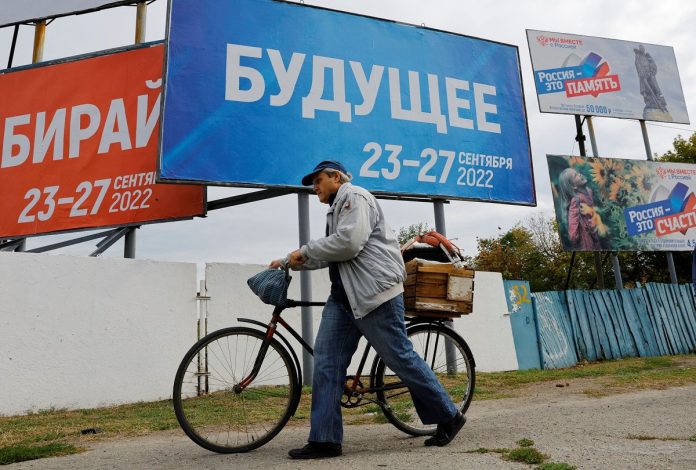
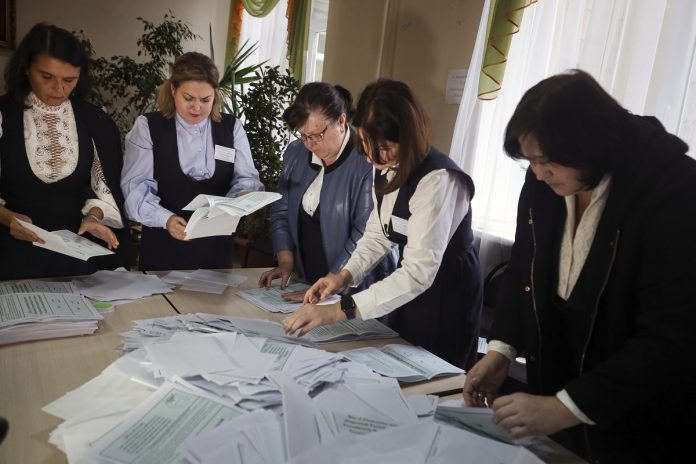
Russian-installed officials in occupied regions of Ukraine have reported huge majorities in favour of becoming part of Russia after five days of voting in so-called “referendums” that Kyiv and its allies have condemned as illegitimate and a sham.
Hastily arranged votes took place in four areas — Donetsk, Luhansk, Zaporizhia and Kherson — that make up about 15 percent of Ukrainian territory.
Luhansk authorities said 98.4 percent of people there had voted to join Russia. In Zaporizhia, a Russian-appointed official put the figure at 93.1 percent. In Kherson, the head of the voting committee said the “yes” vote was above 87 percent.
Denis Pushilin, head of the self-proclaimed Donetsk People’s Republic, stated 99.2 percent of participants in the region had voted to join Russia. In all four areas, officials said all the ballots had been counted.
Within the occupied territories, ballot boxes were taken from house to house in what Ukraine and its allies have called an illegitimate, coercive exercise to create a legal pretext for Russia to annex the four regions.
Russian President Vladimir Putin could then portray any Ukrainian attempt to recapture its territories as an attack on Russia itself. He said last week he was willing to use nuclear weapons to defend the “territorial integrity” of Russia.
Ukraine has repeatedly warned that Russian annexation of territories would destroy any chance of peace talks with Moscow, which began its invasion seven months ago. Kyiv stressed the votes meant there could be no negotiation.
Zelensky says Ukrainian military is moving forward on the frontline
Ukraine’s President Volodymyr Zelensky said that the Ukrainian military is “moving forward” on the frontline, but did not go into details.
“As for the front, I will say briefly and without details, although there will be good news: we are moving forward and liberating our land,” he stated during his nightly briefing.
He also noted that Ukraine will act to protect people living in Russia-occupied regions in Ukraine — including Kherson, Zaporizhzhia, Donbas, Kharkiv, and Crimea — despite Russia’s recent referendums.
“This farce in the occupied territory cannot be called even an imitation of referendums, ” Zelensky added.
UN official: There is “so much evidence” of human rights violations and war crimes in Russia-Ukraine war
United Nations Under-Secretary-General Rosemary DiCarlo said rarely had the international community collected so much evidence of war crimes and human rights violations as it had in investigating Russia’s invasion of Ukraine.
“We are gravely concerned by allegations of violations committed in parts of northeastern Ukraine, including after the recovery of over 400 bodies from improvised graves in Izium. OHCHR is working with local authorities to investigate this and other allegations of human rights violations and abuses in areas in Kharkiv region that were until recently under Russian control,” DiCarlo stated in an address to the United Nations Security Council on Tuesday.
She added that after investigations in the areas of Kyiv, Chernihiv, Kharkiv and Sumy, the Independent International Commission of Inquiry on Ukraine (mandated by the Human Rights Council) had concluded that “war crimes were committed in Ukraine. Among other findings, the commission was struck by the large number of executions and other violations carried out by Russian forces.
DiCarlo also noted the commission had processed two incidents of ill treatment against Russian Federation soldiers by Ukrainian forces.
“Rarely, if ever, has the international community collected so much evidence of human rights violations, war crimes and other atrocities as they were happening. It is tragic that we have not been able to stop them. But it would be shameful if we were not able to ensure justice for the victims and their loved ones. Those responsible for the outrages being committed in Ukraine, wherever they sit, must be brought to account,” she continued.
Ukraine will not be swayed by Russian nuclear threats, annexation votes: Kyiv
Ukraine will not be swayed by any nuclear threats from Moscow or annexation votes held on its territory and will press ahead with its plan to wrest back all its occupied land from Russia, a Ukrainian presidential adviser has stated.
The official, Mykhailo Podolyak, said in an interview that Kyiv wanted the world’s nuclear powers to warn Russia that any use of strategic or tactical nuclear weapons in Ukraine would be met with concrete action – and not just a United Nations Security Council resolution.
No change to US nuclear posture due to Russia threats: Pentagon
Despite Russian threats to Ukraine and NATO about the use of nuclear weapons, the Pentagon has not seen any changes that would lead it to alter the posture of American nuclear forces, a spokesman has said.
“We obviously take these threats seriously. But at this stage, we’ve not seen anything that would cause us to adjust our own nuclear posture at this time,” Brigadier General Patrick Ryder told a news briefing.
Pressed on whether there had been any new Russian movements of its nuclear forces, Ryder declined to elaborate beyond saying the United States did not “have any reason to adjust our posture at this stage”.
An ally of President Vladimir Putin on Tuesday outlined the scenario of a nuclear attack on Ukraine, saying that the US-led NATO military alliance would be too scared of a “nuclear apocalypse” to directly enter the conflict in response.
Russia’s alarming rhetoric regarding use of nuclear weapons is “unacceptable”: UN official
United Nations Under-Secretary-General Rosemary DiCarlo called Russia’s thinly-veiled rhetoric about the use of any and “all weapons systems” to “defend itself” as “unacceptable.”
“We have also heard alarming rhetoric regarding the use of nuclear weapons. This is unacceptable. Such rhetoric is inconsistent with the Joint Statement of the Leaders of the Five Nuclear-Weapons States on Preventing Nuclear War and Avoiding Arms Races, made on Jan. 3 2022,” DiCarlo said while addressing the United Nations Security Council on Tuesday.
“Let me reiterate the secretary-general’s appeal for all nuclear-armed states, including the Russian Federation, to recommit to the non-use and progressive elimination of nuclear weapons,” she added.
Her comments come after Russia’s President Vladimir Putin threatened to turn to nuclear weapons amid a series of embarrassing setbacks on the battlefield in Ukraine.
In a speech last Wednesday, he warned that “In the event of a threat to the territorial integrity of our country and to defend Russia and our people, we will certainly make use of all weapon systems available to us. This is not a bluff.”
NATO warns Russia of ‘severe consequences’ in case of a nuclear strike
Any use of nuclear weapons by Russia is unacceptable and would have severe consequences, NATO said after an ally of Russian President Vladimir Putin issued another stark nuclear warning to Ukraine and the West.
“Any use of nuclear weapons is absolutely unacceptable, it will totally change the nature of the conflict, and Russia must know that a nuclear war cannot be won and must never be fought,” NATO Secretary-General Jens Stoltenberg stated.
“When we see that kind of nuclear rhetoric again and again from Russia, from President Putin, it is something that we have to take seriously – and therefore we are conveying the clear message that this will have severe consequences for Russia,” he added.
UN official says so-called referendums in Ukraine are not legal and not reflective of popular will
The United Nations under-secretary-general underlined in Tuesday’s United Nations Security Council meeting that the so-called secessionist referenda that just wrapped up in occupied areas of eastern Ukraine were not legal under international law and that the UN remained fully committed to the sovereignty and unity of Ukraine within its borders.
Rosemary DiCarlo said developments including the referendums threatened to further escalate the conflict.
“As we meet, so-called referenda were just conducted by de-facto authorities in the Donetsk, Luhansk, Kherson, and Zaporizhzhia regions” she underscored.
She added that the vote happening during an armed conflict that involved de facto authorities going door-to-door in cases with soldiers in tow could not be viewed as a legitimate read of the will of the people there.
“Voting took place in polling centers. De facto authorities accompanied by soldiers also went door-to-door with ballot boxes,” DiCarlo continued.
“They cannot be called a genuine expression of the popular will. Unilateral actions aimed to provide a veneer of legitimacy to the attempted acquisition by force by one state of another state’s territory, while claiming to represent the will of the people, cannot be regarded as legal under international law. Let me reiterate here that the United Nations remains fully committed to the sovereignty, unity, independence and territorial integrity of Ukraine within its internationally-recognized borders, in accordance with relevant UN resolutions,” she added.
She also said Russia was obliged under international law to respect the laws of Ukraine in their administration of the occupied territories.
France says sanctions will follow Russian-organized sham referendums in Ukraine
French Foreign Minister Catherine Colonna said that the Russian-organized referendums in occupied Ukraine are “a sham.”
She stated a new round of European sanctions against Russia would follow “in the days to come” in response to the voting.
Colonna rejected the description of the votes as “elections,” as she asked, “How do you expect people to express themselves freely under duress and in territories occupied by a foreign power?
“There’s no sincerity in the votes that can be cast,” she added.
She called for a clear response from the international community.
The votes hold, “no legitimacy, no value, we will not recognize them,” she said, adding that they will lead to further sanctions from France, the European Union and other international allies.
CIA warned Germany about possible attacks on gas pipelines: Report
The US Central Intelligence Agency (CIA) had weeks ago warned Germany about possible attacks on gas pipelines in the Baltic Sea, German magazine Spiegel has said, after gas leaks in Russian pipelines to Germany were reported.
The German government received the CIA tip, and Berlin assumes a targeted attack on Nord Stream 1 and 2 pipelines, Spiegel reported, citing unnamed sources.
A German government spokesperson declined to comment, Spiegel added.
Blinken says West will ‘never recognise’ pro-Russia annexation votes in Ukraine
US Secretary of State Antony Blinken has vowed that the West will never recognise Russia’s annexation of Ukrainian territory after Kremlin-installed authorities started claiming victory in annexation votes in regions under Moscow’s control.
“We and many other countries have already been crystal clear. We will not – indeed, we will never – recognise the annexation of Ukrainian territory by Russia,” Blinken told reporters.
Number of Russians crossing into the EU up by 30 percent: Frontex
Following a partial mobilisation ordered by Moscow, the EU border agency Frontex said illegal crossings are likely to increase should Russia decide to close the border to potential conscripts.
“Over the past week, nearly 66,000 Russian citizens entered the EU, more than 30 percent compared to the preceding week. Most of them arrived to Finland and Estonia,” Frontex announced in a statement.
During the last four days alone, 30,000 Russian citizens arrived in Finland, according to Frontex.
White House: US welcomes Russians seeking asylum
The United States welcomes Russians seeking asylum from President Vladimir Putin’s “unpopular” war, White House Press Secretary Karine Jean-Pierre has said.
“We believe that regardless of their nationality, they may apply for asylum in the United States and have their claim educated on a case by case basis,” she added.
Gas bubbles from Nord Stream 2 pipeline will continue for several days
Gas bubbles from the damaged Nord Stream 2 pipeline measure more than 100m in diameter, the Danish Energy Authority has announced.
The leak will continue for several days and perhaps even a week, the authority’s head told Reuters news agency.
Danish Prime Minister Mette Frederiksen also said Tuesday during a press statement Denmark sees the Nord Stream pipeline leaks as “deliberate actions”.
The Danish prime minister’s comments follow the discovery of three leaks in the Nord Stream 1 and Nord Stream 2 pipelines near the Danish island of Bornholm in the Baltic Sea.
“We do not see a direct military threat against Denmark,” Frederiksen added.
When asked by a reporter if she saw the incident as a declaration of war, Frederiksen replied “no”.
“It is our assessment that the leaks are not caused by accidents but by blasts,” the Danish energy minister Dan Jørgensen also stated.
Jørgensen added that the damaged pipelines are at 70 to 80 meters in depth and that he expects the Nord Stream gas leaks to last “at least a week”.
Norway to strengthen security at oil, gas installations
Norway will strengthen security at its oil and gas installations in the wake of the gas leaks in the Baltic Sea and the reports of drone activities in the North Sea, the Nordic country’s oil and energy minister told news agency NTB.
Blasts near North Stream were explosions, not earthquakes: Swedish seismologist
A Swedish seismologist has said he was certain the seismic activity detected at the site of the Nord Stream pipeline gas leaks in the Baltic Sea was caused by explosions and not earthquakes nor landslides.
Bjorn Lund, seismologist at the Swedish National Seismic Network at Uppsala University, announced seismic data gathered by him and Nordic colleagues showed that the explosions took place in the water and not in the rock under the seabed.
Sweden’s Prime Minister Magdalena Andersson has stated that two blasts had been detected in relation to the leaks of the Nord Stream pipelines with information suggesting likely sabotage, though this did not represent an attack on Sweden.
Andersson told a news conference the Swedish government was in close contact with partners including NATO, and neighbours, such as Denmark and Germany, concerning the developments.
US says Nord Stream leaks won’t have huge impact on Europe’s energy resilience
US Secretary of State Antony Blinken has stated his understanding was that leaks detected in the Nord Stream gas pipelines would not have a significant impact on Europe’s energy resilience.
Blinken noted the United States had not yet confirmed initial reports that the leaks could be the result of an attack or sabotage, but said if they were due to sabotage, that would not be in anyone’s interests.
EU president says any deliberate disruption of energy infrastructure will lead to a strong response
Any deliberate act to disrupt European energy infrastructure, “will lead to the strongest response possible,” European Commission President Ursula von der Leyen stated.
Von der Leyen, who said in a tweet that she spoke with Danish Prime Minister Mette Frederiksen about the “the sabotage action #Nordstream,” wrote that it is “paramount to now investigate the incidents, get full clarity on events & why.”
“Any deliberate disruption of active European energy infrastructure is unacceptable & will lead to the strongest possible response,” she added.
Her comments follow the discovery of three leaks in the Nord Stream 1 and Nord Stream 2 pipelines near the Danish island of Bornholm in the Baltic Sea.
Zelensky says he discussed further military assistance with NATO chief
Ukrainian President Volodymyr Zelensky said he had discussed further support of Ukraine’s armed forces by NATO member states, in a call with the bloc’s Secretary-General Jens Stoltenberg.
The phone call came in the wake of votes staged in four occupied regions of Ukraine on annexation by Russia. Zelensky thanked Stoltenberg for his condemnation of the votes, which Ukraine and its western allies call illegal shams.
“We discussed current battlefield developments and further support of the Alliance’s member states to the Ukrainian Armed Forces,” Zelensky wrote.
Annexation vote ‘a blatant violation of international law’: NATO chief
The votes in four occupied regions in Ukraine on annexation by Russia are a “sham” and “a blatant violation of international law,” NATO’s chief Jens Stoltenberg said on Tuesday.
Stoltenberg tweeted that he spoke with Ukrainian President Volodymyr Zelensky “and made clear that NATO Allies are unwavering in our support for Ukraine’s sovereignty and right to self-defence”.
“The sham referenda held by Russia have no legitimacy and are a blatant violation of international law. These lands are Ukraine,” Stoltenberg added.
Pro-Russian authorities declare huge majorities in referendums as Western nations describe process as a sham
According to election commissions in four occupied regions of Ukraine, the referendums over the past four days have returned huge majorities in favor of joining the Russian Federation, Russian state media say.
The referendums — called at short notice by pro-Russian authorities — were widely condemned by Western governments as a “sham” and against international law. They were not observed by independent monitors.
Russian state news agency RIA Novosti reported that the commissions published the results of referendums in the Luhansk and Donetsk People’s Republics, Kherson and Zaporizhzhia regions on joining Russia. It did not specify whether they were the final results.
RIA Novosti claimed that “The public addressed the authorities of the Donetsk and Luhansk People’s Republics, Zaporizhzhia and Kherson regions with a proposal to urgently hold referendums.”
There is no evidence of that. The referendum plans were suddenly announced a week ago by Russian-backed local administrations and immediately welcomed in Moscow.
Ukrainian officials say that turnout has been extremely low and claimed that people had been bused in from Crimea to add to the turnout.
Nord Stream leaks a ‘terrorist attack’: Ukraine
Mykhailo Podolyak, adviser to Ukrainian President Volodymyr Zelensky, has tweeted about recent leaks to the Nord Stream pipeline and called them a “terrorist attack”.
The leaks, in parts of the pipeline running through the Baltic Sea, are being investigated by Denmark, Sweden and Germany.
“‘Gas leak’ from NS-1 is nothing more than a terrorist attack planned by Russia and an act of aggression towards EU,” Podolyak wrote.
“Russia wants to destabilize [the] economic situation in Europe and cause pre-winter panic. The best response and security investment – tanks for Ukraine. Especially German ones,” he continued.
Earlier on Tuesday, Kremlin spokesperson Dmitry Peskov told reporters that “No option can be ruled out right now” about possible sabotage. Peskov noted the Kremlin was very concerned about the damage to the pipeline.