EU freezes $26bln in private assets of sanctioned Russians since February 2022: Report
The total value of Russian private assets frozen in the European Union under sanctions over the Russian special operation in Ukraine has reached 24.1 billion Euros ($25.9 billion), German newspaper Welt am Sonntag reported on Saturday, citing European Commission data.
The value of frozen Russian private assets under sanctions increased from 18.9 billion euros in December to 24.1 billion euros in late May, the newspaper said.
As many as 1,473 individuals and 205 firms from Russia have been sanctioned by the EU, Welt am Sonntag added.
After the start of Russia’s military operation in Ukraine on February 24, 2022, Western countries have imposed comprehensive sanctions against Russia, including the freezing of nearly half of the country’s foreign Currency reserves – amounting to about $300 billion. The European Union alone has frozen assets of Russian entities and individuals worth dozens of billions of Dollars under 10 packages of sanctions.
Russian forces ease attacks on Bakhmut to regroup: Kyiv
Russian forces have temporarily eased their attacks on the besieged eastern Ukrainian city of Bakhmut to regroup and strengthen their capabilities, a senior Kyiv official has stated.
Russia’s Wagner private army began handing over its positions to regular Russian troops this week after declaring full control of Bakhmut following the longest and bloodiest battle of the war.
In a statement on Telegram, Deputy Defense Minister Hanna Maliar said Russian forces have continued attacking but that “overall offensive activity has decreased”.
Construction worker killed in shelling in Russian village: Governor
A construction worker was killed near the Russian village of Plekhovo, a few kilometres from the border with Ukraine after shelling from the Ukrainian side, Roman Starovoit, governor of the Kursk region said on Telegram.
Works were being carried out not far from Plekhovo on fortifying defensive lines for the state border, the governor added.
Ukrainian military starts training in Germany to operate US Abrams Tanks
About 400 Ukrainian troops in Germany have started a training to operate the US-made M1 Abrams tanks, The New York Times reported on Saturday, citing a Pentagon spokesman.
About 200 Ukrainian troops started combined arms instruction at training ranges in Grafenwoehr and Hohenfels on Friday, while another 200 started being trained in tank refueling and maintenance, spokesman Garron Garn was cited as saying.
Western countries have been supplying military aid to Kiev since Russia started it military operation in Ukraine in February 2022.
The aid evolved from artillery munitions and training to heavier weapons, including tanks. For months, Ukraine has pushed donors to supply fighter jets.
It was not until last week that the White House gave its consent to European allies to sent Ukraine their US-made F16 jets Kiev’s fighter aircraft of choice. Germany said it would not send fighter jets but would continue supporting Ukraine in other ways. The Kremlin has repeatedly warned against Western arms deliveries to Kiev.
Russia accuses Japan of ‘cynical speculation’
Russia has accused Japan of “cynical, unscrupulous speculation” over Tokyo’s comments about the nuclear threat Moscow poses.
Chief Cabinet Secretary Hirokazu Matsuno condemned Russia’s plan to deploy tactical nuclear weapons in Belarus, saying it would further inflame the situation.
“The desire to attribute the non-evident intention to use nuclear weapons in relation to events in Ukraine to Russia is nothing more than cynical, unscrupulous speculation,” the foreign ministry said.
The ministry also took issue with Matsuno’s casting of Russia as engaging in “nuclear blackmail”.
China to make efforts for political solution: Envoy
China will make concrete efforts for a political solution to the Ukraine crisis, the Chinese foreign ministry quoted special envoy Li Hui as saying.
China has always adhered to an objective and fair position on Ukraine, argued for peace and promoted talks, Li was quoted as telling Russian Foreign Minister Sergey Lavrov.
Li, China’s special representative for Eurasian affairs and former ambassador to Russia, held meetings and talks with Lavrov, and Deputy Foreign Ministers Andrey Rudenko and Mikhail Galuzin.
Ukrainian President Vladimir Zelensky imposed sanctions against 51 people and 220 legal entities, connected to Russian and Belarusian transportation, communication and industrial areas Saturday; the decree was published on the presidential website.
Companies included in the new sanctions list include MTS mobile carrier, Russian Railways subsidiaries, the State Research Institute of Chemical Products and the Minsk Automobile Plant.
Lavrov says US, UK start questioning Kiev’s sanity after controversial remarks on Putin
The United States and the United Kingdom are certainly starting to question the Ukrainian government’s sanity after one of its official’s statement calling Russian President Vladimir Putin a target, Russian Foreign Minister Sergey Lavrov said on Saturday.
Earlier in the week, deputy chief of Ukrainian military intelligence Vadym Skibitsky told German daily Welt that Putin was at the top of Kiev’s list of targets.
“I have no doubts that the puppeteers in Washington and London are starting to question whether these people are sane. I hope that sanctions will be imposed against these so-called leaders,” Lavrov said in a video comment posted on Russian journalist Pavel Zarubin’s Telegram channel.
Top Ukraine military official hints counteroffensive could be imminent
In a short but surely carefully crafted post on the messaging app Telegram, the commander in chief of Ukraine’s armed forces has ratcheted up speculation that a massive counteroffensive against Russia’s occupying forces could be imminent.
“The time has come to take back what is ours,” General Valerii Zaluzhyhi wrote Saturday morning.
The text appears underneath a video just over a minute in length showing Ukrainian forces apparently training at sunrise.
The video shows an array of western provided equipment, including German-made Leopard 2 tanks, seen as one of the key battlefield acquisitions by Ukraine in recent months, as well as US-made MRAP (Mine-Resistant Ambush Protected) armored vehicles, M777 artillery pieces and HIMARS rocket launchers.
The video ends with soldiers and their commander chanting a defiant message: “Ukraine, my native motherland, Lord, our heavenly father, bless our decisive offensive, our sacred revenge, our holy victory.”
Officially the counteroffensive is yet to begin. As we have previously reported, the different signals from Ukraine may be an attempt to keep Moscow off-balance.
Biden reacts to Russia moving tactical nuclear weapons to Belarus
US President Joe Biden has told the journalists that he feels “extremely negative” about Russian tactical nuclear weapons being stationed in Belarus.
Biden’s comment, which was reported by Reuters, came hours after Belarusian President Alexander Lukashenko announced that “the deployment of nuclear munitions has already begun.”
Russia shouldn’t worry about the safety of its weapons as the Belarusians, being “practical and thrifty people,” will be able to keep them safe, Lukashenko added.
The Russian embassy in Washington responded to the reaction from the White House by pointing out that “it is the sovereign right of Russia and Belarus to ensure their security by means we deem necessary amidst a large-scale hybrid war unleashed by Washington against us.”
Moscow’s actions are “fully consistent with our international legal obligations,” the embassy said on Telegram on Saturday. Tactical nuclear weapons aren’t being transferred to Belarus, “the control over them and decision on their use remain with the Russian side,” it added.
“Before blaming others, Washington could use some introspection. The US has been for decades maintaining a large arsenal of its nuclear weapons in Europe,” Russian diplomats suggested.
At the moment, American tactical nuclear weapons are present on the territory of five European NATO countries – Belgium, Germany, Italy, the Netherlands, and Türkiye.
Russian leader Vladimir Putin announced that tactical nuclear weapons would be stationed in Belarus in late March. He said the move had been prompted by the UK’s decision to provide Ukraine with depleted uranium munitions amid the conflict between Moscow and Kiev.
Belarus had been asking its closest ally Russia to deploy nuclear weapons on its territory, citing aggressive Western policies towards the country and the perceived threat posed by US nuclear weapons deployed in neighboring European countries.
Moscow and Minsk sealed an agreement that allows Russian tactical nuclear weapons to be stationed in Belarus on Thursday. According to Russian Defense Minister Sergey Shoigu, Russia has provided the Belarusian military with nuclear-capable Iskander-M missiles and has helped the country to modify some of its fighter jets so they can carry nuclear weapons.
Explosion damages Russian oil pipeline building near border with Belarus
An explosion in Russia’s Pskov region damaged an administrative building of an oil pipeline near its border with Belarus, local governor Mikhail Vedernikov said on Saturday.
Vedernikov claimed the building in the Nevelsky District was attacked by two drones.
There were no casualties and emergency services are at the scene, Vedernikov added.
Few other details are available on the incident at this stage but we will bring you more as we get them.
One person killed in Russian shelling of Kherson
One person was killed after Russian shelling of Ukrainian-held parts of Kherson, Oleksandr Prokudin, the head of the Kherson regional military administration, said on Saturday.
Prokudin claimed Russia had launched “45 attacks, firing 193 shells from mortars, artillery, Grad, tanks, UAVs and aircraft” on the region over the past day.
He said the shelling occurred in residential areas of the region’s settlements, including a grain elevator in the Beryslav district.
Ukrainian military hit occupied Mariupol with missiles
Ukrainian armed forces hit Mariupol on Friday with two long-range missiles, according to the occupied city’s Russian-installed mayor, Oleg Morgun.
In a Telegram post, Morgun said emergency services were at the scene but there were no deaths, injuries or damage to the city’s infrastructure, according to preliminary reports.
Officials with the self-declared Donetsk People’s Republic had earlier said explosions in the city Friday were due to a Ukrainian rocket attack.
Petro Andriushchenko, an adviser to the city’s Ukrainian mayor, chimed in about Friday’s blast in a series of Telegram posts.
He stated that Russian forces have set up checkpoints blocking a bridge near the Azovstal plant, and described a scene of confusion, with Russian emergency workers at the scene of the strike.
The Ukrainian official announced that Russian forces set up an ammunition depot near the plant.
“The hit was on the territory of Azovstal,” Andriushchenko said, adding, “Remember we said that they were setting up a base there to avoid strikes? Well, they set it up along with the ammo depot.”
Andriushchenko went on to mock the Russian-backed officials’ handling of the strikes.
“Buses with workers are being sent to Azovstal to clear the rubble,” he continued, noting, “The official version is that they are looking for ‘workers.’ Why on earth would you need workers in the middle of the night is clear to everyone … we can conclude that everything is bad at Azovstal.”
Ukraine has not claimed responsibility for the strike.
Dnipro hospital attack proves Russia deliberately targets civilians: Ukrainian presidential adviser
Russia’s attack on a hospital in Dnipro city was a “deliberate strike on a civilian object,” Ukrainian presidential adviser Mykhailo Podolyak said, adding that it proves Russia is targeting civilians.
“This is absolutely clear evidence that Russia has in principle changed the tactics of its rocket attacks. Now it is mainly strikes on civilians — deliberately on facilities such as the hospital in Dnipro, with the intention to inflict a psychological (blow) and obviously kill as many people as possible,” Podolyak stated in an interview with CNN’s senior international correspondent, Fred Pleitgen.
The hospital attack Friday morning killed two people and wounded at least 30, including young children, local officials say.
Podolyak said similar strikes have hit residential areas and places like hospitals and schools in the last few months. Specifically in the southern Kherson and eastern Kharkiv regions, Podolyak said Russia destroys “residential areas every day with artillery, in the same way.”
“It seems to me that it’s time to stop expecting Russia to behave conventionally, as a country that follows some rules imposed by international law or some conventions. No, it wages war against the civilian population as demonstratively as possible,” Podolyak added.
The presidential adviser said attacks on Ukraine’s civilian population constitute war crimes.
Ukrainian President Volodymyr Zelensky said of the Dnipro attack in his daily address Friday: “It is a pure atrocity: a Russian missile, ballistics – against a hospital and a veterinary clinic. Absolutely sick creatures.”
Attack on Dnipro medical center wounded 31 people, including 8 doctors: Authorities
The number of people injured in Friday’s attack on the city of Dnipro has risen to 31 people, including eight doctors and two children, according to the head of Dnipro’s regional council, Mykola Lukashuk.
Among the injured, 16 people were taken to hospitals and the others are receiving outpatient treatment, Lukashuk said in a Telegram post.
“Two of the injured are in serious condition, 12 people are in moderate condition, and the rest have minor injuries,” Lukashuk added.
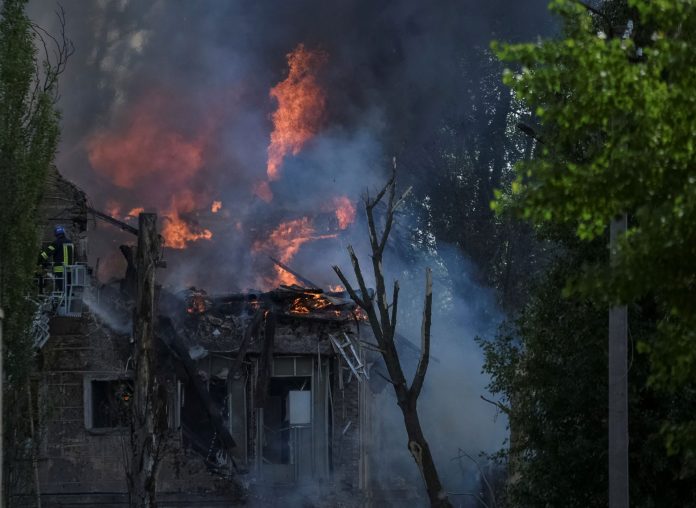
It was a ballistic missile that hit Dnipropetrovsk City Hospital No. 14, which was partially destroyed, Lukashuk stated. The blast set the second floor on fire.
A one-story business nearby also caught fire, but firefighters extinguished the blaze, the official said. A sports complex, school, surrounding homes and cars were also damaged.
More than 900 attacks on health care in Ukraine since Russian invasion began: WHO
There have been more than 900 attacks on health care in Ukraine since the Russian invasion began, according to the latest figures from the World Health Organization.
Of the 967 total attacks, 868 of them impacted medical facilities, WHO data shows. In total, strikes on health care in Ukraine have resulted in at least 97 deaths and 126 injuries since February 25, 2022.
Russia’s attack on a medical facility in Dnipro city on Friday is not yet included in the WHO data or death toll, given that the organization’s process for verifying attacks takes some time. The most recent attack on health care in Ukraine that is recorded by WHO occurred on May 7, 2023, and impacted a mobile clinic.
“WHO condemns all acts of violence against healthcare. These attacks not only kill and maim but also deprive people of urgently needed care, endanger healthcare providers, and undermine health systems,” WHO spokesperson Dr. Margaret Harris said in a statement to CNN.
“Attacks on health care workers, patients, transport, supplies, and health facilities are a flagrant violation of International Humanitarian Law and Human Rights Law and must stop now,” Harris continued, adding, “We call for an immediate cessation of all activities that endanger the lives of health care workers and patients or impede delivery of essential health services.”
EU warns against Russia’s “extremely dangerous” move to deploy nuclear weapons in Belarus
The European Union is condemning the agreement between Moscow and Minsk to deploy Russian nuclear weapons in Belarus, calling it “a step which will lead to further extremely dangerous escalation,” the bloc said Friday.
“The Belarusian regime is an accomplice in Russia’s illegal and unprovoked war of aggression against Ukraine,” the European External Action Service said in a statement, calling on Belarus to “reverse decisions that can only contribute to heightening tensions in the region, and undermine Belarus’ sovereignty,”it added.
“Any attempt to further escalate the situation will be met by a strong and coordinated reaction,” the European Union warned in the statement.
Belarus President Alexander Lukashenko said Thursday that the transfer of some tactical nuclear weapons from Russia to Belarus has begun, according to state news agency Belta.
Brazilian president rejects invite to Russia, but backs Ukraine peace talks
Brazilian President Luiz Inácio Lula da Silva has rejected an invitation from his counterpart Vladimir Putin to visit Russia, he said Friday. Lula said Putin invited him over the phone to visit the International Economic Forum in St. Petersburg.
“I replied I cannot go to Russia right now, but I repeated Brazil’s availability to, along with India, Indonesia and China, to talk with both sides of the conflict in search for peace,” Lula tweeted.
In turn, Putin said Russia is open “to dialogue on the political and diplomatic track, which is still blocked by Kiev and its Western sponsors,” the Kremlin said in a statement Friday, adding the phone call was initiated by the Brazilian side.
The two heads of state also talked about the recent Group of Seven meeting, and about Russian-Brazilian cooperation.
The Kremlin did not mention an invitation to St. Petersburg.
On Thursday, Lula also tweeted he talked on the phone with Chinese President Xi Jinping about the “need for peace in Ukraine.”
Lula has been trying to position himself as a possible mediating force in the conflict for months now.
The Brazilian president has proposed creating “a G20 for peace” — a group of countries strong enough to be respected at the negotiating table, but that are still considered by some as neutral in the conflict between Russia and Ukraine. Indonesia, India, and China would play a crucial role in his vision, but Latin American countries are also invited to join the apparent initiative. He also revealed that during his talks with Xi in April, they discussed forming a group of like-minded leaders on Ukraine.
Lula has struggled to make his proposals widely persuasive. One controversial idea that he floated would see Ukraine cede Crimea, which Russia annexed in 2014, in exchange for peace — a concession Kyiv has ruled out and which the White House described as “simply misguided.”