Moscow will consider cargo ships sailing to Ukrainian ports as military
Russia’s defence ministry has said that from midnight on July 20 (21:00 GMT on July 19), all ships sailing in the Black Sea to Ukrainian ports, will be considered as potential carriers of military cargo.
“Accordingly, the flag countries of such ships will be considered involved in the Ukrainian conflict on the side of the Kyiv regime,” the ministry announced in a statement.
IMF says Russia exit from Ukraine grain deal risks adding to global food inflation
The International Monetary Fund (IMF) has announced that Russia’s exit from a deal allowing Ukrainian exports via the Black Sea worsens the global food security outlook and risks adding to food inflation, especially for low-income countries.
“The discontinuation of the initiative impacts the food supply to countries that rely heavily on shipments from Ukraine, in particular in North Africa, the Middle East, and South Asia,” the IMF said.
“It worsens the food security outlook and risks adding to global food inflation, especially for low-income countries,” it added.
‘Goal of strike has been achieved’: Russia
Russia’s defence ministry has announced that the country has achieved its goal of striking Ukraine’s Odesa overnight and all targets have been hit, according to a report by Russia’s TASS news agency.
“Overnight, the Armed Forces of the Russian Federation launched a group strike with high-precision sea and air-based weapons on military industry facilities, fuel infrastructure and ammunition depots of the Armed Forces of Ukraine near the city of Odessa, as well as on the Kanatovo air base of the Ukrainian Air Force in the Kirovograd region,” official representative of the Russian defence ministry, Lieutenant-General Igor Konashenkov said.
“The goal of the strike has been achieved,” he added.
The Russian Ministry of Defence also announced its forces have captured Movchanove railway station in northeastern Ukraine’s Kharkiv region, according to a report by the Russian state news agency TASS.
Ukraine, which recaptured much of the region in September, said this week that Russia was again on the offensive there and “heavy fighting” was taking place.
MI6 chief makes open plea to Russians to spy for UK
The head of Britain’s foreign intelligence service used a rare speech in Prague Wednesday to issue a plea to disaffected Russians to spy for the UK.
Speaking in Prague, Richard Moore appealed to Russians “wrestling with their conscience” to take a stand against “the Vladimir Putin regime” and offered them the opportunity to “share secrets with MI6.”
“There are many Russians today who are silently appalled by the sight of their armed forces pulverizing Ukrainian cities, expelling innocent families from their homes, and kidnapping thousands of children,” he said.
“They are watching in horror as their soldiers ravage a kindred country. They know in their hearts that Putin’s case for attacking a fellow Slavic nation is fraudulent,” he added.
Moore also issued a warning to African states that are connected to the private mercenary army Wagner, saying if its leader Yevgeny Prigozhin could “betray” Russian President Vladimir Putin then it will betray them in turn.
“The truth is that Russia has no interest in peace or stability and African countries,” he said, adding Moscow “requires active complex, and weak states, which the Kremlin views as targets to be controlled, and exploited in a new Russian imperialism.”
The Kremlin was recently startled by a short-lived insurrection led by Wagner chief Prigozhin. The incident marked the greatest challenge to Putin’s authority in 23 years.
Kremlin accuses West of turning blind eye to Ukrainian ‘terror attacks’
The Kremlin has accused the West of turning a blind eye to what it said were “terrorist attacks” committed by Ukraine inside Russia.
Two people were killed on Monday after Moscow said Ukraine used naval drones to attack the bridge linking Russia to the Crimean Peninsula, which Russia annexed from Ukraine in 2014.
Kyiv says Crimea is Ukrainian territory and that it intends to take it back by force.
Zelensky says Russia “deliberately targeted grain deal infrastructure”
Ukrainian President Volodymyr Zelensky said on Wednesday that in attacking Odesa, Russia was deliberately targeting infrastructure associated with the Black Sea grain deal following its decision to withdraw from the initiative on Monday.
“Russian terrorists deliberately targeted the grain deal infrastructure, and every Russian missile is a strike not only against Ukraine, but against everyone in the world who wants a normal and safe life,” Zelensky wrote on Telegram.
“The military was instructed to strengthen the protection of people and port infrastructure, and the foreign ministry was instructed to intensify contacts with partners to increase pressure on the terrorist state and continue normal exports of Ukrainian grain,” he added.
It comes after Zelensky’s chief of staff said Russia’s second night of attacks on Odesa shows Moscow needs “hunger and problems in the countries of the Global South.”
Ukraine’s Air Force said that for the second night in a row, Russia targeted Odesa with a barrage of cruise missiles and attack drones.
“The Russian terror of Odesa proves once again that they need hunger and problems in the countries of the Global South,” Andriy Yermak wrote on Telegram, adding, “They want to create a refugee crisis for the West. Everything is done to weaken allies and politically interfere in the internal affairs of these countries.”
Britain’s intelligence chief optimistic Ukraine will prevail against Russia
Britain’s intelligence chief has said he is “optimistic” Ukraine will prevail in its war against Russia, whose forces have lost momentum on the battlefield.
Richard Moore said Ukraine has “recovered more territory in a month than the Russians managed to achieve in a year” and that “there appears to be little prospect of the Russian forces regaining momentum.”
It will be up to Kyiv to “define” the end of the war, as “most conflicts end in some kind of negotiation,” he added during a speech in Prague Wednesday.
Moore’s words come as Ukraine continues its spring counteroffensive against Russian troops. Since the counteroffensive began in June, the fighting has proved tougher than some anticipated, with progress being measured in hundreds of meters as opposed to tens of kilometers.
Ukraine had hoped to use the push to expel a significant amount of Russian forces from Ukrainian soil and turn the tide of the war.
Odesa attack shows Russia needs “hunger and problems” in Global South countries: Zelensky’s chief of staff
Russia’s second night of attacks on Odesa shows Moscow needs “hunger and problems in the countries of the Global South,” Ukrainian President Volodymyr Zelensky’s chief of staff has stated.
Ukraine’s Air Force said that for the second night in a row, Russia targeted Odesa with a barrage of cruise missiles and attack drones.
The attacks on the Black Sea port city come after Moscow pulled out of a key UN-brokered grain deal this week, drawing condemnation from Ukraine, the United States and their allies.
“The Russian terror of Odesa proves once again that they need hunger and problems in the countries of the Global South,” Andriy Yermak said on Telegram.
“They want to create a refugee crisis for the West. Everything is done to weaken allies and politically interfere in the internal affairs of these countries,” he added.
Yermak noted that Ukraine’s allies should limit Russia’s access to components needed for weapons manufacture, and called for more long-range weapons to be sent to Ukraine.
He also called on countries in the Global South to support Ukraine’s proposals for expelling Russia from Ukraine and achieving peace.
EU lawmakers call for Lukashenko prosecution over role in Ukraine war
The Foreign Affairs committee of the European Parliament has urged the International Criminal Court (ICC) to consider an arrest warrant for Belarus President Alexander Lukashenko over the country’s role in the Ukraine war.
In a new report, the committee also called on the Belarusian regime to release all political prisoners, and expressed concern over the country’s subordination to Moscow, the committee said Tuesday in a news release.
“Belarus is responsible for damage caused to and crimes committed in Ukraine, including through the regime’s role in the illegal transfers of children,” the EU lawmakers said.
The report also “calls on the EU institutions and member states to take all necessary steps at international level to enable the criminal prosecution of those Belarusian political and military leaders responsible for crimes against humanity and genocide.”
The ICC in March issued an arrest warrant for Russian President Vladimir Putin and Russian official Maria Lvova-Belova for an alleged scheme to deport Ukrainian children to Russia.
Russian attack was “one of most horrible nights” of war: Odesa mayor
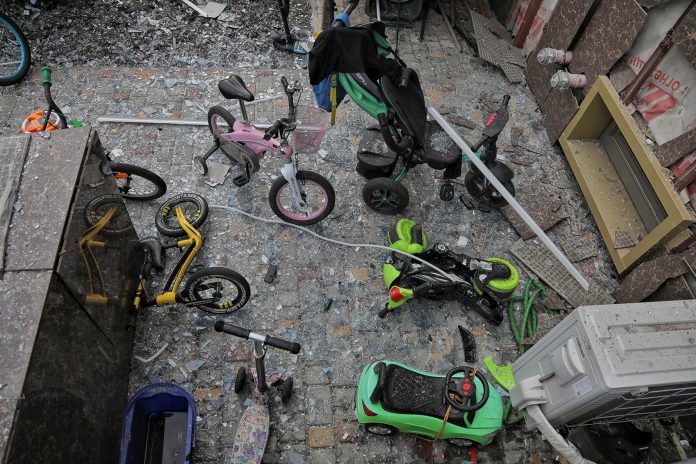
Russia’s aerial assault on Odesa overnight into Wednesday was “one of the most horrible nights” of the war, the southern Ukrainian city’s mayor said.
“We do not recall such a scale of attack since the beginning of a full-scale invasion,” Mayor Hennadii Trukhanov said on Facebook.
There were no casualties, but the city was rocked by explosions and several people were injured by a downed Russian missile, officials stated.
“We are getting stronger from our righteous fury! We are grateful to the air defense system. It was a fierce air battle,” Trukhanov added.
Ukraine’s Air Force said that for the second night in a row, Russia targeted Odesa with a barrage of cruise missiles and Shahed attack drones.
The attacks on the Black Sea port city come after Moscow pulled out of a key UN-brokered grain deal this week, drawing condemnation from Ukraine, the United States and their allies.
In a Telegram post, Oleh Kiper, head of the Odesa regional military administration said fires broke out after Russian strikes hit a grain and oil terminal and other industrial facilities.
Several civilians, including a 9-year-old boy, were injured after air defenses shot down a cruise missile, he added.
Zelensky becoming ‘toxic’ to West: Moscow
Ukrainian President Volodymyr Zelensky has become “toxic” to the collective West, Russian Foreign Ministry spokeswoman Maria Zakharova has claimed, pointing to veiled criticism in Washington of the Ukrainian drone attack on the Crimean Bridge which killed two civilians.
“The White House has publicly disavowed attacks carried out by the Kiev regime, drawing a dividing line between arms sales and terrorist attacks. This is, of course, just another manipulation. But something else is important – Zelensky has become toxic to the West,” Zakharova wrote in a Telegram post.
The remarks apparently came in response to statements made by US National Security Council Coordinator for Strategic Communications John Kirby on Monday. The official insisted the White House was “not in a position to attribute the attack to any particular party at this point,” refusing to confirm the attack on the strategic bridge was launched by Kiev.
Moreover, Kirby noted the attack on the structure had hardly impacted Russia’s military capabilities and was not expected to have a “dramatic effect” on them in the long run.
“I think it’s just too soon to know whether that attack on that bridge is going to have any significant military impact on their ability to continue to fight this war,” he said, adding that “the Russians have many, many, many other ways of providing logistics and sustainment to their troops in Ukraine.”
US pressuring Ukraine for ‘decisive breakthrough’: Report
US officials are reportedly concerned that Ukraine is not making enough progress in its much-lauded counteroffensive, the Washington Post reported on Tuesday citing anonymous sources.
According to the outlet, Washington is urging Kiev to commit to a decisive breakthrough as Ukrainian commanders have yet to employ the large-scale offensive tactics they were taught by Western instructors.
An unnamed US official explained to the Washington Post that the West had trained Ukrainian forces in integrated offensive maneuvers, provided mine-clearing equipment, and stressed that it was “paramount” that Kiev’s troops quickly apply those capabilities to breach Russia’s defenses.
Western officials have reportedly criticized Ukraine’s military for embracing an attrition-based approach aimed at firing artillery and missiles at command, transport and logistics sites at the rear of Russian positions instead of using Western-style “combined arms” operations that involve large-scale maneuvers featuring tanks, armored vehicles, infantry, artillery, and air power, the outlet said.
Analysts at the Institute for the Study of War have pointed out that Ukrainian commanders have chosen to embrace more low-profile advances involving groups of 15 to 50 soldiers in order to preserve manpower. The Washington Post also noted that Kiev has so far only fielded “four of a dozen trained brigades in the current campaign.”
Kiev’s attempts to breach Russian defenses have so far been met with “overwhelming artillery, anti tank missiles, loitering munitions and helicopter fire” which have caused significant losses. Russia’s extensive use of drones has also presented a challenge that “not even American forces – for all their combat experience in recent decades – have faced on this scale,” the Post said.
Experts have said that while advances on foot would likely reduce the attrition sustained by the Ukrainian army, such tactics would be much slower and be much less likely to provide an opportunity for a rapid breakthrough.
Ukrainian officials, in turn, have rebuked demands from their Western counterparts to speed up the operation and have instead stressed the need to avoid unnecessary losses and complained about the lack of air support.
Kiev has repeatedly pleaded with its Western backers to provide its forces with US-designed F-16 fighter jets, arguing that they would play a key role in countering Russian air power.
Western officials, however, have reportedly insisted that the jets would not be a “game changer,” while Russia has responded by saying the aircraft would be destroyed like any other foreign military equipment in Ukraine.
G20 finance chiefs end their meeting in India without consensus on Ukraine
A meeting of finance chiefs and central bank governors of the Group of 20 leading economies has ended in India’s western state of Gujarat without a consensus because of differences between countries over the war in Ukraine.
Following two days of talks in Gandhinagar, there was no final communique. Instead, India, as the host nation, was forced to issue the G20 Chair’s Summary and Outcome Document.
India’s finance minister said the reason for the chair’s statement was “because we still don’t have a common language on the Russia-Ukraine war”.
According to the chair summary, China and Russia objected to paragraphs referring to the war, saying it was causing “immense human suffering” and “exacerbating existing fragilities in the global economy”. The wording was taken from the previous declaration in Indonesia, where leaders had strongly condemned the war.
Ukrainian air defenses repel Russian attack on Kyiv
Ukraine’s Air Defense repelled Russian airstrikes on Kyiv early Wednesday, the region’s military administration said in a Telegram post.
“The movement of enemy UAVs (unmanned aerial vehicles) was detected! The air defense is active in the region,” the post said.
The air alert is ongoing, the Kyiv city military administration in a Telegram post.
“Air defense is operating in the region, on the outskirts of Kyiv city. Stay in shelters until the air raid is over!,” stated Serhii Popko, head of the Kyiv city military administration.
Explosions were heard in the capital, Mayor Vitali Klitschko added.
Russia launches air strikes on Odesa for a second night in a row
Russian forces launched more than 60 airstrikes at Ukraine overnight, with the “main focus” of their attack targeting the southern Odesa region, the Ukrainian Air Force said in a statement Wednesday.
The Russian barrage included Kalibr, Kh-22 and Oniks cruise missiles, and attack drones, the Air Force announced.
Ukrainian air defenses destroyed 14 cruise missiles and 23 drones, it added.
It marks the second consecutive night of Russian airstrikes on Odesa. Russian forces targeted the port city Tuesday in what Moscow said was retaliation for Kyiv’s attack on the Crimean bridge linking the annexed peninsula to Russia.
UN says ideas ‘floated’ on how to get Ukraine, Russia grain to world
There are a “number of ideas being floated” to help get Ukrainian and Russian grain and fertiliser to global markets after Moscow quit a deal allowing the safe Black Sea export of Ukraine grain, the United Nations has said.
“There are a number of ideas being being floated,” UN spokesman Stephane Dujarric told reporters, without giving details.
He added that UN Secretary-General Antonio Guterres “will continue to explore all possible avenues to ensure that Ukrainian grain, Russian grain, Russian fertiliser are out on the global market”.
US believes Western warplanes won’t help Ukraine: Report
Even if Ukraine receives modern Western-made jets, they will be of little use because of Russia’s powerful air defenses, the Washington Post reported on Tuesday, citing unnamed US officials.
Amid a Ukrainian counteroffensive that Moscow claims has failed to gain any ground, officials in Kiev have stepped up requests for advanced aircraft, particularly US-designed F-16s, arguing they could play a key role in countering Russian air power.
While Kiev’s Western backers have announced a training program for Ukrainian pilots to fly the jets, they have yet to greenlight their delivery.
According to the Washington Post, Ukrainian officials have rebuked their Western counterparts, claiming that if they were in the same situation as Kiev, they would never have pressed ahead with a large-scale offensive without air support.
“So, to say that it [the offensive] is slow or too fast is at least ridiculous to hear from those who have no idea what it is,” the commander-in-chief of Ukraine’s armed forces, Valery Zaluzhny, told the paper.
However, according to unnamed US officials interviewed by the Post, “Western jets would have little utility” for Ukraine in the current circumstances because of Russia’s “extensive air defenses.” Instead, one source argued that Kiev’s best tactic would be to rely on a “combined-arms approach.”
Another US official told the paper that while Washington has trained Kiev’s troops how to conduct offensive maneuvers and has provided them with mine-sweeping equipment, they are still struggling to overcome strong Russian anti-tank defenses and drone strikes. “We don’t underestimate or under-appreciate that it’s a very tough situation,” the source added.
Citing F-16 pilots, Bloomberg reported in May that while the jets would definitely help Kiev, they would not be a “game changer” because their radars and missile systems are inferior to modern Russian equipment. That would mean using the warplanes either defensively or as part of high-risk operations.
Russian President Vladimir Putin has warned that if the West proceeds with F-16 shipments to Ukraine, the aircraft “will burn” just like other hardware. Russian Foreign Minister Sergey Lavrov has said that F-16 deliveries would be an escalatory move as they can carry nuclear weapons.
Moscow would return to grain deal if its demands are met: Russian ambassador
Russia would be prepared to return to the Black Sea grain deal if Moscow’s demands are met by international partners, according to Russia’s permanent representative at the United Nations headquarters, Gennady Gatilov.
In remarks published on the Russian Foreign Ministry Telegram channel Tuesday in response to a question from Reuters, Gatilov accused the deal of deviating away from its “intended humanitarian purposes.”
“Implementation of one of the two components of the Istanbul Agreements – the Russia-UN Memorandum – has failed to make any meaningful progress due to the disruptive stance of the Western countries,” Gatilov said.
“They continued to increase their sanctions pressure on our country, which constrained Russian agricultural exports by completely blocking bank transactions, insurance, logistics, foreign assets and supplies of spare parts,” he added.
Gatilov did say the UN “tried on its part to urge the Western governments and business structures to implement the Russian-UN Memorandum.”
“However, despite the efforts, the leadership of the UN Secretariat could not overcome the resistance of the Western countries and private companies, on which depended the fulfillment of our demands,” he continued.
Gatilov also claimed that Ukraine “repeatedly used the Black Sea humanitarian route for provocations and attacks against Russian civilian and military vessels, as well as infrastructure.”
Russia pulling out of grain deal will result in more crises around world: Zelensky
Ukraine’s president is warning that Russia’s withdrawal from the Black Sea grain deal will result in more crises around the world.
“Last year, thanks to our Black Sea Grain Initiative, we managed to prevent a price crisis in the global food market. A price explosion would inevitably have been followed by political and migration crises, particularly in African and Asian countries,” President Volodymyr Zelensky said Tuesday night.
He stated a wide range of countries will feel the effects and that Ukraine is “working without partners to prevent this.” Russia pulled out of the deal on Monday.
“Obviously, the Russian leadership is now trying to provoke these crises. Without our exports, the deficit in the global market will, unfortunately, be very significant,” Zelensky added.
Ukraine is developing options for action and agreements “to preserve Ukraine’s global role as a guarantor of food security, our maritime access to the global market, and jobs for Ukrainians in ports and the agricultural industry,” he said, adding Kyiv is “fighting for global security and for our Ukrainian farmers.”
Ukrainian forces are creating conditions for further advances in South: Deputy DM
Deputy Defense Minister Hanna Maliar stated that Ukraine is creating conditions to continue advancing along the southern front.
“The enemy’s task is to stop our advance and they are putting a lot of effort into this. Our enemy is strong. Therefore, our troops have to move in an extremely difficult situation,” Maliar said on Ukrainian national television Tuesday.
“In addition, we need to create certain conditions for further advancement,” she continued.
“Remember the liberation of Kherson — it also took more than one day,” she added.
Her comments were supported by the Commander of the Tavria Joint Forces Operation, Brigadier General Oleksandr Tarnavskyi, who said Ukraine was making gains along the southern front.
“Fighting continues in the Tavria sector, with the Ukrainian Defence Forces gaining ground in some areas and the enemy retreating,” he wrote in Telegram.
“Over the last day, the enemy’s losses in killed and wounded amounted to more than three companies. 41 units of enemy military equipment were destroyed,” he continued, adding, “Four enemy ammunition depots were also destroyed.”
Ukraine also claimed gains in the east, around Bakhmut, and said it had stopped Russia’s push near Kupyansk.
“The enemy’s offensive in the Kupyansk sector is currently unsuccessful. Fighting continues, but the initiative is already on our side,” Maliar said in a Telegram post on Tuesday.
“On the southern flank around Bakhmut today, as in all previous days, there was an advance of our troops,” she noted.
Ukrainian counteroffensive “far from a failure” despite moving slower than expected: Top US general
The Ukrainian counteroffensive is “far from a failure” despite moving slower than anticipated, the Chairman of the Joint Chiefs of Staff Gen. Mark Milley said Tuesday.
“It started about five or six weeks ago, and the various war games that were done ahead of time that predicted certain levels of advance and that has slowed down. Why? Because that’s the difference between war on paper and real war,” Milley said during a press briefing.
“These are real people in real machines that are out there really clearing real minefields and they’re really dying. So when that happens, units tend to slow down, and that’s rightly so, in order to survive in order to get through these minefields,” he stated.
“It is far from a failure,” he continued, adding, “In my view, I think that it’s way too early to make that kind of call. I think there’s a lot of fighting left to go.”
Milley also said that Ukraine has a “significant amount of combat power not yet committed” to the counteroffensive.
“I will not say what’s going to happen in the future, because that’s going to be a Ukrainian decision as to where and when they commit their reserve, etc,” he continued, adding, “Right now they are preserving their combat power, and they are slowly and deliberately and steadily working their way through all these minefields.”
US defense secretary says Washington and allies discussed plans to ramp up ammo production for Ukraine
US Defense Secretary Lloyd Austin stated Tuesday that the Ukraine Defense Contact Group, which met virtually Tuesday, discussed Ukraine’s “urgent need for ammunition.”
“We also discussed plans to ramp up production at both the national level and the multinational level through the European Union’s important initiative to produce more ammunition,” Austin said.
The US and Europe are struggling to keep up with Ukraine’s ammunition needs as they battle Russian forces.
Macron says Putin made “huge mistake” with his decision to pull out of Black Sea grain deal
French President Emmanuel Macron said that Russian leader Vladimir Putin made a “huge mistake” with his decision to “weaponize” food by pulling out of the critical Black Sea grain deal.
Speaking to reporters at the Council of the European Union in Brussels on Tuesday, Macron said Russia assumed “a huge responsibility” towards numerous countries by participating in the UN-brokered grain deal.
“Middle Eastern, African, even Asian countries are very much dependent on these agreements, which will be impacted by the unilateral decision of Russia,” Macron added.
“For those who were still doubting about the sincerity of President Putin, and his commitment to common good, I mean, the answer is very clear he decided to weaponize food,” the French leader stated, going on to call it a “huge mistake.”
Macron stressed that France’s “responsibility” is to “facilitate” the export of grains, cereals, and fertilizers, as part of the farm initiative it launched last year to support countries grappling with food security issues.
France initially responded to the news of Russia’s decision to exit the grain deal, accusing Putin of “blackmailing global food security.”
In a statement Monday, the French foreign ministry called Russia “solely responsible” for blocking shipping in the Black Sea.
The deal proved vital for stabilizing global food prices and bringing relief to the developing countries which rely on Ukrainian exports. The impact of the war on global food markets was immediate and extremely painful, especially because Ukraine is a major supplier of grain to the World Food Programme (WFP).
According to the European Commission, Ukraine accounts for 10% of the world wheat market, 15% of the corn market, and 13% of the barley market. It is also a key global player in the market of sunflower oil. The Food and Agriculture Organization (FAO), an UN body, warned at the time that as many as 47 million people could be pushed into “acute food insecurity” because of the war.