US to announce $1.3bn in military aid for Kyiv
The US will announce a new pledge to buy $1.3bn worth of military aid for Kyiv in the coming days, two anonymous US officials told the Reuters news agency.
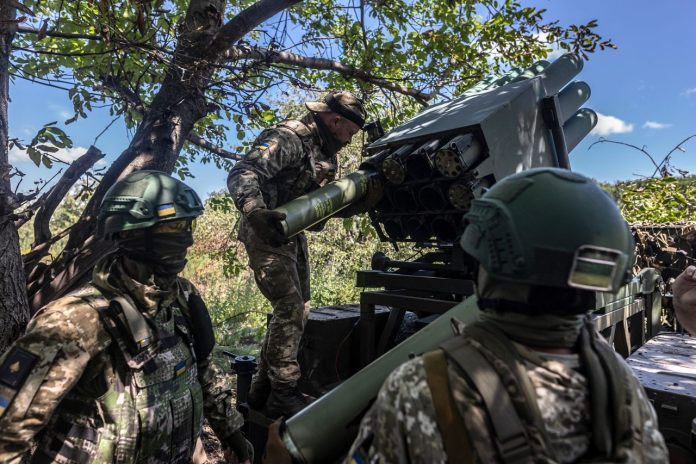
One official said that the weapons package is expected to include air defences, counter-drone systems, exploding drones, and ammunition.
Additionally, Ukraine will get many counter-drone systems made by Australia’s DroneShield Ltd alongside radars, sensors and analysis systems.
Washington uses funds in its Ukraine Security Assistance Initiative (USAI) programme, allowing President Joe Biden’s administration to buy weapons from industry rather than pull from stocks.
In the 2023 fiscal year, from October 1, 2022, to September 30, 2023, the Pentagon has provided more than $10.8bn in security assistance for Ukraine under the programme.
G20 members denounce Russia for quitting grain deal
Several Group of 20 (G20) members condemned Russia for quitting the Black Sea grain deal during a two-day summit in Gandhinagar, India’s finance minister said.
“Several members condemned it, saying that shouldn’t have happened … passing through the Black Sea shouldn’t have been stopped or suspended,” Finance Minister Nirmala Sitharaman told reporters.
But finance ministers from the G20 nations have not reached a common language on the war in Ukraine, Sitharaman stated.
Most Western countries, including the United States, United Kingdom, Germany and France, had pushed for a firm condemnation of Russia and the war in Ukraine, while Russia and China had opposed any such move, an Indian government official added.
India has adopted a neutral stance over the war in Ukraine and has declined to blame Russia and urged for a diplomatic solution while at the same time increasing purchases of discounted Russian oil.
Russian parliament moves to extend mobilisation age
Russia’s parliament extends the maximum age at which men can be mobilised to serve in the army by at least five years, up to 70.
The law allows men who have completed their compulsory service without any further commitment to be mobilised up to the age of 40, 50 or 55, depending on their category, the State Duma or lower house of parliament said on its website.
Russia also maintains a “mobilised reserve” of men signed up for periodic military training and a stipend after their compulsory or professional service ends.
The new law means that those from this reserve with the highest ranks can now be called back into service up to the age of 70 rather than 65, other senior positions up to 65, junior officers up to 60 – and all others up to the age of 55 rather than 45.
Defence Minister Sergey Shoigu has previously said he plans to increase combat personnel to 1.5 million from 1.15 million.
US aid agency chief: Putin “playing roulette with hungriest people in world”
By pulling out of the Black Sea grain deal Russian President Vladimir Putin is risking the safety of some of the most vulnerable people on the planet, Samantha Power, the administrator of the US Agency for International Development (USAID), told CNN Tuesday.
“The idea that Putin would play roulette with the hungriest people in the world at the time of the greatest food crisis in our lifetimes is just deeply disturbing,” Power said to CNN’s Alex Marquardt in the southern Ukrainian port city of Odesa.
“The whole world needs to raise its voice – particularly the global south, countries in the global south – to say that it’s unacceptable to hold hostage the hungriest people in the world because of some power play and aggression carried out by Moscow,” she added.
The Kremlin announced Monday that it was terminating its participation in the grain deal, which allowed Ukraine to export food from its ports and navigate safe passage through the Black Sea, to Turkey’s Bosphorus Strait. It came after Russia barricaded key ports in the region, cutting off Ukrainian grain exports to the rest of the world.
During her visit to Odesa, Power announced that the US government was providing $250 million dollars to support Ukraine’s agricultural sector, on top of $100 million already invested, according to USAID. The organization is seeking an additional $250 million “from the private sector, other donors, and foundations.”
The aid will be used to strengthen key agricultural infrastructure and will help Ukraine plan its 2023 sowing and harvesting demands.
Russia has regularly claimed that it did not receive the fully pledged benefit from the deal, and that Russian agricultural products cannot reach market. Power took issue with that characterization, calling it “absurd.”
She visited Odesa just hours after the Russian military launched what it called retaliatory strikes against the city, for Ukraine’s destruction of part of the Crimea bridge on Monday.
Russia, Turkey discuss exporting Russian grain
Russia’s foreign ministry says Foreign Minister Sergey Lavrov spoke to his Turkish counterpart, Hakan Fidan, about ways of exporting Russian grain via routes “that would not be susceptible to Kyiv and the West’s sabotage”.
Lavrov added that Moscow was disbanding a grain coordination centre in Istanbul after its exit from the Black Sea grain deal.
Russia refused to extend the agreement because it said the West had failed to meet its obligations under a parallel agreement to facilitate exports of Russian grain and fertiliser.
Debt increase is inevitable: Russian minister
An increase in Russia’s debt burden has become inevitable as Moscow spends on the military and economy, a deputy finance minister said.
Deputy Finance Minister Irina Okladnikova stated that Russia’s current level of debt is 22.8 trillion roubles or 14.9 percent of gross domestic product (GDP).
“We understand that in the current situation, we will increase debt, it is a hopeless situation,” said Okladnikova at a meeting in Russia’s upper house of parliament.
“We will have to do this because the expenditure part is growing – we need to support the economy, we have to support the military bloc, and our four new regions need significant support,” Okladnikovaadded.
The four new regions refer to Moscow’s illegal annexation of Ukraine’s Donetsk, Luhansk, Kherson and Zaporizhia regions.
NATO grapples with shortage of critical ammunition for Ukraine
The US and Europe are struggling to provide Ukraine with the large amount of ammunition it will need for a prolonged counteroffensive against Russia, and Western officials are racing to ramp up production to avoid shortages on the battlefield that could hinder Kyiv’s progress.
The dwindling supply of artillery ammunition has served as a wake-up call to NATO, US and Western officials told CNN, since the alliance did not adequately prepare for the possibility of a protracted land war in Europe following decades of relative peace.
UK Secretary of Defense Ben Wallace told CNN last week that while NATO was poised early on for a “night one, day one” offensive, “no one had really asked themselves the question, well, what if ‘day one, night one’ becomes ‘week two, week three, week four?’ How much of our exquisite capabilities have we actually got in stock? And I think that’s been the broader question.”
US officials emphasized to CNN that there is a set level of munitions in US stockpiles around the world, essentially an emergency reserve, that the military is not willing to part ways with. The levels of those stockpiles are classified.
But officials say the US has been nearing that red line as it has continued to supply Ukraine with 155mm ammunition, the NATO standard used for artillery rounds. The US began ramping up ammunition production last year when it became clear that the war would drag on far longer than anticipated. But the ammunition will still take “years” to mass produce to acceptable levels, National Security adviser Jake Sullivan told CNN Sunday.
A German government source told CNN that Berlin has taken steps to try to close existing gaps in ammunition stocks and to increase ammunition reserves, noting that the munitions for the Swiss-made Gepard tank, which has been provided to Ukraine, is now being produced in Germany. Ammunition from that new production line is expected to be delivered this summer, the source said, allowing Germany to ship its own rounds since Switzerland remains unwilling to send its supply.
Meanwhile, the UK will invest an additional 2.5 billion euros into stockpiles and munitions, and will also increase “investment in the resilience and readiness of the UK’s munitions infrastructure, including storage facilities,” according to the country’s newly released Defence Command Paper Refresh.
Kremlin says new security measures are being “worked out” following Crimea bridge attack
Russia is assessing how it will respond to Ukraine’s attack on the Crimea bridge earlier this week, the Kremlin said Tuesday.
Kremlin spokesperson Dmitry Peskov stated that ramped-up security measures “are being worked out” following the incident on the nearly 12-mile-long crossing, which links the occupied Crimean peninsula to mainland Russia.
An official from Ukraine’s Security Service (SBU) has confirmed that Monday’s attack was a joint operation of the SBU and Ukraine’s naval forces.
“Of course, they are being worked out,” Peskov said told journalists on a conference call, when asked whether President Vladimir Putin has already received proposals regarding Russia’s response and the enhancement of the bridge’s security.
Russian forces launched a “retaliatory strike” on parts of southern Ukraine overnight, the Russian defense ministry announced on Tuesday.
Russia claims strikes on Odesa were in retaliation for Crimea bridge attack
Moscow launched a barrage of drones and missiles at the Ukrainian port city of Odesa overnight in retaliation to Kyiv’s attack on the Crimea bridge earlier this week, the Russian Defense ministry said Tuesday.
“Tonight the Armed Forces of the Russian Federation carried out a group retaliation strike with precision sea-based weapons against facilities where terrorist acts against the Russian Federation were being prepared using uncrewed boats, as well as the place where they were being manufactured at a ship repair plant near the city of Odessa,” the ministry noted, using the Russian spelling for the southern city.
It is unclear whether those strikes indeed reached their targets as claimed. The Ukrainian Air Force said it intercepted all six Russian Kalibr cruise missiles launched at Odesa, as well as “the vast majority” of attack drones.
The Russian government said Monday that two Ukrainian seaborne drones were responsible for the attack on the bridge linking the annexed Crimean peninsula to the Russian mainland. A source in Ukraine’s Security Service (SBU) also told CNN the attack was a joint operation of the SBU and Ukraine’s naval forces.
The nearly 12-mile crossing, also known as the Kerch Bridge, is the longest in Europe and holds huge strategic and symbolic importance for Moscow. Monday’s attack on the bridge was the second since Russia launched its invasion of Ukraine, after a fuel tanker exploded while driving over it in October.
Ukraine: situation ‘complicated but under control’
Kyiv reported a “complicated” situation in fighting in eastern Ukraine and success in parts of the south on Tuesday as it pressed on with its counteroffensive against occupying Russian forces.
“The situation is complicated but under control [in the east],” Gen Oleksandr Syrskyi, commander of Ukrainian ground forces, said on Telegram.
He added Russia had concentrated forces in the direction of Kupiansk in the north-eastern region of Kharkiv, but Ukrainian troops were holding them back.
Reuters reports that Ukrainian officials have increasingly pointed to an intensification of Russian military activity near Kupiansk and Lyman in the north-east. Both cities were retaken by Ukraine late last year.
On Monday, a spokesperson for Ukraine’s eastern forces stated that the Russian military had amassed more than 100,000 troops and more than 900 tanks in the area.
Zelensky discusses restoring Black Sea supply routes with UN chief
Ukrainian President Volodymyr Zelenskyy stated he spoke to United Nations Secretary-General Antonio Guterres about restoring food supply via the Black Sea routes a day after Russia withdrew from the Black Sea grain deal.
“This is another Russian attempt to weaponize hunger and destabilize the global food market. The terrorist state has endangered the lives of 400 million people in various countries that depend on Ukrainian food exports,” he said in a tweet.
“The most critical situation is in such countries of Africa and Asia as Somalia, Ethiopia, South Sudan, Yemen. The Black Sea Grain Initiative must be preserved,” he added.
Russia’s grain deal withdrawal endangers 400 million lives: Ukrainian official
The head of Ukraine’s Presidential office claimed Tuesday that Russia’s withdrawal from the Black Sea grain deal exposed Moscow’s aim “to endanger the lives of 400 million people … that depend on Ukrainian food exports.”
Moscow pulled out of the agreement on Monday to widespread condemnation from Kyiv and its allies, who warned the move could worsen food insecurity and increase prices.
“The world must realize that the goal of Russia is hunger and killing people,” Ukrainian presidential adviser Andriy Yermak claimed in a Telegram post.
“They need waves of refugees. This is how they want to weaken the West,” he added.
The agreement, brokered last year by Turkey and the UN, allowed Kyiv to export grain from its ports and navigate safe passage through the Black Sea after Moscow blockaded docks in the region. The deal had been renewed three times, but Russia has argued that it has been hampered in exporting its own products. Over the weekend, Russian President Vladimir Putin indicated he would not renew the pact, saying its main purpose — to supply grain to countries in need — had “not been realized.”
More than 9,200 civilians have been killed in the Ukrainian conflict, UN Under-Secretary-General for Political and Peacebuilding Affairs Rosemary DiCarlo said at a UN Security Council meeting.
According to her, over 500 days since the beginning of Russia’s special military operation in Ukraine, 9,287 civilians including 537 children, have been killed. Another 16,384 people, among them 1,117 kids, have suffered wounds.
“These are only confirmed figures. The actual number of victims is likely considerably higher,” DiCarlo noted.
“Currently, more than 6.3 million Ukrainians are refugees, and an estimated 5.1 million people are internally displaced,” she added.
Russia intercepts large Ukrainian drone attack in Crimea: Defense Ministry
Russian air defenses intercepted a large Ukrainian drone attack targeting Crimea, Moscow’s Ministry of Defense announced Tuesday.
In a Telegram post, the Defense Ministry said there were no casualties or damage from what it described as a “terrorist attack.”
A total of 28 Ukrainian unmanned aerial vehicles (UAV) were intercepted, it added.
The reports come a day after the key Crimean bridge linking the annexed peninsula to Russia was hit by two strikes.
A source from Ukraine’s security service (SBU) said the attack Monday on the Crimean bridge, also known as the Kerch Bridge, which killed a couple and injured their daughter, was a joint operation of the SBU and Ukraine’s naval forces.
Ukraine says it shot down a barrage of Russian missiles and drones over Odesa
Ukraine’s air defenses intercepted multiple Russian missiles and drones launched overnight from the Black Sea at the southern port city of Odesa, the Ukrainian military said Tuesday.
Fragments from six Kalibr cruise missiles destroyed by the Air Defence Forces damaged port infrastructure facilities and several homes, the Operational Command South said in a statement.
An elderly man was hospitalized after missile debris hit his home, the statement said.
An additional 21 attack drones were destroyed near Odesa, while four others were shot down over the neighboring Mykolaiv region, where an industrial facility caught fire, the statement added.
The strikes came after Russian President Vladimir Putin vowed to respond to an apparent Ukrainian attack Monday on the Crimean bridge connecting the annexed peninsula with Russia.
Ukraine says it’s advancing along southern front, despite Russian strikes and landmines
Ukraine says it is advancing along the southern front, despite Russian airstrikes and a large concentration of landmines, the commander of the Tavria Joint Forces, Brig. Gen. Oleksandr Tarnavskyi, said on Monday.
“Work continues in the Tavria sector. The Defense Forces are continuously destroying Russians. Our soldiers are advancing despite the mined areas and enemy air strikes,” he wrote on his Telegram account.
Tarnavskyi added Russian forces had been battering Ukrainian forces, but said the soldiers under his command were firing back.
“Artillery units of the Ukrainian Defense Forces in the Tavria sector completed 1,412 firing missions,” he continued, saying “Over the past day, the enemy attacked our positions 16 times and carried out 650 shelling attacks.”
Tarnavskyi added that 25 units of Russian military armor had been destroyed, along with three ammunition depots.
Zelensky: Russia does not have “right to destroy food security of any nation”
Ukraine’s president on Monday blasted Russia’s decision to pull out of the Black Sea grain deal, saying, “no one has the right to destroy the food security of any nation.”
Russia announced it was suspending its participation in a crucial deal that allowed the export of Ukrainian grain, once again raising fears over global food supplies.
“If a bunch of people somewhere in the Kremlin think that they supposedly have the right to decide whether food will be on the table in different countries: Egypt or Sudan, Yemen or Bangladesh, China or India, Turkey or Indonesia… then the world has an opportunity to show that blackmail is not allowed to anyone,” President Volodymyr Zelensky said during his nightly address.
The deal — originally brokered by Turkey and the United Nations a year ago — ensured the safe passage of ships carrying grain from Ukrainian ports in the midst of Russia’s invasion. So far the deal has allowed for the export of almost 33 million metric tons of food through Ukrainian ports, according to UN data.
Zelensky added throughout the course of the war, Russia “destroyed navigation freedom in the Black and Azov seas” and attacked Ukrainian ports and grain terminals.
“The only possible consequence of this is the destabilization of food markets and social chaos in the countries critically dependent on food imports. Ukrainian food is basic security for four hundred million people,” the president continued.
Zelenksy stated the deal should keep operating without Russia. He said he sent official letters to Turkish President Recep Tayyip Erdogan and United Nations Secretary-General Antonio Guterres with a proposal to continue the initiative.
Ukraine acknowledges “difficult” conditions in the east and says Russia is redeploying forces around Bakhmut
A top Ukrainian general has acknowledged his country is facing “difficult” conditions on the eastern front and said Russian forces are redeploying around the embattled city of Bakhmut to try and stop Kyiv’s offensive.
“The enemy is intensely redeploying additional forces and means to this area, mainly airborne troops, in order to stop the offensive of our troops in the Bakhmut area,” Oleksandr Syrskyi, the commander of the land forces of the Armed Forces of Ukraine, said Monday, according to the country’s Military Media Center.
Syrskyi went on to say conditions on the eastern front were “challenging.”
“The operational situation in the eastern sector remains difficult,” Gen. Syrskyi continued, adding, “At the same time, the enemy launched an offensive in the Kupyansk direction, aiming to defeat our troops in the Kupyansk area and continue the offensive deep into our combat formations.”
“Amid such challenging conditions, I visited the combat brigades of our grouping and met with unit commanders to adjust our plans and resolve problematic issues on the spot,” he noted.
On Sunday, Ukraine’s Deputy Defense Minister Hanna Maliar said the positions on both sides are “changing dynamically” along the eastern front as fighting there has “somewhat escalated.”
“In Bakhmut itself, we are shelling the enemy, and the enemy is shelling us,” she added.
Ukrainian foreign minister questions whether Kerch Bridge can be considered civilian infrastructure
Ukraine’s Foreign Minister Dmytro Kuleba challenged whether the Kerch Bridge, which was attacked early Monday, could be considered civilian infrastructure when he said it’s mainly used for military purposes.
“What makes you believe that Kerch Bridge is a civilian infrastructure given that it is mainly used to supply Russian army in the occupied Crimea, and in the south of Ukraine, with ammunition, fuel and other military equipment necessary for the Russian army to continue its war of aggression against Ukraine,” Kuleba said during a news conference from New York on Monday.
“Not every bridge is civilian by definition. And this particular bridge, first it was built illegally. It exists beyond the law, and we should always remember that. And second, it is mainly used for military purposes and we should consider it as such,” Kuleba added.
A Ukrainian security official earlier on Monday claimed Kyiv’s responsibility for an attack on the bridge linking the annexed Crimean peninsula to the Russian mainland — a vital supply line for Russia’s war effort in Ukraine and a personal project for President Vladimir Putin.
The nearly 12-mile crossing is the longest in Europe and holds huge strategic and symbolic importance for Moscow.
Monday’s attack on the bridge was the second since Russia launched its invasion of Ukraine after a fuel tanker exploded while crossing it in October.
Ukrainian defense minister thanks US for supplying cluster munitions
Ukrainian Defense Minister Oleksiy Reznikov on Monday discussed several topics with US Defense Secretary Lloyd Austin, including the situation on the battlefield and the needs of the Ukrainian Army in regard to weapons and equipment.
Reznikov thanked Austin and the US “for the supply of cluster munitions.”
“We will use them wisely, with caution, and in strict accordance with previously-specified condition,” Reznikov tweeted.
The US has confirmed it sent cluster munitions to Ukraine as part of a new military aid package. The munitions arrived in Ukraine July 14, according to the Pentagon.