
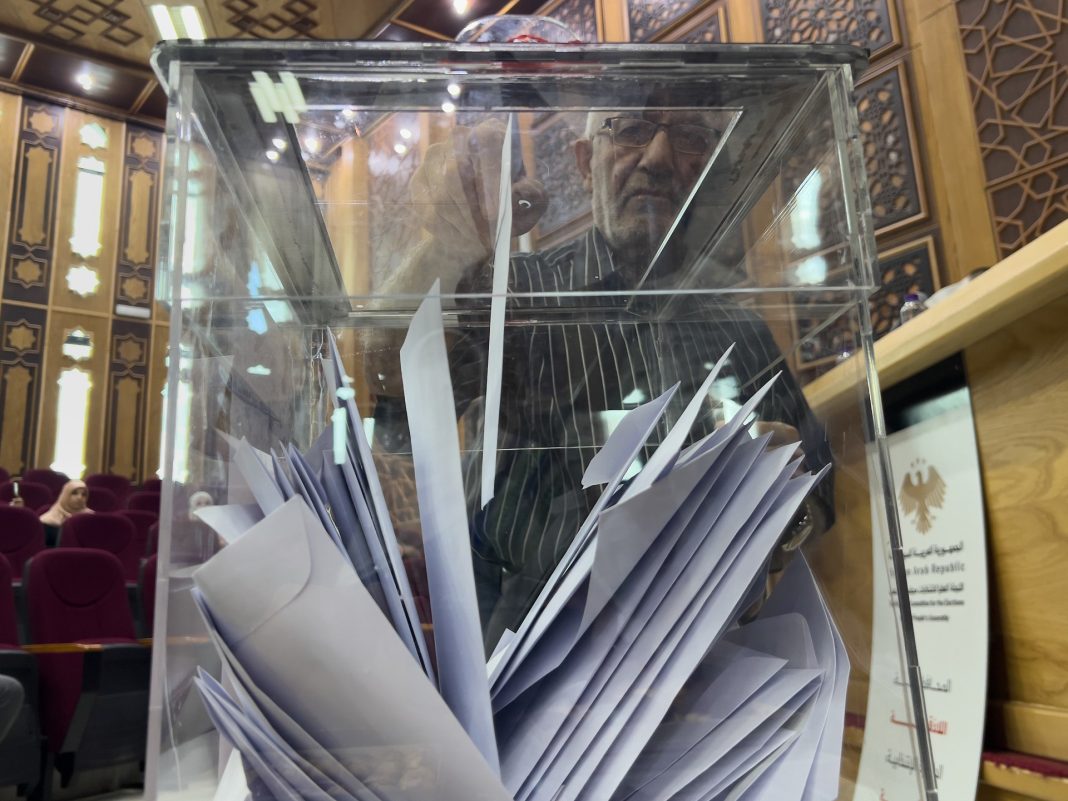
Nawar Najmeh, spokesperson for Syria’s Higher Election Committee, told the state-run SANA news agency that voting in Sunday’s elections had concluded in some electoral districts, and the winning candidates will be announced during a news conference later in the day.
Members of Syria’s electoral colleges had gathered to vote for the new lawmakers in a process being criticised as undemocratic, with a third of the 210 members of the revamped People’s Assembly appointed by interim leader, Ahmed al-Sharaa. The remaining representatives have not been voted on directly by the people, but chosen instead by electoral colleges around the country.
Critics say the system favours well-connected figures and is likely to keep power concentrated in the hands of Syria’s new rulers, rather than paving the way for genuine democratic change.
In a joint statement last month, more than a dozen nongovernmental organisations announced that the process means al-Sharaa “can effectively shape a parliamentary majority composed of individuals he selected or ensured loyalty from”, which risked “undermining the principle of pluralism essential to any genuine democratic process”.
Elections in the restive Druze-majority province of Suwayda and in northeastern areas controlled by the Kurdish-led Syrian Democratic Forces have been indefinitely postponed due to tensions between local authorities and the central government in Damascus.
In a speech after observing the votes being cast at the National Library Center in Damascus, al-Sharaa hailed the election as a key moment in rebuilding the country.
He applauded the fact that the country was able “in just a few months, to engage in an electoral process suited for its current circumstances”.
“This historic moment among Syrians is very important,” he said, adding, “There are many pending laws that need to be voted on to advance the process of construction and prosperity.”
During the al-Assad dynasty’s years in power, regular elections were held, but they were widely viewed as sham, and the al-Assad-led Baath party always dominated the parliament.
During its 30-month term, the incoming parliament will be tasked with preparing the ground for a popular vote in the next elections.
The People’s Assembly has 210 seats, of which 140 were voted on by electoral colleges throughout the country, with the number of seats for each district distributed by population. The remaining 70 deputies will be appointed directly by al-Sharaa.
A total of 7,000 electoral college members in 60 districts – chosen from a pool of applicants in each district by committees appointed for the purpose – were eligible to vote for the 140 seats.
However, the postponement of elections in the Kurdish-dominated northeast provinces of Hasakah and Raqqa, and the Druze-majority southern province of Suwayda, which remain outside Damascus’s control, means that seats there will remain empty.
All the more than 1,500 candidates came from the ranks of the electoral colleges and ran s independents, as existing political parties were dissolved by Syria’s new authorities following al-Assad’s ouster, and no replacement system has been established to register new parties.
While the lack of a popular vote has been criticised as undemocratic, some analysts say the government’s reasons are valid.
Al-Sharaa has stated it would be impossible to organise direct elections now due to the large number of Syrians who lack documentation after millions fled abroad or were displaced internally.
Critics have also expressed concerns about the representation of minorities and women in the new assembly, with only 14 percent of the candidates being women, and Suwayda and the northeast excluded from the process.
