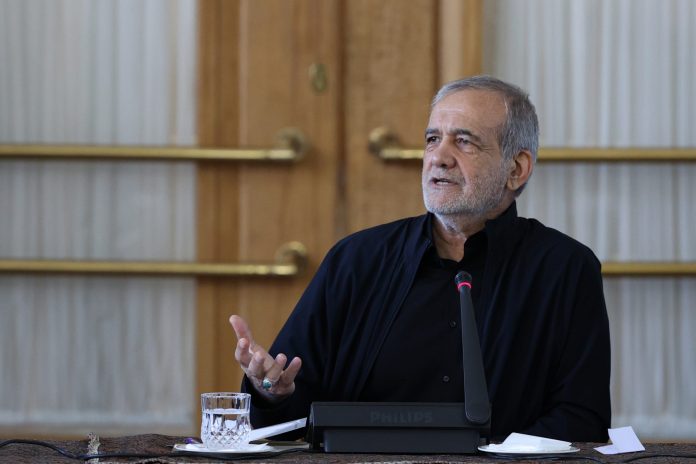
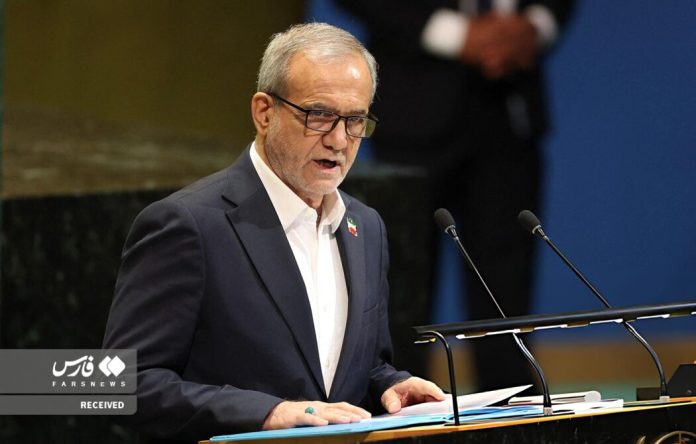
The Iranian president told the audience at the UN General Assembly in New York on Wednesday that it was a “heavy blow” to international trust and regional peace.
The president said the attacks, which struck Iranian cities, homes, and infrastructure while diplomatic talks were ongoing, represented “a grave betrayal of diplomacy and a weakening of efforts to establish peace and stability.”
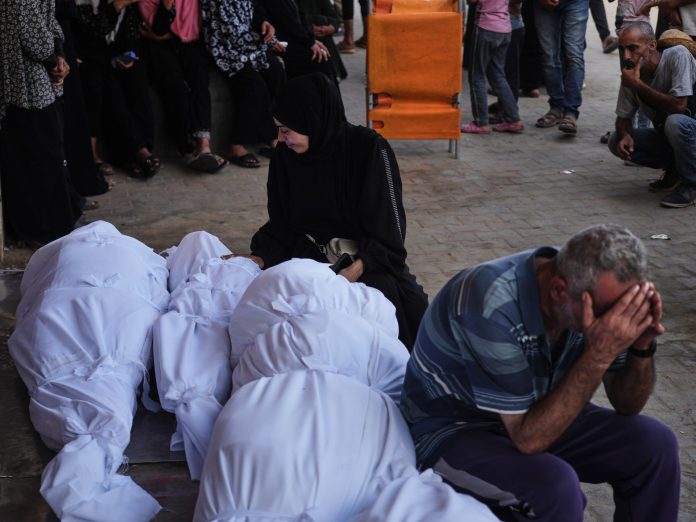
“What you see in these images of killings and crimes is the massacre of children and women. It is a black record of slaughter carried out by Israel in our country against our people, including women, children, and youth, under the name of preserving peace and security in the region,” he added, holding out pictures of the victims.
Pezeshkian underscored Iran’s resilience, saying the country was “the world’s oldest continuous civilization” that has withstood the storms of history.
“Despite the harshest, longest, and heaviest economic sanctions, psychological warfare, media campaigns, and constant efforts to sow division, the Iranian people, from the very first bullet fired at their soil, stood united behind their brave armed forces, and today they continue to honor the blood of their martyrs,” he underlined.
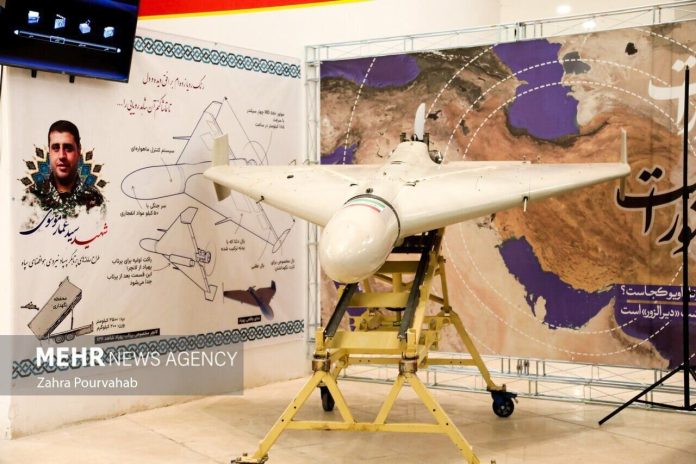
The Iranian president said the strikes killed commanders, women, children, scientists, and national elites, while also damaging internationally-monitored facilities. He said the strikes constitute “a black record of crimes” carried out under the pretext of preserving regional security.
“Assassination of state officials, systematic targeting of journalists, and the killing of individuals solely because of their knowledge and expertise are flagrant violations of human rights and international law,” the Iranian president told delegates from around the globe.
Israel and the United States have shed the blood of thousands of innocent people in Gaza with the same approach, he added.
Pezeshkian accused Washington and Tel Aviv of deliberately undermining negotiations through military escalation.
The president stated that the foundation of all divine religions and human conscience is the golden rule: “Do not do unto others what you would not want done unto yourself.”
“Let us look at the past two years: the world has witnessed genocide in Gaza; the destruction of homes and repeated violations of sovereignty and territorial integrity in Lebanon; the devastation of Syria’s infrastructure; attacks on the people of Yemen; the forced starvation of emaciated children in their mothers’ arms; the stealthy assault on the sovereignty of nations, violations of states’ territorial integrity, and the open targeting of national leaders.”
“Would you accept such things for yourselves?”
The Iranian president warned that if such “dangerous violations” go unchecked, they will spread worldwide.
The president denounced what he called the “absurd and delusional” plan for a “Greater Israel,” accusing Israel of pursuing aggression and apartheid under the guise of “peace through power.”
“Today, after nearly two years of genocide, mass starvation, the continuation of apartheid inside the occupied territories, and aggression against neighboring countries, the absurd and delusional plan of a ‘Greater Israel’ is being shamelessly declared at the highest levels of this regime.”
He stated that such policies amount to “bullying and coercion — not peace, and not power.”
The Iranian president outlined an alternative vision for West Asia, calling for a “strong region” built on collective security, cultural diversity, joint investment in infrastructure and science, energy security, environmental protection, and the non-negotiable principles of sovereignty and territorial integrity.
“We seek not peace through force, but power through peace.”
He also reiterated Iran’s longstanding support for a West Asia free of weapons of mass destruction, criticizing nuclear-armed states for violating the Non-Proliferation Treaty (NPT) while pressuring Iran with “baseless accusations.”
“But we want our powerful Iran, alongside powerful neighbors, in a strong region with a bright future,” Pezeshkian said.
“We stand against mega projects that impose genocide, destruction, and instability on the region, and we defend a shared and hopeful vision: a vision that guarantees collective security through genuine mechanisms of defensive cooperation and joint responses to threats… a vision that seeks not ‘peace through force’ but ‘power through peace.’”
The president added in such a rich region, “there is no place for killing and bloodshed.”
“That is why, for many years, my country has been one of the staunchest supporters of creating a region free of weapons of mass destruction.”
“Yet those who themselves possess the largest nuclear arsenals, and who, in blatant violation of the NPT, make their weapons ever more lethal and destructive, have for years subjected our people to pressure with baseless accusations,” he said.
Turning to the standoff over the so-called snapback mechanism of the 2015 nuclear deal, Pezeshkian denounced three European countries for attempting to reinstate annulled UN Security Council sanctions against Tehran, calling the move “illegal” and carried out “at the order of the United States.”
“Last week, three European countries, after failing, through a decade of broken promises and later by supporting military aggression, to bring the proud people of Iran to their knees, at the order of the United States, attempted through pressure, bullying, imposition, and blatant abuse to reinstate the annulled UN Security Council resolutions against Iran,” he added.
He accused the European powers of abandoning goodwill, bypassing legal obligations, and misrepresenting Iran’s remedial steps after the US withdrawal from the 2015 nuclear deal.
“They falsely presented themselves as ‘well-intentioned parties’ to the agreement, and labeled Iran’s sincere efforts as ‘insufficient.’ All of this was aimed at destroying the very JCPOA they themselves once called the greatest achievement of multilateral diplomacy,” he said.
The president added the move, which also faced opposition from some Security Council members, lacks international legitimacy and “will not be welcomed by the global community.”
He reiterated that Iran has never pursued nuclear weapons, citing a religious decree by Leader of the Islamic Revolution Ayatollah Seyyed Ali Khamenei.
Calling for a new approach to security, he urged world leaders to embrace “confidence building, mutual respect, and regional convergence” rather than force.
“I invite everyone to practice listening to one another instead of raising voices; to reconsider the intellectual foundations of polarization and political violence that today afflict not only the international community but also create tension and turmoil within societies; and to embrace, as the common ground of all beliefs and cultures, the principle of not imposing on others what we would not accept for ourselves.”
The Iranian president concluded by appealing for the restoration of the credibility of international institutions and the creation of a regional security framework in West Asia.
“Let us restore and rebuild the credibility of international institutions and legal mechanisms, and commit to establishing a system of regional security and cooperation in West Asia.”