Thursday, April 9, 2026
Home Blog Page 5042

A research chair is to be set up in memory of late Mina Izadyar

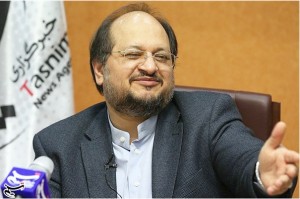
sattari

IzadyarFarvahar, a monthly belonging to Tehran Zoroastrian Youth Organization, filed a report in its 464th issue about the 2nd Mina Izadyar Scientific Festival in October. What appears below is the translation of part of the report:

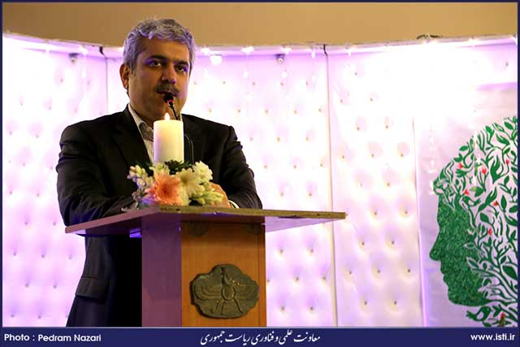
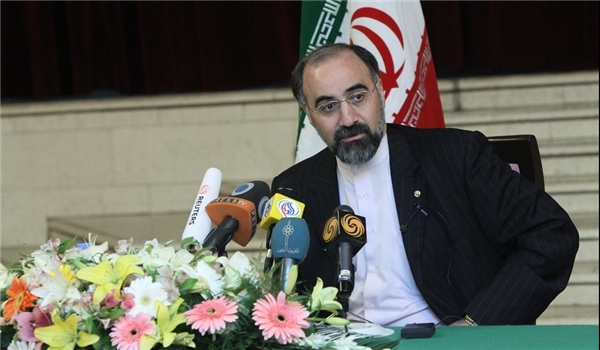
“A budget of around $50,000 is to be allocated to a research chair under the name of the late Dr. Mina Izadyar, the founder of the Iranian Thalassemia Society,” Vice President for Science and Technology Dr. Sorena Sattari told the festival.

“Iran’s National Elites Foundation (INEF) is set to dedicate a special award to the Zoroastrian elites,” Sattari, who also heads the National Elites Foundation, said.

Recalling the accomplishments of individuals awarded at the festival, he said, “These people are the assets of the nation and we are trying to set a trend so that Iranians can serve their country no matter where they are.”

At the festival, Dr. Majid Arasteh, the head of the Iranian Thalassemia Society, said, “Thalassemia used to be regarded as an ailment which took a toll on longevity. However, as a result of Dr. Izadyar’s  endeavors, a number of those suffering from this blood disorder have graduated with medical and engineering degrees and are now serving their society. All members of the Thalassemia Society remember that Dr. Izadyar convinced officials to import Thalassemia medicines which were still little known in regional countries. Above all, she appealed to officials to give patients free access to such medications.”

Dr. Majid Arasteh also underscored the effectiveness of her efforts to train teams at different Thalassemia societies across the country.

“Although she had a ready smile, she was a serious person. Such a characteristic helped her found the Iranian Thalassemia Society. Even after that, she made trips to different cities of Iran and set up a Thalassemia center wherever there was a blood transfusion center. We used to have 2,500 people suffering from Thalassemia, whereas thanks to efforts by her and others, now as few as 200 to 300 babies are born with this blood disorder each year. Last year we lost two invaluable Iranian ladies, Dr.Mina Izadyar and Dr. Parvaneh Vosough [a pediatric oncologist who dedicated her entire life to treating children suffering from cancer, and a co-founder of Mahak Charity Organization] who are sorely missed and their void won’t be filled any time soon,” said Dr. Mardavij Al-Bouyeh, Dr. Izadyar’s professor and colleague.

Among others, Dr. Mahbanoo Tata, the founder of Iran’s science of statistics,Dr. Darius Ravari, an orthopedic surgeon, and Manuchehr Hemmati, a mechanical engineer whose novel ideas have introduced innovation into solar desalination systems over the past 36 years, were awarded as top Zoroastrian figures.

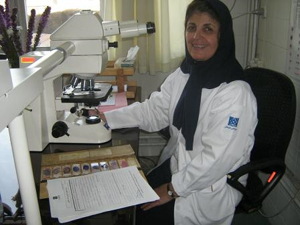
The late Dr. Mina Izadyar was the founder of the Iranian Thalassemia Society, a professor at Shahid Beheshti University of Medical Sciences, a pediatrician, a hematologist-oncologist, the chairwoman of the Iranian Thalassemia Society’s board of directors, a ward manager at a number of top Tehran hospitals and the head of hematology-and-oncology ward at Children’s Medical Center [affiliated to Tehran University of Medical Sciences].
Dr. Izadyar whose husband, Parviz Malekpour, previously represented the Zoroastrian community in the Iranian parliament, lost her battle against cancer after two years and passed away on June 21, 2013.

Rare caracal sighted in Iran’s Hamadan Province

Iran-Wildlife-caracal

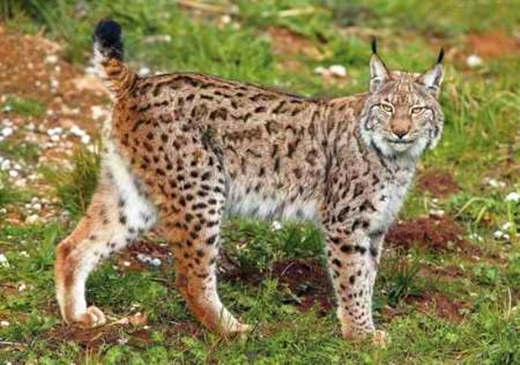
“A rare species of caracal has been sighted in a no-hunting zone near Razan, a town 85 km to the northeast of Hamadan in western Iran,” Director of the Provincial Environment Protection Department Seyyed Adel Arabi told the Islamic Republic News Agency (IRNA) on November 12.

“Following reports that a leopard-like animal has been seen in the zone, the environmental police in Razan began to monitor the area and spotted a rare species of felidae there. The previous sighting went back to 2005 when a caracal was seen in one of the protected areas of Hamadan Province. In 2011, a dead caracal was found near Razan,” he added.

Describing this feline as a rare species of Iran’s biodiversity, he said, “Felines are one of the most important species, because they top the food chain and maintain the balance of other species. The presence of such species in the region shows that the habitat in the area is dynamic and normal for carnivorous and herbivorous animals alike.”

“Caracals are shy and cautious animals, yet they are not timid. They tend to live on their own away from human communities. These mammals usually leave their habitats at night and cannot be seen during the day,” he concluded.


Iran, Azerbaijan call for stronger cooperation in all areas

Aliyev-Rouhani-meeting

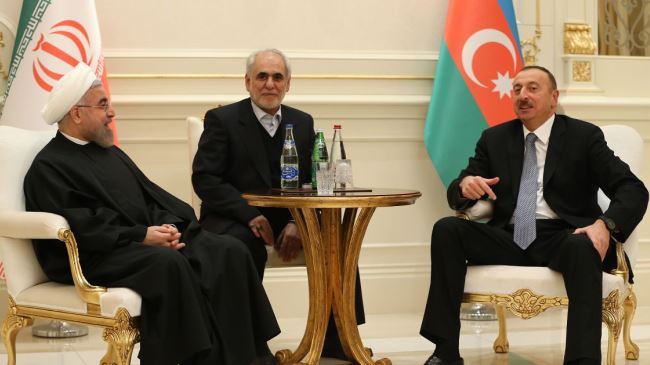
In a meeting with Aliyev in the Azeri capital city of Baku on Wednesday, Rouhani said the Islamic Republic of Iran and the neighboring Republic of Azerbaijan enjoy great potential for expansion of bilateral cooperation.

The two countries are blessed with abundant capacities in economic, cultural, political and international fields that must be taken advantage of, he added.

Rouhani also expressed hope that all subjects of mutual interest would be discussed with Azeri officials during his two-day stay in Baku.

Aliyev, for his part, pointed to the commonalities between the Iranian and Azeri nations, stressing that his administration strongly favors closer interactions between the Iranian and Azeri people and governments in all areas.

Upon his arrival at Heydar Aliyev International Airport in Baku on Wednesday, Rouhani told reporters that he hopes to sign agreements and explore avenues for the improvement of Tehran-Baku relations during his visit to the Republic of Azerbaijan.

“The Republic of Azerbaijan is a very good neighbor for the Islamic Republic of Iran and today, our relations are better than previous years,” he said.

On September 29, Rouhani said Tehran and Baku have great potential for the expansion of bilateral cooperation, particularly in the fields of energy, commerce, environment and tourism, adding that Iran-Azerbaijan Joint Economic Commission should play a more active role in this regard.

A look at Iranian newspaper front pages on Nov. 12

Iranian Newspapers Headlines

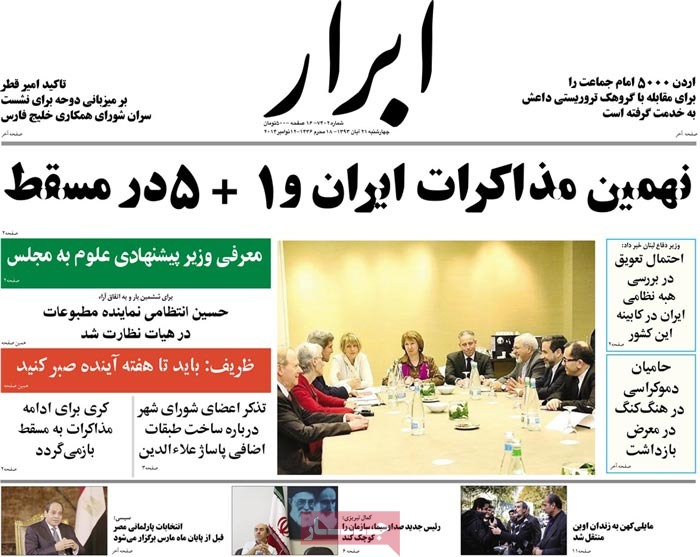
Reelection of Hossein Entezami as the representative of the press managing editors at the Media Supervisory Board dominated the front pages of Iranian dailies on Wednesday. The imprisonment of Mohammad Mayeli Kohan, the former head coach of the Iranian national soccer team, the president’s nomination of Dr. Fakhreddin Ahmadi Danesh-Ashtiani as science minister and conclusion of nuclear talks between representatives of Iran, the EU and the US in Muscat, Oman also grabbed headlines.


Abrar: US Secretary of State John Kerry is likely to return to Muscat to take up the talks where they were left off.
A look at Iranian newspaper front pages on Nov. 12


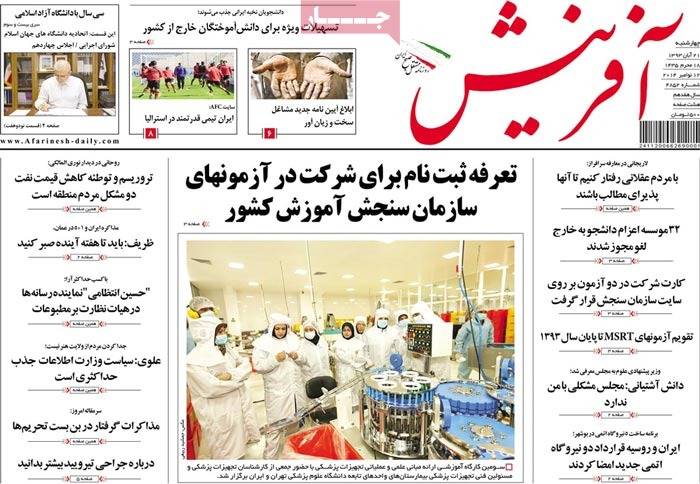
Afarinesh: “Terrorism and the plot to send oil prices tumbling are the two major problems regional people are facing,” President Rouhani told the visiting Iraqi vice-president.

Afarinesh: Iran and Russia have signed a deal over construction by Russia of two new nuclear power plants in Iran.
A look at Iranian newspaper front pages on Nov. 12


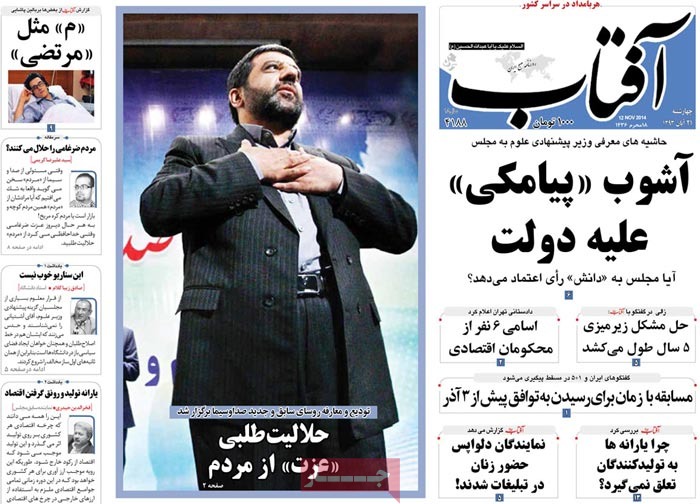
Aftab-e Yazd: A race against time is on to clinch a nuclear deal before a November 24th deadline.
A look at Iranian newspaper front pages on Nov. 12


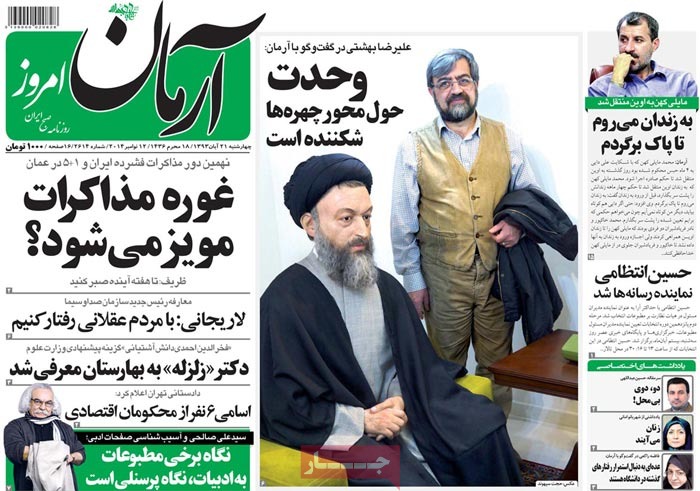
Arman-e Emrooz: Mohammad Mayeli Kohan, a former coach of the Iranian national soccer team, has been taken to Evin prison to serve a four-month term after he was found guilty following a suit filed by Ali Daei, another national team coach.
A look at Iranian newspaper front pages on Nov. 12


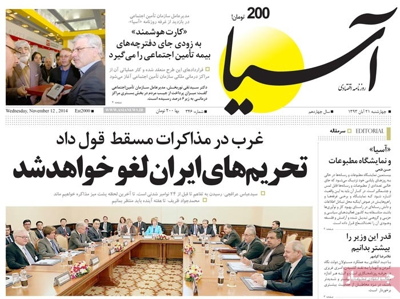
Asia: Hossein Entezami has been reelected as the representative of the managing editors of the press at the Media Supervisory Board. In being elected to the board for a 6th time in a row, he garnered 305 votes of the total 319 cast.

Asia: In the talks in Muscat, the West promised to lift the sanctions it has imposed on Iran.

Asia: Yanni, a world-famous Greek pianist, keyboardist and composer, is to perform in Tehran and in the southern Iranian island of Kish soon.
918317b5


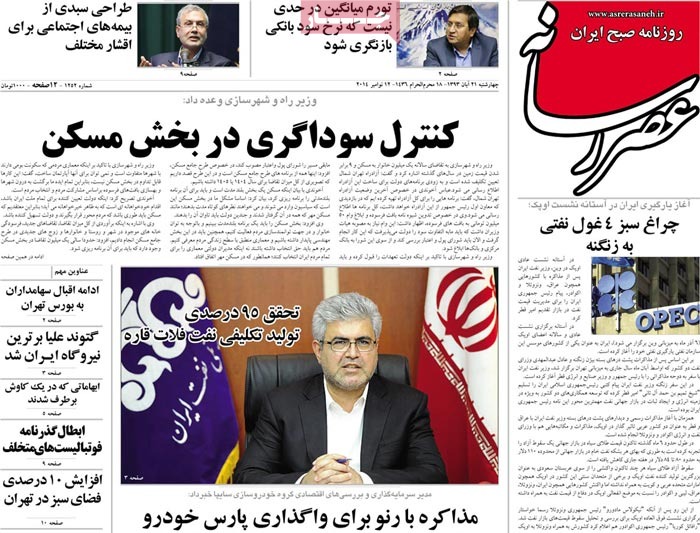
Asr-e Rasaneh: Talks are underway with France’s Renault to hand over Iranian automaker Pars Khodro.
A look at Iranian newspaper front pages on Nov. 12


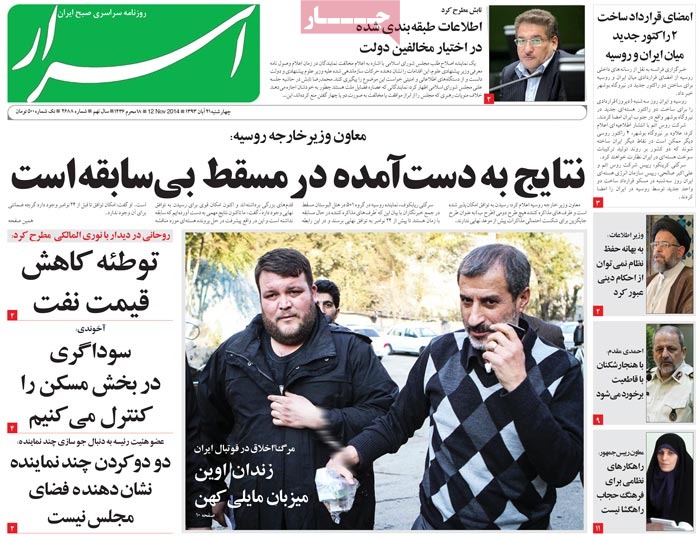
Asrar: “Military mechanisms won’t work in institutionalizing the hijab,” said Vice-President for Women’s Affairs Shahindokht Molaverdi.

Asrar: “Police will seriously deal with those who break the norms,” vowed Police Chief Brigadier General Esmail Ahmadi Moghaddam.
A look at Iranian newspaper front pages on Nov. 12


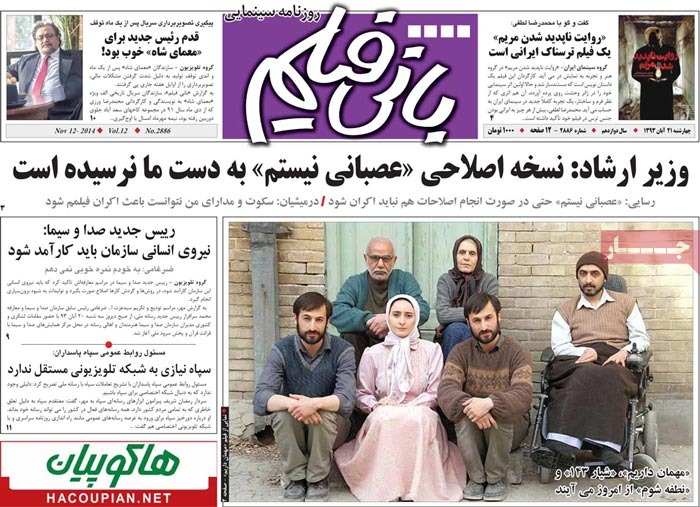
Bani Film:“The Islamic Revolution Guard Corps does not need its own independent TV channel,” says the head of the Public Relations Department of the force.
A look at Iranian newspaper front pages on Nov. 12


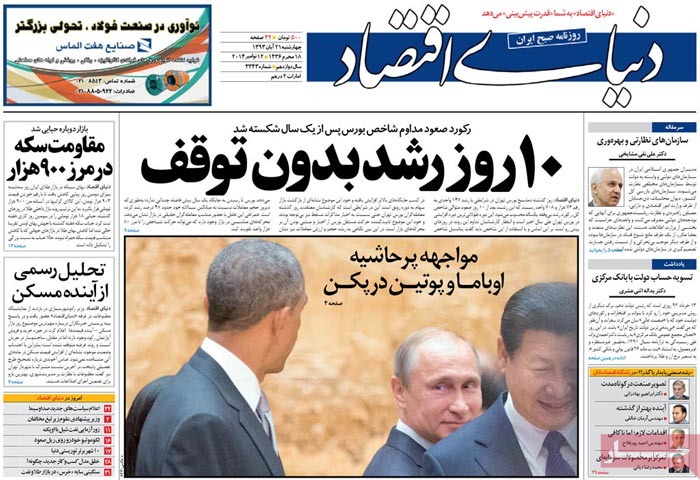
Donyay-e Eghtesad: The Tehran Stock Exchange index is on a 10-day rising streak.
A look at Iranian newspaper front pages on Nov. 12


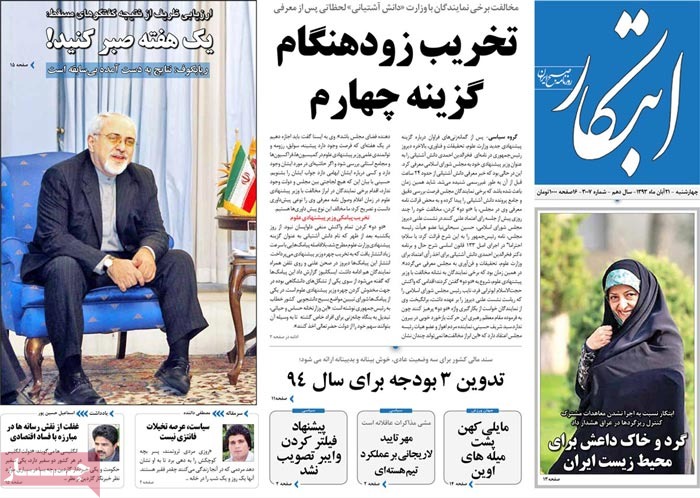
Ebtekar: The president’s fourth nominee to take over the Ministry of Science, Research and Technology has come under a torrent of attacks from some MPs.

Ebtekar: “You have to wait for a week,” Foreign Minister Mohammad Javad Zarif said in response to questions about his assessment of Muscat nuclear talks.
A look at Iranian newspaper front pages on Nov. 12


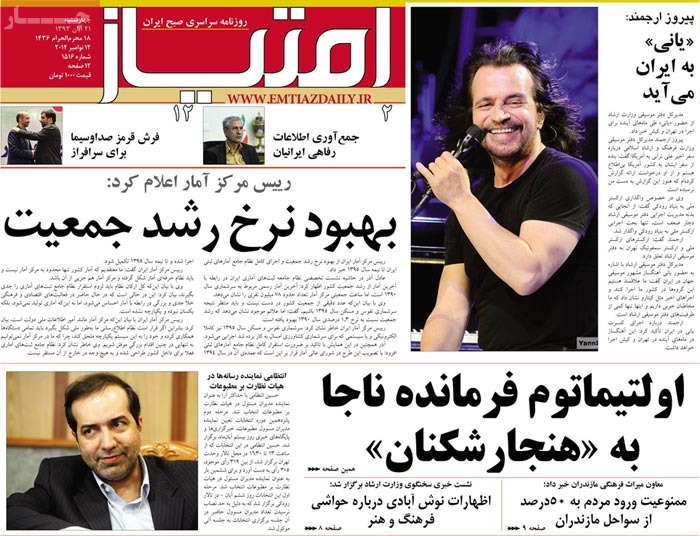
Emtiaz: Mohammad Sarafraz has been inducted as president of Islamic Republic of Iran Broadcasting (IRIB).
A look at Iranian newspaper front pages on Nov. 12


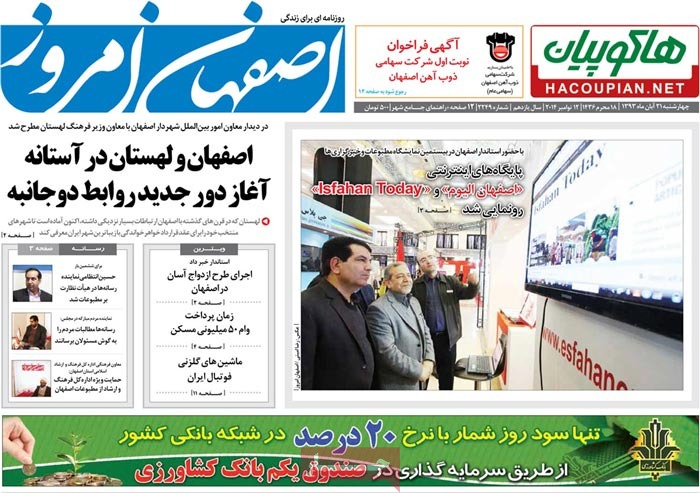
Esfahan Emrooz: Isfahan and Poland are close to launching a new round of bilateral relations.
A look at Iranian newspaper front pages on Nov. 12


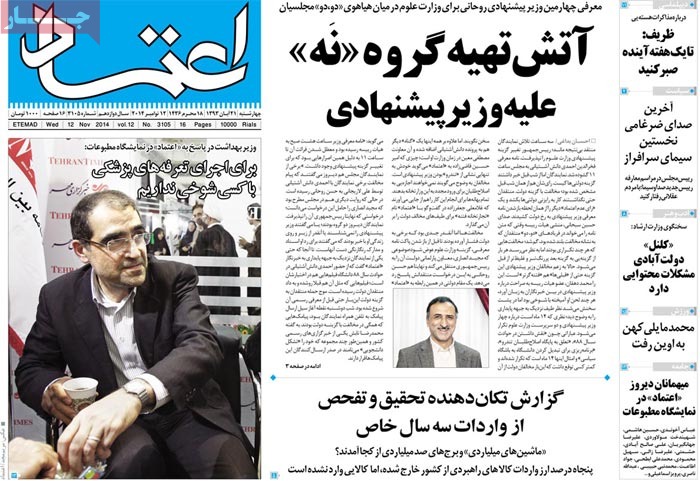
Etemad: A spokesman for the Ministry of Culture and Islamic Guidance has said that the content of The Colonel by Mahmoud Dowlatabadi needs to be revised before it is given the go-ahead to go to press.

Etemad: “We are quite serious in implementing medical fee regulations,” Health Minister Seyyed Hassan Hashemi said.
A look at Iranian newspaper front pages on Nov. 12


Ettela’at: The government spokesman says 246 development projects will have been inaugurated by the end of the year [March 21, 2015].

Ettela’at: To counter water scarcity, modern irrigation techniques will be used on some 4 million hectares of agricultural land across Iran.

A look at Iranian newspaper front pages on Nov. 12


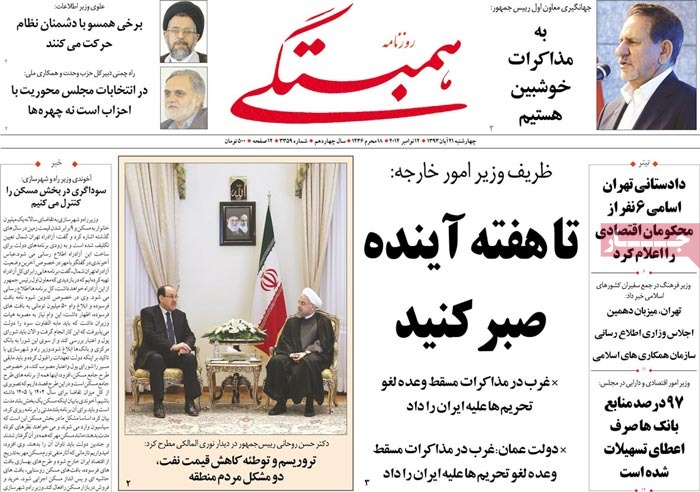
Hambastegi: Tehran prosecutors have released the names of six individuals convicted of corruption.

Hambastegi: Tehran is to host a meeting of the information ministers of the Organization of Islamic Cooperation.
A look at Iranian newspaper front pages on Nov. 12


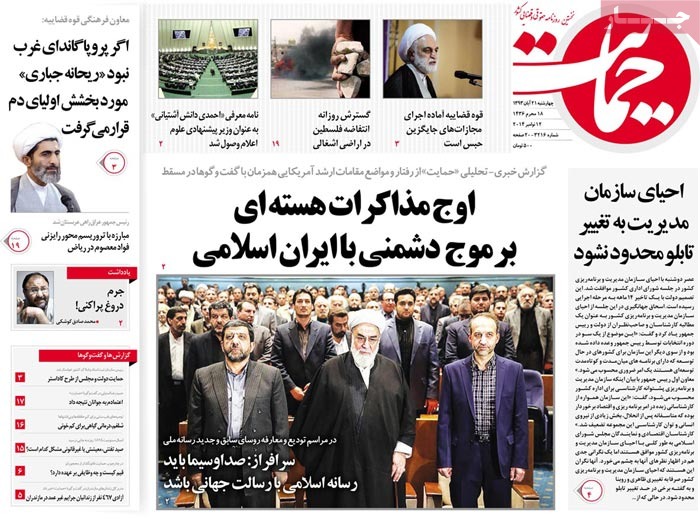
Hemayat: The Palestinian uprising in the occupied territories is growing daily.
A look at Iranian newspaper front pages on Nov. 12


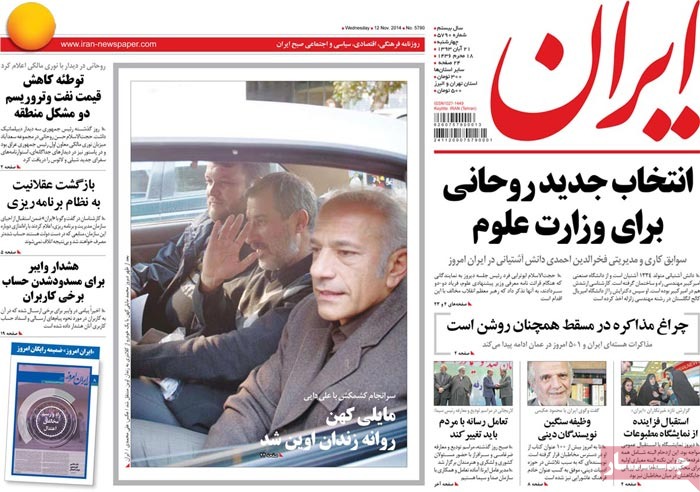
Iran: The number of people visiting the 20th Exhibition of the Press and News Agencies is huge.
A look at Iranian newspaper front pages on Nov. 12


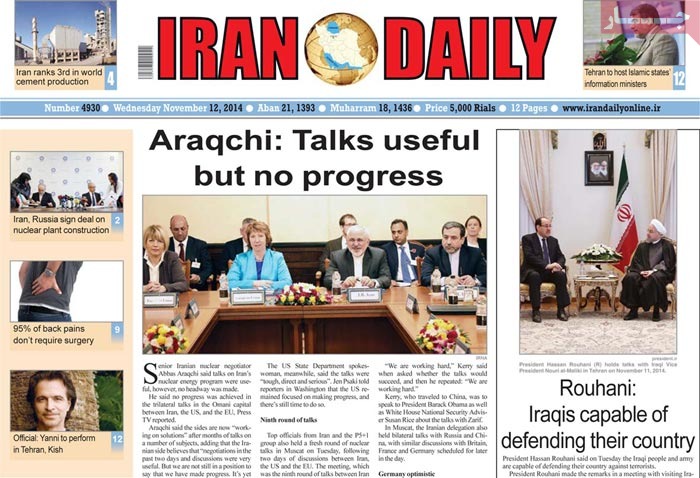
Iran Daily: Iran ranks 3rd in world cement production.
A look at Iranian newspaper front pages on Nov. 12


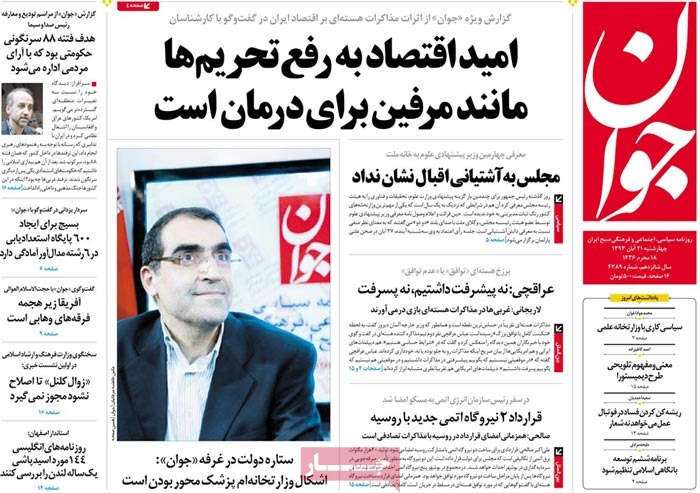
Javan: The Islamic Consultative Assembly has not welcomed the nomination of Dr. Fakhreddin Ahmadi Danesh-Ashtiani by the president for the portfolio of science minister.
A look at Iranian newspaper front pages on Nov. 12


Jomhouri Islami: “Opening letters of credit for imports of airplane spare parts has become possible,” said the minister of roads and urban development.

A look at Iranian newspaper front pages on Nov. 12


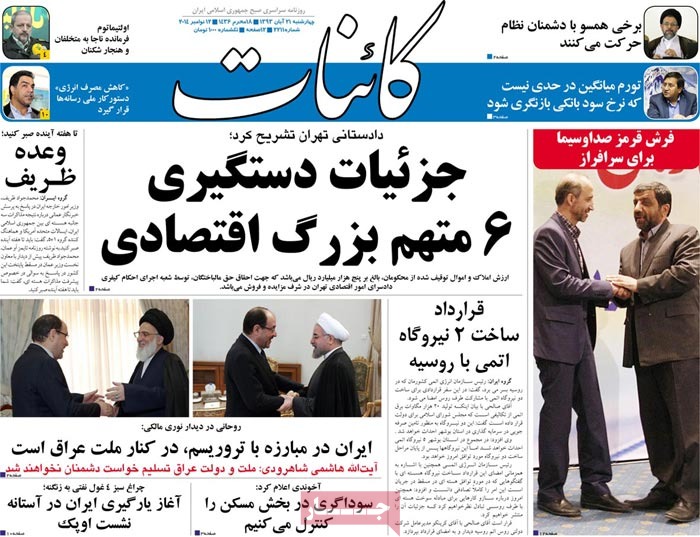
Kaenat: Average inflation is not at a level to warrant a review of banking interest rates.
A look at Iranian newspaper front pages on Nov. 12


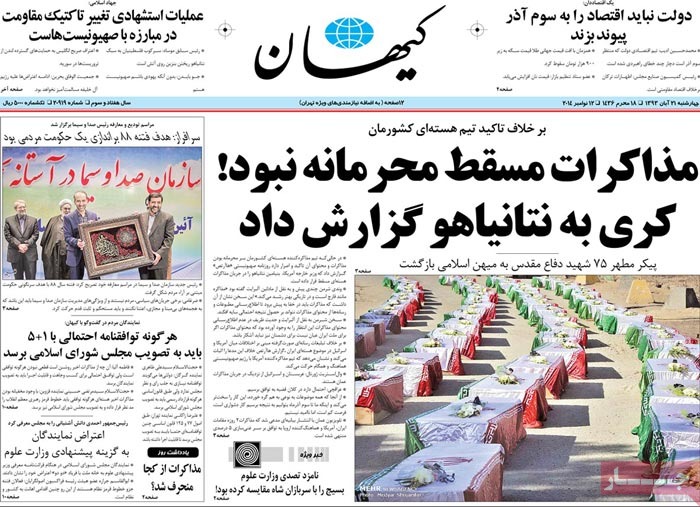
Kayhan:The remains of 75 Iranian soldiers who fell martyr during the Sacred Defense [the Iran-Iraq war in the 80s] have returned home.

Kayhan: Despite statements by the Iranian nuclear negotiating team that only those who were involved in the Muscat talks were privy to what happened, US Secretary of State John Kerry has offered a report to Netanyahu.

Kayhan: President Rouhani’s proposed minister of science has compared Basij [volunteers] to soldiers of the Shah!!!

Kayhan: MPs have voiced opposition to the president’s choice for the minister of science.
A look at Iranian newspaper front pages on Nov. 12


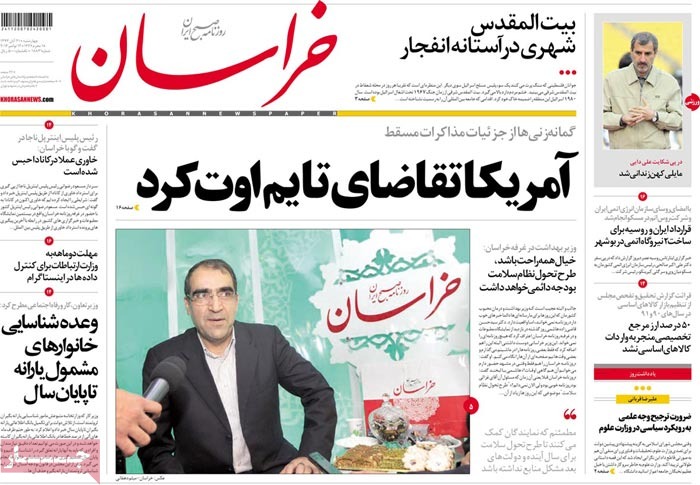
Khorasan: “Mahmoud Reza Khavari, [who is wanted by authorities in Iran for corruption], is practically in prison in Canada,” the head of the Interpol Division of the Iranian police force said.
A look at Iranian newspaper front pages on Nov. 12


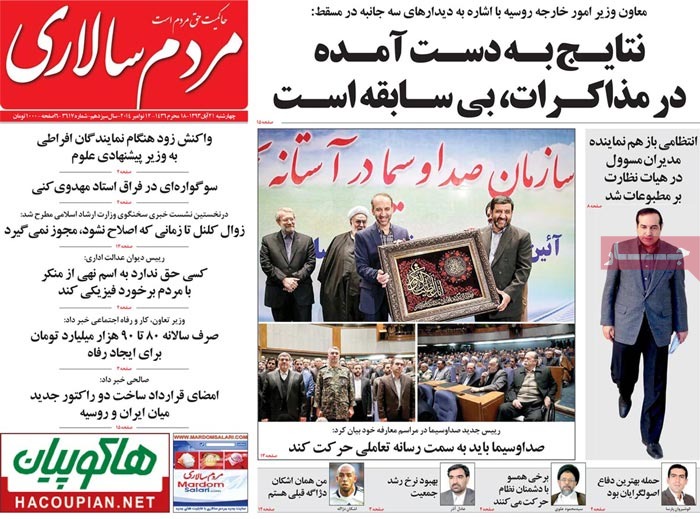
Mardomsalari: “Individuals have no right to resort to physical action in the name of preventing vice,” said the head of the Administrative Justice Court.
A look at Iranian newspaper front pages on Nov. 12


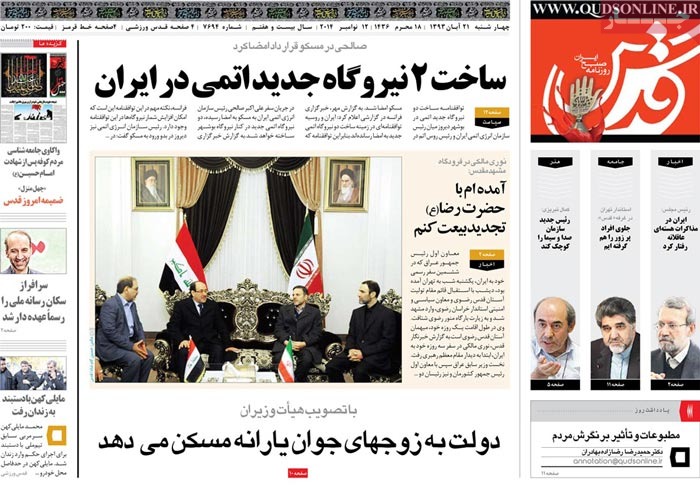
Qods: “Iran acted logically in nuclear talks,” said the speaker of the Islamic Consultative Assembly.

Qods: Government is to offer housing subsidies to young couples.
A look at Iranian newspaper front pages on Nov. 12


Rah-e Mardom: “That the quality of Tehran’s air has improved is not simply a claim,” said the director of the Environment Protection Organization.

A look at Iranian newspaper front pages on Nov. 12


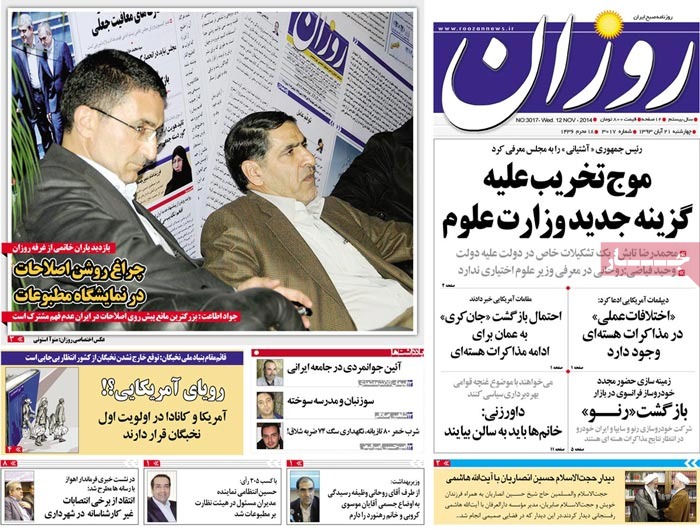
Roozan: “President Rouhani has commissioned me to supervise the physical well-being of Messrs. Mousavi and Karoubi and Mrs. Rahnavard,” said Health Minister Seyyed Hassan Hashemi.
A look at Iranian newspaper front pages on Nov. 12


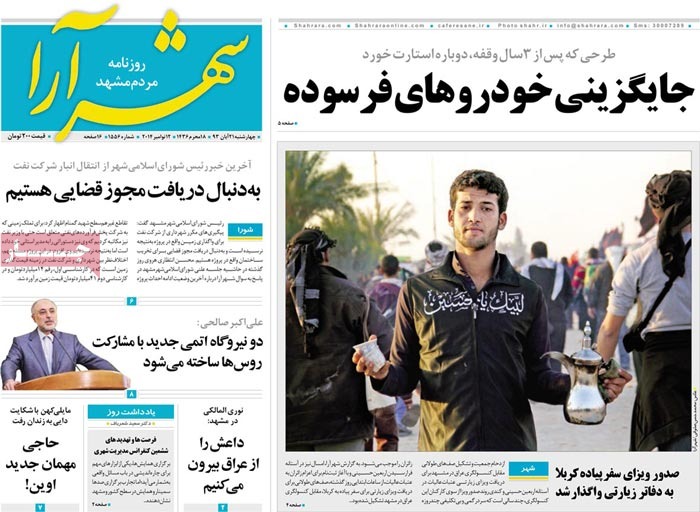
Shahrara: Iraqi Vice-President Nouri al-Maliki, who is in the holy city of Mashhad, said, “We will drive IS out of Iraq.”
A look at Iranian newspaper front pages on Nov. 12


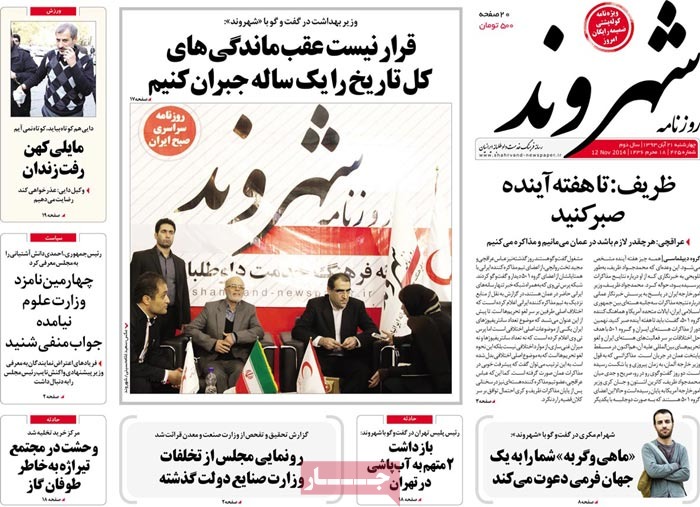
Shahrvand: “We are not supposed to make up in one single year for the lack of development over a long period of time,” the health minister said.
A look at Iranian newspaper front pages on Nov. 12


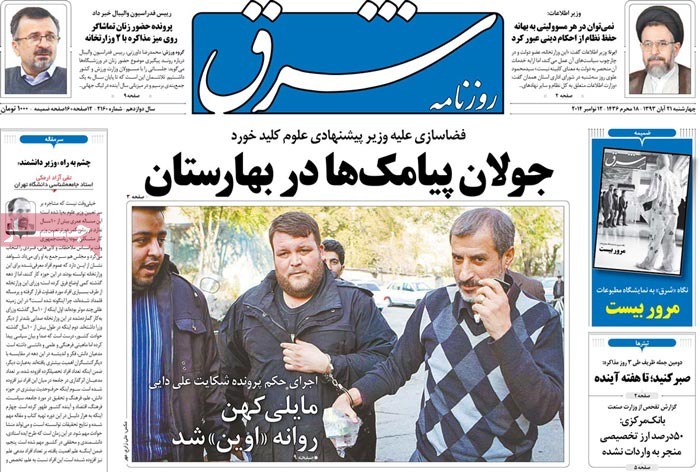
Sharq: The head of the Iranian Volleyball Federation has said he has talked to the officials of the ministries of Youth and Sports and the Interior about the presence of female spectators in sport arenas.
A look at Iranian newspaper front pages on Nov. 12


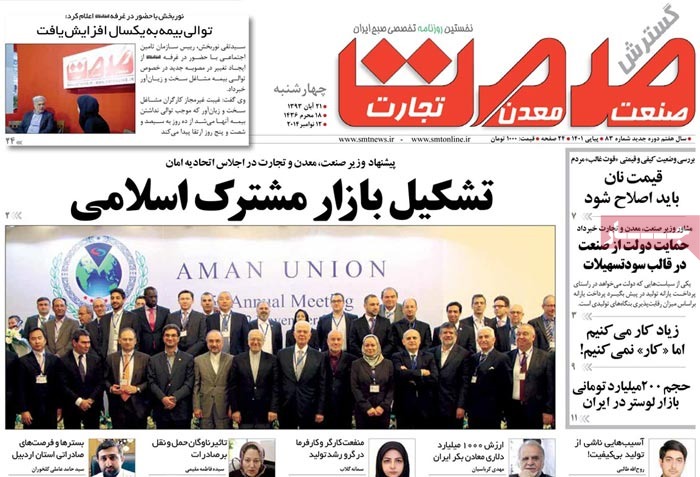
SMT: At a meeting of Aman Union, Iranian Minister of Industries, Mining and Trade Mohammad Reza Nematzadeh has put forth the idea of forming an Islamic Common Market.
A look at Iranian newspaper front pages on Nov. 12


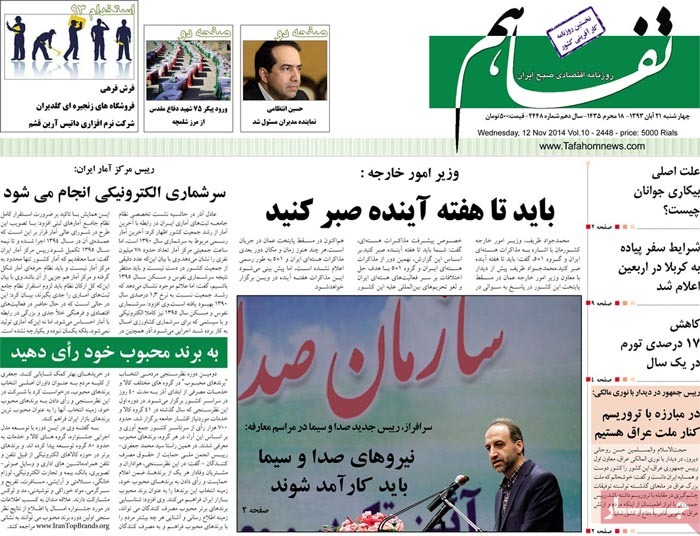
Tafahom: Inflation has declined by as much as 17 percent in a single year.

Tafahom: The new president of IRIB has said the national broadcaster’s human resources need to become more efficient.

Tafahom: The head of the Statistical Center of Iran has said an electronic census will be carried out.

A look at Iranian newspaper front pages on Nov. 12


Reciprocal Trade Visits between Iran, US on Agenda: Official

Mohammad Reza Sabzalipour

Head of Iran’s World Trade Center Mohammad Reza Sabzalipour announced that Iran and the US have plans to start reciprocal trade visits in the future.

“The reciprocal visits by Iranian and US economic delegations are on the agenda of Iran’s World Trade Center but not now; the relevant information will be released through the media once the grounds are prepared,” Sabzalipour said on Tuesday.

He also dismissed The Times report that Iran has held secret talks with American officials in Baku to discuss opening a US trade office in Tehran if a deal is reached over its nuclear program and sanctions are lifted, and said, “The information spread by The Times newspaper about holding secret negotiations between Iran and the US in Baku is untrue.”

“The important point is that the trade offices will be reopened in both countries one day in future, but none of these plans will be finalized before the finalization of the Geneva nuclear deal,” he added.

Meantime, Sabzalipour revealed that a delegation headed by him had visited the US during the past two years, but rejected the reports that the meetings with the American officials have been made in recent days.

The US embassy in Azerbaijan also denied information, spread by The Times newspaper about holding secret negotiations between Iran and the US in Baku.

“This story is completely untrue. There are no such trade talks involving US government officials, nor have there been. We are not currently considering opening a trade office, and we have had no conversations, and have no plans to engage in conversations, in trade talks or any talks similar to those described in this misleading news story”, the embassy said in statement in response to a request by Azerbaijan’s Trend news agency.

Iran World Heritage Attractions (No. 2)

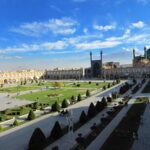
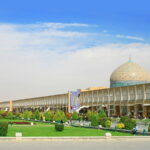
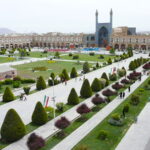
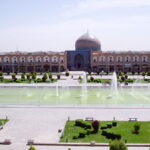
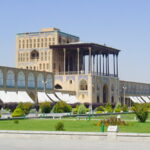
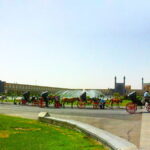
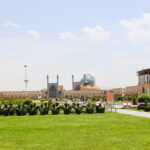
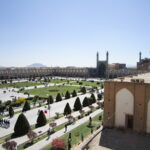
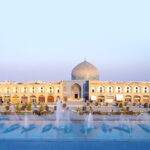
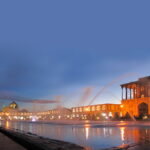
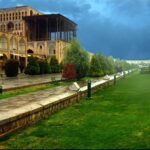
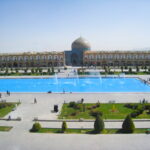
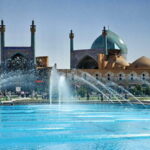
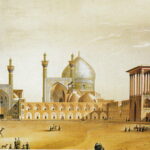
Iran-Isfahan Naghsh-e Jahan Square

As a vast country with a history that stretches millennia, Iran has made significant contributions to human civilization. Over the centuries many awe-inspiring monuments have been set up in Iran. In 1979 Iran joined the UNESCO World Heritage Convention. As of 2009, ten Iranian monuments had been officially registered as World Heritage Sites. Several others have been nominated for registration.

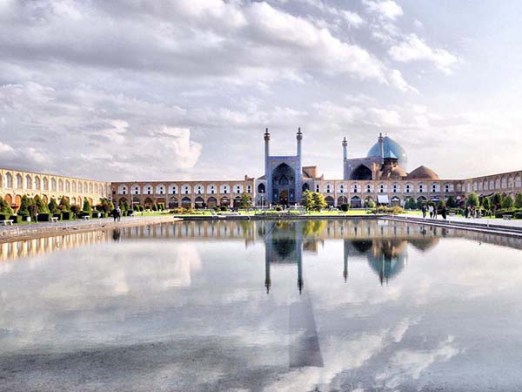
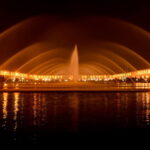
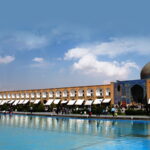
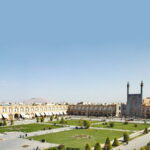
In an October special issue that focused on tourism and sustainable development, Safar (Travel) monthly, took a closer look through a camera lens at these World Heritage Sites, among them Isfahan’s Meidan-e Imam which is also known as Naghsh-e Jahan Square:

The square, a masterpiece of urban construction in the center of Isfahan, was built in the 17th century on orders of Shah Abbas, a Safavid Dynasty king. Naghsh-e Jahan, which means image of the world in Farsi, has been described as an Iranian equivalent to Saint Mark’s Basilica in Venice.

The square, which was registered as a UNESCO World Heritage Site in 1979, is 508 meters long and 160 meters wide. Two beautiful mosques, namely Masjed-e Imam and Masjed-e Sheikh Lotfollah, along with Aliqapu Palace, a six-story structure, surround the historic square.


Gas injection into IR-5 centrifuges has not stopped: Iran’s FM Spokeswoman

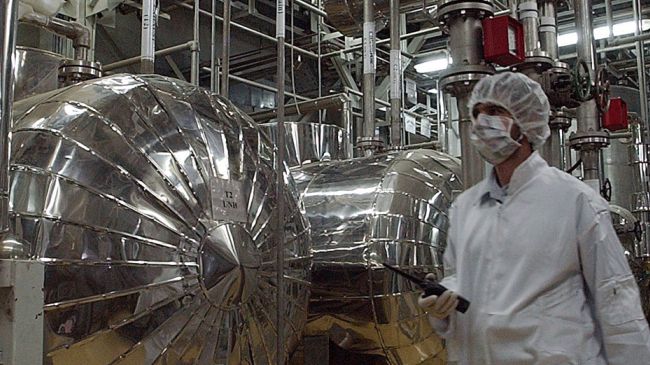
Nuclear Site

The Islamic Republic of Iran has played down reports that it has agreed to stop injecting gas into its first-generation centrifuges.

Iranian Foreign Ministry Spokesperson Marzieh Afkham said on Tuesday that Iran began testing the IR-5 centrifuges before it reached an interim nuclear deal with P5+1 in Geneva last November, adding the tests have continued after the agreement as well.

Under a deal reached between Iran and the five permanent members of the UN Security Council – the US, France, Britain, Russia and China – plus Germany, the six countries undertook to provide Tehran with some sanctions relief in exchange for Tehran agreeing to limit certain aspects of its nuclear activities.

Afkham said Tehran once again tested the IR-5 centrifuges in March in line with nuclear research agenda of the Atomic Energy Organization of Iran.

“All reports by the [International Atomic Energy] Agency over the past seven months verified the Islamic Republic of Iran’s commitment to the Geneva deal and no case has been reported about any violation of the agreement,” the Iranian spokeswoman added.

She described such reports as media propaganda and said Iran would test the centrifuges whenever it deems necessary.

Afkham’s remarks came after the Washington-based Institute for Science and International Security (ISIS) claimed that Iran may have violated the interim deal by starting to inject natural uranium gas into its IR-5 centrifuges.

Iran, Iraq to Set Up Joint Bank Soon: Iran’s VP

Mohammad Shariatmadari

Tehran and Baghdad are planning to establish a joint bank to facilitate trade transactions and money transferring between the two sides, Iranian Vice President Mohammad Shariatmadari announced on Tuesday.

“The Iran-Iraq bank will be established with the help of the private sector,” Shariatmadari said, addressing the First International Iran-Iraq Trade Conference in Tehran today.

He reiterated that Iran and Iraq have strategic relations, and said, “The two countries’ ties have moved on an upward trend since the coming to power of the Islamic government in Iraq to the extent that the volume of Iran-Iraq trade balance has increased by more than 20 times, while there is still a capacity for increasing their trade balance to $30 million.”

Last month, Head of the Trade Promotion Organization of Iran Valiollah Afkhamirad announced that Iran and Iraq have signed a trade protocol for the promotion of cooperation between the two countries.

“This protocol has 15 paragraphs and it has been signed to facilitate trade transactions between Iran and Iraq,” told Fars News Agency at the time.

He pointed to the recent visit of Iraqi Trade Minister Mohammed Abdul Karim to Iran and his meetings with senior Iranian officials, and said, “The Iraqi minister discussed the problems Iranian businessmen face for exporting their goods to Iraq.”

Afkhamirad, meantime, pointed to the recent visit of Qatari Economy Minister Abdullah bin Jassim al-Thani to Iran and said, “The Iranian and Qatari officials discussed facilitating expansion of trade exchanges between the two countries’ businessmen.”

Iran and Iraq have enjoyed growing ties ever since the overthrow of the former Iraqi dictator, Saddam Hussein, during the 2003 US invasion of the Muslim country.

Russia “optimistic” about Iran nuclear talks

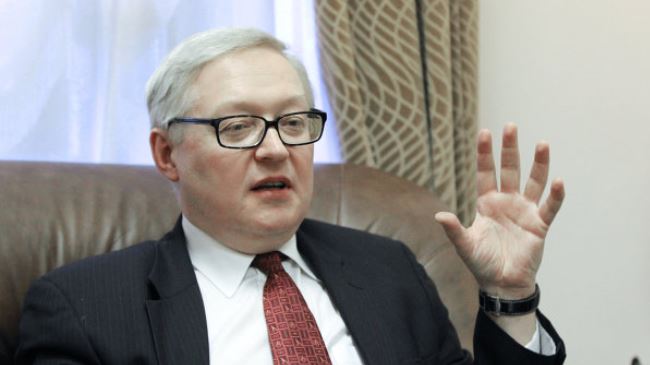
Sergei Ryabkov

Russia’s deputy foreign minister says he is “reasonably optimistic” that Iran and P5+1 can reach a comprehensive nuclear deal before the November 24 deadline despite the remaining disagreements.

“The glass is not half empty. We are reasonably optimistic but not to an extent that we are sure that this agreement can be achieved. It is really a unique and never-tried-before effort,” said Sergei Ryabkov in the Omani capital city of Muscat on Tuesday.

Ryabkov added that Russia is “fully committed” to the talks between Iran and the six world powers and is doing its best to help the negotiations end in an agreement.

“Russia nationally has done a lot to facilitate progress. Russia is very interested in achieving this agreement and very wrong are those who believe that — for whatever reasons — because of our complications with the West, with the US, we are now less interested in this agreement. This is not true, we are fully committed and we are working towards this end,” the Russian official stated.

Top officials from Iran and P5+1 wrapped up talks over Iran’s nuclear program in Muscat on Tuesday.

The meeting was led by Iran’s Foreign Minister Mohammad Javad Zarif and European Union’s envoy, Catherine Ashton, who represents the six countries in the talks.

Sources close to the Iranian negotiating team say the main stumbling block in the way of resolving the Western dispute over Iran’s nuclear energy program remains to be the removal of all the bans imposed on the country, and not the number of centrifuges or the level of uranium enrichment.

Tehran wants the sanctions entirely lifted while Washington, under pressure from the pro-Israeli lobby, insists that at least the UN-imposed sanctions should remain in place.

Iran serious in resolving “artificial nuclear crisis”: Iran’s FM

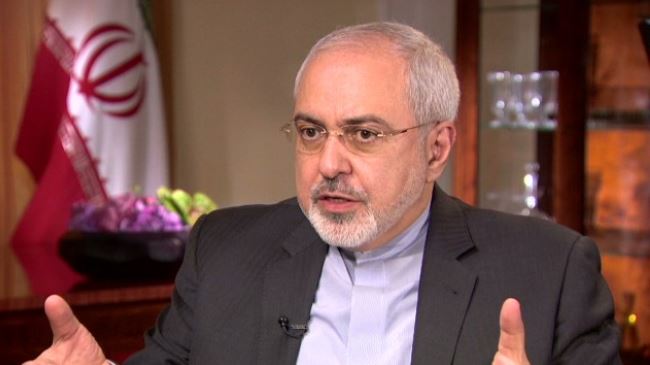
Mohammad Javad Zarif

Iran’s foreign minister says the country is serious in its pursuit of the resolution of the “artificial crisis” about its nuclear energy program.

“Iran is seriously after the resolution of the artificial nuclear crisis and has entered negotiation with absolute good will,” Mohammad Javad Zarif said in a meeting with Oman’s Deputy Prime Minister Sayyid Fahd bin Mahmoud Al Said in Muscat on Tuesday.

Muscat began hosting three days of crucial negotiations over the Islamic Republic’s nuclear energy program on Sunday.

On Monday, Zarif, US Secretary of State John Kerry and European Union envoy Catherine Ashton wrapped up two days of discussions in the Omani capital. On Tuesday, top officials from Iran and P5+1 wrapped up the talks, which were led by Zarif and Ashton.

The Muscat meetings discussed the outstanding issues that must be resolved before the conclusion of a final deal on Iran’s nuclear energy program.

On the top of the agenda were the volume of Iran’s uranium enrichment and the timetable for the removal of sanctions. The next round of nuclear talks between Iran and the world powers is set to be held in the Austrian capital Vienna on November 18-24.

“The issue of sanctions and the issues surrounding it have had no effect on the Iranian nation’s will… to possess peaceful nuclear energy,” said the Iranian top diplomat.

“Some countries have fallen prey to miscalculation owing to wrong analysis.”

The Omani official termed the holding of the nuclear negotiations and trying to reach a solution as intelligent and judicious.

“Oman hopes this trend leads to good results,” he said, adding that “should such a thing happen, its positive effects would be in favor of all.”

The two sides also expressed satisfaction with the trend of bilateral relations, described the capacity of the bilateral cooperation as vast and diverse, and laid emphasis on the two sides’ will to improve bilateral ties.

They also discussed the latest developments in the region.