Wednesday, April 8, 2026
Home Blog Page 5024

Six thousand Americans seeking trip to Iran

Travel to Iran

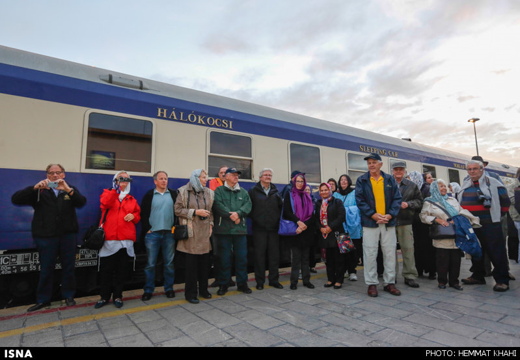
Six thousand Americans are waiting to visit Iran by nine Golden Eagle Danube Expresses in 2015.

The train has already entered Iran twice, but it would come to Iran nine other times. The Golden Eagle Company’s manager said that all tickets for Iran were sold out and 45 percent of the passengers are Americans.

The train would start 14-day visits from Budapest, Hungary, and then passes through Romania, Bulgaria and Turkey to arrive in Iran.

Then the passengers would visit Zanjan, Yazd, Shiraz, Tehran, Kerman and Mashhad cities in a week-long trip.

The train whose design is similar to those of the 1950s is equipped with bathrooms and warm water and is fueled with coal. It costs 9 to 15 thousand dollars to visit Iran by the train.

12,000foreign visitors have called for visiting Iran after the train’s first arrival in the country.

The train which includes 13 wagons is able to carry 102 people (65 passengers and 35 crew members).

Iran eager to broaden ties with neighbors

Iran-Rouhani-central-asia

President Hassan Rouhani says the Islamic Republic is keen to further expand relations with its neighbors, especially Turkmenistan and Kazakhstan.

“Expansion of ties with neighbors is a top priority of Iran’s foreign policy,” Rouhani said in a Wednesday meeting with his Kazakh and Turkmen counterparts, Nursultan Nazarbayev and Gurbanguly Berdimuhamedow, in the Turkmen city of Inche Boroun.

Referring to the recent inauguration of a railroad connecting Iran to the two Central Asian neighbors, Rouhani said the move would prepare the ground for the enhancement of trilateral and regional relations.

“We must make efforts [to forge] closer ties in order to establish stronger peace, stability and security in the region and set the stage for the promotion of trilateral relations,” Rouhani added.

The Iranian president also said the formation of a joint commission will step up economic cooperation among the three countries, adding that Iran’s private sector is ready to work with Turkmen and Kazakh companies.

Nazarbayev, for his part, said that the railroad aims to strengthen interactions among regional states.

The Turkmen president emphasized Iran’s significant role in the region and said trade with the Islamic Republic, which has a strong economy, could help the economic development in his country.

Berdimuhamedow also stressed that the railroad would pave the way for many achievements for the three neighboring states in economic and political areas.

The three presidents on Wednesday attended a ceremony to put the railroad into service in Inche Boroun on the Iran-Turkmenistan border.

The railway can connect great countries like Russia, China, Pakistan, Turkey and Iraq to the Persian Gulf and the Sea of Oman. It is 920 kilometers in length and will shorten the distance between the Persian Gulf, Central Asia and Europe.

Iran summons Yemen chargé d’affaires over bomb attack

Iran-Yemen

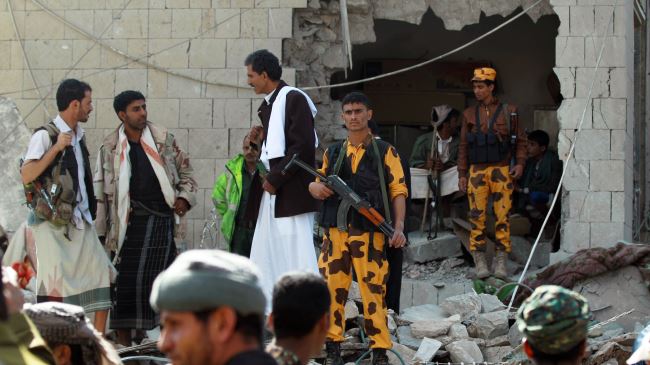
Iran has summoned the Yemeni chargé d’affaires in Tehran after a car bomb attack targeted the residence of the Iranian ambassador to Sana’a.

The Wednesday blast, which took place in the diplomatic district of Hada in the Yemeni capital, left three people dead and several others wounded.

The attack also damaged the Iranian envoy’s residence, but no Iranian diplomat was hurt in the incident.

The Yemeni official was summoned to Iran’s Ministry of Foreign Affairs to convey the Islamic Republic’s vehement protest to his government.

Tehran also laid emphasis on the need for the identification and punishment of the perpetrators and provision of relevant support for the protection of Iran’s diplomatic premises.

The Yemeni official voiced regret over the terrorist incident and said he would immediately communicate Tehran’s message to Sana’a.

Day of People with Disability in the eyes of people with no disability

Disabled people
Disabled people

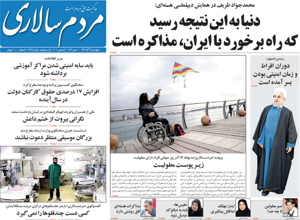
December 3 marks the International Day of People with Disability. Several Iranian newspapers on Wednesday ran news and special reports on the day. Mardomsalari dedicated four full pages to the physically challenged people and their problems. The following is the translation of a piece by Hamidreza Shokouhi, the editor of the Social Desk of the daily, which opened the paper’s coverage:


mardomsalari newspapersThe way non-disabled people look at people with disability is not correct. That is what we have heard over and over, but nobody has ever tried or wanted to solve this attitude problem.

My view of the disabled people was not correct either. To be frank with you, I cannot remember how I looked at them. Perhaps I thought they were not capable enough, and deserved sympathy…

However my friendship with a physically-challenged person back in high-school years changed my mindset. We hit it off and our enduring friendship has already lasted 15 years.

He had a motor skills-related condition. He did not need a wheelchair to get from A to B, but he had problem walking. He was a poet too composing great sonnets; he loved Mowlana’s Mathnavi. Years came and went ….

Now he is married. He has secured a master’s degree in literature from a prestigious public university in Tehran and has released several books, not to mention the fact that he has failed to secure the go-ahead of officials to get some of his poems published!

He is a journalist going to great lengths to reflect in the media the problems people with disability are wrestling with. He has launched a special page for disabled people in several newspapers including Hamshahri, Etela’at and Mardomsalari.

He is actively involved in Baavar (Belief) Association which zeroes in on people with disability. His wife, Masoumeh Nouri, is an educated, capable woman and a journalist too.

He pens articles for Mardomsalari every now and down. We have kept in touch. His name is Seyyed Mohsen Hosseini and his pseudonym is Taha. He is among a handful of high-school friends I am still in touch with.

As far as the question of disabled people go, he is the one who changed my perception and opened the doors to a new world in which I developed new insight into society, an insight which the time I spent at a social sciences faculty failed to provide me with.

Through him I made friends with more people who had disabilities. Saeed Zarouri was one of them. Unlike Mohsen, who is crazy about poetry and books, Saeed is an adventurist. His friendship helped me get familiar with another angle of the life of people with disability, those who crave for adventurist activities such as diving, paragliding and many other activities I myself do not dare get involved in!

I really like to see all people develop a correct understanding of the life of people with disability, like what I did. The only thing I can do is to try my best to reflect their problems. To that end, I have dedicated the social supplement of Mardomsalari (December 3 issue) to those people to mark the occasion.

It is worth mentioning that almost all materials which appear in this supplement have been penned and compiled by disabled people; naturally they can write about themselves better than non-disabled people.

I have experienced how it feels to become one with people with disability. It was a pleasant experience awash with fresh feelings. I wish all of us could develop a correct understanding of how people with disability lead their lives. I wish nothing stood between us. It may seem hard, but by no means is it impossible.

I’d like to say, Happy International Day of People with Disability.

The same supplement also featured images of people with disability engaged in diving and paragliding as well as the comments of the head of parliament’s Caucus to Support People with Disability on what measures the chamber is taking to ease the problems these individuals are facing.

Heated debate over an Iranian musician’s failure to accept prestigious French award rages

Hafte sobh daily 12-3

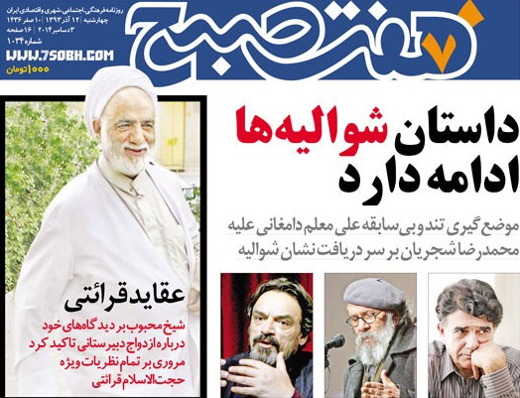
Leading classical composer Hossein Alizadeh’s refusal to accept France’s Chevalier of Legion of Honor has been a hot-button issue in Iran over the past few days. Internationally-acclaimed vocalist Mohammad-Reza Shajarian described it as “objection to those among us who have taken and still take advantage of such awards”. IFP released a translation of his reaction to Alizadeh’s move on Tuesday.

Today, Haft-e Sobh, a daily, carried a front-page piece on what Ali Moalem, the head of the Iranian Academy of Arts and a poet whose poems mainly have a revolutionary theme, said in response to the comments of Shajarian. The following is a partial translation of his strongly-worded criticism of Shajarian:

[…]

There is still confrontation [between us and the West]. In a showdown when two sides have lined up against each other, it is impossible for the army of our enemy to honor our commanders with awards. [If it happened,] it would convey the wrong message; that’s why those who are wise, including Alizadeh, don’t accept such an honor.

Some individuals like Dariush Mehrjui [an Iranian director], and Mohammad-Reza Shajarian judge themselves by such titles. Based on such judgment, people realize that these individuals don’t want to be on this side [Iranian side]; rather they prefer to get an award from the other side [our enemy]. […] This is a confrontation where one won’t welcome any thing that makes him indebted to the enemy.

I may have been offered such an award! Why would they want to offer me such a prize? Because their world is not like ours; they denounce us as primitive and backward, and no award is offered to someone for backwardness. They offer this award to someone to say that this individual is like them and has got a lot in common with them.

These awards reflect their interest in advertising. Whether such awards should be accepted or turned down requires tactfulness. A wise individual should size up everything to see if it is worth accepting the award. If it results in remorsefulness later, they should not accept it.

Anyway, they [the West] act in a way that is beneficial to them. […] Shajarian has taken two or three missteps of late. For instance, his famous pre-Iftar prayer which was a fixture [on radio and TV before sunset during the fasting month of Ramadan] touched people and made them pray for him. Why did he ask the prayer to be taken off the air? I think such a move cannot stem from wisdom.

Or what he has done on stage of late does not fit his status. A figure who has always performed with dignity and grace on the stage is not expected to depict behaviors which are suitable for [people as young as] his son and are typical of teenagers. He is a mentor who is not supposed to show such manners. […] I wish he had valued himself.

Free access to information bylaw confirmed

Shargh daily-12-3
Shargh daily-12-3

News on the confirmation of a bylaw focusing on the release of and free access to information appeared on page 2 of Shargh newspaper on December 3. The daily reported the bylaw obliges all public and state institutions to provide the public with free access to information without asking for the reason behind the request. Below comes the translation of part of that report:

The board charged with reviewing the cabinet’s decisions to see if they conform to the existing laws studied and later approved a bylaw which calls for the provision of free access to information.

The bylaw which was adopted on January 24, 2010 during the tenure of the eighth parliament and communicated to the government of former President Ahmadinejad one week later had required the previous government to piece together executive regulations for the law within six months.

However under the previous government, the legislation was allowed to languish. And when the eleventh government took over, it tried to draw up the executive regulations.

[…]

Mohsen Esmaeli, a jurist and member of the Guardian Council, has said, “The release of and free access to information law recognizes the right of Iranian citizens to free information and allows them to request access to public information, people’s private information excluded, without citing any reason.

“All government and public institutes are obliged to provide citizens with such information according to the existing rules and without inquiring about reasons for access to the information. Naturally when the right is recognized for every single Iranian, the right of reporters has been reaffirmed too.

“The law recognizes the rights of reporters to release and have free access to information. Under the law, an office holder who refuses to provide reporters with public information can be prosecuted for infringement of the law. […]”

“The sixth chapter of the law has mentioned civil and penal punishments for denying access to such information; it means any delay in giving and disseminating information which may cause losses for citizens and media should be compensated for by the violator(s).”

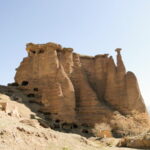
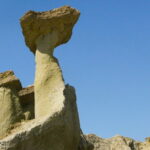
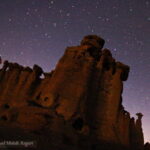
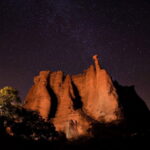
Behestan Castle in Zanjan Province in photos

Iran Behestan Castle

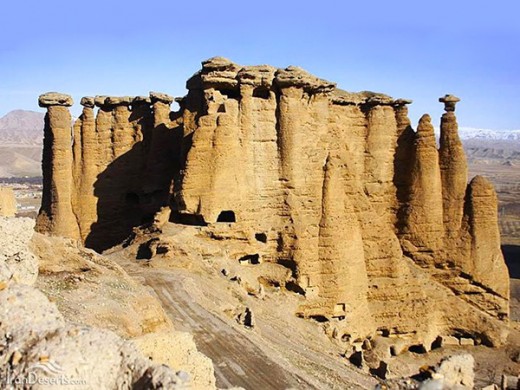
Behestan Castle is a historical castle in Mahneshan, a town in northwestern province of Zanjan. The fort, designed to defend those in power as well as ordinary people against probable attacks, was built during the Achaemenid Empire [First Persian Empire].

The upper levels of the castle were for defensive purposes, whereas the lower parts were used as a storage depot. Standing at the heart of a mountain made of heavily compacted soil consisting of conglomerate rocks, this ancient structure has been exposed to erosion thanks to strong winds and a river flowing nearby.

Archeological research suggests that the castle has been in use five centuries after the dawn of the Islamic era.

The following is a photo gallery that Young Journalists Club has released about this timeless tourist attraction:


An acid attack by a doctor on a doctor

Acid attacks - Javan Daily

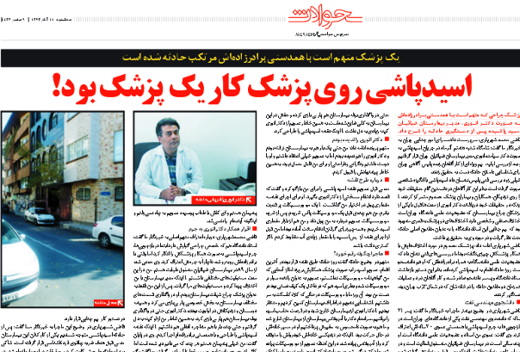
Javan newspaper on December 2 featured a detailed report on a recent acid attack in the capital in which a physician was targeted. The news that Siamand Anvari, the head of Ziaeian hospital in Tehran, was attacked with acid – the latest incident in a string of attacks in the country in less thanthree months – was followed by reports that two suspects, one of them a surgeon, have been arrested in connection with the November 29 attack. The following is a partial translation of the report:

Mohammad Shahriari, a Tehran Court judge, said that a special team of police from the Criminal Investigation Department launched a probe into the attack after news broke that Dr. Anvari was attacked late Saturday on his way home.

After the team found out that the attack was personal motivated, police zeroed in on Anvari’s relatives, colleagues and patients and learned that Dr. Anvari had been for long at odds with a surgeon in the hospital over personal and professional questions. The surgeon – a faculty member at the University of Tehran – came on police radar as the prime suspect.

Police investigations also revealed that the suspect’s nephew, an oil engineering student in Tehran, was an accomplice in the acid attack. Then the police arrested the two suspects during two separate operations.

The 21-year-old nephew admitted during the interrogation that he aided and abetted his 40-year-old uncle in the attack, saying that his uncle who was relieved of his posts in the hospital a while ago had complaints about Dr. Anvari. “My uncle nursed old grudges against Anvari and that’s why he devised a plan to launch an acid attack.”

The accused further said that he had never been to the hospital, nor had he seen Anvari before, but he accepted the plot because, as he put it, he could not see his uncle suffer. He went on to say that his uncle said he wanted to take revenge.

The partner in crime was given money by his uncle to buy a motorbike and some acid. Fearing the acid might cause too much bodily harm, he said he diluted it with water before carrying out the attack.

He further said that he personally carried out the attack despite what was decided before. “I don’t have a driver’s license, so my uncle rode the bike.

“That day we waited on the bike in ambush near the hospital, having safety helmets on in order not to be identified. The subject left the hospital in an ambulance and we shadowed him. Dr. Anvari got off the ambulance somewhere near his home where my uncle got physically involved with him. He knocked Dr. Anvari down, asking me to throw the acid at his face.

“I opened the container and threw the content at Anvari. Then we escaped the scene as he was crying. […] We did what we did according to plan. Everything we did was calculated and we never thought that we would be captured.”

He showed remorse saying he wished he had not helped his uncle only to ruin his own future.

The uncle, a digestive surgeon, first denied any wrongdoing when grilled but came forward after he encountered his nephew, explaining his grievances about Dr. Anvari’s performance, particularly the delegation of his responsibilities at the hospital.

“I harbored grudges against him, so I plotted the attack and carried it out in collaboration with my nephew. He trampled upon my rights, and practiced cronyism in the hospital […]”

The surgeon remorsefully said he knew it was too late, but he wished he hadn’t made the stupid decision.

The investigative police have been ordered to continue the probe.

It was not the first incident at ZiaeianHospital. Police are still investigating a knife attack on a hospital staffer several months ago.

Whole region to benefit from Iran-Central Asia rail

Iran-Rouhani
Iran-Rouhani

Iran’s President Hassan Rouhani says the railroad connecting Iran to two Central Asian countries of Turkmenistan and Kazakhstan will benefit the whole region.

Rouhani made the remarks Wednesday in a ceremony to put the railroad into service in the Turkmen city of Inche Boroun on the Iran-Turkmenistan border where his Kazakh and Turkmen counterparts, Nursultan Nazarbayev and Gurbanguly Berdimuhamedow, were also present.

The Iranian president described the inauguration ceremony as “memorable and historic”.

The railway aims to facilitate transportation for the three countries and the whole region, Rouhani said.

“Today is a happy day for the countries in the region and all countries that can use the railway,” Rouhani said, adding that the day ushers in a new beginning for better interaction among regional nations.

Rouhani further noted that the railway will make the transportation of commodities among the countries cheaper, and also make economic cooperation between them more profitable.

He also said that the railway has the potential to transport millions of tons of commodities and thousands of passengers annually, saying the capacity should be increased.

The railway can connect great countries like Russia, China, Pakistan, Turkey and Iraq to the Persian Gulf and the Sea of Oman.

The railway is 920 kilometers in length and will shorten the distance between the Persian Gulf, Central Asia and Europe.

A look at Iranian newspaper front pages on Dec. 3

Iranian Newspapers Headlines

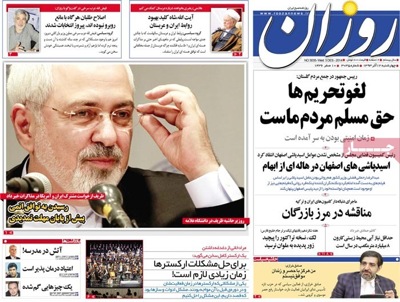
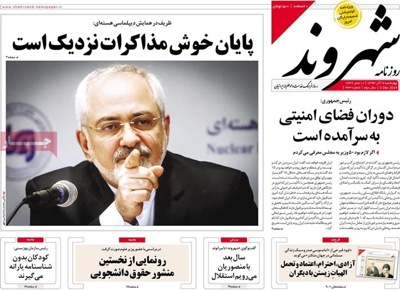
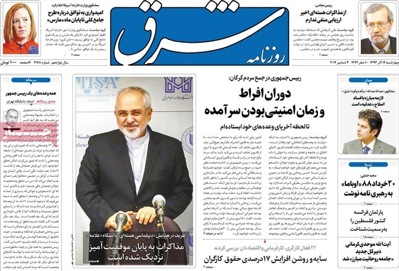
Snapshots of a visit by President Rouhani to the northeastern province of Golestan and his remarks that he would stay committed to his election promises were splashed across Iranian dailies on Wednesday. Another top story of the day covered the comments of Foreign Minister Mohammad Javad Zarif about nuclear talks and that a deal is in the offing.

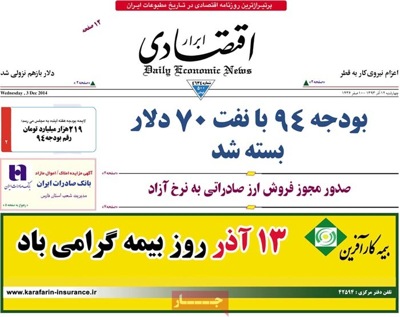
Abrar-e Eghtesadi: “The spending package of next year [starting March 21, 2015] has been pieced together on the assumption that oil prices will hover around $70 per barrel.”
 

Abrare eghtesadi  newspaper 12 - 3


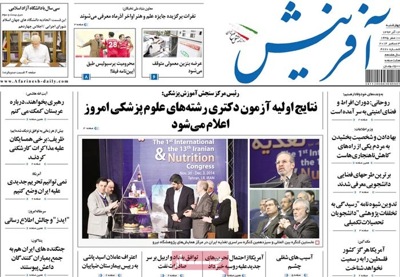
Afarinesh: “If the Supreme Leader wants me to help with the Saudi question, I will offer assistance,” said Chairman of the Expediency Council Akbar Hashemi Rafsanjani.

Afarinesh: “Some of our neighboring countries put a spoke in the wheel of nuclear talks,” said Foreign Minister Mohammad Javad Zarif.
 

Afarinesh newspaper 12 - 3


Afkar: “Iranian handicrafts have been introduced in the 19th International Crafts Selling Exhibition in Milan, Italy.”
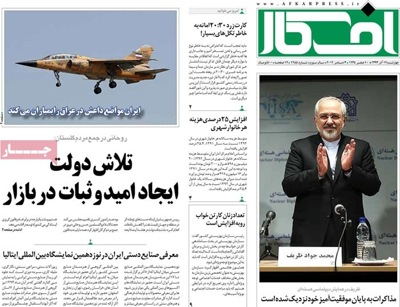
 

Afkar newspaper 12 - 3


Arman-e Emrooz: “Gone are the days of going too far and creating a security atmosphere. If necessary, I would have introduced 50 ministers [a reference to his efforts to fill the vacant seat at the helm of the Ministry of Science. Only did his fifth pick secure the confirmation of parliament]. I will stay committed to my pledges,” said President Rouhani.
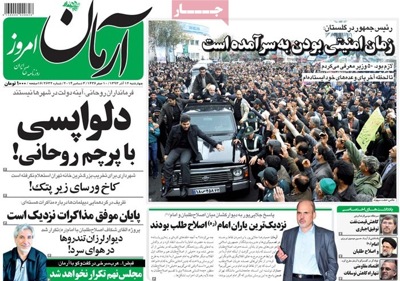
 

Armane emruz newspaper 12 - 3


Asr-e Iranian: “The evidence that the International Atomic Energy Agency refers to is fabricated and unreal,” said the Atomic Energy Organization of Iran.
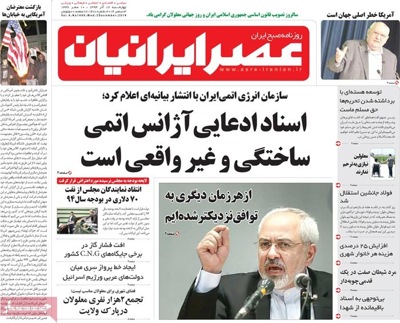
 

Asre iranian newspaper 12 - 3


Asrar: “There is no point in cultivating a restrictive atmosphere,” said Seyyed Hassan Khomeini, the late Imam Khomeini’s grandson.

Asrar: “The individual behind an acid attack in Mashhad [a city in Khorasan Razavi Province] has been apprehended.”

Asrar: “The growth in the number of women who lead a single life is worrisome,” said the interior minister.
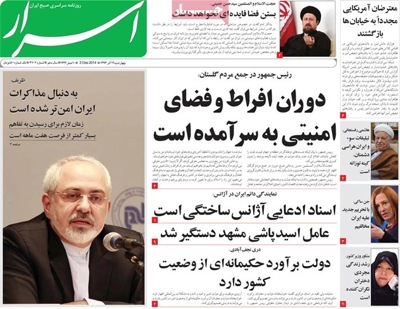
 

Asrar newspaper 12 - 3


Ebtekar: “Nobody needs to be concerned, Iran’s nuclear structure will be maintained under [a future] deal,” said Foreign Minister Mohammad Javad Zarif.
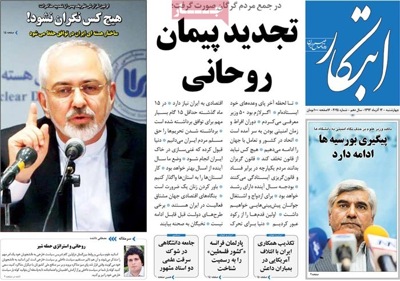
 

Ebtekar newspaper 12 - 3


Eghtesad-e Pooya: “There has been a rise in the number of women who sleep rough and 2,000 street children have been identified,” said the director of the State Welfare Organization of Iran.
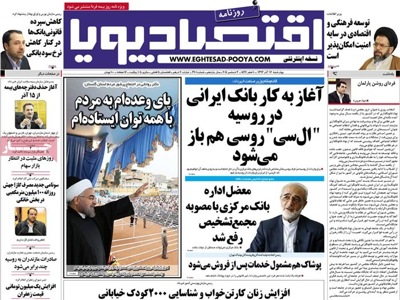
 

Eghtesade puya newspaper 12-3


Etemad: “The reason why they [Karroubi, Mousavi and Rahnavard] were placed under house arrest had nothing to do withthe sedition [the unrest that erupted in the aftermath of presidential election in 2009]. Their house arrest came months after the vote because they were orchestrating fresh sedition,” said former Secretary of the Supreme National Security Council Saeed Jalili.
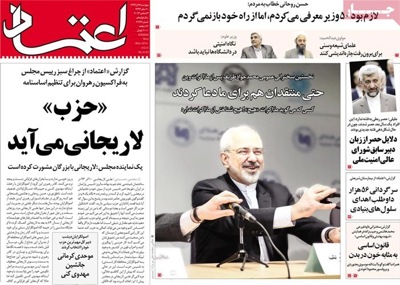
 

Etemad newspaper 12 - 3


Ettela’at: “Cultural and economic development can take place only in the presence of security,” said the intelligence minister.

Ettela’at: “There will be a 17-percent pay rise for state employees in next year’s budget.”
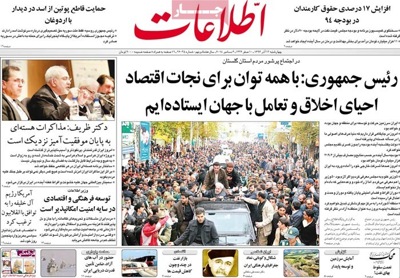
 

Ettelaat newspaper 12 - 3


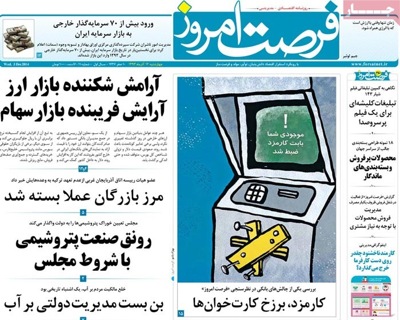
Forsat-e Emrooz: “The Bazargan border crossing in the northwest of Iran has been practically closed after Turkey failed to make good on its pledges.”
 

Forsate emruz newspaper 12 - 3


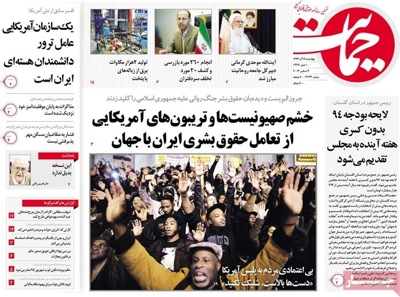
Hemayat: “[Five] Iranian nuclear scientists have been assassinated by secret American paramilitary troops supported by the CIA,” disclosed Jim W. Dean, a former US Army officer.”
 

Hemayat newspaper 12 - 3


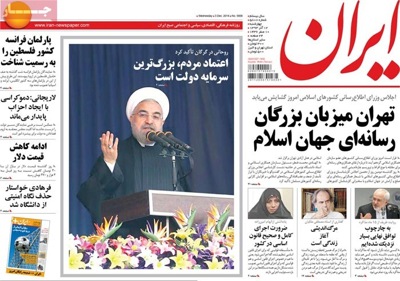
Iran: “France’s lower house of parliament has passed a [symbolic] vote to recognize Palestinian statehood.”
 

Iran newspaper 12 - 3


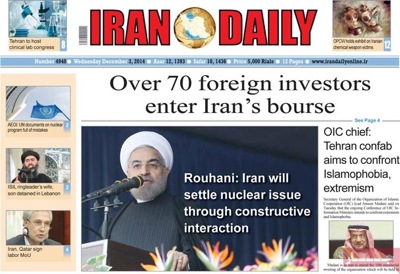
Iran Daily: “Over 70 foreign investors enter Iran’s bourse.”
 

Iran daily newspaper 12 - 3


Jomhouri Islami: “Nuclear talks are close to their successful end,” said Foreign Minister Mohammad Javad Zarif.”

Jomhouri Islami: “We will deliver good news about drugs for refractory diseases in two weeks,” said the health minister.
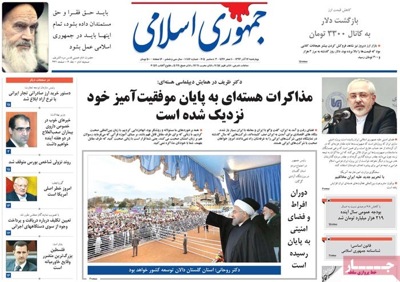
 

Jomhorie eslami newspaper 12 - 3


Kaenat: “A deficit-free spending package bill will be handed to parliament,” said President Rouhani.
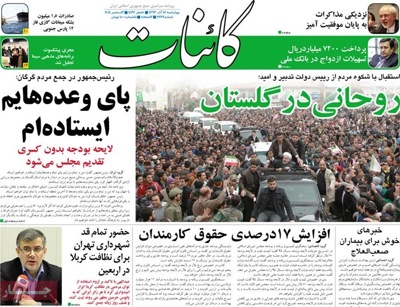
 

Kaenaat newspaper 12-3


Kayhan: “American university students have joined the chorus of protests in tens of cities across America against police brutality after Michael Brown, an unarmed black teen, was shot dead by a white police officer in Ferguson, Missouri.”
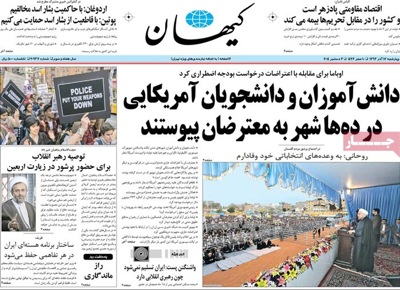
 

Kayhan newspaper 12 - 3


Khorasan: “The International Court of Arbitration dismissed a complaint that Turkey had filed against Iran in a natural-gas dispute.”
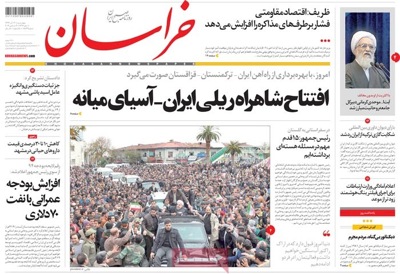
 

Khorasan newspaper 12 - 3


Roozan: “I have never approved of house arrest or jail term,” said Seyyed Mohammad Sadegh Kharrazi, a member of the newly-formed NEDA [Farsi initials for a Second Generation of Reformism] Party.
 

Ruzan newspaper 12 - 3


Shahrvand: “The first Charter ofUniversity Students’ Rights has been unveiled in the presence of the minister of science.”
 

Shahrvand newspaper 12 - 3


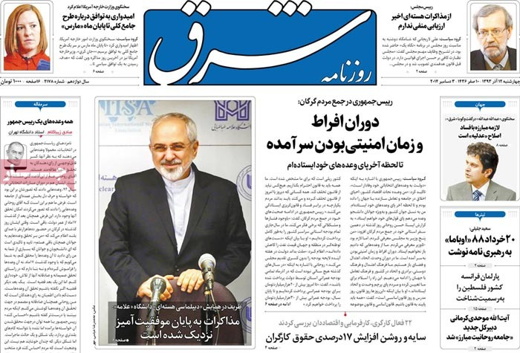
Sharq: “Ayatollah Ali Movahedi-Kermani has become the new Secretary General of the Combatant Clergy Association.”

 

Shargh newspaper 12 - 3