Saturday, December 27, 2025
Home Blog Page 5020

One month in Mexico City; the women’s city

Marjan Riahi - iranian ninja movie

Zanan-e Emrooz (Today’s Women) magazine in its 5th issue in October carried a first-person narrative by Iranian filmmaker Marjan Riahi about her visit to Mexico City. What follows is the translation of the account in its entirety:
Everything started with an email, going ‘Congratulations! Your movie, The Iranian Ninja, has been admitted to the competition section of Guanajuato International Film Festival’. It is an email welcomed by every filmmaker around the world, from the most professional to the very amateurish who is blown away at the sight of it. It instills a sense of confidence and recognition in filmmakers. Anyone who claims that the admission email fails to impress them is either displaying false modesty or telling an outright lie!
Of all small and large global film festivals, when your 30-minute documentary is admitted to one – unknown in Iran – the important matter is not just presence in a festival whose selected films will gain direct entry to the British Academy of Film and Television Arts (BAFTA) or whose chosen film will appear on the preliminary list of the Academy Awards. Rather, what is of great significance is that you will be the first Iranian to explore a festival which has never played host to an Iranian and is held in a country which used to be home to Mayas.

How did the journey begin?

Before I set out for Guanajuato, I had to make a trip to South Korea to head the jury at the Asian film section of the Puchon International Fantastic Film Festival. Since there was a short interval between the two festivals, after 18 hours on the plane I finally arrived in Tehran from Puchon, but I had to leave Tehran again for Mexico City in eight hours, a journey which would last as long as 24 hours considering the layover in Frankfurt. In fact, after 50-hour missing out on sleep, I got to the other half of the world. When I got out of the plane in Mexico City, my blood pressure stood at 70 mmHg. Not feeling well, I stood in a long line to have my passport controlled. A very polite airport official approached me to check my passport. After scanning it, the official asked me to go to Booth 9.

iranian ninja movie cover
Iranian Ninja Movie – by: Marjan Riahi

Having stood for half an hour in the line for Booth 9, it was finally my turn and the officer in charge of checking visas said something in Spanish waving his hand to let me know to follow him. We went through a narrow corridor and left behind some rooms and finally got to a room where a few girls were sitting and crying. I asked them what had happened and one of them said “They deport Iranians”.

At last, it was my turn. In a white room, I was questioned in Spanish by two officers in black suits. I was sitting on a chair in the middle of the room to answer their questions.

– Why did you come here?

I produced the invitation sent by festival officials.

– That’s not a compelling reason. Are you going to go to America?

– I would if my film was submitted [to an American film festival] and the festival picked up the bill for my travel costs, but now I am here to take part in the Mexican festival.

– It’s everyone’s dream to move to America.

– But I have more important ambitions. I feel comfortable in my country and I have no intention of migrating. As a matter of fact, I love my country.

– You seem to be too boastful of yourself and your country!

– Yes, I am. Do you have a problem with it?!

– Welcome to Mexico!

After three hours of interrogation, I was warmly greeted by a group sent by the festival. They apologized profusely to me for the behavior of the visa officer, promising that we would shortly get to San Miguel and have a rest. They also made another apology for not being able to accompany me and sending me there alone in a van. The last apology was for the fact that the driver could not speak English!

When we were on the potholed road to San Miguel in utter darkness and complete silence, I thought about not taking a trip to the north of Iran for ages because of my dislike for overland journeys, not knowing that one day, I would be forced to travel in a van, which was more like a roller coaster, for five hours after missing out 53 hours on sleep to get to a city where the festival was scheduled to be held!

Finally after 58 hours, I arrived in a city which was the hub of history and a piece of heaven! When the van was going through the passages of the city, I thought that amount of beauty could not be real. It could be the set of a film studio!

When a team on behalf of the festival came to greet me there and gladly asked me if I cared to take part in a gathering that evening, the half awake and utterly exhausted of me opted for a rest in a hotel. It was then that I was told there would be no hotel. They showed a 16-year-old girl to me, a volunteer who helped them with coordination of the festival. They told me that the girl’s grandmother was going to put me upduring my stay there. In fact, everyone invited to the festival was expected to be accommodated in the houses of locals.

Grandmother’s place

When the door opened, I looked in awe at the taste in furnishings and the beauty of flowers and plants there! The grandma greeted me with the kindness typical of Latin Americans and I slept like a log on the nice bed in her house until morning.

I woke up in heaven the next morning. When the grandma was preparing omelet and coffee with freshly-baked bread for me, I was thinking to myself that it was worth the long-haul trip from Puchon to Guanajuato, telling myself that even if I had to stay in this beautiful kitchen for the rest of my trip and eat home-made bread and omelet, I would be one of the happiest women in the world!

The grandma did not speak English and only knew a few words. However, the bond formed between us was so strong that we interacted for hours without understanding each other’s languages. She roasted pumpkin seeds for me and I offered her Sohan [a traditional Iranian saffron brittle toffee]. Her daughter, who was a baker, sent us sweets and freshly-baked bread as gifts.

At night, when I had difficulty sleeping, she insisted that I drink herbal tea. She was worried about the dark circles around my eyes and about her stubborn granddaughter who did unpaid work for the festival rather than helping her mother with running the bakery.

One night she asked, “Given that you are a filmmaker and spend your time from dusk to dawnin front of the computer screen, are you rich?” Before I uttered a word, she called out to her granddaughter who turned up in the kitchen in astonishment. The grandma pointed to me and said, “Look at her! Look well, she works allnight and has developed dark circles around her eyes, yet she does not make much money! Do you want to end up like her? Is that what you want?!”

And now the festival

Well, as the first Iranian who took part in Guanajuato International Film Festival, I must say it was a magnificent festival with good international status. This year, the festival was intended to pay tribute to Polish filmmakers, and to that end prominent figures of the Polish silver screen were invited to screen their films.

Next year, the festival will have its focus on Turkish cinema. One of the unusual features of the festival was that every filmmaker had to pay a daily visit to the festival’s palace to find out about the timetable of each day; there was no schedule in print.

There was a long distance between where I was staying and the festival’s palace which I travelled back and forth by either taxi or bus. More interesting was the addresses of the places; festival programs were usually held in an institute or a university every night. We were often told to go to that street or to that building and we would see the festival’s organizers at the entrance!

There was no exact postal address and everything was left up to your luck about whether or not you would find the direction to the place. Except for the festival’s executive team, there were over 100 volunteers working for the event. Among other things, the pitching workshopand the presence of the most famous film production studios on the sidelines of the festival stood out about the festival. During the event, it was easy to meet independent and non-independent film producers from across the world.

The films for the competition section of the festival had been chosen meticulously and most importantly, the festival had its focus on animal rights. It was so unlucky ofa filmmaker like me to be there with a film whose theme revolved around women!

Over the first few days, I found out that the movie theaters for documentaries were not as busy as those screeningdrama. However, because I had already predicted such a problem and taken a lot of leaflets featuring the exact timing of the screening and photos of The Iranian Ninjas with myself, I did not sit on my hands and started handing them out to those interested indrama. I invited them to come and see my film. That earned my film fame within a few hours and aroused the jealousy of other filmmakers participating in the competition section. It was also recognized as the most-watched documentary of the festival.

At itspremiere, it was screened to a full house, drawing the astonishment of the organizers. At a Q and A session, the first question was whether my culture and my government allowed a woman to travel by herself. In answer, I said neither my culture nor my government has a problem with it. However, the Mexican government seems to have a problem with female filmmakers who want to enter Mexico. On my arrival, airport officials kept interrogating me for three hours! My comment was greeted with a thunderous ovation by women and when I left the podium, a member of the Mexican Female Filmmakers Society invited me for coffee.

The screening tour of the film

The Mexican Female Filmmakers Society is a non-governmental organization. Its 130 female members, from make-up artists to directors and producers, help each other, gratis, making a film. Influential women from the Mexican film industry make up the board of directors of the society. They mostly run a cinematic department or a film school with a lot of students. Most importantly, they are very supportive.

The board liked ‘The Iranian Ninja’ very much and believed that they could identify with the women in my film. Over coffee, I was asked to have my film screened at some important Mexican universities of cinematic arts. From Centro de Capacitacion Cinematografica whose founder was Luis Buñuel and Busi Cortés, the first woman who made a dramatic film at that university and is now teaching there, toUniversity of Guadalajara. The showing of the film was followed by a few-hour-long conference. On the whole, with the help of such supportive women, the screening tour of The Iranian Ninja across Mexico was arranged and the only female Mexican festival, run by the society, nominated the film for screening.

In one of the meetings, it was mentioned that because of lack of sponsors for female festivals they cannot organize any competition. Surprised by the comment I said, “All well-known brands have branches in Mexico, given that no restrictions are imposed either by the government or your customs, why don’t you ask L’Oréal, or Victoria’s Secret for that matter, to sponsor your festival?”

The response by the chairwoman of the festival board knocked some sense into me: “We do not want to be like those women who are after cosmetic brands and extravagant outfits. We cannot let them advertise their products in our festival and lead women toward artificial Barbie-like beauty. Instead, we want to inspire women to have confidence and be proud of their natural beauty and the way they are dressed.”

In Mexico, it looks as if Mexican women are in charge not only at home but also in society! If you ask a foreigner who is married to a Mexican man about what her married life is like, her first response will be: “You can’t even imagine going on a trip, to a restaurant or anywhere else without his mother even for a day!” Throughout the whole city, you can see young couples accompany an old lady with profound respect and gracefulness. In shopping centers, long lines, which are pretty common in Mexico and a typical feature of the country – in fact as a Mexican you have to spend a considerable amount of your time in lines at bus stops, banks, public rest rooms and checkouts of shopping centers – one can see a large number of women who keep the company of their mothers-in-law in long lines.

Also, in academic circles and film festivals, women play an important role. For instance, the secretary of Guanajuato International Film Festival was a woman and its planning directors and the executive team were mostly young girls who were fluent in a few languages. Having a good command of a few languages in a country like Mexico, where 90 percent of people do not bother to learn or speak English even in academic circles is of great importance.

I stayed in Mexico for a month and had my film screened in different cities and met many people. However, getting familiar with the Mexican Female Filmmakers Society was the highlight of my trip. I met Amazonian women who took great pride in being women and in their natural beauty, women who helped each other like sisters, members of a society whose absence is strongly felt in Iran.

Kids in Tehran go to museums to listen to tales, so the story goes

kids-children-in-tehran-musum

Khabaronline filed a report on Wednesday November 12 on concerted efforts by the Cultural Heritage and Tourism Research Center to celebrate the National Week of Book and Book Reading in Iran and cultivate the habit of book reading, saying that several museums in the capital will host book reading events as of November 15. What comes below is the translation of that report:

The Cultural Heritage and Tourism Research Center is to implement a “Seven Museums, Seven Tales” plan as of Saturday [November 15] to mark the national Book and Book Reading Week.

The plan which is to be carried out in seven museums in the capital aims to promote book reading and introduce [Iran’s] legends and myths as a symbol of oral and intangible heritage.

It also intends to create more attractiveness in museums and revive the art of storytelling.

Creative instructors of storytelling and members of Children’s Book Council will come together in seven museums, namely Iran’s Post Museum, National Museum of Iran, Golestan Palace Museum, Carpet Museum of Iran, Tehran Peace Museum, Moghadam Museum and Bagh-e-Negarestan [Complex] to host Iranian children and their parents as well as other guests between November 15 and 21.

The plan will make good use of various attractive methods of storytelling among them: reading out loud, creative plays, and musical storytelling.

The stories are picked according to the congenial atmosphere of museums and cultural heritage sites for children of any age.

For the project to get off the ground, the International Council of Museums (ICOM) has cooperated with the library and document center, and the research and training center for children and teenagers at the Cultural Heritage and Tourism Research Center.

The museums will open their doors to visitors at 11:00 a.m. local time and all those story lovers can attend the cultural event.

IAEA removes UAE’s fake name for Persian Gulf islands

Persian Gulf - Abu Mousa - Lesser and Greate Tunb islands

The International Atomic Energy Agency (IAEA) has removed a fake name used by the United Arab Emirates for three Iranian islands in the Persian Gulf.

The UN nuclear agency deleted a fake map of three Iranian islands of the Greater Tunb, the Lesser Tunb and Abu Musa published by the UAE that was used on the IAEA’s official website.

On its page on the IAEA Country Nuclear Power Profile (CNPP), the UAE used a fake name for the Persian Gulf and the three Iranian islands of Abu Musa, the Greater Tunb and the Lesser Tunb.

Following the UAE’s move, the Atomic Energy Organization of Iran objected to the use of a forged name for the Persian Gulf and also the three Iranian islands.

The three islands have historically been part of Iran, proof of which can be found and corroborated by countless historical, legal, and geographical documents in Iran and other parts of the world. However, the United Arab Emirates has repeatedly laid claim to the islands.

The islands temporarily fell under British control in the 1800s, but were returned to Iran on November 30, 1971 through a legal procedure that preceded the establishment of the UAE as an independent state.

Iran: Premature reporting tarnishes IAEA image

Behrouz Kamalvandi

A senior Iranian nuclear official has criticized the International Atomic Energy Agency (IAEA) for releasing its reports prematurely, warning that the move will tarnish the image of the UN nuclear agency.

“The IAEA reports should be submitted confidentially before they are finalized; therefore, the premature release [of reports] in the media will undermine its (IAEA’s) credibility,” said Behrouz Kamalvandi, the spokesman for the Atomic Energy Organization of Iran (AEOI), in a Friday interview.

He pointed to the correction of the IAEA’s latest report on Iran’s nuclear activities, saying, “It has not been the IAEA’s first mistake and if the present trend continues, it seems it would not be the last one either.”

On Thursday, the IAEA corrected its previous estimate of the size of Tehran’s low-enriched uranium stockpile, saying it is 8,290 kg.

This came after the agency announced last week that Iran’s stockpile of low-enriched uranium had increased by 625 kg to around 8.4 tons since the IAEA’s September report, estimating the stock to be nearly 8,390 kg.

Kamalvandi noted that the IAEA’s final report on a country can be officially released only after it is discussed at the Board of Governors by the member states and the respective country.

“The release of these reports at certain websites linked to Western countries has been politically-motivated and aimed at influencing the process of [nuclear] talks [between Iran and P5+1]…,” the AEOI spokesman pointed out.

The size of Tehran’s uranium stockpile is one of the moot points in the nuclear negotiations between Iran and P5+1.

The IAEA correction came two days after top officials from Iran and P5+1 — the US, Britain, France, Russia, China and Germany – wrapped up talks over Iran’s nuclear program in the Omani capital city of Muscat on Tuesday.

The next round of nuclear talks between Iran and the world powers is set to be held in the Austrian capital, Vienna, on November 18-24.

A look at Iranian newspaper front pages on Nov. 15

Iranian Newspapers Headlines

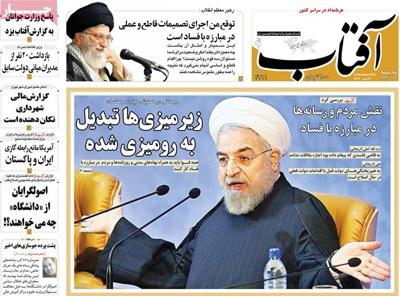
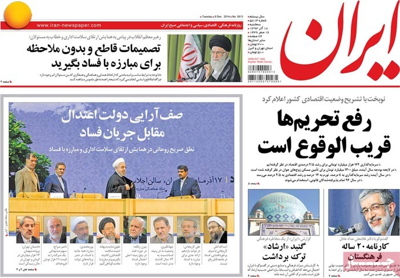
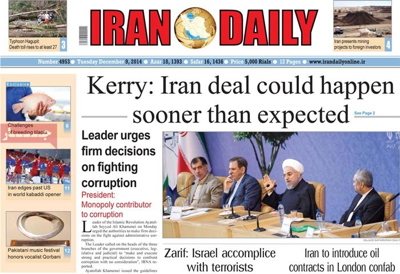
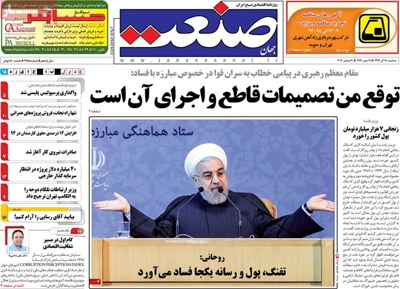
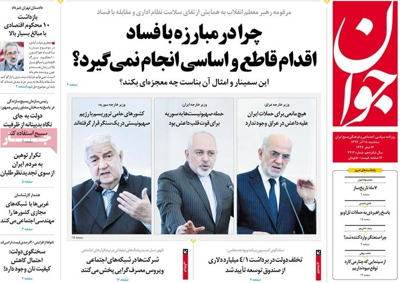
The passing of pop singer Morteza Pashaei at the age of 30 after a year-long battle against cancer and the conclusion of the 20th Exhibition of the Press and News Agencies dominated the front pages of Iranian newspapers on Saturday. Also in the news were speculations on whether the Islamic Consultative Assembly confirms President Rouhani’s fourth nominee for the post of science minister and on whether Iran and P5+1 will strike a nuclear deal before a November 24deadline.


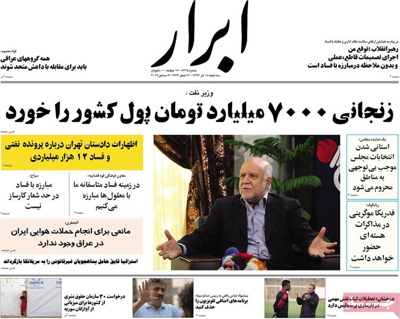
Abrar:President Rouhani says the weapon of sanctions is a rusty and useless one.

A look at Iranian newspaper front pages on Nov. 15


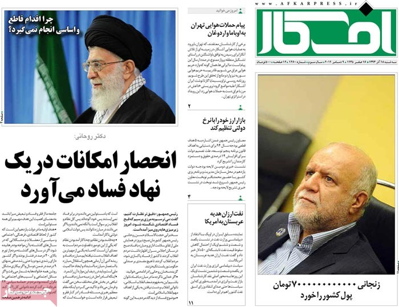
Afkar: “Iran’s membership in the Interexchange Electronic Union (IEU) will facilitate foreign trade.”

A look at Iranian newspaper front pages on Nov. 15


Aftab-e Yazd:Mohammad Sadr, a former Iranian deputy foreign minister, says Iran and the US are determined to strike a final deal.

A look at Iranian newspaper front pages on Nov. 15


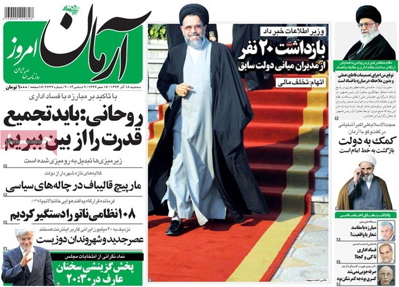
Arman-e Emrooz:The number of police stations in the capital is not enough.

A look at Iranian newspaper front pages on Nov. 15


Asr-e Iranian:Parliament will step in if nuclear talks fail to uphold the rights of the nation, said Gholamali Haddad Adel, a Tehran MP and a former speaker of the Islamic Consultative Assembly.

A look at Iranian newspaper front pages on Nov. 15


Asr-e Rasaneh: Plans to put into force the third phase of the Targeted Subsidies Act are in the offing. High income families still receive cash handouts eight months into the year (starting March 21, 2014).

Asr-e Rasaneh: Tehran’s intranet will become operational soon.

A look at Iranian newspaper front pages on Nov. 15


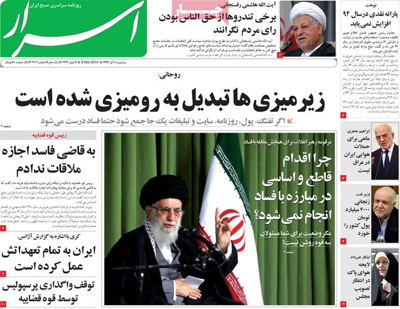
Asrar:“Allegations against Danesh Ashtiani [President Rouhani’s pick for science minister] are unreal and politically-motivated,” said Mohammad Reza Khabbaz, a senior official at the Parliamentary Department of the Presidential Office.

A look at Iranian newspaper front pages on Nov. 15


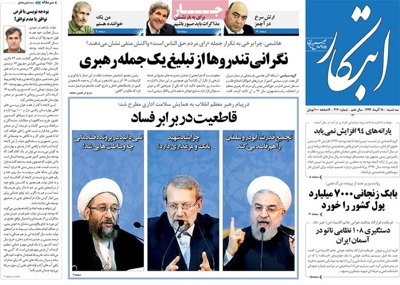
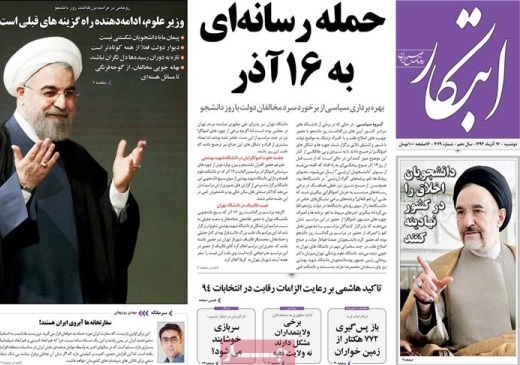
Ebtekar: “Young pop singer Morteza Pashaei has passed away.”

A look at Iranian newspaper front pages on Nov. 15


Eghtesad-e Pooya:Ground has been broken on the largest airport in the north of the country.

A look at Iranian newspaper front pages on Nov. 15


Emtiaz: “Air quality in the capital is poor,” a spokesperson of the Air Quality Control Organization reported.

A look at Iranian newspaper front pages on Nov. 15


Etemad hasquoted the health minister as saying that the costs of treating cancer will decline.

A look at Iranian newspaper front pages on Nov. 15


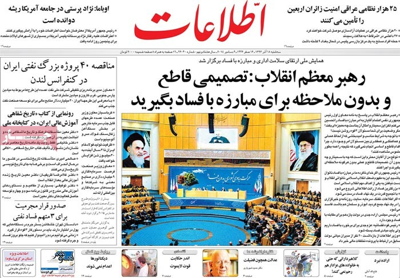
Ettela’at: “The financial and banking structure of the country gives rise to violation of laws,” said the public prosecutor of Tehran and Revolutionary Courts.

Ettela’at: “Nuclear talks are likely to be extended.”

A look at Iranian newspaper front pages on Nov. 15


Farhikhtegan: “Arrogant treatment of the public leads nowhere,” said Ali Akbar Nategh Nouri, the head of the Inspection Office, an affiliate of the Supreme Leader’s Office.

A look at Iranian newspaper front pages on Nov. 15


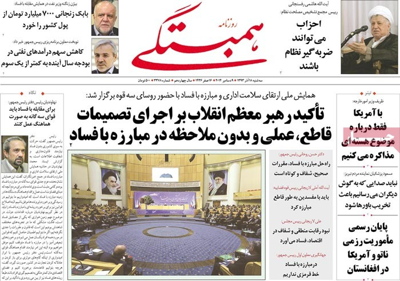
Hambastegi:We are optimistic about reformist parties reaching a consensus, said Hadi Khamenei, the secretary general of the Assembly of the Followers of Imam’s Path.

A look at Iranian newspaper front pages on Nov. 15


Hamshahri:Road accidents in Iran are 20 times as many as the global average.

A look at Iranian newspaper front pages on Nov. 15


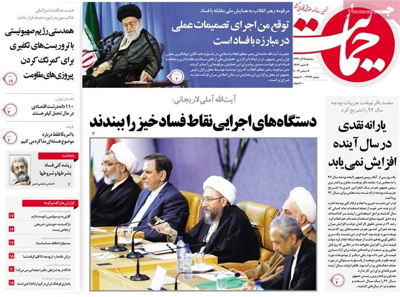
Hemayat: The age limit for Palestinians seeking to take part in Friday prayers at the al-Aqsa Mosque has been lifted.

A look at Iranian newspaper front pages on Nov. 15


Iran: “Iran seeks to see moderation dominate the region,” said President Rouhani.

A look at Iranian newspaper front pages on Nov. 15


Iran Daily: “Iran’s [weightlifter] Rostami snatches world gold.”

A look at Iranian newspaper front pages on Nov. 15


Isfahan Ziba: “In nuclear talks with P5+1 principles of the establishment cannot be compromised,” said the chairman of parliament’s National Security and Foreign Policy Committee.

A look at Iranian newspaper front pages on Nov. 15


Jahan-e Eghtesad: “Smart filtering of Internet content will start as of next month,” said the minister of communications.

A look at Iranian newspaper front pages on Nov. 15


Jahan-e Sanat: “The last round of nuclear talks [between Iran and P5+1] will be held on November 18,” said Iranian nuclear negotiator Seyyed Abbas Araghchi.

A look at Iranian newspaper front pages on Nov. 15


Jamejam:“The excessive demands of the US can prevent the sides from striking a nuclear deal,” said the new president of Islamic Republic of Iran Broadcasting.

A look at Iranian newspaper front pages on Nov. 15


Javan: “The way has been paved for the defeat of the Islamic State of Iraq and the Levant,” reported the daily, saying that the liberation of Baiji in northern Iraq has raised the possibility of Mosul and Tikrit being retaken from ISIL terrorists.

A look at Iranian newspaper front pages on Nov. 15


Kaenat: Gasoline prices are likely to be raised in Iran next year (starting March 21, 2015).

A look at Iranian newspaper front pages on Nov. 15


Kar va Kargar:“Iran gives top priority to establishing trade relations with its neighbors,” said President Hassan Rouhani.

A look at Iranian newspaper front pages on Nov. 15


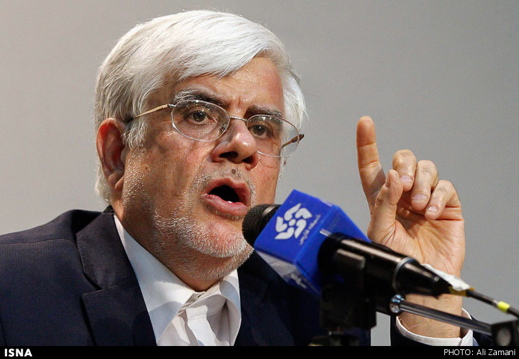
Kasbokar:“Outright lifting of sanctions holds the key to the success of nuclear talks,” said former Vice-President Mohammad Reza Aref.

A look at Iranian newspaper front pages on Nov. 15


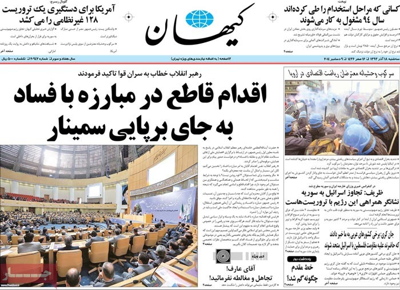
Kayhan:“The language of force does not work in dealing with Iran,” said Tehran’s Friday prayer leader.

A look at Iranian newspaper front pages on Nov. 15


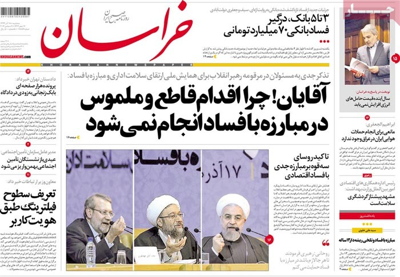
Khorasan: A plot to assassinate [Lebanon’s Hezbollah leader] Seyyed Hassan Nasrallah on Ashura [the peak of religious ceremonies to mourn the martyrdom of Imam Hussein, the grandson of the Prophet Muhammad (PBUH)] was foiled.

A look at Iranian newspaper front pages on Nov. 15


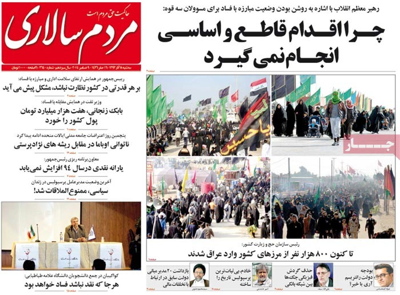
Mardomsalari:Ayatollah Sistani, Iraq’s most senior Shiite cleric, has thrown his weight behind the role Iran’s [Major General] Ghasem Soleimani plays in Iraq’s fight against IS.

A look at Iranian newspaper front pages on Nov. 15


Nasl-e Farda:“All Iranian journalists will be given insurance coverage,” said Deputy Minister of Culture and Islamic Guidance Hossein Entezami.

A look at Iranian newspaper front pages on Nov. 15


Roozan: The deputy interior minister for security affairs has said that the Islamic Revolution Guard Corps and the Intelligence Ministry have got involved in investigations into a recent spate of acid attacks in Isfahan.

A look at Iranian newspaper front pages on Nov. 15


Sepid: The 20th Exhibition of Press and News Agencies wrapped up its work on Friday.

A look at Iranian newspaper front pages on Nov. 15


Tafahom: “One-thousand-two-hundred new hotels are to be constructed in Iran.”

A look at Iranian newspaper front pages on Nov. 15


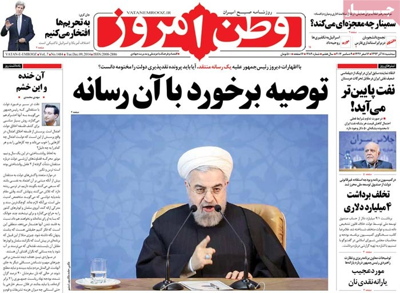
Vatan-e Emrooz:Iranian pop singer Morteza Pashaei passed away after a one-year battle against cancer.

A look at Iranian newspaper front pages on Nov. 15


President’s chief of staff reports on diplomacy, Baku visit

Morteza Nahavandian
Morteza Nahavandian

President Hassan Rouhani’s chief of staff Mohammad Nahavandian appeared on a TV talk show late Wednesday to answer a wide range of questions, primarily on President Rouhani’s Azerbaijan visit, regional cooperation and how Iran is faring in the face of sanctions. The following is a partial translation of his comments filed by the Young Journalists Club news agency:

On what stands out about the Baku visit

During the visit, agreements which had been in the making for months were finalized. Also, negotiations were held on banking cooperation and on megaprojects which, among other things, will eventually link the two countries’ railway networks and open a new transit corridor.

Other areas of cooperation discussed were information technology, renewable energies, the environment, water resources, postal services, trade and investment, and energy.

On cooperation with neighboring countries

Transparent cooperation with neighboring countries is a major requirement for the active presence on the international stage, with Iraq being a case in point. Iran’s positive role in Iraq helped save its neighbor to the west from a serious threat like IS.

In Afghanistan, too, Iran’s support for a smooth transition of power was instrumental in foiling plots to re-plunge the country into chaos and turn it into a hotbed of terrorism.

Contacts with countries in the Persian Gulf, including Tehran visits by the Omani Sultan and the Kuwaiti Emir, and the deal Iran has just signed with Russia show that Tehran has opted for interaction as it walks down the path of progress.

On Iran’s regional outlook

Iran’s growth policies do not pit it against other nations. Our interests are not supposed to come at the cost of other countries’ interests. In pursuing a regional growth outlook, Iran takes account of the interests of its neighbors too.

In light of the fact that Azerbaijan plays an important role in global energy markets, the stage is set for Iranian businesses to invest in Azerbaijan’s development projects.

Another question that came up for discussion at talks among officials during the visit was medical tourism. Given that a large number of Azeri visitors come to Iran either for pilgrimage or for medical treatment, officials decided to establish direct flights between Baku and the pilgrimage city of Mashhad [in northeastern Iran] and build more hotels there.

On transportation as a government priority   

Establishing a rail link with neighbors to the north is being given a lot of consideration. During the visit, the project to link Iran’s Astara to Azerbaijan Republic through railway was discussed. It would eventually connect Iran’s railway to Georgia and on to Europe. […] The closer our transport ties with the Central Asian countries, the better our export potential.

On impossibility of the efficacy of the economic embargo

If we manage to convince our neighbors that our economic growth will serve their interests too, they will pay no heed to calls by trans-regional powers to put economic pressure on Iran. The experience of recent years shows that a large economy like Iran cannot be crippled by economic embargo; sanctions do cause certain problems, though.

Iran is determined to overcome the economic problems it has been facing of late. Inflation is now below 20 percent and the country is out of recession. Signs of recovery are in evidence in different sectors.

On sanctions

It’s not that Iran’s economy cannot wait to see the sanctions lifted. Besides, thanks to the improvement of relations with neighboring countries, new sanctions, if and when they are imposed, will never produce the intended result.

Iran has demonstrated that it does not seek nuclear weapons. What we are after is the peaceful use of nuclear technology, and now we can meet our own enrichment needs. In the preliminary deal [with P5+1], they agreed to our continued enrichment activity which is a testament to the power of Iran’s logic.

[…] We hope to guarantee the rights of the Iranian people and at the same time pave the way for a more prominent presence of our country on the international stage.

Tel Aviv sheds crocodile tears for NPT

Tzachi Hanegbi
Tzachi Hanegbi

Kayhan Newspaper in its “Special News Column” on Thursday (November 13) said that the Zionist regime is shedding crocodile tears for the Nuclear Non-Proliferation Treaty (NPT). The following is the translation of the report:

The Zionist regime’s deputy foreign minister has said that Iran is a big threat which can target Israel with its long-range missiles.

Israel’s Deputy Minister of Foreign Affairs, Tzachi Hanegbi, has told Die Welt, a German daily newspaper, Tehran can target Israel with its long-range missiles. The gravest threat is that the fundamentalist Iranian regime acts illogically.

He also claimed that if the West accepts uranium enrichment by Iran, other countries will press for the same thing and this translates into the end of the NPT.

Hanegbi’s remarks came as the illegitimate Israeli regime, which is in possession of several nuclear warheads, is dragging its feet over signing up to the NPT, something which would call for monitoring the Israeli nuclear program.

A conference focusing on the proposed Middle East free of nuclear weapons was slated to be held in Helsinki, Finland last year to pile pressures on Tel Aviv and supervise the regime’s atomic activities, but it was put off thanks to US pressures.

Under the NPT, members of the International Atomic Energy Agency (IAEA) are entitled to uranium enrichment.

Iran has foiled bomb plot targeting Muslim Shiite mourners

Qom-mourning-procession

Iranian Intelligence Minister Seyyed Mahmoud Alavi says the country’s security forces have thwarted a planned bomb attack targeting Shiite religious ceremonies marking the martyrdom anniversary of Imam Hussein (PBUH).

A bomb attack had been planned in the city of Qom, south of the capital, Tehran, during the mourning ceremonies in the lunar month of Muharram, Alavi said on Wednesday, adding that people plotting the bombing “were arrested before they could carry out any such measure.”

Imam Hussein (PBUH), the grandson of Prophet Muhammad (PBUH), and 72 of his loyal companions, were martyred on Ashura in the battle of Karbala against the second Umayyad caliph, Yazid I, in 680 A.D. Imam Hussein was killed after he refused to pledge allegiance to the tyrant ruler.

Alavi further noted that enemies frequently hatch plots against the Iranian nation and the Islamic establishment, but the country’s intelligence forces succeed in identifying and thwarting them.

The Iranian intelligence minister stated that several bombing attacks with explosive vests were also foiled across Iran on International Quds Day on July 25.

On Quds Day, Iranians from all walks of life numbering in their millions took to the streets in Tehran and other towns and cities throughout the country to vent their anger at the Israeli regime’s brutal oppression of Palestinians over the past decades.

Alavi also emphasized that the Iranian Intelligence Ministry closely monitors even the slightest moves of the enemies.

A look at Iranian newspaper front pages on Nov. 13

Iranian-Newspaper-Headlines-02

The countdown to a November 24 deadline for a nuclear deal between Iran and world powers and comments by Iranian officials, including the president, about the talks with P5+1 dominated the front pages of Iranian dailies on Thursday. Also in the news were remarks by the Iranian intelligence chief that a bombing plot in the holy city of Qom has been foiled. News about the release of Mohammad Mayeli Kohan, a former national soccer team coach, from prison grabbed headlines too.

Abrar: As many as 13.6 million people have been displaced by war in Iraq and Syria.


abrar


Abrar-e Eghtesadi: Iranian exports to Europe have picked up.

Abrar-e Eghtesadi: Iran has signed an air transportation deal with Portugal.


Abrar eghtesadi


Afarinesh: President Rouhani has said the fatwa the Supreme Leader has issued [banning the development and use of nuclear weapons] is the strongest guarantee [that Iran does not seek to have nuclear arms].


afarinesh


Afkar: “Iran won’t make commitments beyond what is stipulated in the Nuclear Non-Proliferation Treaty,” said the secretary of the Supreme National Security Council.


afkar


Arman-e Emrooz: The Iranian intelligence minister has said a plot to plant a bomb in the holy city of Qom has been foiled.


arman


Asr-e Eghtesad: President Rouhani is hopeful a win-win [nuclear] deal will be struck. Deputy Foreign Minister Seyyed Abbas Araghchi has said that Iran will continue to enrich uranium.


asr eghtesad


Asr-e Rasaneh: Oil Minister Bijan Namdar Zanganeh has submitted President Rouhani’s message to the Kuwaiti Emir.


asre resaneh


Asrar: Vice-President for Parliamentary Affairs Majid Ansari has denied rumors that President Rouhani has withdrawn his nomination of Dr. Fakhreddin Ahmadi Danesh-Ashtiani as science minister.

Asrar: The attorney general has expressed opposition to the growth of the Justice Ministry’s powers.


asrar


Ebtekar: Secretary of the Supreme National Security Council Ali Shamkhani has confirmed reports that President Obama has recently sent a letter to the Supreme Leader. “Such correspondence dates back a few years and in some cases the letters have been replied to.”

Ebtekar: Chairman of the Expediency Council Ayatollah Akbar Hashemi Rafsanjani has criticized the previous government for hiding behind justice to challenge the rights of the strata of society most in need.


ebtekar


Emtiaz: Eighteen Iranian soccer players have been suspended thanks to their failure to serve military duty.


emtiaz


Esfahan Emrooz: “Air pollution in Isfahan is even worse than the capital,” said the director of the provincial Environment Protection Department.


esfahan emrouz


Etemad: President Rouhani has urged Iran’s nuclear negotiating partners not to take their internal problems to the negotiating table.

Etemad: Ali Daei has forgiven Mohammad Mayeli Kohan [a former coach of the national soccer team who began to serve a 4-month term in jail on Tuesday after being convicted following a lawsuit by Daei].  Mayeli Kohan has now walked free.


etemad


Ettela’at: The presidents of major universities have thrown their weight behind President Rouhani’s nominee for the post of science minister.

Ettela’at: “Free public access to information is the way to counter corruption,” President Rouhani said at a meeting of his Cabinet.

Ettela’at: A tenth round of nuclear talks between Iran and P5+1 will be held in Vienna on November 18.


Ettelaat


Hemayat: “The outcome of the nuclear talks should not deal a blow to the dignity of Iranian people and the self-confidence of their scientists,” said Judiciary Chief Ayatollah Sadegh Amoli Larijani.


Hemayat


Iran: Iran and Azerbaijan have signed five deals to transform cross-border relations.


iran


Iran Daily: Iranian blood donation tops developing countries.


iran daily


Jomhouri Islami: “Iran Air has signed two deals with Boeing,” said the managing director of the Iranian flagship carrier.

Jomhouri Islami: Hopes of clinching a comprehensive nuclear deal have been boosted.


jomhouri eslami


Kaenat: Four Iranian-made RQ170 drones will become operational by the end of the year [March 21, 2015].


Kaenat


Kar va Kargar: The presidents of Iran and Azerbaijan have underlined efforts to boost bilateral ties.


kar va kargar


Kasbokar: “Iran is projected to have exported $48 billion in non-oil items by yearend [March 21, 2015],” said the secretary general of the Chamber of Commerce.


kasbo kar


Kayhan: Iran is to inaugurate [on Thursday] a 500 MW power plant in Najaf as a gift to the residents of the Iraqi holy city.


kayhan


Kayhan International: President Rouhani in Azerbaijan.


kayhan int


Khorasan: “As many as 310 police personnel who acted against protocol have been fired this year [began March 21, 2014],” Police Chief Brigadier General Esmail Ahmadi Moghaddam said.


Khorasan


Payam-e Zaman: No [new] arrest has been made in connection with recent acid attacks in Isfahan, Police Chief Brigadier General Esmail Ahmadi Moghaddam said.


payam zaman


Roozan: “I am not supposed to take over as director of the [newly reinstated] Management and Planning Organization,” Mohammad Ali Najafi, who serves as acting science minister, said.


rouzan


Shahrvand: “The ban on the presence of female spectators at volleyball arenas has been lifted,” said the deputy minister of youth affairs and sports.


shahrvand


Sharq: “Two human rights rapporteurs will visit Iran,” said a deputy of the judiciary chief.


shargh


SMT: Iran’s trade balance with 90 countries is now positive.


SMT


A research chair is to be set up in memory of late Mina Izadyar

sattari

IzadyarFarvahar, a monthly belonging to Tehran Zoroastrian Youth Organization, filed a report in its 464th issue about the 2nd Mina Izadyar Scientific Festival in October. What appears below is the translation of part of the report:

“A budget of around $50,000 is to be allocated to a research chair under the name of the late Dr. Mina Izadyar, the founder of the Iranian Thalassemia Society,” Vice President for Science and Technology Dr. Sorena Sattari told the festival.

“Iran’s National Elites Foundation (INEF) is set to dedicate a special award to the Zoroastrian elites,” Sattari, who also heads the National Elites Foundation, said.

Recalling the accomplishments of individuals awarded at the festival, he said, “These people are the assets of the nation and we are trying to set a trend so that Iranians can serve their country no matter where they are.”

At the festival, Dr. Majid Arasteh, the head of the Iranian Thalassemia Society, said, “Thalassemia used to be regarded as an ailment which took a toll on longevity. However, as a result of Dr. Izadyar’s  endeavors, a number of those suffering from this blood disorder have graduated with medical and engineering degrees and are now serving their society. All members of the Thalassemia Society remember that Dr. Izadyar convinced officials to import Thalassemia medicines which were still little known in regional countries. Above all, she appealed to officials to give patients free access to such medications.”

Dr. Majid Arasteh also underscored the effectiveness of her efforts to train teams at different Thalassemia societies across the country.

“Although she had a ready smile, she was a serious person. Such a characteristic helped her found the Iranian Thalassemia Society. Even after that, she made trips to different cities of Iran and set up a Thalassemia center wherever there was a blood transfusion center. We used to have 2,500 people suffering from Thalassemia, whereas thanks to efforts by her and others, now as few as 200 to 300 babies are born with this blood disorder each year. Last year we lost two invaluable Iranian ladies, Dr.Mina Izadyar and Dr. Parvaneh Vosough [a pediatric oncologist who dedicated her entire life to treating children suffering from cancer, and a co-founder of Mahak Charity Organization] who are sorely missed and their void won’t be filled any time soon,” said Dr. Mardavij Al-Bouyeh, Dr. Izadyar’s professor and colleague.

Among others, Dr. Mahbanoo Tata, the founder of Iran’s science of statistics,Dr. Darius Ravari, an orthopedic surgeon, and Manuchehr Hemmati, a mechanical engineer whose novel ideas have introduced innovation into solar desalination systems over the past 36 years, were awarded as top Zoroastrian figures.

The late Dr. Mina Izadyar was the founder of the Iranian Thalassemia Society, a professor at Shahid Beheshti University of Medical Sciences, a pediatrician, a hematologist-oncologist, the chairwoman of the Iranian Thalassemia Society’s board of directors, a ward manager at a number of top Tehran hospitals and the head of hematology-and-oncology ward at Children’s Medical Center [affiliated to Tehran University of Medical Sciences].
Dr. Izadyar whose husband, Parviz Malekpour, previously represented the Zoroastrian community in the Iranian parliament, lost her battle against cancer after two years and passed away on June 21, 2013.