Wednesday, December 31, 2025
Home Blog Page 4972

Bahram-e Gur Protected Area is home to various species (Photos)

Iran-Bahram-e Gur Protected Area

Bahram-e Gur Protected Area in Fars province is the birthplace and habitat of the Persian Zebra, a subspecies of Asian Zebra (Equus hemionus) and large mammal belonging to the horse family. The Persian Zebra, which is similar to donkey but larger in size, is now critically endangered.

Wild goats, rams, ewes, foxes, wild boars, agamas [small, long-tailed, insect-eating lizards of the genus Agama], and monitor lizards live together with other animals in the conservation area.

The back-to-back droughts the area has experienced in recent years have jeopardized the lives of animals living there.

Tasnim News Agency on January 6 released photos of the protected area in southern Iran. Take a look:


Soul of late maestro Jalil Shahnaz is happy with performance of young musicians

Jalil Shahnaz

Jalil ShahnazA number of young Iranians representing a non-governmental organization have organized a music festival in memory of Jalil Shahnaz, one of the greatest maestros of Persian classical music and the soloists of tar who passed away in Tehran on June 17, 2013. Isfahan hosted the First National Shahnaz Music Festival featuring two competitive and non-competitive sections.

On January 10, Arman-e Emrooz, a daily, carried a brief report about the music festival. What appears below is the translation of the piece:

“At the Shahnaz Music Festival, some young musicians performed so emotionally and adeptly that I must say they made the soul of Jalil Shahnaz happy. Given the capabilities of the tar [a Persian string instrument], the young artists taking part in the festival superbly played this Iranian instrument, raising hopes that the future of our music will be promising,” Houshang Zarif, who sits on the festival jury, told journalists.

“The festival should receive more support, so that more young artists can take to the stage and perform,” he added.

“The style of [Persian classical] music taught and promoted in Isfahan has qualities which deserve more attention,” Fereydoon Shahbazian, a composer, told journalists on the sidelines of the festival.

Describing as interesting the presence of young artists among soloists and bands at the festival, Shahbazian added, “Fortunately, the young artists taking part in the festival have so far presented great works. Mr. Zarif and I were impressed by the remarkable skill that the young musicians displayed.”

Hailing some of the solo performances as immensely impressive, he said, “Some of the performances have struck me as so remarkable that I can say we can be hopeful about the future of Iran’s music.”

Iran strongly condemns fatal bomb attack in Lebanon’s Tripoli

Iran-FM-Afkham
Iran-FM-Afkham

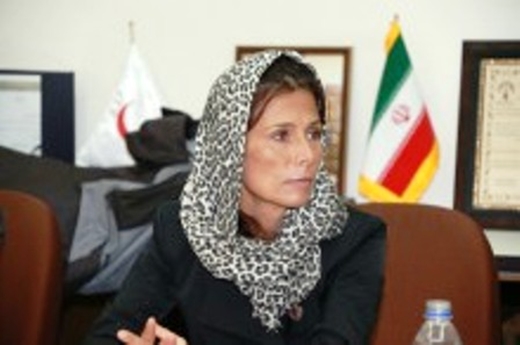
On Sunday, Iran’s Foreign Ministry Spokeswoman Marzieh Afkham offered condolences to the Lebanese government and nation as well as the families of the victims of the deadly attack, saying the perpetrators of the heinous attack targeted Lebanon’s unity, integrity and stability.

She further expressed assurances that Lebanon’s wise authorities, and political leaders and groups will stymie sinister divisive plots hatched by their enemy through enhancing national unity and dialog.

At least seven people were killed and more than 30 others sustained injuries in the attack on Saturday.

Security officials said explosions targeted the Omran café in the majority Alawite neighborhood of Jabal Mohsen.

According to Lebanon’s Daily Star, the ISIL Takfiri terrorist group has reportedly claimed responsibility for the attacks.

According to sources from the Arab Democratic Party, the dominant party in Jabal Mohsen, two bombers were behind the attacks. One of them entered the café, but the second one could not and blew his bomb outside.

Over the past months, Lebanon’s second largest city, Tripoli, has been rocked by turmoil due to the conflict between supporters and opponents of the government of Syria’s President Bashar al-Assad.

Mr. Rouhani, admit that you don’t know the US

Rouhani-Obama

Some political players in Iran have characterized the recent remarks of President Rouhani in a conference on the Iranian economy as a sign of his government’s trepidation about conclusion of a comprehensive win-win nuclear deal with P5+1.

These politicians who are members of the principlist camp believe that America’s political activities, and those of Western governments in general, are in open contrast with striking win-win agreements with developing countries, especially those in the Middle East.

What appears below is the translation of an opinion piece which appeared on January 10 in the Special News Column of Kayhan, a principlist daily those involved in politics do not usually miss:

A journalist who formerly worked for reformist publications says that President Rouhani’s recent remarks [on the possibility of holding a referendum] are indicative of Western failure to cooperate [with Iran] and amount to an invitation to appeasement.

Dariush Sajjadi, a former advisor to [Mehdi] Karroubi [a 2009 presidential hopeful who disputed the election results and sparked unrest in the country] focuses on “Growth is impossible in isolation”, “Principles should not be tied to centrifuges” and the proposed referendum [on major state issues] and writes the following in his blog, “Dr. Rouhani says that swear to God a contracted foreign policy does not help build an expanded economy! That’s right, it is impossible, but what does it have to do with direct popular vote?”

Sajjadi goes on to say, “Mr. Rouhani! You overwhelmingly won the presidential election last year and spearheaded efforts to make good on your [campaign] promises. As you took over the seat of president, you said, ‘The helmsman has now decided on a different course of action’. We know the drill and we should interact with the world. To implement foreign policy you need to know the ropes and that is what we can do.

“Mr. Zarif came into office with the good news of “The man who was perceived to be denying the Holocaust is now gone” and fascinated a nation which was waiting to see his diplomatic proficiency in interacting with the world and pulling Iran out of isolation.

“The Supreme Leader too has fully supported your foreign policy approaches through his ‘Heroic Flexibility’ and you have admitted that you’ve been given plenipotentiary powers in nuclear talks.”

Sajjadi then asks, “What has happened that you keep swearing to God that it’s impossible? If you have failed to clinch a win-win agreement despite your goodwill gestures and tremendous efforts to interact with the world and its Headman [a reference to the US], why are you using your failure as a baton to beat the people?

“If one-and-a-half-year [nuclear] talks with “the Headman” in the princely literature and through smile diplomacy have produced no breakthrough – unlike what you had thought – what breakthrough are you seeking to achieve through a referendum in Iran? Should the Iranians respond to you in a referendum now that you haven’t succeeded in reaching an agreement with foreigners?”

He further says, “Basically what do you like to put to people’s vote in a hypothetical referendum? The answer is: Dear Iranian nation! Despite our sincere endeavors in interacting with the world (the Headman) and the Leader’s backing and our full powers, the Western side did not – and does not – cooperate with us; now you let us appease them so that it [conclusion of a nuclear deal] becomes possible.”

He also says, “Mr. Rouhani, the reason behind “Swear to God it is impossible” lies with an inaccurate presentation of the problem. From the get-go, you dealt with the problem in a simplistic and unrealistic manner.

“As an ordinary citizen, I’ve already told you – as far as my knowledge goes – about the simplistic approach [in the nuclear talks], but you seem unwilling to recognize the realities of the world of politics.”

Acclaimed Shahrdad Rouhani to conduct orchestra in Tehran

Shahrdad Rouhani

Highly-praised and world-renowned Iranian music conductor Shahrdad Rouhani will visit Tehran in upcoming days to perform a two-day concert in January.

Rouhani’s producer and publisher Hamid Esfandiari told Mehr News that the concert will take place on January 22 and 23 in cooperation with prominent musicians from Tehran Symphony Orchestra. It will be conducted by Shahrdad Rouhani.

According to Esfandiari, the concert is comprised of two sections; in the first part, an orchestra bringing together 45 musicians will perform with string instruments, and in the second part an orchestra of 60 musicians will perform the film soundtracks composed by Shahrdad Rouhani.

While assuring that the audience will enjoy a high-quality concert, Esfandiari announced that Rouhani is scheduled to arrive in Tehran in the next few days. Rouhani will also attend a press conference in Tehran so that the audience would obtain more information about the upcoming performance.

Shahrdad Rouhani, an Iranian-American composer, a violinist/pianist, and a conductor who is well-known for composing and conducting classical, instrumental, adult contemporary/new age, film soundtrack as well as pop music.

In addition to appearing as a guest conductor with a number of prestigious orchestras including London’s Royal Philharmonic Orchestra, Minnesota Orchestra, Colorado Symphony Orchestra, Shahrdad Rouhani has arranged and conducted a sixty piece orchestra to supplement Yanni’s keyboard compositions.

He was also commissioned in 1998 by the government of Thailand to compose and conduct the music for opening ceremonies of the 13th Asian Games.

In 1999 Rouhani received the Thailand’s Pikanes award, the country’s most prestigious music award for an outstanding orchestral performance.

Cypriot FM praises Iran’s anti-ISIL efforts

Cypriot Foreign Minister Ioannis Kasoulides

Cypriot Foreign Minister Ioannis Kasoulides lauded Iran’s efforts in campaign against the ISIL terrorist group, and voiced his country’s willingness to cooperate with Tehran in war on terrorism.

“Iran as an important regional country plays a positive role in fighting the terrorist groups like ISIL and we support any decision for fighting terrorist groups and ISIL, and Iran’s measures encourage us in this regard,” Kasoulides said on the sidelines of his meeting with Supreme Leader’s senior advisor Ali Akbar Velayati in Tehran on Saturday.

He referred to the common positions of his country and Iran on Iraq and Lebanon, and said, “There are certain dangers in the regional countries which can threaten us too and we had constructive talks in this regard and we hope that Cyprus as an EU member state and a country which has influence in the EU can move in support of the region.”

In relevant remarks in December, European Union (EU) Foreign Policy Chief Federica Mogherini underscored the constructive and influential role that Iran played in the Middle-East region, and called on the EU member states to engage Tehran in their anti-ISIL campaign.

“Iran is not only the country with which we have nuclear talks, it is also an important regional player and this practically means that we will have to engage with Iran on its neighborhood,” Mogherini said in a press conference after a meeting with EU foreign ministers.

“The European Union is ready to engage with all regional and international actors with influence over the Syrian parties,” she added.

Also in mid-October, United Nations Envoy for Syria Staffan de Mistura in a meeting with Iranian Ambassador to Beirut Mohammad Fathali praised Tehran’s constructive role in resolving the Syrian crisis.

In September, President Assad expressed Syria’s appreciation for Iran’s stances in support of the Syrian people and sovereignty and independence of nations.

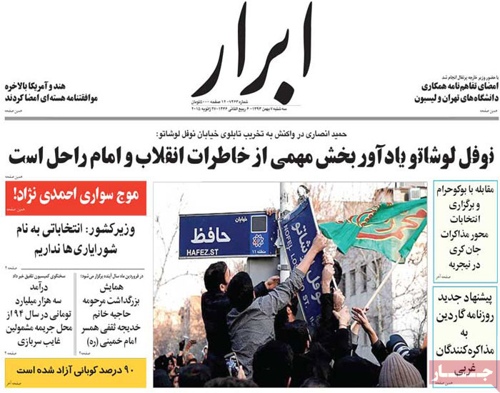
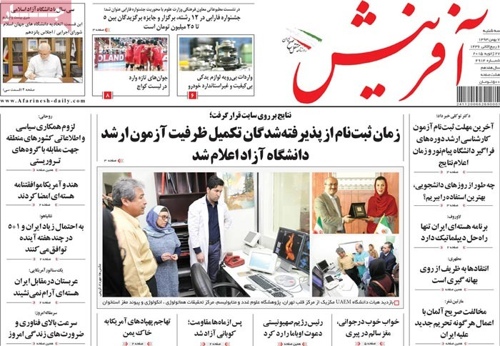
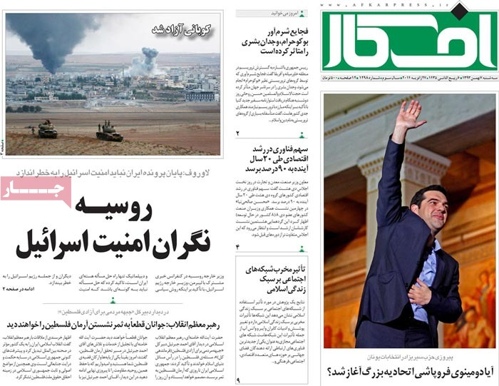
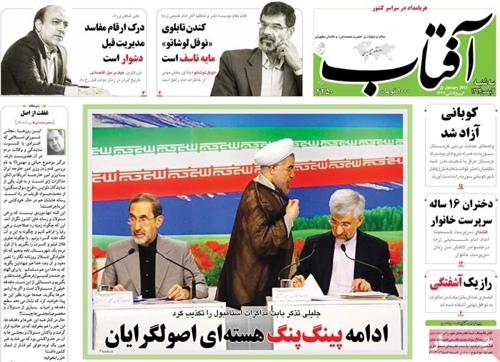
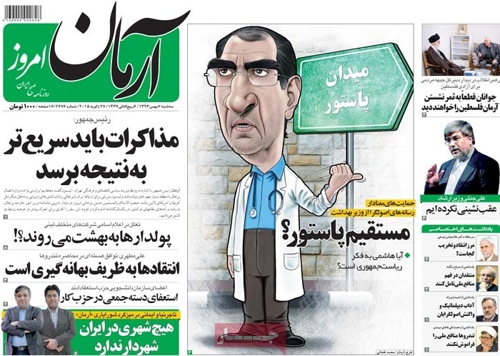
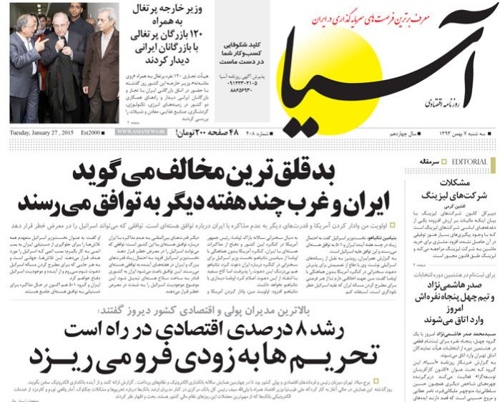
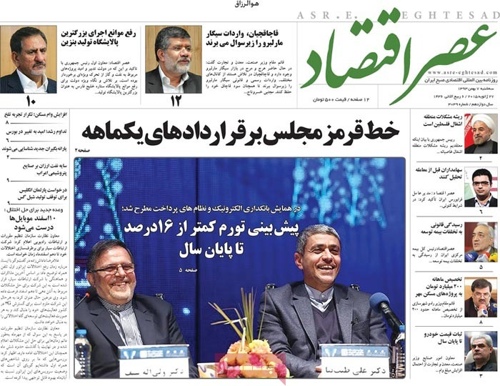
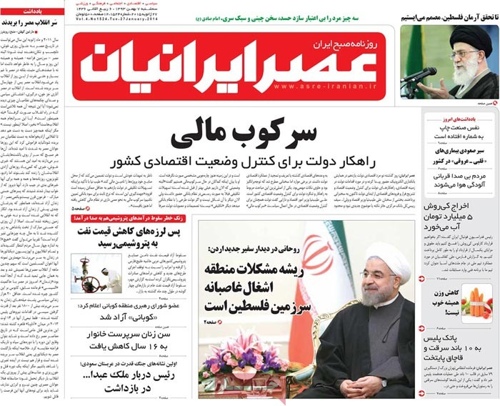
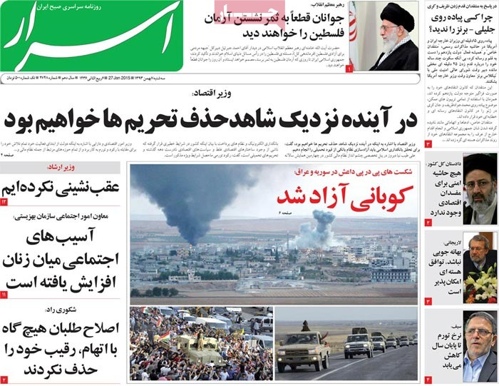
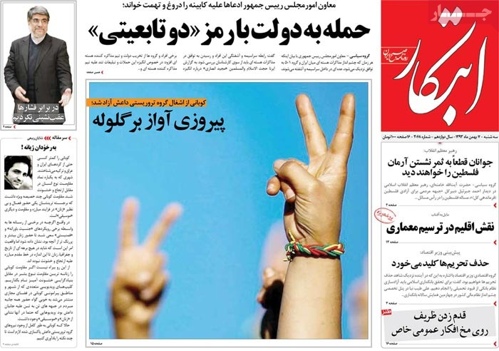
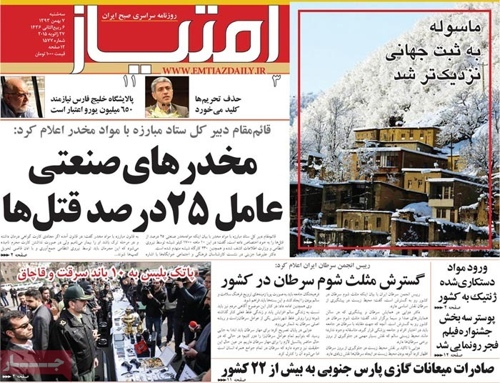
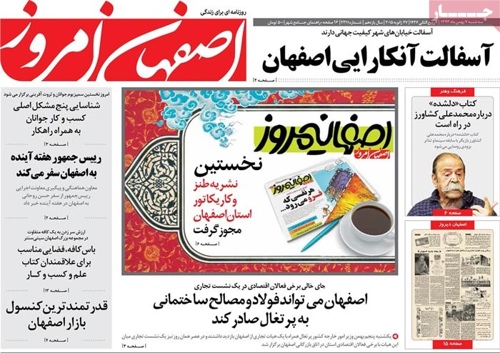
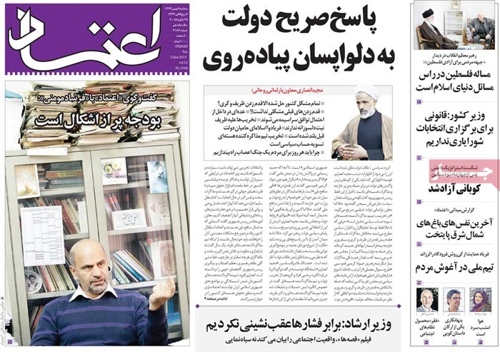
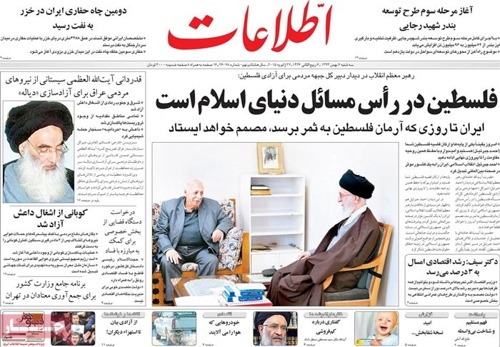
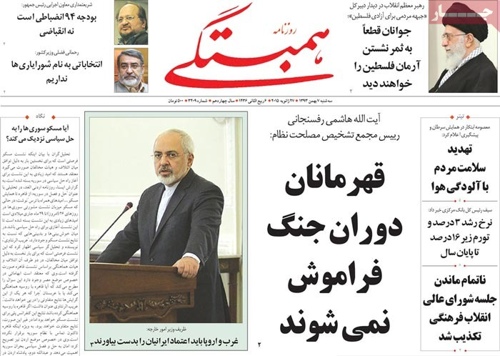
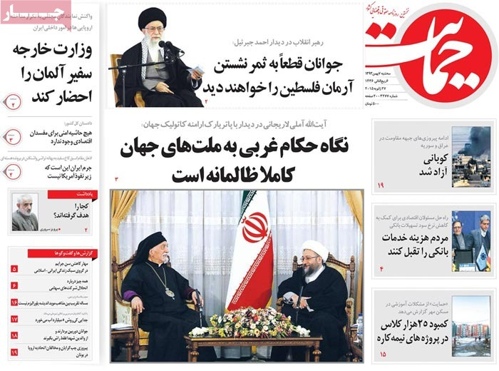
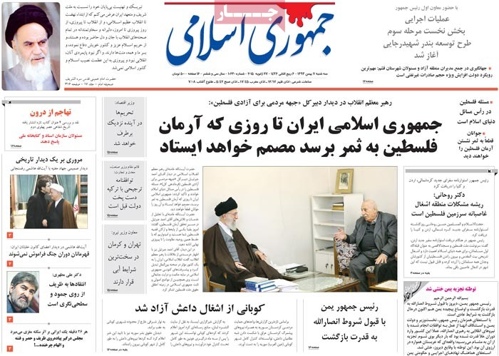
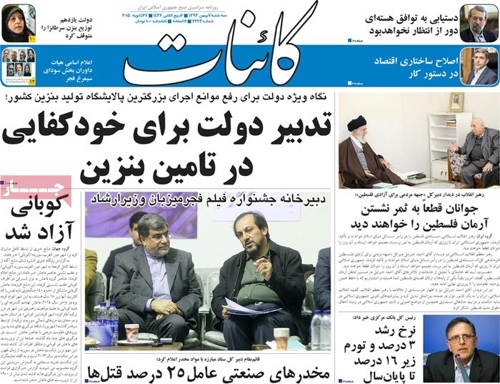
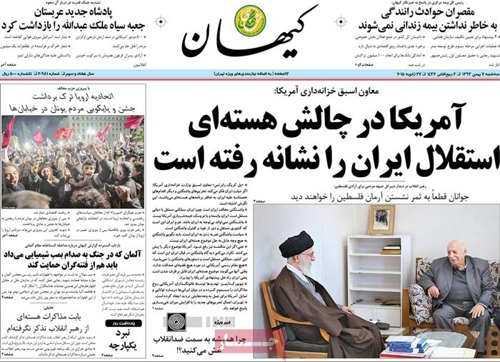
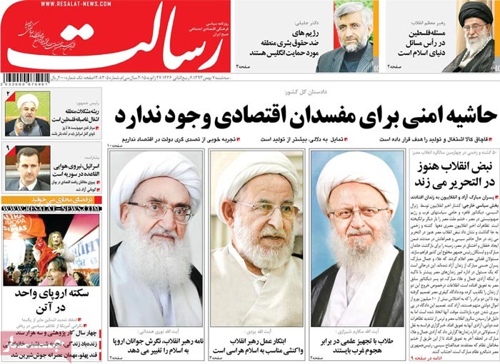
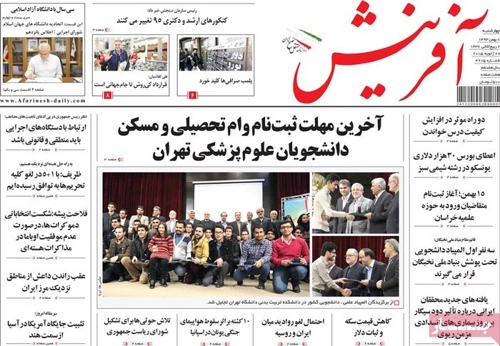
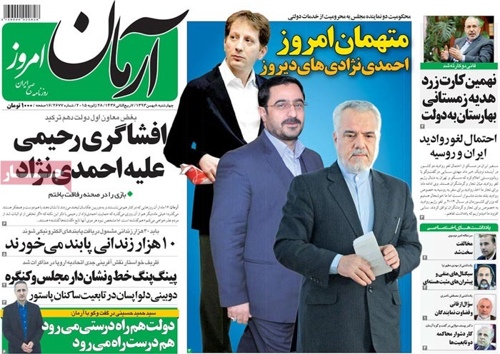
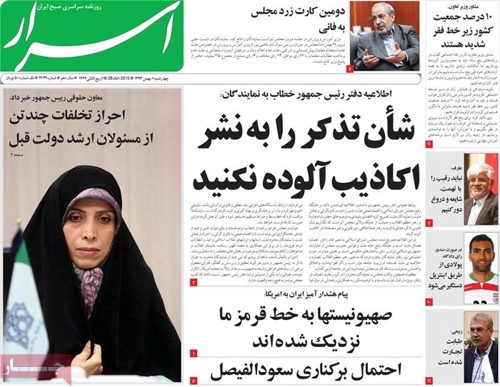
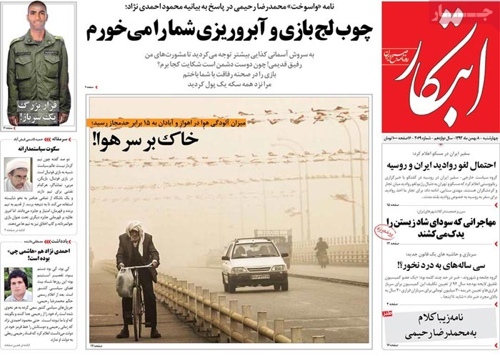
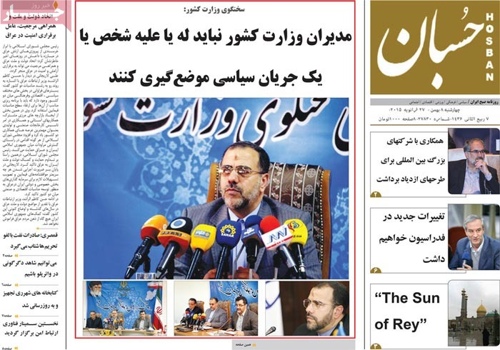
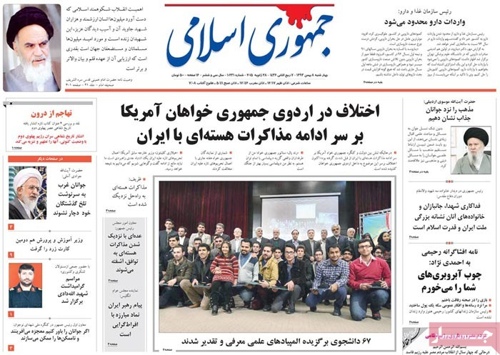
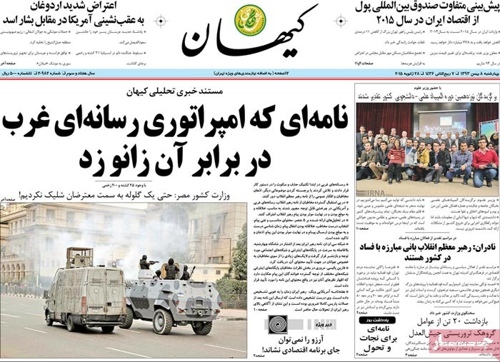
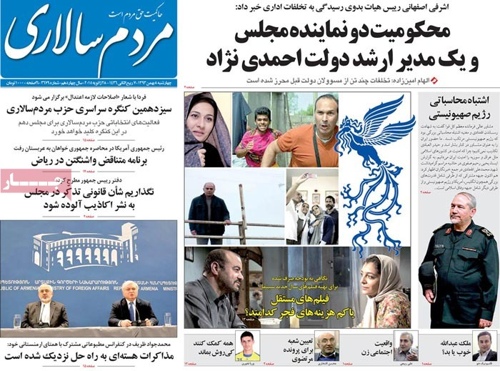
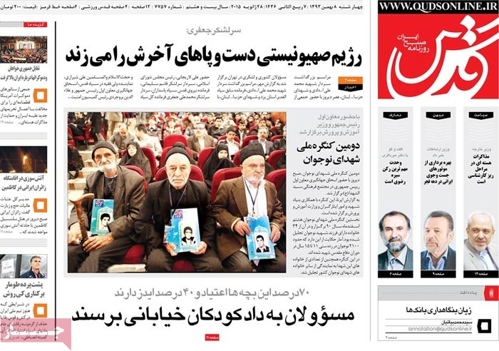
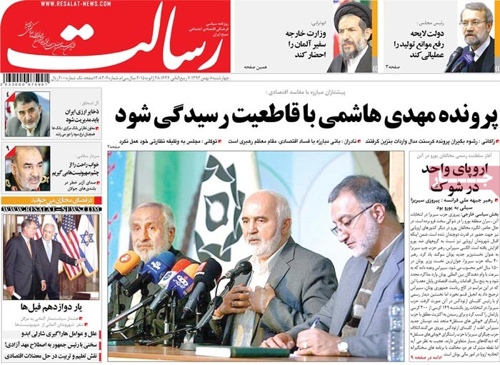
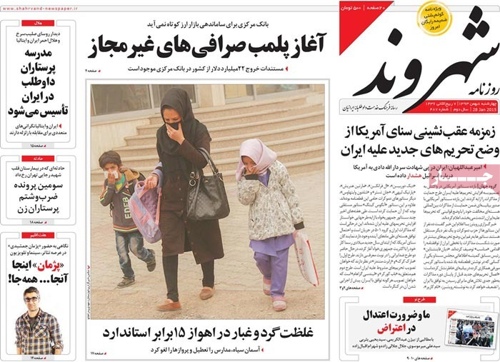
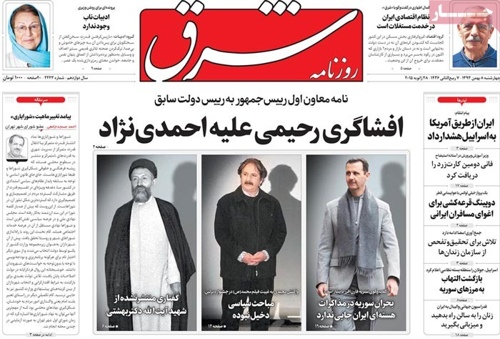
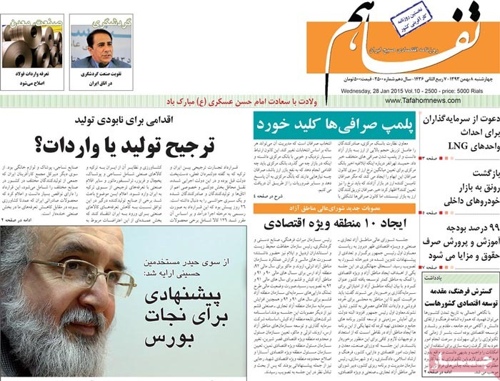
A look at Iranian newspaper front pages on Jan. 11

Iranian Newspapers Headlines

A meeting between the Supreme Leader and visiting Venezuelan President Nicolas Maduro dominated the front pages of the Iranian newspapers on Sunday. In the meeting Ayatollah Khamenei slammed the recent decline in oil prices as politically-motivated. The comments of President Rouhani at a meeting with his Venezuelan counterpart also drew front-page attention. The upcoming sale of the capital’s two most popular football clubs – Persepolis and Esteghlal – was on the cover of dailies too.


Afarinesh: “Security problems are to blame for capital flight,” said Parliament Speaker Ali Larijani.

Afarinesh: “Half-finished projects are to be handed over to the private sector,” said a member of a parliamentary committee dealing with budgetary issues.


Afarinesh newspaper 1- 11


Afkar: Officials with the Supreme Leader’s office have inspected the country’s nuclear facilities.

Afkar: Austrian exports to Iran have registered a 15 percent hike.


Afkar newspaper 1- 11


Aftab-e Yazd: China has overtaken the UAE as the biggest exporter to Iran.

Aftab-e Yazd: “Our dignity does not hinge on economic issues,” said the commander of the Islamic Revolution Guard Corps.


Aftabe yazd newspaper 1- 11


Arman-e Emrooz: Laborers gathered together outside parliament in protest at an amendment to the Labor Law.


Armane emruz newspaper 1- 11


Ebtekar: Cancer is to blame for 15 percent of all Iranian deaths.


Ebtekar newspaper 1- 11


Eghtesad-e Pooya: Exports of Iranian hand-woven carpets are up by 24 percent.


Eghtesade puya newspaper 1- 11


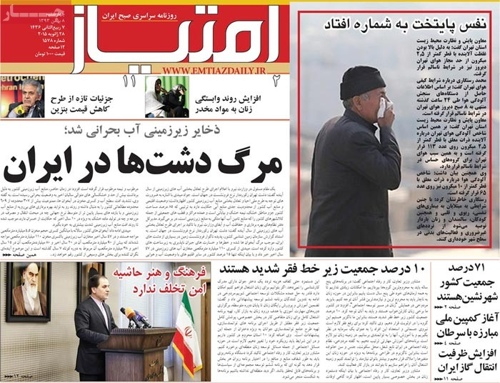
Emtiaz: Iranian bank debts are up 24 percent.


Emtiaz newspaper 1- 11


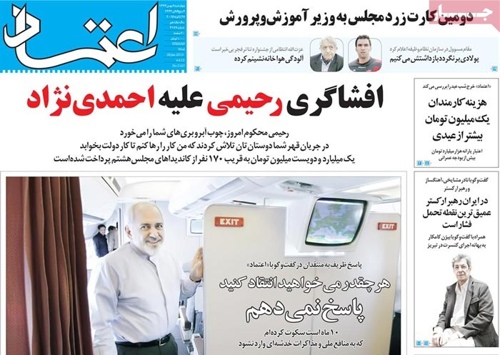
Etemad: At a meeting with the visiting Venezuelan president, the Supreme Leader underlined concerted efforts to counter [a recent] drop in oil prices.


Etemad newspaper 1- 11


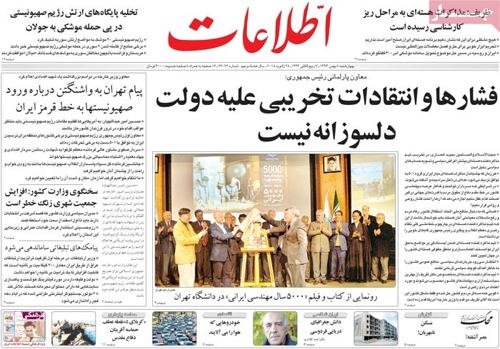
Ettela’at: Persepolis and Esteghlal, two Tehran-based football clubs whose popularity goes beyond the borders of the capital, will be sold to the highest bidders in less than two months.

Ettela’at: “The Health Ministry cannot prop out the healthcare system on its own,” said Health Minister Hassan Hashemi.


Ettelaat newspaper 1- 11


Hambastegi: “Mohammad Reza Shajarian [an internationally-acclaimed vocalist] has the approval of the Ministry of Culture and Islamic Guidance,” said a deputy culture minister.


Hambastegi newspaper 1- 11


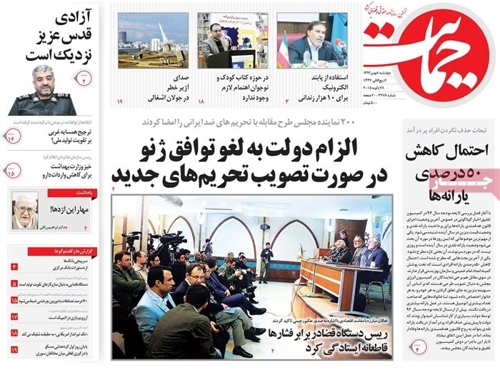
Hemayat: Terrorists are now haunting the very same countries that supported them in the past.


Hemayat newspaper 1- 11


Iran Daily: Kish energy show to host US, European companies.


Iran daily newspaper 1- 11


Javan: Homa, a state-of-the-art Iranian RQ-7 drone, has taken to the sky.


Javan newspaper 1- 11


Jomhouri Islami: “Cooperation of OPEC members which follow the same line can help foil major power plots against this organization,” President Rouhani told his Venezuelan counterpart.


Jomhorie eslami newspaper 1- 11


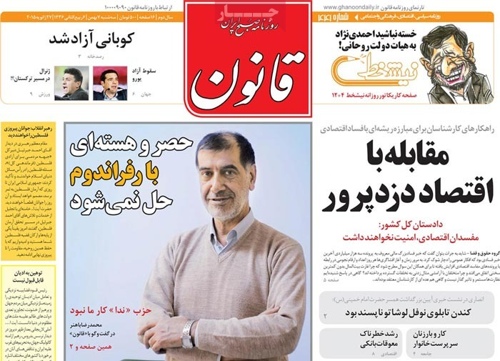
Kaenat: “Iran will not tolerate terrorists,” said the speaker of the Islamic Consultative Assembly.
 

Kaeenaat newspaper 1- 11


Mardom-e Emrooz: US Secretary of State John Kerry has met with Sultan Qaboos bin Said of Oman ahead of a meeting with his Iranian counterpart Mohammad Javad Zarif.


Mardome emruz newspaper 1- 11


Sepid: A ceremony to celebrate the universality of health insurance in Iran will be held on January 12. President Rouhani will be in attendance.


Sepid newspaper 1- 11


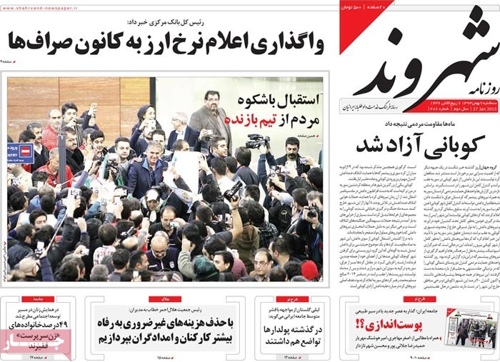
Shahrvand: Officials with the Iranian water and wastewater organization have urged the public to pray for rain.


Shahrvand newspaper 1- 11


Sharq: Iranian police have arrested a man who hacked into as many as 1,508 bank accounts.


Shargh newspaper 1- 11


Iran has answered all IAEA questions: Nuclear chief

Salehi

“Western countries attached a political history to our country’s nuclear issue, while we answered all their 18 technical questions,” said the head of the Atomic Energy Organization of Iran, Ali Akbar Salehi, in a televised program on Saturday.

He said the six countries are still expecting answers from Iran as they have politicized the issue. “The P5+1 group has announced that there is still room for discussion on two questions. The IAEA has, however, almost accepted all the answers.”

Salehi underlined that Iran’s nuclear issue can be settled through political will.

“Our country’s nuclear issue is not technical and can be resolved only through political will,” he noted.

Nuclear negotiators from Iran and P5+1– the US, Russia, China, France, Britain and Germany – wrapped up their latest round of talks on Tehran’s nuclear program in Geneva on December 17, 2014.

The three-day Geneva discussions were held almost three weeks after Tehran and the six countries failed to reach a final agreement by a November 24 deadline despite making some progress.

The two sides agreed to extend their discussions for seven more months until July 1, 2015. They also agreed that the interim deal they had signed in Geneva in November 2013 should remain in place during the negotiations.

Iran steadfast in maintaining unity

Larijani

Iran’s parliament speaker has underscored that different views of certain regional countries would not influence Tehran’s determination to maintain unity among people.

Speaking to reporters upon his arrival in the northwestern city of Orumiyeh on Saturday, Ali Larijani said that the issue of unity is regarded as one of the main tenets of the Islamic Revolution.

Iran will remain committed to pursuing unity “although others in the region may sometimes have not an accurate view on the subject, however, that will not change our attitude,” the speaker added.

He also hailed a long history of peaceful coexistence among diverse sects, religions and denominations in West Azarbaijan province in light of Islam.

Larijani further blamed “foreign trends” for trying to disrupt peaceful coexistence across the Middle East region in recent decades, but made it clear that Iran focuses on unity as the cornerstone.

His comments came after an international unity conference in Tehran that brought together hundreds of Muslim clerics and scholars to discuss the ways to promote sense of rapport in the Islamic world.

Also on Friday, Supreme Leader of the Islamic Revolution Ayatollah Seyyed Ali Khamenei renewed the call for unity among Muslims, and stressed that focusing on the interest of the Islamic Ummah (community) will consequently benefit all Muslim nations.

The Supreme Leader also described as a “big mistake” the foreign policy that certain regional states have adopted to oppose Iran.

“In contrast to such unwise policies, the Islamic Republic continues to pursue its foreign policy on the basis of friendship and fraternity with all Islamic countries, including regional governments,” the Leader added.

Common enemies use oil as political tool: Leader to Maduro

Supreme Leader-Rouhani-Venezuela

In a meeting with visiting Venezuelan President Nicolas Maduro on Saturday, the Leader noted that the steep fall in global oil prices in a very short period of time is “politically motivated” and “is not economic.”

“Our common enemies are using oil as political tool and definitely play a role in this sharp fall in oil prices,” Ayatollah Khamenei added.

The Leader also praised Venezuela’s efforts against the Israeli regime, and described such efforts as the reason for the hegemonic powers’ hostility toward the Latin American country.

“The Islamic Republic of Iran’s definite decision is to continue and increase all-out cooperation with Venezuela,” the Leader noted.

Ayatollah Khamenei also described the late Venezuelan president, Hugo Chavez, as “Iran’s good friend” and further appreciated Maduro’s continued resistance against the plots hatched by the enemies.

Maduro, for his part, thanked the Islamic Republic of Iran for its assistance to and support for Venezuela, saying that the two countries should continue expanding relations by using the existing capacities.

Touching upon the issue of oil, he said his government is making efforts to bring about a consensus among member states of the Organization of the Petroleum Exporting Countries (OPEC) as well as other oil-exporting states to return crude prices to an acceptable level.