Saturday, January 3, 2026
Home Blog Page 4939

Iran and Saudi Arabia; will protocols lose their significance again?

Hashemi-Malik Abdollah

How effective and helpful are personal interests of the leaders and officials of countries in the souring or warming of their official ties? Do the personal traits of senior officials – foreign ministers and government-appointed ambassadors included – such as humbleness and arrogance have any bearing on protecting or jeopardizing the national interests of countries?

Recently, a former US congressman – Jim Slattery who visited Iran in December –described a lack of understanding of and interpersonal relationships between US and Iranian officials as one reason why tensions are still simmering in ties between Iran and his respective government.

Interpersonal interests should be taken into account as a key principle when it comes to establishing ties between two nations in the West and East with two different cultures. The lack or existence of interpersonal understanding and interests between politicians and rulers in Eastern countries has played a major role in the animosity or friendship between their governments. There is plenty of historical evidence to confirm such an assertion.

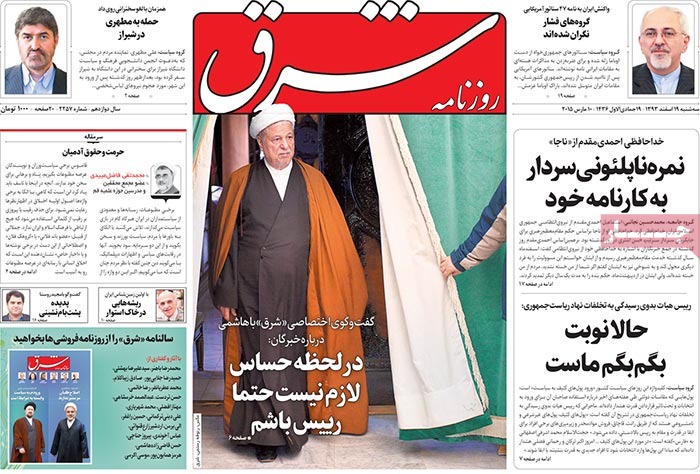
Hashemi Rafsanjani in Iran is known to be key to reopening ties with Saudi Arabia. On several occasions, the question of mediation by the veteran politician has been raised to make Saudi Arabia return to the path of interaction with the Islamic Republic; in reaction, Ayatollah Hashemi has implicitly and explicitly tied the accomplishment of such a key mission – which is meant to restore regional calm – to being given full powers.

As a man in the capacity of the chairman of the Expediency Council and as an age-old friend of the Leader of the Islamic Revolution, what powers does he seek that he lacks now?

The answer to this question is not clear. Ayatollah Rafsanjani’s remark can signify the complexity of a mystery and the Gordian knot in ties between Iran and Saudi Arabia which are two political and ideological heavyweights in the region.

Under normal circumstances it is hard to put ties between two countries back on track. In the case of Iran and Saudi Arabia, two major world players, it would be doubly difficult to promote ties to a level in which their strategies in dealing with regional issues and their decisions at OPEC could turn the Middle East into a safe and powerful region.

In the eyes of Hashemi Rafsanjani, a veteran pragmatic Iranian politician, it is a feasible task to make the impossible possible providing that the two sides share a [political] will.

Mehr News Agency and Tehran Times, an English-language daily, have jointly conducted a detailed interview with Ayatollah Akbar Hashemi Rafsanjani. The original text in Farsi was released by mehrnews.ir in two parts under the headings “Domestic and Foreign Issues” on February 22 and 23.

One question in the second part elaborates on ties between Iran and Saudi Arabia. IFP has chosen and translated this question which features a first person account of the history of warm relations between Hashemi Rafsanjani, a onetime Iranian president, and the late King Abdullah of Saudi Arabia.

Although Ayatollah Rafsanjani leads off his remarks with an expression of regret over “soured relations”, he is openly hopeful about mending fences between the two countries and is not pessimistic about the contribution by Saudi King Salman to the reopening of a friendly chapter between Tehran and Riyadh. The following is the translation of what Ayatollah Rafsanjani said in part of the interview:


A lot of ambiguity has surrounded Tehran-Riyadh relations. The demise of King Abdullah and a recent slump in oil prices have compounded things. What is your take on the state of ties between the two nations and in fact how can the relations be mended?

The general state of affairs was not worse until recent comments, which were made at Tehran Friday prayer sermons, caused things to take a twist for the worse. […]

In pre-revolution Iran, Tehran and Riyadh were at odds over a number of issues including oil, and they kept wrangling. After the revolution, they were initially fearful of our revolution, particularly because back then we kept chanting slogans about exporting the revolution. That had prompted some nations to consider following in Iran’s footsteps. The Saudis were concerned and their relations with us were anything but good. That lasted until I took office.

During the Iran-Iraq war, they stood by Saddam, financially supported him and their airspace was at Saddam’s disposal.

When Iranian pilgrims were prohibited from Hajj [an annual Muslim pilgrimage to Mecca], the late Imam Khomeini got worried and said, “It’s not good for our Islamic government to be denied Hajj which is an unshakable principle of Islam and the holy Koran”. He ordered me to get the issue settled.

Our major disagreement with Saudi Arabia was over oil prices. King Abdullah argued, “If we raise oil prices, they [customers] will find alternative fuels and oil will lose its value.”

I proved to him that an alternative fuel couldn’t come around easily and oil value wouldn’t fall any time soon. He accepted my reasoning and cooperated, therefore the issue of oil was sorted out. The late Imam Khomeini had ordered this.

I kept at it [and made efforts to further improve ties]. When I became president, I kept trying and some progress was made.

I met with Abdullah, who was back then the Saudi Crown Prince, twice in Senegal and Pakistan. We discussed things and his attitude changed. In fact he learned about certain facts about which he had quite contrary views.

At the Islamic summit in Pakistan, Abdullah was supposed to come to my room for a word. Earlier in Senegal I had gone to his room and it was agreed that in Pakistan he would come over to my room.

I was sitting at the conference hall when all of a sudden I was told that Abdullah was waiting for me. [My foreign minister] Mr. Velayati said, “We agreed that he would come this time”. He wondered what we should do. In response, I said, “We shouldn’t display arrogance; after all, we seek to talk.”

We were walking toward his room when we saw Abdullah and his entourage come out of the room to welcome us, saying, “We are about to go to your room.”

His attitude seemed to have changed drastically. The modesty that I showed impressed him and encouraged him to come over to my room. Several points of disagreement were resolved during our talks there.

For instance, they were opposed to holding the next summit in Tehran; that issue was settled. They had released a statement in Riyadh, but after our talks, Abdullah called Saud al-Faisal and ordered the statement withdrawn.

After the meeting, we were invited to lunch by the Pakistani prime minister, so we came out, waiting for our cars to pick us up. My car turned up sooner and Abdullah got into my car without any bodyguard. Journalists and others were surprised. We entered the summit together and that spoke volumes.

Later, our friendship found its way into our families. When I traveled there, our families got together; actually our relations went a little beyond diplomatic ties and turned into family relationships.

Abdullah, who travelled to Tehran to attend a summit, let go of diplomatic protocols and insisted on coming to my house.

Anyway, lots of problems were addressed in that atmosphere. We worked a lot on improvement of ties. Now if we both try to improve the conditions, we can go back to the point we were. Back then King Salman was the governor of Riyadh. He threw a party for us and treated us with humility. Everything was brotherly. He described things for me in a friendly fashion.

But now there are things over which we have disagreement like Yemen, Bahrain, Syria, Iraq, Lebanon, and even the Zionist regime. We do not approve of the current level of their relations with Israel. Such disagreements exist and need to be addressed. In my opinion, we can return to where we were.

IFP has changed the title and written its own foreword to the interview.

An International Relations Council is to be formed in Iran

Hesameddin Vaez Zadeh

On February 23, Ettela’at quoted Dr. Hessamoddin Vaezzadeh, a professor of international relations at University of Tehran, as saying that an International Relations Council is to be set up for the first time in the history of the Islamic Republic. What comes below is a partial translation of what else he had to say:

Such an institution could lend assistance to the country’s diplomacy apparatus and help those who are active in the public sector or in the field of business deal with the turbulent and competitive atmosphere of the modern world.

The need for such non-governmental organizations has long been felt, because they can narrow the gap that exists between plans in theory and in practice. That’s why a year ago a number of scholars, elites and senior experts started carrying out studies to found a first such council in Iran.

Iran’s International Relations Council is an NGO which acts in line with the sacred objectives of the Islamic Republic and is backed by the establishment.

Among other things, the council aims to secure a common understanding and create a chance for the free expression of different ideas and an exchange of views in a calm atmosphere which is free of any political, factional wrangling.

Russia offers Iran latest anti-aircraft missile system

anti-aircraft missile system

The head of Russian state defense conglomerate Rostec says Moscow has offered Iran its latest Antey-2500 missile defense systems after a deal to supply less powerful S-300 missiles was scrapped under Western pressure.

Tehran is now considering the offer, Russia’s TASS news agency quoted Sergei Chemezov as saying on Monday.

“As far as Iran is concerned, we offered Antey-2500 instead of S-300. They are thinking. No decision has been made yet,” Chemezov said.

There was no immediate response to Chemezov’s comments from Iran.

Under a contract signed in 2007, Russia was to provide Iran with at least five S-300 defense systems.

However, Moscow refused to deliver the system to Iran under the pretext that it is covered by the fourth round of the United Nations Security Council sanctions against Tehran over its nuclear program.

Following Moscow’s failure to deliver the systems, Iran filed a complaint against the Russian arms firm Rosoboronexport with the International Court of Arbitration in Geneva.

The Antey-2500 was developed from the 1980s-generation S-300V system (SA-12A Gladiator and SA-12B Giant). It can engage missiles traveling at 4,500 meters per second, with a range of 2,500 kilometers (1,500 miles), according to the company that makes it, Almaz-Antey.

The S-300 missiles have a 125-mile (200-kilometers) range.

You Are Not Any Less of a Revolutionary If You DON’T Pull Trigger

Sadegh TabaTabai-Mousa Sadr

Seyyed Sadegh Tabatabai*, an associate of the late Imam Khomeini during his years in exile in France, passed away at the age of 71 on Saturday (February 21).

On February 22, Ehsan Razzaghi published a piece in Aftab-e Yazd daily which featured a memory of the late Tabatabai to urge the principlist critics of President Rouhani’s government to rethink their nuclear stance. The following is the translation of the piece:

I am using the passing of Sadegh Tabatabai as a good excuse to recall a memory and make the principlist critics of the government rethink their fiery stances in the days when nuclear talks with P5+1 get closer to their final critical moments.

Let’s assume that their stances are honest and based on good intentions, not an excuse to sandbag and find a way to deflect attention from numerous corruption and mismanagement charges lodged against them for the eight-year performance of their faction [when the principlists were in office].

The late Sadegh Tabatabai once recalled a memory and said, “Yasser Arafat once called the office of Imam Musa Sadr (May their souls rest in peace) and asked Imam [my uncle] to go and see him.”

“When we got to Arafat’s office in Beirut, it was around 1:00 a.m. We were in a big room with a big table in one corner. A few minutes later, Arafat came in. After greetings, he told Imam Musa Sadr that Israelis have sent him a gift and asked a cardboard box which was sitting on the table there to be brought to him.”

“When he opened the box, we saw the severed head of a Palestinian newborn. As Imam Musa Sadr looked at it, Arafat turned to Imam and asked, ‘Oh, brother! What shall I do with this gift?’ By that question Arafat seemed to be asking how his Lebanon-based Palestinian forces (the Fatah movement) should react to attacks by the Zionists.”

“What Imam said in response was strange. ‘Oh, brother! A revolutionary man is not necessarily the one who always pulls a trigger; to be a revolutionary, sometimes you should avoid pulling the trigger. When the enemy seeks to allure you to a path where it can carry out its plans, the real revolutionary is the one who does not fall into the enemy trap and avoids getting stuck in a vicious circle of revenge which culminates in nothing but the killing of innocent people’.” (I don’t recall the exact wording, what I just said was a paraphrase)

If there are people in the West and among those Zionists who are trying to enrage us today, we should take heed of such a strategy, and this is a strategy the government of moderation – backed by the Supreme Leader – has pursued in nuclear talks [with the West], trying its utmost to have the unjust sanctions imposed against the country lifted.

Sadegh Tabatabai was an Iranian writer, journalist, professor at the University of Tehran and politician who served as deputy prime minister from 1979 to 1980. He was the deputy minister of the interior. From 1982 until 1986, he also served as Iran’s ambassador to Germany.

Will Ahmadinejad stand trial?

Mahmoud Ahmadinejad

Some principlists who are vocal in their criticism of former President Mahmoud Ahmadinejad say it would be an act of bravery on the part of the Judiciary if charges were brought against him for disrupting Iran’s economy and squandering national assets during the golden age of foreign revenues. On the other hand, his staunch supporters say his trial would be a great opportunity to reveal many things which have remained unsaid so far.

What comes next is the translation of an analysis published by Fararu on February 21, featuring the perspectives of a critic and a supporter of Ahmadinejad:


We hope that the Judiciary makes good on its pledge to try Ahmadinejad

Expressing hope that the Judiciary will deliver on its promise to prosecute Ahmadinejad, Secretary General of the Guilds and Bazaar Association of Iran, Ahmad Karimi Isfahani said, “Ahmadinejad has a long history in finger-pointing and tarnishing the reputation of others. On certain occasions, by building on such a tactic he has even succeeded in getting things done the way he wants them to be done. The most glaring mistakes in the history of the Islamic Republic were made during his term in office.”

The principlist politician added, “Therefore, it would be appreciable if the Judiciary treated him like an ordinary citizen. Any timely action in this regard will contribute to efforts to safeguard the establishment.”

Arguing that the offenses committed by Ahmadinejad outnumbers those under investigation by the Judiciary, he said, “Thanks to his mismanagement, numerous offenses were committed by officials under him like [Esfandiar Rahim] Mashaei [his senior cabinet member] and [Mohammad Reza] Rahimi [his first vice-president] for which he has to be held accountable. Besides, the heaviest blows were dealt to the economy during the golden age of foreign currency revenues when he could have streamlined the economy.”

Karimi Isfahani said that whenever Ahmadinejad found greater opportunities, he caused more damage to the country’s infrastructure.

He went on to say, “The Judiciary seeks to find out about cases involving a waste of assets or corruption. Even if we assume that his government has not siphoned off public funds, lots of resources have been wasted. Still he says that he will run for office!”

Denouncing offenses committed by Ahmadinejad as major, he added, “Disrupting the economy is his most serious offense. On the international front, he caused disorder too and cast doubt on Iran’s dignity. That’s why in my opinion, Ahmadinejad has to be severely punished.

Supporters of Ahmadinejad, on the other hand, have not expressed any opposition to him being put on trial.


Ahmadinejad will reveal what remains unsaid

Abdolreza Davari, the head of HOMA, a media outlet supporting Ahmadinejad, is among those who has welcomed the idea of trying Ahmadinejad and said, “In my opinion, this trial will be among the most remarkable in the history of the Islamic Republic.”

Stressing the fact that if Mr. Ahmadinejad faces charges, he should be treated like an ordinary citizen, he added, “The current supporting him welcomes the trial, because it will definitely offer an opportunity to say what remains unsaid.”

Whether his case should be heard in an open court is another bone of contention.

In reaction to Davari’s comments, Karimi Isfahani said, “His case should be heard like other cases the Judiciary deals with and the ruling should be made public, because it is obvious that like in the past Ahmadinejad will turn to finger-pointing and tarnishing the reputation of others. Now that not much is at stake for him, he definitely won’t take into account the considerations of the establishment.”

After eight years in power, when Ahmadinejad left office many people and experts denounced him as the main culprit for the economic and political damage the country suffered. We should wait and see when the Judiciary can file charges against him based on current complaints and not necessarily because of the damage he has caused to the country.

The image of you by Vank Cathedral sticks in my mind forever

Zawen-Ghokasian

On February 21, Sharq published a laudatory tribute by Bahman Farmanara, an Iranian director, screenwriter, and producer, to Zaven Ghokasian, a filmmaker, critic, and professor of cinematography who passed away a day earlier. The following is a partial translation of the item in which Farmanara reminisced about the past, paying tribute to late Ghokasian who like him was originally from Isfahan:

Walking next to Vank Cathedral in Isfahan, a pudgy man of medium build approached the camera behind which Bahman Kiarostami was positioned. We were in Isfahan to make a documentary. We soon realized that it was Zaven Ghokasian, the leading cinematography figure in town.
Without him, cinema wouldn’t have survived long in Isfahan. With a lot of enthusiasm, perseverance and kindness, Zaven would attract people to film festivals or to classes he held; he was the one who encouraged the youth interested in cinema to attend such gatherings.

A while ago when Zaven’s mother passed away and we went to Isfahan to attend her memorial, we were astonished at the sight of the large crowd coming from far and wide to offer condolences. It was surprising because Zaven did not hold public office, nor was he a man in a high position.

Still, he was well loved by all those who were enthusiastic about cinema in Isfahan. Although Zaven was at the center of attention, he was surprised about how sincerely the public mourned his mother.

Zaven and I were always fond of food and eating. Sometimes we’d make fun of ourselves for our excessive interest. Our shirts were always the butt of jokes we exchanged. […] He would always laugh off my banters gracefully.

Zaven was the one behind the success of the international short film festival in Isfahan. Leading figures like Abbas Ghanjavi [a film editor] would travel from Tehran to Isfahan every week to teach classes and even stood in for Zaven every time he called in sick.

Zaven Ghokasian was an ordinary citizen of a major city of Iran whose passion for cinema and its survival in his hometown turned him into a giant; a heavyweight who left a mark which will last for good.

My dear friend, rest in peace; you will always remain a sweet memory in my mind. I am ever so glad that thanks to my own disease I did not see you suffer. The image of you as a pudgy man of medium build with your typical laugh walking next to Vank Cathedral will be imprinted in my mind.

Iran to quit talks if interests not secured: Araghchi

Abbas Araghchi

Deputy Foreign Minister and senior nuclear negotiator Abbas Araghchi said Tehran attaches no importance to media hype and will continue to hold talks as long as there is respect at the negotiating table.


He made the remark in reaction to comments by U.S. Secretary of State John Kerry who said Saturday that “significant gaps” remained and warned that Washington was ready to walk away from the talks if Tehran didn’t agree to terms demonstrating that it doesn’t want atomic arms.
Araghchi further said the Iranian nation and nuclear negotiators will never surrender to threats, bullying, pressures, and force

“We have already faced this kind of American rhetoric and it is unfortunate that they repeat it while it has proved a total failure,” Araghchi added.

“Both Americans and other members of 5+1 Group (Russia, Britain, France, China, Germany) have experienced several times that political or media pressures do not cause Iran to change its approaches, demands, and stances in the negotiations whatsoever.”

Stressing that the negotiations should continue in a win-win situation, Araghchi said if one side tries to impose its will, Iran will have no doubt to walk away from the talks, “but this is not the situation we are in now. We continue the talks strongly, but whenever we feel that the negotiations do not secure our national interests, we will certainly walk away.”

On the presence of Director of Iran’s Atomic Energy Organization Ali Akbar Salehi and US Energy Secretary in the negotiations, Araghchi said involvement of Salehi in the talks was very useful because he is an expert on technical aspects of the talks.

“We can’t claim yet that there is a breakthrough in the talks and there are still gaps, but all the sides are seriously trying to get closer to a settlement, although there are not complete solutions in key problems, yet,” said the Iranian negotiator.

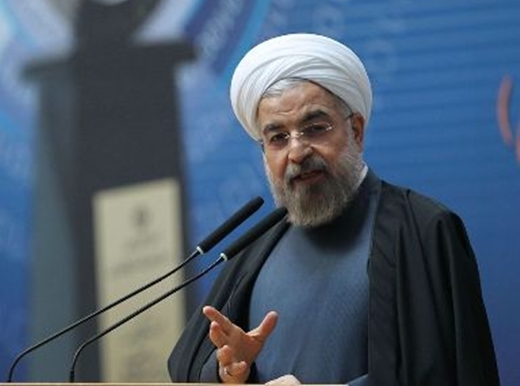
No one could claim Iran pursuing non-peaceful nuclear program: Rouhani

Rouhani-NAM

President Hassan Rouhani said that no one now could claim that Iran is pursuing non-peaceful goals in its nuclear program.

He made the remarks on Monday while addressing the opening of a meeting of Science Ministers of the Non-Aligned Movement (NAM) member states.

He said those who are imposing sanctions against Iran as well as the ones who are running projects to make Iran’s nuclear program a matter of security, are both well aware of the real objectives of the Iranian nation and government.

The president also stressed that today in the world nobody could ever claim that Iran’s nuclear program is non-peaceful.

He said Iranians are under a lot of pressure only because of their determination to safeguard their inalienable right to nuclear technology for civilian purposes.

Discrimination in science, he added, is now used as a tool to keep up the process of underdevelopment, poverty and unemployment in non-developed countries.

He went on to underscore the need for independent countries to adopt collective policies to confront this trend.

The Iranian president also stressed that as long as politicians in developing countries fail to make any reforms and establish a proper link between science and industries, the brain drain will continue in their countries.

He urged the NAM member states to drop non-realistic missions and try to focus on areas of joint scientific and technological cooperation.

He said each NAM country enjoyed remarkable scientific capacities which could be shared with other member states.

President Rouhani said that scientific and technological cooperation within the NAM could serve to enhance progress and prosperity in member states and in the long run help attain the ultimate goal of the organization which is to establish peace and equality in the world.

He said extreme poverty and unemployment in developing countries which is exacerbated in turn by an impotent global political and economic system paves the way for growing extremism and violence in the world.

The president highlighted the right of people to knowledge and technology as an inalienable one.

As learning and teaching knowledge have no borders, he said, the benefits gained from them have no limits either.

Representatives from 58 countries and international organizations, as well as 31 science ministers from the Non-Aligned Movement (NAM) states are participating in the meeting which is hosted by Iran’s Ministry of Science, Research and Technology.

Participants include officials from the Islamic Educational Scientific and Cultural Organization (ISESCO), D-8 Organization for Economic Cooperation, the Islamic Development Bank, the OIC Standing Committee on Scientific and Technological Cooperation (COMSTECH), the African Union, and a number of deans of universities from NAM states.

This is the first specialized summit on science and technology by NAM.

It is aimed at boosting major policy-making cooperation among the member states and improving the movement’s diplomacy of science and technology.

Zarif, Kerry, Salehi, Moniz end nuclear talks in Geneva

Zarif Kerry Salehi

The negotiations which began late Sunday in the Swiss city of Geneva ended after 2.5 hours with the two sides agreeing on resuming negotiations on Monday.

A source in the Iranian negotiating team said that the agenda for Monday is yet to be determined.

The meeting between the two top diplomats was delayed for several hours due to Kerry’s late arrival from London.

Ali Akbar Salehi, the director of the Atomic Energy Organization of Iran (AEOI) and US Energy Secretary Ernest Moniz also attended the talks. The high-ranking officials have already held two rounds of negotiations to discuss the technical aspects of Iran’s nuclear program.

Iranian and US delegates, who attended a simultaneous meeting with negotiators from Russia, China, Germany, France and the UK, later joined talks between Zarif and Kerry.
Deputy Foreign Minister Abbas Araghchi, the head of the Iranian delegation, said after the meeting with P5+1 in the EU mission building in Geneva that it is soon to claim any progress has been made.
The talks are expected to continue on Monday at an expert level with discussions on the technical issues.

The ongoing talks in Geneva, which kicked off on Friday, are among the last attempts by the involved parties to narrow gaps on the remaining issues as a deadline for reaching a comprehensive deal on July 1 draws closer.

The two sides have missed two deadlines since an interim deal was signed in November 2013.

Deputy minister tells colleagues to quit if they can’t manage

Ettemad-Water

On February 21, Etemad daily ran a report on water crisis in Iran and the need for urgent action to defuse it. What appears below is a partial translation of what the energy minister and his deputy have said about the country’s water resources:

“We will have a tough year ahead [starting on March 21]. Over the past 11 months there has been a 30 percent drop in rainfall,” said Energy Minister Hamid Chitchian.

Deputy Energy Minister for Water and Sewage Affairs Rahim Meydani urged officials who play a role in water management across the country to try in earnest to implement the plan aimed at reviving ground water resources.

He underscored that implementation of the plan requires determination and said, “As we joined hands during the Sacred Defense to safeguard our territorial integrity, we should now spring into action to properly protect the country’s water resources.”

Meydani warned, “If those at the helm of water management failed to seize the opportunity, they would be blamed by present and future generations. If a manager thinks that they are not motivated enough to step up to the plate in dealing with water crisis, they should let us know as soon as possible.”

He further said, “Drought has turned out to be a blessing in disguise. In fact it was a wake-up call; it has prodded us to take action to compensate for overconsumption of water and properly manage surface and ground water resources in the face of crises.”