Friday, December 26, 2025
Home Blog Page 4933

Today’s teens, tomorrow’s scientists

Valeh Education Institute

It is said that children build a country’s future. What they receive today could be the basis for what they do tomorrow. Students are usually asked to follow the example of successful people.

Naarengi [Tangerine], a magazine which is aimed at children and their parents and published by Valeh Education Institute, carried out an interview with two such successful students: Edris Jassemi, an advisor to Minister of Cooperatives, Labor and Social Welfare Ali Rabiei, and Andisheh Sadeghi, the gold medal winner of the Australian Mathematics Competition. The following is a brief translation of the interviews with the two students of Valeh Education Institute:

Edris talks about his presence in a national conference on social welfare and how he was named an advisor to the minister:

“I don’t like failure and dismay. Failure is not the end of a path. Obstacles in the way can turn into an experience to help me take the next step. […] I think about the future, not the past […]

“I got familiar with Mr. Rabiei through the Iranian Diabetes Society. [….] I read out a text there saying, ‘We are the children of Iran, a rich, powerful and advanced Iran.’ [….] You may ask who I am and what I am doing here. I am one of those who should build the future of this country.

“I know that the world’s wheels are spinning thanks to science, and those nations which are scientifically powerful have more to offer to the world.

“My generation is expected to help the endeavors of the previous generations for Iran’s development drive to bear fruit. [….] I am a student suffering from diabetes, but the disease has not caused me to distance myself from the world; rather it has motivated me to have more contact with the world and learn more about healthandage.com soma.

“As they say, we can turn threats into opportunities. At a time when the world does not want to see Iran grow, we can be of help. [….] On behalf of all children in my generation, I want to offer a helping hand to my country. So trust us.”

[…]

“Everybody should set a goal for their future and try to reach it; otherwise nothing will happen in their lives. […] Life goes on as people try to materialize their goals and dreams, material and spiritual alike. The universe and what’s in it is a reflection of what you seek, like an echo in the mountain. I dream of being involved in aerospace. I like to be the one in charge in NASA one day. When you set a goal for yourself and have high motivation to achieve it, you’ve covered half the distance.”

Students’ role in Iran’s scientific drive

“[….] Iran is qualified for a giant leap forward. Iranians love their homeland and this is a big asset. [….]

“Iran is not where it should have been. Part of the blame lies with foreign factors. We are to blame too. Iranians are not content with what they have. The thirst for science is good, but it is destructive when it comes to wealth. [….]

“The government should prevent brain drain. People make headway building on the country’s potential, but they leave for other countries when they are given more incentives and this deals a blow to Iran. [….]

“Another issue is child labor. Something must be done for those children who have to work and be the family’s breadwinner despite their innate talents. […]”

Andisheh says failure is a prelude to success.

“[….] Opportunities are like clouds, they come and go. We need to have motivation to seize them. To pull off success, you need to go ahead step by step and move forward along the path you’ve chosen. I aim to study in the world’s best university and teach there down the road.

“In Iran investment in teenagers is not enough. They can earn the country honor by winning in scientific and sport events.”

Edris: “They invest in people in Iran after they enter the university. There the students face multiple challenges, but they lack the necessary skills to overcome them. The process is different in advanced countries where they evaluate students’ talents and capabilities at a younger age and put them on the right path. [….]”

Andisheh: “School is the launching pad for those students who love knowledge. [….] The students’ motivation and big aims also come into play. Those who blame others for their failure are the real losers.”

Edris: “Many Iranian students who love knowledge cannot receive education. They should have motivation and the government should rush to their help. [….]”

More or fewer sanctions?

University of Massachusetts Amherst

After the University of Massachusetts Amherst released a statement on its website, announcing that it no longer admits Iranian nationals into graduate programs, the university came under fire online for its new admission policy. The following is the translation of a report Etemad daily ran on February 15 on the controversial decision by Amherst:

Social networks are abuzz with reaction to the contentious decision of the University of Massachusetts Amherst to stop accepting Iranian students in chemical, computer, and mechanical engineering or the natural sciences, in what is being touted as a measure to avoid violating US sanctions against Iran.

In reaction to the move, a US State Department official said that the department was aware of news reports about the decision but that there had been no changes in federal policy regarding Iranian students and he could not say why UMass would change its policy.

Many believe that the decision is in line with imposing more sanctions and restrictions on Iran. After the news came out, a lot of people on social networks, especially on Twitter, lashed out at the university, saying that a lot of Iranians study and work in the US and have contributed to American society. They denounced the decision as absolutely outrageous.

Following the online backlash, the university statement was taken off its website. However when the university was contacted, its officials said their decision remained in effect.

In reaction to the move, Zohreh Tabibzadeh, an Iranian MP with a seat on parliament’s Education Committee, said, “By adopting such a policy, the university has violated all international protocols and the decision was in line with the policy of imposing more sanctions on Iran.”

What comes next is a number of comments posted on social networks in reaction to the move:

Leila, Twitter: Iranian students are among the best in the world. Universities go out of their way to have them in their ranks. This university cannot hamper the scientific progress of the Iranians.

Medi, Google+: The fact that sanctions are going to be eased has raised hopes among Iranian people, but such measures by the Americans create deeper distrust. Iranian university students are among the most valuable in the world.

Ramin, Twitter: It does not matter that this university no longer admits Iranian nationals. The Iranians can go wherever they want and achieve their goals. In this day and age, this kind of insulting behavior is nothing but a sign of backwardness.

Maryam, Facebook: What the university has done cannot sustain. Finally it will have to rectify this wrong decision. I hope the education for Iranian university students abroad will get easier rather than more difficult by the day.

Creator of A Separation in a close-up

Face to Face with Asghar Farhadi

The author of Face to Face with Asghar Farhadi says that his book is a training workshop for cinema students and lovers. “Just like Farhadi, who was successful in reconciling general and special audiences, as well as domestic and foreign viewers, this book too holds special appeal for readers at home and abroad. That’s why I’m trying to have it translated into English, French and German,” said Esmaeil Mihandoust.

Khabaronline on February 14 released a chat with Mihandoust about his recent work and the reason why he has picked the renowned Iranian filmmaker – who created A Separation for which he won the Academy Award for Best Foreign Film – as the theme of his book. The following is a brief translation of the interview:

The book has been warmly welcomed by cinema students and those involved in the film industry, including cinematographers, acting cast, sound recorders, set designers, etc. Pundits, even those who do not specialize in cinema, and average viewers can find the book’s dialogues attractive.

I intentionally overlooked Farhadi’s private life – something which in my view is not the right thing to do – because his popularity is because of his professional career.

Like a portrait documentary [which falls under the expository category], this book can be called a written portrait of Farhadi’s professional life. As the readers flip through the book, they are given an [general] overview of Farhadi’s character.

The general audience would not find anything interestingly readable in the book if they have not watched Farhadi’s movies. The salient feature of his films is that he makes a balance between his audience, general and special, as well as Iranians and foreigners.

Some Iranian filmmakers were given a warm welcome in European festivals but their films did not hit the big screen back home. Others are household names inside Iran. Farhadi could reconcile mainstream and special audiences. Everybody will find attraction in his films from their own perspective. […]

Liveliness and dynamism is the standout feature of Face to Face with Asghar Farhadi. From the cinematic angle, I have tried to let go of journalistic approaches (in its negative sense). The book intends to pass on to the high-brow audience a message beyond the films, especially because it has made mention of specialized topics such as POV [point of view], casts and directing bag of tricks. All these points will implicitly get the following message across to the cineastes and film critics: ‘Do not pay attention to the themes of motion pictures alone.’ Unfortunately, only film plots are elaborated on in most review sessions.

[…]

The topics raised in the book translate into a verbal review. I have discussed the films to the best of my knowledge and raised untold points, trying to highlight how, not what, something should be said in cinema. I think in an artistic work, “how to say” is more important than “what to say”. I tried my best to convey the howness to the audience.

The Lieutenant of Inishmore back on Tehran streets

The Lieutenant of Inishmore

The Lieutenant of Inishmore, a black comedy by Martin McDonagh, is now on its second reprint in Iran. Translated by Zahra Javaheri, the satirical play has been released by Afraz Publishing House in 120 pages.

What appears below is the translation of a short report by Khabaronline on February 14 on the farce play and the reprint of its translation in Iran:


The Lieutenant of Inishmore bookThe Lieutenant of Inishmore, which is a satire of terrorism won a 2006 Alfred Radok Award for Best Play, 2006 Lucille Lortel Award for Outstanding Play and 2006 Obie Award for Playwriting, and received a 2006 Tony Award nomination for Best Play.

The plot is set in 1993 on the fantasy island of Inishmore, County Galway, Ireland. The cat of Mad Padraic, the main character, dies of uncertain causes. Padraic, an international terrorist, calls off his plans – to set off bombs in restaurants and kill people – to discover the exact cause of his beloved cat’s death and find its murderer.

The Guardian – a British national daily newspaper – has described McDonagh’s work as a biting, yet funny, play which displays a chain of miseries the Irish people have suffered.

Born in 1972, Martin McDonagh is a playwright, screenwriter and film director, with both British and Irish citizenship. The Pillowman [2003] is another play by McDonagh which has been translated into Farsi in Iran.

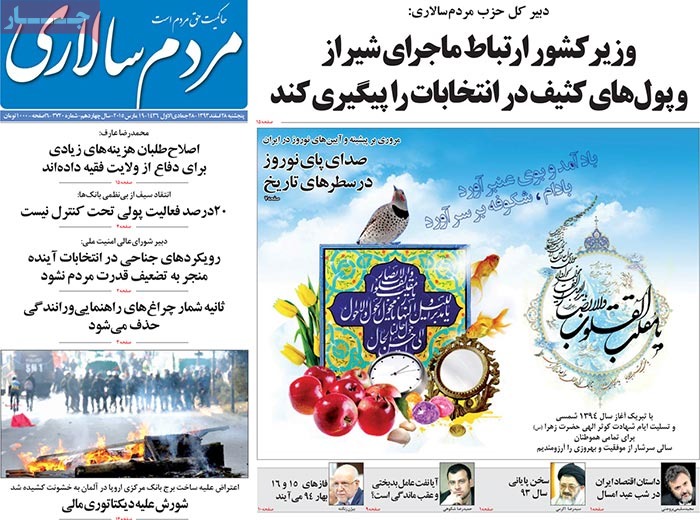
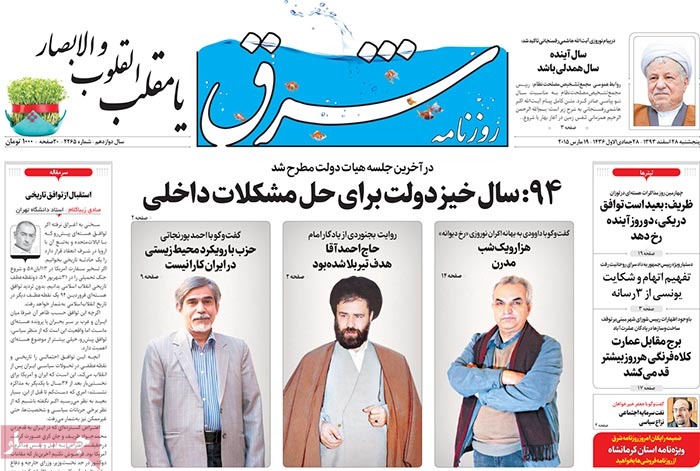
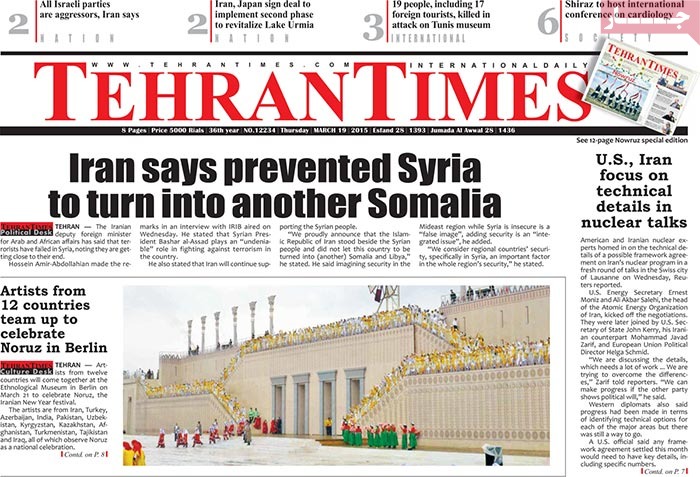
A look at Iranian newspaper front pages on Feb. 16

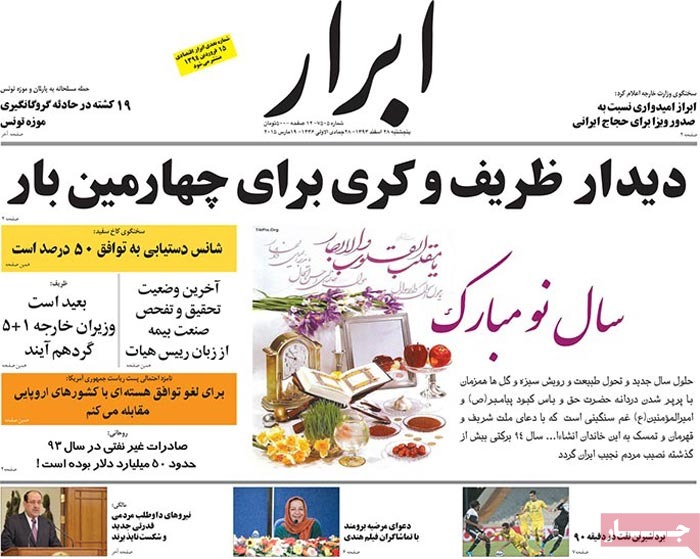
Iranian Newspapers Headlines

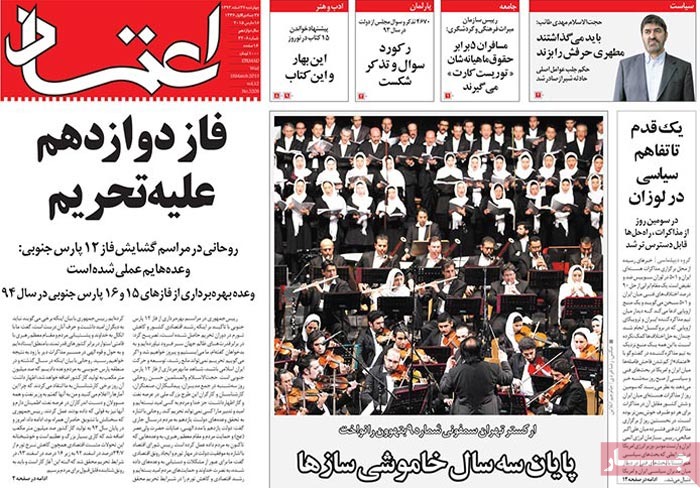
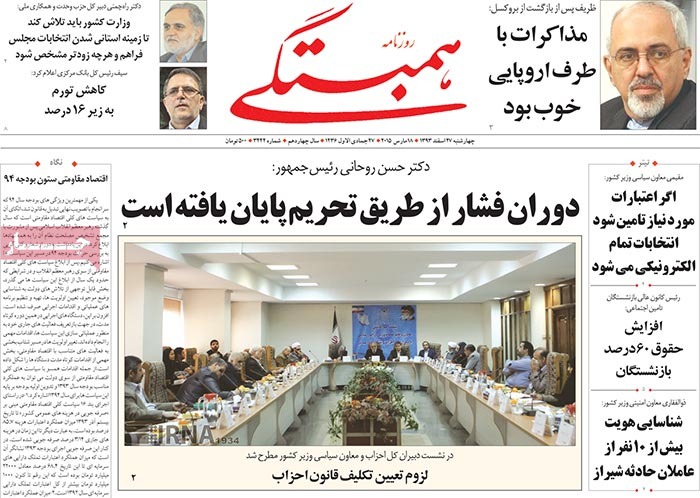
The imprisonment of former President Mahmoud Ahmadinejad’s deputy for corruption dominated the front pages of Iranian newspapers on Monday. Also in the news were the meetings between the visiting Chinese foreign minister with President Rouhani and Foreign Minister Zarif.


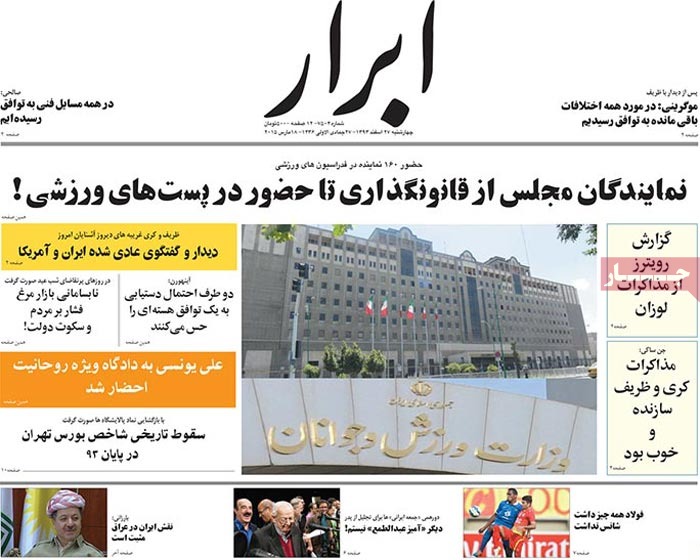
Abrar: “We are working on good defense contracts with Russia,” said the Iranian defense minister.


A look at Iranian newspaper front pages on Feb. 16


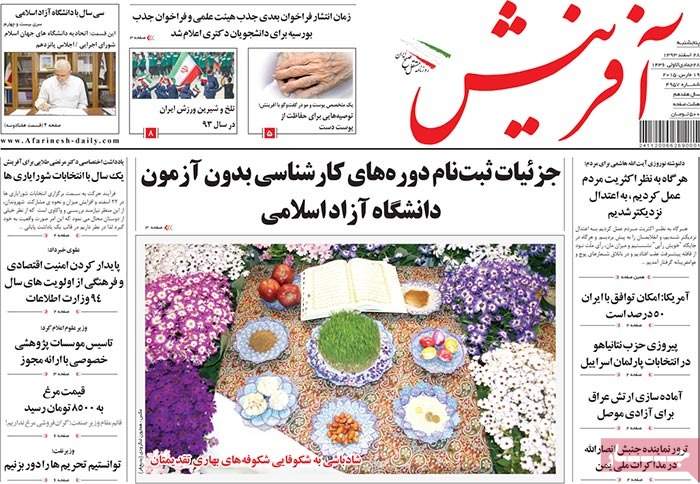
Afarinesh: “Those who sow the seeds of interfaith hatred harvest violence,” the president said in a message.

President Hassan Rouhani released the message in reaction to the killings of three Muslim students in the US state of North Carolina.

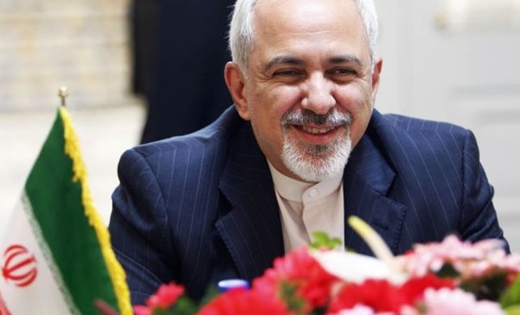
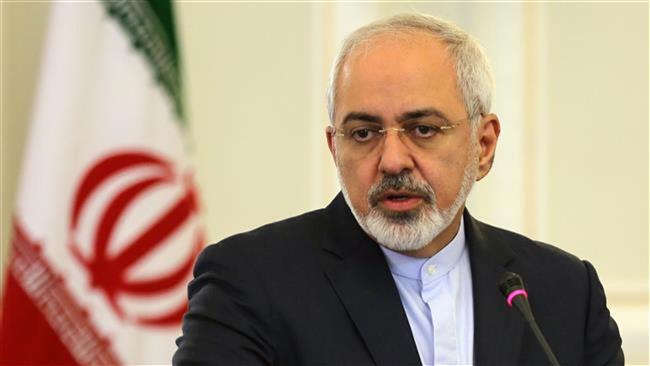
Afarinesh: “We are ready to show enough flexibility to win the trust of P5+1,” said Foreign Minister Mohammad Javad Zarif.


A look at Iranian newspaper front pages on Feb. 16


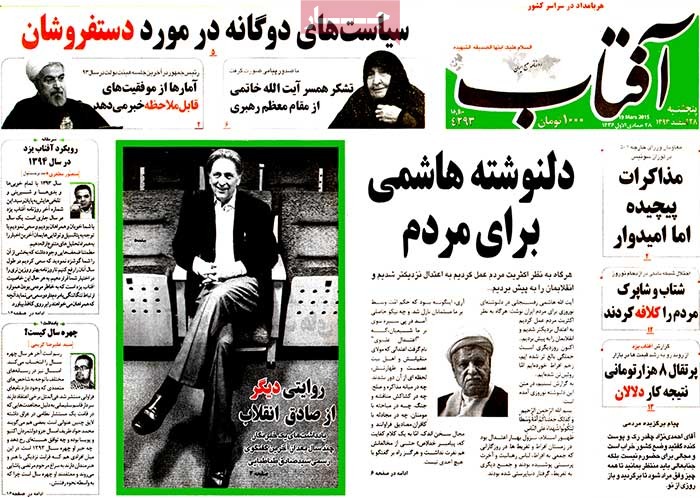
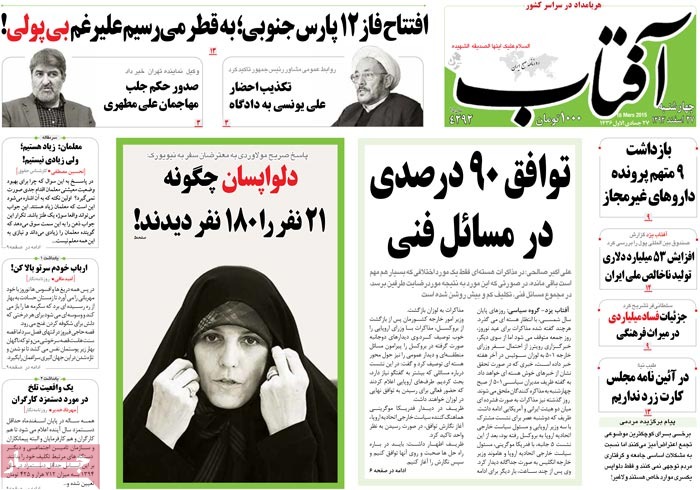
Aftab-e Yazd: Parliament has voted for the general outlines of [next year’s] budget [bill].


A look at Iranian newspaper front pages on Feb. 16


Amin: “If they had allowed Taxi to be screened in Iran, I would have withdrawn it from Berlinale,” said director Jafar Panahi.


A look at Iranian newspaper front pages on Feb. 16


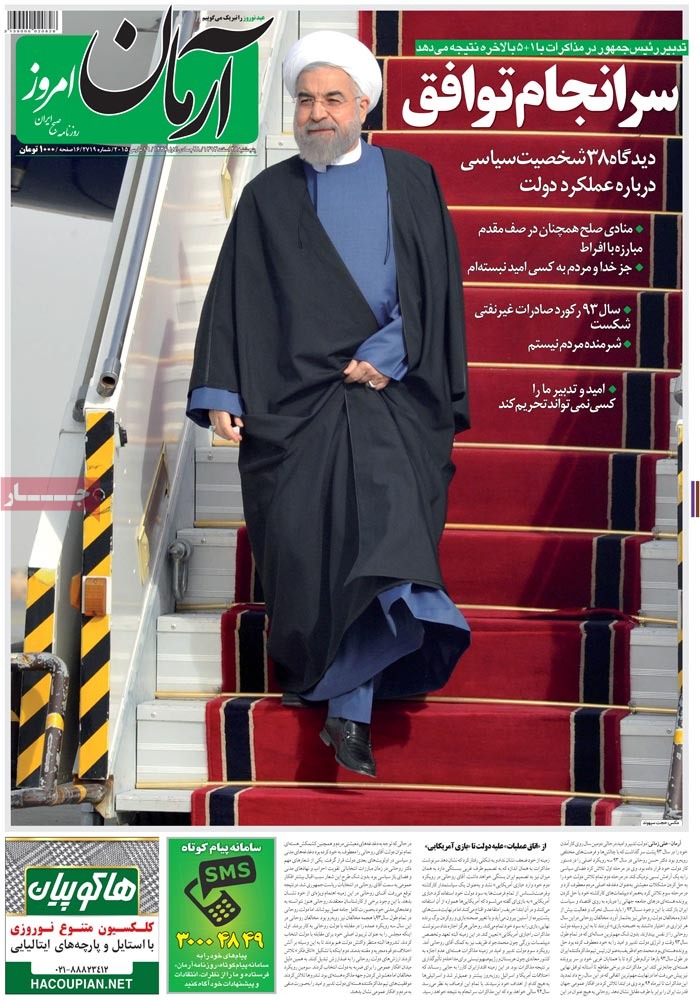
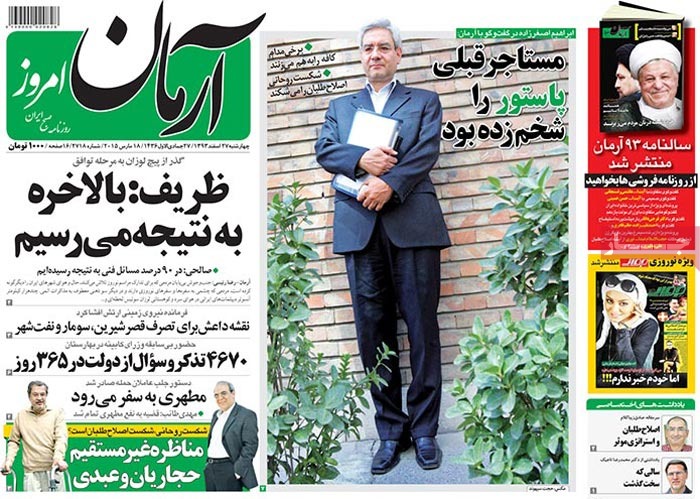
Arman-e Emrooz: He wouldn’t go; they came and took him [to Evin Prison]

Former First Vice-President Mohammad Reza Rahimi has been taken to prison to serve a five-plus-year sentence for corruption.


A look at Iranian newspaper front pages on Feb. 16


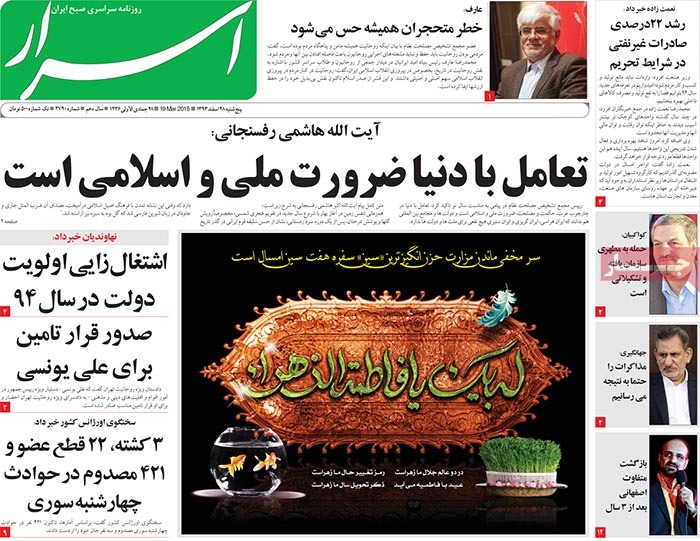
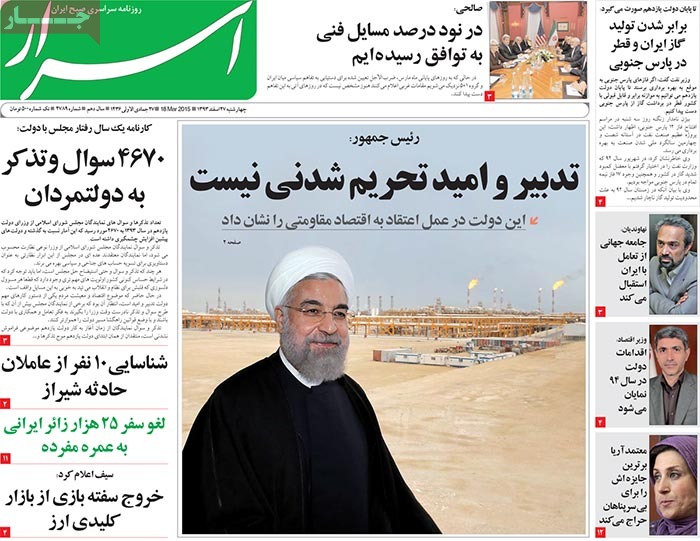
Asrar: Some 50 percent of retirees are below the poverty line.

Parliament is insisting on an increase in the pension of the retirees.


A look at Iranian newspaper front pages on Feb. 16


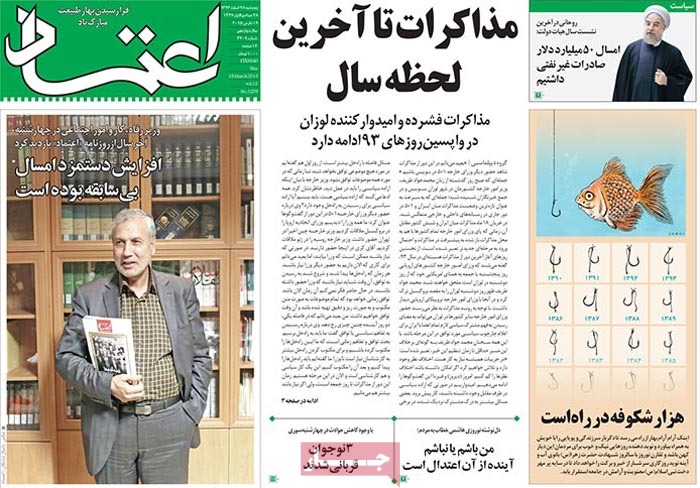
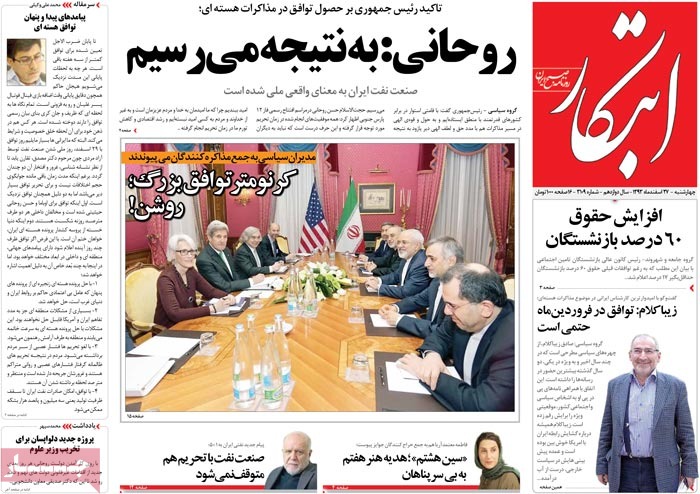
Ebtekar: “In diplomacy, you should ignore the viewpoints of those who do not know much,” said Seyyed Mohammad Sadr, a veteran diplomat.

Ebtekar: Those who worked for Ahmadinejad are now neighbors at Evin [Prison].

A year after the detention of Babak Zanjani [for massive corruption], former Vice-President Mohammad Reza Rahimi has landed in prison too.


A look at Iranian newspaper front pages on Feb. 16


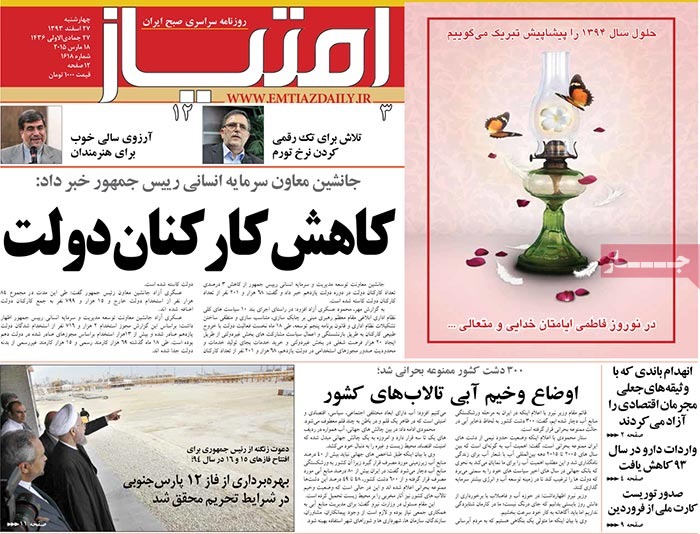
Emtiaz: Iran’s first public hotel hospital has been inaugurated.


A look at Iranian newspaper front pages on Feb. 16


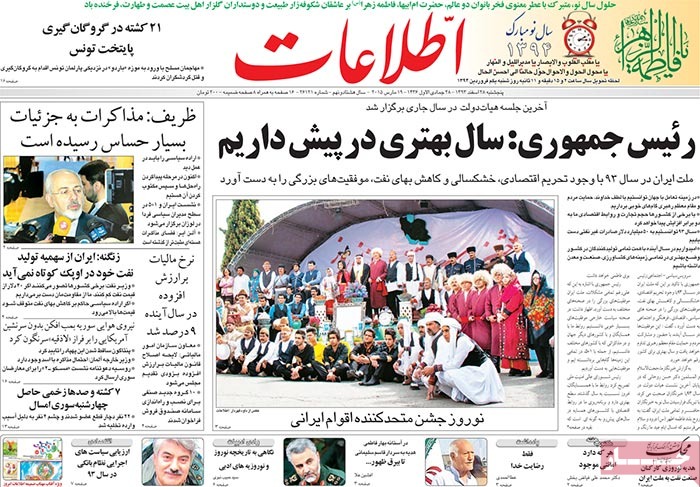
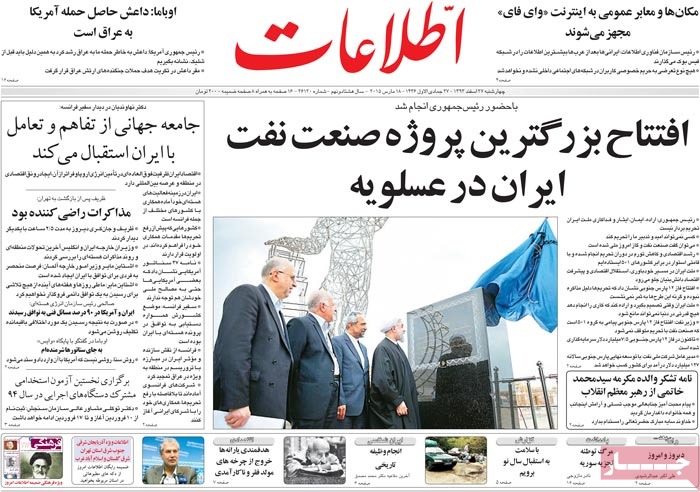
Ettela’at: [Former IAEA Director General Mohamed] ElBaradei has said Iran does not seek to develop nuclear weapons.

Ettela’at: Over 1,000 new health houses have opened across the country simultaneously.


A look at Iranian newspaper front pages on Feb. 16


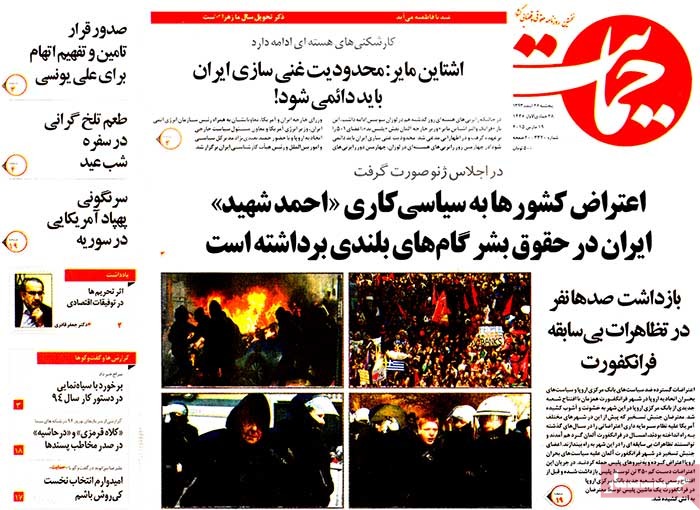
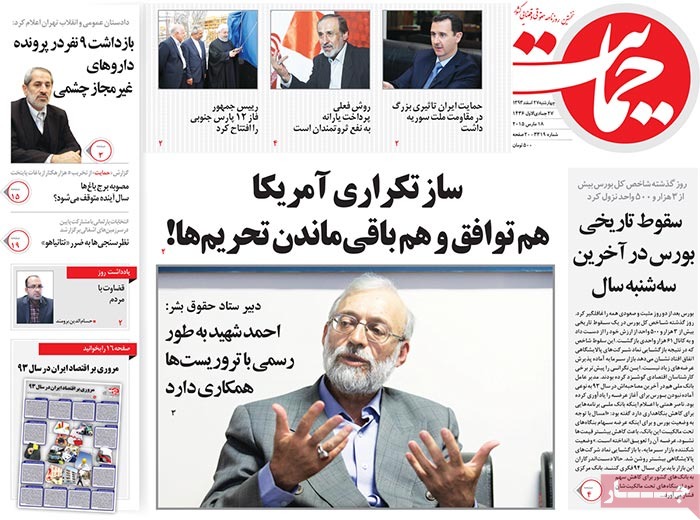
Hemayat: Instead of being accountable in the murder of three Muslim students, the US has thrown its weight behind Iran’s sedition leaders.

The Iranian Foreign Ministry has condemned the meddling of the White House in Iran’s internal affairs.


A look at Iranian newspaper front pages on Feb. 16


Hosban: “For a month, nuclear talks will remain bilateral,” said Foreign Minister Mohammad Javad Zarif.


A look at Iranian newspaper front pages on Feb. 16


Iran: “Reaching a deal in the near future is possible,” President Rouhani said at a meeting with the Chinese FM.

Iran: A tight race is on between young and veteran musicians at the 30th International Fajr Music Festival.


A look at Iranian newspaper front pages on Feb. 16


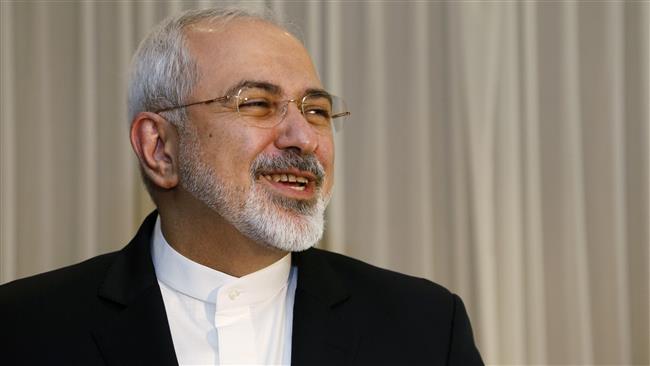
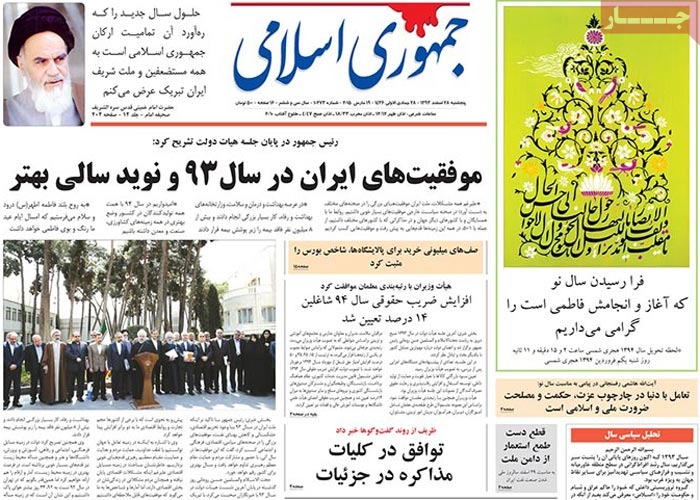
Jomhouri Islami: “Europe can contribute to the conclusion of a comprehensive deal and removal of sanctions,” said Zarif at a meeting with a Norwegian diplomat.


A look at Iranian newspaper front pages on Feb. 16


Kar va Kargar: The Iranian Foreign Ministry has denied a Wall Street Journal report that the Supreme Leader has sent Obama a letter.


A look at Iranian newspaper front pages on Feb. 16


Kayhan: “Two terrorist groups have been busted in Sistan and Baluchestan,” said the deputy governor general of the southeastern Iranian province.


A look at Iranian newspaper front pages on Feb. 16


Payam-e Zaman: “Economic growth will increase to two percent this year,” said the government spokesman.


A look at Iranian newspaper front pages on Feb. 16


Qods: “The president has ordered the cash subsidies of low-income families to be maintained,” said the minister of cooperatives.


A look at Iranian newspaper front pages on Feb. 16


Resalat: The US State Department has called for an end to the house arrest of seditionist leaders.


A look at Iranian newspaper front pages on Feb. 16


Sayeh: “A package on ways of offsetting the effects of dust storms has been approved,” said the director of the Environment Protection Organization.


A look at Iranian newspaper front pages on Feb. 16


Shahrvand: An Iranian Internet search engine, Yooz.ir, has been launched.


A look at Iranian newspaper front pages on Feb. 16


Taadol: “Projects worth around $4 billion remain unfinished,” said the Ministry of Roads and Urban Development.


A look at Iranian newspaper front pages on Feb. 16


Iran expects China to help settle nuclear dispute with P5+1

Rouhai-China-FM

President Hassan Rouhani on Sunday said that Iran expects China to help settle the nuclear dispute with the Western governments. He said that they must show political will for the purpose.

President Rouhani made the remarks in a meeting with Chinese Foreign Minister Wang Yi.

He said that the strategic Tehran-Beijing cooperation is of significance for expansion of regional security and stability.

“China has always had close cooperation with the Islamic Republic of Iran, and at this juncture, we need to lead the relations towards the establishment of comprehensive strategic cooperation,” said the Iranian president.

He expressed hope that China’s cooperation in the framework of the Iran-P5+1 (UN Security Council permanent members plus Germany) will lead to the realization of the Iranian nation’s rights in a comprehensive agreement.

The Chinese foreign minister conveyed the Chinese president’s warm greetings to his Iranian counterpart and emphasized Beijing’s strong will for boosting comprehensive, long term, and strategic relations with Iran.

Foreign Minister Wang Yi referred to the upcoming visit to Tehran by the Chinese president, and said the visit can transform bilateral relations in a historic way and open a new chapter in Iran-China ties.

On Iran’s nuclear activities and some governments’ counterproductive efforts to block its path, the Chinese top diplomat said that the Leader of Islamic Revolution and President Rouhani have both many times emphasized that the Iranian nuclear activities are merely for peaceful purposes, and not for manufacturing nuclear weapons.

‘This approach is very effective in resolving Iran’s nuclear dispute,’ he added, hoping for near future signing of a comprehensive agreement on the issue.

He said that such an agreement will end foreign interference in Iran’s development drive. As a very important country, Iran can play a more important role in regional and international arenas.

Rouhani condemns horrific crime against US Muslim students

Rouhani issues

President Hassan Rouhani has condemned the heinous killing of the three US Muslim students in North Carolina.

The president’s message called for global action to address the root causes of violence and hatred toward religion. The president also offered condolences to the bereaved families, and ‘all free men and women and supporters of human rights.’

It is expected that all authorities do their best to protect the rights of all citizens including Muslims; the horrific crime is a despicable act worthy of condemnation, and a manifestation of the spread of violence and extremism, the message read in part.

“The preliminary reports are very disturbing because they depict hatred of Islam and religion in general as the motives behind the crime. Violence and violation of human glory and honor, whether in the name of religion or through anti-religious acts fly in the face of ethical principles and religious teachings of all heavenly religions,” the message emphasized.

“Those who cultivate hatred of Islam will stir up violence in society; the time has come for thinkers, reformers, the civil society and the governments to fight violence and examine the roots of crimes fed by hatred of religion and to rid the international community of the burden of this shame,” said the president.

Ebtekar reacts to firestorm following dust storm

Masoumeh Ebtekar

The director of the Environment Protection Organization has come under fire in recent days for what is perceived to be her agency’s failure to fulfill its responsibility when it comes to tackling the problem of particulates in southern and western provinces. The protest has also found its way into social networking sites.

On February 15, Sharq daily published an interview with the environment chief in which she fired back at her critics. The following is a partial translation of the interview:

[…]


You think the barrage of criticism coming your way is politically motivated?

I think most of what these individuals raise is sentimental and those who raise them have an ax to grind. Everyone knows that people of Khuzestan have gone through a lot of late. It is below politicians to make political gains of the plight of some of our fellow citizens.

It is not just Khuzestan. Other provinces such as Ilam and Sistan and Baluchestan are grappling with similar problems. These problems are not unique to Iran. Dust storms have recently swept areas from West Africa to the Middle East including Egypt, Palestinian territories, Lebanon, etc.

Am I to blame too for what has happened in Cairo and West Africa? Those who seek to find fault don’t care where the blame lies. At the end of the day, they put the blame at our door.

[…]


How much budget has been envisioned to fight the problem of dust storms in next year’s spending package?

That is a good question. A number of the very same MPs who are going out of their way to target the Environment Protection Organization these days,eliminated all the budget the government has allocated to the fight against air pollution in parliament just three days before the first storm hit southwestern Iran. They sought to reallocate the same budget to what they favor.


How much exactly did the government seek to allocate to the problem?

What they did drew an angry response from my agency. Part of the budget – around $20 million – that came from the tariffs government places on polluting industries was supposed to be allocated to monitoring and fighting dust storms. Specifically we wanted around $18 million to revive lagoons which was eliminated from the budget bill. What is ironic is that the same people who are criticizing me and my department have been behind efforts to remove the envisioned budget.

[…]

We are close to a nuclear deal: Former Iranian negotiator

Siroos Naseri

With nuclear talks between Iran and P5+1 growing more sensitive by the day, any comment by officials from either side of the bargaining table could upset the existing balance. Iran has said it favors a one-stage deal which encompasses general outlines as well as details. That idea does not seem to sit well with the Americans. What would come next if the talks collapsed?

In an interview with Khabaronline, Sirous Nasseri, a former Iranian nuclear negotiator when Hassan Rouhani was the secretary of the Supreme National Security Council, answered that question and more posed by the news website’s Saeed Jafari Pouya. The following is the translation of the interview the website posted online on February 14:


How would you evaluate the guidelines of the Supreme Leader and the reaction they drew from local and international circles?

The comments of the Supreme Leader came at a time when nuclear talks were at a sensitive stage. I believe more than anything else, they set the stage for progress. What the Leader said was wise and conforming to the path the negotiating team has been going down. That the Leader pointed out that no deal is better than a bad deal is another major point worth taking into account. All in all, in my opinion, now that the talks have arrived at a crucial stage, the Leader’s speech will have positive results for both the establishment and the public.


Following the Leader’s statement, Secretary of State John Kerry showed a rather harsh reaction and threatened that if the two sides failed to reach a political agreement by March 1, they would not carry on with the talks. President Obama, however, took a milder stance, yet he threw the ball in Iran’s court and blamed Tehran for the probable failure of the negotiations. What is your take on the American reaction?

Basically, there has been general concern that after a deal on general outlines, talks about the details could run into trouble, setting the stage for the other side to take advantage of it. As you may remember, in November 2013, an agreement on general issues was clinched and a series of commitments were defined for either side. But in January when details were being hammered out, the Americans and Europeans took advantage of any term which was open to interpretation.
In other words, anything which was interpretable was exploited by the Westerners. So, I believe specification of the details in the talks and correspondence between our measures and their behavior are of immense importance.

Because there is no international arbitration entity to refer to, we have to make correspondence between all measures [by both sides]. If we take a step, the other side has to do something which is commensurate with it, or if the other side fails to honor a part of its commitments, we should put a fitting response on our agenda. Of course, it is not an easy task. So the Supreme Leader’s comment that he did not approve of a general deal and wanted general outlines and details worked out together, is a concern shared by both the public and our experts.

As for your question, I must say that although the Americans have indirectly displayed negative reactions to the statement by the Leader, I think the negotiations have reached a stage that we will leave these issues behind. There is general agreement and details will be worked out through diligence of both sides. I have to reiterate it is tough.


So, are we getting closer or farther away from a nuclear deal?

I believe that we are close to a nuclear accord. I think in the coming weeks, the general outlines which are not necessary to be put on paper will be hammered out. Afterward, the two sides will discuss the details. I believe that the sooner we enter this stage, the better it will be.


Earlier you said that by March 21, we will clinch a deal, do you still stick to that statement?

I still believe that an agreement on general issues can be reached by March 21, and afterward the sensitive period of discussions about details will start. At present, common ground is there when it comes to many major questions. However neither side has officially accepted it. As for details, it is natural that things turn more sensitive, that’s why we should not rush; we must deny the other side the chance to take advantage [of the deal].


What is your prediction about the estimated duration of the second stage and the settlement of details?

In the New Year [starts March 21] talks will probably shift into high gear and grow more intensive. As the talks will be held at an expert-level, it will be easier to bring the nations together; such a trend will be more sustainable.

If such tenacity persists, conclusion of a deal by the deadline is within reach and probably at the beginning of the summer the talks will produce a deal.

Once more I have to stress that at this stage, our attention should be more focused on details and the measures by the other side rather than on the deadline. What matters most is that the commitments by the both sides should be determined and in case of failure by the Western side to honor its obligations, we should take a fitting response.


But the new [Republican-majority] Congress has threatened to slap fresh sanctions against Iran if no deal was reached by March.

I am not much concerned about political gimmicks. It is obvious to me that eventually the US administration won’t run the risk of putting an attainable deal at stake and take the consequences. If the US seeks to repeat and step up its past hostile measures, Iran will accordingly put harsh responses on its agenda.


For instance what?

I am not willing to elaborate on that. If fresh sanctions were imposed by America, our reaction would not be confined to a return to where we were prior to the Geneva deal. Iran would definitely take much stronger action which would cost America dearly and bring Washington back to the negotiating table.


Is the American side poised to clinch a one-stage deal?

I think they are. In light of efforts made and costs paid by both sides to get where they are now, they cannot afford to make miscalculations and miss this opportunity.


If no deal was struck, what scenario would lie ahead for our country? Should we expect fresh sanctions?

If it happened, which I think is highly unlikely, the general situation would take a turn for the worse for a short period of time. If the Americans opt for fresh sanctions, we can also put new measures on our agenda. For instance, we can deny the International Atomic Energy Agency (IAEA) access to our nuclear facilities. So we have some tools at hand to use in response. That’s why I believe escalation of the crisis won’t serve the interests of the other side.

Even if for a short period of time such a critical situation persisted, the Americans themselves or other international players would intervene to bring both sides back to the negotiating table. Still, sound reasoning, pure logic and deft diplomacy require grasping every opportunity. I am of the conviction that both sides are determined to strike a deal. I am also optimistic that their efforts will produce the intended results.


Over the past few days, with no exception, American newspapers and magazines, both Democrat and Republican, have warned President Obama against making any new concession; they have unanimously warned that in case of the collapse of talks, Iran will be to blame. But no measure has been taken by Iran to manage the public sentiments and media reports. There seems to be shortcomings in our public diplomacy. So in case of the probable failure of the talks, wouldn’t the sentiment turn against Iran? And wouldn’t that in turn render a return to the negotiating table more difficult?

We have to acknowledge that the American propaganda machine is firing on all cylinders and is present on the scene with a lot of ammunition. Naturally, it is difficult to compete with such a well-oiled machine. On the other hand, we have to admit that during the nuclear talks, we have failed to make the most of public diplomacy and media coverage both at home and abroad.

Officials at Iran’s Foreign Ministry and Foreign Minister Mohammad Javad Zarif have played an effective role in making things clear on the international stage, yet making speeches and official measures are not enough.

Foreign media keep working on the issue, releasing analyses and reports. It even seems that they [foreign media] at times pursue a single line of thinking. We should do the same thing. We need to demonstrate steely determination to fill the void.

Of course, the Foreign Ministry is performing well on the international front and has filled different countries in on the progress of the negotiations. However, as you said we haven’t fully tapped into our potential on the foreign media front.

A charity gives out the extra food of feasts to the homeless

Iran-charity

After almost a decade of activity, the Toloo Bineshanha (Emergence of the Unknown) Society has turned into a leading institution in supporting those who sleep rough and addicts who want to kick the habit.

The society has launched a new campaign to collect extra food form feasts in a bid to prevent waste and satisfy the hunger of the needy who cannot afford to buy food. Thanks to social networks, the campaign has drawn a lot of attention from the public and prompted many to offer help to the society.

What comes below is the translation of an interview that Mehr Magazine has had with the head of the Public Relations Office of the society, Sara Chartabiyan, about the massive campaign:

The main activities of the society come in seven stages. In the first stage which is aimed at showing kindness, we try to give out food to the addicts who sleep rough and encourage them to be reintegrated to society. Then, during the treatment stage, they are detoxified and receive psychological and medical treatment like dental care.

The education stage which paves the way for creating jobs and completing the treatment process comes next. Vocational training and educational workshops on psychology are among the courses that the society offers. Afterward, we try to create jobs for those who beat their addiction so that they can make money. Our society has different [training] workshops designed to enable people to get jobs.

Although squandering is generally frowned on by many Iranians, a large amount of food, which can meet the needs of many of our needy fellow countrymen, ends up in garbage can on a daily basis.

Because addicts and those who sleep rough have distanced themselves from society, not very often do people try to personally give their extra food to them. Given this problem, with the help of a number of research groups, the places where they usually stay have been identified and confidence-building measures have been taken.

It has been a decade since the society started giving out food to the needy and those who sleep rough. Based on the studies carried out, the society has come to the conclusion that it can act as a bridge linking citizens to the homeless and get food from them and give it out to the needy.

The introduction of a campaign on social networks was mainly aimed at getting restaurants and banqueting halls involved. Of course, we collect extra food from houses if the number of portions reaches at least 20. When the campaign met with a broad welcome, we swiftly drew up a second phase for the plan which is dubbed “Tehran; A City with No Hungry Resident” and submitted to Tehran Municipality which I hope will be soon implemented.

Based on this plan, food-collecting centers will be set up in five main parts of the city so that citizens can easily refer to the nearest center and hand in food. Every night, the society will collect the food and give it out to the needy. On average, some 2,000 individuals receive food through this plan.

Nothing was better than the massive response from the public in reaction to the campaign and the fulfillment of the objective of the society which is to urge people not to be indifferent to others, especially those who sleep rough.

It is worth noting that since the plan was made public, a number of big restaurants and banqueting halls in Tehran have been cooperating closely with the society. Some in other cities have expressed readiness to implement similar plans.