Friday, December 26, 2025
Home Blog Page 4932

VP: Eliminating polluting particles calls for multilateral cooperation

Jahangiri-Iran

First Vice President Eshagh Jahangiri said the fight against polluting particles calls for multi-national cooperation.

Talking to IRNA after his meeting with the Iraqi parliament Speaker Salim al-Jabouri, he said the problem of particulates is a major issue at the center of Iran’s attention.

He said Iran, Iraq, Syria, Saudi Arabia and Turkey have to cooperate in this particular field.

He said in his talks with the Iraqi premier too he focused on the issue among other topics.

The Iranian First Vice President further stressed that particulates were initially originated outside the country, particularly in Saudi Arabia.

He said that according to an agreement signed between Iran and Iraq, the two countries are to carry out joint measures to stop spread of polluting particles.

Jahangiri, who arrived in Baghdad on Monday at the top of a high-ranking delegation to participate in the Supreme Joint Iran-Iraq Commission, met with Al-Jabouri and the heads of various fractions at the Iraqi Parliament.

Iran, Azerbaijan FMs explore Nagorno-Karabakh disputes

Iran Azerbaijan

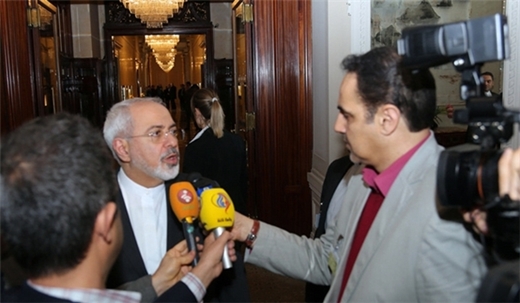
Iranian Foreign Minister Mohammad Javad Zarif and his Azeri counterpart Elmar Mammadyarov discussed Nagorno-Karabakh conflict as well as ways to fight terrorism.

“We discussed battling terrorism. We also explored peace process on Nagorno-Karabakh, but so far no progress has been made on the issue,” Mammadyarov said after a meeting with Zarif in Baku.

He also called Iran-Azerbaijan ties ‘historic’, and reiterated that the two sides need to keep brotherly ties.

Zarif, for his part, said Tehran attaches great importance to relations with neighboring states, especially with Azerbaijan.

“One hundred kilometers of Iranian borders lie in the disputed Nagorno-Karabakh region, and Iran is seeking a peaceful solution to end the dispute through international law. We call for establishment of peace and stability in neighboring countries which are of great importance. Azerbaijan is the most important neighbor for Iran. We are so close to the country, and the conflict can also harm us. Iran has so far worked with Azerbaijan to resolve the dispute,” said Zarif.

The two ex-Soviet Caucasus nations claim the territory of Nagorno-Karabakh, which is located in Azerbaijan but largely populated by Armenians.

Ethnic Armenian forces took control of the enclave, which accounts for 16 percent of Azerbaijan territory, in the early 1990s during a six-year war that took place from February 1988 to May 1994. The conflict left an estimated 30,000 people dead and one million displaced before the two sides agreed to a ceasefire in 1994. A permanent peace accord has never been inked and the dispute still remains unsettled.

Azerbaijan has threatened to take back the region by force if negotiations between the two sides fail to yield results.

Speaker: Iran opposed to extension of nuclear talks

Larijani-China FM

Iranian Parliament Speaker Ali Larijani stressed Tehran’s seriousness in nuclear talks with the world powers, but voiced opposition to any further extension of the negotiations.

“The Islamic Republic of Iran is serious about reaching an agreement in the nuclear negotiations and doesn’t agree with the extension of negotiations,” Larijani said in a meeting with visiting Chinese Foreign Minister Wang Yi in Tehran Monday.

He also underscored the necessity for the Group 5+1 (the US, Russia, China, Britain and France plus Germany) to display political will to reach an agreement with Iran.

Wang, for his part, stressed China’s commitment to the peaceful settlement of Iran’s nuclear issue under any conditions, and said he believed that an agreement should be reached which serves the interests of both sides.

“The West is using the nuclear issue as a pretext to prevent Iran’s progress and economic development,” he added.

Nuclear talks should cover general, detailed terms: Velayati

Velayati-Iran

Head of the Center for Strategic Research Studies at the Expediency Council Ali Akbar Velayati said on Monday that nuclear talks should cover both general outlines and the details.

He made the remarks on the sidelines of his meeting with visiting Chinese Foreign Minister Wang Yi.

“Our nuclear negotiators move in line with the guidelines of the Supreme Leader of the Islamic revolution,” Velayati said.

The Iranian nuclear negotiators are obliged to move within a defined framework and one of the main principles of the framework in question calls for the talks to simultaneously focus on general outlines and details, he said.

“General and detailed issues should proceed in parallel,” Velayati said as he recalled a world experience that drawing a line between the two is anything but useful.

Referring to peace negotiations between Palestinians and Zionist regime in 2104, he said separation of general issues and details in talks is a colonial trick pursued by the Americans and Zionists.

He said that the Western governments try to take advantage of the time envisaged to work out general outlines and then prolong the process, capitalizing on the settlement of details as a bargaining chip.

He said that the Oslo and Camp David accords are good examples of efforts by the West to drag things out.

Such historical examples indicate that separation of general outlines and details in talks is not advisable, he said.

On reimposition of sanctions on Iranian oil tankers by the European Union after the European Court of Justice revoked the sanctions on the oil tankers citing lack of substantive evidence, he said Iran was under tough economic sanctions from the early stages of the Islamic revolution.

“We have learned how to overcome economic sanctions; under no circumstances will the country change its stand or give up its legitimate rights,” he said.

In the meeting, we also discussed Iran’s nuclear program, Velayati said.

Chinese foreign minister believes in the peaceful nature of Iran’s nuclear program and the fact that the Islamic Republic of Iran has no plan to proliferate nuclear weapons, he said.

After the meeting, the Chinese foreign minister told reporters that current level of relations between the two countries is satisfactory, Velayati said.

The two sides should do their best to raise the volume of bilateral trade to $200 billion, he said.

Iran unrivaled in fight against illicit drugs: UN

UNODC

Executive Director of the United Nations Office on Drugs and Crime (UNODC) Yuri Fedotov praised Iran’s achievements in the fight against illicit drugs, saying that the Western Asian country is peerless in this regard.

“No country is identical to Iran in terms of fighting against illicit drugs,” Fedotov told reporters on the sidelines of an international conference in Tehran on Monday attended by a number of regional countries’ ministers and heads of organizations responsible for the fight against narcotics.

“If we draw a comparison between Iran and other countries, it will only be based on the number of martyrs killed in the campaign against drugs,” he added.

He also emphasized that the UNODC is in talks with Iran over the efforts to strengthen border controls, adding that the organization has sent Iran’s list of required equipment to the UN headquarters in New York.

In recent decades, Iran has been hit by drug trafficking, mainly because of its 936- kilometer shared border with Afghanistan, which produces more than 90% of the world’s opium.

According to the UN Office on Drugs and Crime, the Islamic Republic is netting eight times more opium and three times more heroin than all other countries in the world combined.

The war on drug trade originating from Afghanistan has claimed the lives of nearly 3,700 Iranian police officers over the past 30 years.

The 30th Fajr International Music Festival in Milad Tower (Photos)

 30th Fajr International Music Festival

The 30th Fajr International Music Festival opened in Tehran on Friday and will run through February 20.

In addition to the performances of Iranian troupes, foreign groups will hold 15 concerts during the festival.

The following are the photos the Islamic Republic News Agency (IRNA) put on its website on February 16 of the third day of the festival in Tehran’s Milad Power:


US and Pakistan hold the key to Afghan peace: Former president

Hamid Karzai

After 13 years in power, Hamid Karzai left the presidential office in 2014. A man who took office in December 2001, only three months after coalition attacks on Afghanistan, handed power to a national unity government in the first democratic transition of power in his country.

His tenure was the most challenging era for democracy and security in a country which had experienced a few decades of colonialism and foreign meddling; a country the West once turned into a base to contain the influence of the Soviet Union; a country which was bogged down for years in civil war and massacre; a country America and its allies invaded under the slogan of the war on terror in a Security Council-sanctioned operation in the wake of 9/11 attacks masterminded by al-Qaeda.

But the invasion did little to eradicate extremism in Afghanistan. The performance of Karzai during his 13 years in power is hailed by some and denounced by others. To some Afghans, he is a hero; to others he is a leader who failed to fulfill the expectations of his people.

Etemad daily’s Sara Masoumi has conducted an interview with former Afghan President Hamid Karzai. What comes below is a partial translation of the interview the daily published on February 15:

[…]

Since 2001, the international community seems to have adopted a much harsher stance on Afghanistan as opposed to Pakistan. If we make a comparison, Kabul is much safer than many Pakistani cities, yet harsh counter-terrorism measures taken by the West in Afghanistan do not apply to Pakistan. Where do you think such double standards stem from?

The West, especially the US, has goals, and naturally what they do is designed to fulfill their objectives. When America and the West decided to use religion as a tool to keep the Soviet Union in check and create insecurity around it, they took advantage of extremism.

Not only did this tactic plunge Afghanistan into misery, but as we can see it today it has spelt trouble for Pakistan and the West which have yet to stop supporting religious extremism. Even now whenever such support serves their interests, either common or individual, the West and Pakistan step in to assist extremists.

Now that you are no longer in office, you may be better able to answer my next question. Why didn’t you sign a security agreement with America while your country is still dependent on foreign forces to ensure security?

During my final years in office, I definitely concluded that the Americans were not in Afghanistan to counter extremism. Washington views extremism as a tool to accomplish its own objectives. The conflict that started in the name of the war on terror was not the war of Afghan people; rather Afghan people were victimized by that war. So in the frank conversations I had with the Americans, I clearly raised the matter. I told the Americans that if they sought to have military bases in Afghanistan, their goal had to ensure peace and security.

I was unwilling to give the Americans a military base while establishment of peace in my country was not part of their plans under the security agreement and there was no guarantee for it. If America had mapped out a plan to ensure peace or at least if it had defined the enemy we were fighting in Afghanistan, I would have signed the agreement. Today, I still believe that not signing the agreement was the right thing to do.

Do you think signing the deal by the national unity government served Afghan interests?

Although I was strongly opposed to striking the deal as long as its roadmap to peace was not clearly drawn, I remained tight-lipped. All Afghans must support their government and try to bolster it. We should set aside our disagreements and support our government.

Do you think of the Taliban as a faction you can hold negotiations with? If so, why didn’t such objective ever materialize in your government?

Individually, you can negotiate with the Taliban. As a movement, however, they have no independence, because Pakistan holds a lot of sway. We always welcome talks with the Taliban who are Afghans, yet we know well that peace cannot prevail without assistance from Pakistan.

Therefore, if both Pakistan and America seek establishment of peace in Afghanistan, it will be ensured. Nonetheless, if they do not want it, there will be no peace.

Do you think America can drag the Taliban into the peace process?

I believe that America and Pakistan can accomplish this objective together.

Why did the intervention by Riyadh in the peace process lead nowhere?

The al-Saud family made a lot of efforts and hoped that the dispute would be settled, but as I said before, this issue cannot be resolved without the cooperation of America and Pakistan.

The government of national unity reportedly seeks to redefine Kabul-Riyadh ties. A visit by the Afghan president to Saudi Arabia just a few weeks after the transition of power is indicative of such intention. Do you think a Riyadh-Kabul-Islamabad triangle can help ensure peace in the region?  

Definitely! Undoubtedly, China also plays a key role. China, Pakistan, Saudi Arabia can cooperate and help peace prevail. I must repeat myself that as long as the two major factors contributing to the outbreak of war in Afghanistan, Pakistan and America, do not reach an agreement, there will be no peace.

Iran’s Foreign Minister Mohammad Javad Zarif recently paid a visit to Kabul. When you were in office, you helped establish very close and friendly ties between Iran and Afghanistan. Do you think the government of national unity will continue down the same path?

Yes, such trend will definitely go on. The Afghan president attaches great significance to Iran and cooperation with Tehran. Iran is our neighbor with which we share the same religion and language. Our ties date back centuries. Iran has a crucial role to play in Afghanistan. The Afghan president and CEO have admitted that role. We hope that they will both visit Iran shortly and the deal that we were supposed to strike with Iran is clinched soon. Iran can also play a major role in the peace process.

Israel redoubles efforts to make Jews migrate to occupied lands

Mideast-Israel

Following a gunman attack on a synagogue in central Copenhagen, Denmark in which two people were killed and five others wounded, Israeli Prime Minister Benjamin Netanyahu said Sunday, “This wave of attacks and the murderous anti-Semitic assaults that are part of it is expected to go on”.

He called on Jews to migrate to occupied Palestine. “Israel is your home. We are preparing and calling for the absorption of mass immigration from Europe”.

In January the Israeli premier rushed to France – reportedly against Paris’ will – following a deadly Paris shooting to remind the French Jews that they would have a home in Israel, should they decide to go.

Netanyahu’s efforts to capitalize on these attacks together with earlier reports indicating a link between Tel Aviv and terrorist groups have given rise to theories that the Zionist regime is involved in attacks which intend to force Jews to migrate from Europe.


Iran launches domestic Yooz.ir search engine

Iranian Yooz search engine

Iran on Sunday officially inaugurated its domestically designed search engine, dubbed Yooz, which officials say can surf and search through a billion Persian web pages.

The Yooz search engine, available on Yooz.ir, was inaugurated in a ceremony attended by Communication and Information Technology Minister Mahmoud Vaezi in Tehran.

Iran currently holds the sixth place in the world in terms of using the Google search engine, according to Mehdi Naghavi, the Yooz project manager, standing above countries such as Germany, Italy, France and even China.

Naghavi added that the Google search engine has now turned into the “spine of the internet usage” in Iran, despite the fact that, under a 2007 PRISM Project, computer giants such as Google, Facebook, and Microsoft provide the US intelligence apparatus with the information pertaining to their users.

Addressing the inauguration ceremony, Vaezi also announced plans to launch yet another Iranian search engine, Parsijoo, in the spring.

He said his ministry plans to develop competition among local search engines.

He also stated that the ministry does not seek to compete with Google, and that it does not plan to restrict users’ access to the giant search engine.

Iran rejects Washington’s meddling, asks US to protect Americans’ rights

Marzieh Afkham

Iran’s Foreign Ministry Spokeswoman Marzieh Afkham described Saturday’s statement issued by the US State Department spokeswoman as an example of interference in Iran’s domestic affairs.

Afkham said the statement violates the commitments of the US government under the Algiers Accord and is a clear example of meddling in Iran’s internal affairs.

US State Department Spokesperson Jen Psaki in a statement on Saturday called for the release of a number of Iranian prisoners.

Afkham said that instead of making such irrelevant remarks about other countries, US officials had better pay attention to the growing concerns raised by independent sources about violation of citizens’ rights in the United States and take necessary steps to prevent tragedies like the recent killing of three American Muslim students.

Newlywed Deah Shaddy Barakat, 23, a University of North Carolina dental student, his wife, Yusor Mohammad Abu-Salha, 21, and her sister, Razan Mohammad Abu-Salha, 19, a student at North Carolina State University, were killed on Tuesday, February 10, in a condominium about two miles (three km) from the UNC campus.

The brutal killings, said to have been motivated by hatred toward the victims because they were Muslim, provoked widespread reaction by both Muslims and non-Muslims inside and outside the US.