Friday, May 8, 2026
Home Blog Page 493

Mobile cafés in Iran: Where nostalgia meets modern experience

By repurposing old buses and vintage vehicles into charming, on-the-go eateries, these mobile hubs are redefining how people experience coffee and casual dining.

These roving cafés, often stationed in public spaces like parks, streets, and markets, have become beloved gathering spots in Iran.

Their creative designs and cozy atmospheres foster a sense of community, making them a hit among urban dwellers seeking both comfort and novelty.

More than just a nostalgic nod to the past, these mobile ventures are proving to be successful business models.

They combine the allure of retro aesthetics with modern convenience, offering customers a unique experience while tapping into the growing demand for innovative dining concepts.

More in pictures…

Iran sets recordbeaking non-oil trade milestone

Seyed Rouhollah Latifi, the spokesperson for the Trade Development Commission of ministry added that the share of exports in this figure exceeded $53 billion.

He noted that this amount is $8.5 billion more than the same period last year and $4.5 billion more than the eleven-month period two years ago, which recorded the highest exports at that time.

He expressed that it is predicted that non-oil exports for the current Iranian year (1403) will reach around $58 billion.

The significant increase in Iran’s non-oil exports has occurred while the country is under severe US-led sanctions.

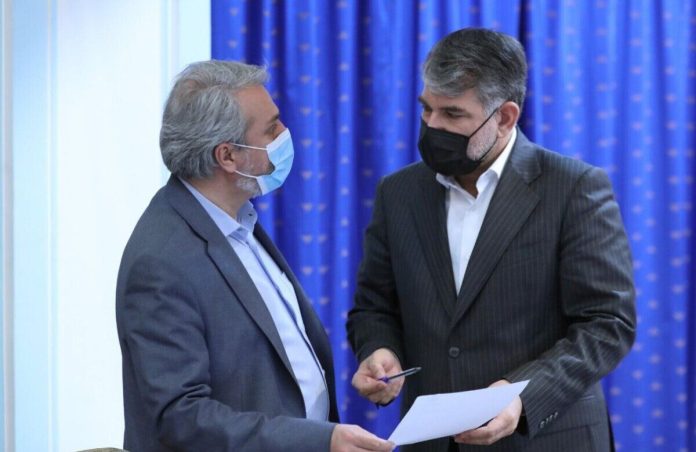
Iran sentences 2 ex-ministers over economic corruption in Debsh tea case

Seyyed Javad Sadati Nejad, former Minister of Agriculture, and Seyed Reza Fatemi Amin, former Minister of Industry, Mine, and Trade, were found guilty of economic misconduct and sentenced to five years in prison.

However, the court later reduced their sentences to two years and one year, respectively.

The case revolved around the fraudulent import of tea packaging machinery and misuse of foreign currency allocations. Court findings revealed that while in office, both ministers were aware of excessive import registrations linked to the Debsh Tea company—three times the national demand—yet failed to intervene or notify authorities.

The former industry minister was found responsible for failing to regulate import orders, allowing fraudulent transactions exceeding 1.4 billion euros under forged company names. Similarly, the former agriculture minister neglected to oversee import volumes, leading to severe economic mismanagement.

The court ruled that their inaction facilitated large-scale currency smuggling and financial irregularities, classifying their offense as complicity in economic disruption.

Iran warns against undermining cooperation with IAEA

IAEA

In response to the latest reports by the IAEA Director General, Iran reaffirmed that it has voluntarily and cooperatively provided all necessary information, supporting documents, and requested access. The mission underscored that Iran has fully adhered to its obligations, including the Comprehensive Safeguards Agreement (INFCIRC/214), ensuring that the IAEA can effectively conduct its verification activities in the country, including monitoring and surveillance of nuclear materials and activities.

The statement criticized the reports for containing numerous shortcomings, asserting that they fail to fully reflect the level of Iran’s cooperation and the progress made in the interim periods.

It also pointed out that a biased approach has been adopted in the reports, lacking objective and professional assessments.

Iran reiterated that all its nuclear materials and activities have been fully declared to the IAEA and have undergone rigorous verification processes. While Iran is not obligated to respond to questions based on fabricated and unreliable documents, it has nonetheless voluntarily provided the necessary information, supporting documents, and access requests to maintain its cooperative engagement with the agency, it added.

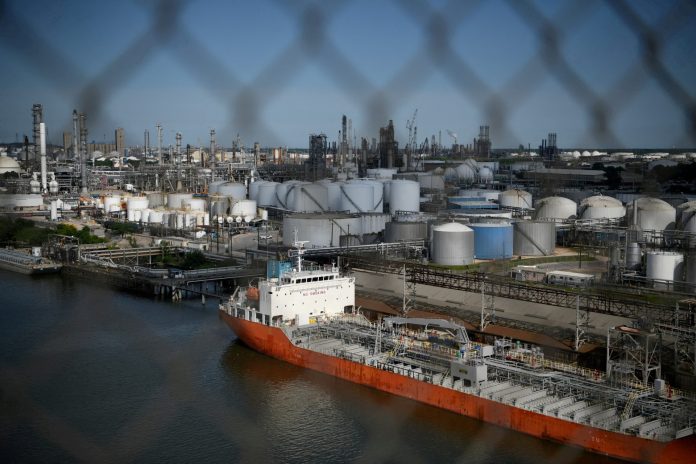
US seeking to disrupt Iran’s oil by halting vessels at sea: Reuters

Iran Oil Tanker

Trump has vowed to restore a “maximum pressure” campaign to isolate Iran from the global economy and drive its oil exports to zero.

Trump hit Iran with two waves of fresh sanctions in the first weeks of his second-term, targeting companies and the so-called shadow fleet of ageing oil tankers that sail without Western insurance and transport crude from sanctioned countries.

Those moves have largely been in line with the limited measures implemented during former President Joe Biden’s administration, during which Iran succeeded in ramping up oil exports through complex networks.

Trump officials are now looking at ways for allied countries to stop and inspect ships sailing through critical chokepoints such as the Malacca Strait in Asia and other sea lanes, according to six sources who asked not to be named due to the sensitive subject.

That would delay delivery of crude to refiners. It could also expose parties involved in facilitating the trade to reputational damage and sanctions, the sources said.

“You don’t have to sink ships or arrest people to have that chilling effect that this is just not worth the risk,” one of the sources stated, adding, “The delay in delivery … instills uncertainty in that illicit trade network.”

The administration was examining whether inspections at sea could be conducted under the auspices of the Proliferation Security Initiative launched in 2003, which aims to prevent the trafficking of weapons of mass destruction.

The US drove that initiative, which has been signed by over 100 governments.

This mechanism could enable foreign governments to target Iran’s oil shipments at Washington’s request, one of the sources said, effectively delaying deliveries and hitting supply chains Tehran relies upon for revenue.

The National Security Council, which formulates policy in the White House, was looking into possible inspections at sea, two of the sources added.

It was unclear if Washington had yet approached any signatories to the Proliferation Security Initiative to test their willingness to cooperate with the proposal.

Iranian President Masoud Pezeshkian has recently told Iran’s parliament that Trump “has once again signed an order sanctioning many of our ships at sea, leaving them uncertain about how to unload their oil and gas cargo”. He was referring to Trump’s latest round of sanctions.

Tehran is not concerned that Trump may decide to toughen sanctions on the country’s oil exports, according to an Iranian minster. Iranian Oil Minister Mohsen Paknejad has stated that Tehran has some valuable experiences in getting around Washington’s sanctions.

Paknejad has stressed that the United States will never achieve its dream of cutting Iran’s oil exports to zero as touted by Trump.

“Blocking Iran’s oil exports is an unattainable dream,” he added.

He insisted that Iran will always come up with solutions to circumvent US bans on its oil exports.


Majority of western Europeans believe Trump is threat to peace: Poll

The YouGov polling of France, Germany, Italy, Spain and the UK was carried out in a dramatic week that left Europe’s leaders scrambling to respond to the prospect of the US pulling long-term support from Ukraine and its European allies.

As the EU debates an €800bn plan to “rearm” Europe, the survey found that only a minority of respondents believed the remaining western allies would be able to support Ukraine if the US withdrew – but relatively few backed greater defence spending.

Most Europeans think it is unacceptable to exclude Kyiv or Europe from peace talks and, while many think Russia would probably attack Ukraine again even after a deal, opinions are divided on Franco-British proposals to deploy European peacekeepers.

After Trump’s apparent alignment with Russia, the polling, carried out between 26 February and 4 March, found majorities in all five countries believed the US president had become a “very big or fairly big threat to peace and security in Europe”.

That sentiment was weakest in Italy at 58%, rising to 69% in France, 74% in Germany, 75% in Spain and 78% in the UK. By comparison, the share of people who said Russia’s Vladimir Putin was a threat ran from 74% in Italy to 89% in the UK.

Trump’s popularity, tested across four countries but not Germany, was also exceptionally low, with majorities ranging from 80% in the UK to 63% in Italy saying they held an unfavourable view of Trump, against a range of 89% to 77% for Putin.

Europeans have become markedly less willing to support the US militarily in the event of it coming under attack, the polling showed, and are also significantly more sceptical that Washington would honour its collective defence commitments under the Nato treaty.

If Russia were to attack the Baltic states and Poland, only between 18% and 39% of people in the UK, France, Spain and Italy believed the US would go to their aid – although people were more confident the US would defend their own respective countries.

Few Europeans think the remaining western allies would be able to support Ukraine enough for it to keep defending itself if the US pulls out: a third of Spaniards (35%) and Britons (33%), and a quarter (24-25%) in France, Germany and Italy.

Many people say they want Ukraine to win the war. In the UK, 67% share that sentiment and say they care a great deal or fair amount that it does, followed by Spain (57%), Germany (52%), France (50%) and Italy (34%). Only 2-7% want a Russian victory.

But while similarly large numbers say current levels of support are not enough to stop Moscow from winning, only a minority in each think that their own country should boost its aid efforts, ranging from 9% in Italy to 24% in the UK.

After European leaders stressed the need for a major and urgent increase in defence spending, recognition that defence budgets would have to rise in the face of uncertain US support has risen, although not to a particularly striking extent.

Britons are the most likely to say so at 46% (up six points), against 39% in France (up 12), 32% in Spain (up six), and just 11% in Italy (unchanged). In December 45% of Germans, who were not asked the question this time, said spending was too low.

The US administration’s decision to seek a peace deal directly with Russia is very unpopular, with majorities (52-78%) in Britain, Spain, France and Italy seeing the exclusion of Ukraine as unacceptable. Large numbers felt the same about Europe.

Most Britons (65%) and Spaniards (55%) think Russia would probably attack Ukraine within 10 years of any peace deal, as do 49% of French respondents and 48% of Germans. Italians were split, with 35% thinking another war likely and 37% not.

The French president, Emmanuel Macron, and Britain’s prime minister, Keir Starmer, have proposed stationing European peacekeepers in Ukraine to counter such an eventuality, and more people support the idea than not in both countries.

About 52% of Britons back the plan, compared with 27% who were opposed, with French respondents 49% for and 29% against. Spaniards were also supportive (53%), but only 36% and 37% were willing in Germany and Italy, with 45% and 47% opposed.

The survey also revealed a widespread belief that Russia would attack other European countries within the next decade. Six in 10 Britons thought this was likely, as did 44-47% of respondents in France, Germany and Spain, though 45% of Italians thought it unlikely.


Putin appoints new Russian envoy to US

According to the document, published on the state portal for legal information on Thursday, Darchiev will also be Moscow’s permanent observer at the Organization of American States (OAS).

The administration of US President Donald Trump handed over to Russia a note with the approval of Darchiev’s candidacy as ambassador during talks between the sides in Istanbul in late February, which were aimed at restoring the proper functioning of the diplomatic missions of the two countries.

Darchiev, who had headed the North Atlantic Department at the Russian Foreign Ministry since 2021, led the country’s delegation during the meeting.

The post of ambassador to the US had remained vacant since Anatoly Antonov was relieved of his duties on October 10, 2024.

Darchiev, 64, worked at the Russian Embassy in Washington as minister-counselor from 2005 to 2010. He was also the envoy to Canada from 2014 to 2021.

Trump’s threats complicate ceasefire attempts, encourage Israel to backtrack on deal: Hamas

Gaza War

“These threats complicate matters regarding the ceasefire agreement and encourage the occupation government (Israel) to refrain from implementing its terms,” Hamas spokesman Hazem Qassem told Anadolu.

He reiterated that there is a signed ceasefire agreement with Washington as one of its mediators which includes the release of all Israeli prisoners in Gaza over its three stages.

“Hamas implemented all its obligations under phase one (of the agreement), but Israel is avoiding entering phase two,” Qassem added.

“The US administration is required to pressure the occupation to enter negotiations for the second phase, as stipulated in the ceasefire agreement,” the Hamas spokesman said.

On Wednesday, Trump issued a stern warning to Hamas demanding the immediate release of all hostages held in Gaza and threatening severe consequences if it does not comply.

“Release all of the Hostages now, not later, and immediately return all of the dead bodies of the people you murdered, or it is OVER for you,” he said in a post on his Truth Social platform.

Israel decided Sunday to halt aid shipments hours after phase one of the agreement expired.

The first six-week phase of the agreement, which took effect in late January, officially ended at midnight Saturday.

Israel, however, has not agreed to move forward to phase two of the deal to permanently end the war in Gaza, which has killed nearly 50,000 people, mostly women and children, and left the enclave in ruins.

In November, the International Criminal Court issued arrest warrants for Israeli Prime Minister Benjamin Netanyahu and his former Defense Minister Yoav Gallant for war crimes and crimes against humanity in Gaza.

Israel also faces a genocide case at the International Court of Justice for its war on the enclave.

Iran’s reformist gov’t faces sabotage from hardliners, calls grow for ‘strategic resilience’

Masoud Pezeshkian

Following the impeachment of economic minister Abdolnasser Hemmati and forced resignation of Vice President Mohammad Javad Zarif, two key figures in the administration, analysts warn that appeasement is not an option.

They urge the administration to adopt a strategy of transparency, resilience, and national consensus-building to counter the internal sabotage.

Hardline opponents, particularly from the Perseverance Front, have been accused of employing “political sabotage” to destabilize President Pezeshkian’s administration, Etemad claimed.

Recent examples include efforts to block key ministerial appointments and the controversial push for a hijab law, despite a Supreme National Security Council decision to halt the measure.

Hardliners have also been accused of exploiting state media, now under the control of Saeed Jalili’s allies, to spread disinformation and portray the government as ineffective.

Critics argue that the factions, rather than engaging in constructive criticism, are using manipulative tactics to derail reforms and maintain their grip on power, the daily argued.

France says providing intelligence to Ukraine after US freeze

Russia Ukraine War

“We have intelligence resources that we are providing to the Ukrainians,” Lecornu said on air on France Inter.

The United States stopped sharing intelligence with Ukraine on March 5, shortly after it froze all military assistance as part of an effort to pressure Kyiv into quick negotiations with Russia.

The decision potentially threatens Ukraine’s ability to strike Russian forces but also detect Russia’s aerial strikes against Ukrainian cities and infrastructure.

Some media suggested that Washington also banned its partners, like the UK, from sharing US-obtained intelligence with Ukraine. US officials signaled that the pause may be temporary and will depend on progress toward peace talks.

Speaking on France Inter, Lecornu also stated that French President Emmanuel Macron instructed him to “accelerate the delivery of French aid packages (for Ukraine) to compensate for US aid that no longer arrives.”

European countries are expected to step up support amid uncertainties about the Donald Trump administration’s commitment to Ukraine’s and Europe’s security. European assistance for Kyiv and the need for greater defense spending will be discussed during an EU summit in Brussels.

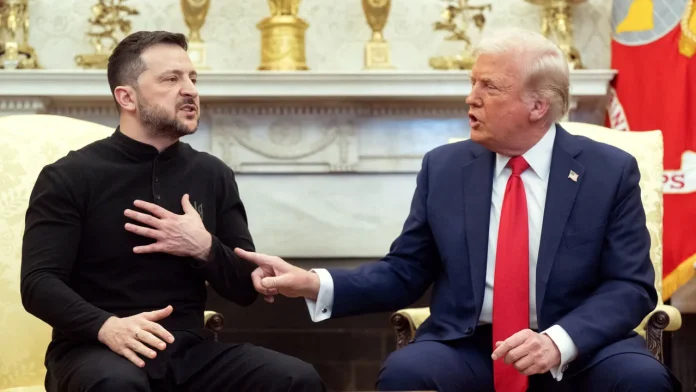
The conflict between Kyiv and Washington has been simmering for weeks as Trump adopted increasingly hostile rhetoric toward President Volodymyr Zelensky while intensifying diplomatic outreach to Moscow. The most explosive episode came last week, when Trump and US Vice President JD Vance publicly berated Zelensky in the Oval Office, derailing plans for the signing of a minerals agreement.