Friday, December 26, 2025
Home Blog Page 4922

Iran denounces Egypt court’s ruling against Hamas

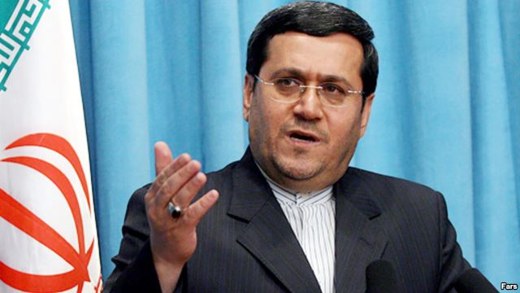
Amir Abdullahian

Iran has reacted strongly after a court in Egypt labeled the Palestinian resistance movement Hamas a “terrorist” organization.

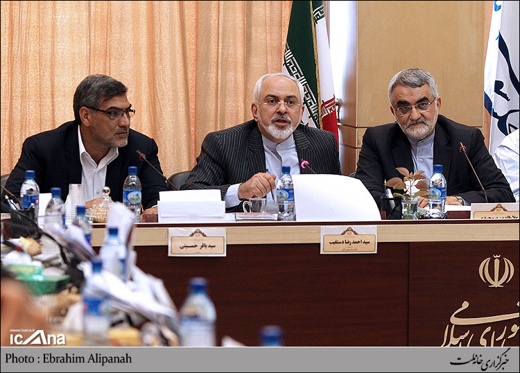
Condemning the verdict, which was issued on Saturday by the Cairo Court of Urgent Matters, Hossein Amir Abdollahian, the Iranian deputy foreign minister for Arab and African affairs, said later in the day that “Hamas is not a terrorist organization.”

“The Tel Aviv regime is the illegitimate and terrorist regime, which is incapable in the face of the resistance, including Hamas and the Islamic Jihad (another Palestinian resistance movement),” Amir Abdollahian said.

“The Islamic Republic of Iran strongly condemns terrorism in all its forms anywhere, including in Egypt, Iraq, Syria, Yemen, Africa, and Europe,” the Iranian official also said.

Following the court’s announcement on Saturday, the Palestinian resistance group released a statement, describing the court’s decision as “shocking and dangerous”.

“The Egyptian court’s decision to list the Hamas movement as a terror organization is shocking and is dangerous, and it targets the Palestinian people and its factions of resistance,” the statement added.

The court had also claimed in a lawsuit on January 31 that the Ezzedine al-Qassam Brigades, Hamas’ military wing, was involved in recent attacks against Egypt’s security forces.

Brotherhood part of Egypt’s reality

Amir Abdollahian further said, “The Muslim Brotherhood is part of the existent reality in Egypt.”

Opposing political groups and terrorists “should be distinguished by adopting a realistic perspective and any side that takes terrorist measures would be hated by the entire world.”

The Egyptian opposition party has been designated a “terrorist group”.

Brotherhood-backed Mohamed Morsi was elected president after Egypt’s 2011 revolution that led to the overthrow of former dictator, Hosni Mubarak. Morsi was later ousted in a military coup led by former head of the armed forces and current President Abdel Fattah el-Sisi in July 2013.

The Egyptian government has been cracking down on any opposition since Morsi was ousted. Sisi has been accused of leading the suppression of Morsi supporters, as hundreds of them have been killed in clashes with Egyptian security forces over the past year.

Supreme Leader’s message to Western youth translated in 21 languages

Supreme Leader’s message to Western youth

Iran’s Islamic Culture and Relations Organization (ICRO) has translated the Supreme Leader of the Islamic Revolution’s message to Western youth into 21 languages.

ICRO’s deputy director said the move is aimed at foiling attempts to distort the content of the letter or marginalize it.

In a letter on January 21, Supreme Leader of the Islamic Revolution Ayatollah Seyyed Ali Khamenei introduced a true image of Islam to the youth in Europe and North America and elaborated on the reasons behind the West’s effort to spread Islamophobia.

In the historic letter, Ayatollah Khamenei asked the Western youth to try to gain direct and firsthand knowledge of the religion in reaction to the flood of prejudgments and disinformation campaigns against Islam.

ICRO has translated the letter into languages such as Russian, Croatian, Serbian, Bulgarian, Swahili, Turkish, Indonesian, Chinese, Japanese, Spanish, Italian, Thai and Albanian.

Figures that have done a number on Greek life

greek numbers

When talking about the Greek numerals, what crosses anybody’s mind is alpha, beta, theta, etc. which featured in chemistry, math and geometry courses back in school days. The following is the translation of a report on Greek numbers, of different kinds of course, Tejarat-e Farda (Tomorrow’s Trade) magazine published in its 123rd issue:

In modern-day Greece in the aftermath of a crippling economic crisis, people seem to be dealing with new figures.

25 percent: Since mid-2008, which marked the start of a monetary crisis in Greece, the country’s economy has contracted by as much as 25 percent compared with its heyday.

25.8 percent: According to the figures put out by the National Statistical Service of Greece, 25.8 percent of people are jobless (1.2 million were unemployed in Greece as of October 2014).

Third ranking: Eurostat, the statistical office of the European Union, has said that Greece ranks third in Europe in terms of the number of people who are at risk of poverty and social deprivation.

23.1 percent: In 2013, around 23.1 percent of the Greeks were at risk of plunging into poverty, according to Eurostat.

33.5 percent or €77 billion: The Bank of Greece says that the volume of outstanding loans – those which remain overdue for more than three months – stands at €77 billion ($89.380 billion).

€70 billion: According to the Bank of Greece, the approximate capital outflow of the country’s banks has exceeded €70 billion over the past five years.

83.9 percent: The value of Greek stocks and bonds has tumbled 83.9 percent since 2008.

One-fourth: The National Hellenic Research Foundation (NHRF) says one out of four middle and small businesses in the country has been closed down since 2008. It has also estimated that the number of closed businesses in Greece stands at 230,000.

Nine-fold: Tax payments by the self-employed increased nine-fold in 2014, according to the Greek Parliament Budget Office.

Seven-fold: Tax payments by state employees and retirees have increased 7-fold compared with the amount they paid in 2009, according to the Greek Parliament Budget Office.

23 percent: The Greek Parliament Budget Office says that the value added tax for a number of goods has increased 23 percent. This comes as the average VAT is 2.5 percent in EU countries and 21.5 percent in the Euro zone.

One-hundred thousand: Based on new stats released by the Faculty of Economic Studies and Political Science at Alexandria University, up to 100,000 Greek scientists and researchers have left their homeland for foreign countries.

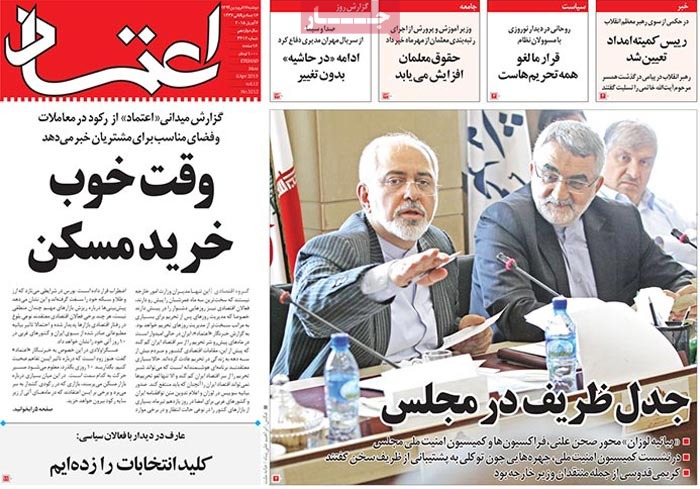
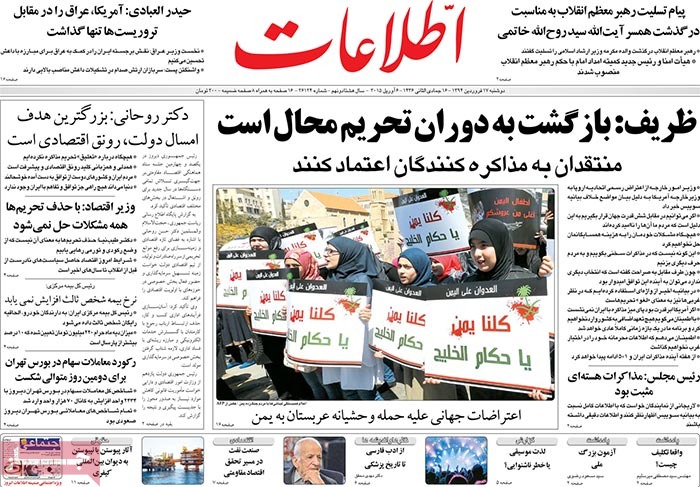
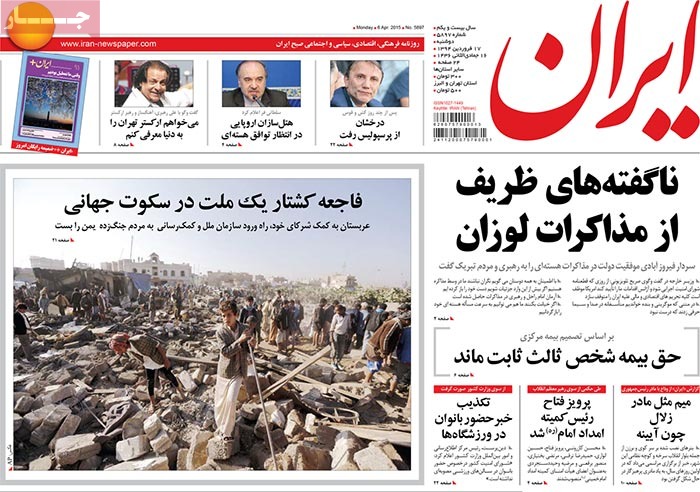
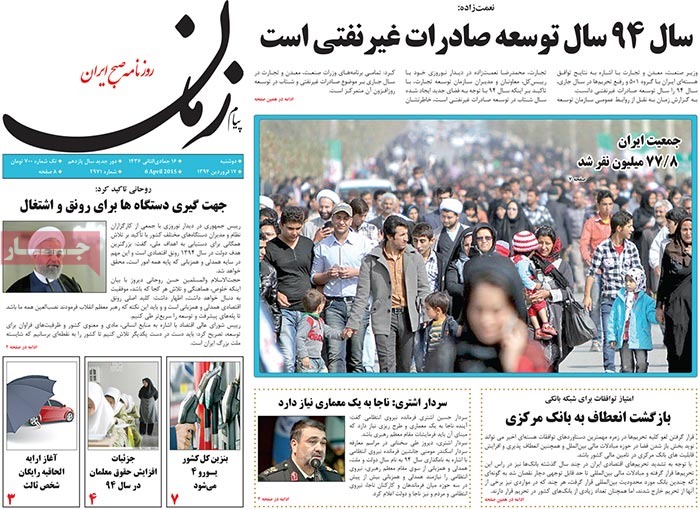
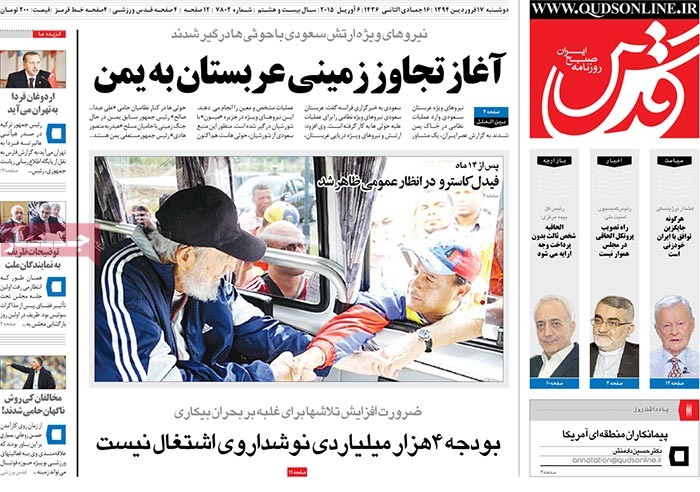
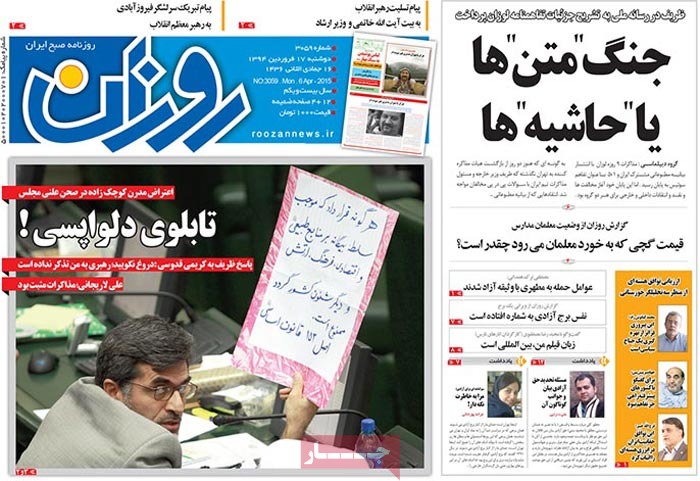
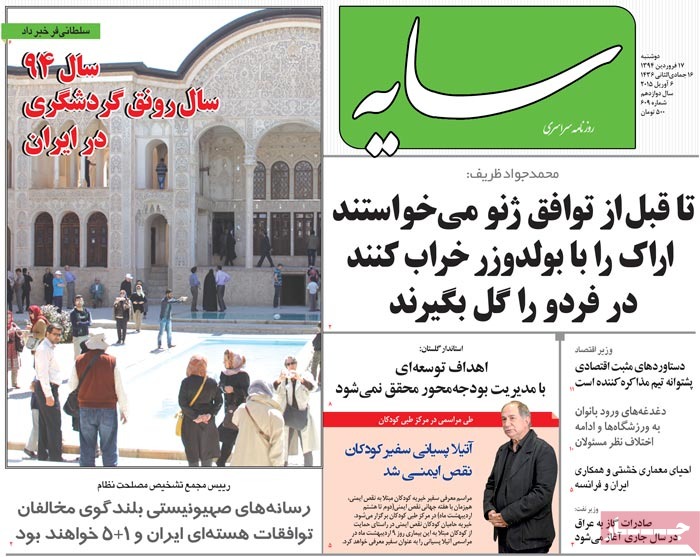
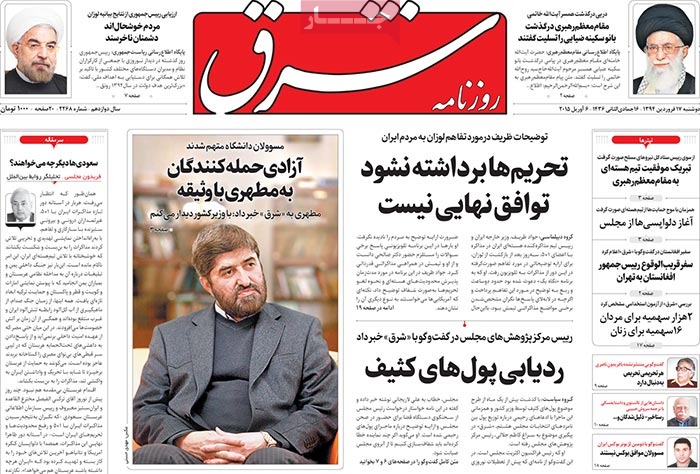
A look at Iranian newspaper front pages on March 1

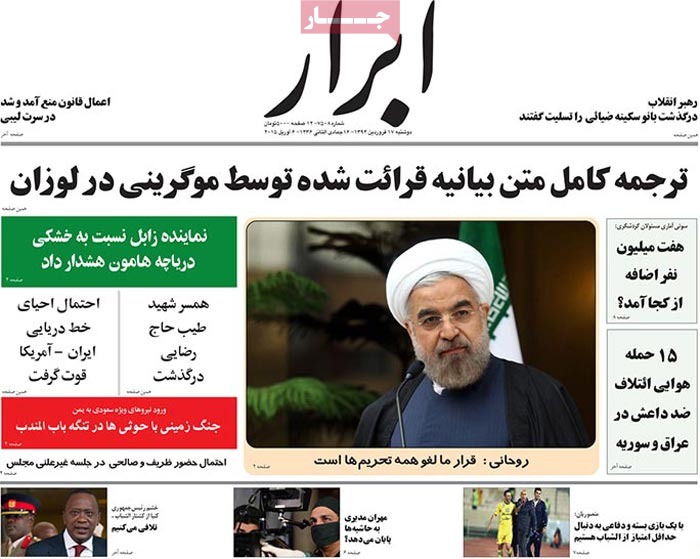
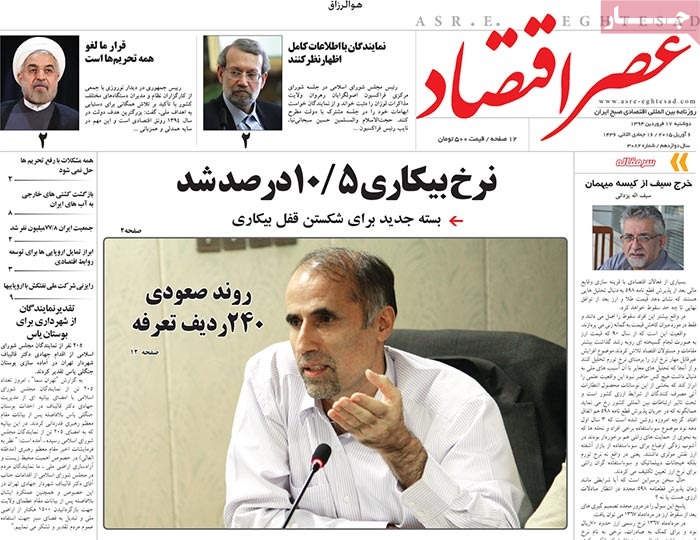
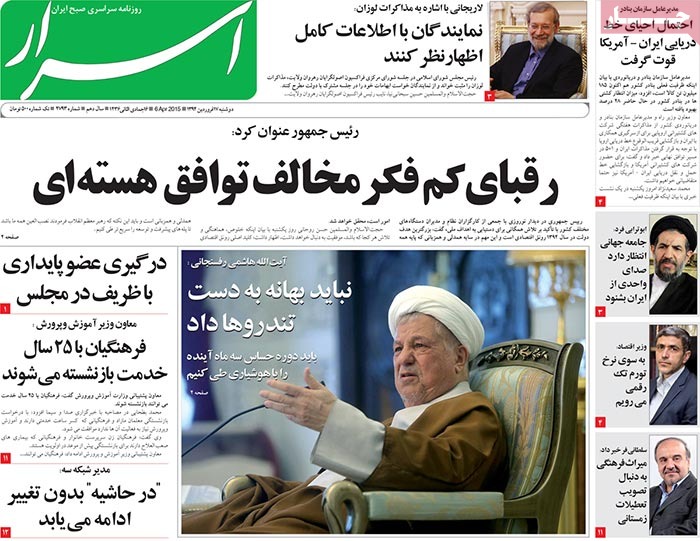
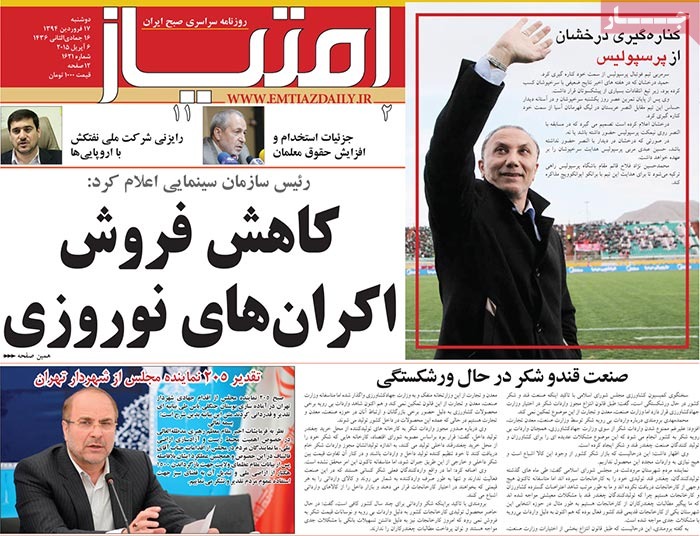
Iranian Newspapers Headlines

As it has been the case in the past few weeks, the nuclear case continued to dominate the front pages of Iranian newspapers on Sunday. The comments of Foreign Minister Mohammad Javad Zarif and US Under-Secretary of State Wendy Sherman were under the spotlight this time. Reformist-leaning newspapers also put on their covers the week-long furlough of Mohammad Reza Rahimi, first vice-president under Mahmoud Ahmadinejad, only less than two weeks after he was imprisoned.


Abrar: A member of parliament’s Agriculture Committee has called for termination of wood import tariffs to protect forests at home.

Abrar: The Italian foreign minister has expressed hope that nuclear talks between Iran and P5+1 will be successful.


A look at Iranian newspaper front pages on March 1


Aftab-e Yazd: [Former Vice-President Mohammad Reza] Rahimi, who is serving time for corruption, has been furloughed for a week.


A look at Iranian newspaper front pages on March 1


Arman-e Emrooz: “[Former nuclear negotiator Saeed] Jalili was admonished by the Supreme Leader twice,” said Sadegh Kharrazi [a former diplomat].


A look at Iranian newspaper front pages on March 1


Asrar: “If MPs are mad at me, they should not make hasty decisions as far as the environment is concerned,” said the director of the Environment Protection Organization.

Asrar: Qom said a big No to hardliners.

It came after senior clerics based in the holy city threw their weight behind President Rouhani’s administration during his recent visit to the central city.

Asrar: Dental care is conspicuous by its absence in the Health Transformation Plan.


A look at Iranian newspaper front pages on March 1


Ebtekar: With nuclear talks ongoing, the value of the standard gold coin and foreign currencies [against the rial] continues to plunge.


A look at Iranian newspaper front pages on March 1


Etemad: The Expediency Council has slapped a ban on any changes to the election laws for 10 years.

Etemad: Iran has expressed readiness to take over Iraqi ancient artifacts which are in danger [of being destroyed by IS terrorists].

Etemad: Completion of [unfinished] development projects takes ages.

Parliament Speaker Ali Larijani made the comment as he took a swipe at the previous government for launching development projects without ever finishing them.


A look at Iranian newspaper front pages on March 1


Ettela’at: Some 27,000 Iraqi soldiers are to take part in a major offensive to wrest control of Tikrit [from IS militants].

Ettela’at: The Iranian environment chief has blamed excessive dam-building for the environment problems the country is faced with.


A look at Iranian newspaper front pages on March 1


Hemayat: The US throws a wrench into the works.

Wendy Sherman has once again said that anti-Iran sanctions would remain in place.


A look at Iranian newspaper front pages on March 1


Iran: The Iranian foreign minister has said that removal of sanctions will be on the table of talks next week.


A look at Iranian newspaper front pages on March 1


Kaenat: Iran’s presence in the Venice Biennial increases 20 percent.


A look at Iranian newspaper front pages on March 1


Kar va Kargar: “Government welcomes competitive production to boost quality,” said First Vice-President Eshagh Jahangiri.


A look at Iranian newspaper front pages on March 1


Kayhan: Millions of Yemenis have poured onto the streets in support of their revolution.

Kayhan: A motion to launch an investigation into the workings of the Environment Protection Organization has been submitted to parliament’s presiding board.

Kayhan: Iraqi news sources say that Abu Bakr al-Baghdadi has been taken to Israel for treatment.


A look at Iranian newspaper front pages on March 1


Khorasan: The US nuclear negotiator has said that terrorism and human rights sanctions against Iran would remain in place for a long time.


A look at Iranian newspaper front pages on March 1


Payam-e Zaman: An Iranian cyclist who is on an overseas tour says he pedals for the cause of peace.


A look at Iranian newspaper front pages on March 1


Resalat: “Differences over termination of sanctions remain,” said Foreign Minister Zarif.


A look at Iranian newspaper front pages on March 1


Rooyesh-e Mellat: A former Mossad chief has admitted that Israel has been involved in assassinations and sabotage in Iran.


A look at Iranian newspaper front pages on March 1


Shahrvand: Over 5,000 hectares of garden has been destroyed within Tehran city limits over the past 20 years.


A look at Iranian newspaper front pages on March 1


Sharq: “In administering political affairs, there is no other way than accepting the opinion of the majority,” said the grandson of the late Imam Khomeini.


A look at Iranian newspaper front pages on March 1


Taadol: The Iranian foreign minister has said that drafting a nuclear deal is likely to start in the first week of March.


A look at Iranian newspaper front pages on March 1


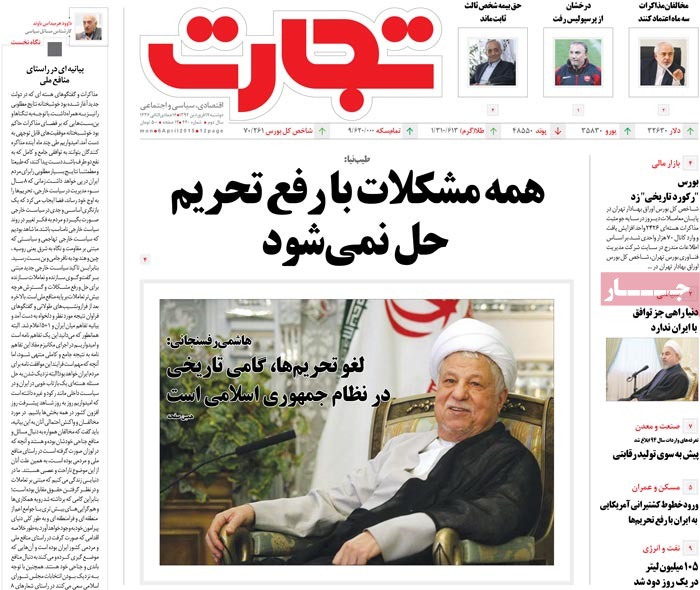
Tejarat: US Under-Secretary of State Wendy Sherman has said that if we get an Iran deal, the world will judge it as a good thing.


A look at Iranian newspaper front pages on March 1


Iranian minority Assyrians call ISIL pet dragon of West

Iranian Assyrians

On Saturday, Tehran’s Assyrian Society released a statement, denouncing the Takfiri group’s abduction of the Assyrians in Syria as well as the West’s silence on the matter.

A Tuesday report noted that ISIL militants had kidnapped at least 220 people from Assyrian Christian villages in northeastern Syria. The abductees included women and the elderly.

The Society’s statement decried the development, referring to the ISIL as “the US and Israel’s pet dragon.”

It regretted that the Western world “finds the killing of an occupying Israeli soldier to be sufficient excuse for supporting the fake and hateful [Israeli] regime in its killing of Gaza’s innocent children and civilians.”

The West, however, is observing these crimes today “with sewn lips as if not believing that it has bred such a dragon itself,” the statement noted.

“The question is ‘what is this concocted US-led coalition, which has itself led the unlimited arming of these criminals, currently doing?’”

The terrorist group has been committing horrific crimes in all regions under its control in Iraq and Syria.

Hundreds of Assyrians have already abandoned their villages to avoid bloody clashes.

Also on Saturday, hundreds of Assyrians marched in the Lebanese capital Beirut in solidarity with those of the community kidnapped by the ISIL in Syria.

The marchers carried placards reading, “Assyrians are the indigenous people of Mesopotamia,” “We demand action from the United Nations,” and “Save the Christians in the Middle East.”

Iran eyeing development of small reactors

Ali Akbar Salehi

Salehi has been quoted by Iran’s local media as saying that this is a new strategy that could decrease the costs and in turn increase the profits over the utilization of nuclear energy.

“During the recent talks with US negotiators in Geneva, US Energy Secretary Ernest Moniz said Washington is also looking into this strategy,” the head of the Atomic Energy Organization of Iran (AEOI) has been quoted as saying by the Persian-language newspaper Ta’adol.

Salehi said the construction of a 1600-megawatt reactor requires an investment of $15 billion. “This is while the construction of small reactors with a capacity of 50-100 megawatts requires much less investment,” he said.

Salehi accompanied Iran’s Foreign Minister Mohammad-Javad Zarif in Iran’s high-profile nuclear negotiations in Geneva on Sunday and Monday in which US Secretary of State John Kerry and Energy Secretary Moniz had also participated.

It was for the first time that Iran and the US were bringing a nuclear chief and an energy secretary into Iran nuclear talks.  Not much has come out on the exact topics of discussions but Iran and the US have already emphasized that some positive steps had been taken during the course of the talks.

Salehi told Iran’s media on Thursday that “very useful results” had been obtained during technical negotiations with the US team.  He also said some “long steps” had been taken over some key technical issues that had previously hit a deadlock in the course of Iran’s nuclear negotiations with the P5+1 group of countries.

Iran and the US will meet again in the Swiss city of Montreux next week to continue discussions that are meant to remove the remaining disputes on the way of a final agreement over the Iranian nuclear energy program.

Iranian news agency interviews US State Department spokesman

Alan-Eyre

Recent years have seen an American figure other than President, Secretary of State or other senior officials draw a lot of attention in Iranian media. The person in question is so fluent in Farsi that he uses Persian proverbs and colloquialism as handily as native Farsi speakers do.

You guessed it right. The following story is about Alan Eyre, a US State Department spokesman who has said the presence of new faces in nuclear talks between Iran and P5+1 is designed to help prime negotiators secure their stated goal. The following is an excerpt of what Mr. Eyre said in an interview with Mehr News Agency’s Abdolhamid Bayati:

The makeup of the team representing the US administration in the talks is not always the same. It keeps changing. For instance, in the latest round of talks Energy Secretary Ernest Moniz was on our team as the chief American expert. He was there to both facilitate technical talks with Iranian negotiators and offer technical advice to Secretary Kerry.

That our energy secretary was on hand for the talks means the negotiations are highly technical. We made progress in this latest round of talks, but there is more to cover before we reach our destination. As they say, you climb the ladder rung by rung.

When it comes to Iran, we have always coordinated with Israeli security and intelligence agencies even when leaders of the two countries are at odds, politically. At an expert level we see eye to eye over Iran’s nuclear program.

Generally, news stories and articles that appear in newspapers do not leave much impact on the way we do business. We want to keep the content of the talks under wraps.

In lifting the sanctions, we can act in keeping with the Joint Plan of Action [the Geneva deal] which says: ‘This comprehensive solution would involve a reciprocal, step-by step process, and would produce the comprehensive lifting of all UN Security Council sanctions, as well as multilateral and national sanctions related to Iran’s nuclear program.’

As far as I know there is no disagreement over the timetable. What is desirable is to secure a principal understanding by the end of March and strike a final deal by the end of June.

When it comes to Iran’s nuclear program, everyone knows that in our country there are differences as to what constitutes an optimal mechanism to deal with the case. But there is unity as far as the final goal is concerned: Iran should not develop nuclear bombs. As President Obama has said we want the case to be solved peacefully through diplomacy.

Let’s not forget the fact that we have made a lot of progress over the past year. The US administration hopes that Iran can prove its claims that in keeping with a religious edict it views nuclear bombs as religiously banned and that its nuclear program is peaceful so that we can strike a final deal.

In that final deal Iran should give assurances to the world that it will never develop a nuclear bomb and in parallel we lift the sanctions to help Iran’s economy come back into the fold.

Any possible deal should be satisfying to both sides; in other words it should guarantee the interests of both parties. A deal like that has been envisioned in the Joint Plan of Action.

Iran-P5+1 nuclear talks at sensitive point: Zarif

Iran-Italy-FMs

Addressing a joint press conference with his Italian counterpart Paolo Gentiloni in Tehran on Saturday, Zarif added that negotiators of Iran and the United States held “accurate” and fruitful talks in the Swiss city of Geneva on February 22 and 23.

“We have announced many times that as long as general issues are not agreed upon, there will not be any agreement,” the Iranian minister said.

He emphasized that there would be no deal unless the sides reach an agreement on all issues.

The top Iranian nuclear negotiator said the sides certainly made “some serious progress” in Geneva, expressing hope the negotiating sides would also make progress next week on other issues, especially the lifting of sanctions.

“In that case, we will draw it up in the form of a comprehensive and accurate deal,” said Iran’s diplomacy chief.

Nuclear talks between representatives from Iran and the United States were held in Geneva, Switzerland, on February 22 and 23 and the two sides held three rounds of negotiations in two days in an attempt to narrow their differences ahead of a key July 1 deadline for reaching a comprehensive deal.

Both top Iranian and US diplomats said some progress was made toward a final deal.

Political directors from Iran and foreign ministries of P5+1 will hold a fresh round of talks about Tehran’s nuclear program in Montreux, Switzerland, on March 5, EU spokeswoman, Catherine Ray, said on Friday.

A series of bilateral meetings will also be held prior to the planned high-level talks between negotiators from Iran and the five permanent members of the UN Security Council plus Germany, she added.

Iran and P5+1 – Britain, France, China, Russia, and the United States plus Germany – are making attempts to narrow their differences on the outstanding issues related to Tehran’s nuclear program.

Veteran translator expounds on the root cause of woes we face

Ezatollah Fouladvand

Ezzatollah Fooladvand, a seasoned translator of philosophical texts, has said that suppression of thoughts, not the thoughts themselves, should be a source of concern. “I believe that any misfortune or misery that has beset our people has its roots in a lack of knowledge.”

What comes below is the translation of a report the Iranian Students News Agency released on February 25 about the comments Fooladvand made at Mahtab Mirzaei award ceremony at Book City Tuesday:

We should extend gratitude to those who in spite of all shortcomings, restrictions, problems and occasional ingratitude still remain committed to the promotion of knowledge and culture in this country; an amazing land which has seen the rise of scholars and scientists like Ferdowsi, Saadi, Hafez, Rumi [all highly revered Persian poets], and Zakariya al-Razi and Avicenna [both prominent Persian scientists].

Eleven centuries ago when by its own admission the West was going through the Dark Ages, a wise man like Rudaki [the first great literary genius of modern Persia] said that knowledge is an enlightening tool which shields individuals from the ills of ignorance.

No wonder, German philosopher Hegel has said that the beginning of evolution of man starts with the history of Persia. However, unfortunately, throughout history, there have been times when we have been deprived of enlightening knowledge and descended into the darkness of ignorance, denied our scholars and artists the gratefulness and respect they have deserved and plunged into superstition and nescience.

[In such periods] Not only have we failed to value our great ancestors, but we have belittled them and also hurt our contemporaries of great caliber, cracked down on them and even shed their blood. A case in point is the murder of Shahab al-Din Suhrawardi [a Persian philosopher] on the order of Salahuddin Ayubi [founder of the Ayyubid dynasty] because of the ideas he held.

I have always believed and continue to believe that any misfortune or misery that has beset our people has its roots in a lack of knowledge.

There is an English proverb which says that to err is human; to persevere in error is diabolical. There have been several times when we have insisted on making an error; inflicting substantial and at times irreparable damage not only on ourselves but on future generations, but what is the antidote?

That no one learns a lesson from history is the lesson we learn from history. However, if we take this concept too seriously, we will have to forget the nations that have learned from the past and gone down the path of progress and prosperity. In that case we will remain stuck in our compound ignorance.

A precious lesson learned in the past and even at present is that in the field of thinking in the battle between pen and sword, the former is the final winner.

A shaky thought in which passion and prejudice replace wisdom and far-sightedness is doomed to failure even if it is founded on good intentions; those who initially rally behind it will eventually end up remorseful.

This experience has repeated itself since the emergence of mankind and has been considered valuable by rulers and the great. In confirmation of this concept, Saadi, the master of eloquence, has said that kings need the company of the wise more than the wise wish to get close to the rulers.

We should not be fearful of thoughts; what should be feared is the suppression of thoughts, because it paves the way for the dominance of lame, insubstantial, misleading and ill-fated ideas.

Therefore, let’s appreciate the intellectuals, authors and artists that truly serve humanity so that they can make their presence felt and market their ideas. I assure you that if they try to sell worthless opinions, they themselves will incur losses and there is no need for any crackdown.

In conclusion, Fooladvand thanked organizers for handing him the award for translation of Philosophy of History.

Ahmadinejad threw nuclear dossier into disarray: Former diplomat

Sadegh Kharazi

On February 28, Khabaronline, a news website, published a report on remarks by Sadegh Kharrazi, a member of the newly-formed NEDA [Farsi initials for a Second Generation of Reformism] Party, among other things, about the role of former President Mahmoud Ahmadinejad in the country’s nuclear dossier. The following is the translation of the report:

Dismissing claims by Ahmadinejad that he did not have any influence on the course of Iran’s nuclear case, Kharrazi said, “Basically, it was Mr. Ahmadinejad who upset the balance of Iran’s nuclear dossier. It cannot be said that he played no role in it. The measures he took, the strange orders he gave to the Atomic Energy Organization, and the nuclear celebrations he organized altogether landed us in trouble.

He tried to tie the nuclear case to the negotiations with America so that he could take all the credit for resumption of ties with the US on the one hand, and claim that he was the one who settled the nuclear dispute, on the other.

From the get-go, a mechanism was in place for Iran’s nuclear program, but he acted in defiance of that mechanism. I must stress that his hands were not tied at all in dealing with any matter. One can even say that in the history of Iran no president wielded as much powers as he did. He manipulated the rules and expressed freely his ideas everywhere.”

Kharrazi went on to say, “By way of ballyhoo, he dealt a blow to Iran’s dignity on the international stage. […] The visit that Mr. Ahmadinejad had with former Russian President Dmitry Medvedev and the response Ahmadinejad produced when the Russian president asked how he was doing turned the Iranian president into the butt of jokes for quite a while in international circles.”