Thursday, December 25, 2025
Home Blog Page 4921

Western rivalry against the backdrop of nuclear talks

Zarif-Fabius-Kerry

Iran has recently hosted Western officials who have come to the country to talk business despite the fact that part of the sanctions are still in place. These visits show a shift of policy in the West which did not want to have economic interaction with Iran before a final nuclear deal, citing that trade transactions with Iran would breach the sanctions regime.

Arman-e Emrooz daily on March 2 ran an opinion piece by Javid Ghorban Oghli, an international relations expert, on how Western countries are impatient to invest in Iran after the possible conclusion of a final nuclear deal. The following is a partial translation of the piece:

[…]

Word has spread that a number of global giants have sent their representatives to Iran to open talks, eagerly waiting for a final deal to get into the Iranian market.

[…]

The Americans, who have been absent from Iran for more than 30 years, are putting together their plans not to let that 30-something-year absence and political disagreements stand in the way of their efforts to make a comeback to Iran.

Thus, a political deal they have raised [as part of a final nuclear deal between Iran and P5+1] is, partly, related to atomic issues, and in part, about the assurances the US needs about its active role in the Iranian market following the conclusion of a comprehensive deal.

That’s why Washington has entered a race in which it has lined up against European nations, among them Italy and France.

[…] What the US is doing could be seen as an attempt to set the stage for the future when a deal is inked with Iran.

[…]

Iran too should play its own part when it comes to the post-deal period. It needs to set up a working group to identify the country’s development needs and recognize those countries whose relations with Iran can bring more benefits to the Islamic Republic.

Unfortunately over those eight years [when Ahmadinejad was in power], Iran had ties with China, Russia and India. So, Iran needs to work on that working group which can – after the nuclear talks possibly end in a final comprehensive deal – manage the country’s ties with other nations, especially economically developed nations, in keeping with its national and development needs.

Beached Greek Ship sinks deeper

Beached Greek Ship

In Greece, the rise to power of a left-wing anti-austerity government has put the European country at risk of plunging into yet another crisis, posing a challenge to the European Union. In Iran, a country thousands of miles away, another Greek symbol is going down, seemingly sympathizing with the economy of her motherland. The following is a partial translation of a report Mehr News Agency published on February 28 on a ship perched off the coast of a southern Iranian island:

The [beached] Greek Ship, a landmark of Kish Island in the Persian Gulf, has started to sink deeper.

The CEO of the Kish Free Zone Organization says that keeping the ship where it sits right now is costly.

The ship which ran aground on July 25, 1966, off the coast of Kish Island with a large cargo of oil, is a main tourist attraction of Kish, which is known as the pearl of the Persian Gulf.

By local accounts, the Scottish ship which was steered by a drunken captain veered off course and instead of docking at a port in the vicinity of the island, ended up on its coast. Because the vessel was en route to Greece, it has since been known as the Greek Ship.

The ship is more prominent than all other tourist attractions of the island, including its luxury hotels, and whenever someone wants to present an image of the island, pictures of the ship come in handy.

[…]

The CEO of the Kish Free Zone Organization believes that with time, the ship will sink deeper, yet the plan presented by Sharif University of Technology to save the vessel from submerging, should be studied to see if it is cost effective.

His comments about the “costly” project come despite the fact that Kish earns extremely large amounts of money thanks to affluent tourists visiting it and sizeable investments in its construction sector.

Tourist says watching the sunset with the Greek Ship in the foreground is a major attraction of the island.

If the fate of the ship is to be tied to ill-considered plans, tourists will need to take their final pictures, because in the not-too-distant future, the vessel will vanish.

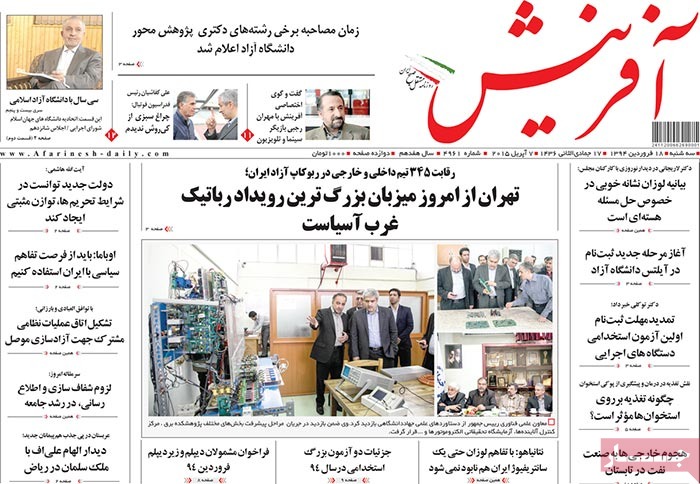
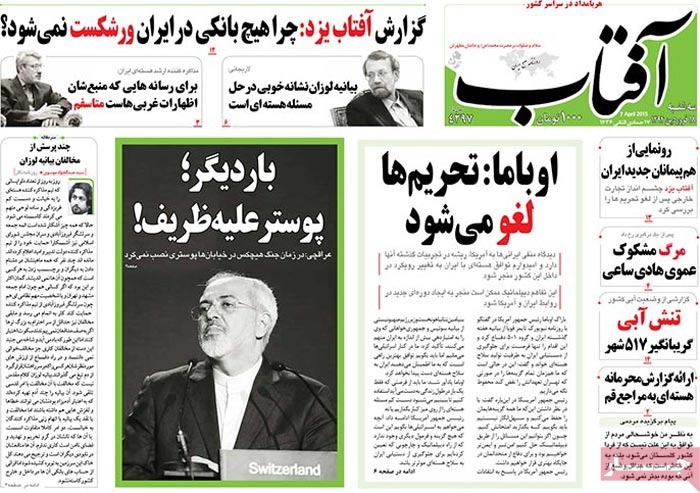
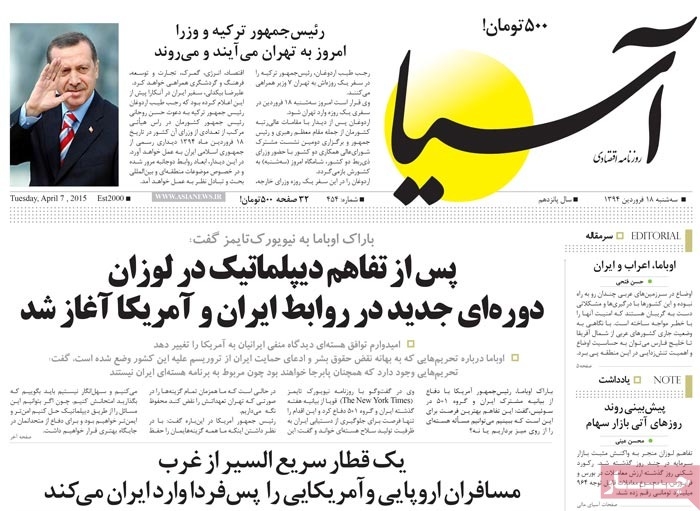
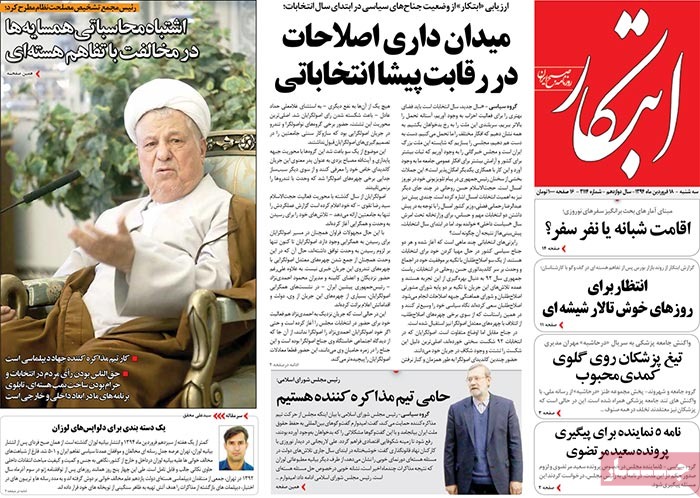
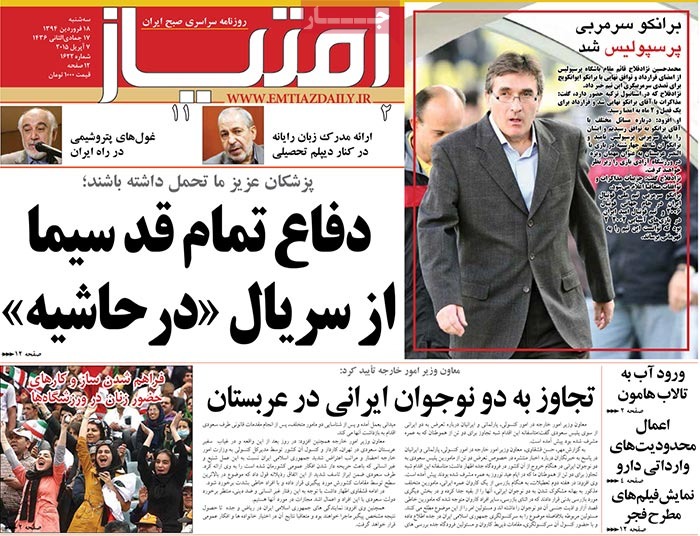
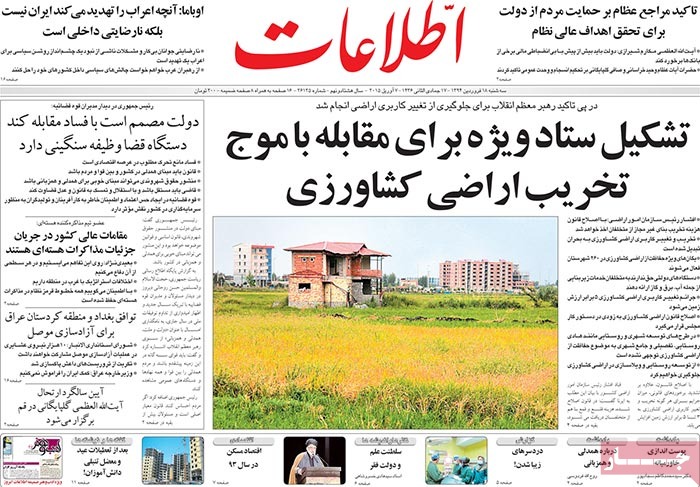
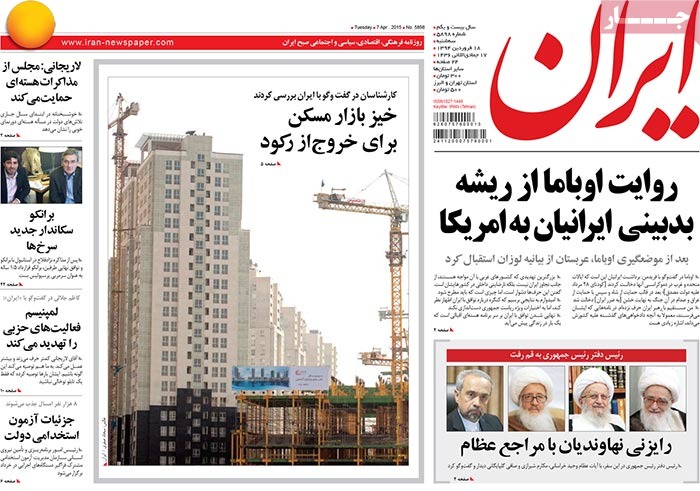
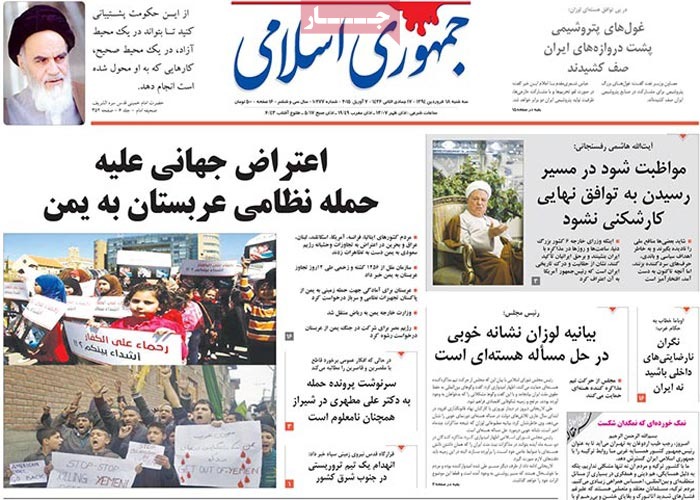
A look at Iranian newspaper front pages on March 2

Iranian Newspapers Headlines

The comments of the Supreme Leader at a meeting with producers of Track 143, a war-themed movie, dominated the front pages of Iranian newspapers Monday. In the meeting the leader said he enjoyed the Sacred Defense drama. And upcoming nuclear talks between representatives from Iran and the US also appeared on the covers of dailies.


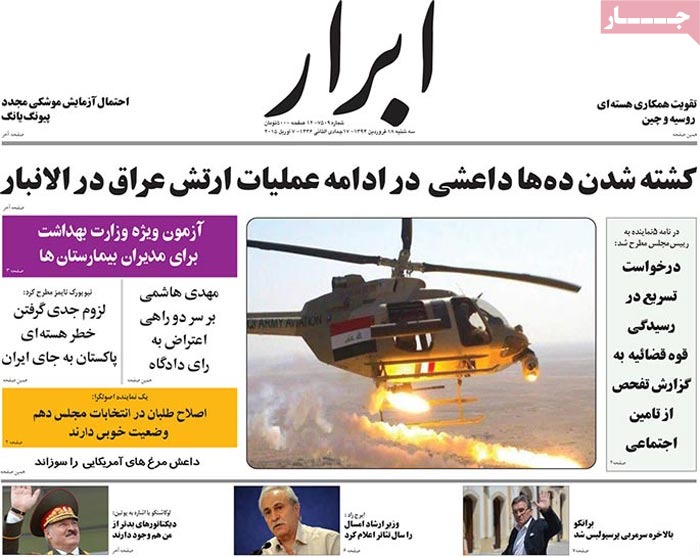
Abrar: “Eighteen couples get divorced every hour,” said an official with the Civil Registration Organization.


A look at Iranian newspaper front pages on March 2


Abrar-e Eghtesadi: [US] Dollar is no longer the currency of choice in 17 percent of trade exchanges in the world.

Abrar-e Eghtesadi: A new round of oil talks between Iran and Italy has gotten underway in Tehran.


A look at Iranian newspaper front pages on March 2


Arman-e Emrooz: The minister of labor has boarded the train of impeachment.

Arman-e Emrooz: Even the purest of waters cannot wash away the mistakes Ahmadinejad committed.

That was the reaction of some MPs to comments by Morteza Agha Tehrani, an ally of the former president.


A look at Iranian newspaper front pages on March 2


Ebtekar: A first Iranian plane has landed in Sana’a, Yemen.


A look at Iranian newspaper front pages on March 2


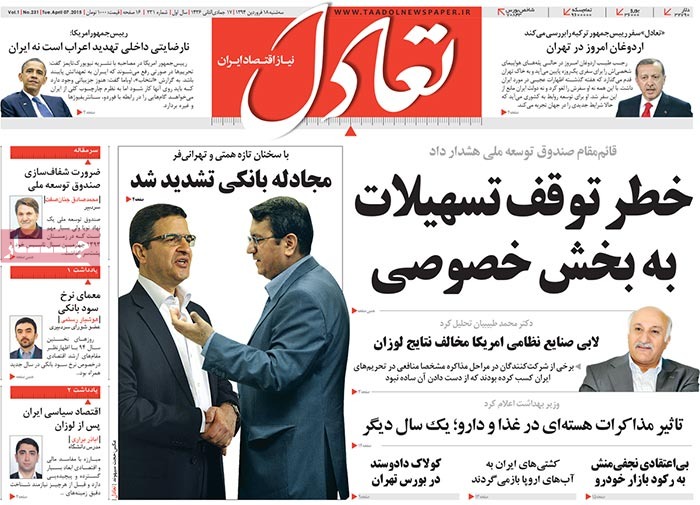
Etemad: A new round of talks to cement progress made so far and cut ifs and buts

Foreign Minister Mohammad Javad Zarif meets with US Secretary of State John Kerry in Montreux, Switzerland on Monday.


A look at Iranian newspaper front pages on March 2


Ettela’at: “All sanctions should be lifted all at once,” the president said at a meeting with the visiting Italian foreign minister.

“Iran has always honored its commitments and everybody knows that Iran is a serious partner in nuclear talks. To settle the nuclear case, there is no other way than to negotiate,” the president further said.

“Collective cooperation is needed to deal with terrorism which poses a threat to all nations.”

Ettela’at: The health minister has called for more attention to healthcare in detention facilities.

Ettela’at: “Tax evasion amounts to one fourth of GDP,” said the Iranian National Tax Administration.


A look at Iranian newspaper front pages on March 2


Hemayat: Banks are interfering with production and industries.

High interest rates [banks pay to depositors] have drawn the ire of Cabinet ministers.


A look at Iranian newspaper front pages on March 2


Iran: The deal between [Iranian automotive giant] Iran Khodro and France’s Peugeot has been finalized.

Iran: A final shot by Netanyahu to prevent the conclusion of a nuclear deal.

Iran: The minister of culture has said that his ministry did not approve of the cancellation of a concert by Alireza Ghorbani.


A look at Iranian newspaper front pages on March 2


Jomhouri Islami: The minister of trade has said that online purchases in Iran stand at around $17 billion.


A look at Iranian newspaper front pages on March 2


Kar va Kargar: “We need to keep talking about the Sacred Defense even 50 years from now,” said the Supreme Leader.

Ayatollah Seyyed Ali Khamenei made the comment at a meeting with those involved in the production of Track 143, a war drama.


A look at Iranian newspaper front pages on March 2


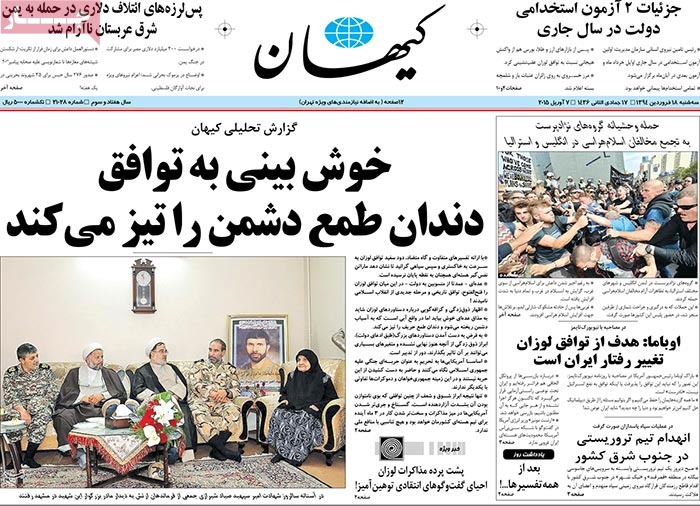
Kayhan: Some 100,000 Pakistani soldiers are to be hired to protect the Saudi Royal Court.


A look at Iranian newspaper front pages on March 2


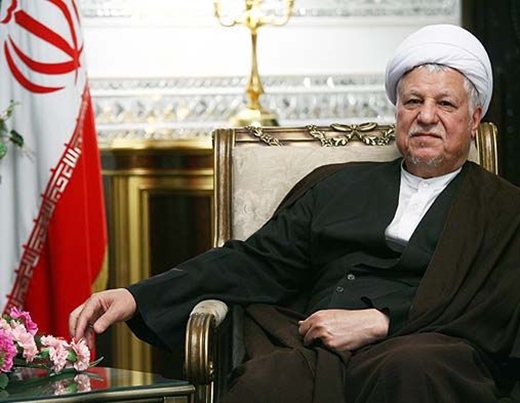
Mardomsalari: “Insistence on continued sanctions runs counter to human rights slogans,” said the chairman of the Expediency Council.

Ayatollah Hashemi Rafsanjani made the comment at a meeting with the visiting Italian foreign minister.

Mardomsalari: “If the other side displays determination, conclusion of a good deal is possible,” said the secretary of the Supreme National Security Council.


A look at Iranian newspaper front pages on March 2


Sharq: The Guardian Council has once again faulted Support for Promoters of Virtue law.


A look at Iranian newspaper front pages on March 2


Iran sanctions must be lifted all at once: Rouhani

Rouhani-Italy FM

“The basis of nuclear negotiations is [making] efforts to reach common views and mutual confidence and we believe that all sanctions should be lifted all at once,” Rouhani said in a meeting with Italy’s Foreign Minister Paolo Gentiloni in Tehran on Sunday.

He added that the sanctions, which have been imposed on Tehran in recent years on “incorrect bases”, have been detrimental to all including the European Union.

“Iran has always honored its commitments and it is currently clear to everyone that Iran is a completely serious side in the talks,” the Iranian president stated.

He emphasized that there is no option but negotiations to settle the outstanding issues about the Iranian nuclear program.

Iran and the P5+1 countries  — Britain, France, China, Russia, and the United States plus Germany – are making attempts to narrow their differences on the outstanding issues related to Tehran’s nuclear program ahead of a July 1 deadline for reaching a comprehensive deal.

The scale of Iran’s uranium enrichment and the timetable for the removal of anti-Iran sanctions are seen as the major stumbling blocks in the talks.

Iran-Italy ties

Rouhani said Iran and Italy enjoy a great deal of potentialities to boost trade ties, adding that Tehran welcomes further expansion of cooperation with Rome.

He said further reciprocal visits by the two countries’ officials and stronger bilateral cooperation would be beneficial to the two sides, the region and the entire world.

Italy’s support for nuclear deal

The Italian foreign minister said his country strongly believes that a comprehensive deal over Iran’s nuclear issue would be in favor of Tehran, Rome and the whole of the international community.

Italy would do its utmost in supporting the nuclear negotiations, Gentiloni added, expressing hope that a comprehensive deal should give priority to sanctions relief for Tehran.

Iran says ready to cooperate with Google

Iran-google

Nasrollah Jahangard, Iran’s deputy minister of telecommunications and information technology, has been quoted by local media as saying that negotiations are underway with Google to establish a version of its servers in Iran.

“This is a normal thing in the world and it will be economical for [IT] companies to be closer to their main clients,” Jahangard has told Iran’s Fars news agency.

He added that similar talks are currently being carried out with several other major US and European internet companies.

Jahangard added that Iran is even willing to help internet companies like Google use its facilities by providing services to the countries of the region, as well.

“Iran will of course not interfere in the services of the companies but we want what they present in the Iranian market to be in line with Iranian laws,” he added.

Jahangard further emphasized that some non-American enterprises have reached advanced stages in talks to enter the Iranian IT market, adding that their names will be publicly announced once negotiations with them reach the final stages.

IAEA intelligence failure on Iran nuclear activity

Robert Kelley

Bloomberg Business, a news website, has in a report entitled “IAEA Refusal to Visit Iran Site Flags Intelligence Doubts” quoted a former IAEA official as saying that United Nations inspectors’ reluctance to follow up a tip on Iran’s nuclear program indicates their agency may be acknowledging the flaws in some of its intelligence.

The following is part of a report by Kayhan daily on March 1 on remarks by Robert Kelley, a former IAEA official, on Iran’s nuclear activities and the UN nuclear watchdog’s intelligence as reported by Bloomberg:

More than three years after the International Atomic Energy Agency published reports of high-explosive tests in Marivan, near the border with Iraq, officials still haven’t taken up Iranian offers to visit the alleged blast site.

“Marivan is a classic case of inexperienced analysts swallowing everything they are told,” Robert Kelley, an ex-IAEA director, said in an interview. “The IAEA’s unwillingness to go to the site of one of their two stated unresolved concerns shows they have now recognized their mistake.”

Kelley then talks about the strangeness of raising the case of Marivan and says, “If you look at the single mention of Marivan as the place that the most important alleged experiments were done you immediately smell a rat.”

Resistance-based economy does not mean shutting the doors to outside world

Resistance-based economy

More than 100 economics professors and researchers have issued a statement in support of resistance-based economy. The release of the statement was timed to coincide with the anniversary of the communication by the Supreme Leader of the policies of resistance-based economy.

The following are the highlights of the statement published by Ettela’at daily on March 1:

To sustain production and get access to new foreign markets, a targeted external strategy should be placed on the agenda of the economy.

One of the biggest hurdles standing in the way of private investment in small- and medium-size business is the lack of easy access to finances.

More than a decade after the general policies of Article 44 of the Constitution were communicated, there is no desirable change in the public-private sectors’ ratio in sovereign responsibilities.

Iran is still far from a point in which people are given a real role to play in boosting economic activities and reducing rent-seeking and monopolistic efforts.

The economics professors and researchers have expressed gratitude for the Supreme Leader’s resourcefulness in piecing together and communicating the general policies of resistance-based economy.

The difference between resistance-based economy and one which shuts the doors to trade with the rest of the world is that it does not push the focal point of economy overseas.

In resistance-based economy all policies are based on measures to boost national production.

Competitiveness of local products is one major requirement for expansion of non-oil exports.

We have read the letter

Letter 4 u
Letter 4 u

To spread word on the letter the Supreme Leader has penned for the youth in the West, some Iranians have emailed the letter to the Westerners they are in contact with. One such individual is author Habib Ahmadzadeh.

The following is the translation of a report Hamshahri Javan, a magazine, published in its 496th issue – out on February 28 – about Ahmadzadeh’s measure.

Habib Ahmadzadeh said, “As an ethical, religious and humanitarian responsibility I sent the letter of the leader to two US pacifists: Phil Wilayto, a Virginia-based antiwar activist and editor of the Virginia Defender, and Michael Berg whose son was beheaded by Alqaeda in Iraq.”

The following is the responses I got from Wilayto and Berg:

“Thank you very much for sending this message. Although the United States prides itself on “freedom of speech” and the free flow of information, I have not seen these words anywhere else. And the Ayatollah’s words are reasonable, direct and enlightening.
Phil Wilayto (Virginia Antiwar Network)

“Habib. Thank you for sending this wonderful letter from Ayatollah Seyyed Ali Khamenei, to the youth of Europe and North America. Did you know that my son Nick carried the Koran with him? This brought him under suspicion of the US Army Police who detained him leading to his death in Iraq in 2004. He wanted to know everything about Islam and did just what Ayatollah Seyyed Ali Khamenei suggested to the youth – find out firsthand with an open mind. What great advice!
I will forward this around and try to get it published in the newspaper.”
Michael Berg

One of the unique lessons our political and cultural officials should learn from the letter of the Leader in talking to officials of other countries and even our own people is to invite them to develop insight into things. In the absence of insight and understanding, quick approval and acceptance won’t last long.

West, regional allies must review wrong policies: Iran official

Shamkhani-Italy FM

“Refusal to revise the previous approaches will intensify instability and increase insecurity,” Secretary of Iran’s Supreme National Security Council Ali Shamkhani said in a meeting with Italy’s Foreign Minister Paolo Gentiloni in Tehran on Sunday.

Referring to Libya and the ISIL militants’ activities in the North African country, he said foreign military intervention would increase human and material losses, destroy economic infrastructure and escalate crises.

Libya plunged into chaos following the 2011 uprising that toppled longtime dictator, Muammar Gaddafi. The ouster of Gaddafi gave rise to a patchwork of heavily-armed militias and deep political divisions.

On February 15, the ISIL Takfiri group released a video showing the beheading of 21 Egyptian Christians in Libya. The Egyptians had reportedly been abducted in the Libyan coastal city of Sirte in two attacks in December and January.

Also in January, alleged ISIL gunmen stormed Corinthia Hotel in Tripoli, killing nine people, including a Frenchman and a US security consultant.

Last month, Libyan Prime Minister Abdullah al-Thinni warned that Libya may turn into a safe haven for the ISIL Takfiri terrorists.

Italy’s stance on terrorism

Gentiloni said terrorism poses the biggest threat to the Middle East and the world.

He called for collective international will to fight terrorist groups in an effective way to help establish peace and stability in the region.

The Italian foreign minister added that Iran plays a very influential and determining role in solving regional problems, particularly in the fight against the ISIL Takfiri militants.

UNESCO pays tribute to world-renowned Iranian Professor Khodadoost

Ali Asghar Khodadoost

The United Nations Educational, Scientific, and Cultural Organization (UNESCO) paid homage to the renowned Iranian Professor Ali Asghar Khodadoost for his invaluable services to humanity. Professor Khodadoost is a veteran scientist pioneering in ophthalmology.

The United Nations organization on Friday held a ceremony in Shiraz, southern Iran, to celebrate the sublime status of the Iranian professor.

Addressing the ceremony, Head of the Iranian National Commission for UNESCO Mohammad Reza Saeedabadi referred to Professor Khodadoost as a scholarly physician who owes all his success to his beautiful views towards the Almighty, his inventions as well as his love for people.

Highlighting that the professor contributed immensely to production and growth of knowledge by his effective and influential presence in different universities, he said that it is for the first time that UNESCO is honoring a living Iranian figure.

Professor Ali Asghar Khodadoost was born in 1935 in Shiraz.

After graduation from high school, he started teaching at a primary school there.

In 1954, he began his higher education in Shiraz University’s Faculty of Medial Sciences as a top student.

When he completed his six-year studies with distinction he became an intern in the Eye, Ear, Nose and Throat Department of Shiraz University’s Namazi Hospital till 1962.

In that year he left for the US to complete his specialized studies in the famous John Hopkins University.

He was admitted as the first and only foreign assistant in the Ophthalmology Section of John Hopkins University in 1963 and throughout the next three years of serving as an assistant there, he was praised as the best assistant of the Wilmer Ophthalmology Center.

A large number of Professor Khodadoost’s articles were published in the website of the Pop Medicine and other international scientific periodicals.

In 1968 he got back to Iran and began teaching in Faculty of Ophthalmology of the University of Shiraz as a full professor.

From 1968 to 1980 he traveled back and forth once every six months between the University of Shiraz and the John Hopkins University where in addition to teaching he also pursed his scientific projects.

During the same period he also taught as a guest professor in various countries’ universities, including those of China, Turkey, Syria, Oman, Peru, Ecuador, and Italy.

In 1982 he was appointed as a full professor in the Faculty of Ophthalmology of Italy’s Sicily University and in 1992 he established the Connecticut Ophthalmology Center in Newington where he served as the senior supervisor.

From 1980 onward, the great Iranian ophthalmologist frequently returned to Iran and flew back to US, participating both in hospital treatments of the patients and in academic trainings of young ophthalmologists of the universities of both countries, especially in Tehran and Shiraz.

His fame in the world in addition to publication of several scientific articles and large-scale research projects in various fields is due to the new remedial methods that he has initiated in eye operations.

The eye membrane section of the John Hopkins University is named after professor as Khodadoost Basement Membrane Line.