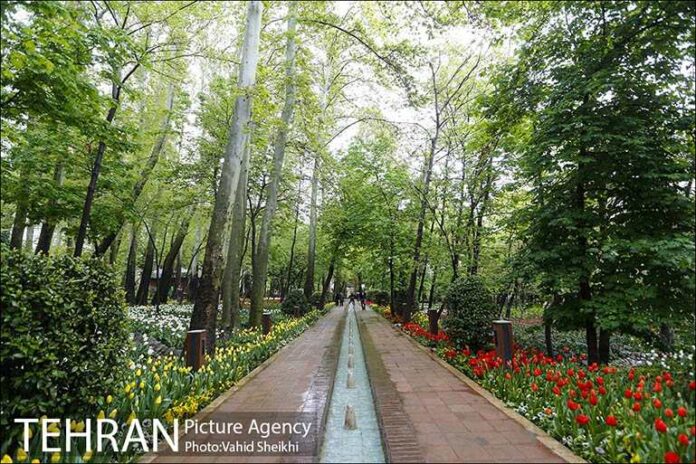
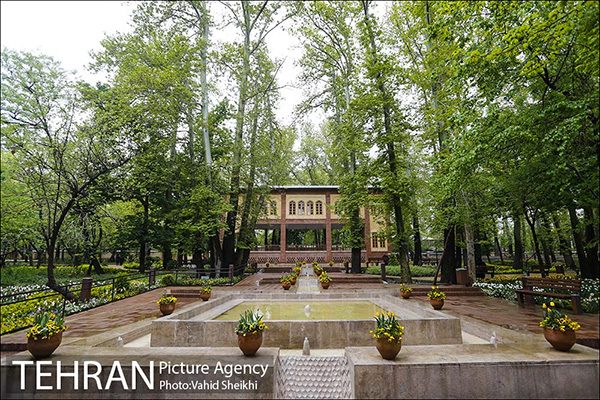
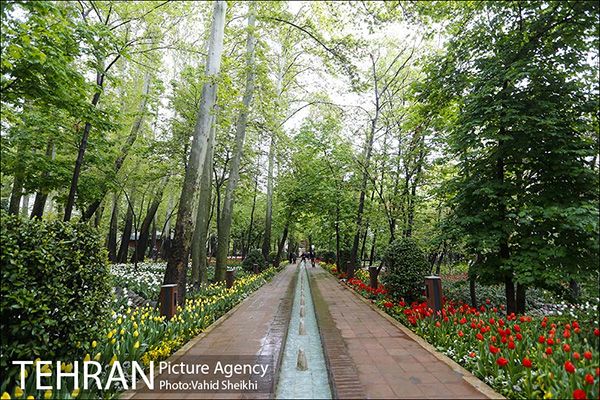
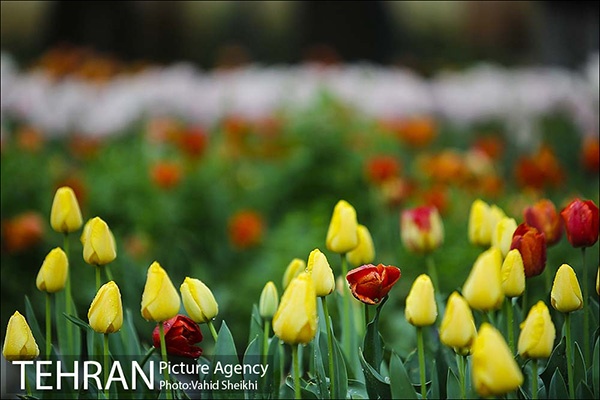
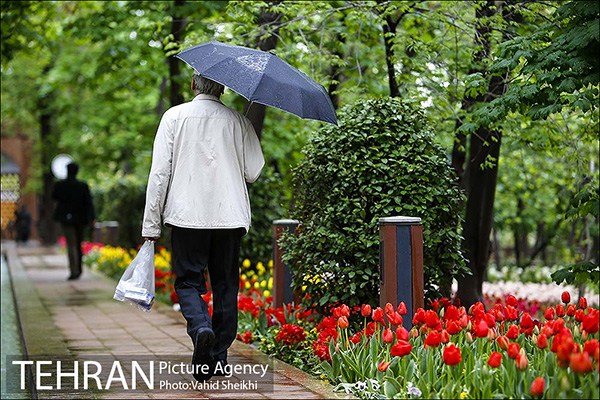
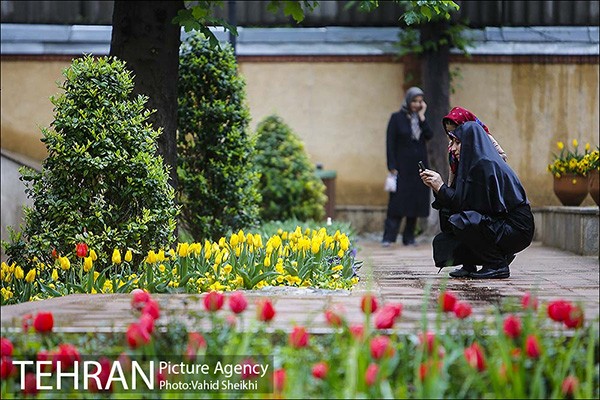
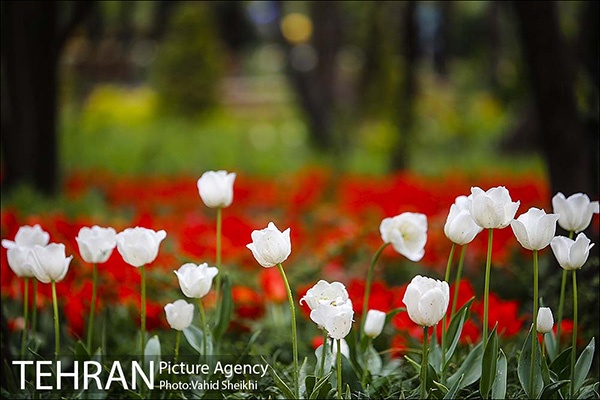
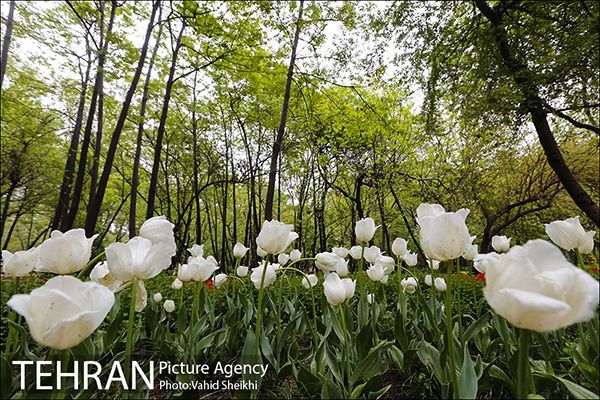
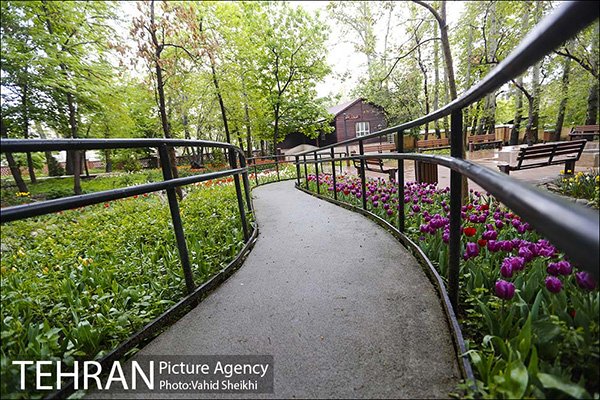
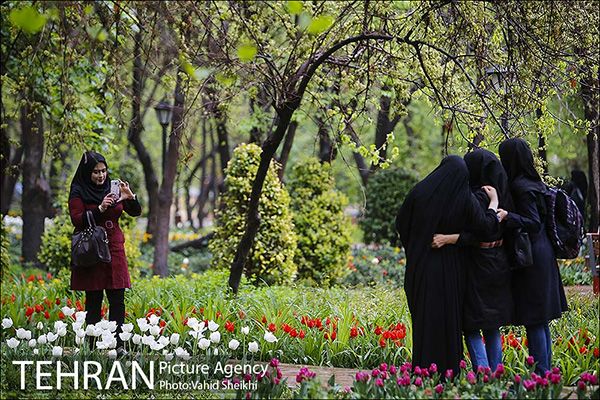
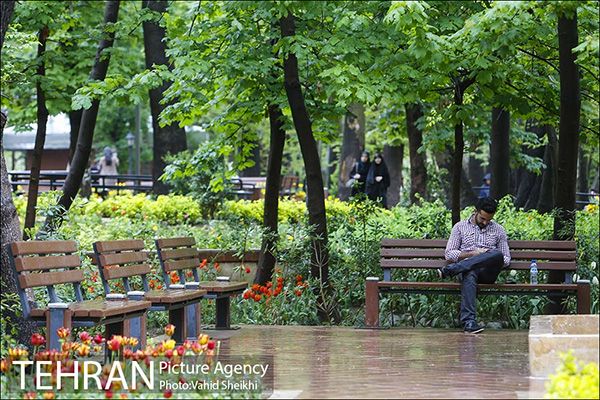
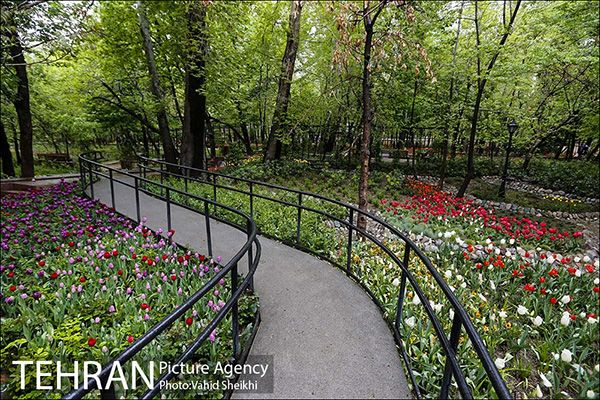
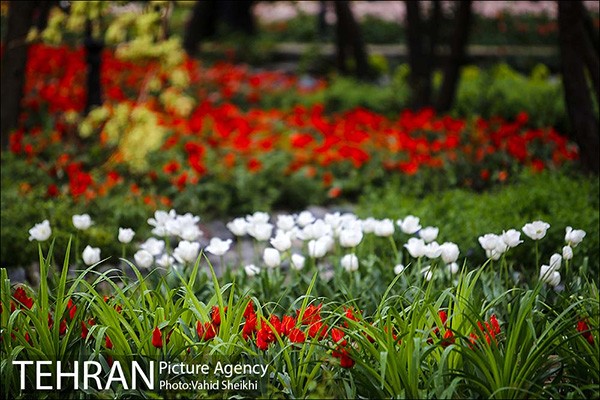
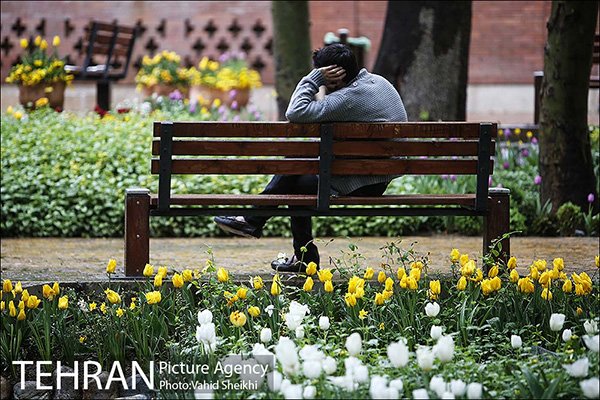
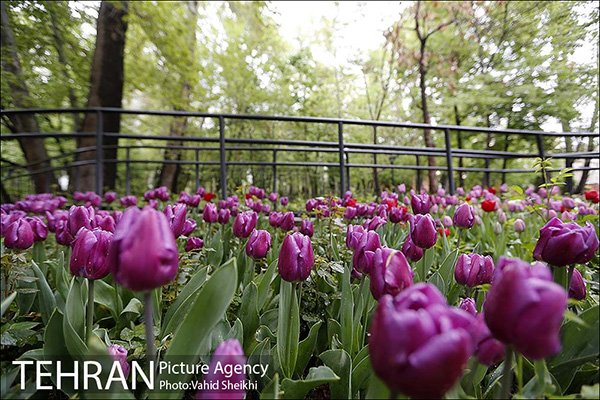
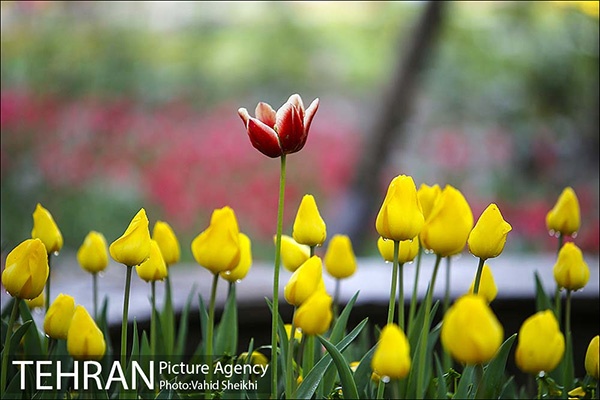
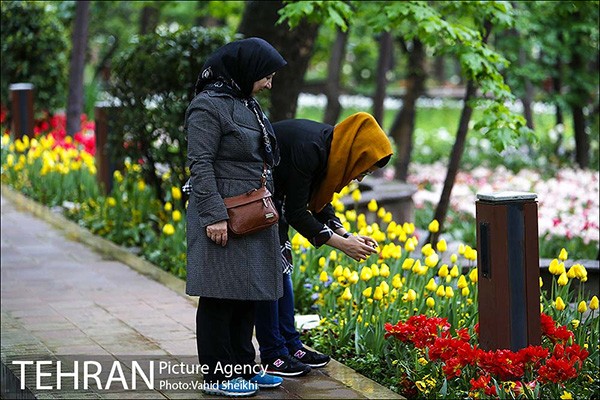
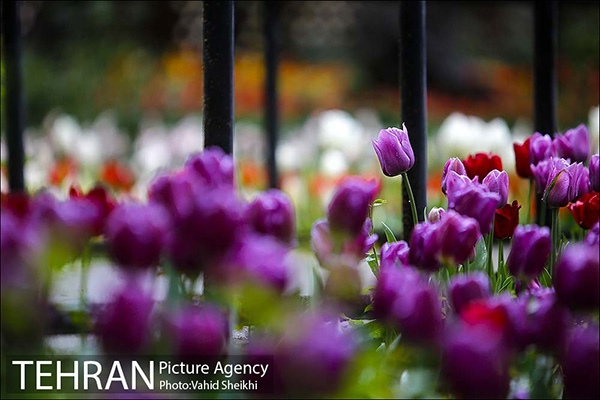
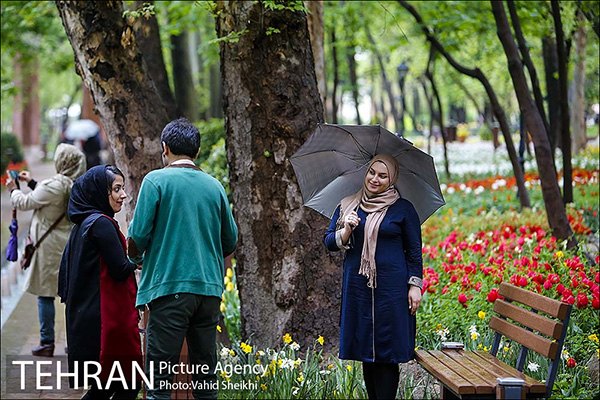
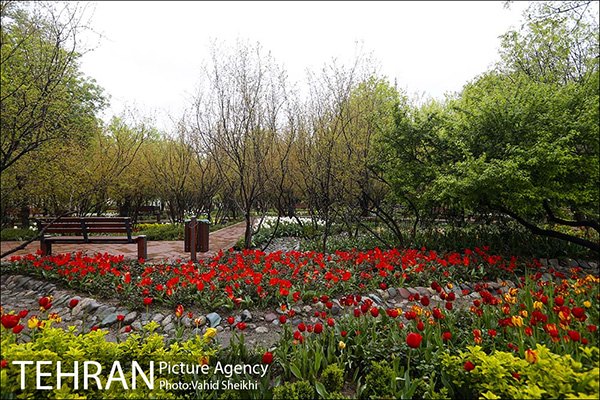
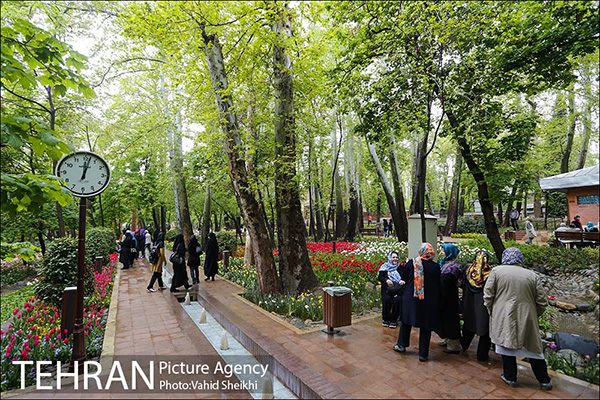
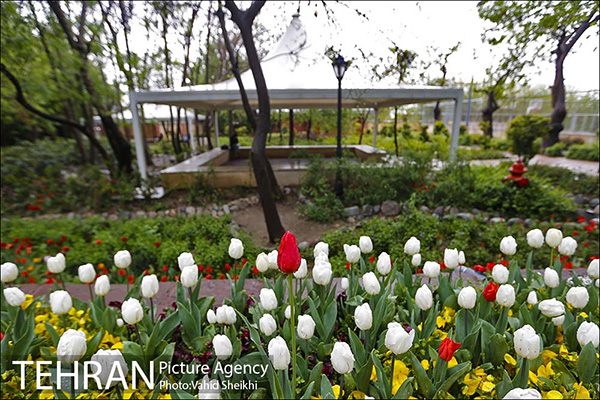
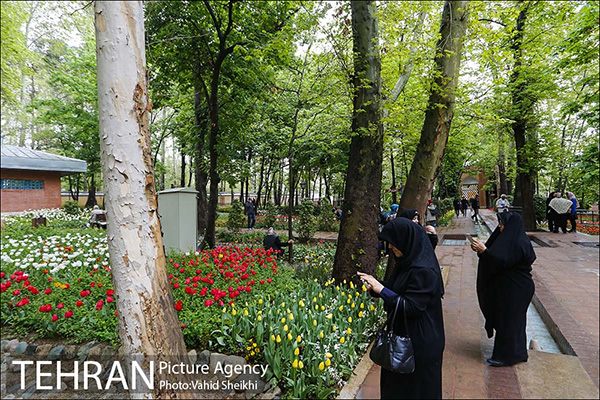
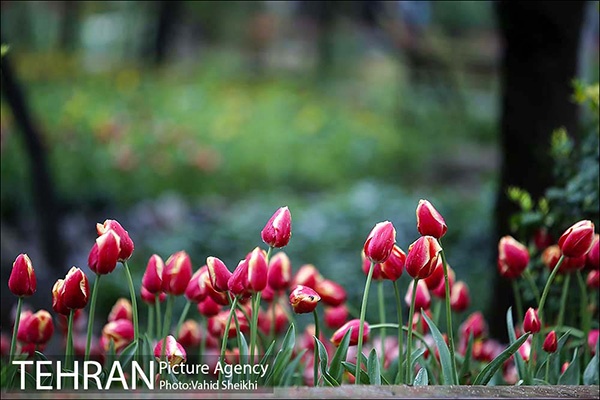
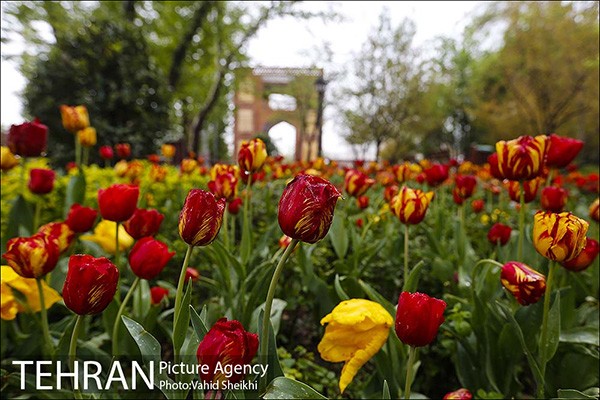
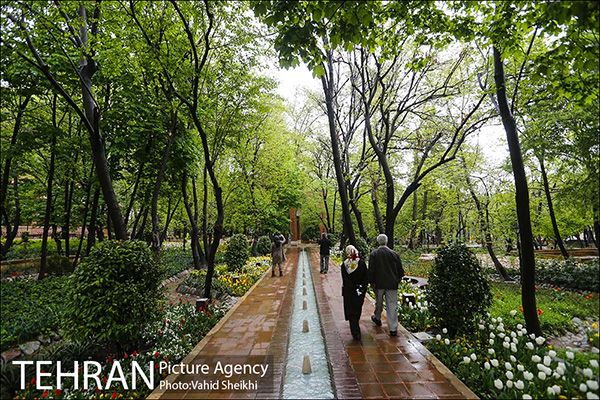
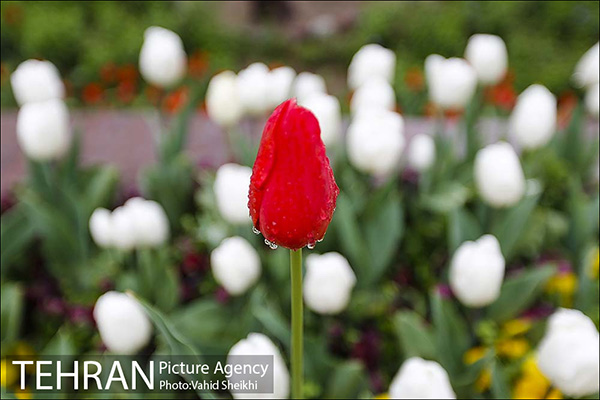
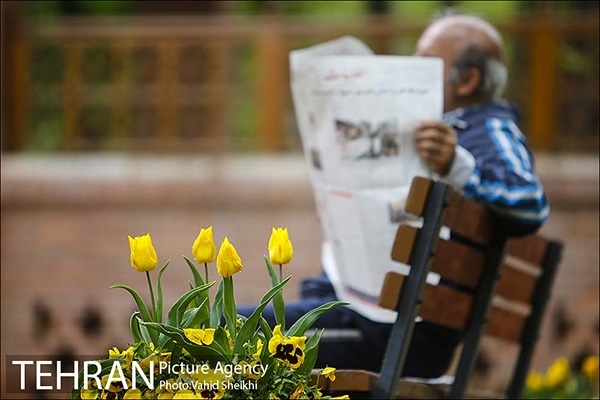
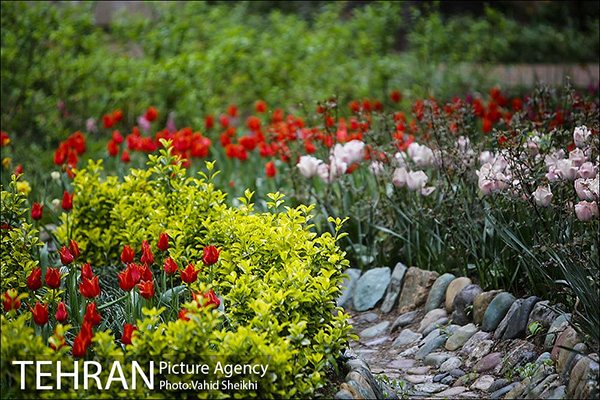
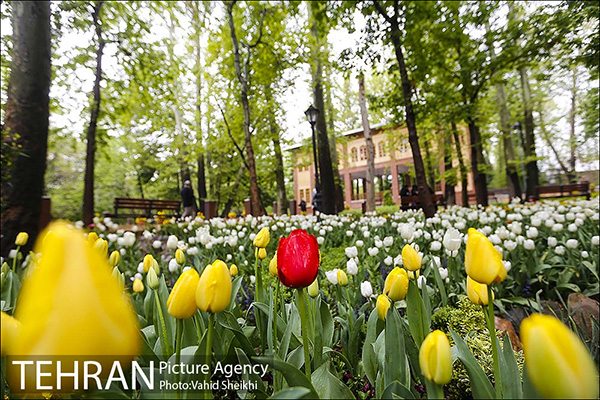
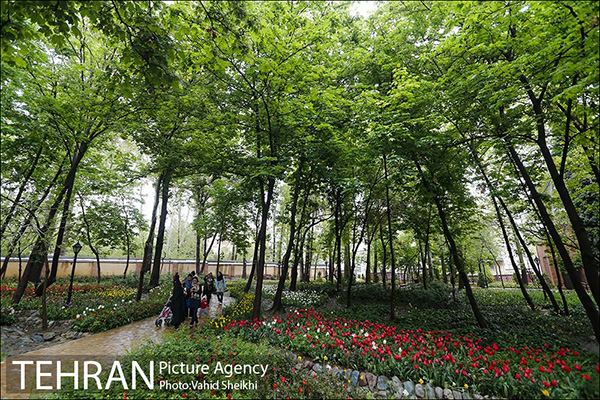
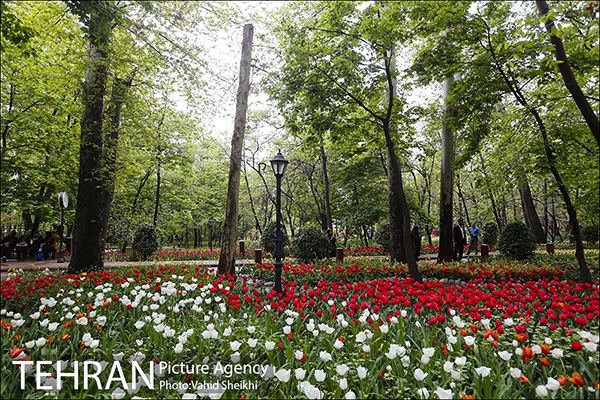
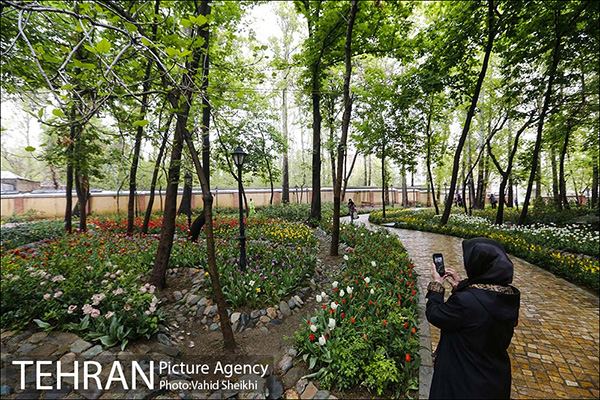
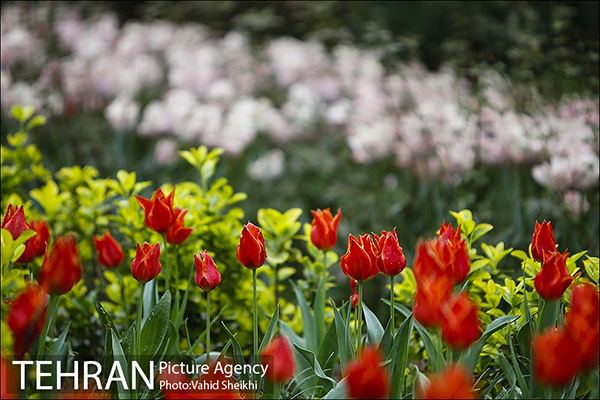
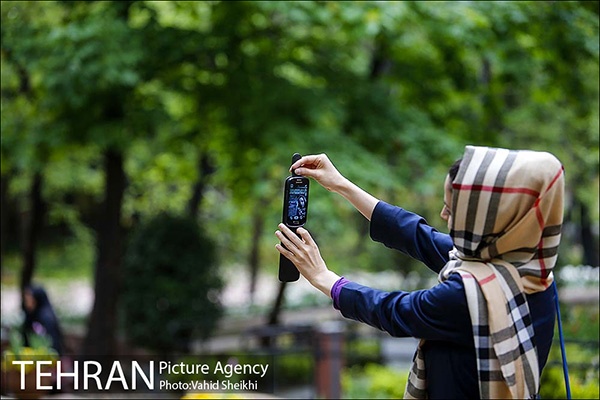
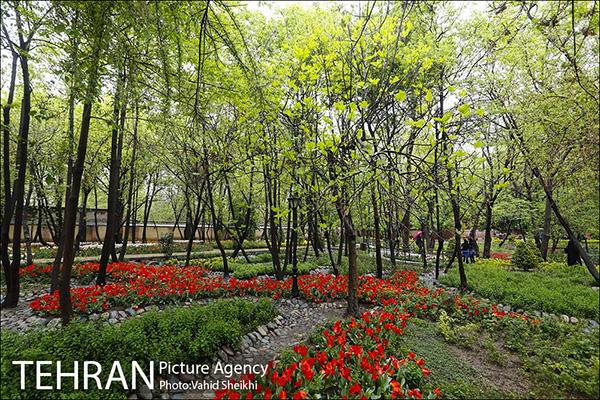
Persian garden Park, which is located in an old neighborhood of northern Tehran, is 3.4 hectares in area. The Persian-style park has become a wonderful sight of the capital, attracting a lot of visitors all year long, in particular on rainy days when flowers seem more lively and amazingly beautiful.
The snapshots below posted online by Tehran Picture Agency display the beauty of the park on a rainy day:
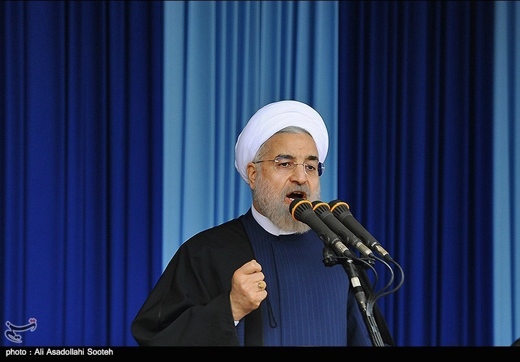
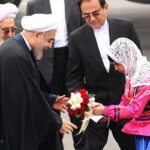
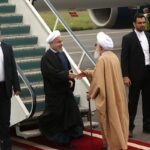
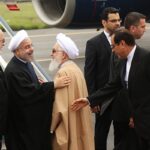
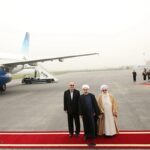
Iranian President Hassan Rouhani on Wednesday stressed that Iran is in talks over its nuclear energy program not with the US Congress but with P5+1 (the five permanent UNSC members plus Germany).
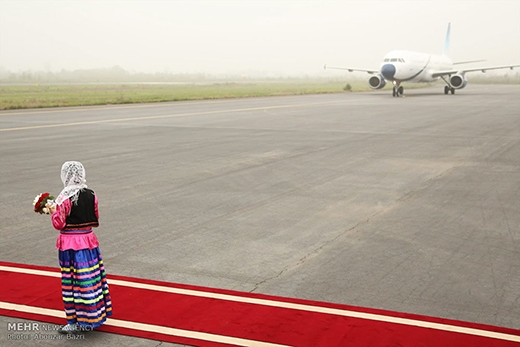
“What the US Senate says, what the US House of Representatives wants, what hardliners in the US seek, and what US puppets in the region say are none of our nation and government’s business,” Rouhani stressed, while addressing a huge gathering of people in Rasht, northern Iran.
He made the remarks in reaction to a legislation passed unanimously by the US Senate Foreign Relations Committee on Tuesday giving the Congress power to review a nuclear deal with Iran.
Rouhani went on to say that Iran is negotiating with all the countries in P5+1 (Russia, China, United States, Britain, France, and Germany), not the US Senate or House.
“We want interaction in return for interaction, goodwill for goodwill, and respect for respect,” he stressed.
The Iranian president reiterated that the world, P5+1, and the US Congress, administration, and president need to know that “there will be no deal if (anti-Iran) economic sanctions are not terminated.”
An announcement of the termination of the “cruel economic sanctions against the Iranian nation” once the deal is signed should be the point where the negotiations end, Rouhani reiterated.
He also reminded that the prospective nuclear deal will be to the benefit of the whole world.
“All European and American, eastern and western companies and even their governments are waiting for a final deal because it would benefit the whole world,” he underlined.
Back on April 2, Iran and P5+1 reached a framework nuclear agreement after more than a week of intensive negotiations in Lausanne, Switzerland, with both sides committed to push for a final, comprehensive accord until the end of June.
The framework provides a series of solutions that will be the basis of a comprehensive Joint Plan of Action.
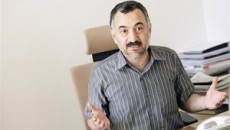
Saeed Laylaz, an economist and journalist, says nuclear talks between Iran and P5+1 which culminated in the Lausanne statement have rekindled hope in Iranian society and produced a big change. He says although the importance of the Lausanne agreement should not be blown out of proportion, it can boost Iran’s economic growth this year.
He takes a look at the performance of the eleventh government, saying that Dr. Rouhani’s administration has fared remarkably well, citing what it has done to crack down on [massive] corruption cases [his government has inherited from the past].
Etemaad, a reformist daily, on April 13 published an interview with Laylaz, who is also a lecturer and faculty member at Shahid Beheshti University, on the government’s domestic policies as well as efforts which could undermine or boost the government’s social base [in the country]. The following is a partial translation of what he said:
Social hope and popular expectations
I think Mr. Rouhani is the manifestation of national willpower, you may disagree with me in one way or another, though. Rouhani is the manifestation of national demands. How much can a president work simply relying on what he has at hand? He has tapped into all he has at his disposal to improve the situation.
People’s vote for Mr. Rouhani was in fact a vote which sent him – as manifestation of their thoughts – inside the establishment. The vote was not a call on him to meet public expectations. I think if Mr. Rouhani is unable to do something [to change the status quo], it means the existing structures do not allow for more to be done.
However, if he can get something done, it means that our national will wants it to happen. In the case of nuclear talks, for instance, the national will was calling for progress, so it happened.
There is a consensus among people from different walks of life and people in power [on the nuclear issue]. But when it comes to ending the house arrest [of the presidential hopefuls who disputed the 2009 election results and caused unrest in the country], the core of the establishment is opposed to the termination of the house arrest, thus the national will fails to play a role and nothing is achieved. This is not inability on Mr. Rouhani’s part; rather, it suggests that the stage is not set for the materialization of what people want to see happen.
[…]
Economic indicators
[…] The flat capital growth in the first three quarters of last year [ended in late March 2015] came after a 30 percent decrease in the two previous years. This shows we set out from a very dangerous point, but we managed to make up for all economic shortcomings of those years. If this trend persists this year, we can return to the point where we stood in the twelve months to March 2013. […]
That many people are not satisfied with the present conditions shows how critical the situation is. It has nothing to do with the inability of Mr. Rouhani.
To be honest, the president took over a government which was on the brink of collapse. It will take a long time to make up for the damage Iran has sustained on its economic, political and social structures. The damage cannot be undone in some areas, including outstanding bank debts. […]
It’s a big loss that almost one-third of Iran’s bank claims is never paid off. Sanctions, which are part of an organized plunder, have hit the economy. […] Compared with an Iran under the Reformist government, Iran has now slipped into $400 billion in accumulated capital deficit. […] Investment should rise twice as much what we have today for the country to be able to make up for the losses in a four-year period. […]
Social trust and hope
There is hope for sure, because there is no other option. People are waiting to see the situation change for the better, thinking that a promising future lies ahead for Iran this year, but domestic disputes remain in place.
Economic results of Lausanne agreement
Nuclear talks have dragged on for about two years with people in the country eagerly waiting for a deal. If clinched, the deal will surely leave a positive impact on society. The business atmosphere and the popular mood have heavily relied on such a deal, but it does not mean that it will come with overoptimism on the economic front. The market, including the stock exchange, is not consumed with excessive optimism [about better days ahead].
The [Lausanne] agreement has injected a sense of hope into the fabric of Iranian society and sparked off a transformation. From this perspective, I think the general psychological mood has become more hopeful and cheerful than before.
Lausanne agreement and next presidential vote
Dr. Rouhani will be certainly reelected for a second term, although it is premature to talk about what the future holds. We need to wait for both the practical outcomes of developments that follow the agreement and for other events which will play out after [2016] parliamentary elections. It’s too early to predict, but the agreement apparently will affect the results of the next [presidential] vote.
Lausanne agreement and economic reliefs
We should not magnify the agreement’s economic advantages. I think it will help the country pay less (by 10-15 percent) for its imported items compared with the price Iran has paid for imports throughout history, especially over the past several years.
It will also stabilize the value of the greenback [against the rial] and improve Iran’s foreign relations. In a two or three-year period, the agreement will boost the country’s economic growth by five to six percent; in other words, it will help national economy grow by two percent each year.
Rouhani and national will
Reformists account for the majority of people in Iranian society. I’m sure that more than 70 percent of the Iranians support reforms and reformists and their leaders. Reformism basically calls for renouncing violence, setting aside radical methods and caring about the country’s political fate.
In 2013, we voted for the best option; this is what we’ve always done. Some might argue there were better options [candidates] than Mr. Rouhani. Yes, that’s right. It can be also said about the head of the Reformist government [President Mohammad Khatami], but the fact of the matter is that nations always vote – in line with genuine frameworks – for the best option that can work in the existing system and look for an exit strategy [to get the country out of the deadlock]. People in Iran did the same thing with Mr. Rouhani. I’m sure our vote was for the right man.
Opponents and the eleventh government
Over the past one and a half years, we have put an end to a great deal of rent-seeking measures. The money – hundreds of millions of dollars in public funds – rent-seekers use each month has been reduced to almost zero. I wouldn’t be exaggerating if I said millions of dollars generated as a result of differences in interest rates is transferred by rent-seekers each year.
Each month different cases involving millions of dollars in foreign exchange embezzlement and the like are reported in the country. The Iranian economy was hit by astronomical misappropriation [of funds]. It is not the case anymore. Mr. Rouhani has done big jobs. That the transfer of the embezzled money has decreased compared with the past two years may sound strange to believe.
In such circumstances, it’s clear that some people begin to air grievances and some others hope to see better days and hear good news from the government.
Assessment of the government
Dr. Rouhani is more serious, perseverant and reformist than what we earlier thought. I think if he reruns for president and challenged by the same rivals, he will certainly garner more votes.
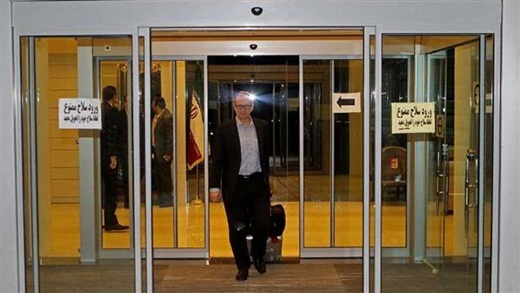
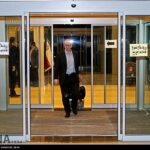
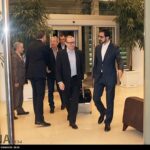
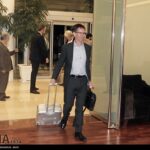
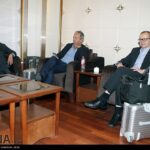
A delegation comprised of five experts from the International Atomic Energy Agency, headed by Tero Varjoranta, the IAEA deputy director general and head of the department of safeguards, arrived in Tehran on Wednesday.
Photos of their arrival by the Islamic Republic News Agency (April 15):
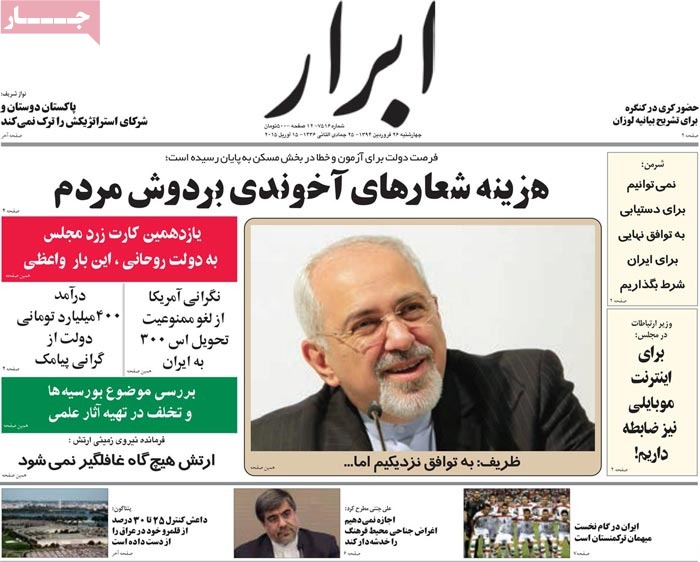
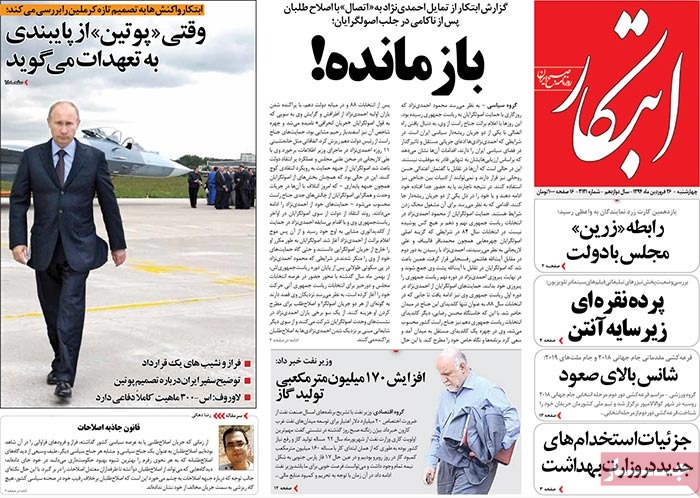
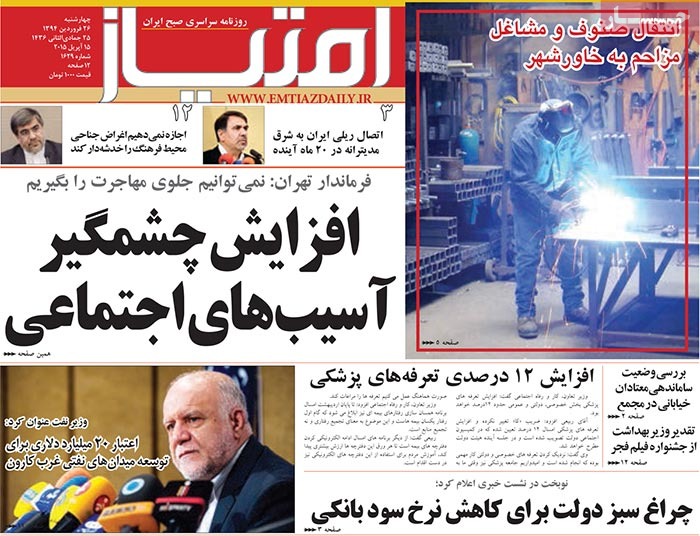
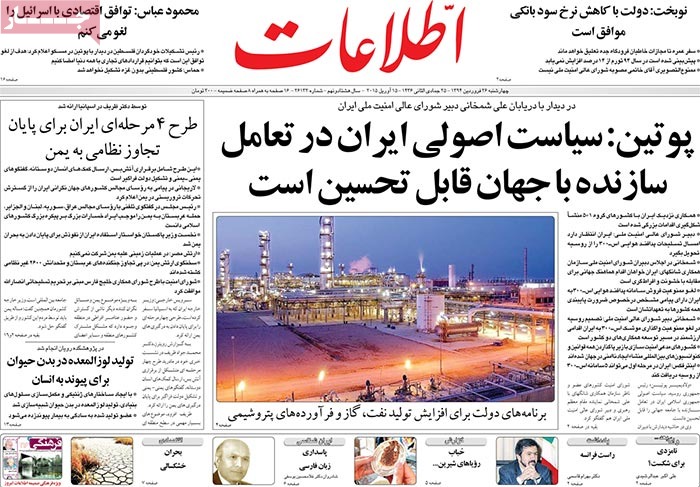
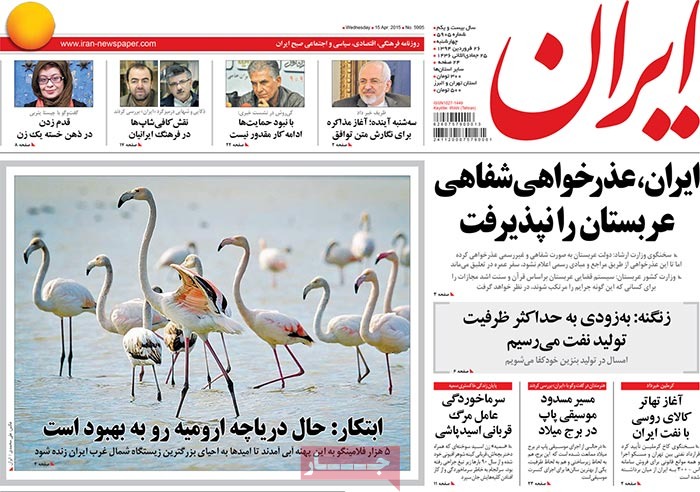
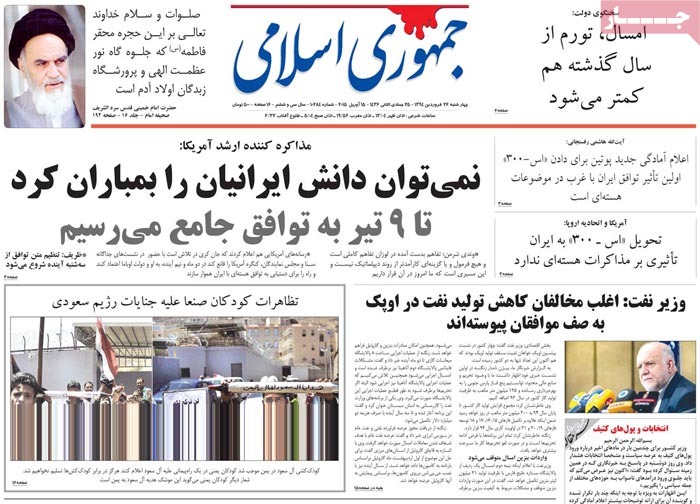
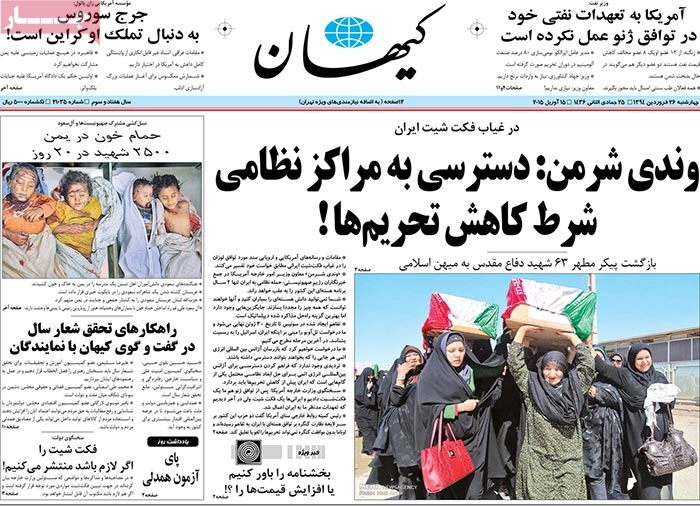
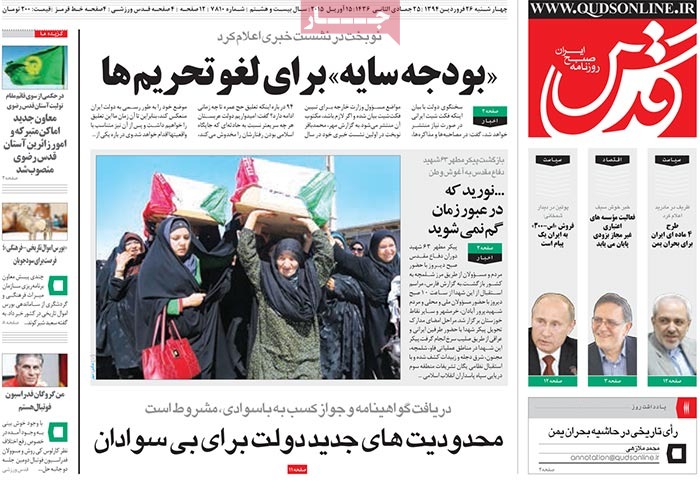
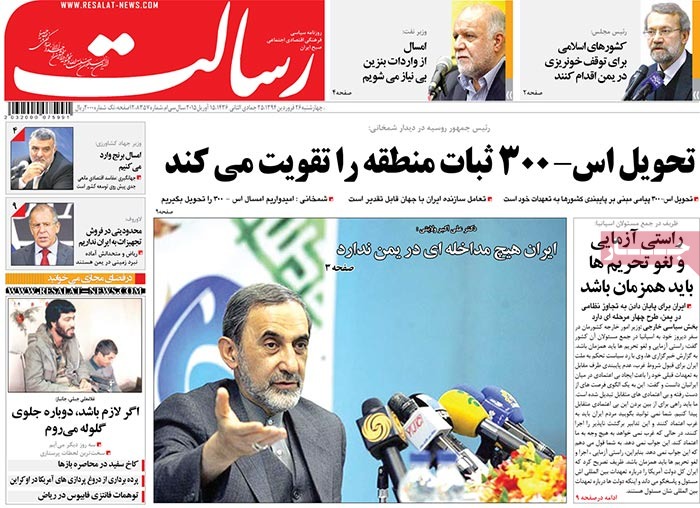
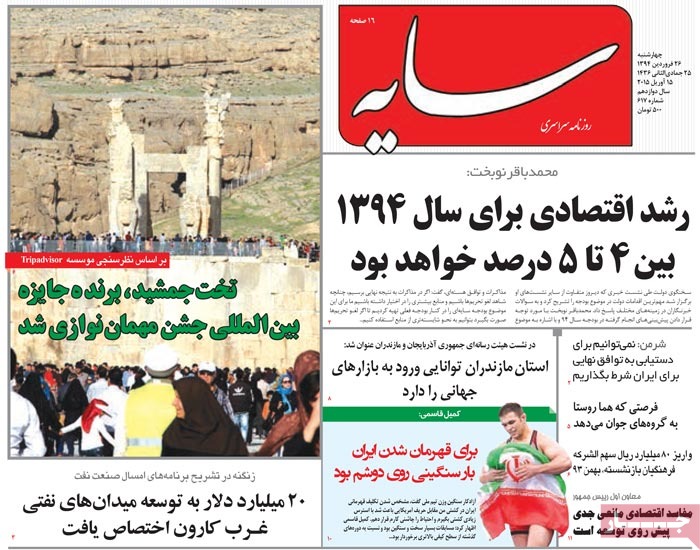
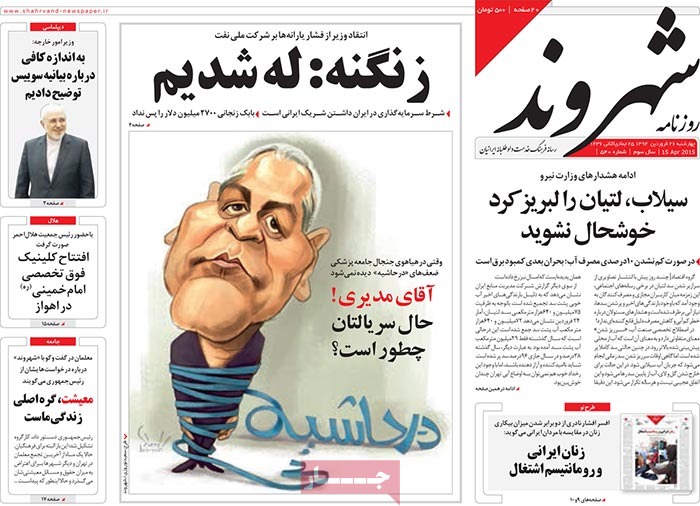
Comments by the oil minister about a wide range of issues, including hikes in natural gas and gasoline production, and about Babak Zanjani, a billionaire who stands accused of siphoning off the country’s oil money, dominated the front pages of Iranian newspapers on Wednesday. Also in the news were projections by the government spokesman about the country’s economic growth in the year ahead.
Abrar: “We won’t allow partisan bias to overshadow cultural activities,” said the minister of culture and Islamic guidance.
Ebtekar: The Outcast!
After failing to win over fellow principlists, [former President] Ahmadinejad seems interested in aligning himself with reformists.
Ebtekar: The Iranian oil minister has reported a 170 million cubic meter increase in natural gas production in the country.
Emtiaz: “Iran will be connected on rail to the Eastern Mediterranean within 20 months,” said the minister of roads.
Ettela’at: “Government favors a cut in interest rates,” said Government Spokesman Mohammad Bagher Nobakht.
Ettela’at: Iran has presented a four-stage plan to end military aggression against Yemen.
The plan made public by the foreign minister entails: a cease-fire, shipment of humanitarian aid, talks between Yemeni groups and formation of a broad-based government.
Iran: Iran has not accepted a verbal Saudi apology.
The spokesman of the Ministry of Culture and Islamic Guidance has said that as long as the apology does not come through official channels, Minor Hajj pilgrimage would remain suspended.
Jomhouri Islami: “Inflation will slip further this year,” promised the government spokesman.
Kayhan: Sixty-three martyrs of the Scared Defense have returned home.
Qods: New government restrictions for the illiterate
Getting driver’s and business licenses hinges on literacy.
Resalat: “Iran will no longer need to import gasoline later this year,” the oil minister said.
Sayeh: “Iran’s economy will post 4-5 percent growth this year,” said the government spokesman.
Sayeh: Iran’s Persepolis has won the hospitality prize in a poll conducted by tripadvisor.com.
Shahrvand: In case citizens do not cut back on water consumption by at least 10 percent, electricity shortage will be in the offing.
The warning by the Energy Ministry came after a dramatic surge in water levels behind Latian Dam prompted people to forget that they had just gone through a very dry winter.
Ahmad Irandoust, an Iranian bodyguard-turned-actor who has been hired in the past by Hollywood celebrities such as Jennifer Lopez, has recalled an encounter with US actor Steven Seagal when he was still the bodyguard of a Hollywood figure.
The following is the translation of his story which originally appeared on cinemapress.ir and then printed on April 14 by Haft-e Sobh daily:
I used to believe that martial arts performed by Steven Seagal were just acrobatic tricks, so I invited him to a fight at the backstage of a movie.
Seagal asked for a written waiver to be cleared of all responsibility in case anything happened to me in the showdown.
Immediately after I threw the first punch, I was thrown in the air and landed on the arm, sustaining multiple fractures to my hand.
In spite of the written deal, Seagal paid for the medical costs, apologized to me and said that he never thought that I would land on my arm.
A delegation of experts from the International Atomic Energy Agency (IAEA) has arrived in the Iranian capital, Tehran, to hold technical talks with Iranian officials.
The five-strong delegation, led by Tero Varjoranta, the IAEA deputy director general and head of the department of safeguards, arrived in Tehran on Wednesday morning.
The IAEA team is scheduled to hold one-day technical negotiations with the relevant Iranian officials within the framework of the implementation of the Framework for Cooperation.
The Joint Statement on a Framework for Cooperation was signed in November 2013 to outline a roadmap on mutual cooperation on certain outstanding nuclear issues between Iran and the IAEA.
Behrouz Kamalvandi, the spokesman for the Atomic Energy Organization of Iran (AEOI), said on Tuesday that the negotiations between Iranian officials and the IAEA team will end on Wednesday night, adding that the day-long talks between Iran and the UN nuclear agency will focus on the two issues of alleged explosives testing at a site in the western city of Marivan and neutron calculations.
Behrouz Kamalvandi, the spokesman for the Atomic Energy Organization of Iran (AEOI)
He also noted that Tehran has already responded to all of the IAEA’s questions about Iran’s nuclear program.
The IAEA claims that Iran has not yet addressed specific issues such as questions on alleged research activities into explosives testing and neutron calculations.
Iran has rejected the accusations as baseless and repeatedly emphasized its readiness for full cooperation with the IAEA as part of its transparency efforts to help settle the country’s nuclear issue.
The IAEA has never concluded in its reports on Iran that there has been diversion in the Islamic Republic’s nuclear energy program toward military purposes.
On March 2, IAEA Director General Yukiya Amano once again verified the lack of any diversion toward non-peaceful purposes in Iran’s declared nuclear material. All Iran’s nuclear activities are strictly monitored by the UN nuclear watchdog.
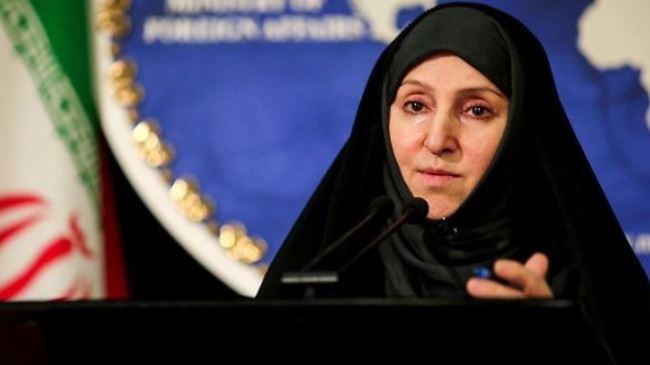
Iranian Foreign Ministry Spokeswoman Marzieh Afkham is to be accredited as the country’s first woman ambassador in the near future, Mehr News Agency reported on Monday.
She will reportedly head the Islamic Republic’s mission in an East Asian country.
The official has been serving as the ministry’s first woman spokesperson for more than a year.
It is not yet clear who will replace her as spokesperson.
Setting precedent has been Mansoureh Sharifi-Sadr, who served as the charge d’affaires of Iran’s Embassy in Japan during the ambassadorship of Abbas Araqchi, the current deputy foreign minister for legal and international affairs. Araqchi had preceded Afkham as the Foreign Ministry’s spokesperson.








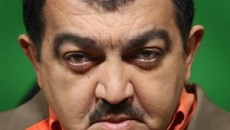 Ahmad Irandoust, an Iranian bodyguard-turned-actor who has been hired in the past by Hollywood celebrities such as Jennifer Lopez, has recalled an encounter with US actor Steven Seagal when he was still the bodyguard of a Hollywood figure.