Thursday, December 25, 2025
Home Blog Page 4914

Iran-P5+1 nuclear talks nearing end game: German envoy

Peter Wittig

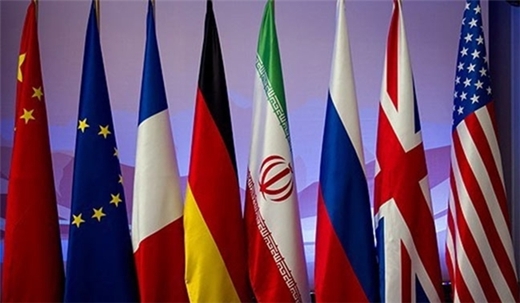
The German ambassador to Washington has described the talks between Iran and P5+1 over Tehran’s nuclear energy program as one of the most important foreign policy issues in the world, which is now nearing an end game.

“This is one of the most important foreign policy issues on, I think, the international agenda. We’re entering here into the end game,” Peter Wittig said in Washington on Monday.

Wittig, who was speaking along with the French and British ambassadors to American lawmakers about the nuclear talks, expressed hope that Tehran and the six countries can reach an “unambiguous, verifiable and permanent deal”.

“We harbor certain hopes that this will be possible, but there is still a lot of work to do on the negotiation table,” the German diplomat said.

He added that efforts to make the nuclear deal possible are “important and a high priority” for Germany.

“We made the case for not imposing sanctions, additional sanctions, while the negotiations were going on. That point was made clear to everybody,” Wittig pointed out.

The German envoy’s comments followed a warning by a group of US Republican senators that a potential deal between Washington and Tehran will be short-lived.

[…]

VP highlights Iran’s measures on gender Justice, women’s empowerment

Molaverdi

Iran’s Vice-President for Women and Family Affairs Shahindokht Molaverdi underlined the government’s firm determination to improve the social status of women, and unveiled plans for striking a balance between women’s capabilities and opportunities in Iran.

Addressing the 59th Session of the Commission on Status of Women at the United Nations Headquarters in New York on Monday, Molaverdi said Iran has formulated plans for realizing gender balance in various aspects of life.

Here is the full text of her speech to the gathering:

In the name of God, the Compassionate, the merciful

Madam Chair, Excellences, Ladies and Gentlemen,

At the outset, I would like to express my pleasure to be here in this gathering, which is an indication of the increasing importance that the world attaches to women’s affairs.

Madam Chair,

During the last year, the comprehensive progress assessment of the Millennium Development Goals (MDGs) identified the most important achievements and challenges in the course of the implementation of the MDGs for women and girls. Common issues in the DMGs and the Beijing Declaration and Platform for Action as well as the UN Secretary General’s report to the 58th session of the Commission on the Status of Women indicate that, despite some progress towards empowerment of women and girls at the global level and some success in some areas like education, however, progress towards the full realization of women’s human rights is still slow and imbalanced. As long as such obstacles as conflicts, insecurity, shortage of financial resources and investment, especially those emanating from sanctions, the weakness of accountability mechanisms or lack thereof, environmental challenges, and so on exist, it will be impossible to reach a comprehensive gender balance. Furthermore, in parallel with chronic, traditional challenges, emerging new ones in modern forms during the last 20 years have had their impact on preventing the full realization of the projected goals.

Madam Chair,

Throughout its 36 years of life, the Islamic Republic of Iran has always had the empowerment of women and improving their status in scientific, cultural, social, economic and political arenas on its agenda while observing their human dignity.

The elevated status of women in Islamic and Quranic scriptures has been a base for the codification of the Islamic Republic of Iran’s laws, including its Constitution. It guarantees women’s material and spiritual rights and provides a normative framework through which Iranian women can be actively present in various arenas while maintaining their human dignity.

Beyond achievements already at hand, in the executive branch, we can point to the resolute actions by the current Iranian government towards realizing gender balance in various aspects of life, and more importantly striking a balance among multiple roles of women in order to eventually bring about the advancement of women’s status, gender justice, and strengthening the institution of family. In this regard, the National Authority for Women’s Affairs was upgraded from a center to the level of Vice-President. Efforts are also being made to strike a balance between capabilities and opportunities, as far as the mission of this vice-presidency is concerned.

Madam Chair,

The Islamic Republic of Iran’s 20 year Vision Plan, as a multi-disciplinary document, has set out provisions on the ways and means on enhancing social justice, legitimate freedoms, protection of humans’ dignity and rights, social and judicial security, health, welfare, food security, social security, equal opportunities, appropriate distribution of income, acceptable sound environment and strengthening the institution of family, with no poverty, corruption and discrimination. Despite 8 years of imposed war on Iran and ever-increasing cruel, unjust sanctions against the Iranian nation, the Iranian women have achieved significant progress in the fields of education and research, science, entrepreneurship, economy and health, and continue to play their influential role in the society.

Nonetheless, the government of the Islamic Republic of Iran is not negligent to the relatively low rate of women’s participation in political and decision-making positions and in the labor market as well as the shortage of data by gender. Therefore, it makes any effort to resolve these issues and expedite the growing trend of women’s empowerment.

I would like to emphasize few more key points:

1.Politics and power relations at the international arena and adoption of unilateral, force-based measures by certain countries, including the imposition of unjust sanctions, serve as an obstacle in the path of development, particularly the empowerment of women. The international community should pay special attention to this important point and take a collective measure in order to avoid politicization of legal and developmental issues and to lift the unjust sanctions.

2. Given the direct relation between security and development, and bearing in mind that women and children have always been the main victims of wars and conflicts, it is important that the international community addresses various types of insecurity, and above all, any form of violence and extremism under any pretext, and include them in the post 2015 development agenda. The government of the Islamic Republic of Iran, as the initiator of the resolution on ‘a World against Violence and violent Extremis’, has already demonstrated its will to help realize this objective. It seems that an exit from the current situation urgently requires a motherly and womanly wisdom in global management so as for the world to become more secure, fair, and peaceful.

3. Complete fulfillment of the Beijing Declaration and Platform for Action requires identifying the root causes of the obstacles in the way of its realization and adopting new strategies and a comprehensive approach which does not overlook specific cultural, religious and historical characteristics of societies.

We should also bear in mind that the issue of women’s progress and empowerment has a mutual and close relation with social justice and human rights in general. Hence, it is necessary to include a gender approach in all development goals, in parallel with a specific goal focusing on gender justice. In this regard, increasing the responsibility of men along with boosting the regional and international cooperation is also necessary.

Republican senators’ letter nothing but propaganda ploy: Iran’s FM

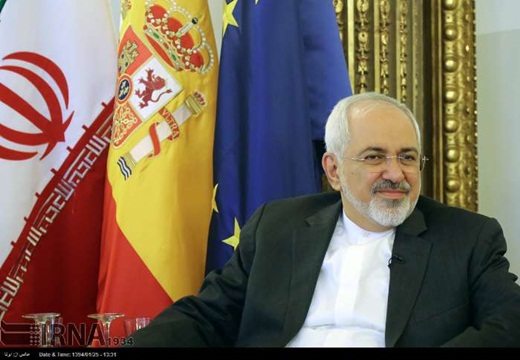
Fm Zarif

Iranian foreign minister and the country’s Chief nuclear negotiator said the recent open letter by a group of Republican senators about Iran’s nuclear talks has no legal value and is just a propaganda ploy.

When asked about the open letter of 47 US Senators to Iranian leaders, Mohammad Javad Zarif said, “In our view, this letter has no legal value and is mostly a propaganda ploy. It is very interesting that while negotiations are still in progress and while no agreement has been reached, some political pressure groups are so afraid even of the prospect of an agreement that they resort to unconventional methods, unprecedented in diplomatic history. This indicates that like Netanyahu, who considers peace as an existential threat, some are opposed to any agreement, regardless of its content.”

Zarif expressed astonishment that some members of the US Congress find it appropriate to write to leaders of another country against their own President and administration. He pointed out that from reading the open letter, it seems that the authors not only do not understand international law, but are not fully cognizant of the nuances of their own Constitution when it comes to presidential powers in the conduct of foreign policy.

Foreign Minister Zarif added, “I should bring one important point to the attention of the authors and that is, the world is not the United States, and the conduct of inter-state relations is governed by international law, and not by US domestic law. The authors may not fully understand that in international law, governments represent the entirety of their respective states, are responsible for the conduct of foreign affairs, are required to fulfill the obligations they undertake with other states and may not invoke their internal law as justification for failure to perform their international obligations.”

The Iranian Foreign Minister added that “change of administration does not in any way relieve the next administration from international obligations undertaken by its predecessor in a possible agreement about Iran’s peaceful nuclear program.”

“I wish to enlighten the authors that if the next administration revokes any agreement with ‘the stroke of a pen,’ as they boast, it will have simply committed a blatant violation of international law.”

He emphasized that if the current negotiation with P5+1 result in a Joint Comprehensive Plan of Action, it will not be a bilateral agreement between Iran and the US, but rather one that will be concluded with the participation of five other countries, including all permanent members of the Security Council, and will also be endorsed by a Security Council resolution.

Zarif expressed the hope that his comments “may enrich the knowledge of the authors to recognize that according to international law, Congress may not ‘modify the terms of the agreement at any time’ as they claim, and if Congress adopts any measure to impede its implementation, it will have committed a material breach of US obligations.”

The Foreign Minister also informed the authors that the majority of US international agreements in recent decades are in fact what the signatories describe as “mere executive agreements” and not treaties ratified by the Senate.

He reminded them that “their letter in fact undermines the credibility of thousands of such ‘mere executive agreements’ that have been or will be entered into by the US with various other governments.”

Zarif concluded by stating that “the Islamic Republic of Iran has entered these negotiations in good faith and with the political will to reach an agreement, and it is imperative for our counterparts to prove similar good faith and political will in order to make an agreement possible.”

Damavand destroyer joins Iran naval fleet

Damavand destroyer

Iran’s domestically-made destroyer, dubbed Damavand, officially joined the Navy’s northern fleet in the Caspian Sea on Monday.

The homegrown vessel, an advanced destroyer, was officially delivered to the naval forces stationed in fourth naval zone, north of the country.

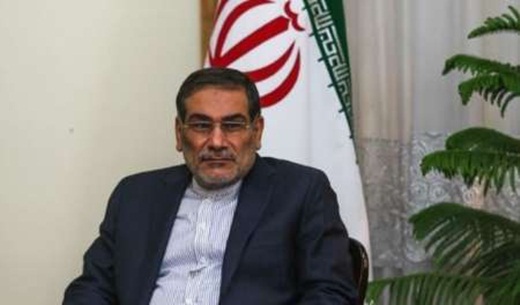
A number of ranking officials, including Secretary of Iran’s Supreme National Security Council (SNSC) Ali Shamkhani, Defense Minister Brigadier General Hossein Dehghan and Navy Commander Rear Admiral Habibollah Sayyari attended the ceremony in the port city of Bandar-e-Anzali.

More than 700 industrial, research and academic Iranian centers have cooperated in designing and producing the military vessel, which is also a training warship.

Experts at Iran’s Defense Ministry have installed 25 homegrown electronics and communication systems on Damavand, including advanced naval radars and systems for communication, detection and interception.

Damavand is a Jamaran-class destroyer with unique features to meet the demands of the Iranian naval forces in the country’s northern waters.

The advanced destroyer is capable of tracking the aerial, surface and sub-surface targets simultaneously.

Delbar, an Asiatic cheetah, might be expecting

Iranian cheetah-Delbar

Kooshki, a 7-year-old male, and Delbar, a 3-year-old female, are two Asiatic cheetahs who have been in captivity in Mian Dasht Wildlife Sanctuary in North Khorasan Province and in Khar Turan National Park in Semnan Province respectively. In December, the two big cats were transferred to a research site in Tehran where they first met.

What follows is the translation of a report the website of Iran Environment and Wildlife Watch posted on March 5 about how the two cheetahs are doing:

Acting on the expert advice of Sean McKeown, a foreign consultant of the Conservation of Asiatic Cheetah Project, Delbar and Kooshki spend three days together every 12 days.

The pair has established a very close relationship. The male cheetah seems to be enjoying the new company more than the female feline.

They are likely to have mated and there are speculations that Delbar is expecting. But, because the mating season has not finished yet, further tests and even a sonogram will be run in the presence of the foreign consultant in late March to determine whether she is pregnant.


Fabius has resumed throwing a wrench in the works

Laurent Fabius

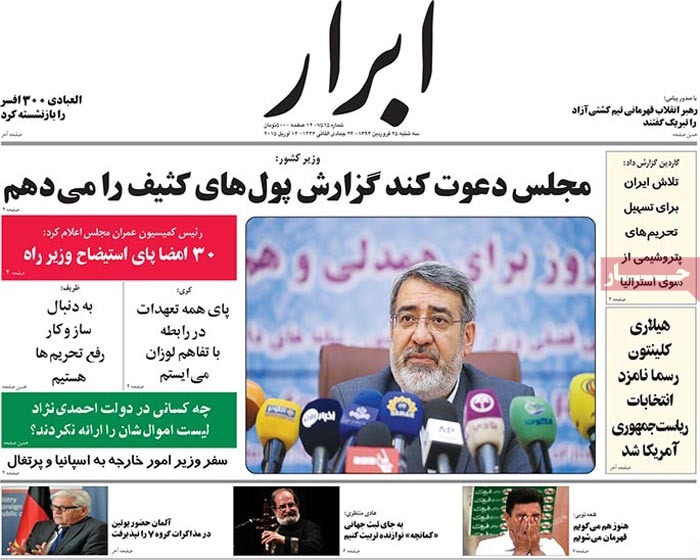
aftab-yazd-daily-newspaper-09-163Iran’s nuclear dossier took center stage in Paris one more time on March 7. Foreign ministers of P5+1 attended the meeting; but Iran’s top diplomat was not in the French capital for the meeting which seemed to be primarily aimed at playing up the role of Paris in talks than finding a solution to the nuclear case.

Paris seems interested in the repeat of what happened in preliminary negotiations between Iran and P5+1. The following is the translation of a report about the role of France in nuclear talks Aftab-e Yazd daily published on March 8:

French Foreign Minister Laurent Fabius said Friday, “There is still work to be done.”

He went on to say commitments offered by Iran in the nuclear talks with six world powers do not go far enough and more work needed to be done, notably on what he called “volume, checks and duration”.

His comments came as EU foreign policy chief Federica Mogherini, in two separate interviews, expressed optimism over conclusion of an agreement, saying that a good deal between Iran and the six world powers is at hand.

Those contradictory comments by two senior European diplomats suggest negotiations for a comprehensive deal are likely to result in the repeat of what happened in preliminary talks.

In the Geneva talks aimed at securing a preliminary deal, when all eyes were riveted to the negotiations between Iran and the US and there were growing speculations that an accord between them would guarantee a deal, it was France which hampered a deal.

A report released by Agence France-Presse (AFP) highlighted [deep] distrust between the two transatlantic allies and said there is a diplomatic fencing match behind the scenes between Paris and Washington over nuclear negotiations with Iran.

“Privately, American officials say there has been concern in Washington over the French position of publicly playing hardball, but then not backing up their words in the negotiations,” the report further said.

Measures by Paris are more of hindrance than help, because the difference in stances adopted by France and other members of P5+1 could put some of the achievements of the past two rounds of talks between Iran and the US – in Geneva and Montreux – at stake.

[On March 9, the daily filed a follow-up report featuring the comments of two experts on why the French foreign minister said what he said. In the report Ali Bigdeli, an international affairs expert, and Heshmatollah Falahatpisheh, a former MP, weighed in on the comments of Fabius. The following is the translation of part of what they said:]

Bigdeli:

In the buildup to the deal in November 24, 2013 similar remarks were made. Back then, Fabius and President Hollande paid a visit to Israel.

These two French officials are Jewish and under pressure from Tel Aviv and Jews in France. One should not forget the fact that France is home to the largest number of Jews in Europe.

Besides, because the French public deems the performance of Hollande as poor, by turning to such remarks, Fabius sought to display a muscle-flexing show, a gesture aimed at Jews in France and in Israel, as well as regional Arab countries. After America, France is the second largest provider of arms to Arab nations.

Therefore, his comments were merely a show of power and are not going to have any impact on nuclear talks which will carry on.

By making these remarks, Fabius sought to put across this message to the French that Paris does not comply with US policies, because the French are sensitive about America.

On the other hand, John Kerry has a very realistic approach to the talks and has made efforts to get the negotiations to this stage.

He consults with other countries because he seeks to maintain America’s friendship with them over other matters and avoids a go-it-alone approach.

The Americans are trying to turn Iran’s case into an international issue and thus have to consult with European countries; in doing so, they even have to visit Arab countries in the region to win them over.

Falahatpisheh:

What he said is not a show of might; rather, it is more a public diplomacy move.

The stances adopted by players such as France, Germany and Britain are among those taken in the line with public diplomacy. Official diplomacy is going on between Iran and America.

Video by Iranian Cheetah Society nominated for top prize in WLT competition

A few months ago an image of an Asiatic cheetah in Naybandan Wildlife Refuge, in Iran’s Yazd Province, became the overall winner of the research categories and rare species winner in the 2014 BBC Wildlife Camera-trap competition.

Now footage shot by camera traps of the Iranian Cheetah Society has drawn worldwide attention.

The video shot by a camera trap installed in Mian Dasht Wildlife Sanctuary has been nominated for top prize in the World Land Trust (WLT) International Trail Camera Competition in Britain.

The video shows two cheetahs and a camel coming to a water hole at the same time and the interesting behavior of one of the cheetahs in reaction to the camel.

“There was no need for discussion; at first glance, we were all unanimous about the film,” said a member of the jury.

The following is the footage the Iranian Cheetah Society (wildlife.ir) has released:

Strong presence in nuclear talks a national honor for Iran

Rouahni-Iran President

President Hassan Rouhani has said that Iran’s strong presence in nuclear talks with six world powers is a source of pride for the nation.

He made the remark Monday in an address to the opening of a gathering to pay tribute to the sublime status of martyrs.

He said such a presence is indeed an honor for the country as the leaders of Iran’s diplomacy are now engaged in a Jihadi war to defend the country.

As the country’s great commanders led the war against the enemies some years ago, now the Iranian diplomats are doing the same to defend the nation, the President stressed.

He went on to pay homage to the sublime position of martyrs and said that Iranians are proud of their leaders, namely the founder of the Islamic Republic the Late Imam Khomeini and the Supreme Leader of the Islamic Revolution Ayatollah Seyyed Ali Khamenei.

The President also noted that Iran’s engagement in the war (against the Iraq’s Saddam regime) was to defend the country, not to attack other nations or usurp other lands and countries.

He said that a nation which pursues the culture of Ashura and looks at Imam Hossein (PBUH) as a role model would never submit to oppressors or give up its ideals.

President Rouhani further said that Iran was not after invading any country or attacking any nation; rather, it sought to defend its own people, dignity and independence.

He said today’s resistance of the Iranian nation against the big world powers could not be possible without the sacrifices and resistance of the martyrs.

Iran’s light crude price rises by $9

Oil

Iran’s light crude prices rose by 9 percent reaching $54.33 per barrel in February, said the National Iranian Oil Company (NIOC).

Iranian heavy crude prices rose by $10 in February compared to the month before, reaching $52.22 per barrel.

On January 18, Iranian Economy Minister Ali Tayyebnia said Iran’s economy is powerful enough to win the battle against falling crude prices.

“The government’s plan is that it envisages different scenarios with regard to oil prices and prepares itself for any rate,” Tayyebnia said.

He said that there has never been any clear forecast of oil prices since the government started drafting its annual budget.

In December, Iranian Parliament Speaker Ali Larijani said exports of crude are just one of Iran’s sources of revenue and the country can live on without oil sales and through exports of its rich mineral resources as well as through reliance on modern industries and its talented people.

“We have different methods and scenarios to run the country under different circumstances and we will not forget which countries are conspiring to reduce oil prices,” Larijani said.

He said that the same countries conspired against Iran in the 1980s when Iran was at war with Iraq.

“It would be a mistake if they (certain governments) imagine that they can change the strategic situation of the (Middle East) through oil (prices),” said Larijani.

[…]

Iran ready to cooperate with Britain on reopening embassies: envoy

Iran-England

Iran’s non-resident chargé d’affaires to London said Sunday that Iran is ready to cooperate with Britain on reopening embassies.

Speaking to IRNA, Mohammad Hassan Habibbolahzadeh said, “We’ve had negotiations in this regard, but there are still issues that have to be resolved.”

Iran and Britain have decided to restore diplomatic relations and are determined to do so, Habibollahzadeh said.

“We have told our British side that we are ready to cooperate with them to solve the issues within the framework of the regulations of the Islamic Republic of Iran and conventions governing diplomatic relations,” he added.

However, he noted that relations with Britain are not an exception and are like diplomatic ties with other countries.