Thursday, December 25, 2025
Home Blog Page 4912

Iran urges activation of North-South Transport Corridor

Rouhani-Torkmenistan

Iranian President Hassan Rouhani has called for the further enhancement of trade exchanges along a transportation corridor which connects Oman, Iran, Turkmenistan and Uzbekistan.

Rouhani on Wednesday said more efforts are needed for the major transportation line, known as the North-South Transport Corridor, to be activated as it can serve the business and economic interests of the countries in the region.

“The two countries (of Iran and Turkmenistan) are determined to activate the North-South Corridor, which goes through Oman, Iran, Turkmenistan and Uzbekistan, in order to meet the interests of the all countries in the region,” Rouhani said in a press conference with his Turkmen counterpart, Gurbanguly Berdimuhamedow, in Ashgabat.

Rouhani added that Iran and Turkmenistan have agreed to expand their trade volume from the current $3.7 billion to $60 billion in the next 10 years, adding that the two sides have also decided to increase the volume of their trade via railway and road by three and two folds, respectively, in the same period.

Rouhani also stated that Iran is ready to help Turkmenistan’s industrial enterprises by providing technical assistance and basic materials.

He touched upon the potential for the cooperation of the two countries in the Caspian Sea, saying that Tehran is ready to engage in a joint operation with Ashgabat on marine-related activities including the activation of seaports and shipping lines.

“Iran and Turkmenistan view the Caspian Sea as the sea of peace, friendship and brotherhood,” Rouhani said.

In a meeting with Berdimuhamedow earlier in the day, Iranian President said Iran and Turkmenistan should tap into their potential to improve their bilateral relations.

Leader’s letter marks new chapter in spread of Islamic Revolution

Major General Mohammad Ali Jafari

A recent letter by Supreme Leader of the Islamic Revolution Ayatollah Seyyed Ali Khamenei to the Western youth marked a new chapter in the spread of the Islamic Revolution in the world, said the commander of the Islamic Revolution Guards Corps (IRGC).

“The export of the Islamic Revolution has entered a new stage today,” Major General Mohammad Ali Jafari said in a Wednesday address to Iran’s Assembly of Experts, referring to the Supreme Leader’s letter to the youth in Europe and America as one of its signs.

On January 21, Ayatollah Khamenei wrote a letter asking the European and North American youths not to judge Islam based on the recent terrorist attacks in Paris.

In his letter, the Supreme Leader urged Western youths to try to gain direct and firsthand knowledge of the religion in reaction to the flood of prejudgments and disinformation campaigns.

The commander also highlighted the Islamic Revolution’s regional clout, saying, “the Lebanese Hezbollah and its resistance against… the Zionist regime’s army is a miracle worked by the Islamic Revolution and (an indication of) the Islamic establishment’s powerful influence… in the region.”

Major General Jafari further stressed Iran’s effective advisory role in Iraq and Syria, saying that the IRGC commanders’ advisory assistance helped Iraq cleanse some of its regions of the ISIL terrorists.

“Today, not only Palestine and Lebanon, but also the people of Iraq and Syria acknowledge the Islamic Revolution’s influential role,” the commander added.

The ISIL militants made advances in northern and western Iraq last summer after capturing swaths of northern Syria.

However, a combination of concentrated attacks by the Iraqi military and the popular forces, who rushed to take arms after top Iraqi cleric Ayatollah Ali al-Sistani issued a fatwa calling for fight against the militants, have blunted the edge of the ISIL offensive.

Iran has repeatedly stressed that it will not interfere militarily in Iraq and Syria, but the Islamic Republic continues to provide support to both countries against ISIL in the form of defense consultancy and humanitarian aid.

Gen. Soleimani knows his stuff; the West should abandon adventurism

Major General Hassan Firouzabadi
Major General Ghasem Soleimani

Tasnim News Agency has quoted Chief of Staff of the Iranian Armed Forces Major General Hassan Firouzabadi as saying, “Commander of the IRGC’s Quds Force Major General Ghasem Soleimani is in Iraq in an advisory capacity. He is a senior commander who is good at fighting. He knows how to mobilize and guide forces against terrorists.”

Major General Firouzabadi added, “The Iraqis are extremely wise and the reason why services of our military advisors were required in Iraq was a breakdown of the Iraqi military order for which the Americans are to blame.”

When asked whether Iran is planning to have military presence in neighboring countries in case of an escalation, the general said, “Definitely, we won’t have a military presence. It’s up to nations to stand up for their own rights, so it’s not acceptable to send armed forces to other countries under the pretext of defense or establishment of peace. That’s why we have expressed opposition to what the Americans are doing.”

The top general added, “Every individual is morally and religiously duty-bound to make sacrifices in defense of his homeland.”

On Palestine, he said, “Jews who have formed a government in occupied territories are usurpers and cannot stay there. Holding democratic elections to ensure people’s right to self-determination is the way to settle the dispute. After democratic elections, Israeli Zionists can decide whether they want to stay or leave; basically it’s not a complicated issue to make so much fuss about.”

On Iran’s stance in nuclear talks, Firouzabadi said, “Time and again, we have said that we are not in pursuit of nuclear weapons. Everyone knows well the world will depend on nuclear energy when oil reserves are finished. The world powers want to keep us dependent and impoverished.”

He concluded, “It’s to the benefit of the West to come to an agreement with Iran and abandon its adventurism and plots. The West should let Iran develop and defend its neighbors.”

Iran, Turkmenistan should use potential to boost ties: Rouhani

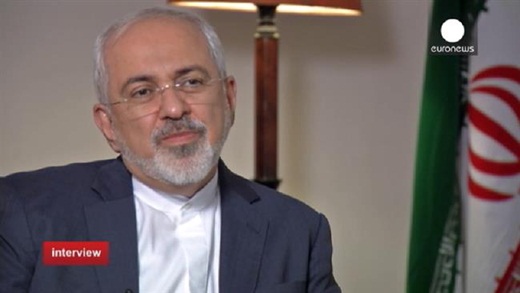
Iran-Turkmenistan-Rouhani-Zarif

Iranian President Hassan Rouhani says the Islamic Republic and Turkmenistan should tap into their potential to improve their bilateral relations.

“The officials of the two countries are well aware of the significance of very good bilateral relations, and we believe that we should utilize all existing potential to develop the ties,” Rouhani said during a meeting with his Turkmen counterpart Gurbanguly Berdimuhamedow in the Turkmen capital of Ashgabat on Wednesday.

Rouhani expressed hope that his talks with Turkmen officials during his visit to the Central Asian country would contribute to the promotion of reciprocal ties.

He welcomed his Turkmen counterpart’s invitation to attend a peace conference in the Central Asian country in late 2015 and said Iran always supports Turkmenistan’s policy of peace, friendship and impartiality.

The Turkmen president, for his part, praised friendly ties between Tehran and Ashgabat, saying the two countries have maintained good ties. He welcomed the further expansion of bilateral cooperation in different fields.

Stressing that the two neighboring countries enjoy common ground on the political front, Berdimuhamedow said that the Iranian and Turkmen governments have been working to contribute to global peace and security.

He also called for further enhancement of ties, particularly in the economic sector.

Heading a delegation, President Rouhani arrived in Ashgabat on Tuesday night on a two-day visit to discuss the expansion of ties between Tehran and Ashgabat.

A look at Iranian newspaper front pages on March 11

Iranian Newspapers Headlines

The election of Ayatollah Mohammad Yazdi as chairman of the Assembly of Experts dominated the front pages of Iranian dailies on Wednesday. Prediction by the government spokesman that the country’s economy will grow 2.5 percent next year was also in the news. Remarks by the foreign minister in a session of the Assembly of Experts on nuclear talks came under the spotlight too.


Abrar: As many as 155 Iranian MPs are working in sport federations.

[The minister of sports and youth made the remark, taking a swipe at members of parliament who are engaged in sporting activities.]


A look at Iranian newspaper front pages on March 11


Abrar-e Eghtesadi: India lends support to oil companies seeking to invest in Iran.


A look at Iranian newspaper front pages on March 11


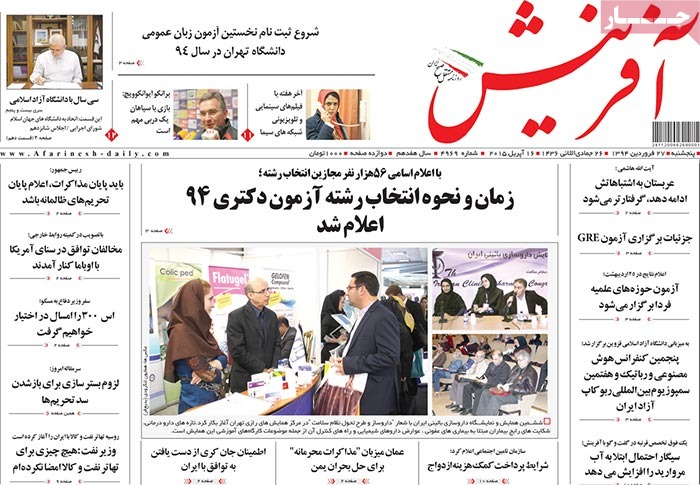
Afarinesh: Ayatollah Mohammad Yazdi was elected Chairman of the Expediency Council for one year.


A look at Iranian newspaper front pages on March 11


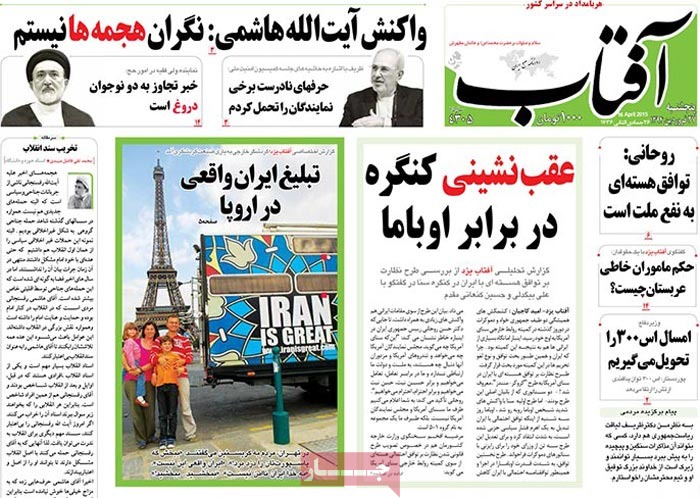
Aftab-e Yazd: “We should respect government officials. They are going through tough times,” said the president of Islamic Republic of Iran Broadcasting.


A look at Iranian newspaper front pages on March 11


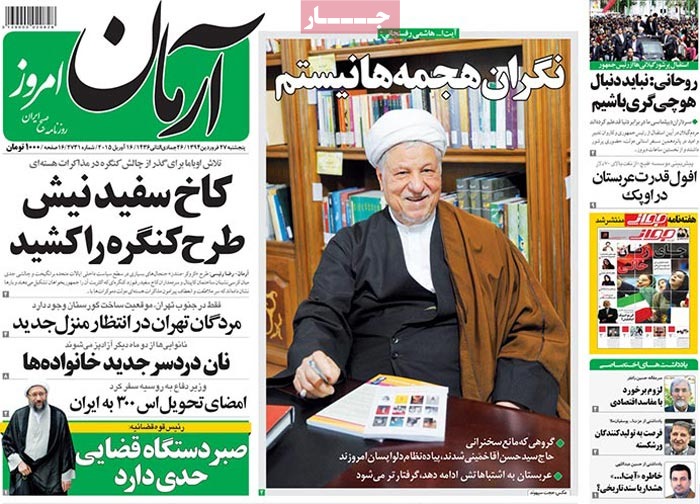
Arman-e Emrooz: Moscow has agreed to Iran joining the Shanghai Cooperation Organization.

Iranian president’s special envoy to Russia, Ali Akbar Velayati, made the remark about his meeting with President Putin.


A look at Iranian newspaper front pages on March 11


Asr-e Iranian: “We have failed in fixing the interest rates,” said Valiollah Seif, the governor of the Central Bank of Iran.


A look at Iranian newspaper front pages on March 11


Asr-e Rasaneh: “Peugeot [a French car giant] is to invest €100 million in Iran,” announced the head of Iran Khodro Industrial Group.


A look at Iranian newspaper front pages on March 11


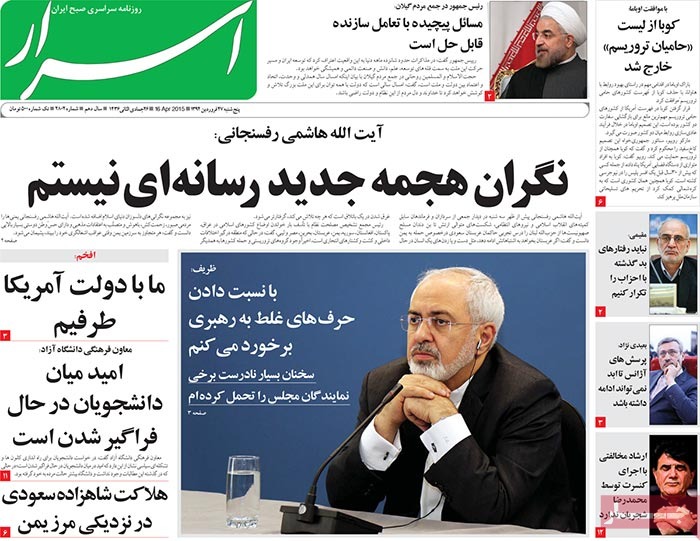
Asrar: “Apparently they wanted to kill or amputate me,” said Ali Motahari, a Tehran MP, about unknown assailants who recently targeted him in Shiraz.

Asrar: “Iran is expected to post a 2.5 percent economic growth next year [starting March 21, 2015],” said the government spokesman.


A look at Iranian newspaper front pages on March 11


Eghtesad-e Pooya: ” Pars Special Energy Economic Zone exported 40 percent of the country’s non-oil items last year [ending March 2014],” said the managing director of the zone on the Persian Gulf.


A look at Iranian newspaper front pages on March 11


Emtiaz: “High-income families will stop to get monthly cash subsidies,” said the deputy minister of cooperatives, labor and social welfare.
A look at Iranian newspaper front pages on March 11


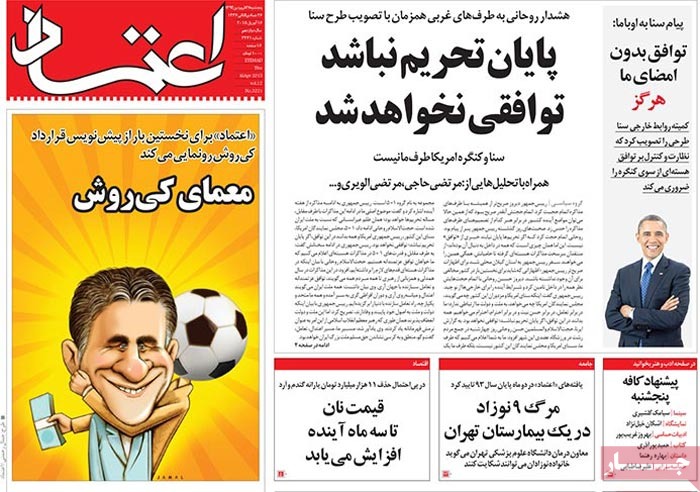
Etemad: “Contaminated ampoules were withdrawn from the market,” said the health minister, adding that 15 people lost their vision as a result of taking the fake eye drug.


A look at Iranian newspaper front pages on March 11


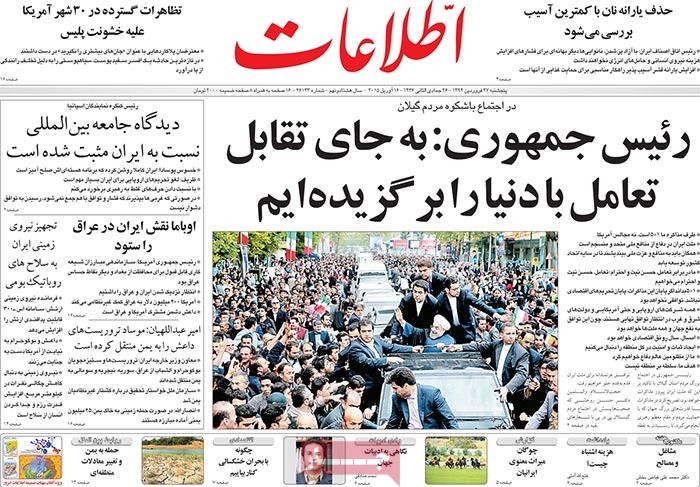
Ettela’at: “We try to help nuclear talks produce satisfactory results.”

Foreign Minister Mohammad Javad Zarif made the remark in the opening session of the Assembly of Experts.

Ettela’at: President Obama has strongly slammed Republicans for their letter to Iranian officials.


A look at Iranian newspaper front pages on March 11


Hambastegi: “Expansion of ties with regional countries is one of the top priorities of Iran’s foreign policy,” said President Rouhani before leaving for Turkmenistan.


A look at Iranian newspaper front pages on March 11


Honarmand: “Mastoor-o Mast links the East and the West,” said Homayoon Shajarian about his new album.


A look at Iranian newspaper front pages on March 11


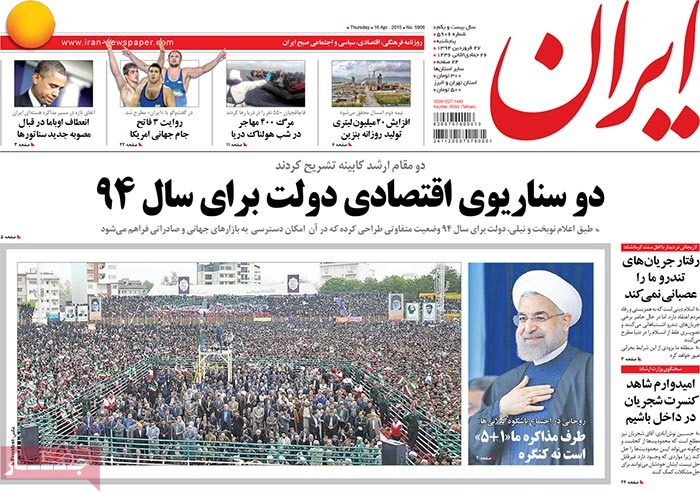
Iran: Some 63.6 percent of Iranians are optimistic about the government performance.

This is the result of a poll conducted in four stages in 30 provincial capitals.


A look at Iranian newspaper front pages on March 11


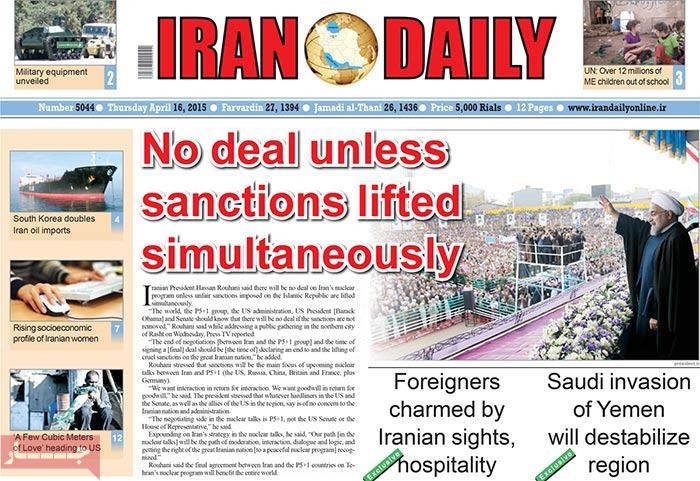
Iran Daily: Trade with EU countries topped €7.5 billion in 2014.


A look at Iranian newspaper front pages on March 11


Jomhouri Islami: The European Commission’s news website has announced that the value of trade between Europe and Iran has increased 21 percent.


A look at Iranian newspaper front pages on March 11


Kaenat: The budget bill was returned to parliament; the Guardian Council has found fault with [an article that deals with ways of] identifying high-income families.


A look at Iranian newspaper front pages on March 11


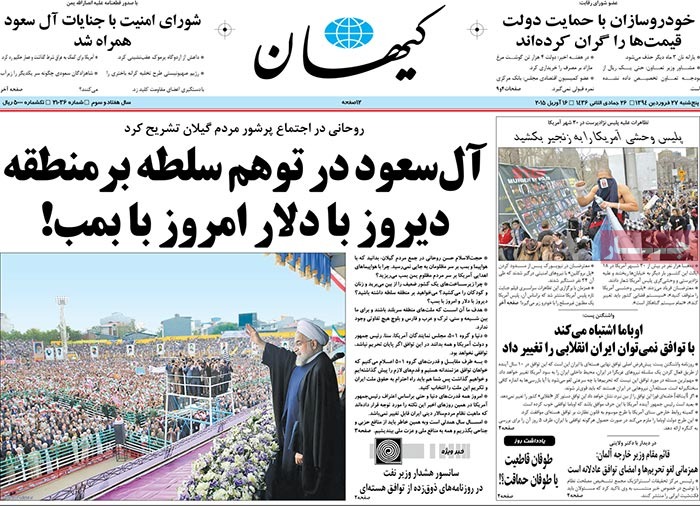
Kayhan: “If our proposal is rejected, Greece will open Europe’s doors to terrorists,” said the Greek defense minister.

[Athens has asked Europe to find a solution to the Greek debt crisis.]

Kayhan: The Iraqi army took the breath of terrorists; Tikrit turned into the graveyard of Takfiri terrorists.


A look at Iranian newspaper front pages on March 11


Kayhan International: Iran is fantastically rich when it comes to cultural heritage.


A look at Iranian newspaper front pages on March 11


Khorasan: “The Guardian Council has faulted a parliamentary decision which calls for the removal of the cash subsidies of high-income people,” said the chairman of parliament’s Budget Committee.


A look at Iranian newspaper front pages on March 11


Qods: “The US showed that it is not trustworthy,” said the foreign minister in reaction to the US Senators’ letter to Iranian officials.


A look at Iranian newspaper front pages on March 11


Sayeh: “The Education Ministry should sow the seeds of learning in the country,” said President Rouhani.


A look at Iranian newspaper front pages on March 11


Shahrvand: A coordinated response by Tehran and Washington to 47 US Senators

Shahrvand: “We are moving back toward illiteracy,” said the education minister.


A look at Iranian newspaper front pages on March 11


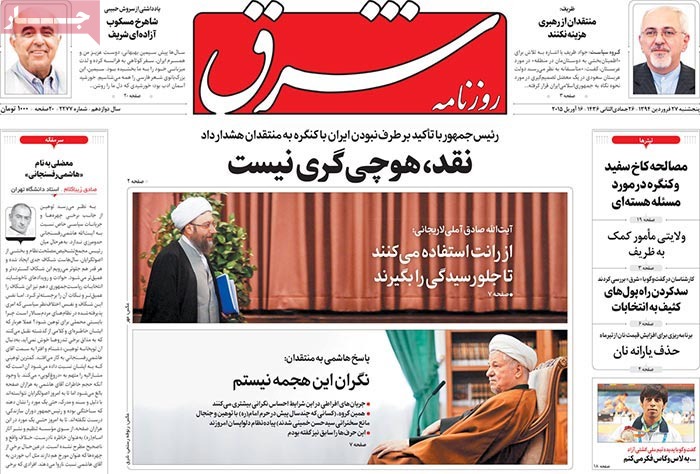
Sharq: “Common sense dictates that we should support the country’s diplomacy team [in nuclear talks with P5+1],” said Ayatollah Mahmoud Hashemi Shahroudi, a member of the Assembly of Experts.

Sharq: A former critic of Hashemi [Rafsanjani] takes the chairmanship [of the Assembly of Experts]; Ayatollah Yazdi replaced the late Ayatollah Mahdavi Kani.


A look at Iranian newspaper front pages on March 11


Tafahom: “Diplomacy is there to reduce costs,” said FM Zarif in the Assembly of Expert.


A look at Iranian newspaper front pages on March 11


Tehran Times: Iraqi army, volunteer forces enter Tikrit from multiple directions.


A look at Iranian newspaper front pages on March 11


Tejarat: “We are planning to unify the foreign exchange rate next year,” the governor of the Central Bank of Iran promised.


A look at Iranian newspaper front pages on March 11


Zarif-Kerry to meet in Lausanne next week

Iran-US-IranTalks

Iranian and US nuclear negotiators are to conduct concise talks in the Swiss city of Lausanne next week.

They will also have a short visit to Brussels for discussions.

The Iranian team will be led by Foreign Minister Mohammad Javad Zarif who is going to hold talks with his American counterpart John Kerry.

They are planning to resume the talks and pick up where they left off in Monteux, Switzerland last week. A European Union (EU) representative will also attend the talks.

Zarif, accompanied by his deputies Abbas Araghchi and Majid Takht Ravanchi will be hosted by the EU Foreign Policy Chief Federica Mogherini during his brief Brussels visit.

Mogherini has invited Foreign Ministers of Iran, Britain, France and Germany to Brussels.

Zarif will return to Laussane then to resume talks with US nuclear delegation.

All sides in Iran’s nuclear negotiation process hope to clinch a political agreement by the end of March and a comprehensive accord by July to finally end the 12-year nuclear row.

Nanotechnology tapped to produce strong aluminum alloy

aluminum alloy

Researchers at Amirkabir University of Technology in cooperation with Spanish scientists have developed a new process through which ultrafine grained and nanostructured materials with high strength can be produced.

The Islamic Republic News Agency reported on March 10 that aerospace and auto-making industries as well as those in which aluminum and other light metals are used have welcomed the research results.

Iran’s Nanotechnology Initiative Council said that nanocomposites and nanostructured metals can be produced through this method.

Sajad Amirkhanloo, the project researcher, said, “Production of alloys whose strength is a few times more than common alloys, reduction in production costs and energy consumption as well as promotion of efficiency in the final product are the advantages of the new method.”

The results of the research work have been published in the journal of Scripta Materialia.

Sajad Amirkhanloo, a PhD holder in Metallurgical and Materials Engineering from Amirkabir University of Technology, Dr. Mostafa Ketabchi and Dr. Nader Parvin, both faculty members at Amirkabir University of Technology along with a group of Spanish researchers from CENIM-CSIC (del Centro Nacional de Investigaciones Metalurgicas) have contributed to the project.

A normal day in world’s parliaments with fighting politicians (Photos)

Parliaments

Politicians in different countries go out of their way when they express themselves, and this at times results in shameful physical conflicts.

The following are a series of pictures Mehr News Agency released on March 10 on parliamentary brawls between lawmakers and statesmen from across the world. Take a look:


Without collective contribution, provision of minimum social support is impossible: Minister

Ali Rabii

On March 10, the Islamic Republic News Agency quoted Minister of Cooperatives, Labor, and Social Welfare Ali Rabiei as saying, “Listening to the deprived class of society who has no platform to have its voice heard is the minimum and most important social support government can lend.”

Speaking at an international conference on social support in Tehran, Rabiei added, “The Government of Hope and Prudence pursues the policy of listening to the voices of all classes of society.”

The minister underlined that without collective contribution, it would be impossible to provide minimum social support, calling on all institutions, ranging from families to political entities, to contribute.

Describing the 11th government as humble, Rabiei said, “A humble government is one which modestly tries to spot its weaknesses and express respect for the knowledge of others.”

He said, “If the tremendous potential of lower classes of society is tapped, it can resolve a lot of social problems. If voices of all classes of society are heard, a great achievement is made.”

The minister concluded, “This gathering can be regarded as a step toward fulfillment of the objectives of the Government of Hope and Prudence which plans to listen to all voices.”

UK official says pursuing embassy reopening in Tehran

Douglas Alexander

The British shadow foreign secretary says he is seriously pursuing the reopening of the UK embassy in the Iranian capital, Tehran.

During a meeting with a delegation of Iranian parliamentarians on Tuesday in London, Douglas Alexander also underlined the need for promotion of ties between Tehran and London.

The British politician said that the UK has made mistakes with respect to its relations with Iran in the past, but that his country would hopefully make positive and constructive moves for a better future.

The member of the Labor Party in the British House of Commons also expressed the shadow administration’s readiness to contribute to the settlement of problems surrounding Tehran’s nuclear issue. Britain is a member of P5+1engaged in talks with Iran over its nuclear program.

Alexander also highlighted Iran’s significant role in the Middle East and the world, saying London is keen to cooperate with Tehran in different areas.

For his part, the head of the Iran-Britain Parliamentary Friendship Group Abbas Ali Mansouri Arani, said that Iran is willing to promote ties with the UK based on the Islamic Republic’s national interests.

In November 2011, Iranian lawmakers voted by a large majority to downgrade diplomatic ties with the UK in response to Britain’s decision to impose sanctions on the Central Bank of Iran over the allegation that Tehran is pursuing non-civilian objectives in its nuclear program.

Two days after the decision by the Iranian Parliament, hundreds of Iranian students staged a protest outside the British embassy in Tehran, pulling down the UK flag and demanding the expulsion of the British ambassador.

Following the incident, the 10 Downing Street announced in November 2011 that it is withdrawing its diplomatic staff from Iran and that the Iranian embassy in London would be closed.

Nearly two years after their diplomatic ties were severed, Iran and Britain agreed in October 2013 to appoint non-resident chargés d’affaires as a first step toward reopening their respective embassies.