Friday, December 26, 2025
Home Blog Page 4909

Queiroz: I will never say good-bye to Iranians for good

Carlos Queiroz

Iranian national football team coach Carlos Queiroz has said that he cannot say good-bye to the Iranians for good, citing the strong bond he has developed with the Iranian people.

Fararu, a news website, on March 21, published the coach’s remarks and news on his travel ban. The following is a partial translation of the report:

Queiroz said that he is going to peacefully quit his post after he learnt that certain people do not want him to stay in the job.

This comes after his decision to resign was announced on Friday following his meeting with Head of Iran’s Football Federation Ali Kafashian in which the two men agreed to terminate cooperation.

Before handing over the job, Iran’s Portuguese coach is expected to lead the Iranian squad in two friendlies it is to play against Chile and Sweden later this month.

Queiroz also congratulated the Iranians on Nowruz and said that he has a strong feeling for people in Iran and cannot say good-bye to them forever, adding the decision [to leave the national team] was not his to make.

He said that Iran has the potential to be the best team in Asia.

On Saturday, news agencies reported that Queiroz was barred from leaving Iran. The Iranian national team coach, who was to leave for Sweden and then to Austria to lead the Iranian team for warmup games before the two friendlies against Chile and Sweden, failed to accompany his team on its overseas tour.

Meanwhile, Ali Kafashian has said that he would come to Tehran [from Kish] to solve the tax problem of the Iranian coach and remove the ban on his travel.

Rouhani vows to increase job opportunities, non-oil exports

Rouhani-Iran-1394

Rouhani made the statement in his annual message to the Iranian nation on the occasion of the Persian New Year early on Saturday.

He also hailed the Iranian nation for standing by the government in the implementation of the resistance economy.

Without the support of the nation, it was impossible for the government to reduce inflation, recession and the economy’s dependence on oil revenue.


What was Iran’s most important political event in 1393?

Iram Map

The year 1393 [March 21, 2014 – March 20, 2015] was full of different incidents and challenges for Iran on different fronts.

Alef, a news website, has carried out an online poll, asking the respondents to choose the most important events of the year on political, social, economic and cultural fronts.

The following is a translation of the online survey Alef released earlier in March:

The viewers were asked to choose the most important events in different areas and share them with other people. Those taking part in the poll are also asked to explain the reason(s) why they picked the event(s) from the following list:

* Extension of the Geneva deal and nuclear talks [between Iran and P5+1]

* The execution of Mahafarid Amir-Khosravi, convicted of massive corruption

* The Supreme Leader’s historical letter to the youth in the West

* An incomplete speech by principlist Tehran MP Ali Motahari in the Islamic Consultative Assembly [who was attacked by fellow MPs]

*The death of Ayatollah Mahdavi Kani, the chairman of the Assembly of Experts and the leader of the Combatant Clergy Association

* The conviction of former first vice-president Mohammad Reza Rahimi and his imprisonment

* Trial of Mehdi Hashemi, a son of Ayatollah Hashemi Rafsanjani, and his conviction

* The impeachment and ouster of the science minister, a first impeachment in the eleventh government

* The attack on the car carrying Ali Motahari, a Tehran MP, in Shiraz before his planned speech which was called off

* The popularity of Major General Ghasem Soleimani, the commander of the IRGC Quds force, in Iran and across the region

Zarif has described talks with Kerry as positive

zarif press

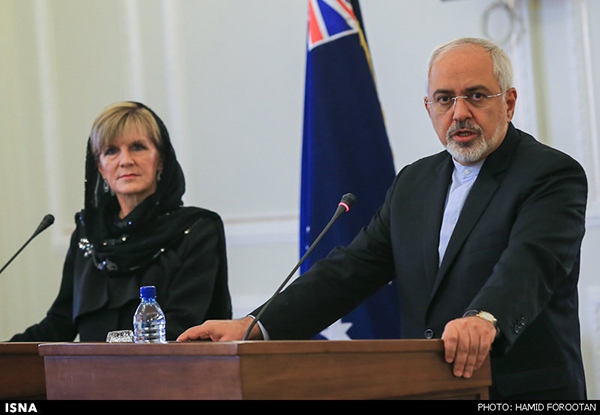
Iranian Foreign Minister Mohammad Javad Zarif said Friday nuclear talks are at a sensitive stage and that his negotiations with US Secretary of State John Kerry earlier in the day have been “positive”.

“On each front there are a couple of issues which have yet to be settled. Naturally these issues are the most difficult,” the Iranian top diplomat said.

Zarif’s deputy Seyyed Abbas Araghchi, meanwhile, said in light of the fact that the US and the European members of P5+1 need to coordinate things, nuclear talks are expected to resume on March 25.

In another development, Secretaries Kerry and Moniz paid a visit to Hossein Fereydoon [President Rouhani’s brother and special adviser] to offer condolences to him on the passing of his mother.

Iranians for engagement with dignity: Zarif to Obama

Mohammad javaz zarid twitter

Foreign Minister Mohammad Javad Zarif on Friday responded in his twitter account to the video message of US President Barack Obama to Iranians on the occasion of Nowruz.

Zarif tweeted, “Iranians have already made their choice: Engage with dignity.”

He also urged the US government to make the right choice saying that the US and its allies are expected to choose between two options: Pressure or agreement.

On Thursday, President Obama said that Iran has met its commitments under the interim nuclear deal and that there has been progress in nuclear talks between Tehran and P5+1.

“Just over a year ago we reached an initial understanding regarding Iran’s nuclear program and both sides have kept our commitments,” Obama said in a video message marking Nowruz, the Persian New Year.

Iran and P5+1 – the US, Britain, Russia, China, France and Germany – are currently negotiating to reach a comprehensive agreement on Tehran’s peaceful nuclear program as a deadline slated for July 1 draws closer.

On the fifth day of the latest round of negotiations in the Swiss city of Lausanne, a meeting was held between Iranian Foreign Minister Mohammad Javad Zarif and US Secretary of State John Kerry.

Following his talks with Kerry, Zarif said that the negotiations have reached an extremely complicated point.

The two sides have already missed two self-imposed deadlines for inking a final agreement since they signed an interim accord in the Swiss city of Geneva in November 2013.

Foreign Minister Zarif named Iran’s man of the year

Happy Zarif

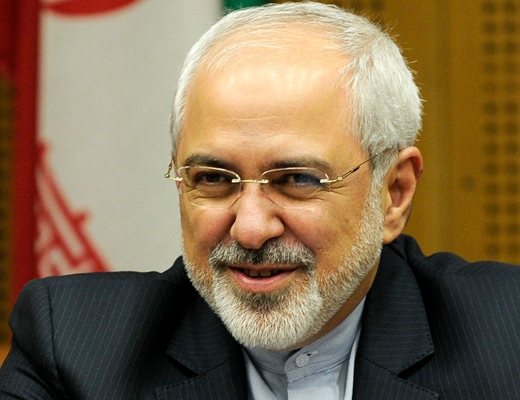
Foreign Minister Mohammad Javad Zarif has been named Iran’s man of the year [starting March 21, 2014], a poll showed.

In an online poll conducted by Tabnak, a news website, Foreign Minister Zarif garnered more than 50 percent of the votes. He was followed by commander of the IRGC Quds Force Major General Ghasem Soleimani, who secured over 28 percent of the votes.

Tehran MP Ali Motahari and Health Minister Hassan Ghazizadeh Hashemi came in third and fourth respectively.

The online survey also suggested that those polled believed that interaction with the rest of the world and struggle for the sake of Iran – when necessary – are the country’s top priorities.

President Hassan Rouhani, Chairman of the Expediency Council Ayatollah Akbar Hashemi Rafsanjani, a former science minister Reza Farajidana and Iranian mathematician Maryam Mirzakhani finished fifth through eighth in the online polling.

Afkham: Recent vote not to change Israel aggressive policy

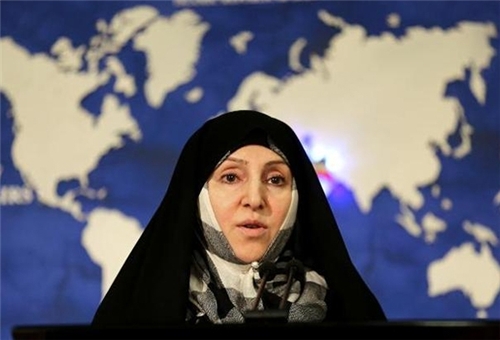
Ms. Marzieh Afkham

Iran says it expects no change in Israel’s policies following the recent general elections since all the regime’s parties follow the same aggressive approach.

Speaking at her weekly press conference on Wednesday, Foreign Ministry Spokeswoman Marzieh Afkham said that the Israeli parties all have an “aggressive nature.”

“The Israeli parties are the same and they are all accomplices in crimes against the Palestinians and in the acts of aggression,” she added.

Israeli Prime Minister Benjamin Netanyahu’s Likud party has claimed victory in Tuesday general elections.

With nearly all the votes counted, the Likud party has now secured 30 seats in the 120-member parliament.

Afkham described the latest round of talks on Iran’s nuclear program as “very intensive, sensitive and complicated” and noted the Iranian negotiating team is seeking to bridge differences in the negotiations.

“We have also made good progress on the technical aspect and as the head of the Atomic Energy Organization of Iran (AEOI) said in an interview, a great number of technical issues have been settled and the talks are still going on over political issues as well as sanctions,” Afkham said.

The latest round of talks on Tehran’s nuclear program kicked off in Lausanne on Sunday. The negotiations are led by Iran’s Foreign Minister Mohammad Javad Zarif and US Secretary of State John Kerry.

On Wednesday, Ali Akbar Salehi, the head of the AEOI, and US Energy Secretary Ernest Moniz resumed their talks on technical issues in Lausanne.

Iranian Deputy Foreign Ministers Abbas Araghchi and Majid Takht-e Ravanchi were also scheduled to sit down with US Under-Secretary of State for Political Affairs Wendy Sherman later in the day.

On Tuesday, Salehi said that Tehran and Washington have resolved their differences over 90 percent of the issues in the talks.

“We have reached mutual understanding on 90 percent of technical issues,” Salehi told IRIB news, adding that “there remains only a single sticking point, which is very important.”

Iran and P5+1 – the United States, Britain, France, China, and Russia plus Germany – are seeking to seal a comprehensive nuclear deal by July 1.The two sides have already missed two self-imposed deadlines for inking a final agreement since they signed an interim one in the Swiss city of Geneva in November 2013.

Foreign Minister Zarif named Iran’s man of the year

Mohammad Javad Zarif

Foreign Minister Mohammad Javad Zarif has been named Iran’s man of the year [starting March 21, 2014], a poll showed.

In an online poll conducted by Tabnak, a news website, Foreign Minister Zarif garnered more than 50 percent of the votes. He was followed by commander of the IRGC Quds Force Major General Ghasem Soleimani, who secured over 28 percent of the votes.

Tehran MP Ali Motahari and Health Minister Hassan Ghazizadeh Hashemi came in third and fourth respectively.

The online survey also suggested that those polled believed that interaction with the rest of the world and struggle for the sake of Iran – when necessary – are the country’s top priorities.

President Hassan Rouhani, Chairman of the Expediency Council Ayatollah Akbar Hashemi Rafsanjani, a former science minister Reza Farajidana and Iranian mathematician Maryam Mirzakhani finished fifth through eighth in the online polling.

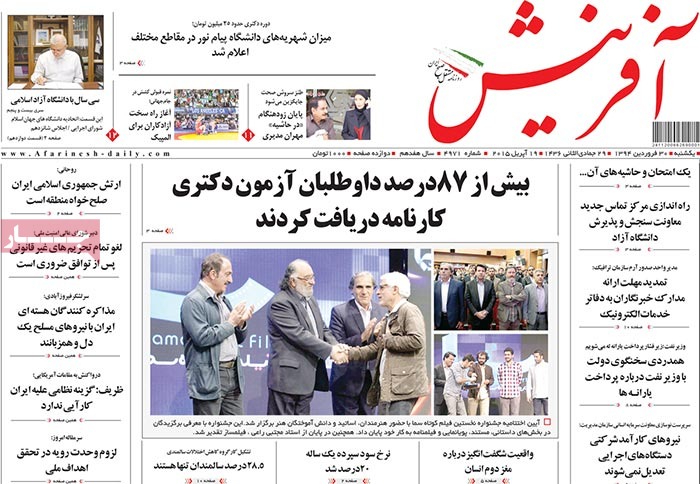
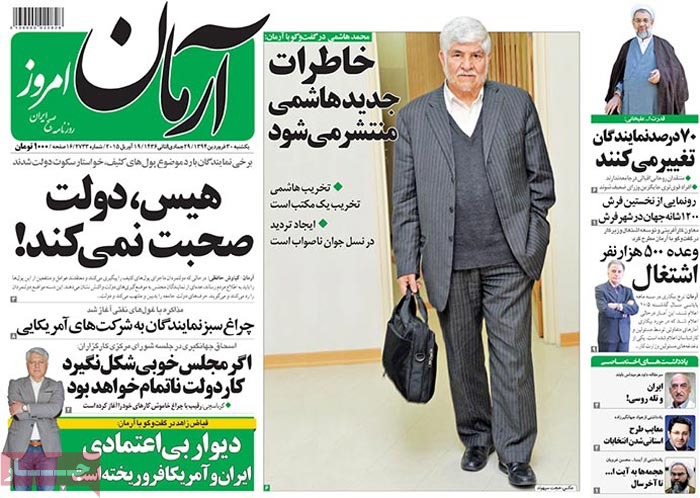
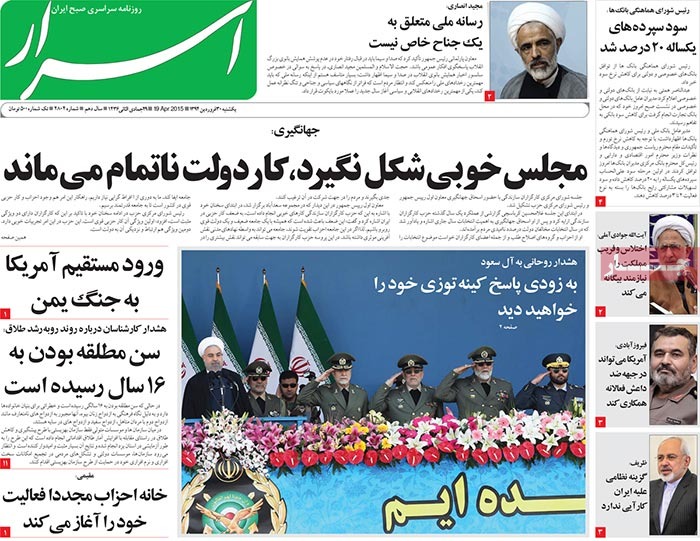
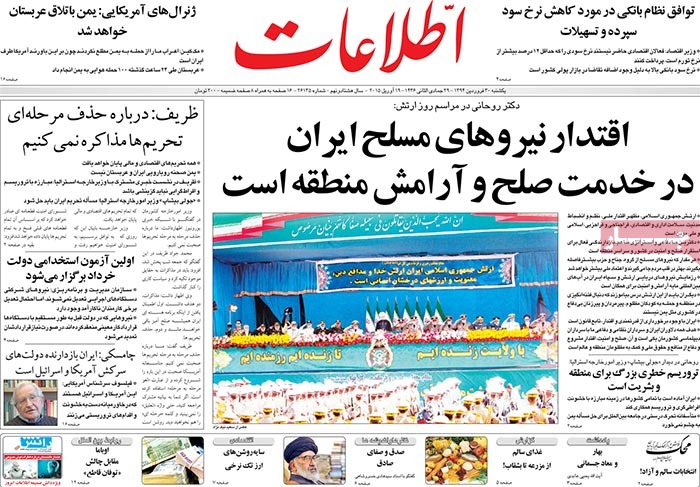
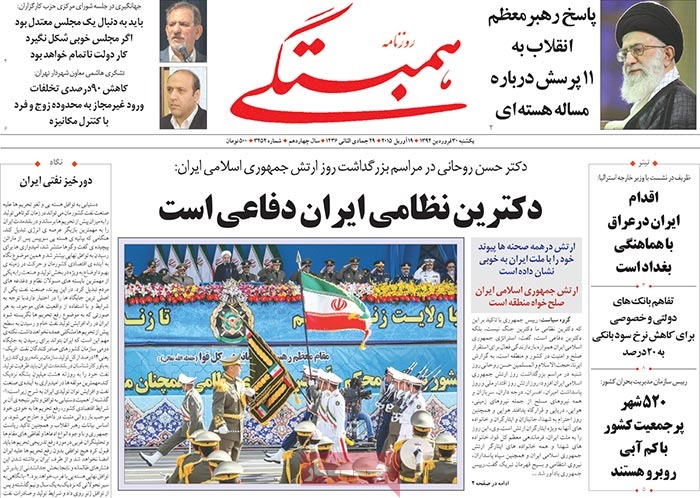
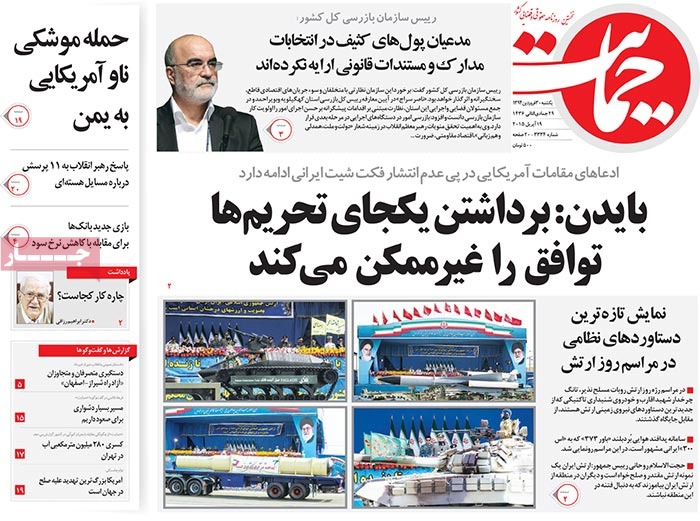
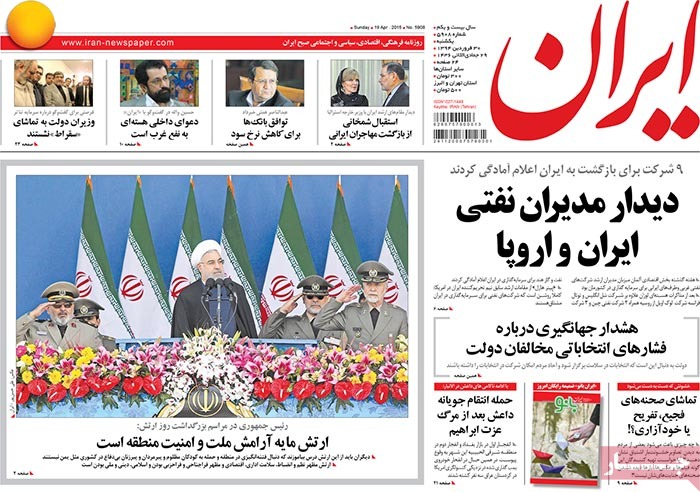
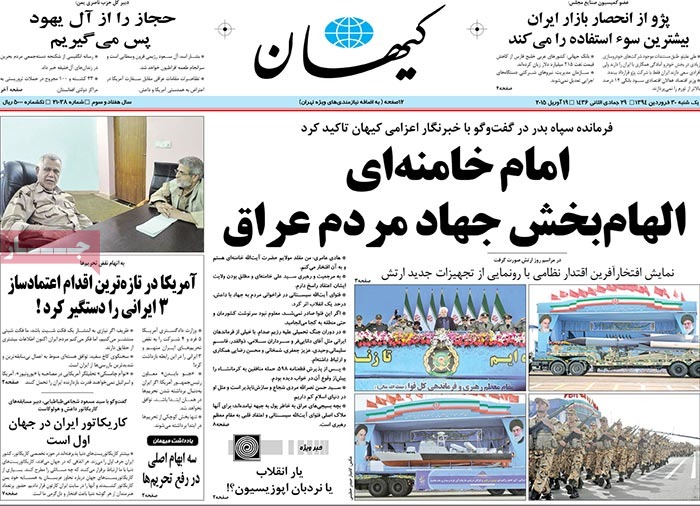
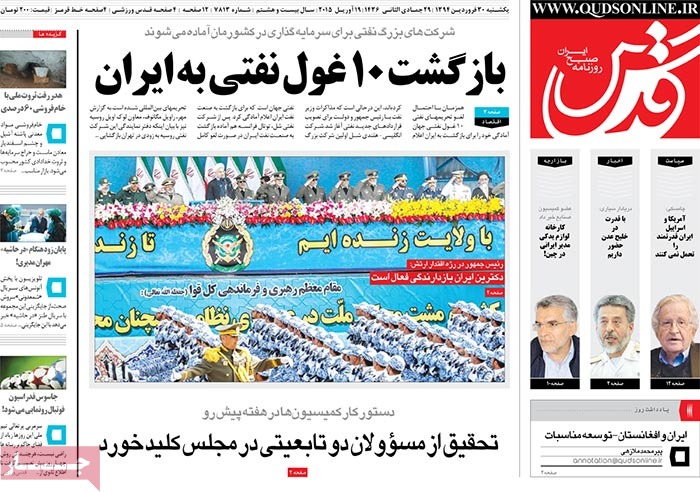
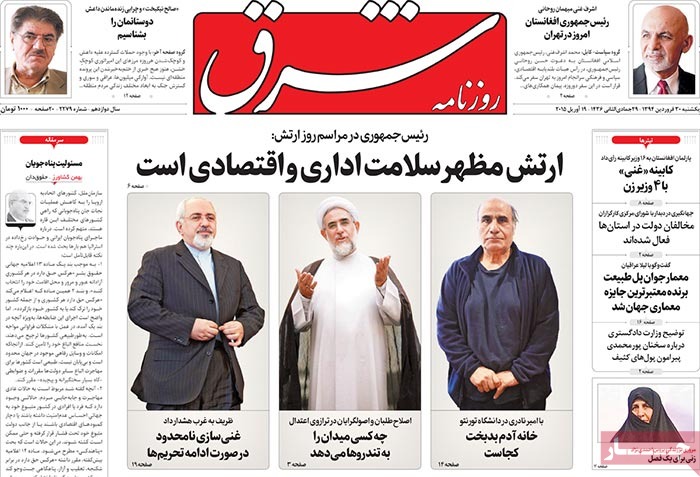
A look at Iranian newspaper front pages on March 19

Iranian Newspapers Headlines

President Rouhani’s review of the performance of his government over the last 12 months and his promise of a better year ahead dominated the front pages of Iranian newspapers on Thursday. Continued nuclear talks and comments by Foreign Minister Zarif about them also appeared on the cover of dailies.


Abrar: The Foreign Ministry says it hopes [Saudi Arabia] will resume issuing visas for Iranian Hajj pilgrims.

Abrar: “Foreign ministers of P5+1 are unlikely to get together [for this round of talks],” said Iranian Foreign Minister Mohammad Javad Zarif.

A look at Iranian newspaper front pages on March 19


Afarinesh: The intelligence minister has said that rendering economic and cultural stability sustainable will be one of the priorities of his ministry next year.

A look at Iranian newspaper front pages on March 19


Aftab-e Yazd: A note by Hashemi Rafsanjani for the people

“Anytime we acted on the demands of the majority, we got closer to moderation and better advanced the cause of our revolution,” said the chairmen of the Expediency Council in the note.

A look at Iranian newspaper front pages on March 19


Arman-e Emrooz: Eventual agreement

The president’s prudence in talks with P5+1 will finally bear fruit.

Arman-e Emrooz: Thirty-eight political figures weigh in on the performance of the Rouhani administration

A look at Iranian newspaper front pages on March 19


Asrar: The minister of industries has said that Iran managed to push up non-oil exports by 22 percent even if the Islamic Republic was under sanctions.

Asrar: “Interaction with the rest of the world is a national and Islamic necessity,” said the chairman of the Expediency Council.

A look at Iranian newspaper front pages on March 19


Etemad: “Non-oil exports brought in some $50 billion in revenues this year,” said President Hassan Rouhani.

A look at Iranian newspaper front pages on March 19


Ettela’at: “Iran’s oil production won’t be less than its share of OPEC output,” said Iranian Oil Minister Bijan Namdar Zanganeh.

Ettela’at: Value added tax will stand at 9 percent next year.

A look at Iranian newspaper front pages on March 19


Hemayat: Ali Younesi [an adviser to President Rouhani] has been arraigned at the Special Court for the Clerics.

A look at Iranian newspaper front pages on March 19


Jomhouri Islami: President Rouhani has talked about the achievements of his government this year and promised a better year ahead.

A look at Iranian newspaper front pages on March 19


Mardomsalari: The secretary of the Supreme National Security Council has warned of factional approaches undermining the public in the future elections.

Mardomsalari: Anti-austerity protests at the opening of a new ECB (European Central Bank) headquarters have turned violent.

A look at Iranian newspaper front pages on March 19


Sharq: “An agreement is unlikely to happen within a couple of days,” said Foreign Minister Mohammad Javad Zarif.

A look at Iranian newspaper front pages on March 19


Tehran Times: Artists from 12 countries team up to celebrate Nowruz in Berlin.

A look at Iranian newspaper front pages on March 19


Zarif: Nothing resolved for nuclear deal till everything resolved

Zarif

Iranian Foreign Minister Mohammad Javad Zarif says to secure a comprehensive agreement on Iran’s nuclear program all issues pertaining to the program should be resolved.

“[…] We have said that nothing is resolved until everything is resolved,” Zarif told reporters in the Swiss city of Lausanne on Wednesday ahead of his announced talks with US Secretary of State John Kerry.

The remarks by the Iranian minister came as representatives of Iran and the US are currently holding talks on Tehran’s nuclear program in the Swiss city.

“We have made more progress on some of the issues and we have made less progress on others,” Zarif said, adding, “I think the most important element required is the political will to reach an agreement.”

“If that (the political will) is there, we can reach an agreement,” he added.

We have come to very detailed issues in the nuclear talks, Zarif noted, adding that there remain “important differences” on Iran’s nuclear program and the aim of the talks is to remove the sticking points.

“[The two sides are] close to mutual understanding on certain issues, but not as close to mutual understanding on some other issues. Anyway, as we have said from day one, nothing will be agreed upon until everything is agreed upon,” Zarif stressed.

Referring to the participation of the foreign ministers of P5+1 in the current round of the talks, Zarif said, “They might come”, but at the current level of the talks their participation is not necessary.

Zarif, Head of the Atomic Energy Organization of Iran (AEOI) Ali Akbar Salehi, Zarif’s deputies Abbas Araghchi and Majid Takht-e Ravanchi, special assistant to Iran’s president Hossein Fereidoun, US Secretary of State John Kerry, US Energy Secretary Ernest Moniz, and US Under Secretary of State for Political Affairs Wendy Sherman as well as European Union deputy foreign policy chief Helga Schmid were present in the second round of the talks between Iran and the US on Tuesday afternoon.

The latest round of negotiations about the Iranian nuclear program kicked off in the Swiss city on Sunday with Salehi and Moniz holding high-level technical talks. Experts from Iran and the US as well as AEOI spokesman Behrouz Kamalvandi also participated in the meeting.

Speaking after his five-hour meeting with Kerry on Monday, Zarif said solutions to outstanding nuclear issues with P5+1 are at hand although differences still remain between the two sides.

“We are closer to a solution in some cases and it can therefore be said that solutions are at hand, but in some cases solutions are still elusive,” the chief Iranian negotiator said.

Iran and P5+1– the United States, Britain, France, China, and Russia plus Germany – are seeking to seal a comprehensive nuclear deal by July 1.