Monday, December 29, 2025
Home Blog Page 4895

Former VP urges students to be tolerant of opposing views

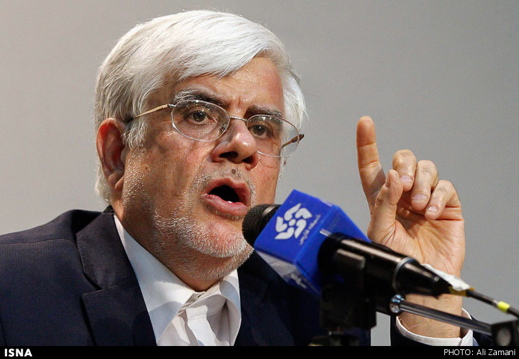
Mohammadreza Aref

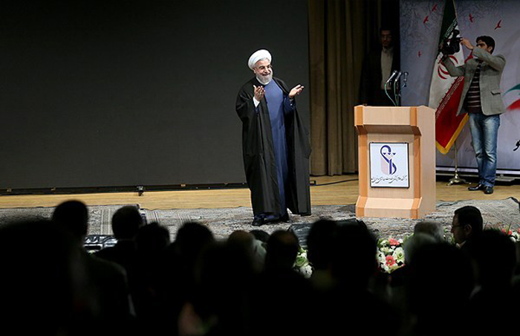
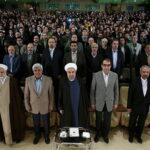
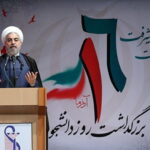
The Iranian Student News Agency (ISNA) on December 7 – national Student Day in Iran – filed a report on the remarks of Mohammad Reza Aref, a member of the Expediency Council and a one-time vice-president under reformist Mohammad Khatami, at a ceremony to mark the occasion in Shahid Beheshti University.

In his speech, the former VP called on university students to open-mindedly listen to different viewpoints and show tolerance for opposing views. What appears below is a partial translation of his remarks followed by what happened on the sidelines of the event:

[…] Idealism, anti-colonial moves, and endeavors to help institutionalize revolutionary values were among the salient features of the student movement in Iran in the first decade of the revolution.

[…]

Students are expected to be the flag-bearers of science, freedom and sagacious criticism, meticulously analyze the country’s situation, remain insightful and tactful when it comes to their homeland’s issues and not get entangled in marginal questions.

Conducting a critical analysis of the student movement is imperative. Narrow-mindedness and bad taste are to blame for failure to hold open-thinking forums in spite of the emphasis high-level officials [including the Supreme Leader] have placed on the question.

Students should avoid hasty decisions and sentimentalism. We need to remain on the scene and advance our objectives in stages and by degrees.

The harsh decisions we make may produce effective results in the short run, but they are of no use in the long run. Reliance of the student movement on off-campus political currents has been a drag on the movement, something which has come at the expense of their independence.

Students should take heed of the country’s macro-issues, form think tanks to plan the course of action they are to take and draw on the viewpoints of veteran activists in their movements.

Ethics and moral conduct are needed to woo people in such movements. Student movements should vie [to win over more audience], not to eliminate each other.

As far as foreign policy is concerned, the Supreme Leader determines in what direction the country should be moving and what policies it should adopt, including ties with the US, and we all follow his guidelines.

[…]

As for concerns that reformists may be disqualified by the Guardian Council and banned from running for parliament [in election slated for March 2016], I should say that people have a big say in the country’s affairs; they choose the officials through their direct and indirect vote. […] We need to have a powerful, expert and resourceful parliament and our MPs should look at things from a national angle.

[…]

Nobody lost in the 2013 elections. The election in 2009 was a lose-lose race, we had a win-win election four years later. […] We should not prejudge the upcoming parliamentary election. I hope the Guardian Council and [its] Supervisory Committee act in keeping with the provisions of law. […]

We are not concerned about possible disqualifications since reformists have enough competent names [to put forward]. We have to think positive and push for a big turnout. The reformist mindset will emerge winner if we can secure the swing and silent votes.

[…]

Developments in universities over the eight years [President Ahmadinejad was in office] led up to a point in which only one voice was heard, but students came to terms with it. The Science Ministry should feel it its duty to restore liveliness to universities. Of course over the past months uncertainty has reigned at the ministry due to the absence of a minister who could call the shots. […] Now the ministry has a boss who will restore stability. I hope student demands will be met in a few months with the help of the science ministry.

Some officials in universities have not taken the message of the 2009 elections. Either they cannot or don’t want to understand this message and public demands and adapt themselves. The government has paid a price for it. The government has remained steadfast in supporting the students’ demands. Never did it budge on its nominations for the science ministry.

If you hadn’t turned out to vote in 2013, Rouhani would not have won the election. This is tough for his rivals to digest. They prefer to see a closed, tense atmosphere in universities. So the onus is on students to rejuvenate universities.

Students are expected to tolerate each other. We all want to see the country grow. […] If the current trend persists and we cannot tolerantly accept the views of others, the atmosphere in universities will remain tense.

In the capacity of a university professor, I have always tried to support the students regardless of their political affiliations. I do not even distance myself from those whose ideas do not square with those of the revolution. I try to attract them since they are all the children of this country.

Silence is not what we pursue. We float our critical points in friendly meetings with the government and try our best to offer constructive criticism, something in line with national progress.

On the sidelines of the ceremony

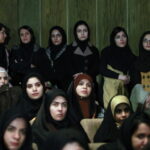
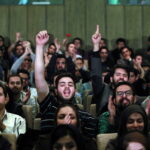
Students taking part in the ceremony were chanting, “Students can easily accept to die, but degradation never they will buy”, “Hail to Aref, Long live Rouhani”, “Hail to Hashemi, Long live Rouhani”.

Some students carried placards which read, “Down with those who turn sedition into a business”. Other placards [carried by an opposing group of students] read, “Down with seditionist”.

Also in the ceremony, a clip produced by Shahid Beheshti University’s Islamic Association of Students was broadcast. Images of Rouhani, Hashemi Rafsanjani, Towfighi, Faraji-Dana, and Seyyed Hassan Khomeini in the clip prompted the students to let out rousing, loud cheers and applause.

As always, Aref was accompanied by his wife, Hamideh Moravej, in the ceremony.
 

A look at Iranian newspaper front pages on Dec. 9

Iranian Newspapers Headlines

A meeting in Tehran on ways of promoting healthy administrative strategies and countering corruption and the message the Supreme Leader sent to the meeting, which was attended by senior state officials, dominated the front pages of Iranian newspapers on Tuesday. In the message the leader urged officials with the three branches of government to match their words with action in turning up the heat on corruption. The comments of the executive, judiciary, and legislative chiefs in the same meeting made front-page headlines, too. Also in the headlines was the statement of the visiting Iraqi Foreign Minister Ibrahim al-Jaafari that Baghdad does not have any problem with Iran conducting air raids against IS positions on Iraqi soil.
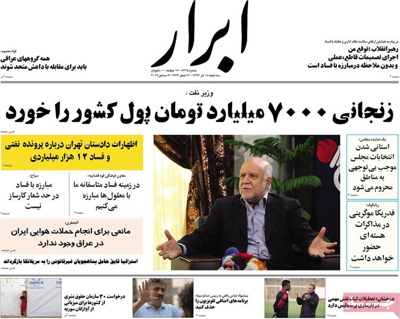
Abrar: “Babak Zanjani [a businessman who stands accused of massive corruption] has siphoned off more than $2 billion in public funds,” said Iranian Oil Minister Bijan Namdar Zanganeh.


Abrar newspaper 12-09


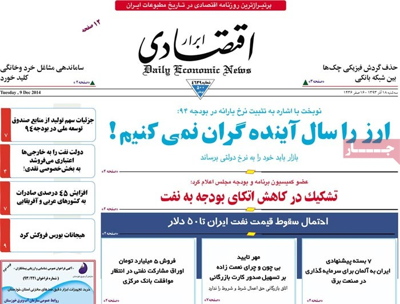
Abrar-e Eghtesadi: Iran’s exports to African and Arab countries have registered a 45 percent hike.


Abrar Eghtesadi newspaper 12-09


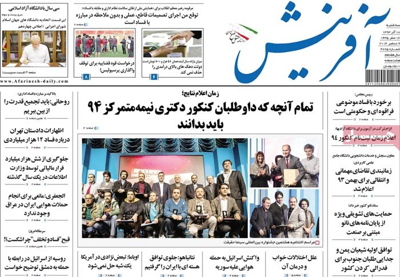
Afarinesh: The Intelligence Ministry has stopped almost $2 billion in tax evasion over the past year.


Afarinesh newspaper 12-09


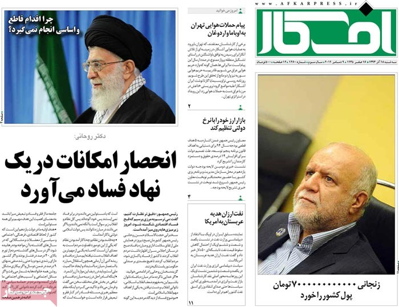
Afkar: “The monopoly of a single institution over resources breeds corruption,” President Rouhani told a national gathering to promote healthy administrative strategies and counter corruption.


Afkar newspaper 12-09


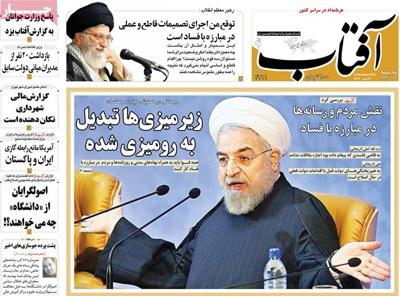
Aftab-e Yazd: “The measures the current government is taking are redressing the problems caused under the previous government,” said Parliament Speaker Ali Larijani.


Aftabe Yazd newspaper 12-09


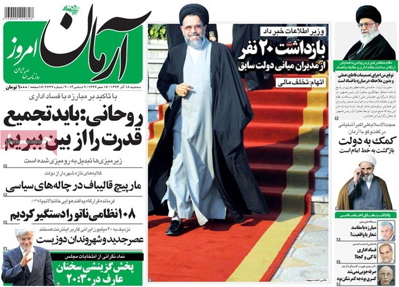
Arman-e Emrooz: There are as many as 40 million Internet users in Iran.


Arman newspaper 12-09


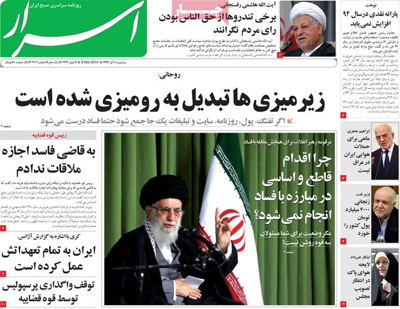
Asrar: “A clean air bill is waiting for parliamentary approval,” said the director of the Environment Protection Organization.


Asrar newspaper 12-09


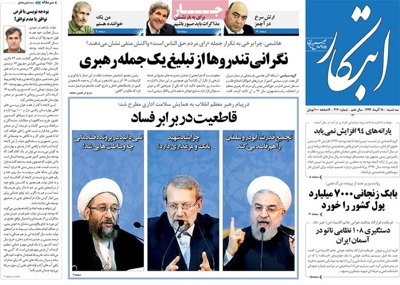
Ebtekar: “Cash subsidies won’t increase next year,” said Government Spokesman Mohammad Bagher Nobakht.


Ebtekar newspaper 12-09


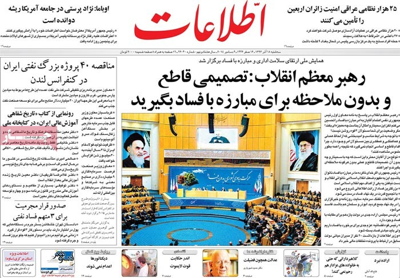
Ettela’at: As many as 40 major Iranian oil projects are to be announced in a Conference in London.


Ettelaat newspaper 12-09


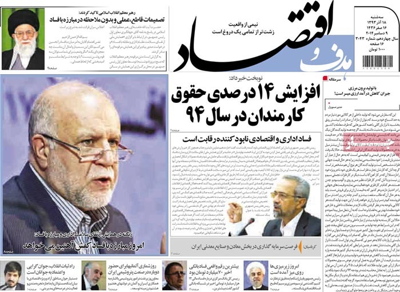
Hadaf va Eghtesad: “Germans are eagerly waiting to return to Iran’s petrochemistry market,” said the Iranian deputy oil minister.


Hadaf va Eghtesad newspaper 12-09


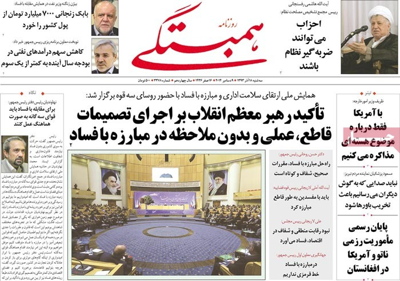
Hambastegi: “Our talks with the United States solely focus on the nuclear issue,” said Iranian Foreign Minister Mohammad Javad Zarif.


Hambastegi newspaper 12-09


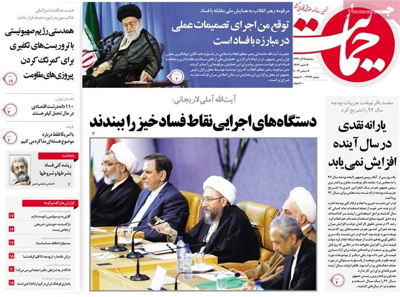
Hemayat: Judiciary Chief Ayatollah Sadegh Amoli Larijani has urged executive institutions to focus more on areas which have the potential for corruption.


Hemayat newspaper 12-09


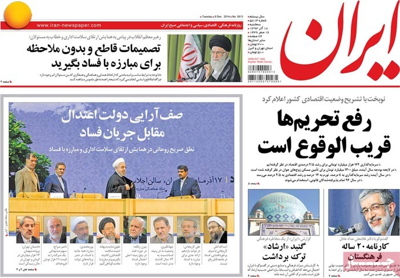
Iran: “Removal of sanctions is imminent,” said Government Spokesman Mohammad Bagher Nobakht.


Iran newspaper 12-09


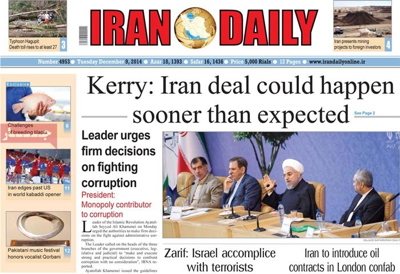
Iran Daily: Iran to introduce oil contracts in London Confab.


Iran Daily newspaper 12-09


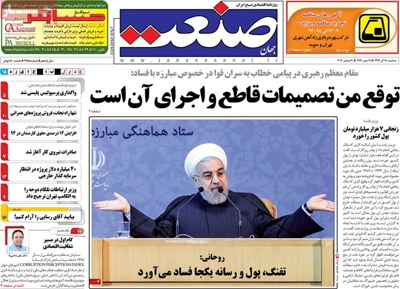
Jahan-e Sanat: “Some $40 billion worth of projects across Iran are waiting for foreign investment.”


Jahane Sanat newspaper 12-09


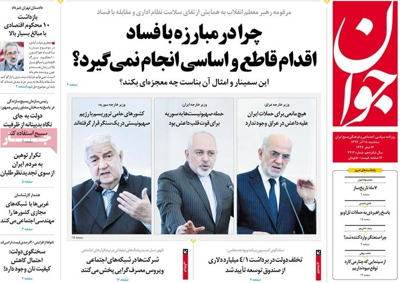
Javan: “There are no problems with Iran conducting air strikes against IS in Iraq,” said the Iraqi foreign minister who is in Tehran to attend a conference on World against Violence and Extremism.

Javan: “Why is it that serious measures are not taken in the fight against corruption?” the Supreme Leader asked in a message to a gathering to promote healthy administrative strategies and counter corruption.


Javan newspaper 12-09


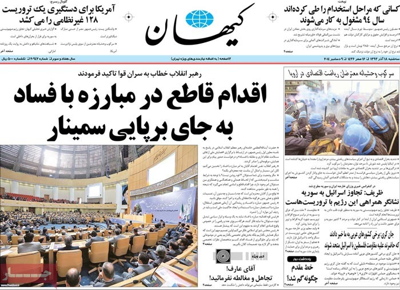
Kayhan: “Instead of organizing seminars, serious measures should be taken in the fight against corruption,” said the Supreme Leader in a message to an anti-corruption conference in Tehran.


Kayhan newspaper 12-09


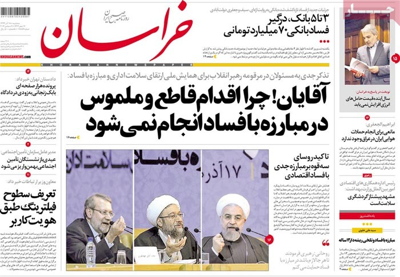
Khorasan: The heads of the three branches of government have underlined measures to crack down on corruption.


Khorasan newspaper 12-09


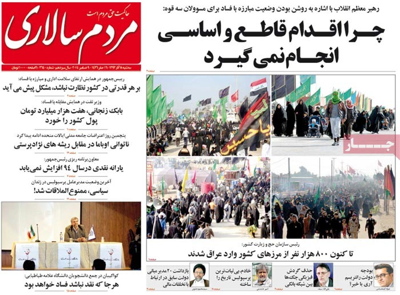
Mardomsalari: As many as 800 thousand Iranians have crossed the border into Iraq to take part in ceremonies to mark Arba’een [a Shiite religious observance that comes 40 days after Ashura, which marks the martyrdom of the grandson of Prophet Muhammad].

Mardomsalari: The managing director of Persepolis Football Club, who is in prison after sponsors filed a suit against the Reds, cannot have visitors.


Mardom salari newspaper 12-09


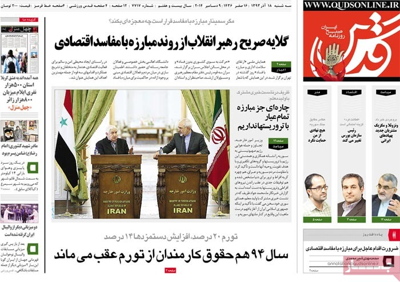
Qods: “Venezuela and Mexico are interested in purchasing Iranian-made drones,” said the chairman of Parliament’s National Security and Foreign Policy Committee.

Qods: The head of the Securities and Exchange Organization is to be replaced.


Qods newspaper 12-09


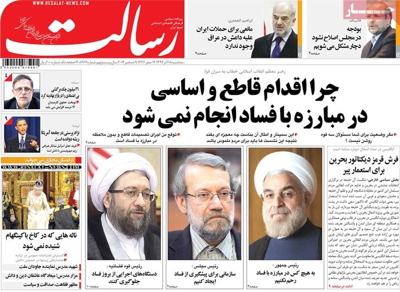
Resalat: “If parliament does not revise [the government-proposed] budget [for Tehran Municipality], we will have problem running the capital,” said Tehran Mayor Mohammad Bagher Ghalibaf.


Resalat newspaper 12-09


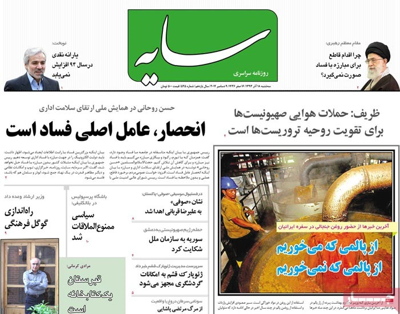
Sayeh: “Airstrikes by the Zionist regime against Syria are designed to boost the morale of terrorists,” said Iranian Foreign Minister Mohammad Javad Zarif.


Sayeh newspaper 12-09


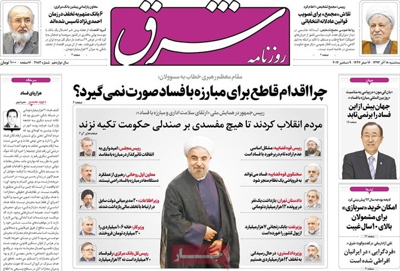
Sharq: “Twenty mid-level managers of the previous government have been arrested for fraud,” said the intelligence minister.


Shargh newspaper 12-09


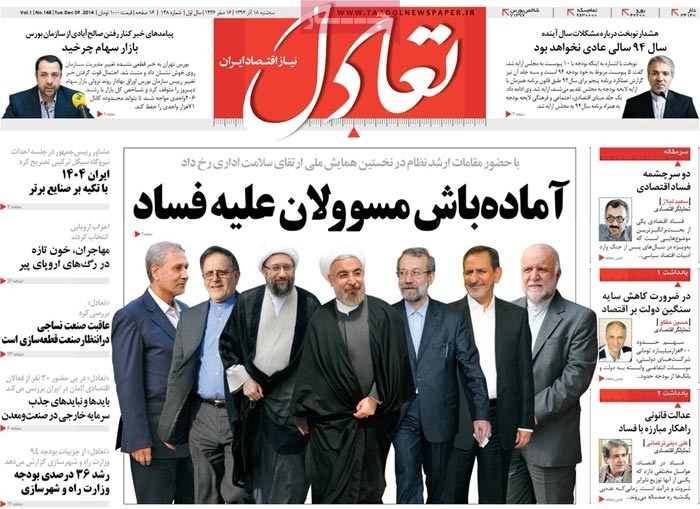
Taadol: Senior state officials on alert to turn up the heat on corruption.


Taadol newspaper 12-09


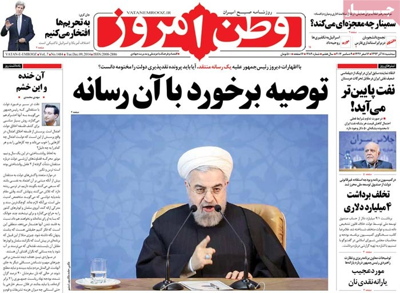
Vatan-e Emrooz: Parliament’s Planning and Budget Committee has established that government has unlawfully tapped into the National Development Fund.


Vatane Emrouz newspaper 12-09


Iraqi political, ethnic groups must reinforce unity: Iran’s Larijani

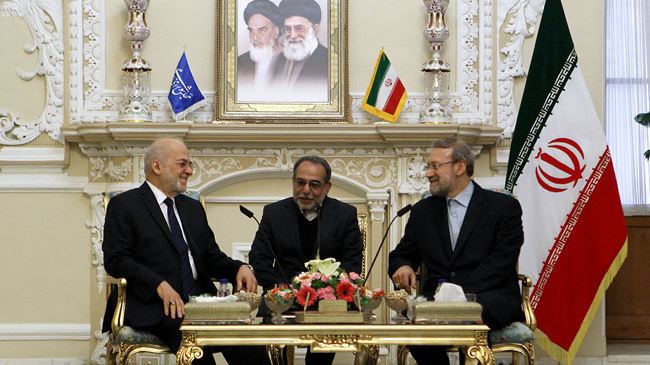
Larijani-Jaafari

Iran’s Parliament (Majlis) Speaker Ali Larijani says political and ethnic groups in Iraq should strengthen their unity in the current “very sensitive” situation in the country.

Larijani, who was speaking during a meeting with Iraq’s Foreign Minister Ibrahim al-Jaafari in Tehran on Monday, also said that Iran is prepared to transfer its experience to the new Iraqi government and help it settle domestic problems.

The Iranian Majlis speaker further criticized the US and its allies for not being serious in their fight against the ISIL terrorist group. He referred to the remarks by US statesmen that the fight on the terrorists in Iraq would take years and said such comments indicate how the Americans have hidden plots.

Iraq is facing a terrorist campaign by Takfiri ISIL militants, who currently control swaths of territory across the country as well as in Syria. They have been committing heinous crimes in the captured areas, including mass executions and beheading of local residents as well as foreign nationals.

A US-led coalition has been conducting airstrikes against ISIL inside Iraq since August.

This is while many of the countries in the US-led bombing coalition, such as Saudi Arabia and Qatar, have been the staunch supporters of the Takfiri ISIL elements in the region.

During the meeting with Larijani, the Iraqi foreign minister, for his part, said Iran, as a powerful country in the region and across the world, has a special position in Iraq’s foreign policy.

He added that the exchange of visits between Iranian and Iraqi officials would improve mutual relations and called for Iran’s participation in the reconstruction of war-stricken Iraq.

Jaafari arrived in Iran on Sunday at the head of a delegation to attend a two-day international conference on the World Against Extremism and Violence (WAVE) in Tehran, scheduled to open on Tuesday in the presence of envoys from 40 countries.

How principlist daily reacts to President Rouhani’s Student Day speech

kayhan-12-08

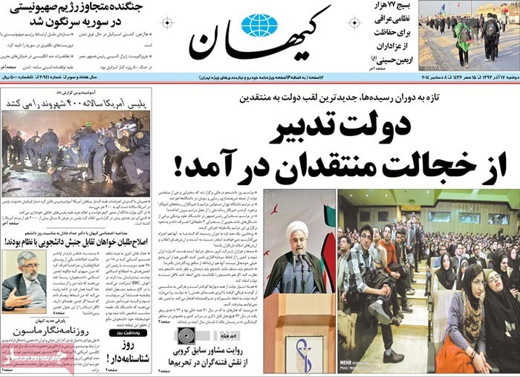
The speech President Rouhani made at Iran University of Medical Sciences on Sunday to mark University Student Day drew a strong reaction from Kayhan whose managing editor Hossein Shariatmadari had the following to say in the editorial of the principlist daily on Monday December 8:

[…]

There have been two glorious peaks in the history of the student movement in Iran. Thanks to the crucial nature of each of these two events, they have turned into  momentous days [in Iranian history]. December 7 and November 4. On both occasions Iranians stood up to the United States and condemned the criminal acts of this hegemonic power.

December 7 has been registered as University Student Day in the calendar of the Islamic Revolution. November 4 is known as the Anti-Hegemony Day. Special ceremonies are held [each year] on these two days to commemorate epic-making moments in Iranian history.

Down with America is an integral part of the identity of these two occasions which are meant to challenge the US administration, as the late Imam Khomeini said not the American people, for the crimes, plundering and killings it commits.

Obviously, if speeches made on ceremonies to mark these two occasions fail to encourage the public to take on the murderous United States and if they do not identify the Great Satan as the main enemy of the nation, Islam and revolution, they have in fact distorted the true nature of these two epic occasions.

Such failure would amount to disregard for the blood of those who were martyred on December 7, 1953 and disrespect for the glorious takeover of the Den of Espionage in favor of the enemy. It is just like failure, in ceremonies to mourn the martyrdom of Imam Hussein, to mention the crimes Yazid, Shemr, Amr ibn Sa’ad and Ibn Ziyad committed.

One should not forget the fact that mourning ceremonies are designed to keep the memory of the grandson of Prophet Muhammad alive and remind the faithful of the crimes Yazid and his followers committed back then, crimes which are being repeated by some in this day and age.

On Sunday, Dr. Rouhani, the esteemed President of the Islamic Republic, who was at Iran University of Medical Sciences for a speech to mark University Student Day talked about anything but the primary theme of the event: the necessity of countering the US and the crimes this renegade power commits.

There are a few points about the esteemed president’s comments before the carefully chosen audience on Sunday. The present article does not seek to go into detail; it simply reminds the readers of a few points.

Despite expectations, in a speech to honor the memory of those who fell martyr on December 7, 1953, the president made no mention of the US role in the murder of three Iranian students and other heinous crimes the US has since committed.

Instead, the president used the occasion to praise the foreign policy of his own government by saying: Today everyone knows that the government of the Islamic Republic of Iran is against violence and extremism, otherwise the Iranian-proposed World against Violence and Extremism initiative put forth at the UN General Assembly wouldn’t have been voted for almost unanimously with the exception of two or three countries, including the US and Israel.

The president’s comments were meant to praise his government, not recall the crimes committed by the United States. Didn’t the General Assembly unanimously – the US and Israel included – vote for the Dialogue among Civilizations initiative of Mr. Khatami? Why was it that President George W. Bush later called Iran part of an Axis of Evil? Mr. President, why have you pinned so much hope on the vote for your anti-violence initiative?

[…]

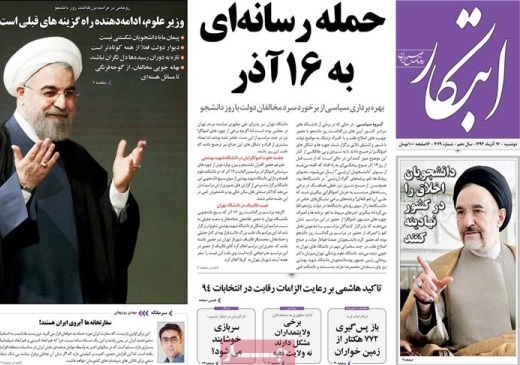
Mohammad Khatami’s message to mark University Student Day

Ebtekar daily-12-08

Students and Islamic Associations in universities should feel it their duty to safeguard an Islam that promotes freedom, supports independence and democracy, and promulgates morality. Students need to institutionalize morality in society and make it the cornerstone of relations among members of the public.
According to the Ebtekar daily, that was part of a video message by former President Mohammad Khatami to a University Student Day gathering at Tehran University. The following is what else the reformist president touched on in his message:
Today students shoulder a heavy burden. They should conduct research, update their knowledge and develop new sciences and at the same time care about their society. In other words, committed students should attach significance to freedom and progress at the same time.
December 7 is designated as University Student Day in Iran, a day that helps establish the identity of students and universities. At a time when a dictatorship which had the backing of foreigners, the Americans in particular, was in power, when freedom-seeking was being quelled, when parties were being put down, when Mohammad Mosadegh was in exile after his government had been toppled, flames of a movement raged in universities.
In the absence of parties, factions and social activism which had been crushed, something which in turn created a sense of despair in society, students shouted protest at the dictatorship of the time. What lends students more prominence today is that at a time when hopes were dashed and suppression reigned supreme, they stood up to authoritarianism.
Students need to throw their weight behind democracy and carry on with their social and political activities in line with the provisions of the Constitution.

What President Rouhani said in his University Student Day speech

Rouhani in students day

In a ceremony to mark University Student Day on Sunday, President Hassan Rouhani made a speech at Shahid Beheshti University of Medical Sciences. December 7 marks the anniversary of the murder of three Tehran University students in 1953 at the hands of police during the Pahlavi rule.

Cancelation of speeches by a number of government critics in different universities made headlines. Among other, the speeches of Hossein Shariatmadari, the managing editor of Kayhan [a daily], Mahmoud Nabavian, a Tehran principlist MP, Hassan Abbasi, the head of the Center for Doctrinal Strategic Studies at the Islamic Revolution Guard Corps (IRGC), Payam Fazlinejad, a once reformist journalist who later broke ranks with reformists, and Hamid Rasaei, a principlist MP and a staunch supporter of former President Ahmadinejad, were called off.

In another development, three major university student bodies released separate letters, saying they were not attending President Rouhani’s speech, citing the fact that no time was dedicated to them to express their ideas before the president. The Student Basij Organization, affiliated to the Islamic Revolution Guard Corps, boycotted the ceremony too. The following is the translation of part of President Rouhani’s comments Fararu news website reported:


Student movement is an anti-colonialist movement

December 7 was the beginning and a turning point in the student movement which is not confined to political parties and factions. In fact, it amounts to the presence of all university students on cultural and political fronts. This anti-colonial movement is all for independence, freedom, patriotism and the battle against any form of injustice.


The government comes under all manner of criticism, but it welcomes critique

University students have to be critiques who act like observers who oversee things. And if students are not allowed to speak their mind elsewhere, they should be allowed to direct their criticism at the government.

The government comes under fire for issues ranging from tomatoes to nuclear energy. The government takes pride in welcoming sympathetic and unbiased critiques. We cannot make headway without critiques, because critique, research and science are the two sides of the same coin.


Students should not be indifferent to the environment

Students should not be nonchalant about social matters, nor should they be indifferent to issues related to water [resources], the environment, energy, status of software development [in the country], social ills and cultural issues.

We cannot live in a country and be indifferent to the matters which could influence the fate of our community, our nation and our region. In our country, ballot boxes are the basis of legitimacy which we cannot abandon; rather we should safeguard them.


The government does not seek a vote of confidence by wheeling and dealing

In the world we live in today we cannot claim that world affairs do not concern us or that we don’t care about public opinion and others’ judgment. [I cannot say that] I do not care what the university thinks when I am appointing a university official. Nor should I pick a minister and lobby influential figures to get him a vote of confidence and then have him at the helm of the ministry. That’s not the way this government does business.

From the get-go, the government has sought expert advice on all technical fronts. I am ever so glad that throughout the [prolonged] introduction of nominees [to secure parliamentary confirmation for minister of science], a poll was carried out that indicated university students and professors approve of the approach the 11th government has taken in running the universities.

The government is consistent in its approach toward universities and won’t backpedal. The new minister of science will pick up where his predecessors in the 11th government left off. Minister of Science Mohammad Farhadi will go down the same path that was supposed to be taken by Ja’far Nili-Monfared [Rouhani’s pick for the ministry who was rejected by parliament] and Ja’far Tofighi [the acting science minister] who were not allowed [to stay on the job].


We won’t break the promises that we’ve made

Our path is still the same one that we promised to you on day one. We won’t break the promise that we’ve made. Today, we are going down a path that requires the contribution of everyone. We should join hands to address our issues within and beyond our national borders.


Hotels across the country are packed with tourists

Today, the position of Iran in the eyes of world nations and politicians is totally different from what it used to be. People across the world have trust in the secure atmosphere of Iran. Our hotels which were empty of tourists two years ago are now packed. Even they are fully booked for the future, an indication of global enthusiasm about visiting Iran. Hundreds and thousands of companies have been waiting to come to Iran and make investment.


A small number should abandon their fleeting interests

Of course, there are a small number of people who are not pleased. I hope they abandon their fleeting interests. A number of startups, for whom we have respect, do not need to be concerned about the future and values of Islam and the revolution.


Iran is opposed to violence and extremism

Today, the world has accepted that Iran is opposed to violence and extremism. At the UN General Assembly when the proposal of World against Violence and Extremism (WAVE) was floated, all other nations, except for two countries, voted for the [Iranian] proposal.

As far as our national interests, expediency and rights are concerned, the government stays committed to all the promises it has made and won’t be intimidated by criticism, vilification and ballyhoo.


The enemy uses hypocrisy rather than coercion

Saeed Jalili
Saeed Jalili

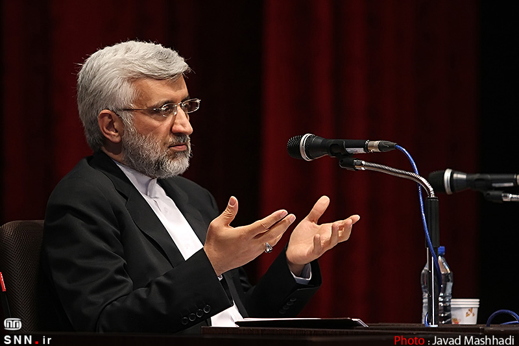
Saeed Jalili, Gholamali Haddad Adel, and Mohammad Bagher Ghalibaf – three politicians who ran for president along with Hassan Rouhani in 2013 – were supposed to deliver speeches at a gathering dubbed “We are here as long as the struggle continues”, a ceremony organized by the Student Basij of Tehran University to mark national Student Day.

But Tehran Mayor Bagher Ghalibaf did not attend the gathering because he was in neighboring Iraq, Karbala to be more exact, to run the Shiite city as part of an agreement between Iran and Iraq which entrusts Tehran Municipality with administering the city’s affairs in the week leading to Arba’een [a Shiite Muslim religious observance that occurs 40 days after Ashura, which marks the martyrdom of the grandson of Prophet Muhammad on December 13].

According to Etemad, a daily, the following is what Saeed Jalili, a former Secretary of the Supreme National Security Council who previously led the Iranian nuclear negotiating team, had to tell the gathering:

The West seeks to use the weapon of coercion and hypocrisy to challenge the rights, values and interests of nations. The experience of the past 35 years shows that our nation has emerged victorious on all fronts. Our nation has been able to advance its cause at all times, and today the West is worried about the determination of the Iranian people which is helping bring about progress.

Universities should turn into bases for resistance economy. The sedition of 2009 [the unrest that erupted following the presidential election] had its root in failure to believe in the will of the people. Our enemy seeks to turn opportunities to threats and the sedition of 2009 was a glaring example of such policy.

The enemy knows that it has been unable to contain us, so it is now trying to contain our determination. The threats they issue are meant to throw our achievements and our struggle into doubt.

The enemy has used its first weapon, which is nothing but military action, against the Iranian nation. We were dragged into a war that Saddam’s Iraq imposed on our nation for eight years. The enemy knows that such weapons are too hollow. Now it is targeting the will of the Iranian nation which holds the key to our success. It knows that continued struggle would translate into back-to-back victories for the Iranians, so it seeks to eliminate the struggle itself.

In its bid to eliminate struggle the enemy would resort to means other than coercion, because it knows that such tactic won’t work in dealing with Iran. A third method the enemy employs is to promote what it describes as realism among Iranians. They want to instill realism in our foreign policy. They want us to see things the way they are. Hegemonic powers are not invincible; isn’t it the reality?

After the multiplication of the Iranian example, the enemy admitted that the losing streak of the Zionist regime has started. Isn’t this the reality? Why don’t they allow the reality to be seen?

Rouhani has changed the university atmosphere

Sadegh Zibakalam

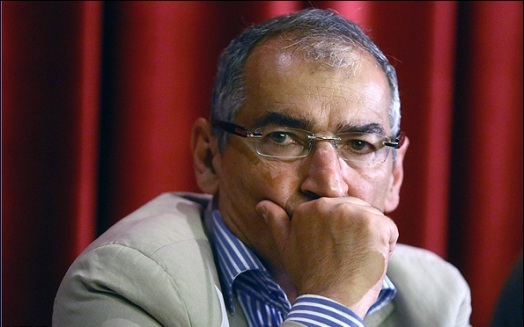
Fararu, a news website, on December 7 featured an interview with Sadegh Zibakalam, a university professor and political analyst, on the election promises of President Rouhani and on whether he has been successful in remaining committed to what he vowed to do after being elected president. The following is the translation of what Zibakalam had to say in the exclusive:

What President Rouhani promised to do on the campaign trail in 2013 can be studied from three angles. First, his promise to settle Iran’s nuclear dispute [with the West] and to cut the Gordian knot which had squeezed the country’s economy and foreign relations for more than a decade.

Second is what Rouhani repeatedly underlined in the pre-election televised debates which concentrated on economic issues: efforts to improve the country’s economic conditions and ameliorate its business environment.

What he said implicitly about ending the house arrest [of presidential candidates who challenged the results of the 2009 election], [releasing] political prisoners and opening up the political atmosphere are the third aspect of his election promises.

I think some of these pledges have been partially fulfilled. The government is trying to materialize some, but some others have yet to come true.

It is not an easy job to make good on the promises that fall into the third category, because the president is not the only decision maker on those issues.

To remove the house arrest, release political prisoners and allow political openness in the country all need extensive consultations and formation of [national] consensus between all government branches, institutions and decision-making bodies. That’s why such promises can’t be readily kept.

The fact that Rouhani underscores that he has honored his promises shows that the president has not forgotten what he vowed and that he is still holding consultations to that end.

Mr. Rouhani may not have done all he said he would on June 14, 2013, but he has lived up to at least one of them, one about [changing the security] atmosphere in universities. The change in universities is evident.

The fact of the matter is that in the four years that followed the 2009 presidential election, universities were like a ghost town and the doors of multiple student bodies remained padlocked.

In those years, a large number of student activists were summoned to on-campus disciplinary committees or to off-campus institutes. Active students were singled out as “starred students” and thus banned from continuing their studies. On the whole, a highly charged security atmosphere prevailed in universities where students preferred to keep a low profile in order not to run into any problem.

In that four-year period, only organizations which were acting in line with principlists were allowed to get engaged in [political] activities in universities. None were independent and were linked to currents outside the universities.

In all fairness, we can say that since late September 2013 when universities reopened after the inauguration of President Rouhani, a vibrant atmosphere has returned to universities where independent student organizations such as the Islamic Associations of Students have been reactivated and lectures and debates are held.

The presence of Mohammad Farhadi, [who has recently secured parliament’s nod to take over as the minister of science, research and technology], will bring about no change to university atmosphere [in place since the election of President Rouhani]. Mr. Farhadi seems unlikely to dance to the tune of the authoritarians and change the status quo.

Even if that is not the case, neither the minister nor anybody else can reverse the current trend. The university atmosphere has changed thanks to the 2013 presidential elections. It is a psychological change; guidelines and directives can do nothing to change it, because it has reached a point of no return.

Iran will stand by Iraq until end of anti-ISIL fight: Zarif

Iran-Iraq-Zarif

Iran will stand by the Iraqi nation until the end of its campaign against the ISIL Takfiri militants, Iranian Foreign Minister Mohammad Javad Zarif says.

Speaking in a joint press conference with Iraq’s Foreign Minister Ibrahim al-Jaafari in Tehran on Sunday, Zarif added that all the Iraqi people are fighting a common enemy.

“The Islamic Republic of Iran realized the danger of violence and extremism in Iraq since the very first day and stood by the Iraqi nation, and we will stand by the Iraqi people including Shias, Sunnis, Kurds and Arabs until the end of [their] fight against extremism and terror,” Zarif said.

He added that Iran calls for amicable ties with all regional countries and believes that Takfiri and extremist groups are threatening the entire region.

“Today, the world has understood the reality that the first country to rush to the help of the Iraqi people in the battle against extremism and terror was the Islamic Republic of Iran, which countered these common threats,” the Iranian minister said.

The Iraqi foreign minister, for his part, said Baghdad calls for further cooperation and assistance from Tehran to fight the ISIL Takfiri terrorists.

Jaafari added that regional nations must beware of the spillover of the ISIL militants’ threats.

The Iraqi minister arrived in Iran on Sunday at the head of a delegation to attend an international conference on the World Against Extremism and Violence (WAVE) in Tehran.

The WAVE conference will be held on December 9 and 10 and will be attended by envoys from 40 countries.

The conference comes against the backdrop of the growing threat of violence and extremism across the Middle East, particularly the atrocities committed by ISIL Takfiri terrorists in Syria and Iraq.

The Takfiri militants have seized swathes of land in Iraq and Syria. They have carried out horrific acts of violence in the two countries, including public decapitations. ISIL has also killed people from Shia, Sunni, Kurd, Christian, and Izadi Kurd communities in Iraq.

Western powers and some of their regional allies – especially Qatar, Saudi Arabia, and Turkey – are reportedly supporting the militants.

Iran makes electronic artificial hand

electronic artificial hand

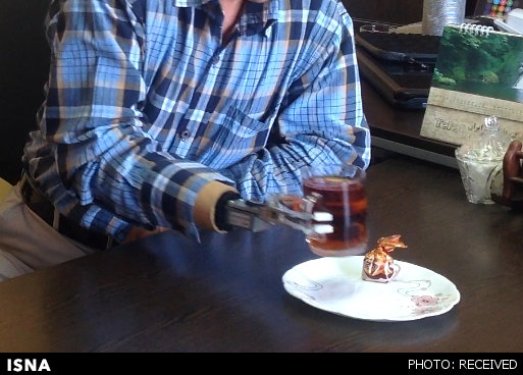
Iranian researchers have designed and built an electronic artificial hand which costs one fourth of the German model.

The artificial device is made of two motion sensors, an electronic circuit, mechanical sections and chargeable batteries, said Kavian Parvaresh, one of the researchers of the project.

The sensors would turn movements of upper arm muscles to electronic commands and transfer them to the electronic section which acts like hand fingers, he said, adding the mechanical section which plays the role of three fingers of a hand can open and close, making it possible for the disabled person to hold different objects and even write easily.

Sensitivity of prosthesis sensors of the artificial hand can be adjusted and the person can take delicate things such as a cup of tea and a pen only after 30 minutes of training.

According to the researcher, fingers of the artificial hand can take 50 50 Newton force.

The German model of the electronic artificial hand costs 7,000 euros. When mass-produced the locally-made new product would save hundreds of thousands of euros in import costs annually.

He also said that the artificial hand has not been mass produced.