Thursday, December 25, 2025
Home Blog Page 4895

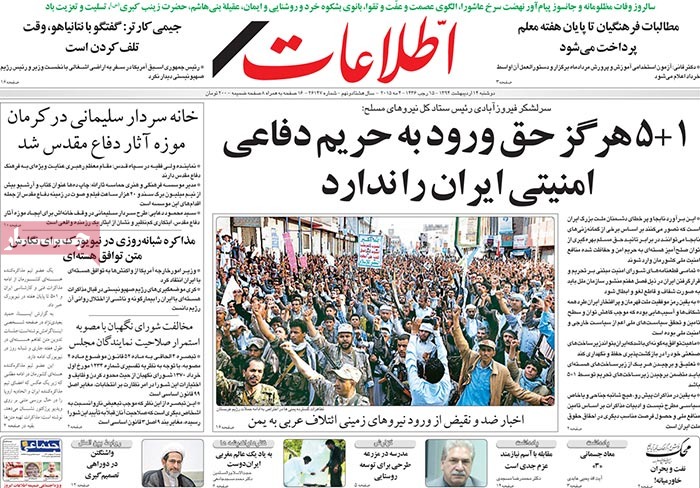
Inspection of military sites a red line, says Iranian defense minister

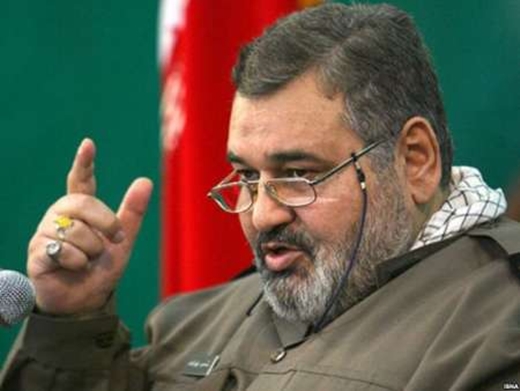
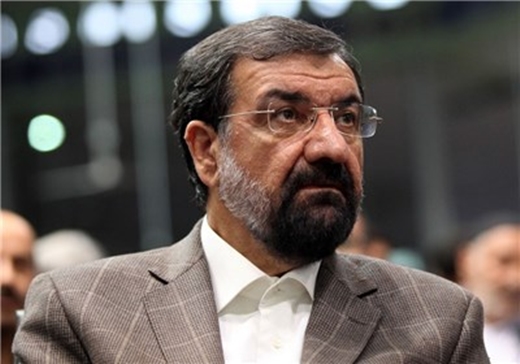
General Dehghan

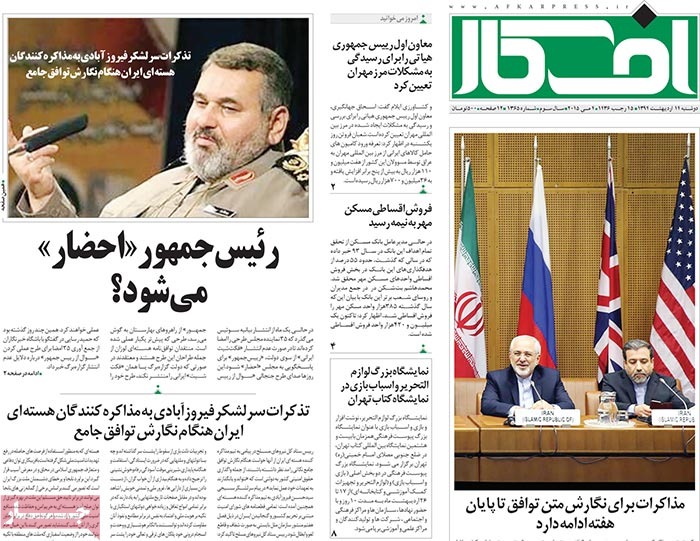
Iranian Defense Minister Brigadier General Hossein Dehghan brushed off media reports that in the recent nuclear talks in Lausanne, Switzerland, there has been any talk of allowing access to Iran’s military sites.

Dehghan on Wednesday dismissed the reports as phony assertions and said there has been “no agreement on inspection of Iran’s military centers and no visits will be allowed (to these centers).”

He stressed that access to the country’s military sites is among Iran’s red lines.

Iran and 5+1 (Russia, China, the US, Britain, France and Germany) adopted a joint statement on April 2 after more than two weeks of marathon talks in Lausanne, with both sides committed to push for a final, comprehensive accord until the end of June.

The framework provides a series of solutions that will be the basis of a comprehensive joint plan of action.

General Dehghan further said that the Iranian nuclear negotiating team that enjoys the judicious support of the Supreme Leader of the Islamic Revolution as well as the backing of the Iranian nation and the country’s branches of power, is determined to safeguard Iran’s nuclear rights and national interests in the future talks.

Iran marks National Nuclear Tech Day, unveils nuclear achievements

Rouhani

Iran marked the National Nuclear Technology Day, with President Hassan Rouhani unveiling the country’s latest nuclear achievements at a ceremony in Tehran.

Among the achievements unveiled on Thursday were three radio-medicines. President Rouhani delivered an address in the ceremony.

Rouhani said that a statement [a reference to the Lausanne statement] was not Iran’s only achievement in the nuclear talks with P5+1, but that the Islamic Republic’s chief gain was the fact that US President Barack Obama acknowledged that the people of Iran will not surrender to bullying, sanctions and threats.

This is a triumph for our country that the first military power in the world admits this fact, the Iranian president said.

President Rouhani then pledged that all the sanctions on Iran would be removed upon the first day of the implementation of a nuclear deal with the world powers.

He said that the Iranian nation has been and will be the victor in the negotiations.

Rouhani further said that the Iran seeks constructive interaction with the rest of the world.

Pointing to the Saudi air strikes in Yemen, Rouhani said, “Nations will not surrender to bombardment,” adding that the future of Yemen will be determined by its people alone.

He called on the other world nations to adopt the path of moderation as well.

Zarif calls for Yemeni solution to Yemen situation

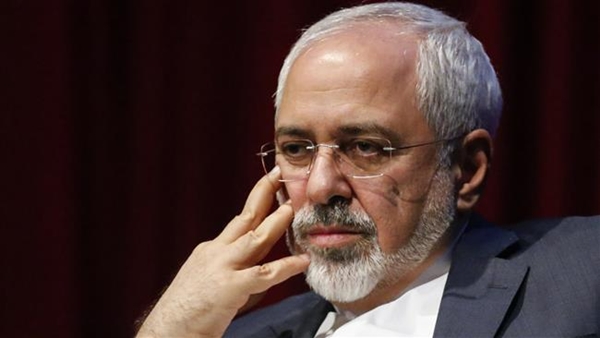
Zarif

Iranian Foreign Minister Mohammad Javad Zarif has called for a ceasefire in Yemen, which is being bombarded by Saudi warplanes since late March.

“Yemen’s issue only has a Yemeni solution,” Zarif said at a joint press conference with Sartaj Aziz, the Pakistani premier’s adviser on national security and foreign affairs, in the capital Islamabad on Wednesday.

“The people of Yemen should not have to face aerial bombardment,” he added, calling for an urgent ceasefire.

The Iranian foreign minister noted that all countries “including Iran, and Saudi Arabia” should help to end the war against the impoverished country.

“It is up to Yemen how it wants to do it. We can only facilitate [the process] as countries in the region,” Zarif said.

Zarif’s two-day visit to Pakistan began on Wednesday following his meeting with Omani Foreign Minister Yusuf bin Alawi in Muscat earlier in the day.

The high-ranking diplomat, who is visiting Pakistan at the head of a 22-member delegation, is scheduled to meet Prime Minister Nawaz Sharif on Thursday.

Saudi Arabia’s air campaign in Yemen started on March 26 in a bid to restore power to former Yemeni President Abd Rabbuh Mansur Hadi, a close ally of Riyadh.

On March 25, the embattled president fled Aden, where he had sought to set up a rival power base, to Riyadh after Ansarullah revolutionaries advanced on Aden, where fighting continues.

To go between nations or go beyond norms

Erdogan

A daylong trip by Turkish President Recep Tayyip Erdogan to Iran against the backdrop of recent regional developments, especially Saudi airstrikes on Yemen, has brought under the microscope Ankara’s stance, with Turkey watchers saying that the country is trying hard to act as a go-between in regional hot spots.

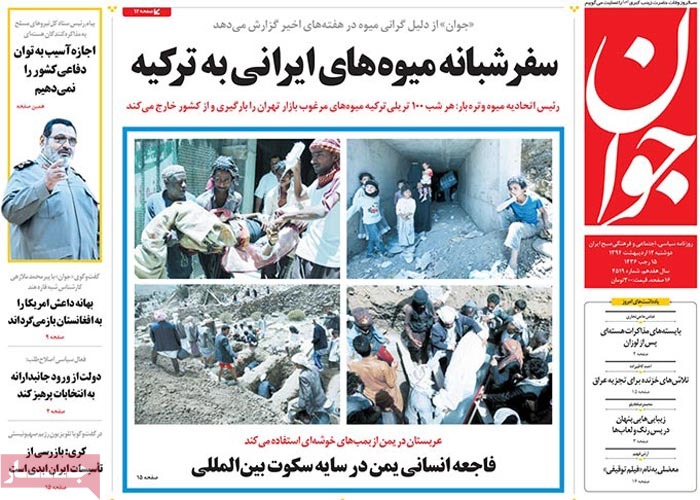
Javan daily on April 8 published an opinion piece by Hadi Mohammadi on Erdogan’s pragmatism and the role his country plays in regional conflicts. The following is the translation of the piece:

Laicism defines the essence of policies adopted by Turkey’s [Muslim] Brotherhood-style Islamist government [of the Justice and Development Party (AKP)] which draws on absolute pragmatism to work out its approaches to domestic and foreign affairs. The government is called Islamist – a decorative title though – but ideological or human values are absent in the government’s official and unofficial policies.

That’s why this government’s alliance with Satan [presumably a reference to the US] is not lambasted and its support for murder, terrorism and extremism is justified as a means to advance the country’s agenda. The Turkish government makes use of Machiavellianism and hypocrisy to put its domestic and foreign policies on track and rationalize its approaches.

Support for ISIL, Alqaeda and the al-Nusra [Front] in Iraq, Syria and the Sinai Peninsula is cast as support for democracy and people. Turkey’s policies revolve around the question of how much economic productivity they can create, and alliance with colonial powers and dictators as well as the role this country plays [in different regional events] are justified only when they produce economic profits and guarantee the country’s gross domestic product (GDP) and economic growth.

The intermediary or rental economy is the centerpiece of Turkey’s economic ties with Iran, something which Ankara has properly taken advantage of. Today Turkish officials once again feel the necessity of mediation, which has assumed a political form this time around.

Erdogan who has, without doubt, drummed up and insisted on support for terrorism at the hands of ISIL and al-Nusra in the region, is weighing up the strategic circumstances in the region as follows: the conclusion of a nuclear deal with the West would weaken the economic position of Turkey in Iran to the level of its passive security and political ties with the Islamic Republic.

His insistence on an upgrade of economic relations with Iran means that Turkey makes no profit from Iran’s nuclear deal with P5+1 and is asking for something in return for its political approach in Yemen where Ankara has failed to join the Saudi-led military operations.

Although the Turks have calculated that the US stances on Yemen – which do not conform to Saudi Arabia’s – are good reason for not following the Saudis in killing the Yemeni people, they do not want to miss out on the political opportunity they have been offered in the Yemeni crisis.

By the same token, the Turkish foreign minister said in a meeting with the visiting Saudi deputy crown prince Muhammad bin Nayef in the buildup to Erdogan’s trip to Tehran that his respective government can act as a go-between in the Yemeni crisis and score [political] points.

Although Saudi Arabia is trying frantically to drag Pakistan and Egypt into ground war in Yemen through staggering financial favors it offers, Turkey seeks to repeat the empty talks of Saudi Arabia on Iran’s interference in the affairs of regional countries and cover up the bloodshed in Iraq, Syria and Yemen only to get concessions from Tehran and Riyadh. To show that it is working with Iran, Ankara tries to pose as a mediator.

It is true that Iranian officials have ignored Erdogan’s stances with magnanimity and welcomed growing ties with Turkey and other regional nations, but the fact of the matter is that Erdogan’s approach to Yemen – which prescribes excessive pragmatism – is similar to his reaction to the Iraqi and Syrian crises.

Mediation in Yemen signifies that Turkey is not ready to follow Saudi Arabia or that Turkey can claim no share in Yemen, so it can only take advantage of bloody tensions in Yemen in the capacity of a mediator.
Turkey’s new stance does not indicate that it is consumed by a human feeling and concerned by the massacre of Yemen’s people by napalm and cluster bombs Saudi Arabia rains down on the defenseless people in Yemen.

The foreign policy Ahmad Davoud Oglu, the former Turkish foreign minister, pursued to give a key and unique status to Turkey [in the region] has now downgraded to a Turkey which acts as a political middleman and Iran has welcomed Turkey’s new role.

EU’s sanctions bring about loss of confidence: Afkham

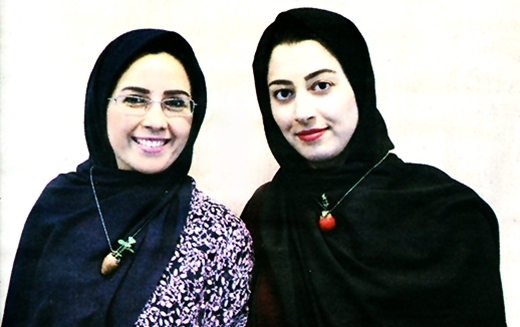
Marziyeh-Afkham
Marziyeh-Afkham

The European Union measure to re-impose sanctions on an Iranian bank and 32 shipping companies is “unconstructive”, Iran says.

Foreign Ministry Spokeswoman Marzieh Afkham said on Wednesday that revoking a decision by a European court to lift the bans leads to “loss of confidence” as Iran and P5+1 are still in talks to clinch a final nuclear accord by the end of June.

“While negotiations continue and efforts are underway for a comprehensive agreement, the EU’s measure… is unconstructive,” Afkham said.

She further voiced “regret” over the EU’s neglect of “decisions by European courts”, noting that reintroduction of the sanctions “will not help the current process of the talks and causes loss of confidence”.

In January, the General Court of the European Union annulled the illegal bans on Bank Tejarat and 40 Iranian shipping companies, citing lack of enough evidence against them.

However, the EU’s Official Journal said Wednesday that 32 of the companies as well as Bank Tejarat are back on the sanctions list based on “a new statement of reasons”.

The decision followed a mutual understanding reached between Iran and P5+1 – the United States, Britain, Russia, France, China, and Germany – in the presence of EU officials in the Swiss lakeside city of Lausanne on April 2. Based on the prospective agreement, all the sanctions will be removed in exchange for some nuclear-related measures taken by Tehran.

Iran has put together its own factsheet: Negotiator

Iran Condemns US Blacklisting of Its Nuclear Chief

The Ministry of Foreign Affairs and the Atomic Energy Organization of Iran (AEOI) have jointly drawn up a factsheet [on the Lausanne statement] which could be released by Foreign Minister Mohammad Javad Zarif to quell ambiguities about the nuclear statement if and when he deemed it expedient, AEOI Director Ali Akbar Salehi was quoted by Iranian Students News Agency as telling reporters Wednesday.

In response to a question as to why Iran did not produce its own factsheet when the talks were still ongoing, Salehi said there are many people out there who are opposed to talks between Iran and P5+1.

In light of the fact that some are at work to disrupt the process, such sensitive talks should be kept under wraps as much as possible in order not to provide anyone with any excuse to disrupt the process, Salehi said.

His comments came after Ebrahim Agha-Mohammadi, an MP, said deputies at the Islamic Consultative Assembly are signing a petition to be sent to the foreign minister to immediately release an Iranian factsheet to counter the untruthful comments of American statesmen.

A plea by deputy environment chief before Afghan president visits Iran

Iran-Helmand-lake-map

Ahmad Ali Keykha

Deputy Director of the Environment Protection Organization Ahmad Ali Keykha has appealed for a number of environmental questions to be raised in talks between senior Iranian and Afghan officials when Afghan President Ashraf Ghani visits Iran on April 18.

On April 6, Khabaronline, a news website, quoted the deputy environment chief as saying “Preservation of Hamoon Lagoon, fed by the Helmand River which originates in Afghanistan, should be an important factor in determining Iran-Afghanistan ties.”

He further said, “Hamoon is holy in different religions like Zoroastrianism, Judaism, Christianity and Islam. To protect and revive the endangered lagoon, every opportunity, including diplomatic potential, must be seized.”

He blamed damage to the environment and the marine ecosystem that Iran and Afghanistan share on inappropriate diplomatic conduct, and said, “It’s true that in the last decade, our interaction with world was not properly regulated, and unfortunately, the general atmosphere was not in favor of Iran.”

He added, “But things have now changed and the current government has put establishment of proper relations with the world countries on its agenda. Some of our interests are embedded in interaction with the rest of the world, and neighboring countries are of immense importance to that end. Neglectful of issues in neighboring countries, we cannot move our national development plans forward.”

Portuguese Castle in Southeastern Iran

Portuguese Castle (2)

The so-called Portuguese Castle is located on top of a hill in the village of Tis which was an important Iranian seaport during the Achaemenid Empire. The castle which is five km away from Chabahar was built during the Safavid era. As the Portuguese started to expand their naval fleet in the 16th century, they used the castle as a base to extend their influence in Iran and other Persian Gulf countries. The area where the castle is built on dates back to the pre-Islamic era. The castle has been registered on the list of Iran’s national heritage sites and is being restored.

The following images have been released by different websites:


Environment protection and development remain elusive in the absence of peace and security

Masoomeh-Ebtekar

The head of the Environment Protection Organization said Wednesday that the nuclear agreement Iran and P5+1 struck in Lausanne last week carried a message for the whole world: Iran has a pivotal role to play in creating a balance in a troubled region beset by incessant wars and [growing] insecurity.

The Islamic Republic News Agency (IRNA) quoted Masoumeh Ebtekar as further saying that the negotiating capability of the Iranian nuclear team is a source of pride for the Iranian nation. The following is a partial translation of what else the environment chief said:

She said that the outbreak of different wars in the region has rendered Western Asia and the Middle East region insecure, adding that a multi-lateral agreement on the nuclear rights of the Iranian nation and the removal of unjust sanctions against Iran show Tehran’s pivotal role in maintaining the regional equilibrium.

Ebtekar said that we have witnessed cases in which go-it-alone policies and interference have created insecurity in countries, adding that a case in point is what Saudi Arabia is doing now against Yemen.

Ebtekar went on to say that the Lausanne statement signals a clear message to the world that Iran has taken a positive attitude toward settling disputes as it tries to serve the interests of its people and respect their dignity.

Iran has demonstrated its determination to hold dialogue to reach a comprehensive agreement which can protect Iran’s rights and help lift the sanctions, she said, adding that the current conditions are a turning point in regional and international relations.

The environment chief further said regional balance, security and peace are the prelude to progress and substantially contribute – from various angles – to improving people’s living conditions and the environment, maintaining balance, restoring security and calm, and establishing cooperation at a global level.

Ebtekar then touched upon the Dialogue among Civilizations – an initiative put forward by the then Iranian president [Mohammad Khatami] in 2001 – and said Iran’s initiative preceded the 9/11 attacks. “President Rouhani’s WAVE (World against Violence and Extremism) proposal was also floated before the emergence of ISIL – an ominous phenomenon – and this shows that Iran has been a pioneer in establishment of peace as well as regional and global balance.

She went on to express hope that all parties involved in nuclear talks will show goodwill and work for a fair, balanced agreement.

Ebtekar said the Lausanne agreement carries much weight for Iran environmentally because security and calm together with the settlement of disputes come before sustainable development.

Regional conflicts which have caused huge collateral damage along with sanctions which target people’s lives have taken a heavy toll on the environment, she said, stressing that sanctions put on hold Iran’s efforts to live up to air quality standards and curb greenhouse emissions. Consequently, Iran embarked on the implementation of its international obligations on greenhouse emissions later than expected.

The environment chief also thanked the Supreme Leader for guiding the Iranian negotiating team as it held talks with world powers.

She praised the serious efforts the president has put in and the professional endeavors of Foreign Minister Mohammad Javad Zarif and his team, saying this is a praiseworthy example of the resolution of international disputes.

She said that the breakthrough [in Lausanne] is a great achievement for both the Iranian nation and the international community, adding that it shows the victory of multilateralism over unilateralism.

It is an outstanding achievement that Iran managed to build a consensus despite differences of opinion and conflicts of interest, she said, adding that the Lausanne agreement can be viewed as a major milestone in international efforts to solve differences.

A look at terrorist attacks and casualty figures in Iran in seven months

Terrorists-Border

A deadly attack by armed bandits on Iranian border guards in the southeast left eight of them martyred. The bloody attack prompted Khabaronline, a news website, to take a look back at acts of terror in Iran in the past seven months.

The following is a list of terror attacks and their casualty figures the website posted online on April 7:

1. An attack on a border area in Chabahar, southeastern Iran, on April 6, 2015 left eight border guards killed.

2. An assault on police in the southwestern province of Khuzestan on April 2 left three police officers killed and another two wounded.

3. Two citizens in the southeastern province of Sistan and Baluchestan were fired upon on January 2. A Shiite teacher and a Sunni Basij volunteer lost their lives in the terrorist attack.

4. A deadly ambush against an IRGC [Islamic Revolution Guard Corps] patrol in a border area in the southeast on December 28, 2014 left three IRGC members killed.

5. A staff member of Iranshahr Governor’s Office was assassinated on October 12.

6. A mortar attack on a police station in the southeast on October 9 left three police officers martyred.

7. An attack against a police station in Saravan, in southeastern Iran, on September 9 left one soldier and two Basij volunteers martyred.