Thursday, December 25, 2025
Home Blog Page 4896

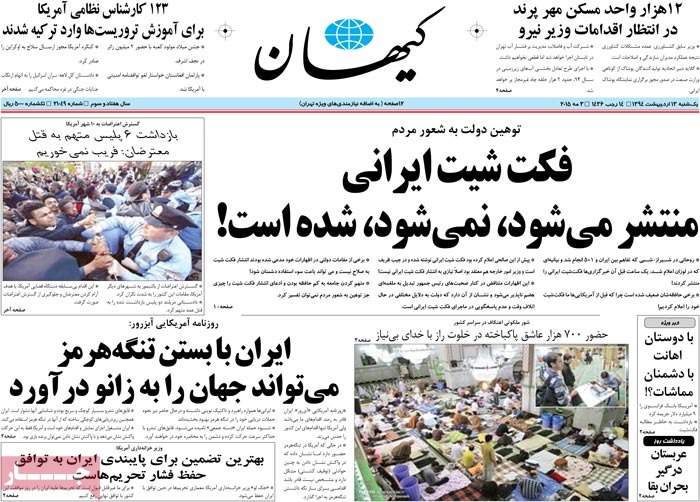
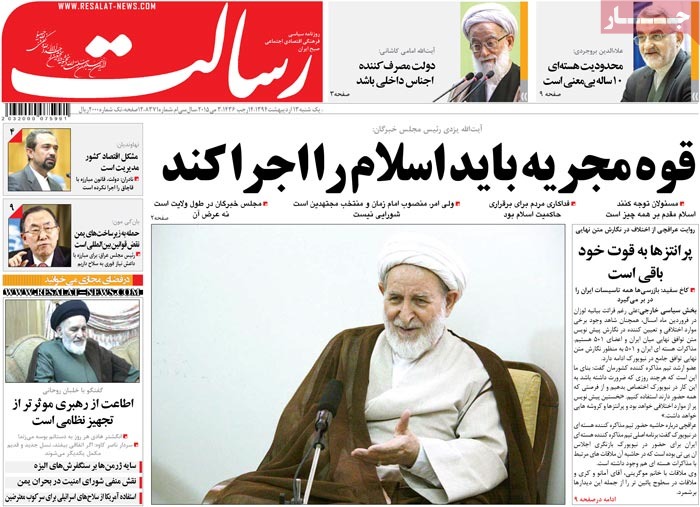
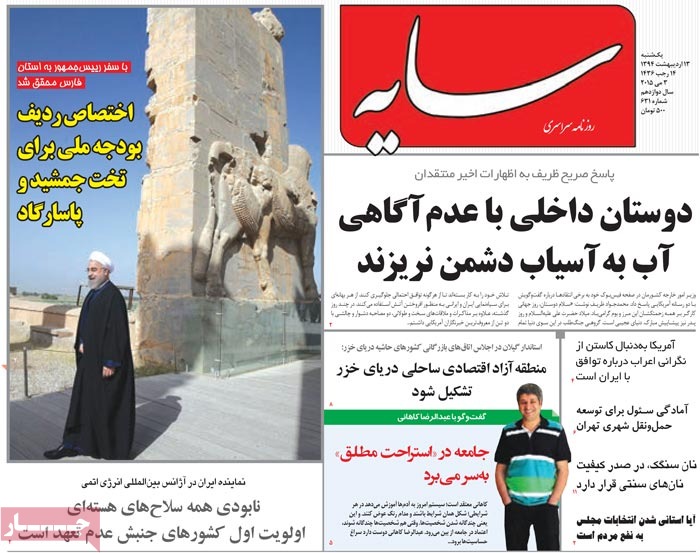
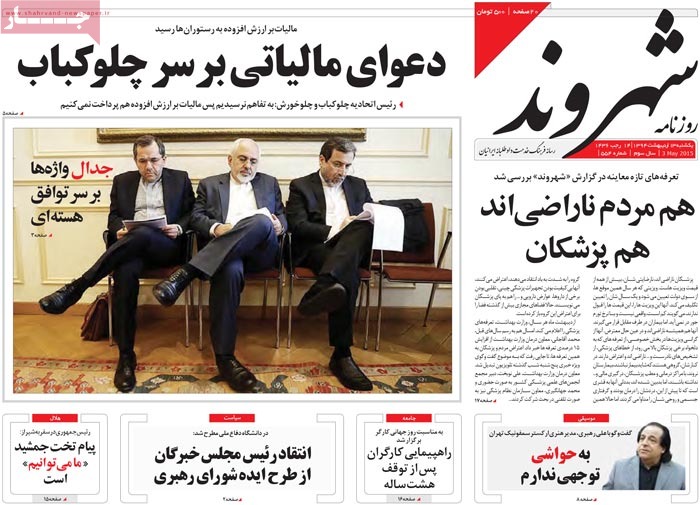
A look at Iranian newspaper front pages on April 8

Iranian Newspapers Headlines

The meetings of visiting Turkish President Recep Tayyip Erdogan with the Supreme Leader and President Rouhani and the agreements Iran and Turkey signed during President Erdogan’s day-long visit dominated the front pages of Iranian newspapers on Wednesday. Also on the covers of the dailies were the comments of Ayatollah Rafsanjani and Major General Mohammad Ali Jafari in support of the nuclear statement Iran and P5+1 released in Switzerland earlier in April and the Iranian negotiating team.
 

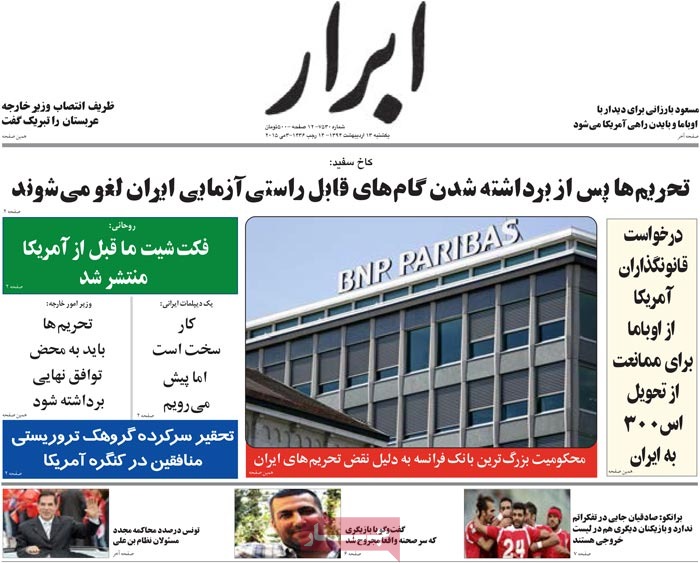
Abrar: An IS attack on an area near Iraq-Saudi Arabia border has been foiled.


A look at Iranian newspaper front pages on April 8


Afarinesh: “The post-nuclear statement liveliness of the people is an asset to the establishment,” said Ayatollah Akbar Hashemi Rafsanjani.

The chairman of the Expediency Council made the comment at a meeting with the vice-president for women and family affairs and a host of MPs, scholars and university professors.


A look at Iranian newspaper front pages on April 8


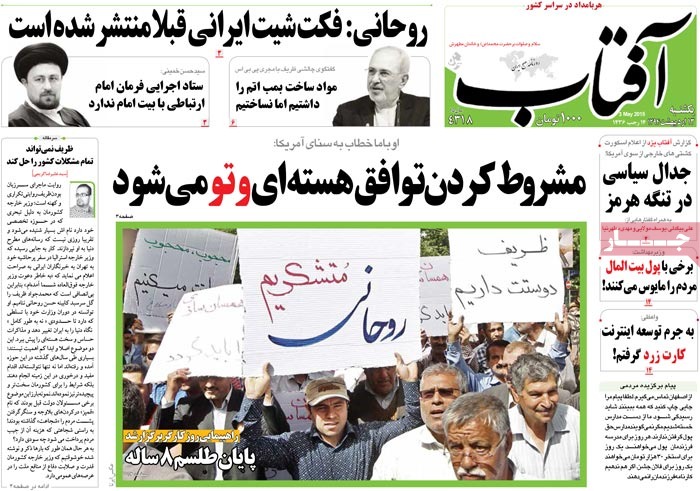
Aftab-e Yazd: “An end to attacks on Yemen and termination of foreign interference are key to settling the crisis of Yemen,” the Supreme Leader said.

Ayatollah Seyyed Ali Khamenei made the comment at a meeting with President Erdogan of Turkey.

Aftab-e Yazd: Women’s political participation in Iran is less than three percent.


A look at Iranian newspaper front pages on April 8


Amin: “Extremism needs to be cracked down on,” President Rouhani told a joint press conference with his Turkish counterpart.


A look at Iranian newspaper front pages on April 8


Arman-e Emrooz: Mohsen Rezaei has returned to the Islamic Revolution Guards Corps.

Rezaei, who once commanded the Revolution Guards, has written a letter to the Supreme Leader demanding to return to the IRGC.

The Leader has accepted the request, and Rezaei is now teaching at Imam Hussein University.


A look at Iranian newspaper front pages on April 8


Asrar: The commander of the Islamic Revolution Guards Corps has said that IRGC appreciates the efforts of the nuclear negotiating team.
 

A look at Iranian newspaper front pages on April 8


Ettela’at: Eight Iranian border guards have been martyred in a terrorist attack in the southeast of the country.
 

A look at Iranian newspaper front pages on April 8


Haft-e Sobh: A young man has admitted to killing his own father and sister in Tehran.


A look at Iranian newspaper front pages on April 8


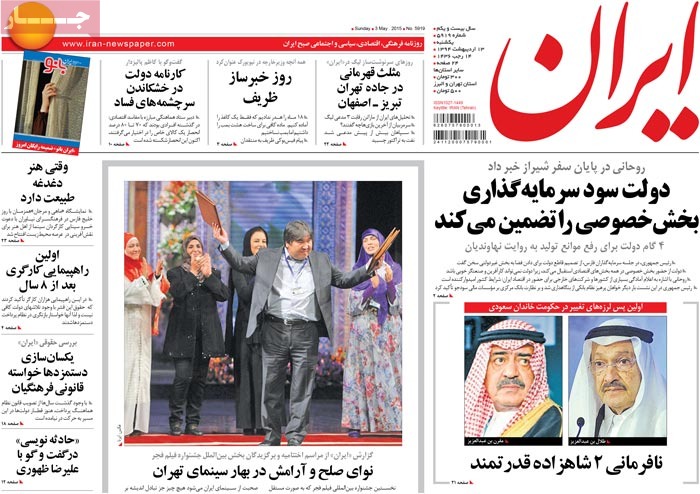
Iran: Insurance coverage of housewives will be finalized this year.

The promise was made by the vice president for women and family affairs ahead of Women’s Day on Friday.


A look at Iranian newspaper front pages on April 8


Javan: Bookstores won’t have to pay taxes anymore.

The announcement was made by the spokesman of the Ministry of Culture and Islamic Guidance.


A look at Iranian newspaper front pages on April 8


Kayhan: High interest rates banks offer to depositors kill enthusiasm to invest in the manufacturing sector.


A look at Iranian newspaper front pages on April 8


Qods: The Portuguese head coach of the Iranian national football team has been given 72 hours to decide whether he’s staying in Iran or not.


A look at Iranian newspaper front pages on April 8


Sayeh: Three major steel projects will be inaugurated in the country this year.

Sayeh: “I’m happy to be back in Iran,” said Branko Ivankovic.

The Croatian national who has been named head coach of Tehran’s Persepolis Football Club led Iran’s national team in the 2006 World Cup.


A look at Iranian newspaper front pages on April 8


Iran’s annual foreign trade hits $102 billion

Trade ship

The Iranian Customs Office announced on Tuesday that the value of the country’s foreign trade in the last Iranian year [which ended on March 21] surpassed one hundred billion dollars.

According to the data released by the public relations department of the Iranian Customs Office, the country has exported $49.744bln and imported $52.477bln worth of goods over the 12 months of the last year.

The volume of Iranian exports in the mentioned period amounted to 98.416 million tons and the figure for the Iranian imports hit 41.234mln tons, the report said.

It also showed that the volume of Iran’s exports last year witnessed a 4.83 percent increase compared to a year earlier, and the value of exports jumped by 18.87 percent.

Back in March, Iranian President Hassan Rouhani announced that the country’s non-oil exports hit a record high, emphasizing that the success was achieved despite Western sanctions.

Speaking at a session of the cabinet on March 18, President Rouhani said the country exported nearly $50 billion worth of non-oil goods in 12 months.

Up to 553 tons of narcotics confiscated last year in Iran: Official

Alireza Jazini

Deputy secretary general of the Drugs Control Headquarters said on Tuesday that 553 tons of different types of illicit drugs was confiscated in Iran last year.

Alireza Jazini made the remarks during a visit of Interior Minister Abdolreza Rahmani Fazli to the headquarters.

Jazini said that 350,000 people were arrested for drug-related crimes or abuse of narcotics last year.

He added that narcotics are a complicated and multi-dimensional issue.

He expressed concern about new issues such as the drop in the age of people who pick up the habit, addiction rate, relations between drug trafficking and political and security issues and a change in the pattern of drug consumption from traditional to industrial.

He said that narcotics production in Afghanistan has risen up.

He criticized the international organizations for negligence about the international campaign against drug-trafficking.

Iran opposes foreign meddling in all countries, including Yemen: Supreme Leader

Leader-Erdogan

Yemen is an example of a new class of problems the Muslim world is faced with, Supreme Leader Ayatollah Ali Khamenei told visiting Turkish President Recep Tayyip Erdogan Tuesday, adding Iran opposes foreign meddling in all countries, including Yemen.

At the meeting the Leader said the US and Zionists are happy to see divisions crop up in some Islamic countries and that the only way to settle this problem goes through cooperation among Islamic countries and adoption of practical, constructive measures.

Ayatollah Khamenei further stated that efforts by Muslims nations to bolster each other and keep division at bay are central to Islamic Republic’s general policy, and that promotion of Iran-Turkey ties serves that purpose.

Recalling the barbaric acts of terrorist groups in Iraq and Syria, the Supreme Leader said those who fail to see the footprints of the enemies of Islam in the developments of these two countries are in fact fooling themselves.

Ayatollah Khamenei said we believe an end to attacks on Yemen and termination of foreign interference are key to settling the crisis of Yemen whose people should determine the future of their country.

At the meeting which was also attended by President Rouhani, the Turkish president said the region is facing many problems and that regional countries should cooperate with each other to settle these problems. “We should not wait for [the assistance of] the West.”

President Erdogan also said he personally does not view IS members as Muslim and has taken a stance against the grouping.

Tehran, Ankara sign eight cooperation documents

Erdogan-Rouhani

Iran and Turkey at a ceremony on Tuesday signed eight cooperation documents and a joint communiqué as part of efforts to boost the value of bilateral trade to $30 billion this year.

Iranian President Hassan Rouhani and his Turkish counterpart Recep Tayyip Erdogan, who is visiting Tehran at the invitation of his Iranian counterpart, as well as a number of other senior officials from the two countries attended the ceremony.

During the ceremony, which was held after the two presidents’ joint press conference, Rouhani and Erdogan underscored the necessity for further expansion of diplomatic and economic ties between the two countries.

They said they viewed the signing of the documents as an important step in the development of Tehran-Ankara relations.

Iran and Turkey have plans to hike the volume of their trade to $30 billion by the end of 2015.

Iran, Turkey urge joint action against extremism

Rouhani-Erdogan

Iran’s President Hassan Rouhani and his Turkish counterpart Recep Tayyip Erdogan have called for more joint efforts aimed at fighting terrorism and extremism in the Middle East, saying that the two countries share a common view on the issue.

“The two sides agree that instability, insecurity and war should stop in the entire region,” President Rouhani said in a joint press conference with the Turkish president in Tehran on Tuesday.

The Iranian president also stated that Tehran and Ankara should boost bilateral efforts to tackle terrorism in the region, saying, “Together, we should fight terrorism and extremism in order to achieve brotherhood between Muslims and people in the region.”

Heading a high-ranking delegation, Erdogan arrived in Tehran earlier in the day on an official one-day visit to hold talks with senior officials of the Islamic Republic. The Turkish president immediately started talks with Rouhani in Tehran’s Sadabad Complex.

Rouhani said he and Erdogan have held “detailed discussions” on the ongoing conflict in Yemen, adding that the two sides emphasized the need for an immediate ceasefire in the Arab country.

Rouhani said the establishment of such a ceasefire could pave the way for sending humanitarian aid to Yemen, adding that Iran and Turkey and other countries should help peace and stability be restored to the Arab country. The president expressed hope that in Yemen “an inclusive government is established through dialogue.”

After the meeting between Rouhani and Erdogan, the two presidents and their accompanying ministers attended a meeting of Iran-Turkey High Council of Economic Cooperation, which saw major agreements finalized between the two sides, including agreements on expansion of cooperation in energy, transportation and commerce sectors as well as the private sector investment.

The Iranian president said the two sides have also agreed to broaden their cultural and academic cooperation. Iran and Turkey will also work for tougher security along the border.

The Turkish president, for his part, said the two countries are determined to open a new chapter in bilateral relations, saying that the time has changed and Iran and Turkey should expand cooperation on various issues.

Iran and Turkey will from now take forward steps in mutual cooperation, Erdogan stated, adding that the two countries could become a role model for the other states in the region.

He further touched upon the current situation in Iraq and Syria, saying that Tehran and Ankara should cooperate on the issue as a matter of Islamic unity.

Erdogan emphasized the need for dialogue in order for the bloodshed in countries such as Iraq to stop.

There’s only one Iran nuclear talks statement: EU

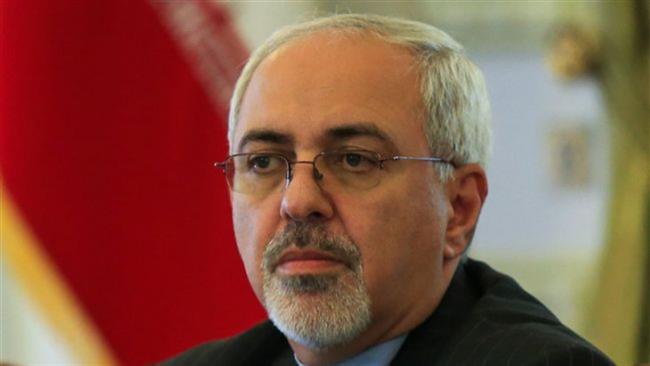
Zarif-EU

The European Union says the only valid statement regarding the nuclear talks with Iran is the one published last Thursday in Switzerland, Press TV reports.

“The general statement, which is valid, is the one which has been agreed on and delivered on the second of April by [EU] High Representative [for Foreign Affairs and Security Policy] Federica Mogherini and Iranian Foreign Minister [Mohammad] Javad Zarif in Switzerland,” said Catherine Ray, Mogherini’s spokesperson, at a media briefing in Brussels.

“The statement was validated by all the parties involved,” Ray said.

She was responding to questions from journalists after the US issued statements that appeared to contradict what had been agreed between Iran and the five permanent members of the UN Security Council plus Germany, also known as P5+1.

Iran and P5+1 along with officials from the EU reached a mutual understanding on Tehran’s nuclear program after eight days of marathon talks in Lausanne, Switzerland, on Thursday.

According to the joint statement, which is considered the basis for a final nuclear deal, the two sides have devised a mechanism to lift anti-Iran sanctions after the agreement, known as the Joint Comprehensive Plan of Action (JCPOA), is reached by the end of June.

The joint statement read by Zarif in Persian late Thursday stipulated the implementation of the JCPOA shortly after its adoption as a United Nations Security Council resolution.

It has been clearly stated that all UN Security Council resolutions will be terminated from the day of agreement, Zarif said in his joint statement with Mogherini.

The statement featured a markedly diplomatic tone. However, Washington has since issued statements, which analysts have described as aggressive and unhelpful.

On Saturday, the senior Iranian diplomat stressed that sanctions will be terminated, not suspended, and criticized the US, saying the fact sheet Washington released is different from the joint statement.

“We officially protested to [US Secretary of State] Mr. [John] Kerry for the statement of positions countering the Lausanne statement. The EU representative has also protested to [US Under Secretary for Political Affairs] Ms. [Wendy] Sherman why they have spoken contrary to their positions,” Zarif said.

“In fact, the Americans brought what they desired in the fact sheet.”

Political savvy prescribes interaction with world: Rafsanjani

Hashemi Rafsanjani

The establishment of the Expediency Council, which has been meant to break the deadlocks between the Islamic Consultative Assembly and the Guardian Council, shows how farsighted the founding father of the Islamic Republic was as a political and religious leader, the chairman of the Expediency Council said.

According to Ettela’at newspaper, Ayatollah Hashemi Rafsanjani made the comment at meetings with the ministers of education and science and their deputies Monday.

On the sixth development plan, he said political and managerial savvy requires us to pay closer attention to interaction with the rest of the world in drawing up the development plan so that the so-called resistance-based economy can bolster the foundation of our infrastructure.

On the nuclear statement Iran and P5+1 released at the close of marathon talks in Lausanne, the top councilor said because of domestic needs, some parties to the talks might have different interpretations of the statement which could in turn overshadow the three months that lie ahead.

“However, as a result of the statement, the world public opinion realized that what was being said about Iran had its roots in bias,” he said.

Recalling the comments of the Supreme Leader that the choice of the public in elections should be respected and that development of nuclear weapons is forbidden, he said these two statements are central to our policies at home and aboard.

Ayatollah Rafsanjani further said Israeli anger at the nuclear statement Iran and P5+1 produced in Lausanne is part of attempts by the fake regime of Tel Aviv to secure legitimacy. “Iran’s neighbors are miscalculating in opposing the nuclear understanding, because Iran has always been a safe place for Muslims and our policies are always rooted in Islamic principles.”

He also said some individuals at home might ignore national interests and make disheartening comments in pursuit of their political and factional goals. “What has been achieved so far is a source of pride, though, and every care should be taken not to allow the final deal to be disrupted.”

Iran voices concern over dire situation of Palestinians in Yarmuk camp

Marziyeh-Afkham
Marziyeh-Afkham

The Iranian Foreign Ministry expressed deep concern over the dire situation of the Palestinians in Syria’s Yarmuk refugee camp which has been under attack by the Takfiri terrorists for the last several days.

“The regrettable situation that started three years ago with the arrival of armed opposition groups in Yarmuk camp, has deteriorated today with ISIL’s arrival,” Foreign Ministry Spokeswoman Marzieh Afkham said on Tuesday.

The spokeswoman voiced concern that the terrorists have turned the camp into a scene of battles and bloodshed against the defenseless Palestinian people residing in there, and blamed the countries that still insist on their irresponsible policies on Syria and support the terrorists’ crimes.

Afkham called on the UN to act upon its responsibilities with regard to this human tragedy and oblige the countries which support the terrorists to cut their financial supports and arms shipments to Syria.

Her remarks came after the Security Council demanded humanitarian access to Yarmuk refugee camp as residents are described fleeing in terror after the arrival of the ISIL terrorists.

The Security Council expressed deep concern about the situation on Monday, said Jordan’s ambassador Dina Kawar, who chairs the council this month.

It called “for the protection of civilians in the camp for ensuring a humanitarian access to the area including by providing life-saving assistance”, Kawar said.

It also stood ready to consider “further measures to provide necessary assistance”, she added, without providing details.

Hundreds of Palestinians have fled the camp, initially built for Palestinians fleeing the 1948 Israeli war, in recent days following the ISIL attacks.

Iranians will support their diplomats on nuclear front: Top guard

Jafari

The resistance of our noble people should be credited for the historic admission by the US president that military option and continued sanctions will only make Iranians stronger and more determined, Commander of the Islamic Revolution Guard Corps (IRGC) Major General Mohammad Ali Jafari said Tuesday on the sidelines of a meeting of top IRGC commanders.

According to IRNA, the top general went on to say that on the diplomatic front the children of the revolution have been able to deservingly stand up for the rights of the Iranian nation. “The Islamic Revolution Guard Corps thanks the diplomacy machine for its sincere efforts and for its insistence on the red lines of the establishment.”

General Jafari further said American failure in the past to honor its commitments makes the road ahead for this diplomatic jihad more difficult. “But, we are certain, as the esteemed president and foreign minister and members of the negotiating team have said the right to enrich uranium and maintain nuclear research and development and have all relevant sanctions lifted are the central demands of the Iranian people.”

In conclusion, he said the Foreign Ministry is expected to fully tap into its potential to maintain the dignity of the country and have the sanctions lifted all at once. “In light of the idea of harmony and unanimity between the public and government, the Iranian people will support the diplomatic front as far as the nuclear issue is concerned and won’t allow the misleading interpretations of the [Lausanne] statement, particularly by the Americans, to dent the existing trust between them and their government.”