Tuesday, December 30, 2025
Home Blog Page 4883

A look at Iranian newspaper front pages on Dec. 24

Iranian Newspapers Headlines

The comments of the secretary of the Supreme National Security Council about nuclear talks and ties with the United States dominated the front pages of many Iranian newspapers on Wednesday. The three-leg regional tour of the speaker of the Islamic Consultative Assembly that has taken him to Syria, Lebanon and Iraq where he took up regional questions as well as issues of mutual interests with senior officials also appeared on the front pages of dailies. Also in the news was the ruling by a Belgian court that will eventually see the return to Iran of historical items dating back 4,000 years.

Abrar: “Tehran supports political dialogue in Lebanon,” Iranian Parliament Speaker Ali Larijani said at a meeting with the Lebanese prime minister in Beirut.
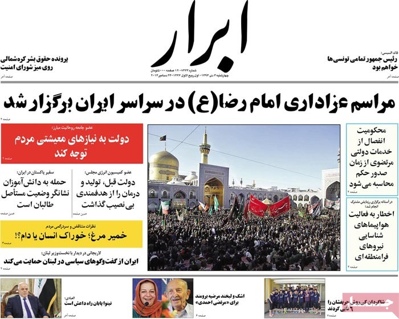
 

Abrar newspaper 12 - 24


Abrar-e Eghtesadi: A ban has been imposed on imports of palm oil. [It came after the use of palm oil in a number of dairy plants caused quite a stir in the country earlier this year.]

Abrar-e Eghtesadi: The economy minister has said interest rates will be cut next year. His comments came less than a week after the Central Bank decided to raise interest rates on 6- and 9-month accounts.
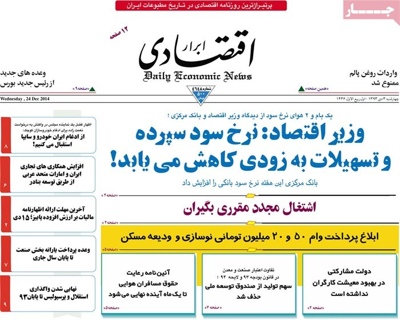
 

Abrare eghtesadi newspaper 12 - 24


Aftab-e Yazd: “Old age was not the only determining factor in the Guardian Council’s decision to disqualify Hashemi Rafsanjani [when he wanted to run for president in 2013],” said former spokesman of the council Abbasali Kadkhodaei.
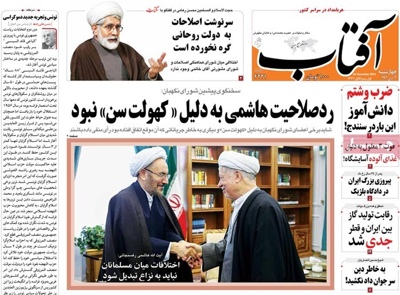
 

Aftabe yazd newspaper 12 - 24


Arman-e Emrooz: A great victory for Iran. Following a Belgium court order, 4,000-year-old Iranian antiques will return home.

Arman-e Emrooz: The justice minister has reported corruption to the tune of 700 billion rials (almost $23 million) in a bank. “So far we have been unable to discover all the assets of Babak Zanjani [who stands accused of massive corruption],” Mostafa Pourmohammadi said.
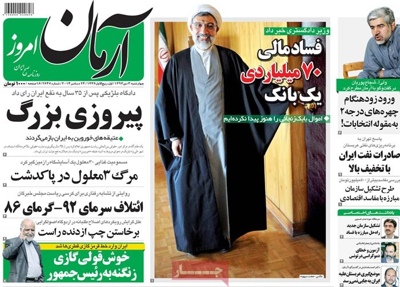
 

Armane emruz newspaper 12 - 24


Ebtekar: “The Supreme Leader does not seek to bring nuclear talks to a halt,” said Ali Shamkhani, the secretary of the Supreme National Security Council.
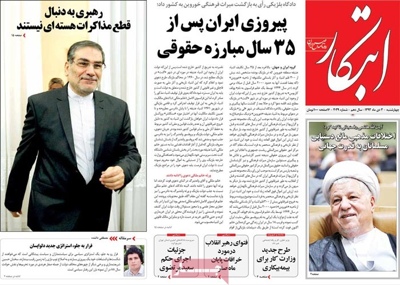
 

Ebtekar newspaper 12 - 24


Emtiaz: Following a drop in precipitation levels this year, the threat of drought looms in 20 provinces across the nation.
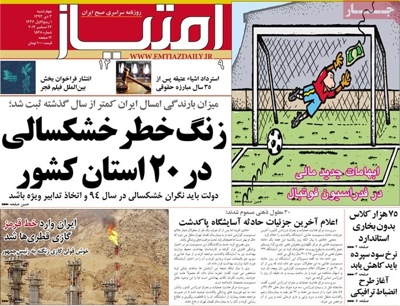
 

Emtiaz newspaper 12 - 24


Etemad: Roozan daily has been banned.

Etemad: Saudi Arabia has dropped an oil bombshell by saying it wouldn’t cut crude production even if prices fell to 20 dollars a barrel.
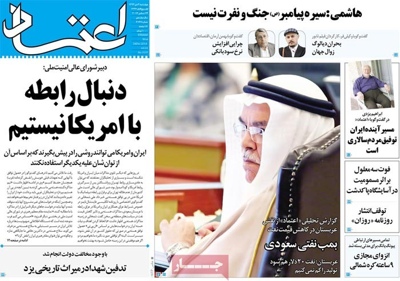
 

Etemad newspaper 12 - 24


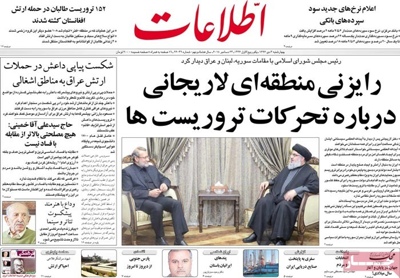
Ettela’at: Iranian Parliament Speaker Ali Larijani has held talks with officials in Syria, Iraq and Lebanon mostly on terrorist threats facing the region.

Ettela’at: IS terrorists have suffered back-to-back defeats following an Iraqi army offensive in the north.
 

Ettelaat newspaper 12 - 24


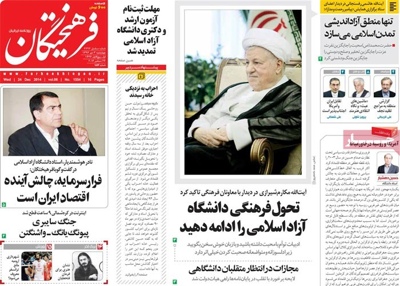
Farhikhtegan: A bill that envisions punishment for students who cheat in writing their dissertations has been presented to the Cabinet.
 

Farhikhtegan newspaper 12 - 24


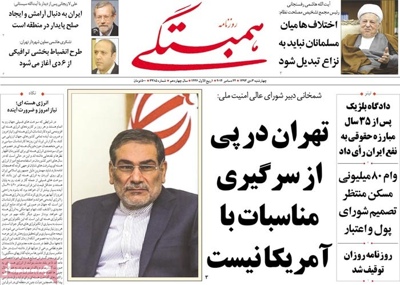
Hambastegi: “Differences of opinion among Muslims should not snowball into conflicts,” said Chairman of the Expediency Council Akbar Hashemi Rafsanjani.

Hambastegi: “Iran seeks to see security and sustainable peace prevail in the region,” said the Iranian parliament speaker after a meeting with senior Iraqi Shiite cleric Ayatollah Sistani.
 

Hambastegi newspaper 12 - 24


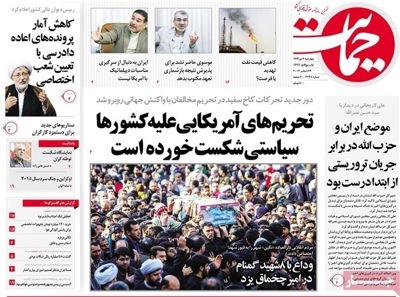
Hemayat: “Iran does not seek to resume diplomatic ties with the United States,” said Secretary of the Supreme National Security Council Ali Shamkhani.
 

Hemayat newspaper 12 - 24


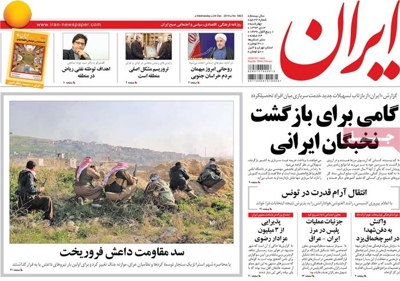
Iran: New arrangements to allow Iranian male expats who have not completed their military duty to pay fines instead is a major step that facilitates the return home of the elite.
 

Iran newspaper 12 - 24


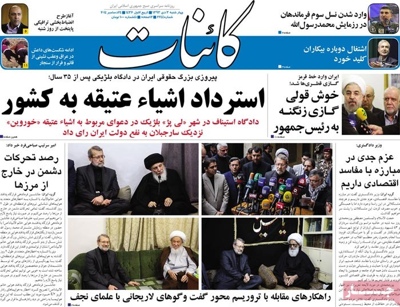
Kaenat: “Officials are determined to take on corruption,” said Minister of Justice Mostafa Pourmohammadi.
 

Kaenaat newspaper 12 - 24


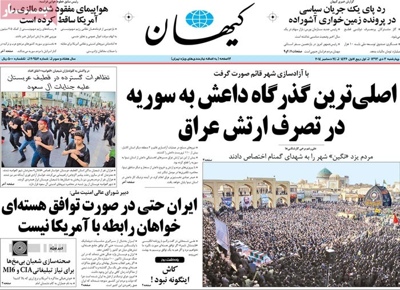
Kayhan: The Iraqi army has taken over the road IS militants use to travel back and forth between Iraq and Syria.
 

kayhan newspaper 12 - 24


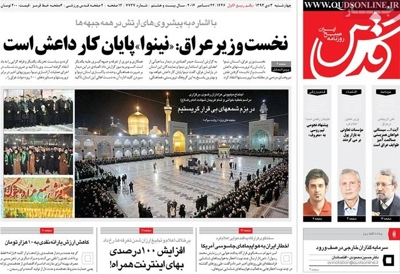
Qods: A Russian team seeks the signature of the captain of the Iranian national volleyball team. Saeed Marouf has been offered an astronomical figure.

Qods: Iran has warned foreign surveillance aircraft ahead of a major military maneuvers it will hold in the south.
 

Ghods newspaper 12 - 24


Resalat: Abbasali Kadkhodaei, an advisor to the secretary of the Guardian Council, has called for designation of a court to hear the cases of Mousavi and Karroubi [two candidates who disputed the results of the 2009 presidential elections and caused unrest].


Resalat newspaper 12 - 24]


SMT: The budget allocated to the mining sector is to increase by 50 percent.

SMT: Iran’s industrial production has registered a 58 percent hike.
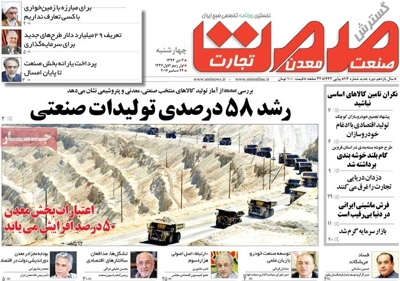
 

Samt newspaper 12 - 24


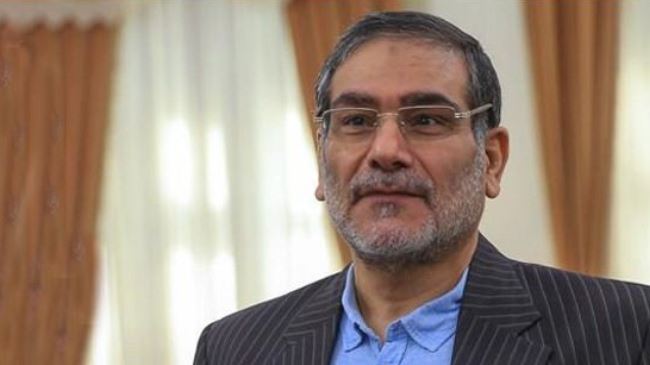
Resumption of ties with US not on Iran agenda: Shamkhani

Ali-Shamkhani

A senior Iranian official says Tehran does not seek to resume diplomatic ties with Washington even if a comprehensive nuclear deal is reached between the Islamic Republic and P5+1.

In an interview with the Financial Times, Secretary of Iran’s Supreme National Security Council (SNSC) Ali Shamkhani said Iran and the US “can behave in a way that they do not use their energy against each other [in the region]. A nuclear agreement can be very crucial in this regard.”

“Everything will depend on the honesty of the Americans in the nuclear talks,” he added.

He rejected assumptions that regular meetings between Iranian and American diplomats during the Iran-P5+1 nuclear talks could lead to rapprochement between the two countries.

Iran and the US severed diplomatic ties in the aftermath of the Islamic Revolution in the country in 1979.

“Negotiations are only for the nuclear issue,” the SNSC secretary said.

He emphasized that Iran would not buckle under international sanctions and would not retreat from its rights based on the Non-Proliferation Treaty (NPT).

“We will not die if there is no agreement and we will not go to heaven if we reach an agreement,” Shamkhani said.

Iran and the P5+1 countries – the US, Britain, France, Russia, China and Germany – wrapped up their latest round of talks on the Islamic Republic’s nuclear program in the Swiss city of Geneva on December 17. Iranian and American diplomats have also held a few rounds of talks over Tehran’s nuclear program.

Shamkhani further said the US-led airstrikes against the Takfiri ISIL terrorists in Iraq have been ineffective.

He said Iran only cooperates with the Iraqi government in the fight against terrorists.

The ISIL terrorists control some parts of Syria and Iraq. They are engaged in crimes against humanity in the areas under their control.

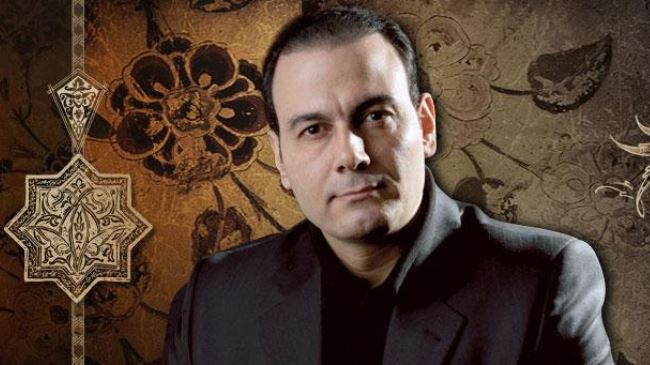
France to release Ali Reza Qorbani’s album

Iranian vocalist- Ali Reza Qorbani

Eminent Iranian vocalist Ali Reza Qorbani’s new album, Lost in Love, is slated to be released in French capital of Paris.

Recorded by the French company, Accords Croisés, the album includes Iranian traditional songs.

The songs have been inspired from the works by the classical Persian poets Abu-Saeid Abul-Kheir and Mowlavi as well as the works by the contemporary poets Fereidoon Moshiri and Mohammad-Reza Shafiei Kadkani.

Lost in Love was composed by the Iranian musician Saman Samimi, who is also a Kamancheh – an Iranian bowed string instrument – maestro.

The album will hit the market with the French title of Éperdument on January 27.

Qorbani has performed concert tours in a number of countries like Germany, Belgium, Algeria, Greece, Turkey, Denmark and Ireland.

He also took part in the Sounds of Persia Festival in Toronto, Canada, and the annual Festival de Saintes in France.

Qorbani, along with a number of Iranian and Tunisian musicians, also had Persian and Arabic performances in Morocco and France. He was warmly welcomed by the audience, particularly traditional Persian music lovers.

He has studied under prominent Iranian musicians like Khosrow Soltani, Behrouz Abedini, Mehdi Fallah, Ahmad Ebrahimi, and Dariush Tala’i, whom he accompanied in numerous concerts.

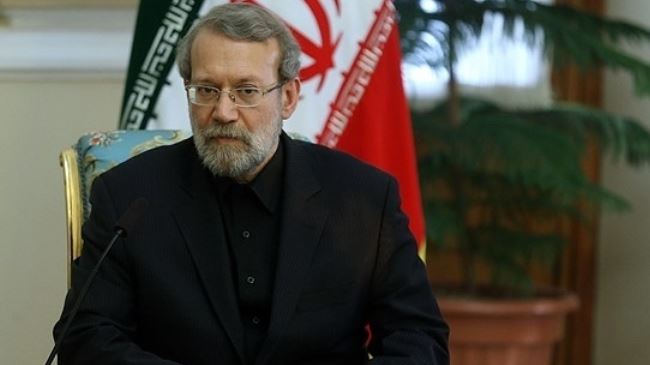
Iran’s top MP raps regional support for terrorism

Iran-Ali-Larijani

Iran’s Parliament Speaker Ali Larijani has criticized certain regional countries for implicitly backing terrorist groups, saying their support has led to the spread of terrorism.

Speaking in the Iraqi holy city of Najaf on Tuesday, Larijani said some countries in the region, however, have sided with the Iraqi people and expressed their opposition to terrorist groups.

“That many regional countries have realized the region’s sensitivities and the danger of terrorism over the past year is a step forward,” the Iranian parliament speaker said.

However, he called for more consultation among regional states on the issue of terrorism.

He also said that the main solution to the scourge of terrorism is collective cooperation and the support of Muslim states for the Iraqi government.

Larijani, who arrived in Iraq on the last leg of a regional three-country tour early Tuesday, noted that his trip is aimed at exchanging views with the senior officials of the country on expansion of Tehran-Baghdad relations and developments in the Middle East, particularly terrorism.

[…]

On Sunday the Iranian parliament speaker kicked off his regional tour which has already taken him to Syria and Lebanon.

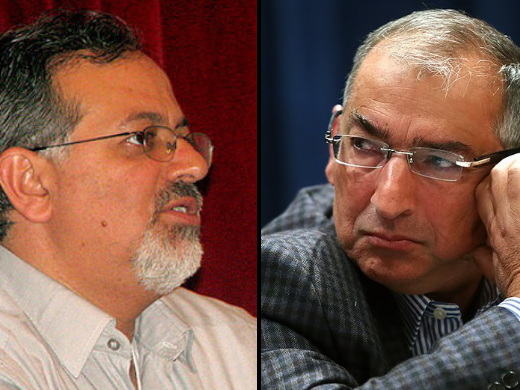
Fars News Agency answers the questions of two Iranian university professors through words of an American

Zibakalam- Shirzad

The comments of Sadegh Zibakalam [a university professor and political analyst] and Ahmad Shirzad [a university professor and former MP] on the country’s nuclear program at a student gathering at University of Tehran have drawn an angry reaction from principlist media and political figures, including some MPs. In addition to an editorial by its managing editor Hossein Shariatmadri, Kayhan ran a report by Fars News Agency on December 22 which took a swipe at the two. The following is the translation of the piece which appeared on page two of the principlist daily:

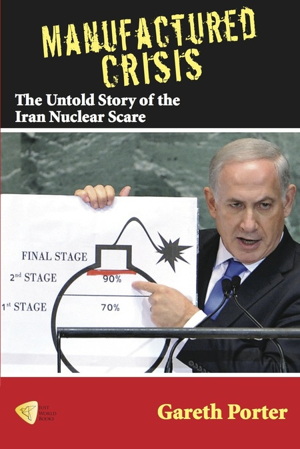
Following iconoclastic comments by Sadegh Zibakalam and Ahmad Shirzad that threw Iran’s nuclear program into doubt, Fars News Agency’s deputy editor for research has sent each a copy of Manufactured Crisis* by American investigative journalist Gareth Porter.

In a cover letter, the Fars News Agency official told the pair, “You have said that the country has had to experience pressures and sanctions for opting to have nuclear technology. Nuclear program has turned into an honor issue and one cannot negotiate on their honor. Why should we tolerate sanctions and pressures? We have crossed the red lines of major powers. What difference does it make to have 10,000 centrifuges or simply 10? No water can be removed from the nuclear well!”

Seyyed Yaser Jebraeili went on to say, “American Gareth Porter has presented evidence to answer all the questions you Iranians have posed. If these questions and the like really prompted you to scratch your heads and if by posing them in a student gathering, you truly sought answers, going through Manufactured Crisis will help you put those questions to rest. I hope you are man enough to rethink your line of thinking and make your revision public. Come out of the Liberalist camp and join the ranks of the nation.”


Manufactured Crisis book* [Amazon Description] In Manufactured Crisis, Gareth Porter brings together the results of his many years of research into Iran’s nuclear technology program. He shows that the origins of the Iran nuclear “crisis” lay not in an Iranian urge to obtain nuclear weapons but, rather, in a sustained effort by the United States and its allies to deny Iran its right, as guaranteed in the Nuclear Non-Proliferation Treaty, to have any nuclear program at all. The book highlights the impact that the United States’ alliance with Israel had on Washington’s pursuit of its Iran policy and sheds new light on the US strategy of turning the International Atomic Energy Agency into a tool of its anti-Iran policy.
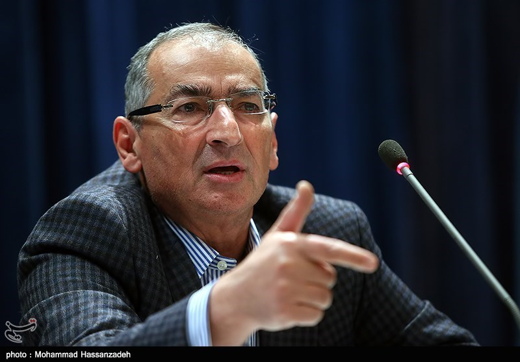

Sadegh Zibakalam: I really thank the Worriers

Sadegh Zibakalam

Arman-e Emrooz, a reformist daily, on December 22 ran an exclusive interview with Sadegh Zibakalam, a political analyst and university professor, on the Western-imposed sanctions on Tehran and their effects on the Iranian economy as well as the viewpoints of the so-called Worriers [former President Ahmadinejad’s supporters who proclaim to be worried and keep sounding alarms about the state of affairs in the country since the rise to power of the moderate government of Hassan Rouhani]. The following is the translation of the Q & A:


You have earlier said that a breakthrough in nuclear talks will open up an opportunity for Iran to make an economic leap and that such a possible breakthrough will bring considerable economic benefits to the country.

Despite the fact that sanctions have been said to have no economic impact and the country’s economic woes are blamed on mismanagement, I believe that it’s not true. I don’t want to deny the role of mismanagement. When the eleventh government took over last year, a deputy minister of industries, mines and trade said that half of the country’s production units had been closed down due to lack of raw material, spare parts and venturecapital – for which sanctions are to blame – and the other half are running below capacity.

Over $120 billion of Iran’s assets has been frozen in overseas banks, of which around $4 billion has been given back to Tehran under the Geneva Interim Deal. Iran is to get $700 million each month [under what was agreed in the November 24, 2014 nuclear talks]. If the knot of nuclear talks is untied, the effects of such openness will be first seen on the economic front.


You said in a letter to nuclear negotiators that efforts to circumvent sanctions have given rise to corruption. What do you mean exactly?

Under President Ahmadinejad officials said they had managed to bypass sanctions, but it has become clear today that, in President Rouhani’s words, the then government bypassed the [national] economy, not the sanctions. In other words, no matter what angle you look at the case from, there is ambiguity. When Iran is not allowed to sell more than 700,000-800,000 barrels of oil [per day] and the international financial system learns that the money [which is going to be transferred] belongs to Iran, it blocks the money. That’s why the country has to do its transactions covertly.


Direct talks between Iran and the US were the turning point of Iran-P5+1 nuclear negotiations in Geneva. What’s your take on mutual talks between representatives of Tehran and Washington and their overall impact on the negotiations?

Certainly it is a step forward. We should have opened bilateral talks with the US many years ago and asked ourselves why Iran harbors hostility toward the US. Now it will be very helpful if we review the areas of contention between the two countries and mull over which line each side has taken and what they are calling for.


Although the US foreign policy establishment has one single attitude, various political groups have taken different attitudes toward Iran’s nuclear case. How should Iran react to such groups and their approaches?

Political groups in the US, as a whole, were opposed to Iran. Things changed after June, 14, 2013 [when President Rouhani came to power] which was followed by efforts by Messrs. Zarif and Araghchi and others to have direct talks with the US secretary of state and other American negotiators. They did what they did to change the atmosphere. This [change] was missing before.

But now senior US officials have met with Dr. Rouhani’s Foreign Minister [Mohammad Javad] Zarif, sat around the negotiating table and exchanged handshakes. This has not been easy.

In the interim, conservative Republicans in the US believe that Secretary John Kerry and [President] Obama have made a mistake [by dealing with Iran]; that’s why you see Republicans and [Israeli Prime Minister Benyamin] Netanyahu are placing pressures on Obama, trying to make their case that trusting Iran is not the right thing to do.

Republicans are opposed to Iran. That’s true. In the new US Congress which is to meet in a few weeks those who are against Iran hold the majority. I think if we can go tougher on the anti-Iran elements in Washington in coming months, we can remain hopeful about positive results. If so, Republicans will fail in their efforts to impose a new set of sanctions on Iran, because they cannot easily withstand the pressure the public opinion brings to bear. Despite the fact that the Republican-majority Congress is deeply opposed to Iran, I am still hopeful that they cannot slap new sanctions on Iran in the months to come.


In remarks in the University of Tehran, you said that the country owes the opportunity it has been given to openly critique the nuclear policies to hardliners. Would you please elaborate on that?

I really thank the Worriers. They presented us with an opportunity to openly analyze [the upsides and downsides] of the nuclear policies, a first in a decade. After Iran and P5+1 inked the Geneva deal in November 2013, hardliners began to attack the so-called Joint Plan of Action.

Then the so-called Worriers staged [protest] gatherings outside the building which used to serve as the US embassy in Tehran and other places during which they publicly hit out at Geneva talks. Some of them went as far as denounce the Geneva deal as being worse than the Treaty of Turkmenchay [the name of an agreement Iran and the Russian Empire signed in 1828 in Torkamanchay, under which the former ceded to Russia control of several areas in the South Caucasus].

The break came when some criticized the nuclear policies the government of President Rouhani had adopted. After all, double standards were unacceptable. In other words, you cannot let others dispute Dr. Rouhani’s nuclear policies but say that nobody is allowed to challenge those of Mr. [Saeed] Jalili and Ahmadinejad.

When President Rouhani’s nuclear policies came in for criticism, naturally similar policies of Mr. Ahmadinejad and principlists were fair game. At least they were not as off limits as they used to be. This helped me join the ranks of other critics and talk in a roundtable in the University of Tehran. That is what the opponents of President Rouhani’s did in other universities in earlier weeks.

The point is this: you cannot say that opposition to Mr. Rouhani is ok, but you have no right to talk against or critically analyze the nuclear policies of Ahmadinejad, Jalili and their fellow principlists. Undoubtedly, we owe the [open] atmosphere we enjoy today to the Worriers. I really thank them [for what they did].


The very group, as you put it the Worriers, have in recent days strongly railed against what you said in your speech in Tehran University.

I sincerely thank them. Since December 17 when the three-hour meeting was held in Tehran University, attacks were launched in radio and TV programs, as well as a number of principlist newspapers and news agencies against what Dr. Ahmad Shirzad and Dr. Davoud Hermidas Bavand and I said in the gathering. I think it is a good thing, because people – out of curiosity – seek to learn what we said that IRIB and the principlist press keep talking about.

I have made a laundry list of those who have talked against my words in the last 24 hours. These critical views are good because they help society open up [to opposing views].

I really welcome the viewpoints of our friends and remain thankful to them. Basically, this is exactly what freedom, democracy and enlightenment of the public opinion call for. In other words, you can easily talk about different issues and there are other groups which can openly stake out their opposing views.

President Rouhani is to bring down the curtain on illegal wiretaps

wiretaps

In a report on December 22, Arman-e Emrooz, a daily, looked back at one campaign promise of President Rouhani and his emphasis on implementation of Article 25 of the Constitution which says: “It is forbidden to inspect letters and to confiscate them, to disclose telephone conversations, to disclose telegraphic and telex communications, to censor them and to stop their delivery. It is forbidden to wiretap conversations. All forms of inspection are forbidden except according to law.” The following is a partial translation of the report which looks at steps taken by the Rouhani administration to uphold that constitutional provision:

In order to guarantee the enforcement of Article 25 of the Constitution, President Rouhani has sent parliament a bill which introduces an amendment to Chapter 31 of the Fifth Book of the Islamic Penal Code.

If the bill were passed by the chamber, while tapping into the latest advanced technology not only would it streamline the telecommunications sector, but it would be an effective step in honoring civic rights by putting the brakes on illegal interference in public communications. It would also fulfill the vow President Rouhani has repeatedly made since he rose to power.

On December 13, President Rouhani handed to parliament a bill entitled “Use of Technical Equipment Mainly Intended for Intelligence Gathering”. The bill says that real or any legal entity that purposely and without permission from the Intelligence Ministry tries to produce, distribute or advertise any equipment used for data mining and intelligence gathering, including audio and video data, will be subjected to punishments enshrined in the Penal Code.

With the passage of the bill, legal and real entities as well as different institutions would not be able to use wiretaps or other equipment with similar purposes to pry into people’s lives unless they are granted permission by the Intelligence Ministry or its affiliates. If signed into law, aside from safeguarding civic rights, it would eliminate undue and unlawful interference by parallel and illegal structures which want to snoop into the private lives of people.

If approved, it would help those in the judicial system and its affiliates deal with violations and infringements with greater ease and stop unlawful interference in people’s lives by offenders who take advantage of legal loopholes when it comes to communications and exchange of information among members of the public.

Park rangers give an injured wild goat life-saving stitches

life-saving

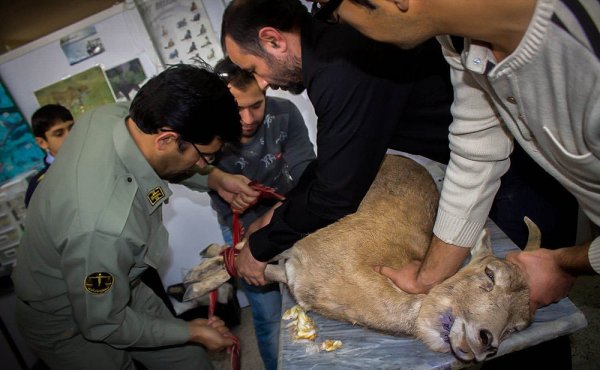
On December 19, Khabaronline filed a report on saving by park rangers in a village near Shahrud, a city in Semnan Province, of a two-year-old wild goat which suffered severe wounds after being attacked by a wolf. What appears below is a partial translation of the report accompanied by a photo gallery:

“Right now, the wild goat is in good condition. The goat was wounded in the throat and immediately taken to Sharud for treatment,” said Mohammad Reza Ghasemi, the head of the Public Relations Office of the Environment Protection Department of Shahrud.

“The wild goat will be taken care of for about 10 days at the Environment Protection Department and then will be released in nature,” Ghasemi added.

The veterinarian in charge of treating the goat said, “If it weren’t for the swift action of people and environment officials, the animal would have definitely died from injuries.”

With rare wildlife species, Shahrud, the second largest protected area in Iran, is very rich in environmental resources.


Ex-IAEA chief warns on unverified intel to pressure Iran

Han Blix

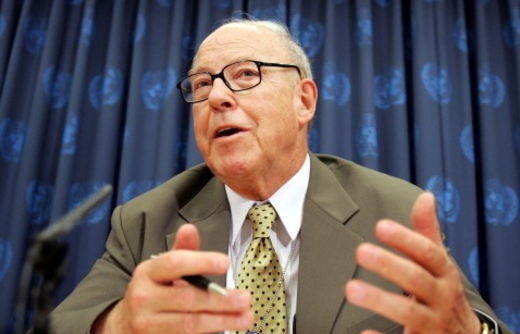
In a critique of the handling of the Iran file by the International Atomic Energy Agency, former IAEA Director General Hans Blix has called for greater skepticism about the intelligence documents and reports alleging that Iran is in pursuit of nuclear weapons.

In an interview in his Stockholm apartment late last month with Gareth Porter, an investigative journalist and historian specializing in U.S., Blix, who headed the IAEA from 1981 to 1997, also criticized the language repeated by the IAEA under its current director general, Yukiya Amano, suggesting that Iran is still under suspicion of undeclared nuclear activity.

Blix, who clashed with US officials when he was the head of the United Nations Monitoring, Verification and Inspection Commission (UNMOVIC) on weapons of mass destruction in Iraq from 2000 to 2003, said he has long been skeptical of intelligence that has been used to accuse Iraq and Iran of having active nuclear-weapons programs.

“I’ve often said you have as much disinformation as information” on alleged weaponization efforts in those countries, he said.

Referring to the allegations of past Iranian nuclear weapons research that have been published in IAEA reports, Blix said, “Something that worries me is that these accusations that come from foreign intelligence agencies can be utilized by states to keep Iran under suspicion.”

Such allegations, Blix added, “can be employed as a tactic to keep the state in a suspect light — to keep Iran on the run.” The IAEA, he said, “should be cautious and not allow itself to be drawn into such a tactic.”

He warned that compromising the independence of the IAEA by pushing it to embrace unverified intelligence was not in the true interests of those providing the intelligence.

The IAEA member states providing the intelligence papers to the IAEA “have a long-term interest in an international service that seeks to be independent,” said Blix. “In the Security Council they can pursue their own interest, but the [IAEA] dossier has to be as objective as possible.”

In 2005, the George W. Bush administration gave the IAEA a large cache of documents purporting to derive from a covert Iranian nuclear weapons research and development program from 2001 to 2003. Israel provided a series of documents and intelligence reports on alleged Iranian nuclear weapons work in 2008 and 2009.

Blix’s successor as IAEA director general, Mohamed ElBaradei, recalled in his 2011 memoirs having doubts about the authenticity of both sets of intelligence documents. ElBaradei resisted pressure from the United States and its European allies in 2009 to publish an “annex” to a regular IAEA report based on those unverified documents.

But Amano agreed to do so, and the annex on “possible military dimensions” of the Iranian nuclear program was published in November 2011. During the current negotiations with Iran, P5+1 (US, UK, Russia, China, France plus Germany) has taken the position that Iran must explain the intelligence documents and reports described in the annex.

The provenance of the largest part of the intelligence documents — the so-called “laptop documents” — was an unresolved question for years after they were first reported in 2004 and 2005.

But former senior German foreign office official Karsten Voigt confirmed in 2013 that the terrorist Iranian exile opposition cult, the Mujahedeen e-Khalq (MEK), gave the original set of documents to the German intelligence service (BND) in 2004. The group has been reported by Seymour Hersh, Connie Bruck, and a popular history of the Mossad’s covert operations to have been a client of Israel’s foreign intelligence agency, the Mossad, serving to “launder” intelligence that Mossad did not want to have attributed to Israel.

Blix has been joined by two other former senior IAEA officials in criticizing the agency for its uncritical presentation of the intelligence documents cited in the November 2011 annex.

Robert Kelley, the head of the Iraq team under both Blix and ElBaradei, and Tariq Rauf, the former head of the Agency’s Verification and Security Policy Coordination Office, have written that the annex employed “exaggeration, innuendo and careful choice of words” in presenting intelligence information from an unidentified Member State of the IAEA on the alleged cylinder at the Parchin military facility.

Blix said he is “critical” of the IAEA for the boilerplate language used in its reports on Iran that the agency is “not in a position to provide credible assurances about the absence of undeclared nuclear material and activities….”

Blix added that it is “erroneous” to suggest that the IAEA would be able to provide such assurances if Iran or any other state were more cooperative.

As head of UNMOVIC, Blix recalled, “I was always clear that there could always be small things in a big geographical area that can be hidden, and you can never guarantee completely that there are no undeclared activities.”

“In Iraq we didn’t maintain there was nothing,” he said. “We said we had made 700 inspections at 500 sites and we had not seen anything.”

Blix emphasized that he was not questioning the importance of maximizing inspections, or of Iran’s ratification of the Additional Protocol. “I think the more inspections you can perform the smaller the residue of uncertainty,” he said.

Yemeni President Hails Iran’s Important Role in Region

Abd Rabuh Mansur

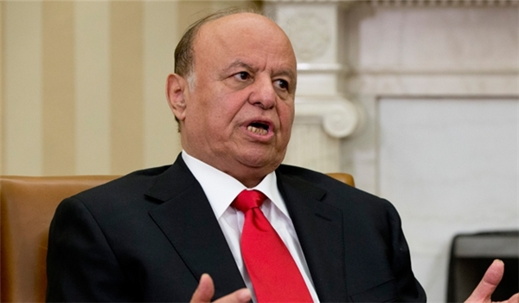
Yemeni President Abd Rabuh Mansur Hadi in a meeting with Iranian Ambassador to Sana’a Hassan Niknam underscored Tehran’s major and important role in settling different problems in the region.

“Iran is a great country in the region,” President Mansur Hadi said during the meeting in the Yemeni capital on Saturday.

He underlined that Yemen and Iran can increase their mutual cooperation in a bid to resolve the regional problems.

The Yemeni president reiterated that Iran can play important roles using its broad capacities and capabilities.

The Yemeni president, meantime, called on the Iranian companies to invest in Yemen’s development projects.

In similar remarks last week, Vice-Chairman of Britain-Iran Parliamentary Friendship Group Richard Bacon underscored Tehran’s capability to establish stability in the region, and called on the West to use Tehran’s power and capacity.

Bacon made the remarks in a meeting with Chairman of Iran-Europe Parliamentary Friendship Group Kazzem Jalali in Tehran.

He hailed the prevailing security in Iran, and said that travelling to Tehran and Iran in full security can rarely be experienced in (other parts of) the Middle East and Iran can play a vital role in regional stability if Western countries attach more significance to Iran’s role.