Iran on Monday protested to the Saudi government over the airstrike near Iranian Embassy in Sana’a, Yemen.

Foreign Ministry Spokeswoman Marzieh Afkham said Monday that Iran has summoned Saudi charge d’affaires to Tehran to protest air strikes near the Iranian embassy in Sana’a.
Afkham told IRNA that Iran has called for a clear response from the Saudi government about today’s attack near the Iranian Embassy.
The spokeswoman said that Iran holds the Saudi government responsible for the air strike by the Saudi-led coalition launching attacks on Yemen.
She said that the Saudi government is accountable for the probable damage to the Iranian embassy, reminding their responsibility to ensure the safety of the Iranian diplomats in Sana’a.
Meanwhile, Deputy Foreign Minister for Arab-African Affairs Hossein Amir Abdollahian said that unfortunately air strike damaged building of the Iranian Embassy in Sana’a, the windows of the embassy were shattered, but, fortunately our ambassador and the diplomatic staff were not hurt.
Amir Abdollahian said that the Iranian Embassy will continue with humanitarian relief operations in Sana’a.
He said that Saudi Arabia, as the aggressor, will be held accountable for any damage to the Iranian Embassy.
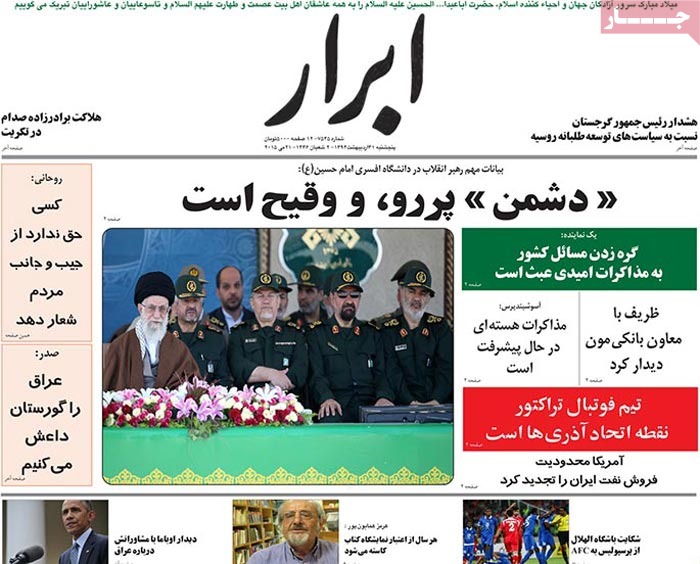
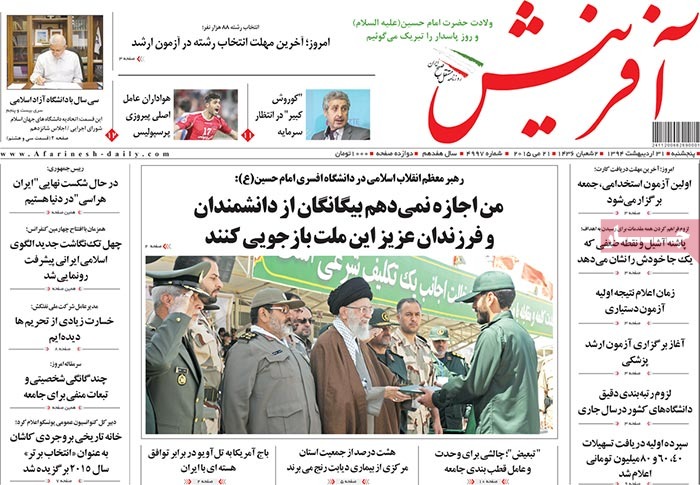
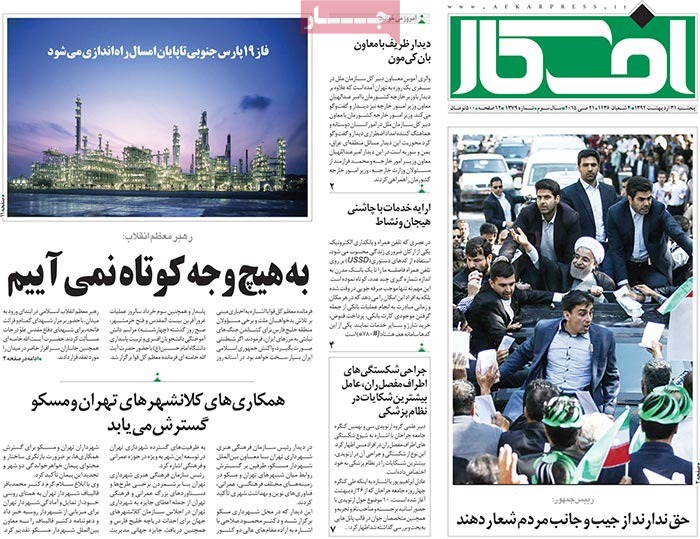
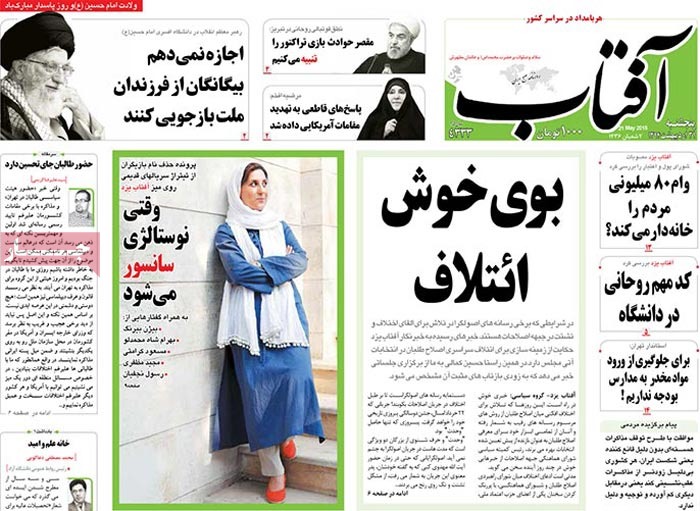
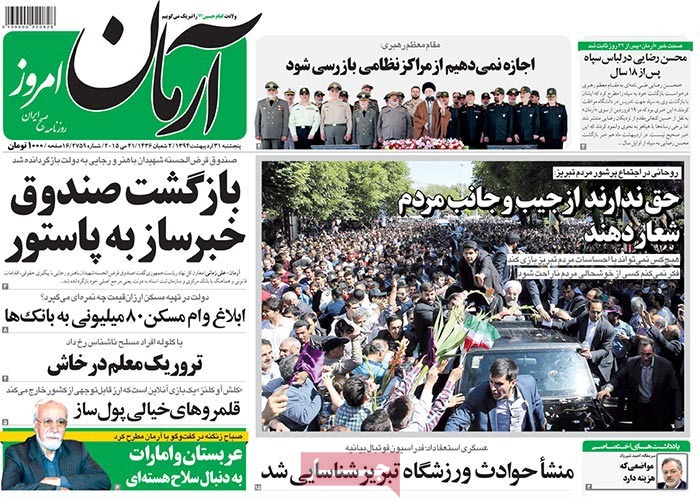
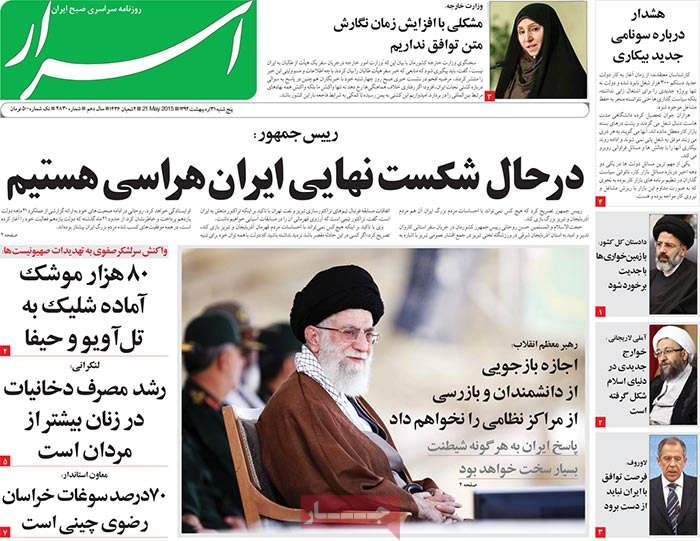
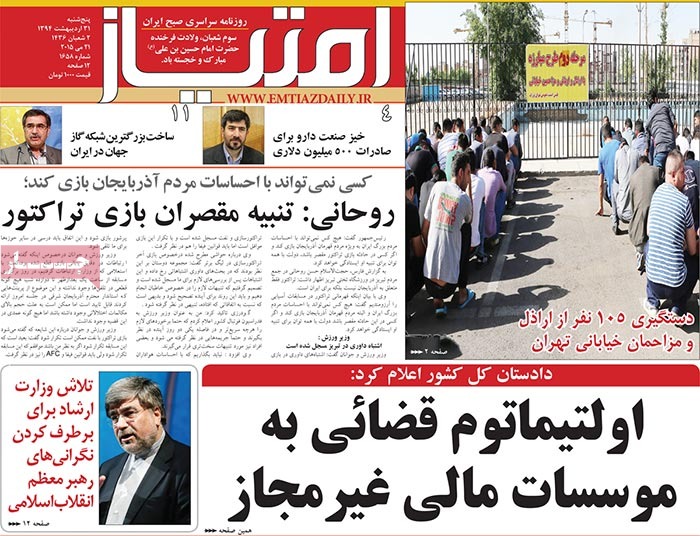
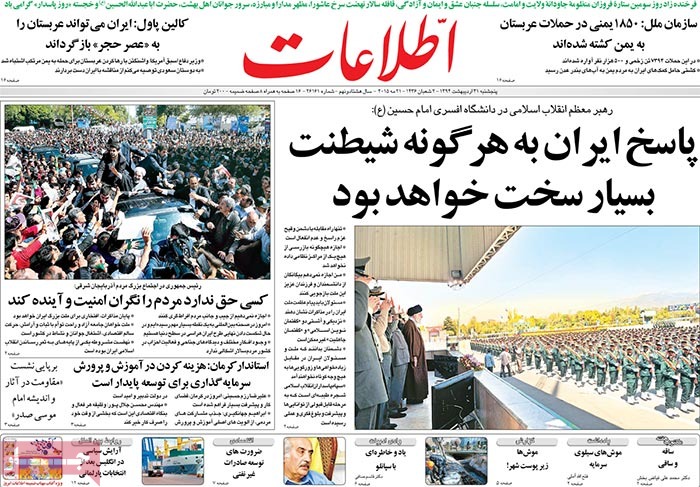
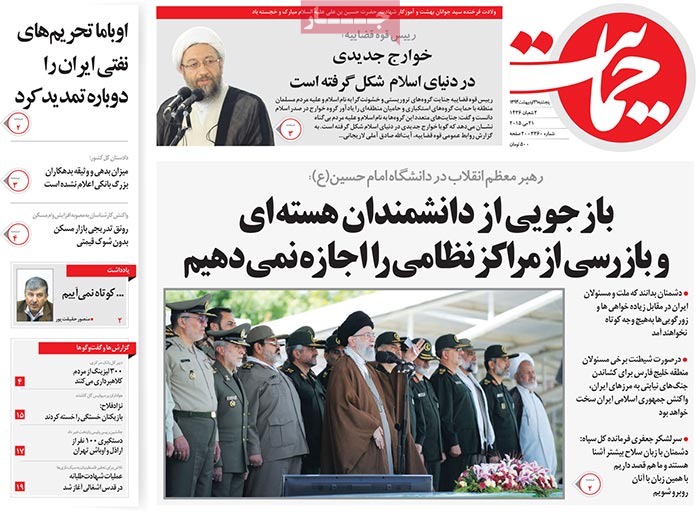
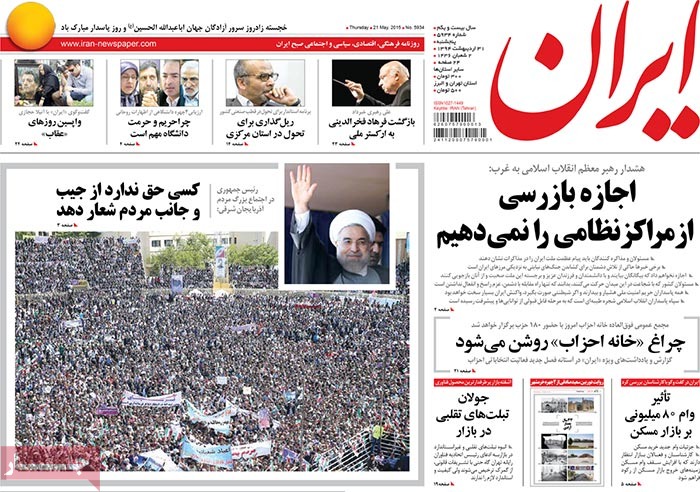
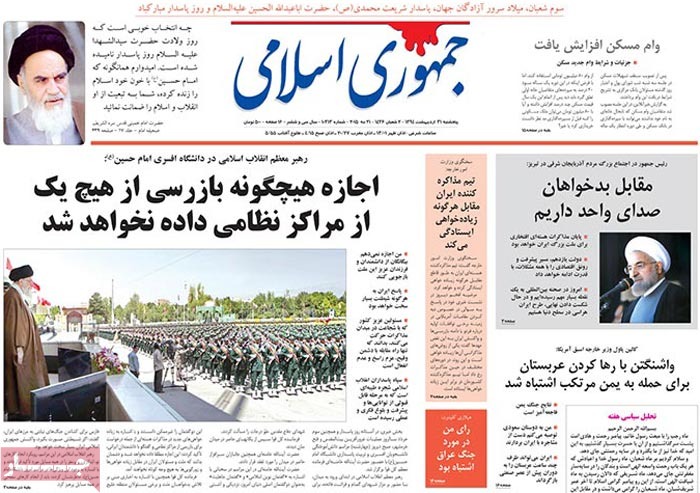
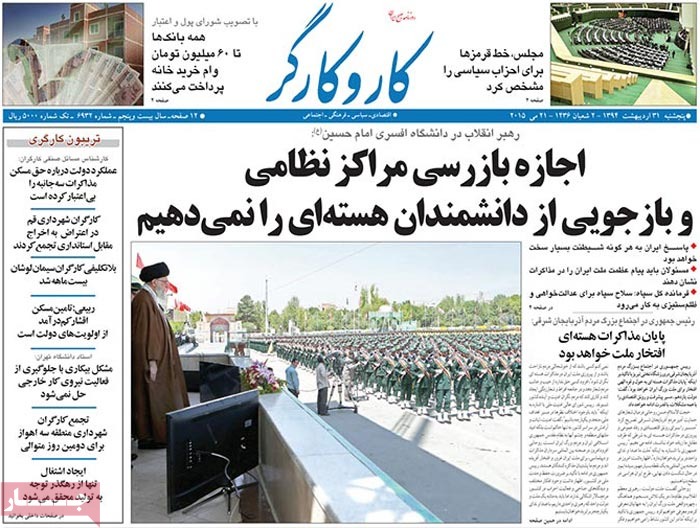
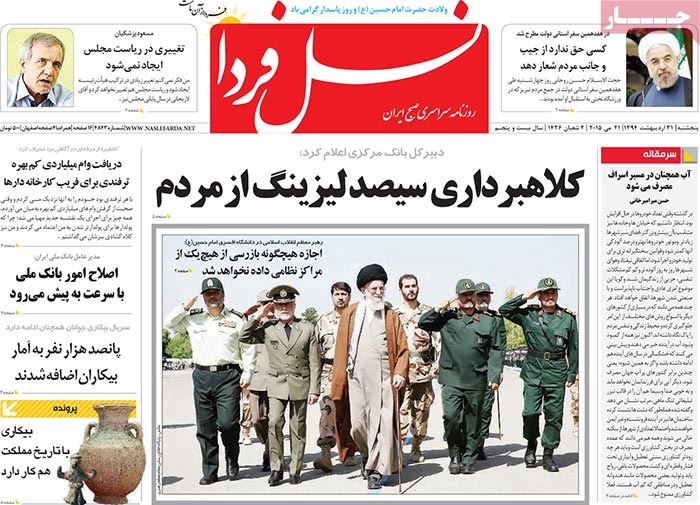
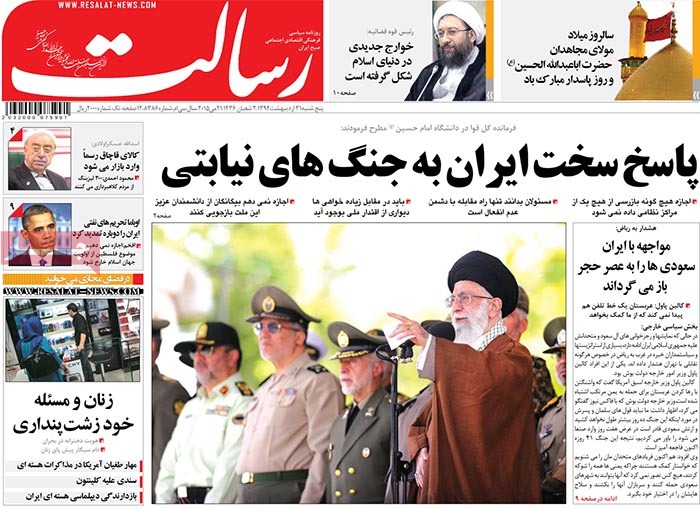
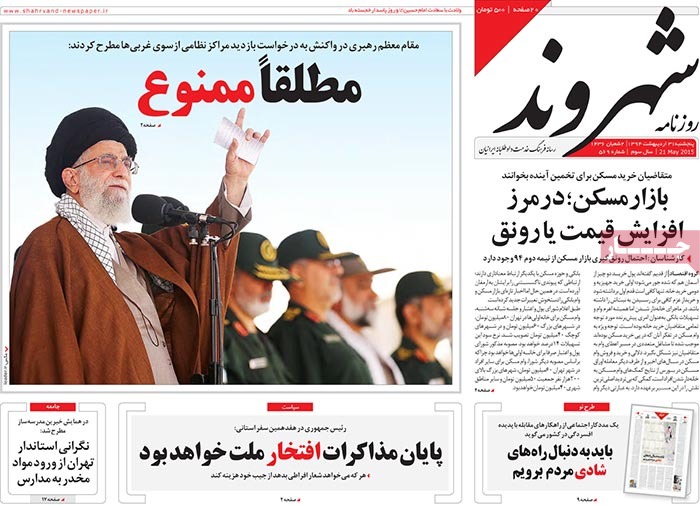
President Rouhani’s comments at meetings with the new ambassadors of Greece, Algeria, Senegal and Thailand dominated the front pages of Iranian newspapers on Tuesday. A gathering in Tehran in which Iranian Foreign Ministry officials answered the questions of those critical of the Lausanne statement also appeared on the covers of several dailies.
Abrar: The Israeli reporter [who visited Iran on her American passport] was not a spy.
The comment was made by a member of parliament’s National Security and Foreign Policy Committee.
Aftab-e Yazd: Some critical comments about the Lausanne statement stem from lack of information.
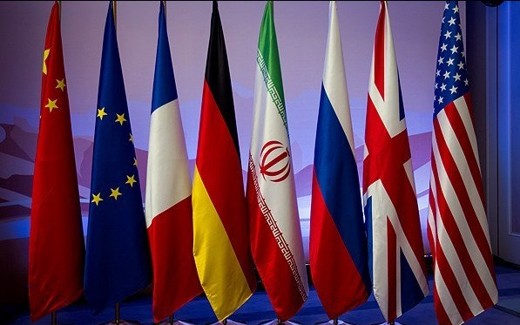
Iranian nuclear negotiator Seyyed Abbas Araghchi said that at a gathering on the tentative nuclear deal Iran and P5+1 struck in the Swiss city in early April.
Aftab-e Yazd: Government has stopped handing cash subsidies to high-income individuals.
The move came after parliament required the Executive to stop the handout.
The economy minister has said the number of individuals taken off the list is not substantial.
Arman-e Emrooz: The Chairman of the Expediency Council says he prefers presidential democracy to parliamentary democracy.
[The comment by Ayatollah Hashemi Rafsanjani came after the idea of reviving premiership was floated.]
Ebtekar: Iran and Venezuela are coordinating efforts to stabilize the oil market.
Iranian Foreign Minister Mohammad Javad Zarif made the comment at a joint press conference with his Venezuelan counterpart.
Ebtekar: Tehran issues an oil warning to Riyadh. The time of crude price decline is up.
Esfahan Emrooz: Students in Isfahan have developed a spherical robot.
Ettela’at: “Israel’s weapons of mass destruction pose the gravest threat to regional security,” said the President.
Hassan Rouhani made the comment at separate meetings with four new foreign ambassadors who met him on Monday to hand in their credentials.
Ettela’at: “If the talks had not been moving forward in our favor, the US Congress would not have tried to sabotage the process,” Iranian nuclear negotiator Abbas Araghchi said.
Javan: Hamid Reza Kamali, an Iranian racing champion, has died in a car accident on a Tehran highway.
Javan: “Some 21 percent of marriages lead to divorce in less than five years,” said a deputy minister of sports.
Kayhan: Officials make contradictory remarks about elimination of cash subsidies.
Shahrvand: “There are some 1.5 million illegal Afghans in Iran,” said the Afghan minister of refugees in an exclusive interview with the daily.
Ibrahim al-Douri, the son of Saddam Hussein’s right-hand man, was killed in Iraq on Monday just a few days after the death of his notorious father Izzat al-Douri.
Security Sources announced that Ibrahim al-Douri was killed during an operation by Iraqi Counter Terrorism Service in the strategic city of Tikrit on Monday.
Izzat Ibrahim al-Douri, former Iraqi general and Vice Chairman of the Iraqi Revolutionary Command Council, also was killed in Iraq on Friday.
Results of the DNA tests conducted on his dead body also confirmed his identity as Izzat al-Douri.
“The final results prove that the body belongs to the criminal Izzat al-Douri,” Iraqi Kataib Hezbollah Group’s Spokesman Jaafar Husseini said, adding that his DNA had gone under test in specialized hospitals.
“We are 100 percent sure,” he added.
Al-Douri, 73, was a former Iraqi general and a commander of the Army of Saddam Hussein’s regime. He was an Iraqi military commander and Vice Chairman of the Iraqi Revolutionary Command Council, until the 2003 US-led invasion of Iraq.
Following the US invasion, he escaped and remained at large. But after a few months, intelligence reports showed that he was leading rebel operations in the country.
Al-Douri masterminded and led terrorist operations, especially those of the Al-Qaeda in Iraq.
Regional intelligence agencies had chased him down in Western and Northwestern Iraq.
Al-Douri was one of the main officials of Saddam Hussein’s chemical arms program and played a major role in the chemical attacks on Iran during the 1980s war as well as the attack on the Northern Iraqi city of Halabche that killed 5,000 civilians.
According to Iranian and Russian intelligence, he provided terrorists in Syria with chemical agents and trained them to manufacture chemical weapons.
Iranian President Hassan Rouhani says the current falling oil prices will be harmful to producers and will threaten the stability of global market.
“Today’s oil price is to the detriment of producers and the world market stability. We hope that coordinated efforts by oil exporters to bring balance back to the oil market would continue,” Rouhani said in a meeting with Venezuelan Foreign Minister Delcy Rodriguez in Tehran on Monday.
He added that “stability and balance” in the oil market will be beneficial to all, expressing hope that Venezuela’s efforts to restore balance to global oil market would lead to balance in the price of oil.
Iran and Venezuela are member states in the Organization of the Petroleum Exporting Countries (OPEC).
Oil prices have nearly halved since the summer of 2014, and currently slightly above 60 dollars per barrel. The fall in prices is blamed on global supply glut and weak demand.
If oil prices remain at current levels, the profits for investors would shrink by up to USD 1,000 billion in 2015. In this case, they would have far less capital for new projects and would be more cautious about their investments.
The Iranian president further said Tehran is keen to improve ties with Caracas, particularly in the economic sector.
“The Iranian nation and government’s will is [based on] expansion of friendly relations and cooperation with Venezuela in all fields,” Rouhani stated.
He emphasized that the era of big powers’ interference in internal affairs of countries is coming to a close and said Iran regards as “unacceptable” the meddling of some powers in domestic affairs of independent countries including Venezuela.
The Venezuelan foreign minister, for her part, underlined the importance of bolstering Tehran-Caracas ties.
Tehran is a strategic partner for Caracas and the Venezuelan government and nation would always stand by the Iranian people, Rodriguez said.
Iran’s Foreign Minister Mohammad Javad Zarif says the Islamic Republic will do its utmost to end the bloodshed in Yemen as Saudi Arabia continues its brutal military campaign against the impoverished Arab country.
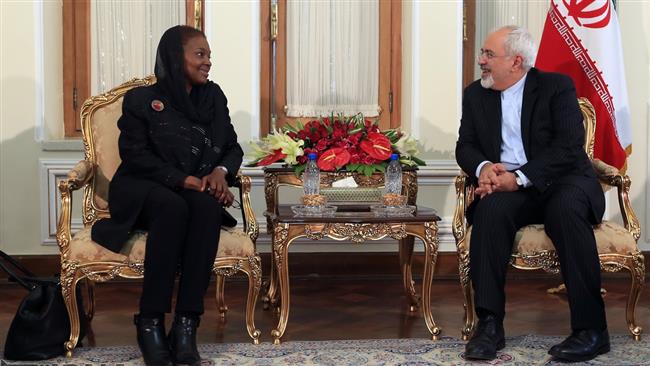
“We are deeply concerned over the killing of defenseless and innocent people in Yemen and the destruction of the country’s infrastructure and we will make our utmost efforts to bring an end to this massacre,” Zarif said in a meeting with Syrian Deputy Foreign Minister Faisal al-Miqdad in Tehran on Monday.
Saudi Arabia started its airstrikes against Yemen on March 26 – without a United Nations mandate – in a bid to restore power to the country’s fugitive former president, Abd Rabbuh Mansur Hadi, a staunch ally of Riyadh.
According to reports, at least 2,680 people, including women and children, have so far lost their lives in the attacks.
Zarif further commended Syria’s efforts in fighting foreign-backed terrorist groups and called for the continuation of talks between the Syrian government and the opposition.
The Syrian official, for his part, said his country supports Iran’s four-point peace plan submitted to the United Nations on the ongoing crisis in Yemen.
He strongly condemned Saudi Arabia’s brutal killing of civilians in Yemen.
In a letter to UN Secretary General Ban Ki-moon on Friday, the Iranian foreign minister submitted a four-point peace plan on Yemen in an attempt to end the bloodshed in the impoverished Arab country.
The plan calls on the international community to take the necessary measures to stop the Saudi airstrikes against the Yemeni people.
“It is imperative for the international community to get more effectively involved in ending the senseless aerial attacks and establishing a ceasefire,” said the Iranian minister.
Zarif and Miqdad also exchanged views on the latest key mutual, regional and international developments.
The deputy foreign minister for European and American affairs said Monday that clinching a deal on the nuclear dispute is not easy, but Iran does its best to reach a settlement.
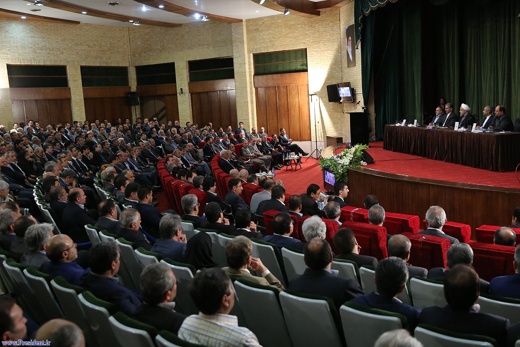
Majid Takht-e Ravanchi made the remarks in a conference on “Views of pros and cons of nuclear negotiations in Lausanne”, saying that continued talks on remaining issues will be very complicated.
The Iranian negotiating team will leave Tehran for Vienna on Wednesday to attend the next round of nuclear talks with P5+1, he said.
He further said that presently we are writing the comprehensive deal, adding that it is a very tough stage, but we will seriously continue with that.
The Iranian official said that we attend the talks vigilantly and precisely, adding that these talks will be complicated, but we will do our best to clinch a good deal.
“We are involved in nuclear talks with the US Administration and we have nothing to do with how the US government will deal with Congress, the academics and the other bodies in the United States,” he said.
A book entitled The 9th Government and the Zionist Regime, which analyzes the policies of the Iranian government under former President Ahmadinejad in relation to Israel, has been published by the Islamic Revolution Document Center, Khabaronline, a news website, reported on April 18.
The book penned by Mehdi Fardadpour deals with a number of topics, among them: developments in Iran’s foreign policy with regard to the Zionist regime, the foreign-policy strategies of the 9th government and regional policies adopted by Tel Aviv following the rise to power of Ahmadinejad in 2005.
One full chapter of the book is dedicated to foreign-policy strategies of the 9th government, an analysis of its approach to the Holocaust and the reasons behind the president’s doubting it as well as the policies that Ahmadinejad’s government adopted in connection with Iran’s nuclear dossier.
Another chapter addresses the regional polices that Israel adopted after Ahmadinejad took office.
*The 9th government was formed by Mahmoud Ahmadinejad in 2005 after he was elected president. He stayed at the helm of the government for another four years after his contentious victory in the 2009 vote.
Iran and Saudi Arabia are two key Islamic countries in the region. They have many things in common and at the same time do not see eye to eye over many others. Over the last century, their relations have gone through ups and downs.
At times they have been rivals and at others they have enjoyed friendly relations; sometimes they have been hostile to each other, and sometimes they have had close cooperation.
In short, Tehran-Riyadh relations have been like a roller coaster ride. If we put aside interactive relations between the two nations and the slightly positive results they have produced, what remains is a number of bitter developments that have jolted bilateral ties in the last century.
The April 19 editorial of Ebtekar daily, penned by Gholamreza Kamali Panah, has looked back at past incidents that have triggered friction between the two countries. What comes next is the translation of the report which encourages the two countries to reexamine their missteps with the hope that it will turn things in favor of the two nations:
1. The decapitation of an Iranian national in Saudi Arabia: In 1943, Abutalib Yazdi, an Iranian Hajj pilgrim felt sick and puked while circumambulating the Kaaba. He tried to cover his mouth with his Ihram dress, but unfortunately some vomit fell to the ground. A number of Wahhabis took him to Saudi guards.
Because of vile comments by some Egyptian witnesses, Yazdi was convicted of defiling the holy place and was beheaded. The author of Rhythm of Hejaz who was in Mecca at the time of the incident, later wrote in his book, “When I was in Masjid al-Haram, I suddenly saw a flurry of excitement. Arabs were overjoyed, telling each other that an Iranian had been killed. Whenever they came across Iranian pilgrims, they would sign a ‘throat slash’, threatening to slit the throats of all Iranians.”
In the aftermath of the bitter incident, the two countries severed ties and a ban was slapped on Hajj pilgrimage. It was lifted in 1948 when Iran and Saudi Arabia reestablished relations.
2. Iran-Iraq war: In 1980 when Saddam invaded Iran, Riyadh lent political and financial support to Iraq. It did not matter to the Saudis who the aggressor was or that both Iran and Iraq were Islamic countries. What was important to them was that an Arab country was at war with a non-Arab nation. Riyadh had taken it upon itself to back the Arab country at any cost.
Back then, humanity or Islamism was not at issue; rather, ethnic and tribal prejudices were important.
3. Tragic martyrdom of Iranian Hajj pilgrims: In bloody clashes in 1987 in Mecca, 275 Iranian pilgrims were martyred. The killing deeply hurt the sentiments of the Iranian nation. Some in Tehran staged protest rallies outside the Saudi embassy and that led to a breakdown in Iran-Saudi relations.
4. Post-Saddam Iraq and Iran: After the US invasion of Iraq and the ouster of Saddam, Shiites secured an overwhelming vote, rose to power and became more inclined toward Iran, a tendency which annoyed the Saudis, and soured relations between Tehran and Riyadh.
5. Cut off the head of the snake: A few years ago, WikiLeaks, a whistleblowing website, in a report revealed that Saudi King Abdullah appealed to America in 2008 to attack Iran, describing what he called “cutting off the head of the snake” as a necessity. The revelation hurt the sentiments of Iranian nation and authorities, a bitter incident which is still engraved in the memory of the Iranian people.
6. The 33-day war with Israel; the victory of Lebanon’s Hezbollah: Popularity and influence of Hezbollah in Lebanon has always worried Saudi Arabia. During the 33-day war, backed by America, Israel sought to finish off Hezbollah once and for all. Back then, Condoleezza Rice, the US secretary of state, said no to negotiations, to any agreements, and to any ceasefire, only pressing for the disarmament of Hezbollah.
However, following 33 days of fighting, it dawned on them that they should think of a way to save Israel from drowning in the quagmire.
It was the first time that one of the world’s most dreaded armies was brought to its knees. Deep down, Riyadh was dismayed at the defeat.
Resentment toward Iran and Hezbollah can be clearly seen in the harsh statements of Saudi Foreign Minister Saud al-Faisal about Lebanon in a meeting of Arab foreign ministers in 2008 where he said that Iran was running the war and that Hezbollah sought to introduce the Rule of Jurisprudence in Lebanon.
The comments drew strong criticism from Yousef al-Ahmad, the former Syrian minister of state, who objected to Faisal wondering whether the Saudi official wanted to sell his own idea that Iran, not Israel, which killed children daily, was the enemy of the Arabs.
He lashed out at the Saudi foreign minister for sitting on his hands and doing nothing while Israel kept dropping bombs on Lebanon during the 33-day war. Ahmad asked Faisal why he did not favor the notion of dispatching troops to fight off the Israeli aggression.
7. Iran and Oman: Oman is a Persian Gulf Arab state. Basically Riyadh expects Muscat to back the Saudi stand in its relations with Iran.
During President Rouhani’s visit to Oman, a contract on construction of a natural-gas pipeline was signed between the two countries. Bloomberg called the deal the latest sign that Saudi Arabia is failing to bind its smaller Persian Gulf neighbors into a tighter bloc united in hostility to the Islamic Republic.
Christopher M. Davidson in his book, After the Sheikhs: The Coming Collapse of the [Persian] Gulf Monarchies, said that Qaboos, the Sultan of Oman, has opted for a safe path and turned into an intermediary who tries to help Tehran-Washington relations improve.
He goes on to describe Sultan Qaboos as the most intelligent Persian Gulf Arab leader who does not want to unite with Saudi Arabia.
A visit by Iranian Foreign Minister Mohammad Javad Zarif to Oman along with Oman’s failure to join the Saudi-led military campaign in Yemen has exposed the deepening rift between the two regional powers.
8. Bahrain, Iran and Saudi Arabia: Bahrain is a Shiite-majority country, but a Sunni minority backed by Riyadh rules the country.
In line with democratic principles advocated by the West, Bahraini people want their rights respected. But the West has either remained tight-lipped or has backed the minority, and consequently the House of Khalifa has launched a crackdown on the Bahraini people.
Riyadh has sent its tanks to Bahrain to support Manama and has practically taken control of the country. The Saudis claim that Iran plays a role in protests, and Tehran condemns [Saudi] aggression against Bahrain as well as the failure [of minority rulers] to recognize the rights of the majority.
9. Syria’s war: The Syrian government and the opposition have been involved in a bloody and destructive civil war for a few years. Tehran supports Bashar al-Assad, while Riyadh backs the opposition in whose ranks are al-Qaeda and IS fighters and provides financial, political and military aid to them. The Gordian knot is yet to be untied.
10. Sexual assault on two Iranian teenagers: The incident at the Jeddah airport wheretwo Saudi airport guards molested two Iranian teens infuriated the Iranian people and dealt a blow to the reputation of the Saudis, a case which Iranian officials are still vigorously following up.
Unfortunately, disagreement over such issues still persists, but people should be vigilant and avoid moving faster than their officials in pursuit of their rights. The public should stand up for their rights while taking steps in tandem with the government.