Tuesday, December 30, 2025
Home Blog Page 4852

Iran’s top security official holds West responsible for potential failure of talks

Iran-Georgia

The six world powers should account for any trouble or failure of the nuclear talks, Secretary of Iran’s Supreme National Security Council (SNSC) Ali Shamkhani warned after the US congress threatened to impose a new set of sanctions on Tehran.

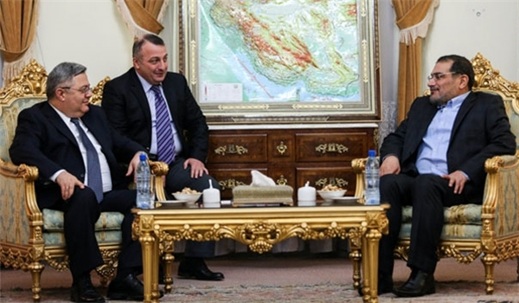
“Iran’s nuclear negotiations with P5+1 serve as a test of these countries’ honesty to see how committed they are to the path of negotiations and removal of all illegal and cruel sanctions,” Shamkhani said in a meeting with Georgian Parliament Speaker Davit Usupashvili in Tehran on Sunday.

He stressed that Iran has shown goodwill in the negotiations, “and the International Atomic Energy Agency (IAEA) reports endorse this fact”.

“But we will show proper reaction and take due action appropriate to the attitude and performance shown by the opposite side,” Rear Admiral Shamkhani underlined.

“The responsibility for any problem in the talks and adoption of approaches whose fruitlessness has already been proved (in similar cases) in the past rests with the opposite side,” Shamkhani underlined.

Democracy not to be achieved by financing terrorism: Larijani

Larijani

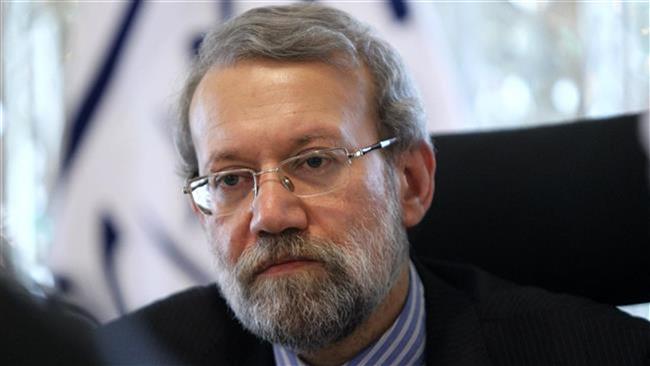
Iran’s parliament Speaker Ali Larijani criticized world powers’ double-standard policies in the region and their support for terrorism.

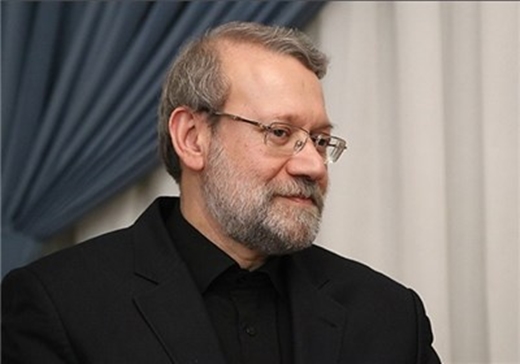
“One cannot establish democracy in a country through providing financial, arms and intelligence support to terrorists,” Larijani said Sunday in a meeting in Tehran with Vice-President of the German Bundestag Claudia Roth.

He was referring to Western support for terrorist militants fighting the government of President Bashar al-Assad in Syria.

Syria has been gripped by deadly unrest since 2011. The civil war was waged by terrorists backed by Western powers and some of their regional allies, especially Qatar, Saudi Arabia and Turkey.

Larijani also underlined the importance of political, economic and parliamentary relations between Iran and Germany and said consultations between the two countries on major regional and international issues could lead to the expansion of bilateral ties.

Roth, for her part, called for more interactions between Iranian and German parliaments.

The German official further stressed the need for an end to the war and bloodshed in Syria as soon as possible, and said talks with powerful regional countries like Iran can help end the Syrian crisis.

Dialog must solve regional problems: Rouhani

Iran-Georgia

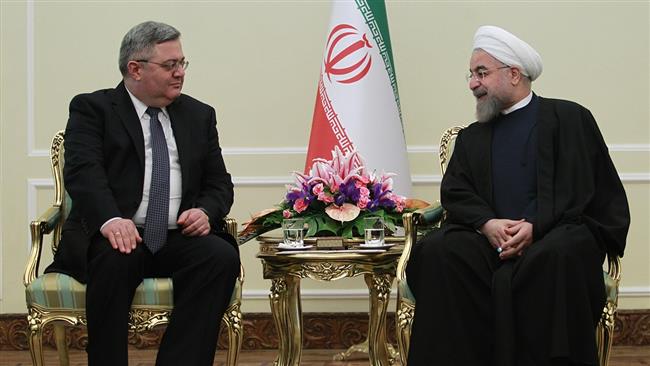
“The way to establish peace and stability is that all [countries] should respect each other’s geographical borders and in case of any problem, they should settle it through dialog,” Rouhani said in a meeting with Georgian Parliament Speaker David Usupashvili in Tehran on Sunday.

He called for the expansion of Iran-Georgia ties and said Tehran and Tbilisi must make use of their utmost capacities to improve cooperation.

The Iranian president said the two countries should boost economic cooperation, particularly in the energy sector, adding that Iran can export its gas to Europe through Georgia while the North-South corridor can link Georgia’s ports to the Persian Gulf and the Sea of Oman.

Rouhani also expressed Iran’s readiness to bolster cooperation with Georgia in scientific, cultural and parliamentary fields.

Urging respect for different religions, cultures and thoughts, Iranian president said, “We should all counter extremism, violence and terrorism hand in hand.”

Enhanced ties with Iran

The Georgian parliament speaker pointed to the growing Tehran-Tbilisi relations during the recent years and expressed his country’s determination to further bolster cooperation with Iran in various fields.

Usupashvili said Iran has close ties with regional countries and can play a positive role in establishing peace and stability in the South Caucasus region.

I hate referring to Daesh as Islamic State

Mohammad Javad Zarif

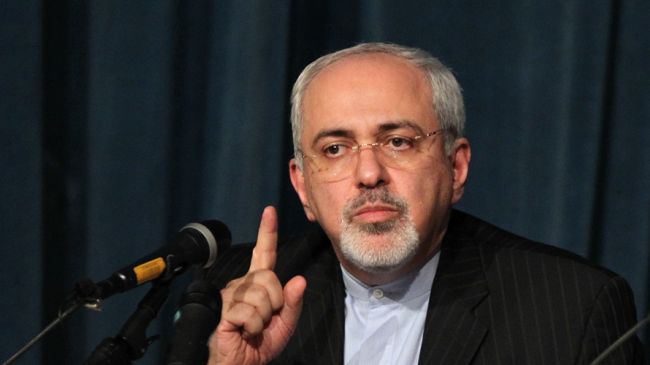
I hate calling Daesh an Islamic State, because it is neither Islamic, nor a government, said Iranian Foreign Minister Mohammad Javad Zarif on Sunday.

Speaking in Davos in a Geopolitical Outlook Panel Discussion at the World Economic Forum, attended by the German defense minister, the South Koran foreign minister, the Vietnamese foreign minister and the executive director of the German firm Henkel, Zarif made the comment in response to a question: What measures are necessary to block the path of the Islamic State of Syria and the Levant (ISIL).

‘Our problem in the region is extremism which has roots in occupation, suppression, and deprivation from natural rights. We need to encounter it, whether we like it or not, as this is a serious crisis in the region,’ said the Iranian foreign minister.

As for the word “Daesh”, he said that in Arabic and Persian languages that word is used to name them, but in the West the Islamic State is used, which he said he does not like.

Zarif then discussed the ways to encounter ISIL and said that efforts to fund the terrorist group should be stopped, adding that the terrorists are used as an instrument in geostrategic games only to exert hegemony in the region.


Multidimensional, solid anti-Daesh strategy needed

The Iranian top diplomat went on to say that some think they can make use of Daesh as an instrument in a short-term tactical game and as a tool against certain governments, adding this mindset does not help.

Acting against ISIS cannot be limited to air raids, he said, adding that a multidimensional, solid strategy against Daesh is needed to uproot the terror group.


2015 challenge: Threat of Cold War era

Zarif said that the world is facing two major security challenges – a return to the Cold War era and the geopolitical competitions of that era.

‘Extremism and the ways to encounter it is one of our major challenges as we see extremism in the Middle East and in Europe. What is to be done? Extremism cannot be encountered by ignoring it, as it is a very perilous threat,’ he said.

The Iranian foreign minister also expressed deep concern about the European sacrilege of religious values, especially Islam, adding it has become a commonplace practice and will lead to escalation of extremism and will deprive many people of their rights.

The West must win Iran trust in nuclear talks

ZArif

Foreign Minister Mohammad Javad Zarif said on Sunday that the Western and European states must gain the confidence of the Iranian nation in the nuclear talks.

Zarif made the remarks in a meeting with his Croatian counterpart Vesna Pusić who is currently in Tehran to exchange views with senior Iranian officials on issues of mutual interest.

Referring to recent developments in France, the Iranian foreign minister regretted that Muslims beliefs are easily insulted in Europe.

He stressed that the boundaries between freedom of expression and insulting sanctities of other religions should not be blurred.

As for Tehran-Zagreb relations, Zarif welcomed promotion of bilateral cooperation in all political, economic, cultural, tourism and sports fields.

He said that private sectors of the two countries enjoy enormous potential for making joint investments.

For her part, the Croatian top diplomat voiced Zagreb’s readiness to expand cooperation with Tehran.

Referring to Iran’s nuclear talks with 5+1, Pusic expressed hope that the negotiations would lead to a comprehensive agreement.

She stressed that Croatia, in line with the European countries and High Representative of the Union for Foreign Affairs and Security Policy, supports nuclear talks with Iran and opposes imposing further sanctions against the country.

Iran calls for expansion of Saudi ties, felicitates new King Salman

President hassan rouhani

Iran has called for the expansion of relations between Tehran and Riyadh as Saudi Arabia’s new King Salman bin Abdulaziz Al Saud ascends to the throne.

President Hassan Rouhani expressed hope for the matter in a letter issued on Saturday, congratulating King Salman on his succession to the throne.

“I hope that in the time lying ahead, with regard to the religious and historical bonds between the Islamic Republic of Iran and the Kingdom of Saudi Arabia, the relations between the two countries expand in all areas of mutual interest,” the Iranian president stated in the letter.

He further wished King Salman success in his new post, and the Saudi nation and government prosperity.

King Abdullah died on January 23 at the age of 90 after weeks of being hospitalized with a lung infection. He had suffered frequent periods of ill health in recent years.

[…]

A look at Iranian newspaper front pages on Jan. 25

Iranian Newspapers Headlines

A warning to the US Congress by Foreign Minister Mohammad Javad Zarif that the Iranian parliament would retaliate in case Capitol Hill imposed new sanctions on Tehran dominated the front pages of Iranian dailies on Sunday. Threats by a deputy commander of the Islamic Revolution Guard Corps against Israel for its killing of an Iranian general in Syria and the aftermath of the Saudi king’s passing appeared on the covers of the newspapers too.


Aftab-e Yazd: The countdown is on for the imprisonment of Mohammad Reza Rahimi, a former first vice-president [whose corruption verdict has been upheld by the Supreme Court].
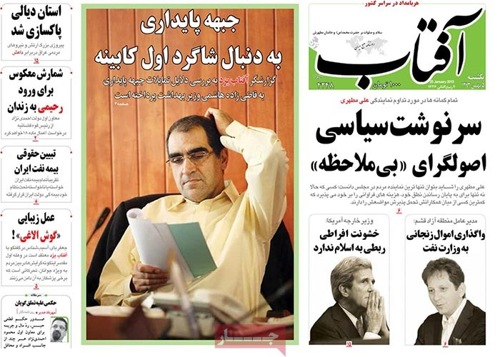
 

Aftabe Yazd newspaper-1-24-2015


Arman-e Emrooz: Qeshm Airlines has been handed over to the Oil Ministry as part of the debts Babak Zanjani [a billionaire charged with massive corruption] owed to the government.
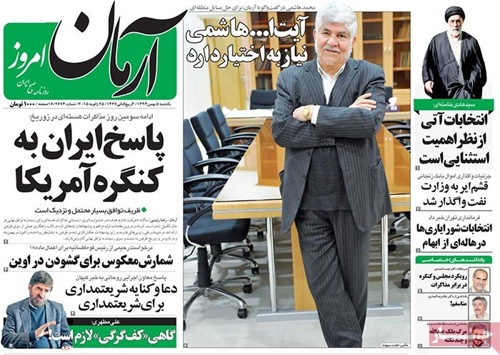
 

Armane Emrooz newspaper-1-24-2015


Asr-e Rasaneh: Between March 21, 2014 and January 20, 2015, non-oil exports brought in some $43 billion.
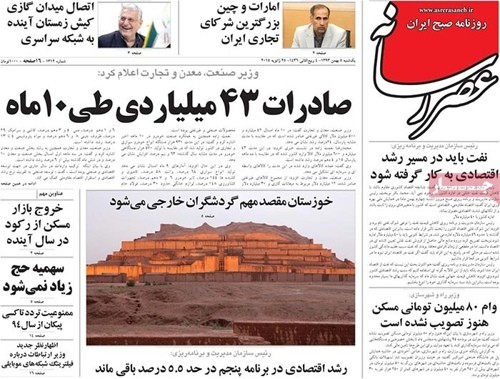
 

asre resaneh newspaper


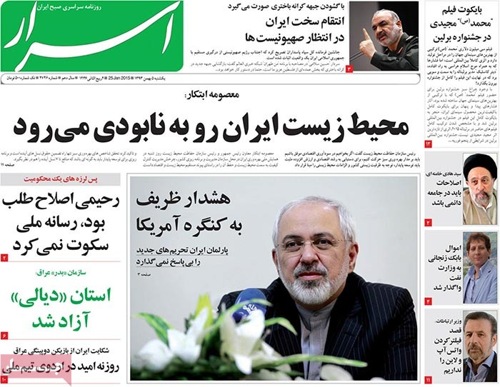
Asrar: “Iran’s environment is teetering on the brink,” said Director of the Environment Protection OrganizationMasoumeh Ebtekar.

Asrar: “Iran’s parliament won’t leave fresh American sanctions unanswered,” Foreign Minister Mohammad Javad Zarif warned the US Congress.
 

Asrar newspaper-1-24-2015


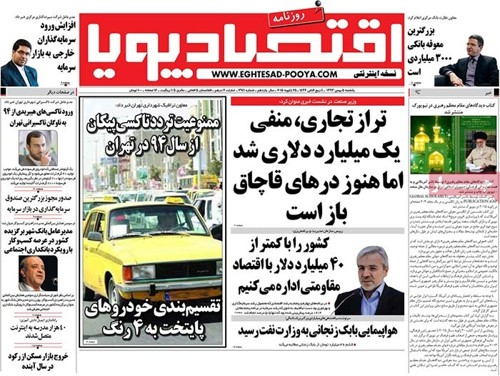
Eghtesad-e Pooya: “We will be able to build on resistance-based economy to run the country on a budget of $40 billion,” said the head of the Management and Planning Organization.
 

Eghtesade pooya newspaper-1-24-2015


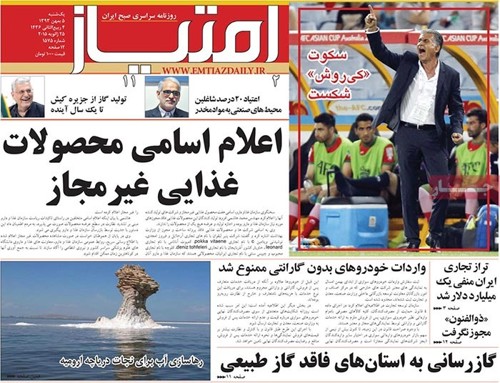
Emtiaz: Iran’s trade deficit stands at $1 billion.

Emtiaz: Natural gas production on Kish Island will get underway as of next year [starting on March 21, 2015].
 

Emtiaz newspaper-1-24-2015


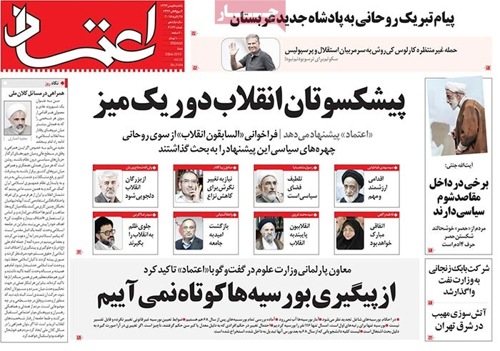
Etemad: President Rouhani has extended congratulations to the new Saudi King on his accession to the throne.
 

Etemad newspaper-1-24-2015


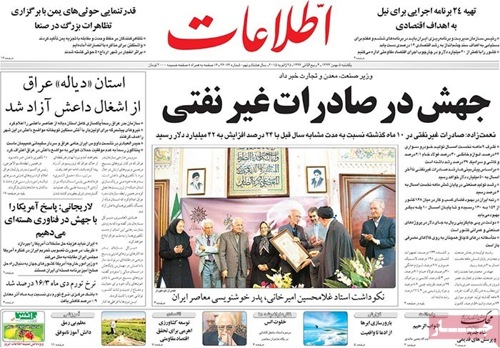
Ettela’at: Iraq’s Diyala Province, which had been overrun by IS terrorists, has been relieved.

Ettela’at: Services of Gholam Hossein Amirkhani, the father of Iran’s contemporary calligraphy, have been appreciated in a ceremony.
 

Ettelaat newspaper-1-24-2015


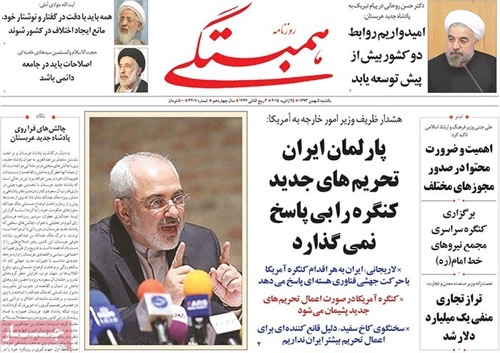
Hambastegi: “Iran will respond to any move by the US Congress by a huge leap in nuclear technology,” said Parliament Speaker Ali Larijani.
 

Hambastegi newspaper-1-24-2015


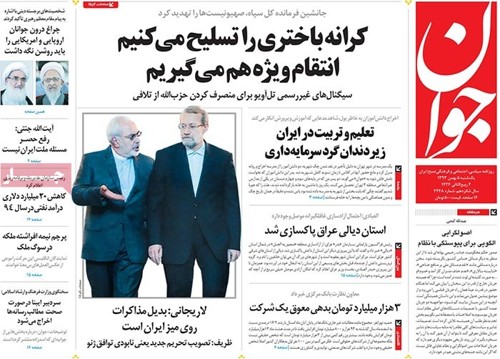
Javan: “We will arm the West Bank; the Zionist regime of Israel is in for an extraordinary act of retaliation,” said the deputy commander of the Islamic Revolution Guard Corps.
 

Javan newspaper-1-24-2015


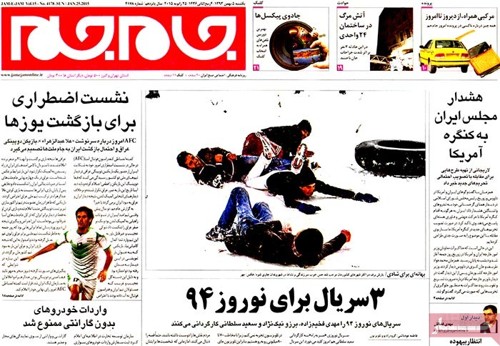
Jamejam: Importing cars that have no warranty has been banned.
 

Jamejam newspaper-1-24-2015


Jomhouri Islami has quoted Foreign Minister Zarif as saying, “We will clinch a deal [with P5+1] pretty soon.”

Jomhouri Islami: A new chapter has opened in cooperation between Iran’s Mobarakeh Steel Company and Oman.
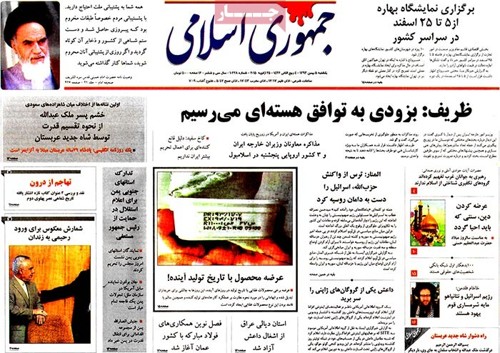
 

Jomhouri Eslami newspaper-1-24-2015


Kayhan: Fearing retaliation, the Zionist regime has called on Russia to convey a message to Lebanese Hezbollah, saying that Tel Aviv does not seek heightened tensions.
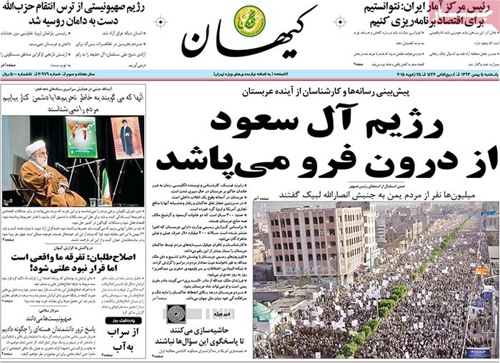
 

Kayhan newspaper-1-24-2015


Kayhan International: Iraqi PM hails Iran’s aid to fight ISIL.
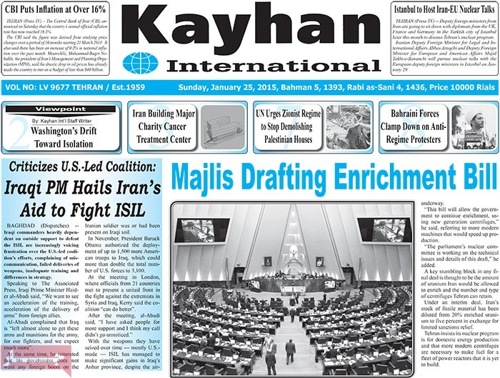
 

Kayhan international newspaper-1-24-2015


Khorasan: Seven provinces across the country have been blanketed by snow.
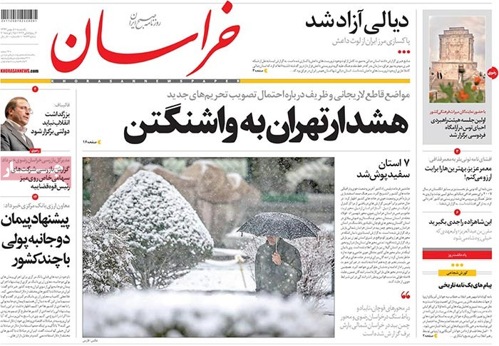
 

Khorasan newspaper-1-24-2015


Mardomsalari: “We are not planning to block WhatsApp and Line,” said the minister of communications and information technology.
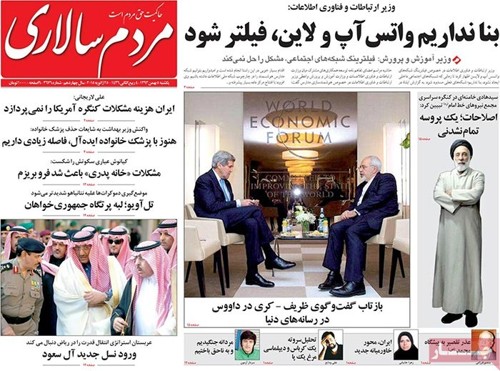
 

Mardom Salari newspaper-1-24-2015


Shahrvand: “Iran’s borders are still open to contraband goods,” said the minister of Industries, Mines and Trade.
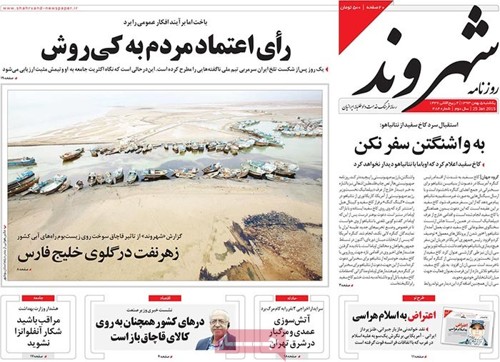
 

Shahrvand newspaper-1-24-2015


Sharq: “Those who call for the house arrest [of Mousavi and Karroubi, two candidates who doubted the results of the 2009 presidential elections and sparked widespread unrest] to be lifted must be slapped in the mouth,” said Ahmad Jannati, the secretary of the Guardian Council.
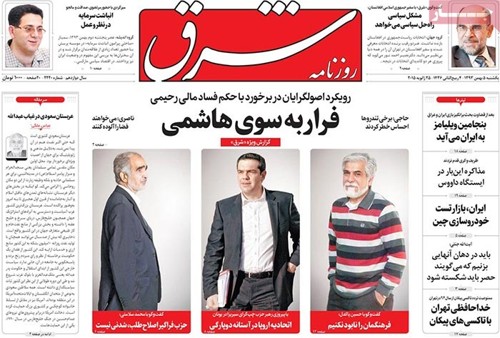
 

Shargh newspaper-1-24-2015


Tehran Times: Iran largest steel producer in Middle East: WSA (World Steel Association).
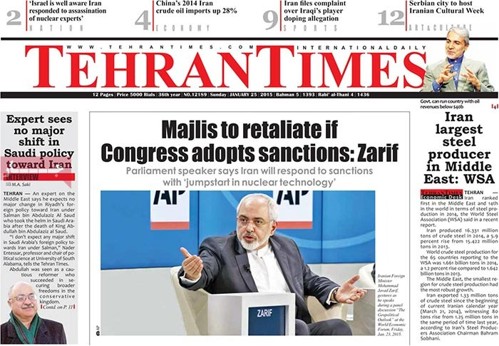
 

Tehran Times newspaper-1-24-2015


Iran mulls ‘special retaliation’ over Israel’s Golan attack: Commander

Commander

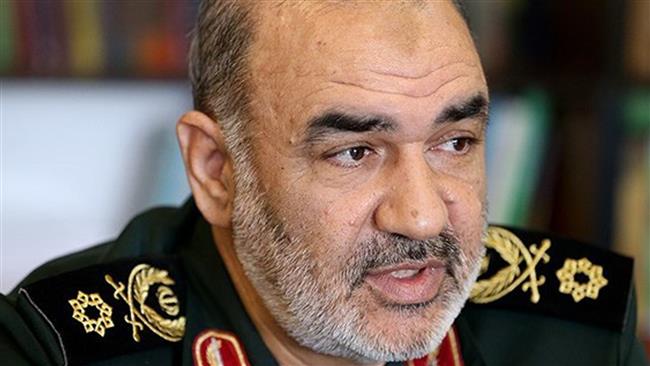
“…We will certainly consider a special retaliation for this issue,” IRGC’s second-in-command, Brigadier General Hossein Salami told al-Alam on Saturday.

The commander also explained about plans to stretch the anti-Israeli battlefield, and open up a new front across the occupied West Bank.

“This is part of a new reality that will gradually unravel,” he added.

Salami said supporting Palestinian and Lebanese resistance fighters as well as creating new defensive infrastructure for Muslims living near the Israeli occupied territories have been and will be on Iran’s agenda.

On Sunday, an Israeli helicopter gunship fired two missiles at the village of Quneitra in the Syrian Golan Heights bordering Lebanon. Six members of the Lebanese resistant movement Hezbollah and an IRGC commander were killed in the attack.

Hezbollah has vowed its response to the attack will be extremely painful.

IRGC chief, Major General Mohammad Ali Jafari, also warned Israel on Tuesday that the Zionist entity “should await annihilating thunderbolts.”

Zurich talks constructive: Iran negotiator

Abbas araghchi

“The two-day Zurich talks were constructive and both negotiating sides entered details,” said Abbas Araghchi, who doubles as the deputy foreign minister for legal and international affairs.

The Iranian team led by Araghchi met with the US delegation headed by US Under-Secretary of State for Political Affairs Wendy Sherman on Friday and Saturday.

Entering details

“Since yesterday, we have held some bilateral and trilateral meetings with the US delegation and Ms. [Helga] Schmid, the European Union representative. Meanwhile, the two sides’ experts have held sessions,” Araghchi said,

“In these meetings, we entered into discussions on different subjects, especially important subjects such as [uranium] enrichment and sanctions, which have exhaustive and complicated details.”

However, he said going into details did not translate into the conclusion of a definitive agreement.

“We are in a situation, where the details and general issues should be discussed alongside each other. All the details should come to light.”

Ministerial meeting

Also on Friday, Iran’s Foreign Minister Mohammad Javad Zarif and US Secretary of State John Kerry discussed the latest developments concerning the nuclear negotiations between Iran and P5+1 (China, Russia, France, Britain and the US – plus Germany) on the sidelines of the World Economic Forum in the Swiss city of Davos.

Ongoing talks

Iran and P5+1 have been holding talks to secure a final comprehensive deal over Iran’s nuclear work.

Since an interim deal was agreed in Geneva in November 2013, the negotiating sides have missed two self-imposed deadlines to ink a final agreement.

US president responsible if Iran nuclear talks fail

Larijani

Iran’s Parliament Speaker Ali Larijani said on Saturday US President Barack Obama will be held responsible if the negotiations over Iran’s nuclear program fail.

Larijani pointed to the attempts by some lawmakers in the US Congress seeking more sanctions against Iran over its nuclear program and said that Obama should manage the domestic pressure himself.

“The issues they raise about the US Congress are not relevant to us. If Obama can’t solve his problems, he himself will be responsible for the disruption of the negotiations,” the Iranian speaker said.

Larijani said Obama’s problems do not concern Iran, adding that Tehran has shown enough flexibility in the negotiations.

Certain lawmakers in the US are drafting legislation to impose new sanctions against Iran as the Islamic Republic and P5+1 are negotiating to reach a comprehensive nuclear agreement. This is while an interim agreement reached between Iran and the six other countries in November 2013 stipulates that no more nuclear-related sanctions should be imposed on the Islamic Republic as long as the deal is in effect.

The agreement has been extended until July this year as the two sides continue to negotiate to reach a final agreement.

Obama has called on the new Republican-controlled Congress not to impose more sanctions on Iran over its nuclear program, saying he would veto any draft bill that may reach his desk.

“New sanctions passed by this Congress, at this moment in time, will all but guarantee that diplomacy fails,” Obama said on Tuesday.

Larijani rejected claims that sanctions have forced Iran to the negotiating table.

“They made something called sanctions so that they can pressure Iran with them but realized later that the bans were not effective either, and Iran advanced [despite the restrictions],” he said.

Iran and P5+1 (China, Russia, France, Britain and the US – plus Germany) have been holding talks to secure a final comprehensive deal over Iranian nuclear work.

Since an interim deal was agreed in the Swiss city of Geneva in November 2013, the negotiating sides have missed two self-imposed deadlines to ink a final agreement.

Iran and P5+1 now seek to reach a high-level political agreement by March 1 and to confirm the full technical details of the accord by July 1.