Tuesday, January 13, 2026
Home Blog Page 4836

For Iran: Life on equal footing; For the world: diplomacy, not war

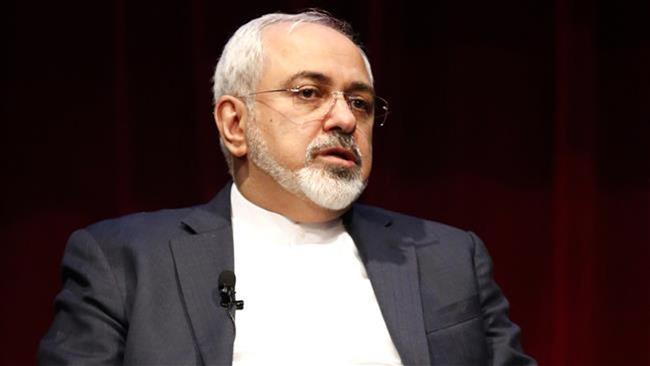
Sadegh Zibakalam

Iran’s economic ills are not expected to become history overnight. In the post-deal Iran, the economy is not expected to immediately register eight percent growth and generate sustainable employment for six million jobless people, observers say.

If the Joint Comprehensive Plan of Action is signed and nuclear talks between Iran and P5+1 – which are one of the biggest diplomatic battlefields since the First World War – produce positive results, the only change that will happen will be on the economic front. The country can better tackle its pocketbook issues and will be on the same footing with other countries after shedding the shackles of sanctions.

At regional and global levels, the conclusiveness of nuclear talks will help settle the existing problems and crises by changing the definition of peaceful coexistence in the world. With a nuclear deal in effect, countries will no longer base their ties with Iran on the Islamic Republic’s friendship or enmity with the West, nor will they rally around or against Iran based on Tehran-West relations.

What will unfold in Iran and around the world after Tehran and P5+1 ink a deal remains to be seen. Iranian and foreign analysts hold different views. Sadegh Zibakalam, an Iranian university lecturer and political analyst, maintains that the nuclear deal will not be like Moses’ stick to perform miracles.

Sharq daily on July 7 published Iran after the Historic Deal, an opinion piece by Zibakalam. The following is the translation of part of the piece:

A nuclear agreement is like the staff of Moses [the stick the prophet used at the parting of the Red Sea] to work miracles for the Iranian economy! It cannot bring down inflation, push down prices and help [slack] businesses get out of recession. Nor can it create jobs for six million people who are unemployed, accelerate the country’s economic growth to an annual eight percent which is obviously unachievable, cause the rain of divine blessings to pour down on the arid plains [of the economy] and, above all, make the systemic corruption which has gripped the administrative system a thing of the past.

The fact remains that such a deal is not expected to immediately transform Iran’s ties with certain neighbors to friendly relations or create a Middle East region free of nuclear weapons. Although the hardliners and those opposing a nuclear deal have wrongly claimed that the eleventh government and the proponents of the nuclear deal are hopeful that everything will become rosy in Iran overnight after the conclusion of a nuclear deal, I should say it loud and clear that the proponents of the nuclear deal do not hold any illusion that if the deal is struck today, everything will be transformed as of tomorrow.

To reform the economy and politics, to help society grow, to have a stable Middle East and to improve ties with certain neighboring countries and the wider world, Iran needs to adopt rational and optimal policies.

[…]

The pro-deal group has insisted on the conclusion of a good deal with the West, because they want to see the shackles the sanctions have fastened around the ankles of the Iranian economy removed. They want the national economy recover and experience normal conditions. […]

It is right to say that Iran will be on an equal footing with other countries only after its economy [battered by sanctions] is unshackled and other domestic obstacles which stand in the way are surmounted. Approval of the Joint Comprehensive Plan of Action (JCPOA) simply would mean that the commodities Iran is buying 30 percent higher than their average global price would be sold to the country at normal global prices.

In the meantime, the deal will be a historic milestone, not only for Iran but for the entire world. […] There is no doubt that the long-term effects of such a landmark deal will be significant for Iran, the Middle East and the whole world. […]

The nuclear deal at an international level will show that a solution will be within reach for many problems if the parties to the talks have genuine intention to settle their disputes and if the parties show willingness to take into account the other side’s considerations and concerns and do not insist on their own unilateral interests alone.

The example of nuclear talks between Iran and six world powers can be followed to settle some of the global crises, to say the least. The impact of a [similar] agreement would not be minimal for the Middle East.

Without exaggeration, the nuclear deal with Iran is likely to redraw the political map of the Middle East. The method by which countries in the Middle East have rallied behind one power over the past 36 years has indicated that a number of nations have taken pro-Western stances thanks to the hostility and gaps between Tehran and Washington, assuming that the West’s animosity toward Iran is a decisive factor for trans-regional powers [to determine which countries can be brought on board].

By the same token, the West’s animosity toward Iran – both in Iran and in the region – has served as a criterion for them [Middle Eastern countries] to decide [on the camp they seek to rally around] and select their political partners. Although relations between Iran and the West are not expected to change overnight after the conclusion of the nuclear deal, the past trend seems unlikely to continue to have a say in [the developments in] the Middle East. No longer will a number of regional countries adopt their policies simply based on hostility between Iran and the West.

The historic nuclear deal will have a long-term impact on Iranian society. To date, confrontation and tension have had the biggest influence on Iran’s ties with the West. Hardly can one see an event or development in the region in which traces of strained Iran-US relations cannot be found.

If Iran can reach an agreement with the United States over their sharp nuclear differences, isn’t it possible that Tehran and Washington can arrive at an agreement on other fronts?

Win-win deal to be clinched if other party avoids excessive demands: Shamkhani

Ali Shamkhani

Secretary of Supreme National Security Council (SNSC) Ali Shamkhani said on Wednesday that a win-win deal could be clinched if P5+1 avoid excessive demands.

Speaking to IRNA, he said setting a deadline to enable the US Congress to put pressure on Iran and P5+1 nuclear talks is totally out of the question and the only limit Iranian nuclear negotiators face is their legitimate rights and non-violation of our red lines.

The deal should guarantee development of Iran’s peaceful nuclear technology, lifting unfair economic sanctions, respecting the country’s independence and security, he said.

The stands taken by the Zionist regime and certain countries against Iran’s nuclear talks are of no value, he said, adding that the Islamic Republic of Iran does not care about the hue and cry orchestrated by media hype and only minds its legitimate rights and avoids hallucination and blind optimism.

Iranian Rock Village Registered as UNESCO World Heritage Site

Rock Village in Southern Iran

At the 39th session of the World Heritage Committee held in Bonn, Germany, the historical and rock village of Meymand was registered as the 19th Iranian cultural heritage site on the UNESCO World Heritage List.

The millennia-old village, which is 420 square km in area and 2,240 meters above sea level, is believed to be among primary human residences.

Snapshots of the rock village in Kerman Province posted online by the Iranian Students’ News Agency:


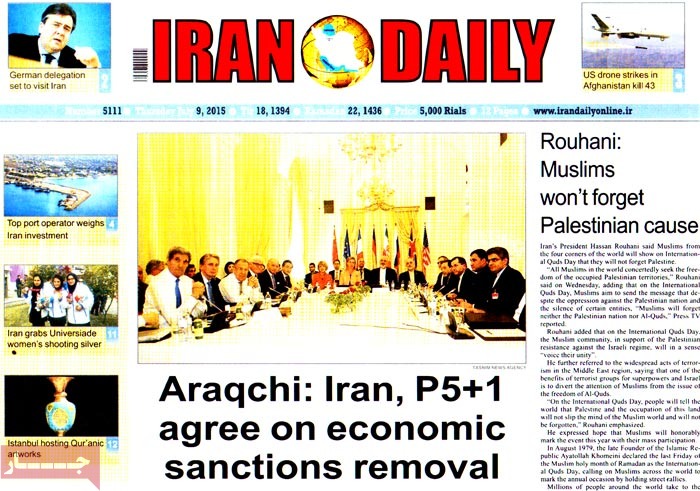
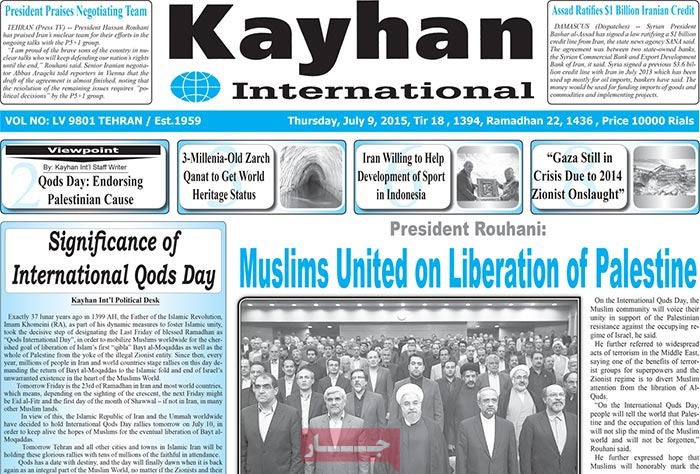
Muslims to show on Quds Day Palestine will not be forgotten: Rouhani

Rouhani-Quds

Iran’s President Hassan Rouhani says Muslims from the four corners of the world will show, on International Quds Day, that they will not forget Palestine.

“All Muslims in the world concertedly seek the freedom of the occupied Palestinian territories,” Rouhani said on Wednesday, adding that on the International Quds Day, Muslims aim to send the message that despite the oppression against the Palestinian nation and the silence of certain entities, “Muslims will forget neither the Palestinian nation nor al-Quds (Jerusalem).”

Rouhani added that on the International Quds Day, the Muslim community, in support of the Palestinian resistance against the Israeli regime, will, in a sense, “voice their unity.”

He further referred to the widespread acts of terrorism in the Middle East region, saying that one of the benefits of terrorist groups for superpowers and Israel is to divert the attention of Muslims from the issue of the freedom of al-Quds.

“On the International Quds Day, people will tell the world that Palestine and the occupation of this land will not slip the mind of the Muslim world and will not be forgotten,” Rouhani emphasized.

He further expressed hope that Muslims will honorably mark the event this year with their mass participation.

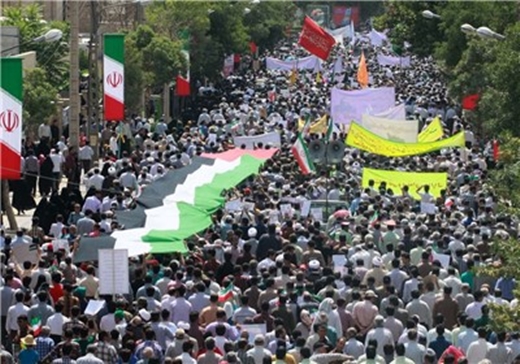
In August 1979, the late founder of the Islamic Republic Ayatollah Khomeini declared the last Friday of the Muslim holy month of Ramadan as the International Quds Day, calling on Muslims across the world to mark the annual occasion by holding street rallies.

Millions of people around the world take to the streets on the day in a show of support for the people of Palestine, demanding an end to the Israeli occupation of Palestinian lands.

President Rouhani praises nuclear negotiators

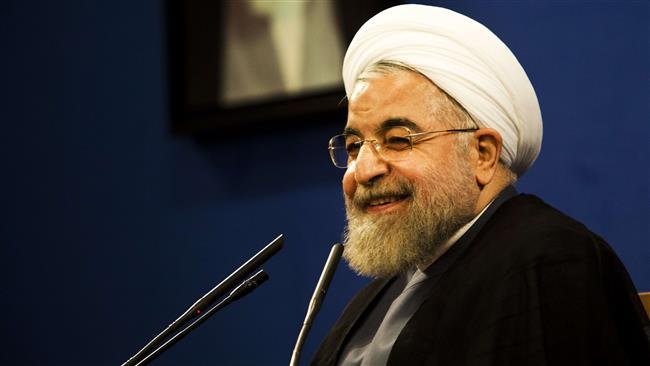
President Rouhani

President Hassan Rouhani has praised Iran’s nuclear team for their efforts in the ongoing talks with the P5+1 group as a senior Iranian negotiator says the main text for an agreement on Tehran’s nuclear program is almost complete.

“I am proud of the brave sons of the country in nuclear talks who will continue to defend our nation’s rights until the end,” President Rouhani said at a gathering of university professors in Tehran on Tuesday night.

Earlier in the night, senior Iranian negotiator Abbas Araghchi told reporters in Vienna that the draft of the agreement is almost finished, noting that the resolution of the remaining issues requires “political decisions” by the P5+1 group.

“The main text is almost complete, only a few paragraphs remain that require political decisions,” he said,  adding, “We have completed drafting as far as it was possible, and parts of the agreement and its annexes that are still between brackets are dependent upon decisions by ministers.”

He noted, “If ministers reach agreement on any of the issues, we will immediately negotiate on the required language and include it in the text.”

The head of Iran’s Atomic Energy Organization, Ali Akbar Salehi, and the US Energy Secretary Ernest Moniz are currently working on the annexes of the agreement, added Araghchi, the Iranian deputy foreign minister for legal and international affairs.

“The annex on sanctions is around 95-96 percent done, only two or three small issues remain; the annex on peaceful nuclear cooperation with Iran is almost done; and various sectors for international cooperation have been determined,” he said.

He added that apart from two or three issues, the annex on joint commission is almost final. “The final annex is about the timeframe and timetable of the implementation on which we are still working because that depends on all issues being resolved.”

[…]

Iran and the six countries missed an initial deadline of June 30 and all parties agreed on a new, July 7. However, the negotiators agreed to extend the deadline until Friday, July 10.

Larijani: Good nuclear deal can serve the entire world

Ali Larijani

Parliament Speaker Ali Larijani said on Tuesday that a good nuclear agreement between Iran and six world powers will serve the interests of the seven countries and the entire world as well.

The Iranian parliament speaker made the comment in a meeting with Palestinian political activist affiliated to liberation movement to free the occupied Holy Quds from Israeli occupation.

Larijani expressed outrage at the acts of Tel Aviv to sabotage Iran-West nuclear negotiations.

‘The heads of that regime act hurriedly and even openly voice their opposition to the negotiations; even during the previous two rounds of the negotiations, it were the Zionist groups that used to create nuisance and some Arab countries were following the Zionists’ model in opposing the nuclear talks proactively,’ said Larijani.

Larijani added that although the Zionist regime adopted stands hurriedly about the ongoing nuclear talks, a good agreement can be beneficial for the entire world.

‘Events such as the nuclear agreement can contribute to the establishment of sustainable security in the region and sever the hands of that (Zionist) regime from making more notorious acts. The Israeli regime’s trouble-making in America has precedent; Netanyahu’s Congress address is one such example,’ he said.

Where does Rafsanjani stand on the Shiite-Sunni issue, regional matters and Iran-Saudi ties?

grand mufti

Chairman of the Expediency Council Ayatollah Akbar Hashemi Rafsanjani says that Iran and Saudi Arabia can work together to bridge the Shiite-Sunni divide plaguing the region.

In an interview with the Arabic-language daily Al-Vefagh, the top councilor talked about a wide range of issues, including his relationships with the Supreme Leader, Iran-Saudi Arabia ties and cross-border relations between Iran and Iraq. On July 5, Alef.ir published a Farsi version of the interview. The following is the translation of PART THREE of the interview which focuses on the problems and prospects of Tehran-Riyadh ties:

WikiLeakes and documents on Saudi Foreign Ministry

This [the release of diplomatic memos by the whistleblowing website WikiLeakes] is a harmful trend. Similar information leaks dealt a blow to the US too. The one behind these leaks is now being used as leverage. Saudis have suffered as a result of these leaks, apparently more than others.

Saudi Arabia is a closed country [to the outside world] with its foreign relations, talks, correspondence and documents remaining unknown [to the public]. No one knows what is going on inside the kingdom. When Saudi information was leaked, it played into the hands of those who sought to tell lies, citing the faked versions of these leaked documents. They [those taking advantage of the leaked information] tell what they want and deliver a blow [to the kingdom] anytime they wish. They make a comment and it takes time before Saudi officials deny their comments. As a result people buy that.

Sedition surfaced at one point and snowballed. Saudi Arabia has to pay a dear price for the leaks, with the negative impacts of such leaks not diminishing anytime soon. The positive measures it [Saudi Arabia] has taken are not publicized, but its incorrect decisions are blown up [out of all proportion].

Saudi aggression on Yemen and nuclear talks

I have no idea about any possible relationship between Saudi attacks in Yemen and Iran’s nuclear talks! In the new group which has come to power in Saudi Arabia, I only know Salman. I saw him at a party in Riyadh. He had invited me and we talked. That’s it. I do not know the other newcomers. […]

I don’t know why they [the Saudis] made such a mistake [airstrikes on Yemen]. They did so because they apparently thought the Houthis were Shiites. The Houthis, however, are not twelve-Imam [Twelver] Shiites; they are mainly four-Imam Zaidiyyahs. If the Saudis are worried about the Shiites, they should be worried about Iran, Lebanon, Iraq, Syria and a large number of other [Muslim] countries.

They made a big mistake in Yemen. Bahrain is a good example [of Saudi mistakes]. The Saudis deployed forces in Bahrain, which is an Arab nation and a member of the Persian Gulf Cooperation Council, to fight against the Shiites. Accordingly, they have concerns in Yemen, especially because the Yemenis have territorial claims on the kingdom. I do not know their exact motives. Perhaps they’ve been provoked to do so. If [the ousted president] Mansour Hadi had been able to stay [in power] in Yemen, he would have remained there. How can he build on Saudi assistance to cling to power?

Saudi Arabia and a nuclear deal

If the Saudis are concerned about the agreement Iran is likely to clinch with P5+1, they need to act in good faith when it comes to such a deal. Saudi Arabia and other regional countries are making a mistake. Iran has banned [the development of] nuclear bombs. Why should they be afraid of us? They should be afraid of Israel.

The Saudis have bought 3,000-km range missiles from China and other countries. They possess highly advanced hardware such as planes, missiles and radar systems. They also have a military base there [in Yemen]. Saudi Arabia knows that Iran does not pose a threat. If Iran had intended to cut ties with Saudi Arabia, it would have made an issue of the killing of more than 400 Iranian pilgrims at the 1987 Mecca incident [at the hands of Saudi police during Hajj rituals], but Iran behaved differently only to help mutual ties with the kingdom remain unstrained.

Ties between Iran and post-revolution Egypt      

Why Iran and Egypt do not have balanced relations [even after an Arab Spring revolution in Egypt and the rise to power of two presidents] is a question the Egyptians should answer, because Iran is seeking to develop ties. We see the Egyptians as people who love the household of the Muslim Prophet. We have no problem with the Egyptian people, especially because we are not neighbors to have [border-related] issues.

There are reasons behind such [cold] relations: First, the Americans, who hold sway in Egypt and support its army, do not approve of Tehran-Cairo ties; Second, Egypt has to cooperate with Saudi Arabia and some other countries; and third, Egypt disapproves of Iran’s presence in Syria, Lebanon and recently in Iraq. We faced similar problems in Afghanistan. They [the Saudis] supported the Taliban and Iran frowned upon their support. I personally talked with King Abdullah, telling him that Riyadh was making a big mistake.

[…]

The threat of a religious war in the region

We are now at a [critical] time with the Shiites under attack in certain regional countries. They treat the Shiites as their rivals, trying to undermine the Shiites in different ways, but the fact is that the Shiites pose no threat or challenge to them.

According to Shiite politics and mindset, they [the Shiites] do not want to get involved in confrontation with their fellow Muslims. It is a big mistake on the part of some regional countries; instead they can count on Iran which is their best friend. Presently I sense danger, and fear that the mounting differences which sometimes lead to the killings [of Muslims in this region] could deepen [even more].

Prospects of Tehran-Riyadh ties

A few years ago when the previous government was in office, I traveled to Saudi Arabia. I was asked to settle the issues Iran had with Saudi Arabia during my visit. After a dinner banquet hosted by King Abdullah, we talked until past midnight. The king’s close advisors, including his foreign minister and Prince Muqrin and others, were also on hand for the meeting. We discussed the differences and arrived at a solution: formation of seven joint commissions.

The first commission was to deal with religious affairs; in other words, the clerics from the two sides were supposed to hold meetings to discuss and work out solutions to the differences between the Sunnis and Shiites. The officials in two countries too were expected to support the viewpoints of the commission so that the problems standing in the way could be removed.

The second commission was tasked with handling mutual ties and cooperating with the executive commission. We also decided to hold one joint commission for Lebanon, one for Syria, one for Iraq, one for Afghanistan and one for other countries. These seven commissions were to meet on a regular basis and bring the viewpoints of the two sides closer together, and the two countries’ high-ranking officials were to supervise the performance of these commissions.

It was a sound decision we made to remove the differences in the region. After I came back to Iran, I realized that those who were to pursue these affairs were unwilling to make them happen. Later [then Saudi Foreign Minister] Mr. Saud Al Faisal came to Iran to pursue what we had already decided on. His first trip was somehow successful, but then everything fell apart due to the problems they had in the kingdom and we faced here in Iran.

I’m sure that if we initiate a joint plan with Saudi Arabia, we can bridge the differences between the Shiites and Sunnis all over the Islamic world. For instance, in Syria which is an independent country, neither Iran nor Saudi Arabia is allowed to fix the destiny of the Syrian people. We should remain vigilant not to allow Shiite-Sunni differences to emerge in that country. We have to let the Syrian government and people solve their own issues. We can simply help them settle their problems.

This holds true for Iraq, Lebanon and other [Muslim] nations. I think even now we can revive what we decided almost six years ago and work out a solution [to Muslim differences] in line with the current situation in the region.

Rare Pallas’s cats seen in northeastern Iran (PHOTOS)

22821_194

After sightings of a leopard-like animal by the locals in a town in North Khorasan Province, the provincial Environment Department sent some experts to the area to gather information about the unknown animal.

The search produced photos of a Pallas’ cat (Otocolobus manul) with its four kittens which are rare in Iran’s wildlife.

Snapshots of a rare small wild cat with its kittens posted online by  iew.ir :


President breaks fast with social workers, physically challenged (PHOTOS)

asli

At an Iftar feast hosted by President Rouhani at Tehran’s Islamic Summit Conference Hall on Monday, the president as well as a number of officials broke their fast with social workers of the Welfare Organization and the Imam Khomeini Relief Committee.
Also in attendance at the ceremony were some physically challenged individuals
Snapshots of the gathering in the fasting month of Ramadan released online by Mehr News Agency:


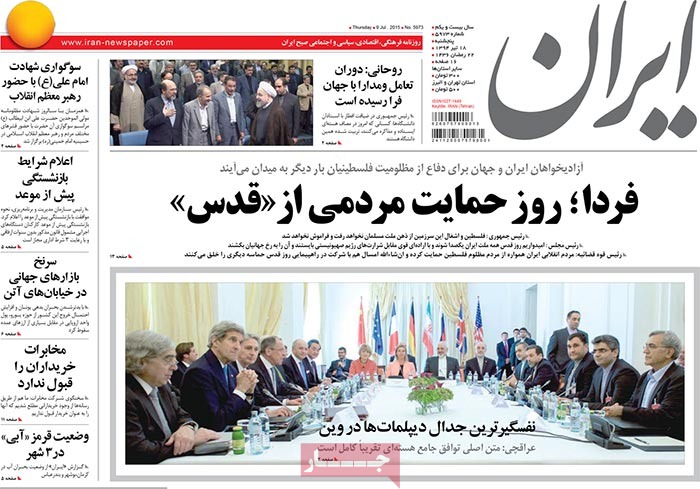
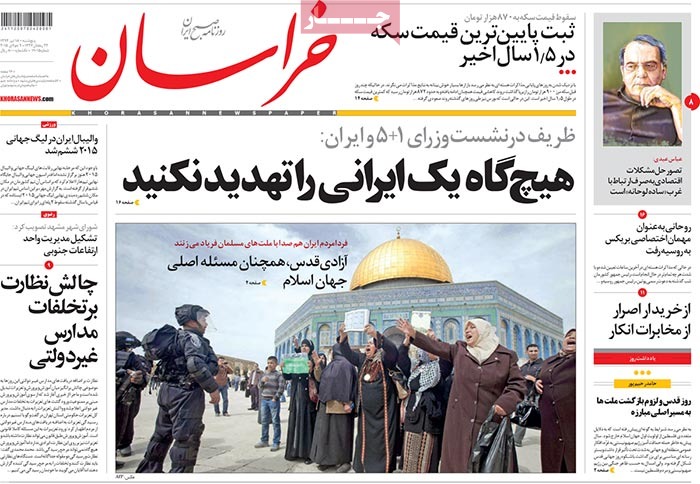
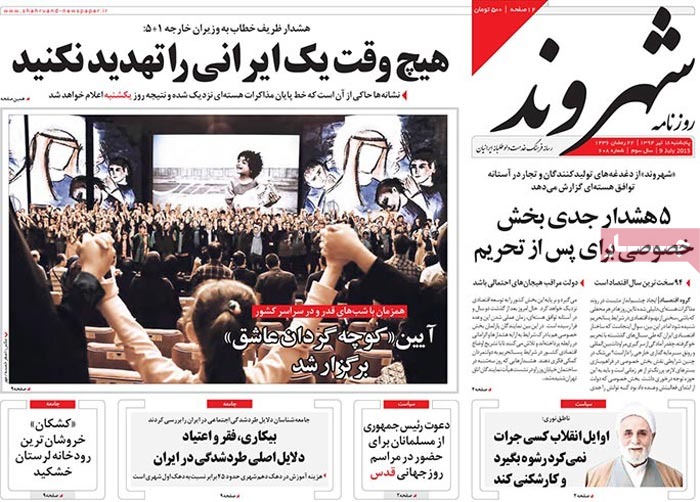
Highlights of Ettela’at newspaper on July 7

Ettelaat-July7

 A final push by Iran and P5+1 to clinch a deal.

A source close to the Iranian nuclear negotiating team has said that in certain areas serious differences remain to be settled.

None of Iran’s nuclear activities will come to a halt when the Joint Comprehensive Plan of Action produces the intended result.

 The littoral states of the Caspian Sea are to ensure the security of the landlocked sea.

The commander of the Iranian Navy said an agreement is being drafted under which the five countries bordering the Caspian Sea will take charge of Caspian security without foreign presence.

 Tehran’s Shahid Beheshti University has hosted a gathering dubbed “Palestine, a symbol of resistance and pivot of Islamic solidarity”.

 “Imam Ali [the first Shiite Imam] did not walk off the path of justice and ethics in dealing with oppression and immorality,” said the President.

Hassan Rouhani further said, “Our main responsibility is to make sure that the ideals of the martyrs, that is to say, the integrity and independence of the nation, are guaranteed.”

 Tens of thousands of Yemeni people have staged a rally in protest at the silence of the international community in the face of Saudi crimes.

It came as Yemeni forces fired 39 missiles at a Saudi military base in Dhahran.

 The public has been urged to take part in Quds Day rallies.

The rallies which get underway at 10:30 will be held in 770 towns and cities across the nation on Friday [July 10].

 The country’s expert capacity will be fully tapped in drafting the Sixth Development Plan.

The director of the Management and Planning Organization said that the 6th plan will be realistic, flexible and effective. Efforts will be made to rid the plan of the defects of previous plans.

 A sudden increase in master’s and PhD admissions has dealt a blow to the quality of education,” said the President of Tehran University.

 Tehran’s subway will be extended to Mehrabad Airport in two months.