Tuesday, January 13, 2026
Home Blog Page 4835

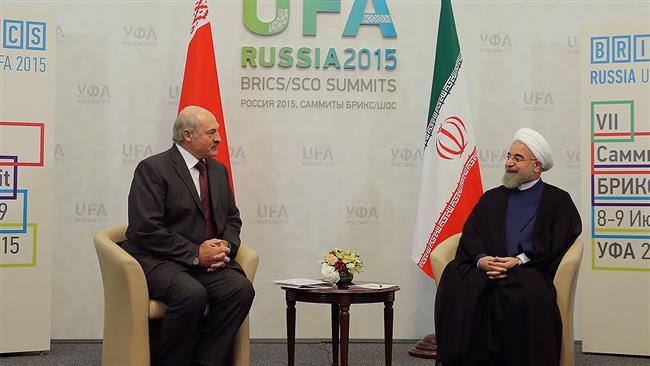
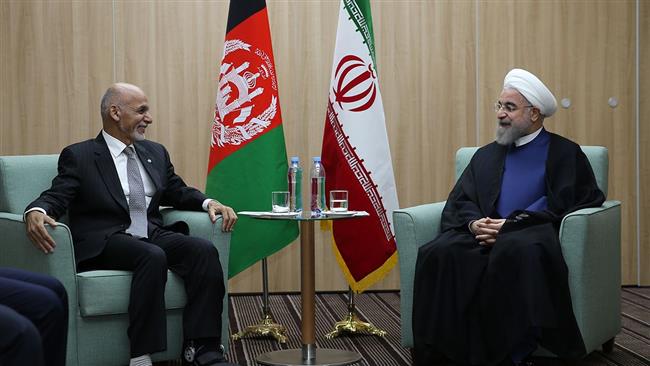
Iranian president in Russia to attend BRICS, SCO summits

Rouhani Iran

The president arrived in the Russian city of Ufa, the venue of the events, on Wednesday night.

Rouhani is accompanied by First Vice President Es’haq Jahangiri as well as Ali Akbar Velayati, a top adviser to Leader of the Islamic Revolution Ayatollah Seyyed Ali Khamenei.

On the first day of his two-day visit, which comes at the invitation of Russian President Vladimir Putin, Rouhani will take part in the summit of BRICS which groups Brazil, Russia, India, China and South Africa.

The Iranian president is also scheduled to address the SCO summit as a keynote speaker on the second day of his trip.

Rouhani will also exchange views with heads of SCO and BRICS member states.

Russian Presidential Aide Yuri Ushakov said Tuesday that Putin and Rouhani will hold talks on July 9 on the ongoing nuclear talks between Iran and the P5+1 countries over Tehran’s nuclear program.

Iran and the P5+1 countries – the United States, Britain, France, Russia and China plus Germany – have been engaged in crucial talks in the Austrian capital, Vienna, to reach a deal over Tehran’s nuclear program.

“Various matters of purely bilateral cooperation in trade, economy, and the military-technical field will of course be discussed,” Ushakov added.

Rouhani has been invited to the BRICS summit as a special guest while he will have an observer seat at the subsequent summit of the SCO. The organization is awaiting the lifting of sanctions on Iran to accept it as a full-fledged member.

BRICS accounts for almost half of the world’s population and about one-fifth of the global economic output. Iran has always supported the group’s rising influence in the global economy, looking for an opportunity to join the five-nation bloc.

No insurmountable problems left at Iran negotiations: Russia

Lavrov

Lavrov said Thursday that the two sides agreed in Vienna, Austria that the quality of a final nuclear deal with due account of Iran’s interests is most important.

Russia’s top diplomat referred to anti-Iran sanctions, saying Moscow wants Iran’s arms embargo “lifted as soon as possible.”

“We are in favor of lifting the embargo as soon as possible and will support a decision made by Iran’s negotiators,” Lavrov pointed out.

Meanwhile, Russian Deputy Foreign Minister Sergey Ryabkov has compared the final round of the ongoing talks between representatives from Iran and the five permanent members of the UN Security Council – Britain, China, France, Russia and the United States, plus Germany – over Tehran’s nuclear energy program to the last and hardest stage of ascending Mount Everest.

“We are working together with colleagues from P5+1 group on proposals made by Iran on Tuesday. This work is hard and time-consuming. We did not meet the July 7 deadline. Those are right who say that talks are like ascending Mount Everest,” Ryabkov said on Thursday.

Moreover, diplomatic sources close to the negotiating teams in Vienna say the nuclear talks between Iran and the P5+1 group of states may stretch into the weekend. They say it may take until July 13 for the sides to clinch a deal on Iran’s nuclear program. Negotiators had earlier extended the talks until Friday after they missed the self-imposed deadline of June 30.

Iranian Foreign Minister Mohammad Javad Zarif, in an article published in the Financial Times on Wednesday, reminded the six world powers engaged in nuclear talks with Tehran to choose between coercion and agreement, warning against opting for the former.

“There is growing acknowledgment that attempting to coerce a proud civilization into submission only leads to further conflict, resentment and hostility,” Mohammad Javad Zarif wrote in an article published in the Financial Times on Wednesday.

“At the outset of this crisis, Iran had less than 200 centrifuges; today, it has 20,000. And so, my counterparts have rightfully opted for the negotiating table,” he said. “But they still need to make the critical choice between an agreement and coercion.” In a video message released on July 3, the Iranian foreign minister had likewise demanded the six powers to select between the two.

Iran, Tajikistan sign MoU to complete Anzob tunnel

Tajikistan

Iran and Tajikistan signed a memorandum of understanding (MoU) to complete the Anzob tunnel, also known as Istiqlol (independence) project, in the near future.

The MoU was signed by Iranian Energy Minister Hamid Chitchian and Tajik Ambassador to Tehran Nematollah Emamzadeh in Tehran on Tuesday, Tajikistan’s foreign ministry announced on Wednesday.

In April 2013, Iran and Tajikistan signed a deal to complete the strategic tunnel in the Central Asian country.

The spokesperson for the Lower House of Tajikistan’s parliament Muhammadato Sultanov said earlier this year that the $3b agreement was signed by the two countries to complete the project.

He added that the Tajik minister of transport, Nizom Hakimov, has briefed the Tajik lawmakers on the project and presented them with the relevant documents.

The Anzob Tunnel is a five-km-long tunnel located 80 km Northwest of Tajikistan’s capital city of Dushanbe.

The tunnel connects the Tajik capital to the country’s second largest city, Khujand. Prior to the tunnel’s construction, the tourists needed to cross the border into Uzbekistan in order to travel between the two cities.

It is also a transit route between Dushanbe and Uzbekistan’s capital Tashkent. Before the construction of the tunnel, especially during winter, the threat of year-round avalanches led to periodic disruptions of commerce.

Regional peace hinges on restoration of Palestinian people’s rights: Iran

quds

A couple of days before International Quds Day, the Iranian Foreign Ministry stressed that the restoration of the rights of the Palestinian people would result in sustainable peace in the region.

Sustainable peace in the Middle East cannot be realized unless the innocent people of Palestine would claim their full rights, the Foreign Ministry said in a statement on Wednesday.

Fulfilling this objective requires strong opposition to the Zionist regime’s aggression and excessive demands, and the empowerment of Palestinians in their resistance, the statement added.

The statement went on to say that “resistance is the only way” to protect the rights of Palestinians and to liberate the occupied Palestine and the holy Quds.

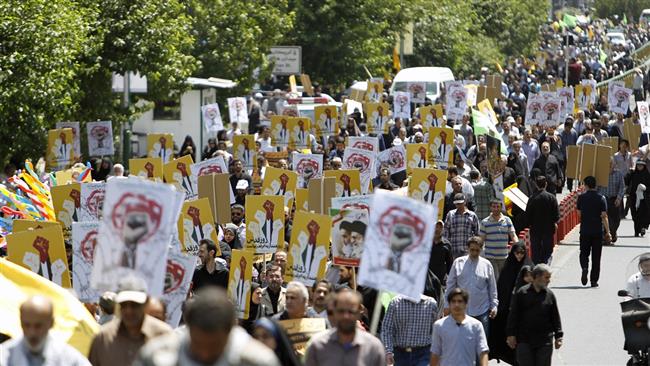
Iran’s Foreign Ministry also invited the Iranian nation to take part in the rallies due to be held on Friday on the occasion of International Quds Day.

Millions of people in Iran as well as other countries in the world are expected to hold massive rallies on Friday to show their solidarity with the Palestinian people and the cause of Palestine.

The event’s overarching theme is the support for the Palestinians and fierce denunciation of Israel.

It is seen as an opportunity for freedom-seeking people across the world, regardless of faith, to voice their support for the cause of Palestine and vent their anger against the Apartheid regime of Israel, which has occupied Palestinian territories since 1967.

The day is also seen as the legacy of the late founder of the Islamic Republic of Iran, Imam Khomeini, who officially declared the last Friday of the holy month of Ramadan as International Quds Day back in 1979.

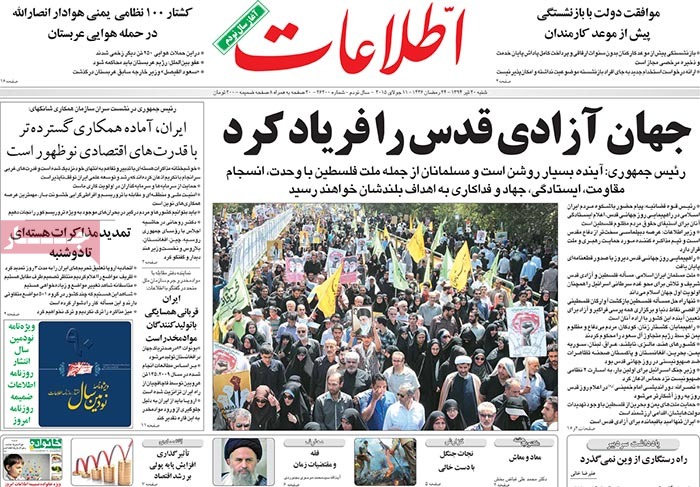
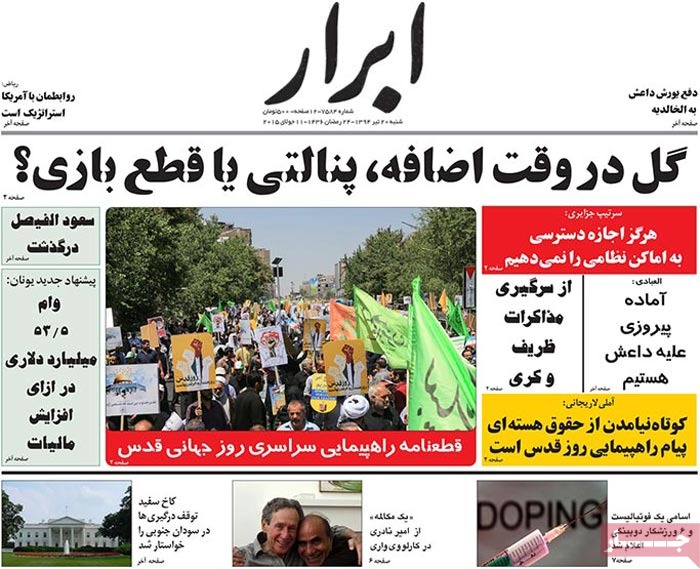
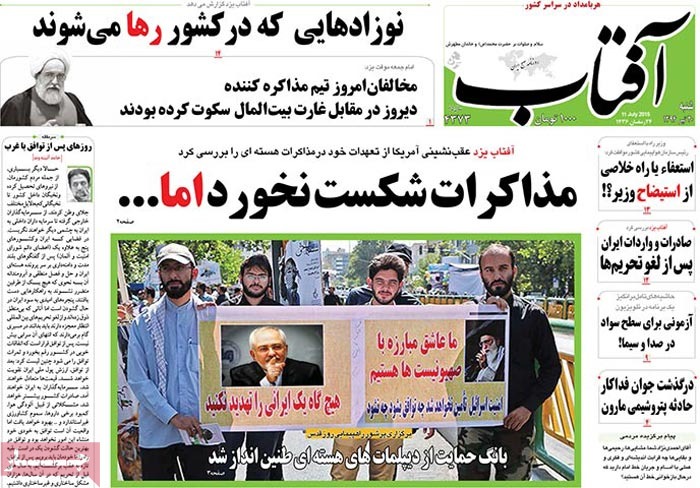
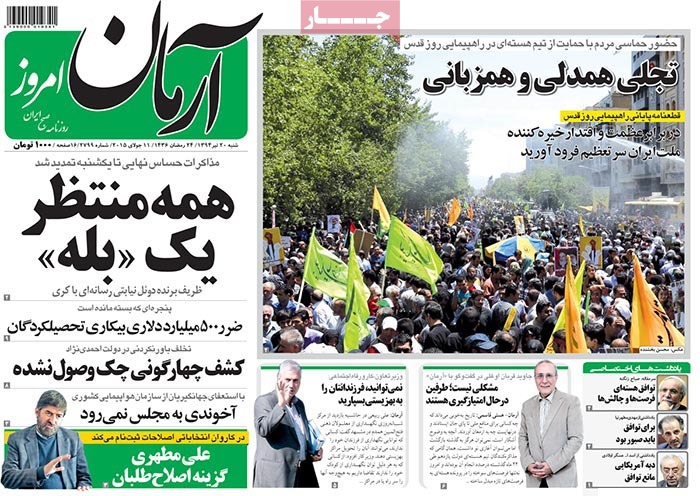
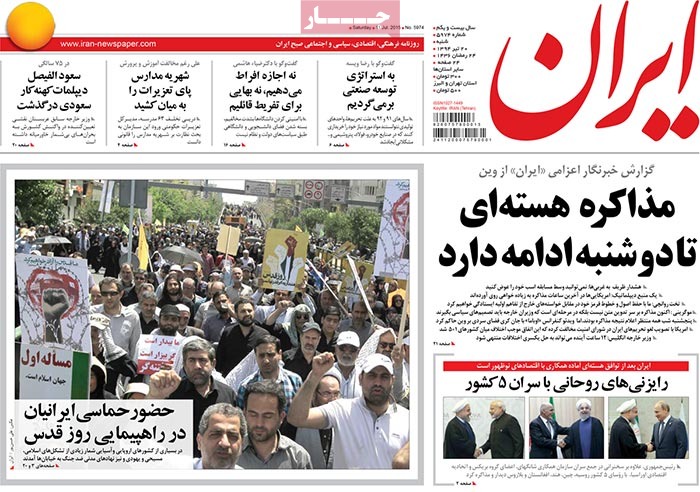
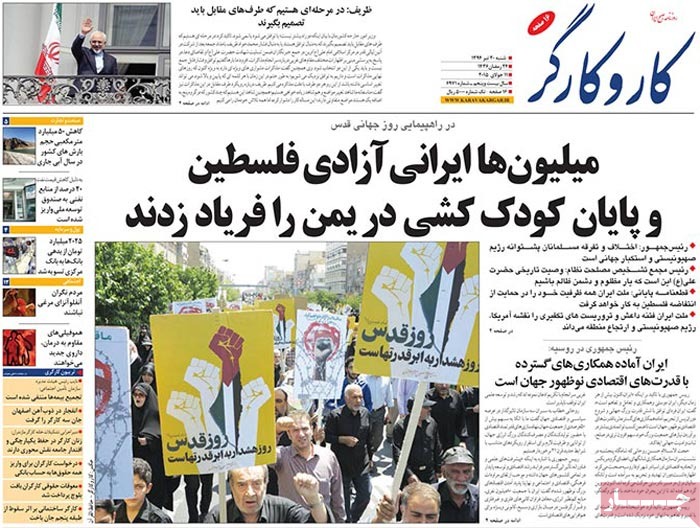
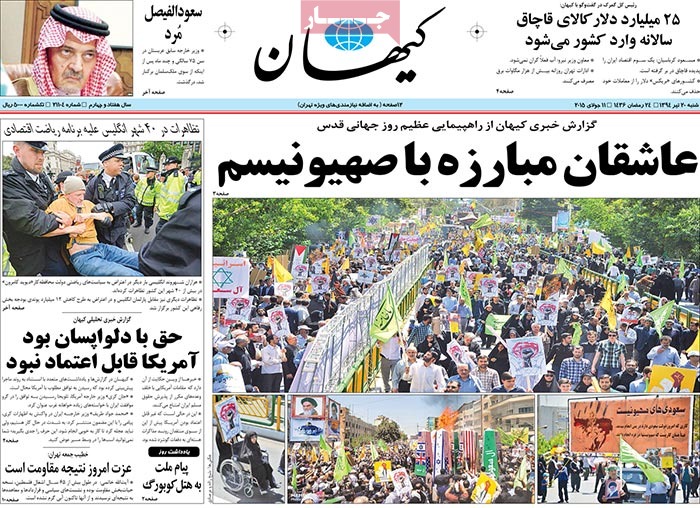
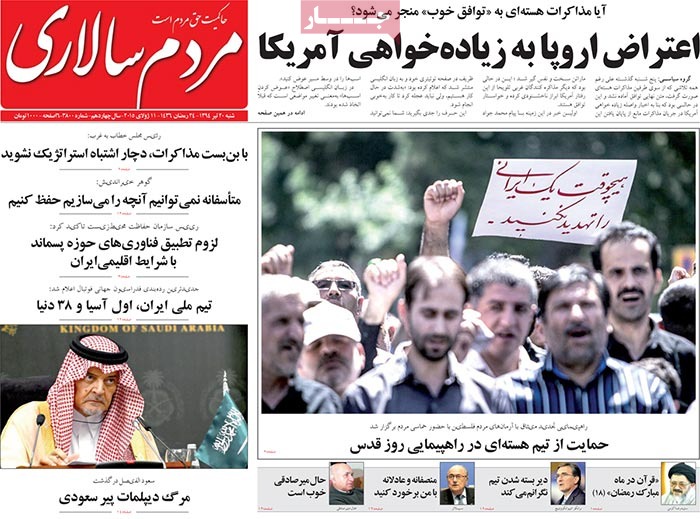
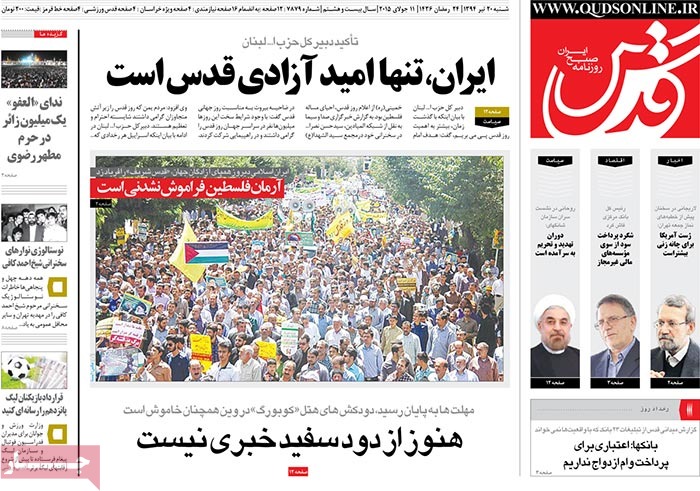
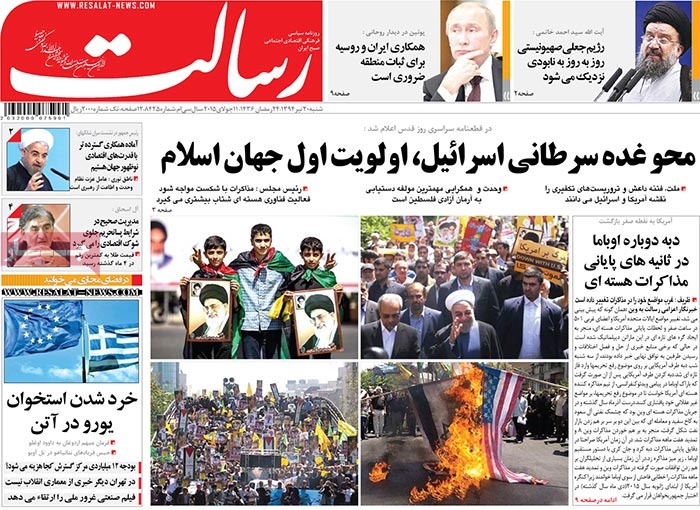
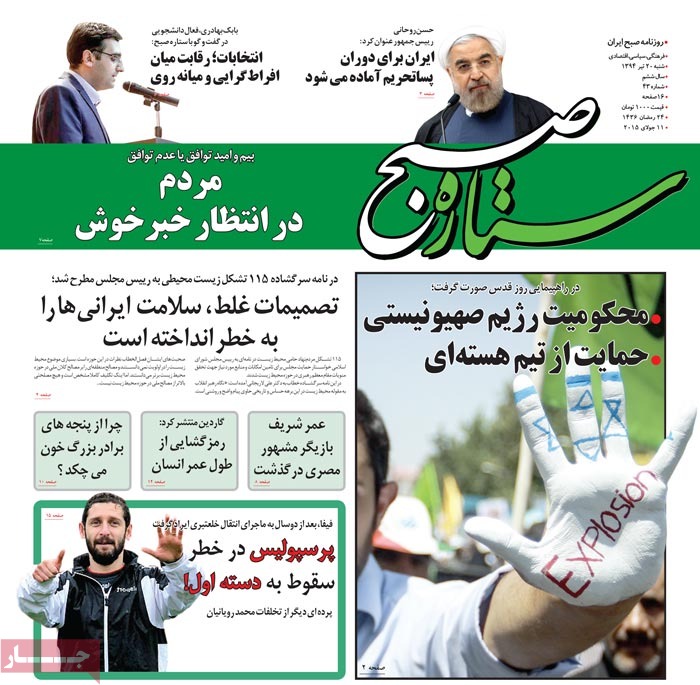
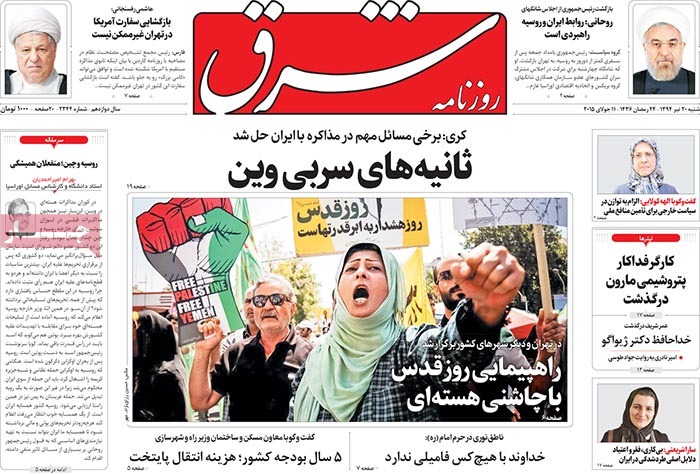
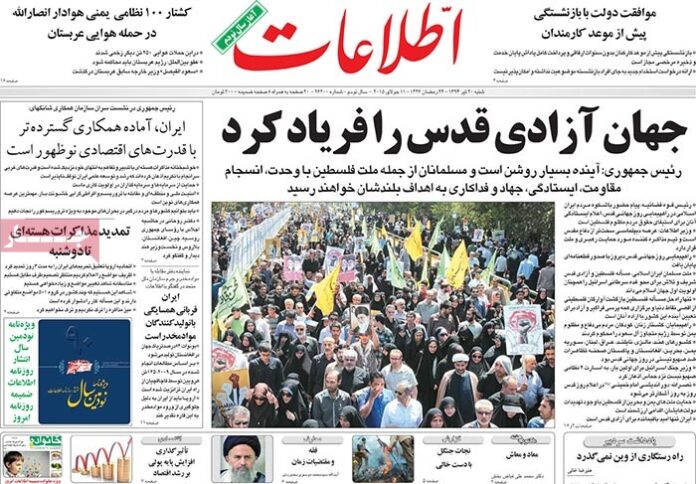
A look at Iranian newspaper front pages on July 9

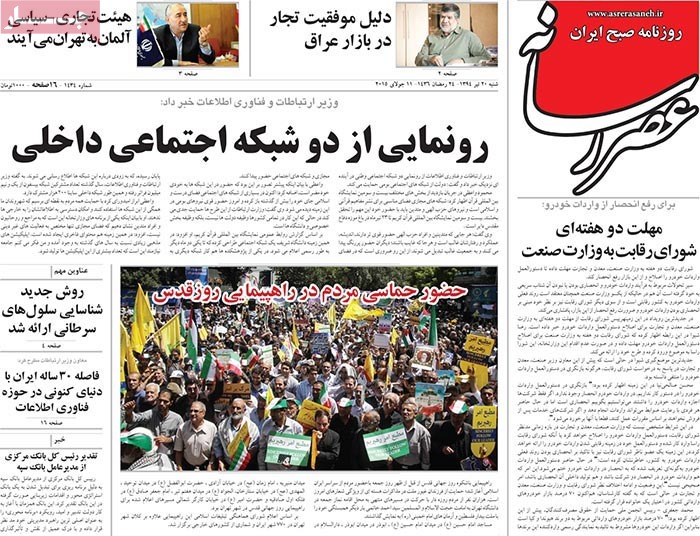
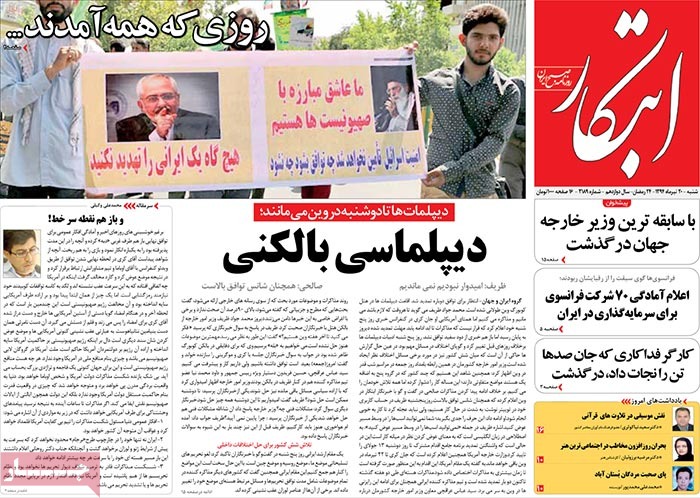
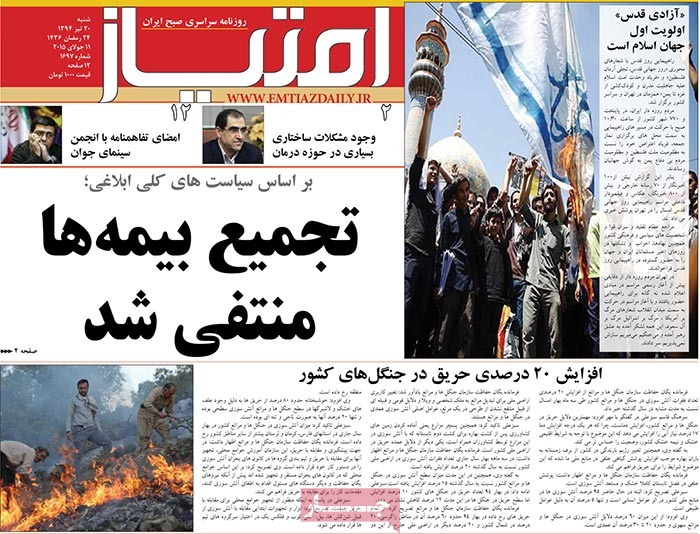
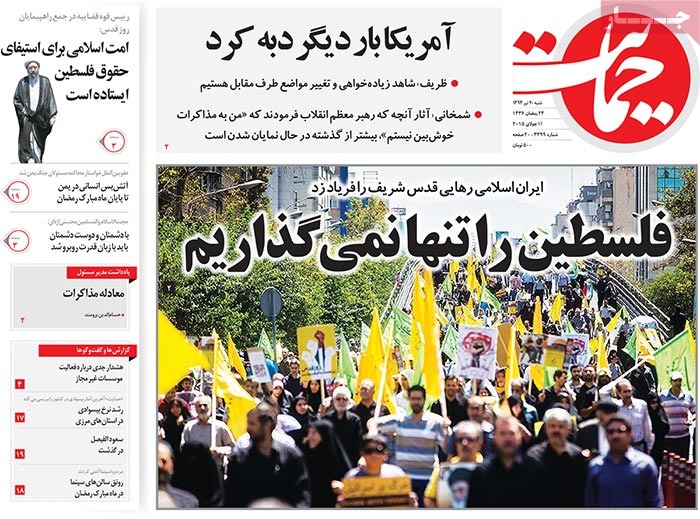
Iranian Newspapers Headlines

Foreign Minister Mohammad Javad Zarif’s warning to officials from P5+1 not to threaten the Iranians dominated the front pages of newspapers on Thursday. Also in the news was the call by Iranian President Hassan Rouhani and various institutions on members of the public to turn out in droves for International Quds Day rallies on Friday (July 10).


Aftab-e Yazd: President Rouhani has said that he takes pride in the Iranian nuclear negotiating team.

Aftab-e Yazd: Will there be détente after 36 years?

The daily says there are speculations that Iran and the United States might resume diplomatic ties after a nuclear deal has been struck.


A look at Iranian newspaper front pages on July 9


Arman-e Emrooz: Chairman of the Expediency Council Ayatollah Akbar Hashemi Rafsanjani has not ruled out the possibility of the US reopening its embassy in Iran.

In an interview with The Guardian, the top councilor said that the world has concluded that it needs to engage in dialogue with Iran.

Arman-e Emrooz:We are victorious.

Deputy Foreign Minister Seyyed Abbas Araghchi has said that the text of the final deal is all but complete.

Foreign Minister Mohammad Javad Zarif has advised his negotiating partners from P5+1 not to threaten the Iranians.

Arman-e Emrooz:  Foreign tourists can bring in as much as $34 billion in annual revenues.

That can help the country shed its staple economy title.


A look at Iranian newspaper front pages on July 9


Etemad: President Rouhani has called on the public to turn out in force for International Quds Day rallies on Friday.

Etemad: A fateful 24-hour period lies ahead. In case Iran and P5+1 fail to strike a deal by early Friday, the US Congress will have 60 days, rather than the current 30, to approve or reject the deal.

Etemad: With record electricity consumption and a halt in power generation in hydroelectric plants, power outages seem to be inevitable.


A look at Iranian newspaper front pages on July 9


Iran: “Time has come for interaction with the world,” said President Rouhani.

Iran: On Friday, the public will throw its weight behind Quds and the Palestinian cause.


A look at Iranian newspaper front pages on July 9


Iran Daily: Rouhani: Muslims won’t forget the Palestinian cause.


A look at Iranian newspaper front pages on July 9


Jamejam: Water shortage alarms have sounded in 547 towns and cities across the country.


A look at Iranian newspaper front pages on July 9


Kayhan: Shiite and Sunni Muslims have taken part in unity prayers in Saudi Arabia.

Earlier, similar rituals had been held in Kuwait and Bahrain.


A look at Iranian newspaper front pages on July 9


Kayhan International: Three-millennia-old Zarch Qanat to get world heritage status


A look at Iranian newspaper front pages on July 9


Khorasan: Gold coin prices have fallen to 18-month lows.


A look at Iranian newspaper front pages on July 9


Shahrvand: “In the early years of the revolution, no one dared to accept bribes,” said Ali Akbar Nategh Nouri, a former parliament speaker and presidential candidate.


A look at Iranian newspaper front pages on July 9


Leader condoles with Kuwait over top Shiite cleric decease

Leader Iran

Supreme Leader of the Islamic Revolution Ayatollah Seyyed Ali Khamenei has extended condolences to the people and government of Kuwait over the demise of prominent Shiite Muslim cleric Ayatollah Seyyed Muhammad Baqir al-Musawi al-Muhri.

In a message addressed to Secretary General of the National Islamic Alliance Sheikh Hussain al-Ma’touq on Thursday, Ayatollah Khamenei pointed to Muhri’s constant endeavors to promote Islamic teachings and offered Iran’s deepest sympathy to the late cleric’s bereaved family, his adherents as well as the Kuwaiti nation.

The Leader also prayed for the departed soul to rest in peace.

Muhri, a renowned Shiite Muslim cleric and member of the Ahlulbayt World Assembly, passed away on Saturday after suffering a heart attack at the age of 66.

He had studied in seminaries in the holy Iraqi city of Najaf under Iranian-born Grand Ayatollah Abul-Qassim Khoei and Mohammad Baqir al-Sadr.

Turkey exhibits Islamic artworks by Iranian artists

Turky exhibition

The Turkish city of Istanbul has held an exhibition of Islamic artworks created by Iranian artists.

Titled ‘From the Earth to Heaven,’ the event was opened during a ceremony at Istanbul’s Cemal Resit Rey cultural center on July 7, 2015.

The opening ceremony was attended by Iran’s consul general in Turkey Mohsen Mortezaeifar and a number of Turkish officials, art collectors and gallery owners.

Iran and Turkey have extensive political and economic relations and ‘From the Earth to Heaven’ exhibition can pave the ground for joint cultural and artistic activities, said Mortezaeifar during the opening ceremony of the event.

The exhibition, which is being held in six sections, mainly exhibits works based on Persian calligraphy and reflecting Safavid motifs.

The main section of the event showcases a number of unique and innovative works of miniature painting and calligraphy created on textile. A group of seven Iranian artists have created the works based on the Baysonghori calligraphy style.

The works are recreations of Safavid works produced on a large scale, and with unique and innovative methods.

The Baysonghori style is named after Persian calligrapher Jafar Baysonghori, who created a world-famous manuscript of Persian epic poet Ferdowsi’s masterpiece Shahnameh in 1429.

Visitors can also see exquisite handicrafts made of turquoise and steel, as well as Persian carpets and paintings featuring Koranic verses and Persian poems.

An interesting part of the exhibition includes stucco paintings created based on similar works found at the Chehel Sotoun Palace in Iran’s historical city of Isfahan.

Iran’s Zarif warns P5+1 against coercion

Zarif

Amid intensive nuclear talks between Tehran and P5+1, Iran reminds world powers that they have to choose between coercion and agreement, warning against opting for the former.

“There is growing acknowledgment that attempting to coerce a proud civilization into submission only leads to further conflict, resentment and hostility,” Mohammad Javad Zarif wrote in an article published in The Financial Times on Wednesday.

“At the outset of this crisis, Iran had less than 200 centrifuges; today, it has 20,000. And so, my counterparts have rightfully opted for the negotiating table,” he said.

“But they still need to make the critical choice between an agreement and coercion.”

In a video message released on July 3, the Iranian foreign minister had likewise said Iran’s negotiating partners had to choose between the two.

Iran and P5+1 – the United States, Britain, France, Russia, China and Germany – have been engaged in crucial talks in the Austrian capital Vienna towards reaching a landmark deal over Tehran’s nuclear program.

The negotiating sides missed an initial deadline of June 30 and all parties agreed on a new, July 7. However, in the wake of the outstanding issues in the talks, EU foreign policy chief Federica Mogherini said on Tuesday that the negotiations would continue for “a couple” of more days.

Is $50 per barrel oil in the offing?

oil price

For the first time in almost three months, Brent prices have slipped below $60 a barrel. Certainly, the no vote the Greeks cast in an austerity referendum on Sunday has played an important role in pushing down the crude prices.

In a report on July 7, Donya-e Eqtesad daily took a look at other factors that contributed to the slump in global oil prices. The following is the translation of an excerpt of the report:

These days most of news stories coming from the oil market are indicative of a decline in prices, and West Texas Intermediate seems to have lost its $60 per barrel footing. The nuclear deal Iran and P5+1 are likely to clinch shortly on the one hand, and an increase, according to Baker Hughes, in the number of American oil rigs – a first in 29 weeks – seem to have knocked the market off its one-month-old balance.

Earlier this year, international institutes such as Morgan Stanley, Goldman Sachs, and the U.S. Energy Information Administration (EIA) said prices were likely to take a downward trend in the second half of the year. Four days into trading in the second half of 2015, their projections came true.

There are a number of factors that may contribute to additional decline of prices to six-year lows.

First, latest estimates suggest that OPEC output is still on the rise. In June, it hit the 32 million bpd mark.

Second, the decline in the number of American oil rigs has stopped. In the week to June 27, the number of rigs posted its first uptick in 29 weeks.

Third, Iran has announced that it will double its output once international sanctions against it are lifted. An increase of 1 million barrels per day at a time when OPEC members are trying to claim a bigger share of the market will definitely have a negative impact on prices.

Saudi Arabia has reportedly opposed the reinstatement of a quota system in the Organization of the Petroleum Exporting Countries (OPEC) and Iran’s proposal aimed at maintaining the market order and the OPEC clout. That shows Riyadh intends to compete with Tehran in oil production and does not want to hand Iran any room to maneuver.

The U.S. Energy Information Administration had predicted that a rise in Iran’s oil production following a nuclear deal with the West could result in a $5-$15 drop in prices, sending them below $50 a barrel.

Israel main beneficiary of ISIL terrorism: Iranian diplomat

Amir Abdollahian

A senior Iranian diplomat says Israel is the main supporter and beneficiary of acts of terrorism by the ISIL terrorist group in the Middle East, urging unity among Muslim nations to secure the future of the region.

Iran’s Deputy Foreign Minister for Arab and African Affairs Hossein Amir-Abdollahian said on Wednesday that the Tel Aviv regime and the ISIL terrorist group are the two sides of the same coin, adding, “ The Zionist regime [of Israel] is the main sponsor and winner of the acts of terrorism and destruction by the ISIL terrorist group in the region.”

He further described “the destruction of the resistance front against the Zionist regime and the plundering of the wealth of Muslim countries” as the main mission of the terrorist and extremist groups in the region.

He added that if the Muslim countries are united, “terrorism and Zionism will have no place in the future of the region.”

Amir-Abdollahian further blamed the United States and the West for their insincerity in the fight against terrorism, and held them responsible for “the intensification of Israel’s crimes and worsening insecurity in the region.”

The top Iranian diplomat also pointed to Saudi Arabia’s aggression against Yemen, saying, “The belligerent attitude of Saudi Arabia, as a Muslim country, against Muslim Yemeni children and women is reminiscent of Zionists’ actions in [the war on the besieged] Gaza Strip and brings shame to the Islamic and Arab world.”

Israel launched a war on Gaza in early July 2014, killing over 2,130 Palestinians and injuring some 11,000 others.

He further called on Saudi Arabia to take measures to help “the security of the region and the unity of Islamic world, provide real support for the oppressed Palestinian people, and counter the crimes of the Zionist regime.”

Saudi Arabia has been pounding different areas in Yemen since March 26 without any authorization from the United Nations.

According to the UN, over 3,000 Yemenis have been killed and 14,000 more injured in over three months of conflict in the country. Local Yemeni sources, however, say more than 4,500 people have been killed in the Saudi strikes.

On July 7, Rupert Colville, the spokesperson for the UN High Commissioner for Human Rights, said 1,528 civilians had been killed and 3,605 others had suffered injuries in the conflict in Yemen since March 27.